Electric vehicles are cars that run on electricity instead of gasoline. They are becoming more popular and changing how car companies make and sell cars.
BYD is a Chinese car company that focuses on making electric vehicles. They are becoming very popular and are now one of the largest electric car makers in the world.
The blade battery platform is a special kind of battery made by BYD. It's designed to be safer and more efficient than regular batteries, helping electric cars go further and charge faster.
Vertically integrated means that a company makes many of its own parts instead of buying them from others. This can help them save money and ensure better quality.
The EV landscape is about how electric cars are changing the car market. It includes how different companies are competing and what new technologies are being developed.
Cost of production is how much it costs a company to make a product, like a car. This includes everything from the materials used to the wages paid to workers.
The Volkswagen ID.3 is a fully electric car made by Volkswagen. It's part of their effort to create more electric vehicles that are affordable and practical for everyday use.
Price cuts mean that a company is lowering the price of a product to sell it better. In this case, Volkswagen had to lower the price of their ID.3 electric car in China.
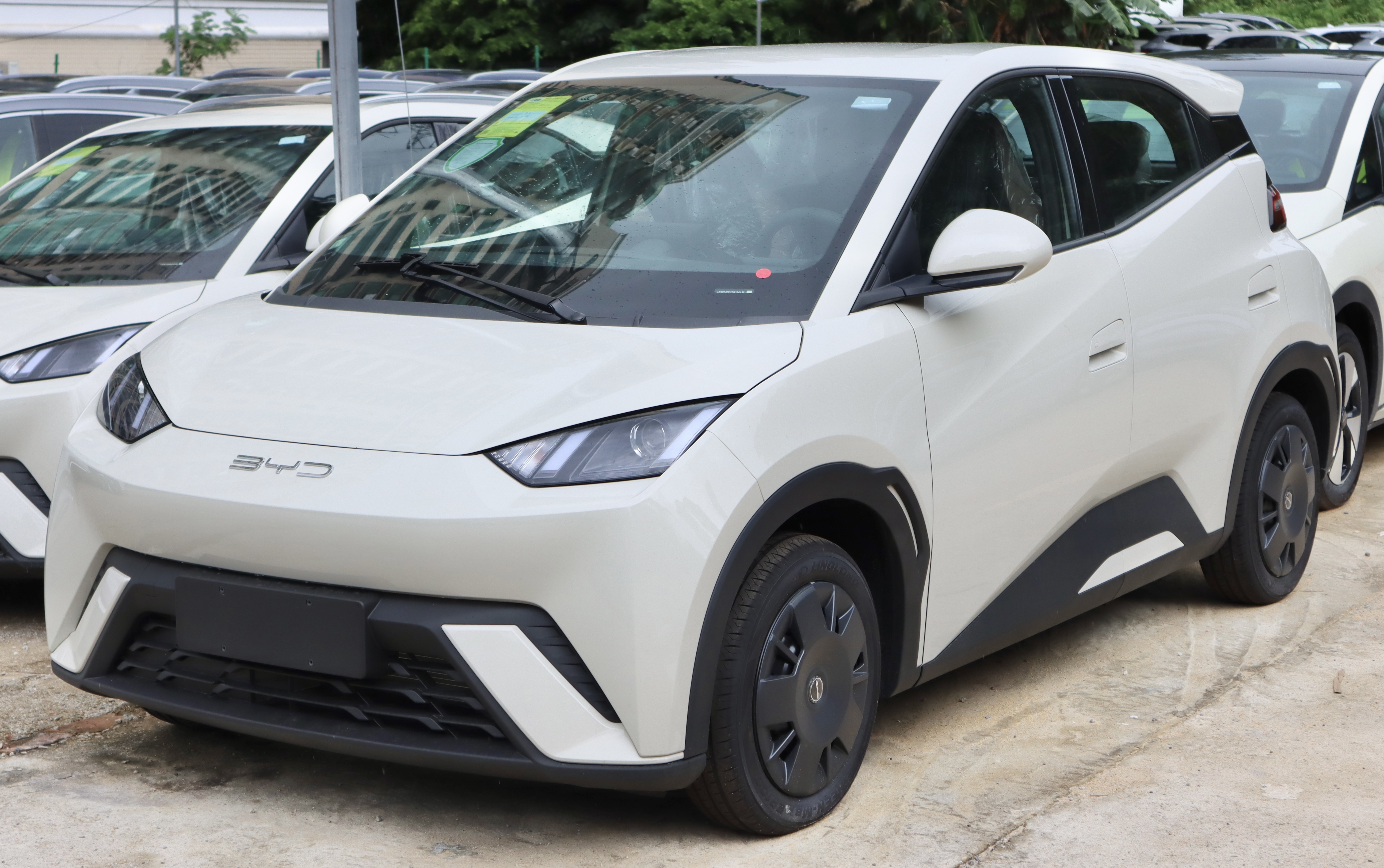
The BYD Seagull is a small electric car made by a Chinese company called BYD. It's aimed at being an affordable choice for people who want to drive electric.
Subsidize means to help pay for something. Here, it means that people in Europe are helping to cover the costs of Volkswagen's problems in China by paying higher prices.
Stellantis is a big car company that was created when two companies merged. It includes brands like Fiat, Jeep, and Peugeot, and makes many different types of vehicles.
A joint venture is when two companies work together on a project while still being separate businesses. They combine their resources to achieve a common goal.
Car
Leap Motor T03
The Leap Motor T03 is a small electric car made for driving in cities. It's designed to be easy to park and use in crowded areas.
The Alpina B10 is a special type of car made by a company that takes regular BMWs and makes them faster and more luxurious. It's important because it shows how some car makers focus on creating unique and high-quality vehicles, but sometimes they face difficulties in making enough of them.
Semi-knockdown kits are packages of car parts that are mostly put together but need some final assembly. Companies use these to save money and meet local rules when making cars in different countries.
Tesla is a well-known car company from the United States that makes electric cars. They are famous for their advanced technology and have a large following worldwide.
Pricing opacity means that it's hard to see how much a car really costs, which can make buying a car confusing. You might not know if you're getting a good deal or not.
Total cost of ownership is how much money you will spend on a car over time, including buying it, keeping it running, and selling it later. It helps you see the full picture of what a car really costs.
Residuals are the expected value of a car when you're done using it, especially if you lease it. Knowing this helps you understand how much you might get back later.
Term
AI
AI stands for artificial intelligence, which is technology that allows computers to think and learn like humans. In cars, AI can help with things like self-driving and making the car run better.
Cutting-edge batteries are the latest and most advanced types of batteries that help electric cars go further and charge faster. They are better than older battery types.
LIVE
Welcome back to EV News Daily, welcome to a special bonus edition of the podcast, and
let's get into a show that I've called BYD versus Volkswagen.
The juggernauts are colliding in Europe.
In the agricultural flatlands of southern Hungary, the soil tells a story.
For generations, these fields produced paprika or wheat today, excavators are carving the
foundations of an EV revolution.
Trenches stretch across the landscape now, not for irrigation, but for the infrastructure
of a battery plant that will consume as much water as a town of 50,000 people.
The land, once sold for a pittance, has revalued itself at 17 times its original price.
To accommodate its new Chinese guest, 800km to the northwest, in the exhausted industrial
heart of Wulsberg in Germany, a different excavation is happening.
Production workers at Volkswagen face the incomprehensible.
The company announced the permanent shutdown of its Dresden plant as the final car rolled
off the production lines in December, marking the first factory closure in its 88 year history.
The crown jewel of German manufacturing shutters itself.
These twin excavations, one rising near Budapest, the other crumbling in Wulsberg, reveal how
electric vehicles are reshaping the automotive industry, and two of the giants of the industry
doing battle on each other's turf.
For a long time, China has been such a profitable place for Volkswagen to go and do business,
but now BYD want to go the other way.
They want to come to Europe for a lot of reasons, and it's not all sunshine and roses at home
in China.
So that's what today's special podcast is going to dive into, the European automotive
sector, along the engine of continental prosperity, is having an existential moment.
China's champion BYD, now the biggest EV maker in the world, of Pure Bevs beating Tesla for
that record, is arriving and it can't afford to fail.
I'll tell you why and what's happening between these two automotive giants on the podcast.
Welcome back to a bonus show.
My name is Martin Lee.
Over the last few weeks, I've been looking into the future of Chinese made and European
made, but Chinese funded EVs.
I'll have a look at some of the big names over the course of coming months.
But today, let's start at the top and BYD.
A reminder, you can get the podcast ad free via the Patreon platform.
They look after the billing, the credit cards.
They take 5%, which is fine by me for all of the relationship you have is with Patreon,
not me, and you can support the channel and they do all of that.
It works beautifully and brilliantly and so smoothly.
And then I get to fund this podcast.
So thank you for that.
And then it's ad free.
If you're listening to the free feed, then sorry about the ads.
I have to pay the bills.
So why is Europe essential for the Chinese to grow?
The narrative discomforts European policymakers and car executives alike.
BYD's expansion into Europe is not a commercial adventure that's born of ambition.
It is a necessity.
I've done some recent bonus shows in 2025 about this.
It's driven by merciless competition inside China, where over capacity
and profit destruction now makes overseas an expansion matter of survival.
So it's not like, well, the Chinese are coming and they want to make more money here.
They have to go overseas if they want to survive.
And no one quite appreciates the level of the urgency.
European manufacturers like Volkswagen have lost ground, not on price,
but now on technology, on supply chain, on political strategy.
The analysis on today's podcast looks at why BYD's conquest of Europe has become
inevitable, how legacy car makers have aided their own decline and why the
rules and regs that are meant to protect the European car makers
are actually causing its demise.
Let's get into it.
The Chinese arithmetic of desperation, the conventional narrative
that I see all the time in the media, in the E.V.
Press as well, generally is that BYD is a juggernaut that is subsidized
by Beijing, that's had loads of government money, like all the Chinese names
bent on global domination, and they're just going to spread their tentacles
everywhere. But look, the reality is a much more,
well, it's considerably more about desperation.
BYD's achievement of outselling Tesla last year marks a troubling domestic contraction
and it masks it rather.
Sales growth inside China actually went down,
collapsing from the 41% growth in 2024, down 7.7% in December
last year alone.
Domestic sales were down 18%, descending into what Volkswagen China's
chief talks about the fact that the Chinese sector has lost all reason.
The root cause is industrial indigestion on a staggering scale in China.
From 2009, and well, this E.V.
first went into the China five year plans in 2005.
But either way, for 2009 to now, the Chinese government have channeled
something like two hundred and thirty billion dollars into E.V.
subsidies. This large S spawned a bloated ecosystem of one hundred and
seventeen car makers, creating production capacity that's double what the
domestic market can absorb.
And the result is a war of attrition, destructive competition where
car makers sacrifice any form of profit at the altar of getting scale.
Car makers have become indistinguishable from one another, competing on price.
Even BYD is bleeding.
The company's quarterly profits fell 30%.
Recently, despite a 16% volume increase, a damning contradiction that
reveals the core problem.
You can grow, but without profitability, it's volume with no value.
So inventory levels that Chinese car dealers are ballooning and more than
double the industry ideal of about 1.5 months.
It's about a 3.2 month supply in China right now.
Manufacturers face it's called the prisoner's dilemma, isn't it?
So if they raise prices, they make more money, but they have a competitor
unwilling to do so.
So that'll capture the market share.
And if they continue the price war, everyone descends into insolvency.
So how do you solve it?
You go abroad in this context, Europe transforms from a nice little expansion
opportunity to something BYD absolutely must make work for a lifeline.
Volkswagen, on the other hand, have it all to lose.
Vehicles that sell for razor thin margins in Shanghai command premium
prices in Stuttgart and London.
The BYD Dolphin sells for 10,000 US equivalent.
It's about 8000 pounds in China.
In the Netherlands, it will be 38000 euros.
Thank you very much.
This dual market strategy allows overseas profits to subsidize the price
wars back at home.
Consider the implications.
BYD can afford to lose money in China and stay solvent because if they
sell cars to European consumers at hefty prices, even with big tariffs,
we'll get onto those and still make more money per car than the likes of Volkswagen.
Well, then they're going to accept that trade off.
This financial architecture is BYD's competitive advantage, not technology.
Though I should say BYD's blade battery platform is formidable and it's all
vertically integrated at BYD.
They tend to make every nut, bolt, washer and battery.
VW can't say that yet.
Not brand prestige at BYD yet, though the company rapidly
improves its European reputation with some upmarket brands like the likes of
Denza. For Volkswagen, though, losing money in China threatens their viability.
The company cannot compensate for German factory losses by doing profitable
exports the other way to China.
It's costs are far too high to compete on price and its technology, despite
decades of engineering tradition, is falling behind the Chinese.
If BYD is the irresistible force reshaping the EV landscape, Volkswagen
is the movable object.
The crisis unfolding at Volkswagen isn't just kind of a corporate restructuring.
It is for Germany, a national trauma for decades.
The pact between Volkswagen management, IG Metall, that's the union, the state,
which even owns a bit of it, lower Saxony, a major shareholder, actually,
underpinned the entire German model.
From 2024 through to now, the unthinkable is now becoming routine.
Volkswagen management, terminating job security agreements that have been in
place since 1994 and a commitment that, in essence, was a job for life,
a permanent employment.
The company unveiled plans to cut 35,000 jobs in Germany by 2030 and close
three factories, the permanent closure of Dresden, as we started the show today.
Dresden closure carries significance beyond just the economics.
They've been making Volkswagen vehicles since the early 1900s.
It's a symbol of Saxon prowess of power.
German engineering and its closure marks the first permanent factory shutdown
in their history.
If Volkswagen can close factories, then nothing left is sacred.
Everything's on the table.
It sends shock waves through the German political establishment.
But what can they do?
Chancellor Olaf Scholz at the time urged the company to keep the factories open,
a plea that sounded desperate, and it went unheard and unheeded.
At VW, the chief exec, Oliver Bloom, framed the situation by saying, and I quote,
the European automotive industry is in a very demanding and serious situation.
Germany, in particular, as a manufacturing location, is falling further
behind in terms of competitiveness and quote.
Well, the numbers.
Back up his pretty grim assessment, isn't it?
The average labor cost in Germany in the auto sector.
Nice work. If you can get it, that's 62 euros an hour.
That is $68 or 53 pounds an hour.
Compare this to Hungary, where the hourly labor cost in the industry is 14 euros.
Not 62, 14 euros.
In Spain, it's 25.
In Poland, it's 18.
For a mass market vehicle with a retail price of, say,
25,000 euros to 35,000 euros, that cost disparity is insurmountable
without having big operational advantages about big steps forward in technology.
And Volkswagen can't solve any of those problems.
A vehicle made in Germany at 62 euros an hour for labor cost
requires up to about 18,000 euros in what's called labor per unit.
So the amount of cost to build the car.
The same vehicle made in Hungary by the Chinese is at 14 euros an hour,
is three and a half thousand to four thousand euros of labor per unit.
You know, 11,000, 12,000 euros difference per vehicle.
The route of Volkswagen's malaise extends beyond just labor.
The company's fundamental problem is the value of its products relative
to their cost of production.
The ID three, heralded as the electric success of the Gulf,
didn't captivate global markets.
It failed to deliver its big profit goals.
And in China, where Volkswagen hoped the ID three would compete against
the likes of BYD, the car suffered humiliating price cuts.
Chinese dealers now offer it for about 16 and a half thousand US dollars equivalent.
That's the price of a BYD seagull for an ID three.
Meanwhile, in Germany, the same ID three starts at 35,000 euros, but goes up a long way.
And so European consumers are having to subsidize
Volkswagen's strategy in China, which is failing and costing them money.
And as the Chinese imports arrive in Europe, this arrangement is untenable.
At least how I see it, I might be wrong.
I'll take a break and I'll come back and we'll talk about what all of this means
for the cars that you and I would get to buy.
Stick around back in a moment.
All right, welcome back to the podcast.
Now, let's talk about BYD versus Volkswagen, the big German and the big Chinese name.
The competition in Europe is fought not only in showrooms,
but in the factories and the corridors of politics.
Two castring strategy, contrasting strategies seem to me to be emerging,
but the outcomes are diverging.
Take Stellantis, the mega corp that's Peugeot, Fiat, Jeep, Abarth and more.
They attempted to purchase a shortcut to being competitive in 2023.
They acquired 21 percent of the Chinese EV maker Leap Motor
for 1.5 billion euros, creating a joint venture
that would manufacture and sell Leap Motors over here.
The joint venture began assembling the little T03, little city car
at the Stellantis plant in Poland in June 2024.
Production targets were ambitious and they could have met them.
But then politics got involved.
Poland, when they voted in the European Union tariff vote,
voted for tariffs on Chinese cars,
imposing duties of 17 percent to 38 percent on top of the 10 percent already.
In response, Beijing strongly suggested
that they didn't make cars in Poland anymore.
And so Leap Motor took that serving suggestion.
I'll say it that way and moved the production lines elsewhere.
The Polish production fell silent,
plans to make the B10, the big SUV, were scrapped entirely.
Stellantis now holds an asset there, which they can't use.
So they scrambled to relocate production to Spain,
or one of the other countries that either abstained from the tariff vote
or voted for in favor of China.
In stark contrast, BYD chose the route,
a robust path of rather than renting capacity, doing a deal,
having a contract manufacturer, which is all, you know, all options.
BYD said, that's OK, we'll just build the factories
and integrate the supply chains and employ the labor in Europe.
The choice of Hungary is a masterclass.
Hungary under the Prime Minister, Viktor Orban, positioned itself as the bridge.
Between East and West, by establishing their base,
their BYD bypasses the tariffs that plague the Chinese competitors.
More importantly, it insulates itself from the political retaliation
that crippled Stellantis and their Polish adventures.
Hungary voted against the EU tariffs.
Ah, that cemented its status as Beijing friendly.
The facility is not just a screwdriver plant
bolting together some semi-knockdown kits or SKD kits.
It's a full scale integrated factory capacity of one hundred and fifty
thousand vehicles expandable to three hundred thousand.
It'll make the seagull, the atto three, the seal and more.
And BYD is not just establishing factories over here.
It's the whole ecosystem, which ticks all of the European boxes.
The company established battery production capacity,
supply chains, R&D centres, university partnerships and lots more.
And this overseas strategy created a political and economic certainty
because they were spending their own money here on European soil, employing Europeans.
That's exactly what they were asked to do.
And so they have this commitment rendered BYD completely immune
to any kind of retaliation because there was nothing to retaliate against.
It was Chinese money, but it was being spent over here.
Now, obviously, there are import tariffs on vehicles.
But by the European Union, BYD vehicles quantify as now European
products in terms of that, facing no more import duties.
When Stellantis and their strategy
had to be adjusted because of politics, BYD just doubled down on Hungary.
So what's happening outside of the European Union since Brexit?
Well, here in the United Kingdom, Britain's import of BYDs is pretty big.
And we had almost half a million BEVs registered last year.
It's almost 25 percent of our new car market is pure BEV.
It was 33 percent last month in December.
The UK is going EV pretty quickly.
The UK ranks well and BYD's sales surge here was about sixfold.
Last year, about three percent of the market share, that's about 50,000 vehicles.
BYD's European sales also surging in November alone.
BYD registered in the European Union over 16,000 units.
So for the first time, BYD is beating companies like Tesla
in the European Union in monthly registrations.
And so the UK here, we have we've been a bit of a test bed,
a bit of a diagnostic market, and so any predictors of success,
what's working with European markets, what's not, they can try things out here
at a less risk scale because we didn't follow the EU with any tariffs,
any extra tariffs on on those Chinese cars.
And so the risk is lower and then they can look at what buyers are after,
price, quality, reliability, cost of ownership.
And secondly, there's a very high price
transparency, transparency in our car market.
There's aggregator websites that'll just find you the cheapest deal.
There's a lot of media scrutiny.
There's city little electric vehicle podcasts, always talking about the industry.
And so there's no real pricing opacity that might elsewhere obscure things.
Now, we have recently introduced incentives,
and I'm not a huge fan of the way it's being done.
But that does muddy the waters a little bit.
That's a more recent thing.
Thirdly, here we have loads of fleet buyers.
So all new cars, about half of them are bought by fleets.
So that is maybe leasing companies and or just big commercial fleets.
And so corporate customers are more analytical and they don't
they'll look at depreciation.
They'll look at the total cost of ownership,
but they're not quite as obsessed about the badge on the front.
They care about residuals and depreciation metrics
that expose whether a vehicle is good value or not.
BID is success in this pretty demanding car market in the United Kingdom.
Working so well so far is probably going to ripple across Europe.
Now, they've learned a lot here.
Now they can go and deploy those lessons on the on the continent.
So procurement decisions that have worked in Birmingham
will probably work in Brussels and Barcelona.
So let's finish off by talking about a mention of the regulations.
So October 2024, the EU put those Chinese tariffs in.
So on top of the 10 percent, they already pay in.
So up to 38 percent, depending on the car company,
they were meant to be a defense to protect European manufacturers.
Don't worry, we'll just charge the Chinese more.
So the reaction has probably been counterproductive.
They didn't slow down BID.
They just accelerated the investment.
So BID were probably, I don't know,
were probably looking at all of those investment decisions.
And then when faced with tariffs
and some of the Chinese makers, you know, and almost 40 percent
on top of the 10 percent already expedited their decision making.
OK, right, let's do Hungary next.
But a factory, we know it's going to take a year.
Let's go. And that hasn't protected European jobs.
It just, well, it triggered retaliation from China for a start.
That damaged European exporters of other industries in a tit for tat thing.
It didn't preserve the European market share.
It didn't help the European car makers.
It fragmented the continent because all the country started arguing.
And then last year, the European Union started saying,
well, maybe we should water down 2035 combustion ban,
maybe allow some more engines because that would help the Germans.
And that's going to backfire as well.
This allowing of plug-in hybrids or synthetic e-fuels, whatever they come up with.
It doesn't help the German.
Carly, the problems run so much deeper.
The change of regulations, if anything, just exposes more weakness
of European policymakers when regulators face genuine competition,
they retreat to, well, they look at the incumbents, the Germans.
They try and accommodate those rather than look at the market as a whole
and transition, which is why try and do on the podcast every day
if people say to me, oh, but you know, America's dropped the fit.
You know, the tax credit, are you really worried?
Everyone going to tune out of EV News daily?
Well, no, because as a planet, we know we will all be
doing our day-to-day chores in electric vehicles.
And petrol cars and diesel cars won't go away.
They'll be niche things.
People still ride horses, but not to work.
So we know we'll be moving around the planet on clean green power.
So no, it doesn't bother me.
This podcast has plenty to talk about.
But the European policymakers have put their blinkers on
and tried to close the door, but the horse has already bolted, as they say.
The factory walls going up in Hungary
are almost built by sometime this year.
Customers will be driving around in European made BYDs.
Totally immune to tariffs powered by cutting-edge batteries, guided by AI.
They'll flow into European markets where consumers
have been battered by inflation, confronted with limited choices,
increasingly indifferent to the badge on the front of the car,
prioritize affordability.
In Germany, they're still dismantling.
The closure of German VW plants isn't just corporate restructuring.
It breaks a post-war
social contract that Germany made with its workers
that high skills, high quality, high productivity
would guarantee high wages and permanent jobs.
And it's just not true anymore.
That equation no longer balances in a world where BYD can turn up
and start making cars so much cheaper that are, frankly, better.
BYD needs Europe, though.
They're not doing it out of benevolence and they're not doing it
because it's a nice little side hobby.
They have to make it work.
And you shouldn't be underestimating the Chinese names.
The domestic market there is a trap.
China's full of overcapacity of destructive competition, margin destruction.
It's an absolute...
I was going to say something else there.
Can't say that. Kids might be listening.
It's brutal.
And so these companies can't remain profitable,
which is why they will come to the West.
And if anyone thinks that what the US and Canada have at the minute
and tariffs to keep them out, they're coming.
So it's how the incumbents respond.
Is it to try and put up walls and keep them out
just to hit the next couple of quarters, get your pension payout
and retire if you're a CEO or for regulators and policymakers?
Should you be thinking, right, this is going to be the way that the world goes.
This is going to be the landscape.
How do we make sure that we're ahead of it,
that we're doing the difficult thinking now?
And they're not.
The tragedy is that European responses have been so disjointed.
The tariffs just accelerated the Chinese investment over here.
Joint ventures have been vulnerable.
Regulations have been watered down.
And the Great Wall is no longer in China.
It's being put up around factories in Hungary, brick by brick by the Chinese.
And the fortress of the European car makers is crumbling.
The diagnostic market of Britain has showed that the early moves
are probably the way to go.
And for BYD, Europe represents a necessity
and a competitive opportunity of the decade for Volkswagen and like.
It becomes the memorial to an era of industrial dominance.
That just couldn't adapt fast enough.
And that's your podcast for today.
I find this very fascinating to talk about.
And I can't talk about the normal podcast on the Daily Show with 90 second to two minute news blips.
But if you've made it 25 minutes into a bit of a ramble
about where the industry goes over the next five or 10 years,
then I guess you and I probably have similar interests.
I find it all very fascinating.
Thanks for listening.
I'll catch you on the next one.
About this episode
The clash between BYD and Volkswagen in Europe marks a pivotal moment in the automotive industry. As BYD expands into Europe, driven by necessity due to fierce competition in China, Volkswagen faces unprecedented challenges, including factory closures and job cuts. The episode explores the contrasting strategies of these two giants, highlighting BYD's investment in local manufacturing to bypass tariffs and the implications for European car makers. With rising labor costs and declining competitiveness, Volkswagen's future hangs in the balance as BYD capitalizes on its advantages in technology and pricing.
In the agricultural flatlands of southern Hungary, the soil tells a story. For generations, these fields produced paprika and wheat. Today, excavators carve the foundations of an industrial revolution. Trenches now stretch across the landscape—not for irrigation, but for the utility infrastructure of a battery plant that will consume as much water as a town of 50,000 people. The land, once sold for a pittance, has been revalued at seventeen times its purchase price to accommodate the Chinese guest. Eight hundred kilometres northwest, in the exhausted industrial heart of Wolfsburg, Germany, a different excavation proceeds. Production workers at Volkswagen face the incomprehensible: the company announced the permanent shutdown of its Dresden plant, as the final car rolled off the production lines in December, marking the first factory closure in its 88-year history. The crown jewel of German manufacturing shutters domestic factories. These twin excavations—one rising near Budapest, the other crumbling in Wolfsburg—reveal how electric vehicles reshape the automotive industry. The European automotive sector, long the engine of continental prosperity, faces an existential reckoning. China's undisputed champion, BYD, has a lot of say in how this all turns out. Welcome back to a bonus edition of the podcast. My name is Martyn Lee and over the last few weeks I’ve been looking into the future of Chinese-made, or European-made but Chinese-funded EVs. I’ll have a look at some of the big names over the course of the coming months, but today we’ll start at the top – BYD. A reminder you can get the podcasts ad-free supporting my work on Patreon.