LIVE
This is the Automotive Repair Podcast Network.
And the real exciting thing is you're going to start seeing it. If you haven't already seen, we have our own app. Yes, it's our own listening app. We have out there right now a YouTube video as to how it works. You are going to love it. It's kind of like an ultimate playlist. It's your own app. All the shows on the network. We're not going to clutter your mind with any junk or we're not going to algorithm you to death. It's all about the quality stuff that we do here. Thank you.
Thank you so much to our great sponsors, Napa Tracks, today's class, Kakuwi, and Pit Crew loyalty. Hey, for over 30 years, Napa Tracks has made selecting the right shot management system easy by offering the best most comprehensive SMS in the industry.
We'll prove to you that Tracks is the single best shot management system in the business. Find Napa Tracks on the web at NAPATRACS.com.
Ready to optimize with today's class. Boy, listen to an episode we do with David Boy's great program. Roll out a training plan for your automotive shop and just five minutes daily boost knowledge retention and improved team performance. Start seeing results today. Join your peers at today's class dot com shop owner. Stop juggling multiple marketing tools. Kakuwi's integrated platform. They deliver four times better website conversions automated follow up and real time.
R O I tracking get industry leading customer support with Kakuwi that's K U K U I dot com. You're probably tired of chasing new customers who never return. We understand pit crew loyalty ends the one and done cycle, turning first visits into lasting reliable revenue on the web at pit crew loyalty dot com.
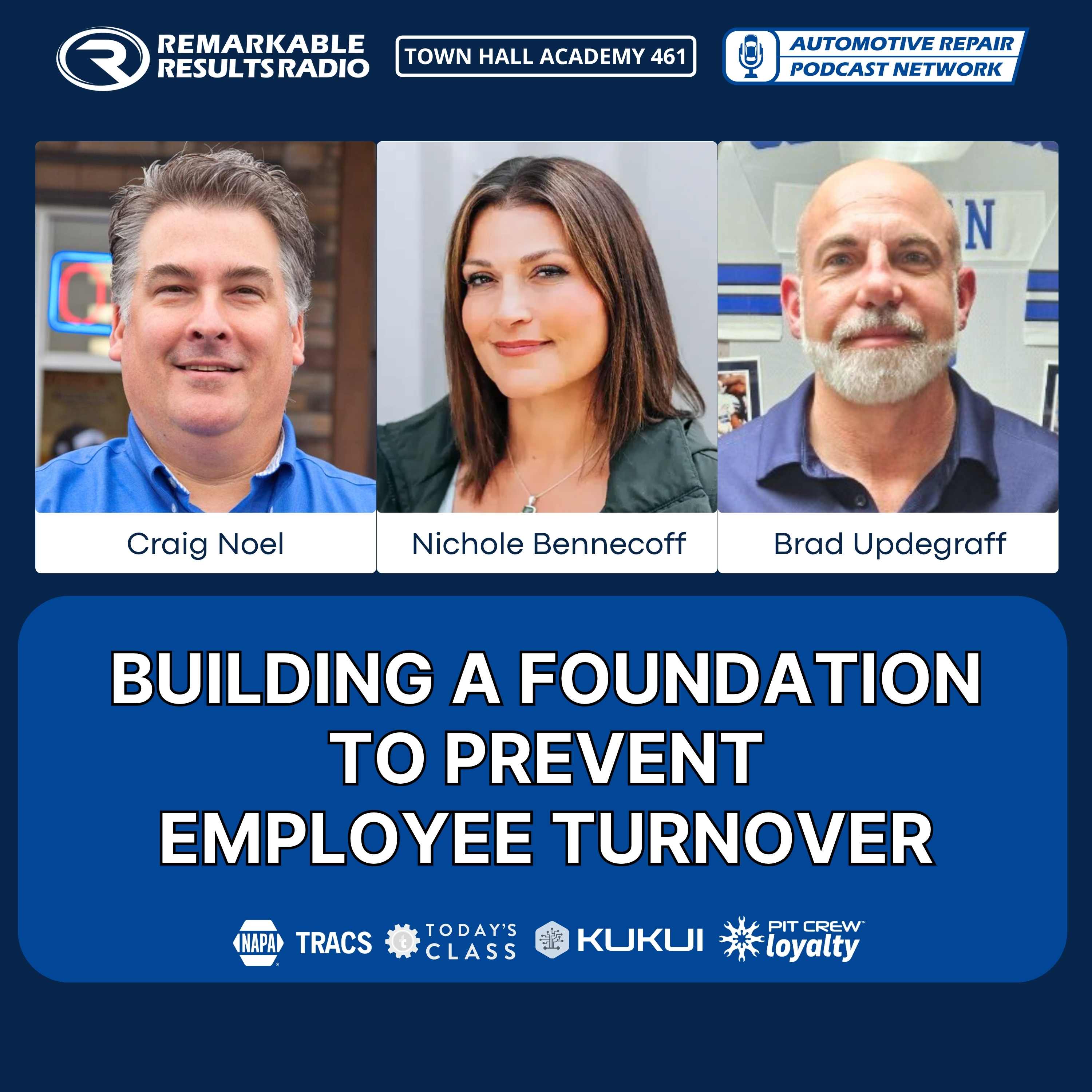
Hey, let me introduce my panel to you. Welcome panel. Hi. Thanks for having us. Good morning. Good afternoon. Good night. Yes. As you all know, we are talking about preventing turn over. Oh, can't wait to hear this one. Nicole Benicoff and power automotive Traverse City Michigan. Hello, Nicole. Hello. Happy to be here. Thank you so much. I appreciate you being here. Brad up to graph. Dave's ultimate Austin, Texas six locations. How you doing, Brad?
Actually, seven now. You see, I took a nap and this is what happens. I'm doing fantastic. I love the talking coin. Honestly, the concept of today is going to be great. Glad to hear it. Appreciate that. Craig Noelle Sun Automotive Springfield, Oregon four or five. Now it's five. I think right. Five. And then we have what's coming. You're
going to happen again. I'm taking Brad's lead on this. You know, I'm sorry. Write it down. You know, I am so happy being semi-retired and continuing to grow Craig, huh? Yes, right.
And that's the truth, by the way. How did you recruit your wife to run the business while you did nothing? I don't understand how does that work. Well, I had a couple of interesting health episodes. However, it's going great. I'm actually officially semi-retired. But yeah, here we go with. I'm good.
He's the Wizard of Oz. He's pulling the levers behind the scenes. That's it. All right. Look, I am hot on this topic. We have been so ingrained in the deep end of the pool on ghosting and recruiting and retention. And this one's about preventing turnover. And I believe our panel. And I've seen their talking points. They're good stuff. They're going to have a great conversation. Is very powerful and things we need to think about. But Brad, I want to go to you. First, it's.
It starts. You say with the interview process completely with that in mind. You know, there's a lot of mindsets for how you interview and a lot of things that can factor into a quality interview. I have colleagues that do three hour long interviews with and they want to invite their family members in. So just make sure they fully understand the picture that the economy, their relationship and how well they would be a fit for the culture of the company. And while I don't have three hours to interview, I really admire that kind of mindset behind it.
What about the interview and Nicole? Are people willing to sit down and give you a really decent interview?
I mean, I think the serious people are the ones that are. They know your culture and they want to be part of it. So it's like you, you attract to you who wants to be with you as well.
That is such a powerful statement. I mean, you'll know in the first 10 minutes if they want in or not. That's for sure.
Did you ever cut in an interview short? Yeah, I have. Last year we were interviewing a lot.
And it was just, I was like, this is okay. You know, so I looked at my interviewing partner and vice-versa manager and we're just like, wrap it up.
Move on. Like, that's not waste anybody's time. Yeah. What's the signal?
If I wiggle my eyebrows twice, let's go.
It's interesting, you know, Nicole's fought on because there is something to remember as we embark on this new generation of potential staff
is that we are looking for the reason not to hire versus the reason to hire.
And when you think about it from that perspective, and we are trying to focus on culture hires for sure, it's not only a culture hire for us, it's a culture hire for them.
And to uncover that does take quite a while because what you don't want to do now in my opinion, my humble little opinion, is you don't want the wrong hire for the obvious reasons we all know.
Everything from training to dealing with all of the different issues.
So the time that it takes to find that right person is extremely important and my advice would be take that time.
Prefending turnover, when you think about the processes that you have to invoke in your business to make it run right and give the greatest client experience possible.
Do people, will they come in and want to do it the way that they've always done it at the previous shop and somehow
buck a little bit of the processes that they're supposed to learn in your place.
I would say absolutely.
In fact, that's actually one of the questions we try to elaborate on the most during the interview process is to try to figure out the type of an employee experience we're hiring and what they're going to bring.
In some cases, they bring some great talent that you actually want to be able to tap into instead of just being, you know, specifically we do it this way, but it's a great time to find out that information.
The buy-in is important like and some of that you just don't know like you there's you try to match that up before the person starts working for you, but we try to focus on one of our values, which is having a growth mindset.
And so the idea that we don't know everything, but we're willing to learn from each other.
So that's important if somebody has that attitude that they've got it all figured out it's just that's probably not a good sign.
Yeah, we'll be just chatting with some independence today about processes and having them lock down and we've seen a piece of software called train you all that puts everything together and holds people accountable for having read it and know it.
And when you get an individual who say seasoned gun hole, I want in to tell them, look, our processes and systems are reviewed occasionally.
And, you know, as you're working into ours, when it's time to revisit any particular policy, you're going to be on the team to be there.
We may be able to learn some really good stuff from you, but in the meantime, this is how we all do it.
That's right.
Does that work?
Can you get the vibe that you're going to be able to hire someone that will stick around?
I would say absolutely.
You know, one of the things that I think is really important is the time span to try to uncover what they're going to contribute is so important because what you want is collaboration.
And you're going to have to distinguish between somebody who isn't going to be the time clock puncher, of course, but you want somebody who's going to contribute because at the end of the day, this is like football.
Look, you can have Tom Rayman, but let's you have a front line and you've got people contributing to the overall goal and the collaboration of the move into the company.
It's not going to work.
I would say now versus say 10, even 15 years ago, it's so dramatically changed because people now really want to be part of something and they're going to try to uncover.
The ones you want are the ones who are going to try to uncover what's going to be quote unquote in it for them or what can they be a part of.
So that changes the strategy of how we talk to people during that hiring process and along the way.
That's right.
Yeah.
One of the things that Nicole brought is a talking point in it.
By the way, Nicole, I love all of you talking points to my panel, but that not all turnover is bad and that's the humbleness of everybody agrees.
You're interviewing someone to call and you don't double wink the eyebrows that we're going to end.
Maybe this person is good, but you're always on the edge of your seat as this individual comes in that says raise your hand if you've made a bad hire.
Oh, yeah.
Okay.
And so that is actually part of business life.
Yes.
Definitely.
I would hope that you know, through these processes, we're taking takeaways from any experience that didn't last and trying to figure out how to not duplicate that same scenario.
I wouldn't piggyback on what Brad said in that, you know, our job at the end of the day.
And here's how I feel about it.
I don't want to put words in other people's mouths.
But in the end of the day, if you've got to let somebody go, I want to be able to put my head in the pillow.
No, we did every single thing that we could, right?
From the educational part, training part, expectation part.
And I always say, I kind of morph as saying, which is like you can lead a horse to water.
My saying is, yeah, you may not be able to make him drink, but you want to be able to make him look himself in the reflection of the water, right?
Which is, look, as long as we both can part ways and understand it, it's just not a good fit.
And sometimes that doesn't work.
Don't get me wrong.
But at least, you know, the gray hair is there for a reason.
I don't want any more gray hair.
So we want to make sure those decisions, whether it's a good fire because of a bad hire.
At least you've gone through the process to make sure that you've given everybody an ample opportunity to grow within your company.
And I think that's what sets you apart as well.
Because I've had more people say, you know what, it's my own day in fall.
I'm the one who screwed it up.
That it's a good company to work for.
And when you have people who have been terminated because of that, then say good things about it.
You've done the right thing.
It's something to think about.
Right.
Absolutely right.
With that, in fact, we've actually had several rehires along the way that simply just learn their lessons from having the hard, you know,
walk away from our company and trying their greener pasture that they thought they had elsewhere and realizing that, you know, really we had it figured out.
Yeah, I agree with both of your viewpoint on, you know, sometimes you hire people and you're not in the same place.
You figure out like, you know, we're like, for instance, I'm in a growth mode and we're pushing, you know, and maybe that person's like, just isn't for me.
You know, I just am not, this is not where I want to be in my life.
And so it's interesting because recently, any hire that hasn't worked out, I feel like it's been a mutual decision on both of our parts.
Like we're mutually, we have an understanding that we're just not going in the same direction.
We respect each other, love each other, but you know what?
Let's part ways.
I just think it can be a healthy process.
And for your team, too, they can see that and they see that we can still have respect, but we're not going in the same direction.
And that really motivates them to to feel involved.
And when they know that somebody who's not on the team fully is going to leave.
Absolutely.
Like sitting down with somebody and say, come on in my office, hey, look, it's not working.
Do you agree?
Oh, without a doubt.
However, if you take that from the five previous steps and conversations relative to, you know, getting to that final decision,
oh, they need to know the writings on the wall, right?
Literally.
There shouldn't be a surprise at either end.
Clearly, right over there.
They're going to have a case where something's going to have to happen.
You're correct.
Now, what's interesting to the retention part is that when you're showing absolute grace and motivation.
And you're trying to guide and coach that also really kind of goes to the current staff.
And they really appreciate the fact that they see the investment in the individual.
It wasn't a shotgun.
Need your reaction to get rid of a certain person.
But when they see that you're trying to invest in those people.
So they see that they're going to get the same investment.
Then they're all rowing in the same direction and really appreciate the fact that, hey, at the end of the day, it is culture over production.
That's absolutely right.
I'm thinking here a little further down the line when it comes to preventing turnover.
And that is that we are getting ready to scale.
Craig, you're buying.
Okay.
Brad, think about what you're doing.
Nicole, you decide to step up into some big financial goals for the team.
So you're in front of them in the back of your minds.
Are you thinking about trying to prevent turnover from the extra responsibility on the team?
Absolutely.
That's probably the number one thing I don't sleep with in regard to my business is my expectations.
I mean, I want to provide for them.
I want them to have, you know, my team to have things out.
I want my family to have things, right?
But it's like that balance between what you're expecting.
And what they can take.
And if that's what they want, you know, that's just it's always changing.
That's very true.
It does help to try to get your team as motivated for your growth as you are.
And that's obviously easier to say when you're a business owner.
But the reality is the more people you can get in that same oxygen as you and thinking the same way,
it just enables them to kind of take on that extra power and really show you what they're capable of in those times.
I would probably add to both of what Nicole and Brad said in that.
For me, when I'm expanding or we're making a change or we're talking about the future,
we talk about retention car.
We talk about what we want to do.
You know, before I think it used to be, here comes Craig.
Oh, we're making a change.
This is what we're going to do no longer is at the case.
Why?
Because I have found that the accumulative effect of all the brains and the input regarding what can happen
for the future of the company is very powerful.
So when you bring them along the journey and have an open ear,
that's just a small part of making them feel like they are a part of something.
Hey, let's face it, your shop management system is the single most important tool in your shop period.
Napa Tracks has made selecting the right shop management system easy by offering the industry's best,
most comprehensive SMS.
Now, it all starts when a local representative meets with you to learn about your business
and how you need to run it.
After all, it's your shop, so it's your choice.
And having local representation is a huge plus.
Customizing tracks to your business, whether you're a one person shop or a large multi-bay or multi-location company,
a representative consults with you to help optimize your shop's workflow, efficiency, and profitability.
Tracks always has the flexibility to do business how you need to do it,
which means it can also grow as your business grows.
And unlike the other guys, we'll be there for you after installation
with the best training and support in the business.
Yes, a learning management system tailored to each role in your company.
Simply put, tracks was designed and built for shop owners just like you.
Visit us on the web at NapaTracks. That's N-A-P-A-T-R-A-C-S dot com.
Hey, Carm here suggesting you discover a smarter way to train your entire automotive team.
Experience powerful bite-size training sessions accessible from any device in just five minutes daily.
It's perfect for technicians, advisors, and managers alike.
Today's class prepares your shop for sustained success by reinforcing crucial knowledge.
Plus add a competitive edge with our leaderboard to make learning fun and rewarding for everyone.
For effective training that delivers, turn to today's class dot com.
Shop owners, we know you are overwhelmed with a flood of missed calls, empty bays, and disconnected marketing tools.
Kakui has spent over a decade building one integrated platform for auto repair shops,
one login, one dashboard, and mobile first websites that convert four times industry average.
Smart, innovative CRM with automated follow-up, 24-7 online booking, and real-time ROI tracking.
With 900-plus years of combined team experience, we fuel the growth of 2,200-plus shops
and have influenced $3 billion in revenue.
Stop working harder, start working smarter, get industry leading customer support,
and book a demo with Kakui, that's K-U-K-U-I dot com.
You know, most shop owners feel trapped, spending on ads while half their first time customers never come back.
It's frustrating, it's exhausting, and it's not your fault.
The industry average is 54 percent, one and done.
We understand how discouraging that can be.
Well, PICRULOILTY changes the story.
Our clients cut that rate by up to 38 percent, raising lifetime value by more than 50 percent.
Loyalty members visit nearly three times more often, creating predictable revenue without extra ad spend.
PICRULOILTY were customers stay and shops thrive.
On the web at PICRULOILTY dot com, two words of a collective.
That's right.
You said that, didn't you?
Yes, sir.
And I love that part, because that's ultimate team.
Now, they may not get every one of their wishes or contributions ingrained or leveled up,
but at least they know they have a say.
With absolutely, and sometimes those say those debt input,
oh, I didn't even think of that, right?
That's a great idea, right?
We're going to run with that one.
Absolutely.
Very inside.
Everything I'm hearing is all about culture.
Oh, yeah.
And that's that enigma, that untouchable thing
that we know that we have to keep working on.
And it's quote, quote, quote, the behavior of the company.
It's how you behave.
They behave.
It's the goals you set that they conform into.
They behave into those your purpose.
And is that preventing turnover, which is our panel's topic?
It seems to me that if the culture isn't right,
you're spinning like a top in turnover,
because you're hiring bad culture,
because you're not looking for good culture to fit.
That's correct.
Yeah, I would say, you know,
and I'm not trying to take over the conversation here,
but because I'm passionate, I'm so passionate about this,
because if we talk about the collective input
and we talk about there being part of something,
we are talking about making sure that somebody's being heard.
We are making it personal.
And so if we think about long-term retention
and we want to make it personal,
then now the across-the-board thought about what things
are going to be offered for people change.
And now it becomes individualistic.
So for one person who's going to be driven with money,
another will be driven with time.
Another will be driven with a particular event
that they've been granted and paid for by the company,
whether it's hunting, yada, yada, yada.
I'm from Oregon, so hunting efficiency big one.
Now all of the things and the tools that we apply
towards retention become individualistic and personal.
And I think that just goes to another level
of how we care as an independent business or company
for that retention.
It's like basic human.
It's basic human need to be understood
or felt valued or just valuable to be recognized.
And so it's like if we're not doing that
and like you were mentioning Craig,
because each person is different
what motivates them and they're why.
So it's like if we don't recognize that
or we don't take the time or we don't care,
I mean, they can tell that immediately
and it's like we can't expect them to be bought in
if we're not bought into them.
It's funny, Carm, because you and I have talked about this
in the past in kind of related topics about culture,
whereas as an owner anymore nowadays,
if you want to be successful, I'm sorry,
but we have to, and I don't mean that by a,
well, that's just a must.
You're going to need to be involved in engaged personally.
And so to do that takes a lot of energy and focus
because I just did it this morning.
I had one personal test.
I mean, from Arizona up to Eugene
to my one tech mission who was an apprentice
to now he is basically an A-Tech.
And he's amazing.
I sent him a, you know what?
What you did last paper, he was unbelievable.
Great job. So proud of you.
And it's just a text.
But these things are similar to a family
and you've got to be able to engage with all of them
to understand how they tech
because then they respond because
you're rewarding them with how they communicate.
In that space as well,
another area that I've actually witnessed
some of the best shop culture I've actually experienced
in areas that were very community driven
were teams that actually worked
as a collaborative effort, collective effort
and did community projects
or community involvement things.
And you could see just how much it brought
their own internal structure together
and in turn help the community see
just how that relationship was going to benefit them.
And that's working together too.
I think anytime you're working for like a purpose
that's collective.
One thing I've noticed it just kind of this year
I've, it's kind of been evident
is like I've been at the shop more.
But I've noticed such a different change
or shift when I am out in the shop.
Like when I'm in the shop,
inspecting a car,
you know they're inspecting a car
and I'm there and I'm asking about it.
It's just like I just feel like it
changes how people view me for one thing.
And I enjoy it too.
I enjoy it more than being further away from them
because that's face that we have a lot of things
you have to do and manage.
But the further I'm away from people,
the better in my shop.
It's like the less joy I have too.
And I feel like it kind of is like that
all the way around our shop.
That is so interesting.
And I was just,
you had me thinking about the captain of a cruise ship
hanging out with the passengers.
Exactly right.
I got a great idea.
Everyone knows I get inspired by these
and I start writing crazy, crazy ideas.
And one of them was in a daily huddle
or a weekly meeting.
Would you consider asking your people
a question but framed two different ways?
Hey, what keeps you here?
Or why you wouldn't leave?
And can we learn from what they say as a team?
Wow, I had no idea, Charlie,
really values that we're buying cutting edge equipment
and it's making his life more efficient.
This guy appreciates lunch and learns it.
And you start going around the room
and you start picking up issues
to your point about the generational thing, Craig.
That everybody has a different need
and a different want.
And some people say,
you know, I'd really,
my son's not doing soccer at 330
and can you all help me get there?
And that's one of the things
that if that would happen, I would never leave.
Those are the kind of things
that I think you as an owner can react to
but I think they as a team can appreciate.
You know, you bring up a fantastic point
because what you talked about right there
is flexibility.
And because of what this podcast right now
is this segment's about,
if we as owners don't adapt
because here's the thing,
I'm going to guess,
but Brad and Nicole are the same way I am,
which is we were brought up
like you work your tail off
to get where you are.
Yet here's the flip of the coin.
Had we taken our experiences
and reflect back on them,
you don't think that I would have liked
to have had a conversation
when my manager said,
hey, Craig,
I really want you to go home
and spend the next couple hours
with your son,
who at the time was handicapped, right?
So to hear that from my boss
would have been what?
Huh?
So we are in now,
I think, a massive shift
to be able to hear these people
who are prioritizing,
and I have to say,
I admire the fact that they are
prioritizing family over work
that work life balance.
What we have to do strategically
as owners now
is to apply what we're talking about
today relative to retention,
because now we have to shift
to what's going to maintain productivity
and what's going to help
on the bottom line, right?
And so it's an interesting dance
that we are in right now generationally
because there's a shift going on right now
between where we are
versus when the vocational people
who are going to be coming out
of that training are going to be.
This next three to five years
is going to be an ability for us
to change that foundation
to really excel through
what I think is going to be a great
10 to 15 years.
It's going to take a head.
Yeah.
Definitely right.
I agree.
I think that this is exciting
to me to talk about
because I feel it.
I'm a mom.
I have their teenagers now, kids,
and I'm the main caregiver.
I have been the main caregiver.
And so I see my team members
and I have flexibility in my schedule.
I work a lot, right?
But we have flexibility.
If I have an appointment
I want to go to, I do it, right?
But to see this dress on their faces
when they have something they need to do or want to do
and they have to ask for that.
And you have to sometimes say,
no, you know,
so I am passionate about this
that that's important for the upcoming generation
now and in the future.
But they have some flexibility.
It doesn't mean
minimal effort while we're here.
But it just means working hard while we're here.
So we can have some flexibility in our schedule.
And Nicole's absolutely right.
I think being able to kind of have
a flexible work life balance
that works for your crew
and that realm is extremely important.
And then back to us as owners.
I'm going to encourage everybody who's here
and listening that we have to be willing
to recognize and work on ourselves as well
to pay attention to the emotional cost
that this will be going forward.
It's going to be an emotional investment.
Here's what I say to that.
There's going to be a point where,
oh my gosh,
these are so awesome
or the best boss ever until you're not.
And that's got to do with our heightened
set of expectations.
And when that happens,
and all of a sudden,
you know, you're deleted from Facebook
or you're not part of their Instagram
or whatever it may be,
it can be painful
because we invest in them and care for them
and we want them to succeed.
I mean, I want everyone on my checklist
to make well over 150K a year, right?
But sometimes at the end of the day,
when things don't align right,
it can be emotionally taxing.
So pace yourself and look yourself in the mirror
and know that what you're doing,
you're doing with a glad heart
and don't expect the return.
But when you get it,
relish in it because that's where the benefits
from coaching come into play
on the return of investment
that we had emotionally for people.
That's a great point, Craig,
and to add to that,
I think aside from the emotional investment,
there's also,
in some cases,
a financial investment that you will be able
to understand as a business.
A quick example would be,
as we were expanding,
we actually acquired two locations
that their business structure
had them open on Saturdays.
Our first models that we had
were Monday through Friday shop
and so there was already a weird,
but also very interesting testable area
to determine culture and happiness
within your employee staffs
between those two locations.
And it was very easy to see
that Monday through Friday's solution
was a much better option for the entire company
and so we made changes
that obviously affected the bottom line.
But they were the right changes for us.
I remember speaking to a shop owner,
we may have done an episode on it,
and I can't remember how long ago
it was so much on my mind right now
with our launch of our app and everything.
But I just wrote these talking points
down that I know I heard birthday cards,
family, children,
and when I started to think that through,
I started to think about bringing work to home.
And I don't mean that they're going home to work,
but if the culture of the business
is so strong,
are you talking about preventing turnover?
Honey, yeah, I know you had a bad day,
but God, I got that $50 gift card for my birthday.
And I'm not saying you're buying loyalty,
you're not buying love or anything,
it's almost a caring moment.
And what do you think about that?
Absolutely it is.
It is.
Huge.
Okay, I can lend quite a bit to this
in that how much does a guy really need, right?
And to me,
so this is the one question for an owner that would be great.
Are you the one owner that likes to see how many presents you have
or do you like to see others open up Christmas presents, right?
So for me, it goes beyond the birthday card.
I mean, it goes everything from all go on
and secretly find out that one of my younger techs
has a $400 bill on the truck.
I'll just pay it off.
I'll take care of one of the guys that I've got
as into floral driving and things of that nature.
I'll just have two tires show up.
Those types of awareness things as if they were family
go a long way.
And you strategically have to do it.
You can keep your ear to the ground.
But these investments are so powerful for them
that to Brad's point,
I've had three who are now with me now long term
who left and came back.
It's that six month thing.
They figure out that the grass is a drinker
and it's green moss.
I need Craig's juice.
I'm intrigued about this particular aspect of it.
So full disclosure,
I am in Eugene Springfield, Oregon,
two hours south of Portland, Oregon.
If you're at all into the news or any of that,
I am in Portland 2.0 in my area.
One of the aspects that affect what we're talking about today
is I'm sorry,
but the political nature of kind of what's going on
is causing the pool that I have the pull from
to actually be smaller.
I can briefly talk about this,
but I went through a period where the last eight months,
finding people with two separate headhunters
that did not work,
it validated that we are doing the right thing
because we hadn't had to advertise for 10 years
for people, employees of all of the different positions.
But it's interesting how politics has affected it too,
because good conservative guys are now going,
I'm out.
I'm going to Texas or locating to hear there
and it's kind of an interesting aspect of what we're dealing with.
Not to get into politics,
not just politics, not just politics.
It limits the pool.
So we got to think about all these things.
No, a shop owner who just lets everybody do what they need
to do based on circumstance in life.
The team is big enough where people,
the story is this,
Bobby had a go somewhere.
And yeah, and he had the privilege
and or maybe the honor to just to go
because that's the culture of the place.
Something came up.
It was critical.
It was important.
Well, when Joe goes on an honest
to God five day PTO,
we all pull together anyway
and all the time.
And that's the thing I think we're forgetting
or not forgetting,
but we have to stop and realize
that as PTO invacations,
which are very big part of our benefit package
and life,
you know,
spending that time away from work
and recharging,
that we survive as a business short-handed.
And it's it being short-handed is not bad,
especially when it's this individual's,
he wouldn't have this life with his family
and that opportunity if he wasn't earning here.
I think another aspect to kind of talk about as well
is I think recognition
and global recognition,
they both go hand in hand.
So to Brad's situation, right?
So I have five going on, you know, six.
So here we sit
and we want to be able to keep them all connected
even though there's separate locations.
So in my company,
so it's son automotive.
We have created an internal culture
called the Sun Performance Team.
So if you,
the only way you get to swag
is to be part of Sun Automotive.
Number two,
we have a quarterly newsletter
and it's called the Sun Times.
And that's when we talk about all those collective achievements,
both personally and professionally,
within that global newsletter.
The other thing is that
even things such as
you take the same template for ASE
and we've made it the Sun Performance Certificate
in this area.
And now they're rewarded relative
to being recognized globally
and then also they're now,
it's something to achieve.
It's something personally.
You can't get it anywhere else.
So even though it's the same as an ASE,
we've sent the structure up to where it's very similar.
So they get the Sun Performance Certification for X, Y and Z.
And those personal types of things
are going to be important as well
to brand nice situation
with multiple locations.
That's very right.
And you had mentioned
even outside of the network type of accreditation.
You know, when you have a technician
that possibly wins,
you know, the technician award of the year
or something in that area,
trying to make sure
that that is as widely publicized as possible.
It's certainly going to make the technician
that won the award feel even better.
But it also,
you know, the shop culture around them.
They pay attention to that
and they're trying to figure out how to get their award.
Yeah.
We have something that we do at our shop,
which is I haven't had anybody
that hasn't wanted this.
But if they really didn't,
I would respect that.
But we have their picture and like a bio
about how they got into the business,
what they enjoy doing,
you know, their pets.
We have like a whole board in our waiting room.
That just like validates them.
And it's funny.
People that come in
are always read them
and they just love
knowing something about that individual.
And even our employees will come in
when there's somebody
and they'll, you know,
they'll read their information.
But it's not like celebrity status.
But it's just,
it's like, you know,
you're special.
And these are the things that make you who you are.
So I think, like,
for some people,
especially some people more than others.
But that's important too,
just knowing that
their background
and what they like doing is
is something to be shared.
And it calls right.
I mean, we actually tested that.
I was curious how many people
really would pay attention to it.
So we actually set up
really interesting bios for them.
We're the one I remember the most.
He specialized in backyard
gator wrestling.
That was his hobby.
And you know how many people
actually would do that
and mention it.
And it was kind of a test thing for me.
But it was like, wow,
this is actually really a big idea.
You know, and it was kind of fun
at the same time.
Very much so.
I was just out at Brett Beachley's place
in Peoria.
And I spoke to the Illinois
automotive teachers association.
I did my rise at the specialist speech
to 140 automotive
college and high school instructors,
educators.
It was just a phenomenal time.
But Brett Beachley picked me up
at the airport.
He's got an unbelievable
shop family operation.
You know Brett Craig.
We were hanging out.
And of course he's got the ASC
certs in the picture
and all that stuff
in plaques for his people.
And so I'm working toward
the words badge of honor.
You cannot go to a doctor's office.
You can't go get an MRI
unless you see the licensing
and the certifications
of not only the professional
level of be it
doctoring and specialists,
but the clinical people
that have to pull the right
levels to find out
what the hell is going on inside.
Those are badges of honors at people.
Is it required by law
that they hang there?
Or is it a proud moment?
And if that's the culture of
the clinic to put these things
up on the wall,
we're proud.
Why aren't we doing this stuff?
Well that fits perfectly
with your brainchild
of creating the specialist culture
within the shops
for the technicians
and advisors.
So I think that that's
Mary's wealth.
Anyway.
I know you did Craig.
We ran with your platform,
Carm.
It was received extremely well
because they really thought,
wow.
I said, well, you know,
this sealed argument of,
you know, I can remember a story
where, and I think I told you
this, Carm, when I was an
advisor back before it.
But, you know, I had a doctor
come up and say, hey,
Craig.
And I had a great relationship
with him.
He was awesome.
And so he'd come up
and said, you know, Craig,
I know you guys got a hard
job, but you got to remember,
you know, we're life for death.
And I happened to have a
frozen, bright bleeder
that I was just playing with
in my pocket.
And I said it on the counter,
and I said, well, Dr. Johnson,
you know, if my technician
leaves this, break,
bleaters throughout,
your whole family
who's going skiing over
the mountain isn't going to
make it.
You get the relative
responsibility of your
entire family on my
shoulder, it's not just one
patient.
And it says to me,
too shady on, man.
But it goes to how serious
what we do every day is.
And we need to pump that
value up, and through
whether it's recognition,
individually on our walls,
whether it's how we talk
about their title,
their skill set,
their value,
how we're presenting that.
I don't use the word sell
my company, use the word
present, because the health
of the vehicle explains
itself.
But if we established that
value through all those things
we're talking about,
they then were talking about
retention.
They then see what you're
doing to respect what they
do.
And I think that's what it is.
They're starting to now see
both monetary compensation
in the market, because now
they're valued.
They're aware,
and they like being finally
respected because their path
shows is not a plan to.
These are critical.
We are a, if someone
argues with me,
I'll take them on.
But we are a high tech
industry.
Yes, we are.
Absolutely.
Period.
Done.
Case closed.
We are looking for high tech
people to join a high tech
industry.
No, we don't do
envidiate chips.
And no, we're not an
AI think tank.
And no, we don't have
computers in the back room
that run the rest of the
world.
And I need to have people
run them, but we have this
computer sitting on four
wheels that needs
technology specialists
big time.
And yeah, I get the
mechanical part and maybe
the player here and there.
But I think we're going to be
less mechanical down the
road.
And especially if you think
about any of these needs,
and where that is going,
and we're going to be more
technical.
And so the word career
has to become part of your
language for preventing
turnover in my mind.
And instead of saying it's a
job or way of this beautiful
trade that we work in.
No, we're a high tech career.
And again, my passion for
this language lift in the
industry, I just keep bumping
into people sharing with me
or me trying to think is
deep as I possibly
can about where this industry
needs to go.
And it's all
umbrella over the word
professionalism.
Absolutely.
So, Nicole, when I think
about the shared values
and how critically important
that is to you for preventing
turnover, how soon
after a new hire?
Any clue?
Is there any
barometer that you can say
with this?
Well, Carm, you know,
we'll know in a couple
months if they're going to fit.
I mean, I don't want to say
that because there are people
that have changed,
that have changed that I have
seen.
I do think that you can see
an attitude that just in my
recent experience, you know,
I was like, I don't know
this attitude.
I'm not sure if they're
getting like our culture.
It's that feeling inside
and you're like, you can ignore
it, push it down, but then
it just keeps coming back up.
So, I feel like my gut
instinct usually comes
true.
You know, it usually comes
with fruition.
But we have this one individual
in particular.
He started as just a shop
assistant, not just a shop
assistant, but he started as
a shop assistant last year.
And he has completely
changed who he is and how he
views life.
And just to hear him talk
to clients and advise them,
I mean, I'm so proud of him.
So, if you had asked me
last year what I thought,
I would have been like,
no, he's not for this career.
I've been proven wrong.
So, I feel it works both
ways.
So, when I think about
preventing turnover,
I think about a situation
that I was in many, many
years ago.
But I was ignoring a problem
that I had.
I recommend never doing that.
It was a person.
I was tolerating and waiting
Nicole to your point.
I think the skies will open
and the beam will come
down from heaven.
And this person will
drill a hole in his head
and say, join the team.
And I kept looking the other way.
And I knew I shouldn't have.
What happened is my senior
team, five of them
came in the office,
closed the door,
and said,
him or us,
you decide.
As you're talking about that,
we're talking about retention,
we're talking about the hiring process.
So, two things happened in my head.
I was listening
and I'm saying to myself,
I'm not sure about Brad Nicole.
But I can tell you that
over the last 10 years,
it's been remarkable to see
how you can't get any information
about a potential employee anymore.
There's no one to call the best friend
isn't going to give you the right information.
And so, through our hiring efforts,
we have to try to expose
as much as we can.
Those two,
what you are just now bringing up, right?
How do you know?
What I've found is that
for most cases,
in most cases,
you got zero to 30 days,
you're going to kind of go through
the assimilation process.
But that 30 to 60
is when you're going to see it, right?
So, one of the things
that I found that really important is,
we have to talk about this
as an ongoing foundational process.
One, we have interviewing
and hiring,
and second, we're talking about retention.
But you've got to start
the expectation out right away.
So, one of my suggestions to people
who have multiple locations are,
we live and breathe literally
by our mission statement and core values.
So, what I do is,
I take every single new employee
and I go on what's called the tour.
And we start with the location
that that person has hired in,
and we go to all of the other locations.
When I hit the other locations,
I will ask one of the staff members
at the front office,
hey, what is the second bold part
on our mission statement about,
and why did we come up with that?
And they see it not only with me
as the manager is not taking on the tour,
Craig's taking on the tour,
and then I'm not explaining
the mission statement the entire team is,
and at the same time,
they are meeting all of the other employees
at the other locations that they may never see,
but now they may be encouraged to pick up the phone
by extension and ask them a question,
who's a technician at an ATAC
about maybe a future problem.
So, it's about immediately setting the tone
for inclusiveness for the company,
right from day one.
I do it day one,
when they start with me,
I pay in eight hours,
we go on the tour, we grab a coffee,
my GM's in the back seat,
and we start having a culture discussion.
To kind of layer onto that.
So, we do have a 90-day probationary period for us,
and we don't wait till the 90-day point
to say yes or no, right?
So, through that point,
we're tracking,
we're paying attention to behavior patterns,
whether or not the receptive to process changes,
and all that,
and we're scoring that information
to where we can use it,
and probably two different opportunities
before that 90-day point
to first notify them of what we see
and make sure we're aligned
on where the strategy is moving forward,
and then a progress check on that,
because sometimes that could get forgotten
if it's not managed from that point.
So, there's a lot of accountability
that shows up to that 90-day point,
where even at 90 days,
they should see it coming.
Oh, yeah.
They'll make it.
But don't doubt,
constant communication about,
hey, what can we do to help you?
What can we do to help you?
How are you doing?
How do you feel about this?
Like week one, week two, week three, week four.
I mean, you're right.
To Brad's point,
yeah, they know.
Nicole, anything we missed
on your talking points
that you'd like to bring up?
It's always changing.
And I think that's just something
that we have to get used to
and accept, right?
And I think that's what makes it fun.
So, I love having this conversation.
It's been awesome.
Everyone in the business
is a dynamic and unique engine
of their very own
and they have different cylinders
and speeds and transmission ratings
and fuel consumption.
Absolutely.
And you are the maestro.
Of this room, room, room, room,
that you have to orchestrate.
But this was great.
Thank you.
Preventing turnover was our topic.
We went to a million different
great places.
You all brought some great things to light
and I'm sure the industry
is really going to appreciate this.
Remember, we are now
the Automotive Repair Podcast Network.
We have our own app.
Those QR codes in the top right corner
are a lot of very, very small.
We'll get you Apple or Android.
But if you go to the new website,
www.reparapudgisnetwork.com,
man, on your smartphone,
go there, click that red dot,
download it to Apple or Google,
you will have such a blast playing
with all the episodes in the network,
saving cool files,
downloading stuff,
making playlists out of it,
and we'll never throw junk
or garbage at you.
It's your tool.
Thank you all so, so much.
Thanks for having us.
Thanks, Carmen.
Bye.
Thanks for being on board to listen
and learn from the
Premier Automotive Repair Business Podcast,
remarkable results radio.
Get your episodic education
on the ARPN Listing App
at AutomotiveRepairPodcastNetwork.com.
Also, enjoy the podcast on our
Carm Capriato YouTube channel.
Carm is all for advancing
the professional automotive service industry.
Until next time.
0:00
46:45