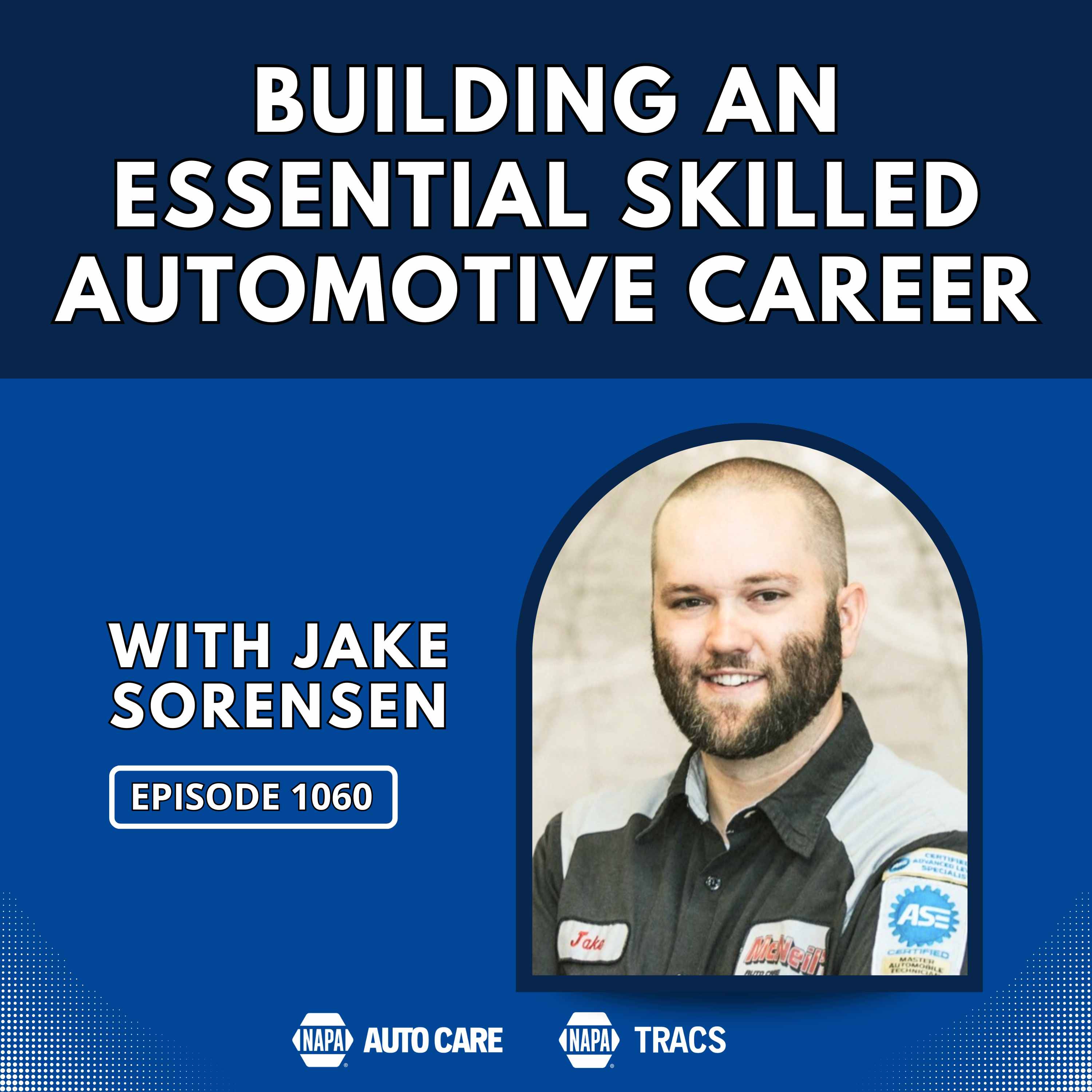
Jake Sorenson, a renowned technician and advocate for the automotive industry, discusses the importance of redefining automotive careers as essential skilled occupations. He emphasizes the need for a cultural shift in how the industry is perceived, particularly regarding work environments, recruitment, and retention strategies. The conversation also touches on the challenges of quality parts, work-life balance, and the significance of continued education for technicians. Sorenson shares insights on creating a welcoming shop culture and the necessity of investing in training to attract and keep talent in the automotive field.
This episode explores how the automotive industry can attract and retain skilled professionals by transforming both its language and its workplace culture. The words we use shape public perception, influence recruiting, and build long-term respect for the profession.
Beyond language, the discussion dives into the physical and cultural environment of repair shops. Topics include maintaining clean, professional spaces that foster pride, offering work-life balance to prevent burnout, and ensuring fair pay progression with clear career paths.
To build a sustainable future, the automotive industry must evolve in how it speaks, works, and cares for its people. Professional language, modern environments, fair pay, education, and a sense of pride in quality will redefine automotive careers as essential, respected, and rewarding.
Thanks to our Partners, NAPA Auto Care and NAPA TRACS
Learn more about NAPA Auto Care and the benefits of being part of the NAPA family by visiting https://www.napaonline.com/en/auto-care
NAPA TRACS will move your shop into the SMS fast lane with onsite training and six days a week of support and local representation. Find NAPA TRACS on the Web at http://napatracs.com/Connect with the Podcast:
"Yeah, I mean, let me first say I'm a huge proponent of aftermarket parts and buying from quality companies that are going to stand behind us with a warranty."
Aftermarket parts are car parts made by different companies, not the ones that built your car. They can be cheaper or better but might not always fit perfectly.
Aftermarket parts are components made by companies other than the original manufacturer (OE) of the vehicle. They can provide more options and often come with warranties, but quality can vary widely.
"...buying from quality companies that are going to stand behind us with a warranty. I mean, you go buy a part from the OE."
A warranty is a promise that if something goes wrong with a part you buy, the company will fix it for you for free or replace it. It's like a safety net for your purchase.
A warranty is a guarantee provided by the manufacturer or seller that promises to repair or replace a product if necessary within a specified period. It is important for ensuring product quality and customer satisfaction.
Term
OE
"I mean, you go buy a part from the OE. Good luck if they do have a warranty and getting them to honor that."
OE means Original Equipment, which are the parts that come with your car when it's new. They usually cost more and can be harder to get help with if something goes wrong.
OE stands for Original Equipment, referring to parts that are made by the vehicle's original manufacturer. These parts are typically more expensive and may have limited warranty support.
"...who knows what the labor rate is and how many hours they'll pay. We're an auto care center and the warranty is amazing, right?"
Labor rate is how much money you pay for a mechanic's time when they work on your car. It can be different depending on where you go.
Labor rate refers to the cost charged by a shop or mechanic for the time spent working on a vehicle. This rate can vary widely based on location, type of service, and the shop's reputation.
"...I have to have an OE part. And I'll say, well, who made that part for the OE, right?"
An OE part is a replacement part made by the same company that made the original part in your car. It ensures that the replacement fits and works just like the original did.
An OE part, or Original Equipment part, is a component made by the same manufacturer that produced the original part for the vehicle. These parts are designed to meet the same specifications and quality standards as the original components used in the vehicle's assembly.
"...a name brand, a Bosch, a Delphi, a Denza, whatever..."
Bosch is a well-known company that makes car parts like brakes and electrical systems. Many car manufacturers use Bosch parts when building their cars.
Bosch is a leading global supplier of technology and services, known for producing high-quality automotive components such as brakes, fuel systems, and electrical systems. Their parts are often used as OE in many vehicles.
"...a name brand, a Bosch, a Delphi, a Denza, whatever..."
Delphi is a company that makes parts for cars, like electrical systems and safety features. Their parts are used in many different car brands.
Delphi is a global technology company that specializes in automotive components and systems, including electrical and electronic systems, powertrain, and safety technologies. Their products are often used as OE parts in various vehicle brands.
"OEM is a part that was manufactured specifically for the OE and then there's another product that they call in that industry OES."
OEM means the parts are made by the same company that made the original parts for your car. They fit perfectly and are usually of high quality.
OEM stands for Original Equipment Manufacturer. It refers to parts that are made by the same company that manufactured the original parts for a vehicle, ensuring compatibility and quality.
"and then there's another product that they call in that industry OES. And that's a secondary product that was made to fulfill the pipeline."
OES means the parts are made by a different company but are meant to work just like the original parts. They can be cheaper than OEM parts.
OES stands for Original Equipment Supplier. These are parts made by a different manufacturer but designed to fit and function like the OEM parts, often at a lower cost.
"...that's less expensive and then I have to bid up the higher quality, more expensive part. We cost more."
Higher quality parts are better-made car parts that last longer and work better. They usually cost more money because they are made with better materials.
Higher quality parts are components that are made with better materials and manufacturing processes, leading to improved performance and durability. They often come at a higher price due to the increased cost of production and testing.
"...that people are selling that we've just seen an extremely high failure rate on."
Failure rate is how often a part stops working or breaks. If a part has a high failure rate, it means a lot of those parts don't last very long.
Failure rate refers to the frequency at which a part or component fails to perform its intended function. A high failure rate indicates that many of these parts do not last as long or work as well as expected.
"...it was from a Mercedes dealership in a different state. But I think most of us, when we hear Mercedes, think higher end luxury vehicles,..."
Mercedes is a famous car brand from Germany that makes high-end cars, often associated with luxury and style.
Mercedes is a well-known German automotive brand that produces luxury vehicles, known for their quality and performance.
Select text to request an explanation
This is the Aftermarket Radio Network. Hey, everybody, Carm, Capriata, Remarkable Results Radio. Good to have you by. We appreciate. I appreciate you appreciating the episodic education that we create for you each and every week here on the Aftermarket Radio Network. We produce seven podcasts a week with five different podcast shows. So glad you're here. I've got Alfa Guest, Jake Sorenson. He's coming up here in a sec.
Hey, when customers choose a Napa Auto Care Center, they get more than a repair. They get trust, savings, and peace of mind. Want your shop to stand out? Connect with your local Napa representative and get the conversation started to become a Napa Auto Care Center. Hey, let's face it. Your shop management system is the most critical tool in your shop. And Napa Tracks will move your shop into the SMS Fastlane. When on-site training, six days a week support and local representation.
Find Napa Tracks on the web at NAPATRACS.com. Hey, welcome back. Jake Sorenson, how are you, my friend? Hey, Carm, I'm doing good. How are you? All the way from Sandy, Utah. I'm great, by the way. I'm always great. There's no reason to be ungrateful. All the way from Sandy, Utah, McNeil's Auto Care, Jake's the 2019 Napa ASC Technician of the Year, the 2019 Rep.
Cratchin' and Rangel Star Technician of the Year. How are those trophies? Are they nice on your shelf? They're getting some dust. It's been a few years, you know?
We're going to have to nominate you for something coming up here. ASC Master Tech, L1, L2, L3, Shop Manager and the Diag Specialist.
We're actually, he helped to develop the Napa Apprentice Program. It's a great story. We've done podcasts on that. So thank you so much for all of that initiative. I know there's at least four figures of people on the Apprentice Program and Jake, we owe it all to you.
Thanks. I think ties into a lot of what we always talk about, but we've got to be working on getting people in this industry.
And now we're going to talk about a bunch of stuff. Please stick around. I think you're going to love it because this is a lot of stuff.
Jake and I just chatted a while back and he says, Carm, I've got these five, six important things on my mind. I've got to get them off my chest. And I said,
let's do this thing. But it was just the other day we were, I was doing a podcast and we were talking about skill trades.
This lens right into the whole Apprentice thing. And I'm really trying to get it changed to what we call an essential skill trade.
This automotive career of ours because it was COVID that said we were essential. So why aren't we using the word in front of people
when we're talking to parents and young people that were an essential skill trade. And what hit me a couple of days ago,
I'm sitting here in the studio and all of a sudden the word trade hit me and I say, it's the wrong word because you know me,
I'm on this huge language shift in the industry. And every time I could find a word, I don't think that has feeling and value.
And it's grounded in the professionalism of our industry. I came up with the word occupation.
So think that through for a moment, we're an essential skilled occupation.
I like that because we aren't a trade. We don't fall into the same category as a lot of those.
Yeah, I know. And what does the word occupation mean, Jake? It really is, I maybe can afford a house and buy a car and find a spouse
and maybe have some kids, a career occupation means career, you're 100% right.
The outside world looking in every time we use lazy language, we just continue to perpetuate the unprofessionalism of our industry.
Yeah, I'm probably as guilty as anyone with it, but you bring up some good points. We have to try and shift that language,
especially if we want to attract people and we want to earn what we deserve.
Are we helping or hurting this staffing shortage that we have? And we have to stop and think about that.
And when we think about many of the things that go on in and outside of our industry,
and sometimes the image that we have, the fact that we aren't doing enough education, the continuing education for our people setting up career paths,
one of the other things that I know, because part of this whole thing is I just hit a recruitment team on.
We were just chatting about hiring people and ghosting and the resume stuff that's so in our industry.
How much does the shop environment, Jake? How much does that matter where professionals want to work today?
More than I think just about anybody considers because I think most people know that you've got to have a clean environment,
a welcoming environment to bring somebody on to hire somebody. And that's true, but what about keeping people?
Do you want to go to work, get a place every day where there's garbage piled up everywhere.
You've got used parts all over the work bench. It's just unprofessional. Things are left out, not taken care of.
It makes your job so much more difficult. And if your job's more difficult, you're not going to want to do that long term.
And so there's a lot of reasons that we're losing people in our industry, but I think the environment is a huge one.
And we really as shop owners need to look at that a little closer as to, you know, are we just cleaning it up to bring somebody in?
Or should we care about what they have to go do every day, 40 hours a week?
Jake, I think of the word pride.
Unfortunately, it feels like a lot of that's been lost. You know, I hate to stand up here saying, you know, we do everything right.
And our shop's perfect in all this. You know, of course, all of us have our struggles and things we work on.
But that's one of the things I lent slip for quite a while at our shop was the pride in taking care of equipment, taking care of your pay, putting your tools away at the end of the day.
Because I kind of took a little bit more of a hands-off approach saying, hey, these guys want to take care of things they want things to be done right.
So I'll let them do it on their own. But you quickly realize if somebody's got the pride in that or not.
And I think most of us have realized by now that that correlates to the quality of repair as well.
You find out pretty quickly that the ones that don't take the pride in their equipment, their appearance, their shop environment probably don't take that same pride in the quality of work that they're performing for your estimate.
It happens to all of us, Jake, as we let them do their own thing, assuming that they're going to go to the level that the expectation has always been set.
And when we don't monitor our own expectations, when we don't walk around and say, come on, guys, did you leave in a hurry last night? What's going on here?
Those kinds of questions that you ask over your people to find out why they're thinking like this, why they're doing those kinds of things.
And we got to be a whole lot more prouder, you know, to come back in the morning and see a clean environment and start with a clean, fresh feel.
Then it is this workbench of yours just looks like Hurricane came through.
Yeah. I think a lot of us have heard the story from the Navy officer saying that you should at least make your bed every day.
And kind of the point is that you start the day with one thing completed already.
So you start off on the right foot, but also you come home to a made bed. One last thing that you have to do that's comfortable.
I think the same applies at work in our shop environment, our bays, our tools, you know, trying to make sure we keep up on that stuff because we feel more accomplished.
If you at the end of the day, make sure those tools are put away. The bay is cleaned.
You know, if you had a vehicle in that you're almost done with, you just complete it.
So the next morning, you're starting fresh. It's a lot easier. You start the day off better. You're in a better mood. You feel more accomplished.
Totally agree. It has a lot to do with the culture of the place, the pride that they show in the work environment.
So that's a great thing. Let's keep in mind the shop environment.
And I remember, oh, isn't the other day that says karma, my air condition, all my shops.
And they say we're going to spend a ton of money, but we're going to do it. Even if it's a month worth of 90 degree days in August, it's up here in the northeast.
They still believe that it may be worth it.
Because sooner or later the people work hard, they go home totally drained physically, mentally because of the heat.
And they're looking for something else to do.
Yeah, when you're applying for a shop to work at, if you've got two options and one's air condition and one's not,
and I could tell you which one I'm going to, there's a lot of other things I'll give up to have that air conditioning,
but then move beyond that once you have the person there working at your shop, it's hard working on cars all day.
It's that much more difficult when the weather is hot and wearing you out physically.
So how many hours of lost production do you have? How many years do you take off of that technician wanting to work in this field?
There's a lot of unintended consequences.
I don't think a lot of shop owners have realized or thought about that things like that.
Yeah, I'm sure it costs some of these shops a lot of money to get that AC put in,
but they're going to recoup a lot on the other end that they may not see.
When I think about losing an individual and they may not necessarily say,
well, listen cheap bastard, you never put in the air conditioning and I just can't handle this anymore.
You'll never really know of the investment in the environment and the culture and the pride you'll never know.
I just don't think people that are leaving Jake tell you everything.
They never tell you the complete why do they?
No, I think you're usually going to hear the final straw.
You know, what broke the camel's back?
You're not going to hear all the things that led up to that, the small frustrations that they had every day,
that got them to the point of looking for another jubber,
but I'm to the point of considering leaving you.
Jake, do you see any issues going on with parts in the industry?
A couple of people have been chatting with me lately.
They're talking about reliable parts now.
I know that everybody in the industry works their butt off to get high quality stuff.
I mean, I know we have options.
We have the private brand stuff and the brand names out there.
We couldn't be this viable of an industry if we weren't making really good stuff in occasion.
We get some stuff you're not happy with.
Yeah, I mean, let me first say I'm a huge proponent of aftermarket parts
and buying from quality companies that are going to stand behind us with a warranty.
I mean, you go buy a part from the OE.
Good luck if they do have a warranty and getting them to honor that
and who knows what the labor rate is and how many hours they'll pay.
We're an auto care center and the warranty is amazing, right?
We know what we're going to get.
They pay it.
But one of the problems we're having in the aftermarket with aftermarket parts
is quality and fitment issues.
And I think that a lot of people just say,
well, you know, it didn't work.
Let's get another one.
We'll try something different.
But what they don't realize is the frustration that that creates for technicians
or for our repair professionals in the back,
you know, they don't want to install a poor quality part.
But when they try and install it and it doesn't work,
and they have to make it fit or make it work,
that's frustrating.
And then if the thing fails and there's a warranty
and they eventually have to install better quality part,
they might have lost some of the hardware that the aftermarket part didn't require or changed.
And it just creates a lot of problems that if your technicians are on a flat rate
or some sort of performance pay plan like that,
they may not get paid for or compensated for properly, right?
Even if you have a warranty in place, you know,
how much time did they spend trying to figure out what the problem was,
trying to make that work, finding the correct hardware.
So I know a lot of times from a divisor point of view,
it's easy to go with the cheapest part, right?
We want to save the customer money.
But I'm a big proponent of always installing quality parts.
And trust me, I'm the one getting an argument with our technicians when they say,
hey, I have to have an OE part.
And I'll say, well, who made that part for the OE, right?
If it was, you know, a name brand, a Bosch, a Delphi, a Denza, whatever,
we can buy that from the aftermarket.
It's OE quality part.
And I'm 100% on board with doing that.
What I'm suggesting though is there's a lot of poor quality parts that have entered the market
that don't fit properly, don't come with everything you need,
don't get the job done properly,
and it's creating frustration for the technicians.
And if we want to keep these people, if we want to keep these for repair professionals,
we've got to give them the quality parts
and help them get compensated for the time they're spending.
Absolutely.
It's a great point you bring up.
OEM is a part that was manufactured specifically for the OE
and then there's another product that they call in that industry OES.
And that's a secondary product that was made to fulfill the pipeline.
Can you imagine five years ago that you're getting the OE product
that was made to go on that specific car coming down the line?
I don't think so.
And as much as we really respect the dealers, we need them to be there,
I think we may, a lot of people love and will only buy OE from the dealer.
But it's not necessarily the kind of part that they think it is.
And I'm not saying I'm an expert at it,
but I've been around the horn a little bit.
And we've done shows on this.
We've done shows on the quality of the part.
And I think if it gets to the point where the aftermarket
is going to start suffering losses in their growth,
they're going to open their eyes and try to find out what it is.
It's services that availability is at quality.
If quality is the issue, Jake, then we got a problem.
I believe we do.
And I hope that shops will get on board to try and fix this.
I mean, first of all, I think we buy the quality parts, right?
And I'm buying them from aftermarket parts companies,
but buy the quality parts.
But when a technician repair professional comes and tells you
that the part didn't fit properly,
or we have to warranty that part because of a failure,
or they tell you, hey, I can just tell this thing is not the right quality.
This thing is not built properly.
It's going to fail, you know, whatever that reason is,
make sure you're processing that warranty.
I think some of the times the stuff gets swept under the rug
and I worry that they never realize there's a problem
and they're just going to keep selling those parts to everybody.
But if all of us are on board making sure we get these things warranty,
talk to your local part store about it.
Let them know that you're having these problems
and you'd like them to talk to the manufacturer
and let them know what issues you're having.
Hopefully we can start to address some of these
and get these issues taken care of,
but don't want to just give it to your professionals
in the back to have them struggle and have problems with.
Are you an APA AutoCare Center ready to elevate your shop?
Then it's time to step into the premier tier
NAPA AutoCare Gold Certified Program.
Gold certified centers are recognized as the best of the best,
delivering a consistent trusted customer experience nationwide.
Now that consistency means more repeat business,
more referrals and more opportunities to grow your car count.
Now when you're gold certified, you unlock advanced resources,
maximizing technology, boosting your local marketing presence
and keeping your team fully trained on the latest trends and tools.
In short, gold certified status separates you from the rest.
So what does it take to be gold?
To qualify, your shop must be a NAPA AutoCare Center
for at least one year, have been open for two years or more,
employ an ASE Master Technician or hold ASE Blue Seal status,
co-brand with the Pro Image Program,
maintain a four star rating or hire on Google,
Yelp or NAPA CSI, use digital vehicle inspections,
offer NAPA consumer financing, purchase $7,500 or more
in NAPA parts monthly, and participate in a NAPA Business Development Group.
It's a true partnership, and in return,
NAPA rewards gold certified shops with premium benefits
like free priority placement on the NAPA Online.com locator,
annual marketing funds, enhanced warranties,
rebates, training opportunities, and a whole lot more.
Are you ready to take your shop to the gold level?
Will contact your local NAPA sales representative today
to see if you qualify and start your journey to gold certified?
Increase car count, build trust with customers
and stand out as one of the best.
Talk to your local NAPA representative today.
Hey, let's face it, your shop management system
is the single most important tool in your shop period.
NAPA Tracks has made selecting the right shop management system
easy by offering the industry's best most comprehensive SMS.
Now it all starts when a local representative meets with you
to learn about your business and how you need to run it.
After all, it's your shop, so it's your choice
and having local representation is a huge plus.
Customizing tracks to your business,
whether you're a one person shop or a large multi-bay
or multi-location company, a representative consults with you
to help optimize your shop's workflow, efficiency, and profitability.
Tracks always has the flexibility to do business
how you need to do it, which means it can also grow
as your business grows.
And unlike the other guys will be there for you
after installation with the best training and support
in the business.
Yes, a learning management system tailored
to each role in your company.
Simply put, tracks was designed and built
for shop owners just like you.
Visit us on the web at NAPA Tracks.
That's N-A-P-A-T-R-A-C-S dot com.
You did mention a few moments ago
the service advisors are going to buy the cheapest part.
I can't imagine the friction that it may cause
but an individual's had a little bit of a,
if you're managing your warranties and or your returns,
your quality issues, if you got it on a spreadsheet
and you start seeing the brands that are complicating the issue,
that are making for a comeback rate
that's unbecoming of a quality specialist in the back base,
that's something you've got to manage to your point.
Let's stop buying the cheapest forever
until our customer, this is the price
because I know it's not going to come back.
I've heard the argument that, well, if they go to shop A
and they offer them this lower quality part
that's less expensive and then I have to bid up
the higher quality, more expensive part.
We cost more.
I have a hard time believing that's a common issue, first of all.
But I also don't understand why we wouldn't want to explain that
to our customer.
Hey, there's some parts out there that people are selling
that we've just seen an extremely high failure rate on.
We wouldn't trust it.
We wouldn't want to put it on our cars.
And we can't offer you a warranty if we do this.
We'd rather get you in this part that we know we can stand behind.
And if there was an issue,
we're going to get that thing taken care of for you.
I think that's a lot better way.
You just said a ton and I hope you, my listener,
listened heavy to that.
We've tracked it.
We've recorded it.
We know what the failure rate is
and I'm not sure that the other shop that you're looking at
to do this job who's $100 less than us,
you may have to go back.
But the reason that we're where we are is this is,
we're going to buy a specific part
that we know won't cause an issue with your car.
That's why you know how to trust us
and you come here because we want to make really good decisions.
Great.
Completely sell your quality, right?
Sell your quality.
Oh, boy.
One other thing I know that you wanted to chat about
that is an issue in our world is work-life balance.
We talk about this almost to the point
where people are tuning it out.
But Jake, you have a passion about this.
We know that we're working hard,
but we also, there's this thing about having a life
that's so important.
I'm sure that the specialists that you're looking to hire
that you've interviewed in the past saying,
hey, you think I can actually work five days a week
and spend time with the family?
Do they ever say that?
Yeah, I mean, when they apply,
that's always the selling point,
especially if they came from a dealership,
they're saying, hey, I'm spending my whole life there.
I'm constantly there and they like the idea
that we're closed Saturdays or things like that.
But I'm going to tell you right now,
I don't think we've done a great job at this.
There's done as well as we should.
And I know other shops are fighting
with some of the same battles.
But you know, say you've got a specialist
that's worked his 40 hours or more that week.
Maybe it's in the middle of summer.
It's hot.
He's had some difficult jobs, big engines,
replacements or something like that,
where he's just beat up and worn out.
But we know we've got some big jobs that are sold.
We'd like to get them done.
We don't have anybody who can get that.
How many shop owners or service advisors,
service managers, whoever it is,
are asking your specialists if they're willing to stay
that evening and work a little longer
or come in on the weekend
and knock that job out for you.
And we try and sell ourselves that,
hey, we're helping them make more money, right?
We're going to pay them.
They're going to come in.
Work all these hours.
It's going to be a huge paycheck.
And you've got to fill it out.
Some guys, you know,
that's what they love and that's what they breathe.
But we're going to burn out most people doing that eventually.
And at some point,
you've got to be the professional to say,
it's not reasonable to ask the average guy
to work more than 50 hours a week
in this environment with the stresses
and frustrations that come along with our job
and expect them to be their long term.
You know,
the whole reason I even reached out to you
and said I wanted to talk about something was,
I'm always up on my soapbox about apprenticeships
and, hey, you've got to help train these people,
bring people in, invite people to our industry.
But what good does that do us
if we've got a lot of shops
where we're encouraging people to leave.
We're not helping retain these people.
And so maybe your shop can't do an apprenticeship.
Maybe your shop can't help bring somebody in.
Are you doing everything you can
to make sure that the people we have
have a good quality job
and want to stay in this industry
and have that work life balance.
They can see their family.
They can go relax on the weekends.
You know, whatever that is for them.
Maybe it's sitting at home watching football.
Maybe it's going out camping.
Whatever that is,
people need that mental and physical break.
And I don't know why.
It feels like to me anyways,
our industry doesn't see or care about that.
And man, we're pushing a lot of people away
and we've got to fix that, I believe.
You said something so big and impactful.
We are going to burn our people out.
We're going to burn them out.
Yeah, but I got to get the workout.
You didn't understand.
I can't find anybody.
We're all working triple double shifts and everything.
This is what we do in this podcast realm of mine.
We talk about this stuff to attempt to move people
off their top dead center.
Meaning, I can't find anybody.
I want the guys that I have.
We're going to have to work our ass off.
And they're all with me.
And they're all behind me.
And they all agree.
And then sooner or later,
you're going to lose another one of them.
Maybe a year down the road.
And you're going to atrophy.
And you're not going to give any quality of life to anybody.
And there's people out there that want these workaholics.
But they want to give them a 40-hour work week to accomplish it.
Okay.
I mean, hear me.
I'm not saying that you can't have a guy work after hours
or come in and help finish a job.
100%.
You know, if that guy's on board with it
and you approach it the right way, do it.
But you've got to be careful with how often you're doing that.
And you've got to be the one to see it.
Because hey, almost every specialist I've met,
almost everyone that I've worked with,
they're in this industry because they want to help people.
They want to fix cars.
They want to make sure these things are safe to drive.
They're yes people.
Most have a hard time saying no.
And I get, you know, there's some people listening to me saying,
oh, yeah, come work with the guys I'm with.
They'll tell me no and heartbeat.
Most of them want to make you happy.
They want to say the right thing.
So when you go ask them constantly,
if they'll stay a little later,
if they'll come in for the weekend, they're going to say yes,
whether they can or whether they want to or not.
So you've got to be the one to realize how often you're asking that
when you're pushing the boundaries, you know,
and pull back before you get to that burnout point,
before you ruin that guy.
And I'm not ready to talk about,
well, yes, they want to do that because there's some overtime
and it's money and, you know,
if the pay was right for the first 40 blah blah blah,
the profit of the company.
And I'm not ready to talk about that, but I just did.
It could open up a whole lot of new conversations, right?
And who knows the right answer,
but 50, 60 hours a week isn't the right answer.
I know that.
I've really been curious about the mobile business.
Really curious, Jake.
And from your perspective as a real key industry leader
from what do you see?
What do you smell out there?
All right, you're asking my opinion.
So this is just that, an opinion.
I could be wrong, okay?
But I came across an ad the other day looking to hire a mobile,
oil change, tire change, you know,
quick service type person.
And it was from a Mercedes dealership in a different state.
But I think most of us, when we hear Mercedes,
think higher end luxury vehicles,
the service departments are generally very nice.
So I'm thinking that's going to attract some people.
You know, the younger generation is going to love the idea
if I get my own van.
I get to drive around working from Mercedes.
I'm going to be working on top quality vehicles.
The most interesting part of that ad to me though,
I scrolled down and the pay was 20 bucks an hour.
And I know we have different markets everywhere.
But all I can think is you're going to get a guy
that's really excited to get into this.
It said we'd help train, you know.
So you're going to get a guy that's really excited
to enter the automotive field and think he found the right spot.
And then he's not going to make the money he needs
to support himself or to support a family.
And what is the growth from there?
Are you going to bring him into the shop eventually
and help him learn other specialties?
You know, is he going to stay in that van?
And then I also started thinking about,
you know, if you were the one doing that job every day,
is that as fun as it sounds going and changing oil
and somebody's driveway?
You know, when the cold temperatures or the hot temperatures,
being as careful as you can that you better not spill a drop on there.
And if you do, you know, what do you have to do
to get that cleaned up properly?
Not suggesting that we're spilling oil in the shop easily,
but I think most people understand what I'm saying.
It's not as big a deal here and we can clean it up easier here.
But out on the road, I think it makes everything more difficult.
And so I understand that from a sales point of view,
we're saying, hey, this is how we're going
to take care of our customers.
It's more convenient for them.
I know a lot of businesses are going this way.
Tesla has their mobile service.
There's a new startup, EV related auto shop in my area
that's doing mobile service as well.
And it's the big selling point.
But all I can think is I've never met a shop owner
that tells me he doesn't struggle with hiring.
That he's not having a hard time finding specialists.
And it feels like we're looking for new ways
to push people out of this industry.
We're going to find somebody that's excited.
And we're going to put them in this job
that just I don't think is as enjoyable as they want to believe.
And it's at a lower pay and there's no upward mobility there.
I don't know what we're doing.
Well, at least there's no mobile upward mobility
at least described in the ad.
Please join us at this entry level position.
We will show you when we get together with you
that you can have a hell of a career path in learning
in all about the Mercedes platform.
But let's just chat about what is that entry level position worth?
Is it 30 bucks, you think?
I really don't know.
And again, markets are going to vary, right?
I mean, if you're living in San Francisco,
but I got a hard time believing that in almost any market,
$20 an hour is the reasonable rate
unless you're offering something like training
and let's say an apprenticeship type thing
where you're saying, hey, we're offering the education.
We're putting you through schooling.
We're helping you get into a career.
And you're in that.
And it's a guarantee.
And you can move forward with that.
But otherwise, go look at what the fast food joints
in your area are hiring at.
And I think you'll be surprised.
$16, $18, I mean, just for an entry,
just for a French fry maker.
We talked about this recently.
How do I quickly figure out what the yearly salary
at $20 an hour is?
It's so easy.
In fact, you should multiply that number by 2018.
But drop the $80 so that in your mind,
it's nice and quick, you know,
$2000, $20 times $20, $40, $30 times $20 is $60.
And you have to ask yourself,
if I'm putting this mobile vehicle on the road
to do all these really neat, cool things,
I've got to invest X amount of money in that vehicle.
You know, the whole environmental thing,
the pump, the oil, the tanks, and everything.
And what's my ROI based on the person
that I have to hire on top of that?
That's the other investment.
And maybe, just maybe,
that entry level positions
in our industry, Jake,
aren't $20 positions anymore.
And they may not even be 25.
Yeah.
And then look upward from there too, you know.
You've got a specialist who's been working for you
for 10 plus years, you know,
as he's been getting his yearly raises.
Are you keeping up with that pay progression?
I like that you said,
multiply that hourly rate out,
figure out what that is yearly,
because I know a lot of guys are looking
at the hourly rate and saying,
wow, that's fantastic.
But they're not looking at the yearly, you know,
the annual salary to realize,
can you live on that salary in your area?
Owners have to do what they have to do
to grow a profitable, successful business.
I get that.
And there are some great strategies
on how to make money
from expense control.
I get that to what gross profit margins are
and all of that.
And sometimes you can find an entry level individual
that will come in for $25, $28 to start
with a career plan.
I hired this guy for $20, Jake.
This is really cool, man.
I'm going to make so much money
on that mobile vehicle.
And three months later,
you have appointments
and you have no one to drive
the vehicle and go service people
because they realized
that Duncan was paying 19.
Yeah, how easy is it going to be now
to take care of your customers?
And it may not be 40 hours a week.
I get all of that.
But our economy and the stress
on earning a living and enjoying life
is higher than it's ever been before.
And there's a lot of us
that have to stop living in the old days.
And it goes back to,
can you live on this?
How about this?
Can I live on this?
Hey, I like what you just said there.
We have to stop going back
to the old days.
I think that's part of it
is a lot of shop owners
were working in the field.
You know, they were the ones
in the back fixing the vehicles
and they're the ones saying,
hey, I was working 60 hours a week.
That's what I had to do.
And yeah, that's true.
But are you now?
There was light at the end of the tunnel for you.
Either you were working at a place
that required that new left
to go do your own thing
or you were doing that for yourself,
building something
so you didn't have to eventually.
And, you know,
I think if we got to remember that,
that you're not doing that anymore,
or if you are,
hey, that's your business,
that's your baby,
and not everybody wants to do that
for you and your passion.
Right?
Ever think MacNeil's
would put on a mobile truck
to do stuff?
There's been conversation
about it.
Let's just say that.
But I'm not the chair leader for it.
Even though I opened up
that can of worms, Jake.
Let's talk about
something else,
about mobile.
What features could this mobile vehicle
be used for in a brick and mortar shop?
Is it all diagnostics?
Is it eight-ass calibrations?
Any thoughts on that?
I've given it some thought.
I don't know that I have the answer.
I mean, things like eight-ass
oftentimes you need low-light conditions
or you need to be able to block the light,
I should say.
So outdoors is really difficult.
So if you've got shops
that have the space that can allow you,
that might work.
And I know there's guys doing it.
So if you're listening to me saying,
well, of course it can be done.
Guys are doing it.
I understand that.
I think it's difficult to do it properly
at 100% of the time.
I think even most of the mobile ones
that I know have to have a location
they can go to for some of those calibrations.
Diagnostics, that might be a thing.
I'll tell you my initial reaction though
is we're going to devalue what we're doing.
If Joe can pull up in his van
and plug in his tool
and 30 minutes in your driveway
tell you what's wrong with it.
What do I owe him?
But at the same time,
I feel like you're going to have to charge more
if you've got that mobile aspect of it.
So I know a lot of them
are doing the light maintenance thing.
And I see the reason for it.
It's a customer.
Man, that'd be nice if I don't have to go stop
and to get my oil changed
or to get my tires rotated or whatever.
But I'm just looking on our end
how difficult it is to do that right
or do that well.
And when you do run into problems,
how do you fix it?
How do you solve that?
It's so worthy of a crazy discussion
because I know guys that do this
and they're successful at it.
But when you think about
to diagnose an issue,
a heavy computer issue,
sensor issue,
a lot of the heavy-end
technology specialists that are out there.
Someone else does the mechanical work.
They just find out what the problem is.
But if you're going out
and you're a high-level technology specialist
and you find this,
you mean that necessarily
want to get the wrenches out
and have that sensor delivered to you
and fix the problem.
Yeah, and I guess there's
two different sides of that too.
If you've got the wholesale guys
doing the testing, the diagnostics
coming to shops and helping them,
yeah, of course, that's an industry
that's doing well and is much needed.
As far as to the general public,
I guess, is where I'm skeptical
that that could work.
I have to agree with you.
So, Jake,
when you look back to the apprentice program
that you worked your butt off
to help develop on your own,
the Napa said,
hey, Jake, what the heck you do in here?
This is great.
And they embrace this
and they're doing so well with it.
Jake, the thing I so worry about
getting our youth to come in,
work with the high school,
so work with the colleges.
I got to tell you,
God bless all the independents
that are getting involved in education,
but there's not enough of us to want it.
No, I think that's the whole point here.
There's two parts, you know,
one, what we've been talking about is
let's not push people out of this industry.
Let's try and retain what we've got.
But the second is we've got to do a better job
of bringing people in
and helping give them that opportunity.
You know, I just recently had
one of the managers at a part-store
that we work with asked me,
hey, my sister is working at a tire store,
wants to get into this industry.
It's all she's ever wanted.
They've been telling her for years
that they've got an opportunity available
for they're going to teach her.
They're going to help train her,
but they never have.
And she says,
what do we have to do to help her
get into an apprenticeship with you guys?
And I said, hey,
give her my number.
Let's talk.
I want to see what's going on.
And about a week later,
I hadn't heard anything.
I said, hey, your sister never reached out.
Do you want to give me her number?
I'd like to talk to her.
And she said, well,
I guess I talked to her and she said,
she's just done with the industry.
She's sick of being told that something's coming
and it never is.
She doesn't want to try again.
She says, I told her that you guys
are different and it'll work,
but she's just done.
And that's one story that I heard.
How many of those are out there?
So if you've got the apprenticeship program
or an apprenticeship program,
remember,
you can't dangle that carrot forever.
Be reasonable and make sure they know.
We tell new applicants all the time.
If we've got one or two in line
to join the apprenticeship,
I make sure they know that.
They're, hey, assuming that it works out with this person
and then this person,
you would be third in line.
And I don't know when those openings come,
but it could be, you know,
six months best case scenario.
It could be a year worst case.
And I want to make sure you understand that.
So the nine months,
you're not saying, hey, you guys lied
or you held this dangle,
this carrot out there,
and it never came.
Be honest and transparent with these people,
but make sure it's a reasonable timeframe too.
The complication, I think,
from many shop owners that have not jumped into apprenticesing
is,
while at the end of this run,
I may not have a position.
You've got to have the facility,
the space,
the revenue,
the action
to bring in an apprentice.
Let's ask ourselves a hypothetical question.
How many shops in America?
Let's say there's 250,000 independents.
Shouldn't there be a hundred thousand people
going through an apprentice program?
If we literally care about growing our business
and staying ahead of a curve?
Yeah.
I mean, remember,
this thing doesn't build that person for you tomorrow.
It's, you know, most programs
are going to be somewhere in that two-year range.
So you're feeling that pipeline,
but I would say how many shops
haven't needed a technician
over the last ten years.
You know, can you say there was a time
where there was a year
where you just didn't need anybody
and if the right person came knocking on your door,
you wouldn't have hired them.
I'm guessing most are going to say
they would have hired the right person
if they came along at any time.
So start prepping today
so that, you know, two years from now,
you've got that person.
Jake, I think of the word incubate.
It's a crazy word, Jake,
but that's what you're really doing
with a long-term apprentice program.
You're incubating your future.
You're creating.
You're building.
And you're showing them your environment,
getting them prepared for your environment.
These people are made for your shop
when it's done.
What else is on your mind?
The only other that I think is more important
than is often realized
is the continued training.
You know, one thing that we've seen as well
is we'll get some of these guys
that either have been through our apprenticeship program
or maybe came to us with a couple of certifications
a few years of experience
and we help them advance
and eventually get to, let's say,
the master ASC master status, right?
A lot of them at that point go,
well, what's next?
You know, what do I do now?
I feel like training,
continuing education is so important.
And I know you're going to have a lot of your guys,
a lot of your employees are going to say,
I don't need it or I don't want it
or whatever that is,
but you've got to push them to do that.
That's what's going to help keep them in this industry.
I hear it all the time that,
hey, cars are so complicated
and they're evolving so rapidly
and every year they're more difficult to repair,
to diagnose,
but then the same people are telling me
that don't go to any continued training.
They aren't learning anymore.
So I've got to tell you,
it's one or the other, right?
Either these things are getting more complicated.
They're more difficult
and you've got to keep up on this technology
and you need to go to training to stay up on it.
Or if you don't need that training,
if you don't need to continue learning,
then these things aren't that difficult, right?
I mean, I don't know how you can fight both sides of that.
So I'm a big proponent of training,
keeping our guys engaged.
One thing we're working on right now
is trying to figure out a way that we can do
in-house training during the day
because you know,
put yourself in their shoes.
You work that long day in the shop,
beating your head against these difficult cars
and then at 6 p.m. to 9 p.m. whatever it is,
you're supposed to go to a hotel,
you know, 30 minutes from the shop,
eat some cold pizza,
listen to this training,
and then drive home,
get home at maybe 10 o'clock,
try and shower,
change, go to bed,
get back up and go to work the next day.
Do you want to do that?
I mean,
I know we've all done it
and we can,
but it's not enjoyable.
It's not something
these people want to do
or anybody wants to do.
That's what we're working on right now.
The problem is,
the classes aren't offered
during the day,
oftentimes, you know,
because a lot of shops don't want to do that.
So, we're working on in-house
during the day.
Okay.
Thank you for letting me think this through
in these very single minutes
that you brought this up.
When I think about shops closing down
and taking a very large portion of their teams
to a vision, for example,
to an Asta,
they're pulling three days worth of
potential productivity.
Could be one, could be two,
depends on how many days that they're open.
They invest a lot of money,
a lot of my airfare hotel,
food, all that stuff,
and the cost of the training.
If you closed down
once every three months
at noon on a particular day,
didn't book anything for that,
make sure that your clients
who care about your access
and availability knew this.
And you didn't have the airfare.
Maybe you had the airfare for the trainer to come in
and I believe you could find a trainer
that will fly in
and do just about anything for you,
hotel, boom, food.
It's going to cost you,
I don't know,
maybe a grand or two.
I don't know.
But it's not going to cost you anywhere near
when you shut down.
So what's wrong with daytime-based training,
even if it's noon or if it's the whole damn day?
If it's three times a year,
four times a year,
maybe add up how many hours that is
and you see that upon the continuing
education process for all of your people,
I talked to these top guys.
I've heard Matt's podcasts
with these top diet guys.
They've never stopped learning.
They thrive on finding out
new things and staying on the edge.
And they're cocky about their abilities
but they're also humble
when it comes that they're constantly having to learn.
Which is, you said the right words
because training, we train dogs
and athletes, we educate people.
And so you said the right words,
continuing education.
And that's what I think helps people understand.
We're not sending you to training class,
we're sending you to continuing education,
perpetual.
And maybe this concept
of in-house,
and again remember,
we've done shows on three or four guys
in a town get together
and split the cost of this trainer.
And they all do the same thing.
I'm telling you, I think you have something here.
Yeah, however you have to do it.
I'll tell you, it's just one of those things
where, for years, we've said,
well, that's when the training is, you know,
it sucks and we complain about it.
But we're finally at the point.
And this is where I think you have to be with most things.
We're finally at the point where we say,
okay, well, how do we fix it?
Instead of complaining about it, what's the answer?
And so that's what we're working on
is what day of the week is it going to be?
How often is it going to be?
It's going to be a down for half a day.
And we're going to have all of our guys there learning
and hopefully lighting that fire to want to learn more.
Amazing to have an in-house trainer
that you can also be doing hands-on
and learning at that same time.
And this scope says this,
and this pattern is about that.
And it's interactive,
instead of being sage on the stage,
and you're just there at night,
falling asleep after you had, you know,
double cheese pizza.
Yeah, and it's with the equipment
that you have available in your shop.
You go to an event.
They might be talking about using, you know,
this brand of scope,
and you're going, well,
I've got this other brand.
I hope my guys really understand the differences,
and they might not.
But if it's in your shop,
hey, well, let's use our scope right now.
Let's figure out how ours functions.
I'm just assuming if you pick up the phone
and you call Mr. Rainey and said,
listen, I need a trainer in here on this particular day,
they just probably would show up with bells on.
We're working on some stuff on that end,
but I want top quality training
in our shop during the day.
That's my goal.
Edavoy.
All right, there's the trend
that we're going to keep an eye on this, Jake.
All right.
Can't wait.
Jake Sorenson,
McNeil's AutoCare, Sandy Utah,
the 2019 NEPA ASE
Technician of the Year,
the 2019 Ratchet and Render All Start Technician of the Year,
and my friend,
and I appreciate you being here,
and thanks for all your incredible wisdom, Jake.
Thank you, Karma.
I always enjoy talking to you.
Me too.
Have a blast.
Stretching my think.
Thanks for being on board
to listen and learn
from the premier automotive aftermarket podcast.
Until next time.
Request an explanation for:
Request an Explanation
Heard something you'd like explained? We'll add it to this episode.
Sign in to request explanations for terms you heard.
Want to learn more?
Browse our glossary for plain-English explanations of automotive terms, jargon, and concepts.
See something that's not quite right? Our annotations are AI-generated and can sometimes miss the mark.
Click the flag icon on any annotation to suggest a correction.