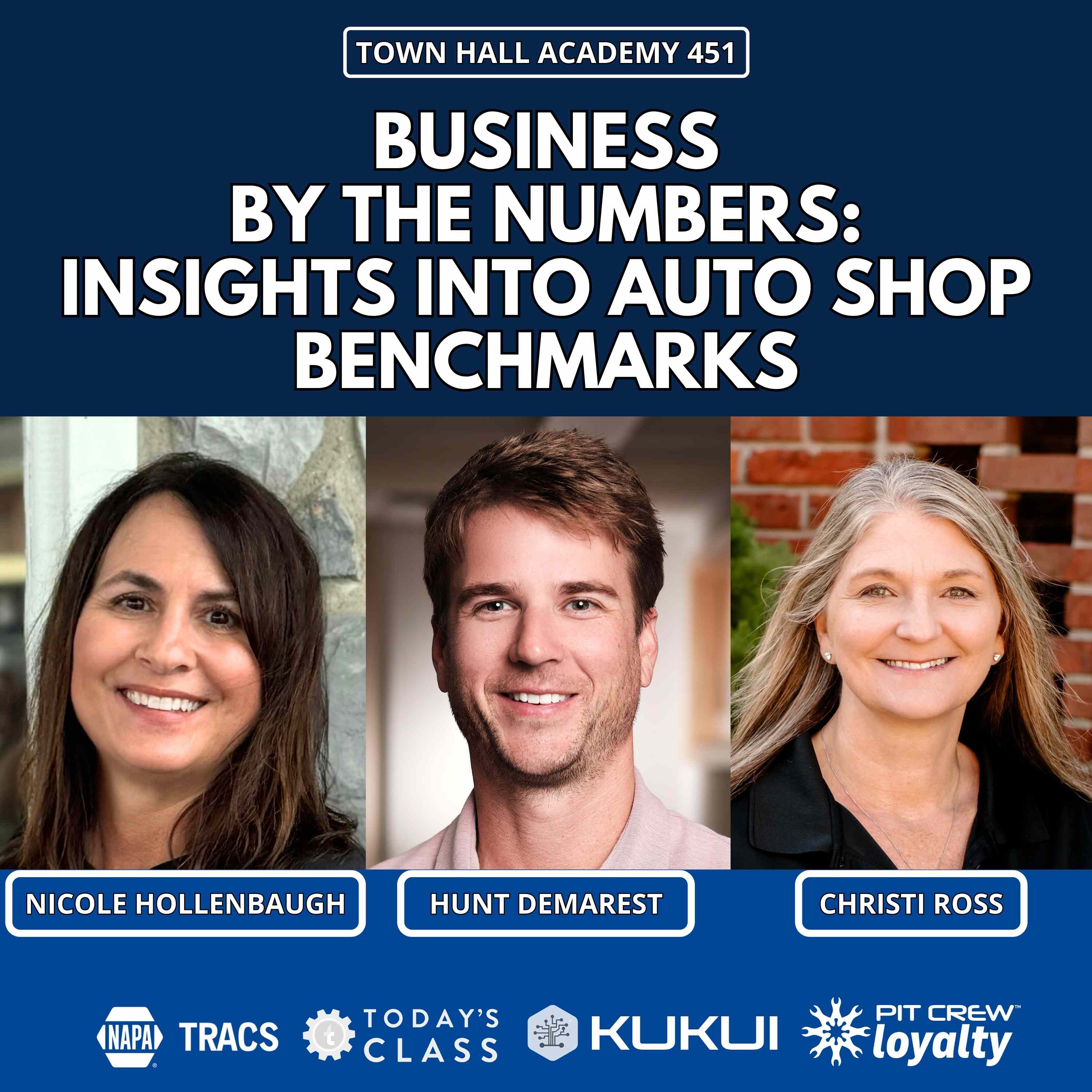
Business By The Numbers: Insights Into Auto Shop Benchmarks [THA 451]
Remarkable Results Radio Podcast
Business By The Numbers: Insights Into Auto Shop Benchmarks [THA 451]
Remarkable Results Radio Podcast · Sep 19, 2025
Annotations will appear as you listen
0:00
56:59

LIVE
This is the Aftermarket Radio Network.
Hey everybody, welcome to Town Hall Academy from Remarkable Results Radio, Carm Capriato
here.
Ten years in, just a few recordings to help advance the wonderful automotive repair aftermarket.
I got a great show today, Hunt Demerist, CPA, Parmelis, and podcaster extraordinaire from
Business by the Numbers podcast is going to be here.
His firm produces each and every year a real cool benchmark report, and I want to hear
Hunt's particular view of it, but Hunt also asked a couple of his shop owners to come
on and see how those benchmark numbers have a positive and or a challenge inside of their
company and how they work with it.
But before we get started, great partners, you got to support them.
Hey, for over 30 years, NapaTrax has made selecting the right shop management system
easy by offering the best, most comprehensive SMS in the industry.
We'll prove to you that Trax is the single best shop management system in the business.
Find NapaTrax on the web at NAPATRACS.com.
Hey, how well does your team know their stuff?
Test their automotive skills with the today's class of basic, advanced, or service advisor
quizzes.
It's a quick, effective way to spot gaps and grow stronger teams.
Take the quizzes now at today's class.com forward slash TC quiz.
Shop owners stop juggling multiple marketing tools.
Kukui's integrated platform.
They deliver four times better website conversions, automated follow up, and real time ROI tracking.
Get industry leading customer support with Kukui.
That's K-U-K-U-I dot com.
You're probably tired of chasing new customers who never return.
We understand.
Pitt Crew Loyalty ends the one and done cycle, turning first visits into lasting, reliable
revenue.
On the web at PittCrewLoyalty.com.
Hunt Demerist, good to see you, man.
Good to see you, Carm.
Thanks for having us on.
Glad you're here.
Parmelson Associates Accounting Firm, you are the shop accounting firm of our industry.
Business by the Numbers podcast on the aftermarket radio network.
So glad you're on with all of us.
Christy Ross is here.
Hello, Christy.
Hello.
Thanks for having me.
How are you?
I'm great.
Premier AutoCare, Titusville, Florida.
You know there's a Titusville in Pennsylvania too?
I did know that, yes.
Just checking.
You're on the space coast, I think they call it?
Yes.
Our shop is actually located on US one and we are very close to the launch pad.
So we get to see the rockets go up all the time.
Cool.
Does the earth rumble?
Yes, absolutely.
And the shop and the house.
For sure.
TMI, 12 years out there with husband Keith.
Yep, we have been growing.
Try to wrap my brain around the last 12 years is a lot.
We've had a lot of changes, a lot of growth.
Yeah, it's all good.
I call that good.
Just like you said, it's all good, right?
You take those interesting trajectories and you look back and you say,
wow, I can't believe where we are and how we got there.
It is nice to look back and reflect how this all started and the struggles
that we've been through and the things that we've overcome and where we are today.
So it's very nice to reflect back on all that.
Well, you believed in the rule of holes and that is that you need to know
when to stop digging and move forward, right?
And put the earth back under your feet so you can climb up and out.
And so many shop owners today that are struggling,
that just don't make for a good industry.
They're more, you know, hurting us by, oh, I'll take it at any price, get me the job.
And you could have been there had you not together with your husband.
Decided, hey, we got to do something about it.
And that's good new stuff.
Nicole.
Hello.
Nicole Hollenbaugh.
Thanks for having me.
Good to see you.
Premier Auto Entire.
Can you imagine, this is wild.
There's two companies named Premier on here.
I actually did even think about that until I like sent them out that I'm like,
wait, this is the same shops not associated whatsoever.
Nicole is actually really close to us here in Maryland.
And then like I said, Chrissy's down in Florida.
Thank you.
I have the official report that we're going to talk about.
And Nicole, again, as I said, Premier Auto Entire,
couple of locations in Maryland, 20 years in business.
Yes.
As of July is our 20th year as my husband and I owning it.
Good for you.
Husband is Brandon.
Yes.
And Justin and Brandon Jr. work in the business, two of your sons.
Yes.
Justin is at the counter.
He's one of our service writers and my son Brandon works in the shop and works on the cars.
Do you ever show Justin the reports, the financial statements?
It's funny you say that.
I didn't show him the reports, but yesterday I was actually working on a formula.
I've been all over this report and I was really into the whole productivity part of it.
And I was working on a formula and I had to use algebra to do like backwards math to figure
something out.
And I realized I was making it more complicated than it needs to be.
So I texted him a picture.
I said, remind me how to do this.
He did like a chat GPT.
But in the meantime, I figured out I'm like, I figured it out.
I didn't need it.
But then I realized I was over complicating it and I only needed to multiply two numbers
by each other.
And when did we learn algebra?
Was that in like eighth grade or ninth grade?
I think high school-ish.
Yeah.
Yeah.
On the cusp of high school.
And you know, every time someone says algebra to me, this XY thing just floats across my eyes.
I must just be a nerd or something because I actually do use it a lot.
I tell my teacher friends, just use me as an example.
Good for you.
I'm so glad you're all here.
I love your report.
It says 2025 by Hunt.
You say all the numbers in here reflect 2024.
And the report's been out for a while.
Where can people get this if they want it?
So they can get us on our website parmellus.com.
There's a download page on there.
We can download that benchmark report and a number of other things.
It is a well laid out, incredibly intelligent report.
I love the graphics in it that really help show everything that you offer.
And you got to get it.
And you got to apply what you know about your business to it.
And either be happy that you're above average or sad that you're not meeting,
if you will, the standard.
A couple of things that came out of it.
Monthly average sales were 123K.
Average monthly sales per specialist or technician,
31, 816, labor gross profit, 59, 3, parts gross profit, 46, 1.
Listen and weep if you're not there.
And that's why this show is all about improving your company, improving your life.
Average repair order, 702, owner pay plus profit divided by sales.
God.
There's that algebra, I think, right?
Yeah, there you go.
And once people realize that when we talk percentages from a financial perspective,
we're always dividing it by sales and so many people don't get that and understand that.
And I found that to be interestingly low since most of the coaches that I know shoot for 20%
net profit.
Forget about the owner's piece of that.
It's 20.
Other stuff that's in there, benefits, retirement, coaching, strengths, weaknesses,
productivity, and so much more.
So our goal is to have two shop owners look at their positives and negatives in a couple of
small areas and hunt to maybe put some clarity to all of that.
Christy, let's start with you.
The first thing that you're happy about where you are that you may have exceeded the averages in
the report were shop supplies divided by overall sale.
You're adding shop supplies or you're controlling shop supply?
Both, actually.
Shop supplies are automatically in our point of sale.
So we know that that's never going to be overlooked, that there has been adjustments
made to that over time.
So we do keep an eye on that, like all metrics.
So that is an automatic percentage of what the RO is up to a max per order.
So we're guaranteed to have the shop supplies charged out.
And then also on the back end of that, controlling our costs and dealing with our vendors
and having a relationship with them and just shopping around and making sure that we're
getting the best price on the cost of the shop supplies.
So that's where it's very impactful when it comes to that.
Do you have shop supplies as a line item on the expense report?
On the expense report or on the RO?
On the expense report.
We track it.
So the cost of goods sold for shop supplies is a little tricky.
A lot of our clients track it.
But the thing that's hard about it is a lot of our client shop supplies
are added onto their Napa bills and not everyone splits it out.
So usually when you're looking at shop supply cost, that's the lowest amount.
But what we generally see, whether you know it or not,
most shops are spending around 2% of their sales on shop supplies.
Makes sense.
And you said, hey, we did pretty good in this area.
Yeah.
Good for you.
Nicole, what's a positive at your end?
I would start with our parts gross profit because in the past this was something that we really,
I don't want to say we struggle with it.
But Reed from Parmelas was always saying there's something going on here.
There's something going on here.
And we just couldn't seem to get it right.
So I was very happy to see that our number looked really good on the benchmark for that.
And I would have to say we always use the parts matrix.
But we realized that some of our service writers were discounting and overriding
and not completely following it the way they were supposed to.
So we really cracked down on that.
One of our writers isn't with us anymore.
We did realize a big improvement after he was gone
because we realized he was the biggest culprit that was doing it.
But there's just other things that just making sure if you have a bad part or
part that needs to go back that it gets sent back.
And it's not just sitting on the counter somewhere forgotten.
So we've been really good about getting the parts returned,
making sure we're checking parts and voices when the delivery guy delivers the part
to make sure that the cost on there is what they quoted us over the phone.
We're just trying to be a little bit more diligent
and having our service writers check all those things.
So my question is if you're ordering online
and you're seeing what the price is coming directly from your supplier,
how often do you see that the cost you're putting into your RO
and the cost on the invoice is different?
I mean, I wouldn't say it's a lot, but it does happen at times.
It does happen. So you got to pay attention.
I love what she said, Hunt.
Especially both of these ones have a concern to both name Premier.
Obviously, it's a popular name.
And one of the things that we see just as often as them getting charged
an incorrect amount is, hey, that's Premier, but that's not the right Premier on it.
It's true. Yeah.
That's a great point. So it goes back to what she said about Reed saying,
you know, there's something not right here when you have an individual,
which is so cool about having these advisors in your world, in your life,
be it a coach, be it an attorney, be it your CPA,
you have to pay attention to what people say as they hover over and look into your business
from sometimes a 10,000-foot view. Okay.
And then you have to apply your God-given intuition to that meeting,
to that statement that was made.
And if you don't have intuition, you better figure out how to get it.
Because in so many cases, you can overcome some of the challenges that you have by saying,
wow, it could take 30 days later, but Reed was right. Hunt was right.
But you didn't ignore it. You need to covet this kind of information.
Right. That's why it's nice to have an extra set of eyes.
And, you know, my husband and I, we discuss numbers all the time.
You know, I'm kind of in the background. I'm in the office.
I'm doing the bookwork, the accounting work.
I'm not actually in the day-to-day operation of the business like he is.
So he's seeing, you know, that side of it. I'm seeing this side of it.
And, you know, then we just have to come together and, you know, talk about the numbers
and the reality of both sides of it.
Perception versus reality, right?
And that's essentially what I think that this benchmark is,
because you've made a couple of jokes about Khan,
but like people have sent me real messages.
Your numbers are wrong. Hey, you've reported this on there. That's not right.
And I'll say it again, like, hey, you might not like the numbers.
They might be higher, lower than you expected.
They absolutely were different in some areas than I was expected to see.
But these are real shops financials.
This is the trailing 12 months of what shops around the industry are doing.
But the cool thing that I'll give Christie and Nicole both credit for
is this is a really hard report sometimes for people to process.
And really having someone give that 10,000 foot view is sometimes very uncomfortable,
because what we're coming to say sometimes is,
you guys thought that you were doing parts correctly, right?
You thought that the matrix was doing fine,
and you thought that everything was working okay.
This report is now saying that things aren't right.
And what a lot of people like to do at first is say,
this report must be junk. My numbers are wrong, right?
There's no way that my perception can be different than the reality.
But like Nicole was talking about, I'm sure Christie has done this too of like,
all right, I need to look at this and maybe I can find where something is wrong.
And these are incorrect numbers.
But like Nicole found out, these are wrong.
But the fix is not, hey, I need to fix my numbers.
I need to fix the process and procedures so that this doesn't actually happen.
That is like almost the key to this whole discussion.
Ladies, please chime in when you say, oh, we found this issue to call that,
you know, somebody was discounting pretty heavily.
But it probably was not a policy that said you can go ahead and sell from your own wallet,
blah, blah, blah, and pretend everyone's your mom.
You have stringent policy in play that was being not adhered to.
If it's productivity, if it's quality control, whatever it is,
there needs to be a system and a policy around it.
You'll be in total chaos with zero control if you don't have that.
And to me, that's a big part of the whole digging problem that people have
and can't understand why I can't be successful.
And how could this person be making 20% and I'm just about barely, you know,
giving grocery money to mom?
Yeah, I mean, you've got to look at your numbers daily, weekly, monthly, yearly,
like you have to, you can't not do that.
I want to speak on that if that's okay.
I can tell you 13 years of business and I don't know if everybody experiences this,
but when we started our shop, you were spending so much time in the day to day,
you're just trying to keep your head above water.
The first three years of business, we were so in the day to day and so many things to
keep your eyes on, it's almost impossible to even focus on your financials.
So as the business grows, we are now on the outside of that working more on the business
than in it.
My husband still goes in from time to time, but I'm like Nicole, I work from home.
I've always had my hands in the books, but I never really truly had time to understand
my financials to the degree that I do now and the help that Hunt and his report and his monthly
reports that he provides to his clients, I am in those reports and I'm digging and I'm asking
questions because I want more than ever now to understand my financials now that we are
really able to work on the business than in the day to day that just exhausts you.
Like the demands of being a shop owner are relentless.
They're endless.
And so it takes away your focus from the financials, but it's the most important part
that you can oversee.
It's the pulse to the whole business.
Hey, let's face it.
Your shop management system is the single most important tool in your shop, period.
NapaTracks has made selecting the right shop management system easy by offering the industry's
best, most comprehensive SMS.
Now it all starts when a local representative meets with you to learn about your business
and how you need to run it.
After all, it's your shop, so it's your choice and having local representation is a huge plus.
Customizing tracks to your business, whether you're a one person shop or a large multi-bay
or multi-location company, a representative consults with you to help optimize your shop's
workflow, efficiency and profitability.
Tracks always has the flexibility to do business how you need to do it,
which means it can also grow as your business grows.
And unlike the other guys, we'll be there for you after installation
with the best training and support in the business.
Yes, a learning management system tailored to each role in your company.
Simply put, tracks was designed and built for shop owners just like you.
Visit us on the web at NapaTracks, that's N-A-P-A-T-R-A-C-S dot com.
Hey, Karm here, suggesting you discover a smarter way to train your entire automotive team.
Experience powerful bite-sized training sessions accessible from any device
in just five minutes daily.
It's perfect for technicians, advisors and managers alike.
Today's class prepares your shop for sustained success by reinforcing crucial knowledge.
Plus, add a competitive edge with our leader board to make learning fun
and rewarding for everyone.
For effective training that delivers, turn to today's class dot com.
Shop owners, we know you are overwhelmed with a flood of missed calls,
empty bays and disconnected marketing tools.
Cacui has spent over a decade building one integrated platform for auto repair shops,
one login, one dashboard and mobile-first websites that convert four times industry average.
Smart, innovative CRM with automated follow-up, 24-7 online booking and real-time ROI tracking.
With 900 plus years of combined team experience, we fuel the growth of 2,200 plus shops
and have influenced three billion dollars in revenue.
Stop working harder, start working smarter, get industry-leading customer support
and book a demo with Cacui that's kukui.com.
You know, most shop owners feel trapped, spending on ads while half their first-time
customers never come back.
It's frustrating.
It's exhausting.
And it's not your fault.
The industry average is 54 percent, one and done.
We understand how discouraging that can be.
Well, pit crew loyalty changes the story.
Our clients cut that rate by up to 38 percent,
raising lifetime value by more than 50 percent.
Loyalty members visit nearly three times more often,
creating predictable revenue without extra ad spend.
Pit crew loyalty where customers stay and shops thrive on the web at pitcrewloyalty.com.
So you're looking at things, you're working on the business
and you're trying to compare what you see, what you know should be,
where benchmarks in the industry are and you sit down with Keith and you say,
Keith, finish my sentence.
Well, I can tell you one thing.
What he seems from the point of sale and what I see from QuickBooks
and then what Hunt helps us oversee because that extra set of eyes are on the books,
it tells a story.
And it's a very important story because just like Nicole said,
like when something's wrong, you know about it,
you don't want 12 months to pass before you have an opportunity to fix those things.
That's a really good point there, Christy, of like making sure you're timely.
But I think both of you guys can attest to the most common one that I see of the disconnect
and the good nature of having people kind of boots on the ground
and then also kind of high level is productivity.
Carr mentioned before my wonky way of measuring productivity.
We can talk about why I do that.
But essentially the reason that I do this is like if Nicole and Brandon are sitting down,
Brandon is like, man, these guys were out there.
They were busting. I saw them.
They're working on cars all day.
They're sweating.
What he's seeing is inputs, right?
Hey, these guys are busting their butt.
Nicole and I look at this at the end of the day.
We say you got four guys out there.
That's 160 hours of labor.
We sold 80 last week.
Productivity is our number one issue.
Without these numbers, can you see anyone that's in the shop
looking at these guys busting their butts thinking, hey,
productivity is our issue, but the numbers don't lie.
But now the tricky part about this is productivity is selling 80 hours a week.
And these guys just sitting on their phone half the time.
That's a real possibility.
But in a situation like that, what happens a lot is,
hey, these guys are working.
These guys are on stuff.
Do we need to get more hours?
Do we need to become more efficient?
Because these people are working hard.
I don't think that I have 50% more capacity here.
And again, seeing this from different sides,
if you look at the numbers only and you ignore the people side of this business,
it's going to be miserable, right?
It's just not that simple, but the same flip side of it.
If you just try to do the people side of it, ignore the numbers,
it's going to be very, very hard to figure out which levers to pull and how much and where.
Yeah. And that productivity part of this report,
I don't know why that's something I never focused on before.
I don't know if I overlooked it, if it was never presented to me in that way.
But I have been crunching and crunching numbers based on this whole productivity,
the very bottom part of this report.
And I have just been trying to figure out what we can do to get a little bit more productivity
out of our guys, just knowing where the goal is.
Like I said, I feel like that's something we probably overlooked a little bit.
And now I feel like I have a goal of where the total hours per week we should try to have them.
And the good thing is the goal doesn't seem like it's 100%.
You know, based on the report, top shops I think were what 59% or something.
So if the goal could be 60% productivity out of the guys,
that was kind of one of the little formulas I was working on yesterday.
And I realized I really, if that's my goal, it doesn't have to be everybody's goal.
But if 60% is my goal, I just have to take the amount of hours they work.
And times it by 60%. And that's how many hours they should be turning each week, right?
And getting paid for, right? And so I'll do it.
I mean, does that sound right?
No. And so usually, like when I talk about people, I say if you can get your technicians
to get 30 hours at your street rate, at your door rate on it, I'm not going to say you're
going to have a good business, but I will say that you're probably going to start focusing
on other things. Like you can generally make that work. And if you look at our top shops,
the numbers don't lie. That is the one that gets argued with me all the time.
People hate that number. They say it's wrong. Also, everyone loves to look at productivity
in these weird rose-colored lenses. A lot of our clients used to be technicians.
And a lot of them, I think, have rose-colored lenses of how many hours they used to turn.
When I was in the shop, I was turned in 80 hours a week like clockwork. You probably weren't.
Now, when they look at their own technicians, a lot of people say,
oh, these guys are turning 1,000 hours a week. I'm looking at the numbers, guys, they aren't.
So the big number that we have on there is what is your total labor sales? What is your labor rate?
And I'm going to figure out how many hours you sold, because I don't care how many hours you
sold. I care how many hours you sold and got paid for. Yeah, that's great, Nicole, that that
technician sold you 40 hours last week. We got paid 200 bucks. So essentially, we sold one hour.
And so that's what this productivity breaks out is who cares how many hours your technician
turn. That's kind of a useless number for what we're looking at here on outputs and a P&L.
How many hours do we sell at our street rate? And that will tell us a lot.
Now, the tricky part about this is, like we mentioned before,
that takes everything out of the equation and just says how many hours are we getting paid
at our street rate? So if you have someone that is at 50% productivity, that shop could actually
be 100% efficient. All their technicians are working every hour, but they're discounting this
stuff off and they're only recognizing half of what their street rate is. Or that could also
just be a shop that is about 50% productive as well. But what that does is it kind of takes out the
playbook. That's great that your shop is 110% efficient. But if your labor rate is 200 bucks,
because that's where you set it, that's where you calculated this, and you're only recognizing
effective labor rate of 100. Again, productivity is not your issue. Now pricing is.
So the productivity factor, I believe for you, Hunt, is labor sales divided by labor rate
divided by the number of text times 2080 or the hours in a year. And that's, Nicole,
what hit you upside the head. Yeah, I don't know why that formula threw me for a loop,
but it did. Just trying to understand what all the pieces of the formula were.
I usually use 2000, just like this is, we're talking about algebra and like how
my mind has been corrupted with a calculator on my desk. I can't do simple math.
2080, so that's standard full time for a year, 52 weeks times 40. If you're a look at your technician,
you say, my technician's 100% productive. Well, then you should see that he sold you 2000 hours.
And if you want to really see how much you got paid for, see what their labor sales was divided by
your labor rate, and that's how many hours that technician sold and you got paid for.
That's usually the number I look at. Like when I talk to people about productivity on this or
any of this, especially if they have a lot of pricing and a lot of weird things like that,
hey, cut the hours out of there. I don't care about the hours, figure out how many hours you
sold at what rate you're trying to, and that's the number you need to fix. Don't ignore this.
This is so, so important. Here's two shop owners. Nicole, thank you for sharing that.
Are you posting or sharing the math after you do it and saying, here's our goal and here's
where we're at this week, that week, this month? Oh, you mean for employees to see?
Yes. I haven't gotten that far. I kind of mentioned the suggestion to my husband,
but we haven't had a chance to actually come up with a concrete thing that we're going to do
with the guys and we're going to share with them. Christie, how about you?
Well, I can tell you productivity is one of the things that we scored low on,
and I think most shops do struggle in this area. It's hard to find good techs, productive technicians.
I can tell you something that we're weak on is we do see potential in people. We'd love to grow
our own techs, kind of have them learn from us, and because they're good people, they have potential,
but that really does affect efficiency with us. Finding somebody who's very productive,
finding good techs that fit into a good culture that we've worked so hard to
achieve and then maintain, because just once you get a good culture, then you have to maintain it.
It's hard. It's really hard to find those technicians that are not playing on their phone,
or like Nicole said, what is in their way of being productive? There's some things that we are in
control of. We can set them up for success every way that we can, but they have to produce,
they have to have goals set ahead of them, and everybody's on different levels. You have to
make sure that you are giving the jobs to the technicians that they are capable and best at
doing. We have found a lot of productive increases when you really think deep on, okay, am I going
to give this AC job to this technician that he's going to struggle at that? Just putting all of those
things into place to make sure that you're setting them up for success with productivity.
But yeah, our team knows what's expected of them. We do have our son-in-law as our general manager.
He's our second in command. There is plans for him to take over the business in the future,
so he does have regular huddles and meetings with the guys on what the expectation is on weekly,
daily goals of where they should be. They don't always meet them, so the accountability part
on the backside of that is tough for us. So as a quick aside on that, productivity is an issue
with like 95% of my shops. I got some people that haven't figured out, but like Christy said,
generally they've found a couple of unicorns that just turn 45 hours and you just don't have to do
anything. But yeah, I mean, this is something where you go back and say, man, my guys just aren't
doing enough. The team's not living up to my expectation. About half the clients that I talk
to, and I say, what is your goal for the team? And either my client doesn't have one, or even
worse, they have one and the team has never been told that. How can they not meet your expectations
when they don't know what your expectations are? Like I assure you, most employees want to do a
pretty good job. Most employees want to kind of take care of their customers, take care of the
rest of their team, and keep their boss happy. They're not stupid. You guys are paying them.
But perception is reality. They don't know what you're perceiving as a good or bad job until you
say, guys, this is the target. This is what we need. Here we are above and below it. And the crazy
part about this is a lot of my clients, when they say, well, how do we fix this? It's like,
you guys know the answers. This is not something you get from me, a coach. You guys need to talk
and figure this out. And a lot of this is not, oh, well, I know why they're not productive because
they're smoking cigarettes out back. Well, hey, the reason he was smoking cigarettes out back is
you dispatched to work so poorly, he had nothing to do. And this guy had three stacked up. So
even though it's hard, a lot of this is self-reflection. Okay, what could we have done better?
And also a lot of this is not that easy. Like, you can't do this alone. Talk to your team. Hey,
what is hurting your guys' productivity? What can I do better? What can the counter do better to
make your life easier? And really what we're trying to do here is just reduce friction. A business
that we can do the least amount as possible as profitably as we can, the easiest, that's kind
of whatever one is shooting for here. It reminds me of a discussion about being lean, about being
organized, about being clean. Oh, we can play on the phone or we could play in clean. I was just
being a little sarcastic there. But I can't give this air job to this particular technician of mine
because he's going to struggle with it. Right up on the board, educational opportunity. What are
they? Are we as a team working to get everyone at a level that improves not only themselves
and a career opportunity path in the business, but the company? I'm so glad we're talking about
productivity, Hunt, Nicole and Christy, because it has everything to do with the success of the
business and the engagement of your people. Exactly. It really does. It definitely opened my
eyes when I saw that figure. And like I said, I just don't know why I didn't pay as much attention
to it before as I did this time. And really, Keith and I have been recently talking about
capacity and what our location can actually do. And it all points back to efficiency on the guys
that we have upfront and in back and how do we get those goals in place to meet capacity at the
location? Because Nicole, you had said that you have two locations. Keith and I have considered
having that conversation about opening another location, but I just don't feel like that makes
sense when you need to tap out where you're at with capacity first. And it all points back to
efficiency and how everybody is working. Yeah, Hunt knows this better than anyone. You go to
number two, you're going to stress number one. Number one would be easily stressed if it's not
operating at top efficiency. Yeah, but also like what Chrissy just said there, right? A lot of people
look for number two. Nicole was able to do it and they've been doing it for a while,
but a lot of people are not as successful on there. And if they really looked at their numbers,
like, hey, you're making like 200 grand for whatever reason, you wanted to make 400 grand.
You could have done that in your existing location, probably a lot less work
than trying to double your sales and trying to double your profit. Because
magically, most people realize like, hey, I just got this business, took me 15 years to scale up
to $2 million. But this next one, I'm going to scale to $2 million over the course of 12 months
and instantly not use up any more of my time, double my profit and make my life much easier.
That's when Nicole's nodding because she's like, yeah, it's that easy.
Yeah, I mean, we always have the conversation, you know, do we just go back to the one
shop? You know, would we just make end up making the same amount of money
with just the one shop as the other? I was telling Karm before the episode that, you know,
we call the one shop our big shop, it's our seven bay shop, we call our other one our
little shop, it's two bays. So lately, we've been looking at the little shop more as a satellite
location. And if the customer calls in and needs work done, that shop isn't capable of doing,
the customer can still drop it off there. And then we'll bring it over to our big shop
and have them work on it. And because a lot of people, even though our shops are actually only
like 10 miles apart, we have a completely different customer base at each shop. It's
very strange, but it really is a completely different customer base. So the shop that we have
on Main Street, our little shop is convenient for a lot of the lawyers, doctors, we have a hospital
right there, you know, all the businesses offices are there. So it's a lot of people can just
drop the car off and walk to work. So then if we can do the behind the scenes of moving the car
around to get the repair done that needs, then they still have that convenience of
bringing it to us. So yeah. And that's what everyone's looking for. Convenience, right? And
one of the things that we talked about in the benchmark is like, what is your biggest strength,
what is your biggest weakness on there? And like they do similar reports for the consumer side of
this. But what we're seeing now and for most markets is people are not really concerned about
cost. Even people that money should be a concern on it. We're in an environment of I want this to
be as easy and as pain free as possible. And I want to call you guys, I want to text you,
I set up an appointment on my phone, you're going to come, I'm going to drop it off there while you
go to work. And then you're going to text me invoice, I'm going to pay it. And then when I
come back, I'm going to pick up my keys. A lot of our customer base, which has drastically changed,
that is like the best auto repair experience they've ever had on it. Price is secondary. Like the
fact that they don't have to talk to a big scary service advisor and have a high pressure sales,
it will come back there every single time. And yeah, I mean, a lot of what this is is like a
continual cycle of like, you're trying to improve your business, you're trying to get a feedback
loop internally, right from your team, your counter, right, your ownership. And then also from your
customers, like you can't be stuck in echo chamber of like, we want to do this, we want to do this,
hey, customers like this, we're going to try that. Hey, customers didn't like that, we're not going
to try that. And again, the clients that we're seeing that have successful businesses that are
running like, you know, clockwork on it, what people don't see is behind the scenes is like,
hey, this is their 150th try. They've tried a lot of different things, a lot of different iterations,
high production, low production, heavy on the counter, not heavy on the counter.
And then what people kind of realize is like, hey, this is our lane, and we're going to figure it
out. And once you get your lane in it, then it's just about what can we do to scale this and make
this even easier. It's a great point. I think of them as key droppers on just here, just do what's
got to be done. Let me know. I trust you and make my car last. COVID really pushed those key
droppers. And I know a lot of people, not all of my clients no longer allow waiters because I was
like, well, I don't want people waiting in the waiting room. So my clients literally got rid of
their waiting room, right? Because they want an extra space. But then even the aspect of waiters,
like I did now understand of like, all right, if someone's waiting and they really do need another
service on there, this becomes really strange because now they're sitting in your lobby with no
car. There's a lot of different changes on it. And I think most of them are pretty good. And I
think for a lot of shops that have been able to kind of keep up with what the demand has been from
customer base that, you know, they've been doing very well. We recently did an episode with Uber
and loaner cards. And it was very interesting. It was about probably about a month ago for that.
Look, let's move on to another area about managing expenses. I know, Christie, you weren't happy with
how you fared. Yeah. So I will speak on that. First of all, let me just say this. Thank you both
for your incredible honesty, opening up your transparency to this, because there's not a lot
of people that want to say, I failed, I screwed up, but you're of the class that says, but we're
going to fix it. Yeah. Thank you for saying that. I can tell you, I just feel that if it's an opportunity
for somebody else to learn from us, we're all in this together. Once you think you got it right,
you got something else to fix. It's got a moving target. We all know this. So if this, even doing
this podcast and, you know, being here together and answering these questions and looking at this
benchmark, there's so much to take from this report. As far as the expenses go, I'm in charge of that.
I oversee that. And so it's like an expense audit never used to be something that I did.
I thought I always shopped around for the best price, you know, even coming down to insurance,
you know, things like that and revisiting even to automobile insurance, everything.
But then when that kind of starts to hike up, it's like, wait, this is getting over what is
recommended. Like, let's revisit this. I can tell you now, since this report and probably before
doing the expense audit, there's things you can reduce. When you really dig deep into it
line by line and really pay attention to it, there's things you can be without you can reduce.
I just feel, I don't know who, what everybody else does, but I feel like this needs to be done
maybe annually, maybe even more frequently. I don't know, but it's something that I wasn't in a
routine of doing, but I am now for sure. With our total expenses, we do have a shuttle. So,
because you brought up Uber, we have Keith's mother doing the shuttle. She is retired.
I saw her picture on your website. Yes, she loves the customers. She does not want to fully retire.
She lives very close to the shop. She is there within moments. She loves taking people to work
and even to the airport or land at the airport. She doesn't want to give that up.
Her and Keith started the business 13 years ago. It was her behind the desk, believe it or not,
and him in the garage. So, those were good times. But as the business grew, she needed
something to do and she absolutely loves it. And she really bonds with, they call her grandma Uber
to be honest. Grandma Uber. So, she's really connected still. She didn't want to lose that part
of having that connection. So, back to the expenses. We have five family members in our
expenses. When it comes to me and Keith and her, and then our daughter also does the marketing
for our business. We never had somebody overseeing that before. She's probably been doing that now
for two years, which is huge if you ever look at our social media. She does an amazing job.
And then, of course, our general manager, which is our son-in-law. So, yeah, always visit the
expenses. Those audits are super important because we did that at the beginning of this year and was
able to cut back on more than I realized. I agree. I look at that number pretty faithfully.
I would say definitely six months. And then again, at the end of the year,
I go through and take the average of the expenses and make sure they're
at a reasonable percentage where they should be. And if something needs adjusted, we figure out
where we can make changes. But yeah, that's huge and something that I look at pretty regularly.
One thing I will add on here because it kind of goes back to one of your first
questions there, Karma, of this net income plus owner's pay seems lower than what some people
talk about. And it all goes back to what we're talking about here is in your expenses.
And we like to get aggressive. We don't like to pay more taxes than we need to.
And so some people have a little bit of crossover between their personal life and their business
life. So the biggest thing here that I want to tell people is like, if you're trying to really
get a handle on your finances and you are lost without a paddle, keep your personal life out of
it. I know that you want the tax deductions on it, but it's going to be the hardest thing to overcome.
If you have your personal life running down through there, when you run that report,
it looks exactly the same as your overhead is really high. Once you figure this stuff out,
a lot of my clients go in, they look and they're like, huh, I'm shooting for that 20%. I'm shooting
for that 20%. What they're showing is a 15% net income, but their grandkids is on there,
their sisters on there, their race cars on there, they got eight jet skis, every single travel
expenses, their personal life. And so what I tell them is, hey, that 15% net income comes after
overhead of 40%. And you're beating yourself up because your overhead is too high. 10% of that
overhead is going to you. If the expenses are going to you, that's looked at a lot different
as an expense going to state farm or to, you know, cacui or whoever it is. When you guys are looking
at this, all expenses on a P&L look the same. If you're running to yourself, that's looked at
differently. If your owner pay is going into your own pocket, that's looked at differently.
If your kid is college is getting coated under education, I'm making up stuff,
Carmen. None of this stuff ever happens. But one of the biggest things here is like, again,
like removing variables from your financials. If you start seeing things that are weird and
you know that you're doing weird stuff on your financials, you shouldn't be surprised.
Sort it out. Especially if an advisor like Hunt Reed comes by and is starting to question certain
things, the owner says, well, look, you know, I'm doing this and I'm doing that. As long Hunt
is you say it makes sense or it looks good and you're not going to get called out on the carpet
for it, then you may not hit your 20 and I'm with you and I hear you on that. And I think you have
to be very careful on the size of the payroll when it comes to family too. That's a lot of mouths to
feed. You're feeding a ton of mouths. But when you have an extended family, I'll say five, four, five
or six and I can't even imagine what mom earns. I mean, she's probably, you know,
hauling down $50 an hour to be your Uber driver. Tell her I said that.
I have downloaded the app and done Lyft and I'm like, wait, it takes $35 to take somebody to the
hospital? Yeah, we're not doing that. So I have.
And apart from that, you're only getting like eight bucks out of that $32.
Yeah.
Hey, let's wind this down and let's talk about gross profit a little bit. I mean,
I know you all have passion for that. I mean, it really starts there. You have to pay your
bills from your gross profit dollars and sometimes people don't, you know,
oh, my percentage is great, but not the kind of dollars you're looking for.
So let's talk a little bit about that. Nicole, any perspective, what you're working on,
successes or challenges?
Yeah, I have a lot of perspective on gross profit. That's another number I look at
all the time, because if that number is not right, if you're not even in the ballpark,
you need to change something. You need to figure something out. So I do try to
stay in check with that number. I feel like that's one of the things that Paramellis helped us with
when we joined them. However, many years ago, I think I've been with them 19 years or something
was moving our technicians up to cost of goods sold, which is before your gross profit.
It sounds like something simple and people are probably listening and have no idea what I'm
talking about, but learning how cost of goods sold works and how it's different from fixed expenses.
And if you don't know about this, you need to check with your accountant and get educated on it,
because that was something huge for us to make sure all of our accounts are where they should be
and that we have a true gross profit number coming through.
I feel like I'm keeping us pretty much where our goal should be. I'd like to be a couple
percentage points higher, but I think we're doing pretty good where we are.
Ever have a gap between the SMS and the financial statements when it comes to gross profit?
She's going to say no, because she's going to make me look good. But yeah, everyone has it, right?
But her point about labor here is if you don't know what Nicole just said, you have a massive
gap on it because in a normal world, your shop management system should be pretty darn close
on parts. If you don't do a ton of work, it's not even going to be close at all on labor.
And that's the scary part is a lot of people are living and dying off of these shop management
software reports on GP dollars or percents. And I pull up their gross profit report and they're
saying that they're making 85% on labor. And immediately I throw it in the trash and say,
your entire business, you know, the pace that you've been trying to do, your forecasting
is all off of flawed numbers. And because you don't have your QuickBooks set up correctly,
this is the first time anyone's ever told you that.
Are those the people that say, but then where's the money?
Yeah, to a large extent. And again, like this is like all goes back, right? You solve one issue
and you're like, well, if that's not right, then that means that's probably not right easier.
And that's when you say, exactly, this is why we start to clean this stuff up,
because you fix one thing and it kind of shines a light on something else. Well,
hey, that's good now. But here's the real issue. And what ends up happening is,
if you have a multitude of issues, they're going to kind of be muddy by a lot of different things.
But what ends up coming out of this is most shops have one core issue that they need to focus on.
Is it pricing? Is it scale? Is it volume? Right? Is it overhead on it?
And if you're starting with bad information on shop management, so offer no information on
financials, the only way that you can fix is if you get lucky, right? And your dart just hits the
right thing on it. But again, once you get these numbers, your understanding is pretty low, right?
So what you think is your fixes is going to be low. But as you work on this, as you go back and see
this, see how these changes, you know, change different things in day to day, then hopefully
you get a better understanding and ultimately a better solution.
Christie, I do want to go to you about gross margin, but a point that I just have
culled from what Hunt just said, we have to be, if we're going to survive this credible industry
of ours, profession. And in order to be professional, it's going to require a lot of work. And Nicole,
Christie, I don't remember which one of you said that. Oh my God, there's just such a heavy lift
to constantly improve themselves. And that's the thing I want to impress. And I think we've
all impressed everyone who's on the aftermarket radio network. We drive that point home.
You cannot give up an ounce. Don't relax just one day. I'm not saying that you can't enjoy a
vacation, but you need to be, and this is my favorite word about the attitudes that you need to have
to be a great successful CEO. You have to be bold, italic. Think about that as far as a type face.
Bold, italic. Yeah, you have to be on it every day. You can't just let it go. You have to be
looking at your numbers. And like we said, not just the financial side of things, but the physical
side of what capabilities does your shop actually have? What people do you have working for you?
What can they actually produce for you? So that's why sometimes it's nice that I am behind the scenes
of my husband's right in the thick of things, because then we can kind of come together and
look at things from two different perspectives and put a reality to the numbers. Just like I always
say to my husband about the service writers, because they're looking at the cars on the screen.
They're looking at the technician that's working on the cars. And sometimes I say to him,
are they actually walking out into the shop and seeing that car and putting a reality to what
that computer screen is showing them? There really is a car in the bay up on the lift,
and they really are working on that. And it's not just a red or a blue line on the screen.
It's like there's that reality. It's like, are they putting two and two together and physically
walking out there, making sure this technician is actually the one working on this vehicle?
And how far along are they? We can put statuses all we want on our software in progress or parts
ordered, but physically go out there and make sure that that's really happening and keep updating
that system. But that's where looking at a computer screen compared to a reality meshes together
sometimes. Okay, I have a quick hack for you. On the computer screen right above it, somewhere,
you need to put a note and it says reality check, question mark. Yes. Yeah, it's true. Yes. It's
like people say, well, near the phone, I put, you know, smile, you know, it's mom or whatever.
The reality check is one of the biggest takeaways from this episode. It's like,
stop for a moment and stop to realize that I know we're in a mill. We're in a computerized,
generated, you know, screenshot world. But the reality is there's real people out there turning
real wrenches working on real cars. Wow, that's huge. You know, don't just take the tires and set
them down in a bay and assume that they may see it, but they may not see it, you know,
physically make sure they know that the parts are there. That could be the title of this episode,
a reality check. Think about it, because we're looking at numbers and we're comparing what you
have. It's a great tie in at the end. Thank you for that, Nicole. Christie Gross Prophet,
let's finish this up with your perspective. I want to really branch off of what Nicole was saying
and also Hunt. When we became clients of his, and I think I got a five-year anniversary card,
so thank you, Hunt. When people say that with him for 19, 20 years, I'm like, yeah,
I probably made a mistake not jumping on that a lot sooner. But the structuring of the P&L,
like if that's not set up correctly, that's step number one. You do not have a clear vision of
what your gross profit is on a P&L without that structure being there. Obviously, the labor is
about the sales and the cost of goods for the sales above the line. When you're pulling that from
your point of sale, it tells you one thing, but when you're really looking at the profit and loss
and structuring it and putting the categories where they belong, you're getting a clear vision of
what that GP is. One big takeaway that Hunt, I learned from him, I don't know if it was this
year last year, but I've been working on it, is the 50, 30, 20 targets. You want to shoot for the
50% gross profit and keep your expenses around the 30 and hoping for a net of 20 and just having
that as a target helped me hugely because it's like, I don't even know what I'm looking at,
honestly. How do I know what to do with this? That was huge for me. I've learned by collaborating
with other shop owners that some people have that sales above the line, some do not. I'm like,
okay, well, whether it's underneath your operating expenses or above, I feel it should be above. I
think that's changing your picture of what you're looking at. That was huge for me,
is just being able to look at that and understand that. Not only just from the point of sale,
but also once it hits your P&L and how they need to be accurate.
I love the passion that you two have shown here today. You could talk for an hour.
What great clients, Hunt. I know. I'm very lucky. Yes, you are. They're great as well.
If there's a takeaway here, if you don't have a quality accountant who understands our industry,
then you're getting a financial statement, a profit and loss balance sheet, maybe a cash
flow statement, but none of it means anything to you unless you start driving it through your own
KPIs and your own formulas and you look at other benchmarks. What it looks like that I'm hearing
from Hunt and you, too, Nicole and Christie, is that you're more engaged from a financial
perspective than ever. I can't encourage enough people to download this benchmark report.
All the formulas are there. Do your own math. Yeah, but I feel like it's not even about,
even if someone understands the formulas and can figure it out, do they understand
the results and the numbers? I just feel like it's more important to get with your accountant,
know what your percentages should be and understand them and why they're setting them,
where they're setting them. Read knows I will continue to ask him the same question over and
over until I actually understand and he knows he's not going to get off the phone with me
until I actually understand and I won't get off the phone with him until he explains it in another
way or whatever he has to do to get it through my head. Sometimes a good teacher knows that,
that the repetition, I'll never forget, I had a major learning curve and one day that I got it,
it was almost like the whole weight of the world was lifted off of me because I finally got it.
Someone was willing to work with me. Yeah, sometimes that light goes off and it's like, ah.
We see that on shops financials a lot is financials are far into a lot of people,
but then there's becomes a moment when they see what's going on in real life and they see how
their financials are affecting it and it's like, oh, this isn't different. This is essentially
my life or my business life in number form there, but like the big takeaway on the benchmark is
kind of what Nicole was mentioning here and Christie to a large extent is if your financials
are not set up where you can compare some of your numbers to the benchmark, then it's highlighting
your core issue right there is if your financials are not set up correctly and in a format that you
understand, then they're completely worthless. I'm not saying you have to hire me. I'm not saying
that you have to fire your accountant, but you have to go back and get an understanding like I
have a really hard job because I don't actually sell anything. I'm selling bowling Christie,
their own financials, their own numbers on it. But really what I tell my clients is I'm not even
selling you monthly financials because if I send you the financials and you don't know what's on that,
then they're worthless because these numbers are just the starting point for you guys.
Now you guys have to do the heavy lifting and really the ultimate takeaway from the benchmark
should be completely different for every single person that looks at that.
What you'll see in that benchmark is our top shops, half them on flat rate, half them on hourly.
If you look at some of our top shops, you know, some of them renting for themselves,
some of them altering health insurance, some of them aren't. So there's a lot of different
ways to slice a pie on there. But at the end of the day, what most people will find out is
if my profit is maybe less than the average on it, then I can probably find one or a couple
key indicators that are the actual root causes of my underlying profitability not being where I
want it to be. What a great summary. This was great. Thank you ladies and hunt for being here,
hunt Demera CPA, Parmelas & Associates, and Business by the Numbers podcast on the
Aftermarket Radio Network. Christie Ross, Premier Auto Care, Titusville, Florida,
thank you for your great insight and also you, Nicole, Nicole Hollenbaugh, Premier Auto Tire,
both companies named Premier, two locations, Elkton, Maryland, with husband Brandon and
Christie with husband Keith. I think this was very, very inspiring, tons of great information,
and I think we nailed a great episode. Thanks for being here. Thank you. Thank you so much for having us.
Thanks for being on board to listen and learn from the Premier Automotive Aftermarket podcast.
Until next time.
About this episode
Insights from automotive shop owners and CPA Hunt Demerist reveal the importance of financial benchmarks in the auto repair industry. The discussion covers key metrics like gross profit, productivity, and expense management, emphasizing the need for accurate financial reporting. Shop owners Christy Ross and Nicole Hollenbaugh share their experiences with improving their businesses through understanding and applying benchmark data. The episode highlights the challenges of managing expenses, the significance of setting clear goals, and the necessity of ongoing education in financial management.
Original notes
Thanks to our Partners, NAPA TRACS, Today's Class, KUKUI, and Pit Crew Loyalty
Watch Full Video EpisodeThe conversation draws on insights from the 2025 Paar Melis Benchmark Report, built from verified financials and survey data from hundreds of shops. The report reveals what top performing shops are doing differently and where common challenges remain.
Key Takeaways:
Thanks to our Partner, NAPA TRACS NAPA TRACS will move your shop into the SMS fast lane with onsite training and six days a week of support and local representation. Find NAPA TRACS on the Web at http://napatracs.com/ Thanks to our Partner, Today's Class Optimize training with Today's Class: In just 5 minutes daily, boost knowledge retention and improve team performance. Find Today's Class on the web at https://www.todaysclass.com/ Thanks to our Partner, KUKUIStop juggling multiple marketing tools. KUKUI’s integrated platform delivers 4x better website conversions, automated follow-up, and real-time ROI tracking. Get industry-leading customer support with KUKUI at https://www.kukui.com/ Thanks to our Partner, Pit Crew LoyaltyYou’re probably tired of chasing new customers who never return. We understand. Pit Crew Loyalty ends the one-and-done cycle, turning first visits into lasting, reliable revenue at https://www.pitcrewloyalty.com/ Connect with the Podcast:
- Paar Melis Report Insights: Get a real world look at what drives profitability, efficiency, and growth across the industry.
- Track the Right Metrics: Focus on gross profit, productivity, and expense management.
- Use Benchmark Reports: Compare your numbers to industry averages to spot strengths and weaknesses.
- Seek Expert Guidance: Professional input helps shop owners interpret data and optimize results.
- Adapt to Grow: Success comes from knowing your numbers and being willing to adjust processes.
Thanks to our Partner, NAPA TRACS NAPA TRACS will move your shop into the SMS fast lane with onsite training and six days a week of support and local representation. Find NAPA TRACS on the Web at http://napatracs.com/ Thanks to our Partner, Today's Class Optimize training with Today's Class: In just 5 minutes daily, boost knowledge retention and improve team performance. Find Today's Class on the web at https://www.todaysclass.com/ Thanks to our Partner, KUKUIStop juggling multiple marketing tools. KUKUI’s integrated platform delivers 4x better website conversions, automated follow-up, and real-time ROI tracking. Get industry-leading customer support with KUKUI at https://www.kukui.com/ Thanks to our Partner, Pit Crew LoyaltyYou’re probably tired of chasing new customers who never return. We understand. Pit Crew Loyalty ends the one-and-done cycle, turning first visits into lasting, reliable revenue at https://www.pitcrewloyalty.com/ Connect with the Podcast:
- The Aftermarket Radio Network:https://aftermarketradionetwork.com
- Follow on Facebook:https://www.facebook.com/RemarkableResultsRadioPodcast/
- Join Our Private Facebook Community:https://www.facebook.com/groups/1734687266778976
- Join Our Virtual Toastmasters Club:https://remarkableresults.biz/toastmasters
- Subscribe on YouTube:https://www.youtube.com/carmcapriotto
- Follow on LinkedIn:https://www.linkedin.com/in/carmcapriotto/
- Follow on Instagram:https://www.instagram.com/remarkableresultsradiopodcast/
- Follow on X:https://twitter.com/RResultsBiz
- Visit the Website:

Remarkable Results Radio Podcast
Carm Capriotto, AAP
0:00
56:59