Daytime running lights are lights that turn on when you drive during the day. They help other people see your car better, but they usually only light up the front, not the back, which can be a problem in some situations.
Rear fog lights are special lights on the back of some cars that help other drivers see you when it's foggy. They are brighter than regular lights and are used when visibility is really low.
Headlight knobs are the switches you use to turn your car's headlights on and off. They can also let you change how bright your lights are, which is important when driving at night or in foggy weather.
The 'auto' setting on your car's headlights means they will turn on by themselves when it gets dark or when it's foggy. This helps you remember to use your headlights when you need them without having to think about it.
Full light systems mean all the lights on a car are turned on, like the front and back lights. This is important for safety, especially when it's dark outside.
Daytime running lights are special lights that turn on when you drive during the day. They help other drivers see your car better, but they usually only light up the front of the car.
The Kia Telluride is a family-friendly SUV known for being roomy and having a lot of features. It's a popular choice for people looking for a comfortable vehicle that can carry several passengers and their belongings.
Gasoline prices are how much you pay for fuel to run regular cars, and these prices can change a lot depending on where you are and what's happening in the market.
Charging costs are the money you spend to recharge an electric car's battery, which can change depending on where you charge it and how much electricity costs.
Residual value is how much a car is expected to be worth after a few years. It helps people understand how much they might get back if they sell or trade in the car later.
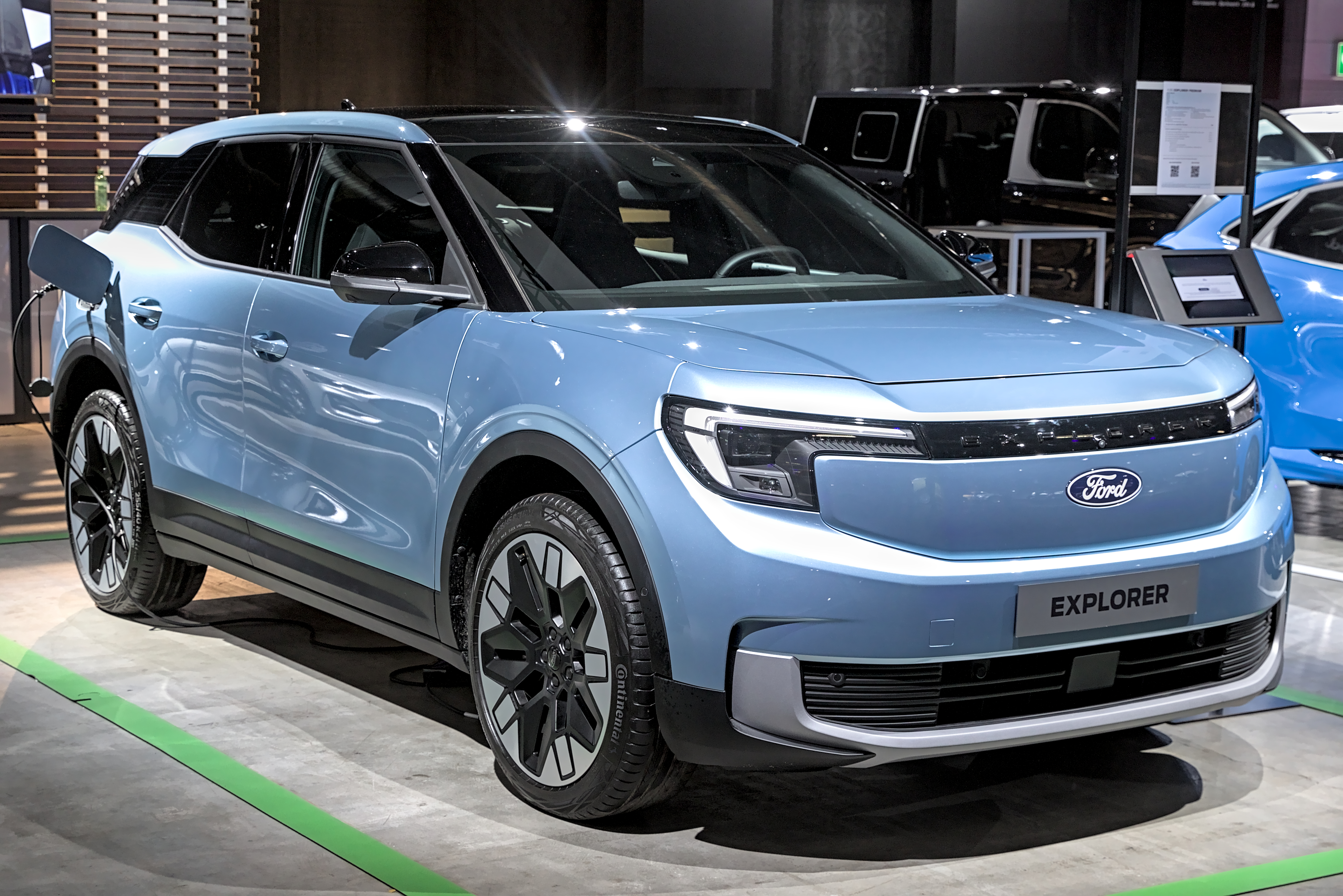
The Ford Explorer is a type of SUV, which stands for Sport Utility Vehicle. It's known for being spacious and good for families or people who need to carry a lot of gear.
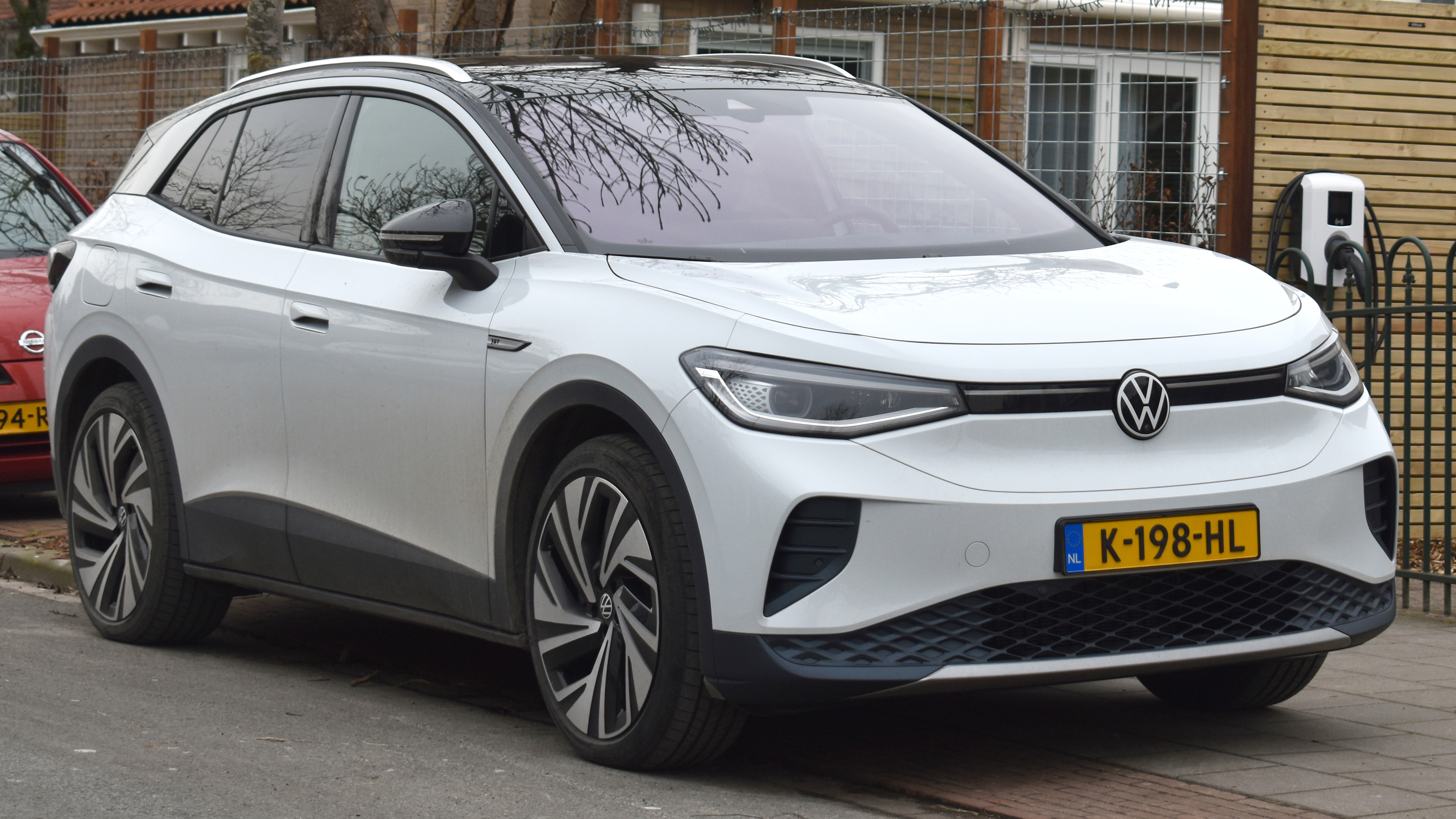
The Volkswagen ID.4 is a fully electric SUV, meaning it runs on electricity instead of gasoline. It's designed to be eco-friendly and has a modern look and feel.
'Rebadged' means that a car is made by one company but sold under another company's name. It's like putting a different sticker on the same product to sell it as something else.
The Volkswagen ID. Buzz is a new electric van that looks a lot like the old VW buses from the 1960s. It's designed to be eco-friendly and has lots of space for passengers and cargo, making it a fun and practical choice for families.
A fully electric vehicle is a car that runs only on electricity, not gasoline. It uses batteries to power the motor, which makes it cleaner for the environment because it doesn't produce exhaust fumes.
The Jeep Cherokee is a type of SUV that can drive on rough terrains. It's popular for its ability to go off-road while still being comfortable for everyday use.
The Jeep Wrangler is a tough vehicle built for driving on rough terrain. Many people like it for off-roading, even if most owners don't actually take it off-road.
Off-road means driving on surfaces that aren't smooth like regular roads. It's about taking vehicles like the Jeep Wrangler into nature, where the ground can be rough and uneven.
LIVE
He is Robin Leach, he is Jada Markin, this is CarKeys.
Good morning to our listeners for this week's CarKeys show with Jada Markin and Robin Leach.
I would like to start off talking about driving in fog.
It is October when this show is being done and there seem to be mornings in which there is a considerable amount of low level
clouds, which is otherwise known as fog, that are existing in large sectors of our listening area and beyond.
My experience is that I want to talk about is on this day of the show and fog is a funny sort of situation.
It moves in and out thick to thin, to non-existent, back to thin and thick again.
And visibility when it's thick is very difficult to see when cars are unlit.
That is rear taillights if you're following cars, headlights or DRLs if you're looking for oncoming cars.
I have noted in my journey to in this day show that silver cars, light cars are even more invisible.
Before you actually get to see them, then darker cars, especially when there are no lights on the cars that are lit up.
DRLs are not necessarily suitable for cars from which you were following because DRLs, daytime running lights for those who don't know that,
are usually just front only lighting on cars that have them properly operating.
That means the taillights are not lit up and Jay will jump in about that in a flash or in a minute or so.
And you cannot necessarily see cars that may be closer than you think when you are in thick fog conditions.
When you are traveling along a highway, a multi-lane or single lane at 70 miles an hour and the fog gets thick,
here is what I suggest drivers do.
If they don't have their lights on, they better get them on.
But if they don't have rear lights on and if they know that they don't have rear lights on, I'm afraid that is probably not a very known situation for many of the drivers in these cars, old or new, get them on.
But distance yourself more further behind whatever car you can't or can't see and slow down a bit from maybe a high-speed traveling MPH miles per hour if you cannot see anything in front of you except thick fog.
Jay, you want to comment on that before I go on?
Sure. As somebody who's grown up, I grew up in Belgium with a lot of fog in September and October, pretty much every morning, a little bit like you had this morning.
It's a problem.
Lights are obviously the obvious first thing to do, put on.
European cars have rear fog lights and many cars have them here.
Even though for some reason I have a Volkswagen that does not have rear fog lights, but if you do have rear fog lights, do not hesitate to put them on because they are way more powerful than even brake lights.
And they will really help people following you see your car.
The problem is very few cars overall have these rear fog lights.
So I really, you know, to this day have to wonder why it's been 50 years now that they've had them in Europe.
And we have all sorts of very strict regulations when it comes to safety in this country.
But evidently rear fog lights does not seem to be a concern on a federal level.
And that's a bit of a shame.
So yes, slow down.
You want to make sure you see the lights in front of you.
If you don't, you know there is a problem and slowing down without slamming on your brakes would be, you know, the reasonable and prudent thing to do.
It takes a lot of concentration to drive in the fog and you really cannot let your eyes get off, you know, the road.
And I think there's not much more to say.
I mean, a lot of crashes happen in the fog.
And unfortunately, they usually happen.
It usually happens that the fog is usually a morning thing.
And, you know, people are usually on the highways and going to work.
So you do see a lot of crashes in these conditions.
And yeah, keep your eyes peeled, keep your lights on.
I would just like to maybe I'd like to finish this by saying I'm not sure how many people know what their headlight knobs or stock controls
do at the different settings that they have.
And it would be something that I would wish that drivers would learn when they are either having a new car or even if they have an old car and they don't generally have
spend time knowing what the controls are.
Older cars usually don't have auto, the term auto on their stocks or their knobs.
All the newer cars seem to.
And it would be my suggestion to listeners who are listening to this particular part of the show that they learn to set when they're if their cars have the auto feature on them.
They need to have them set no matter what the outside conditions are.
But in five conditions, the auto setting may not turn on the full set of lighting.
And why I mean a full set of lighting?
It is front and rear lights as opposed to my earlier conversation comment about DRLs, which is daytime running lights.
I experimented with my auto setting versus on setting this morning.
And obviously, when you're driving a car, you can't get out and look at the rear and the front to see what lights are or are not on when they have the different settings.
But I know auto is mostly designed to turn on the full light systems when it gets dark at night, whereas DRLs don't change from what their settings are, which is basically front lighting conditions.
That is a standard system in Canada.
It does not seem to be necessarily a standard system in all new cars.
Jay, I'm not sure.
Maybe all new cars have the auto setting, but the older cars certainly don't.
So if you have if if listeners, if you have newer cars with the auto feature and daytime running lights automatically and they are working and I see some newer cars with daytime running lights not on.
So I'm not quite sure whether they are because the settings on your control stock or or knobs are controlling that situation or whether maybe some cars aren't coming through with automatic daytime running lights that run all the time.
Oh, I can comment on that.
I can comment on that.
It's very simple.
Hyundai Hyundai's Toyota's for sure.
And Lexus you if you turn the lights off, you do not have daytime running lights.
Your daytime running lights only come on if you put the setting on auto on other cars.
They're the daytime running lights will go on regardless if you have them on on or off.
OK, that's good.
But anyway, thank you, Jay.
So our listeners who are thinking of driving in five, please remember to learn what your control settings need to be so that your lights are properly on during this kind of condition that we have been discussing for the past few minutes.
Moving on out of the fog.
Go ahead. Moving on out of the fog.
We're going to talk about driving in Europe.
Yeah, I just spent two weeks in Europe and it was a great time, actually.
And drove through the French countryside while through to Paris and then through the French countryside for three or four days.
And other than other than the fact that it's always a, you know, a fun.
It was a fun trip and great roads.
What I do see, you know, in France and other European countries are pretty much the same.
People have calmed down a lot over the last 10, 20 years since I've lived there.
Drivers are slower than they used to be.
I find it that people are actually driving around the speed limit or even under the speed limit.
Obviously, photo radar and scan and speed scanners
have made it such that driving over the speed limit is is becoming pretty risky.
I also, and this is a beef of mine, as people who know me will attest to,
people drive in the right lane.
If there are three lanes on the highway, the trucks and the slower traffic.
Actually, all of the traffic is in the right lane.
And then you start moving over one or moving over two to make a pass.
As soon as you've made a pass, you go back as far right as you can go.
And yes, people seem to be cutting you in front of you.
And it seems a little aggressive as far as driving is concerned at first.
But it makes a lot of sense.
And I was looking at the flow of traffic and there really are no issues,
no passing on the right, no weaving through traffic.
So I think they've come a long way.
I've also noticed having gone to a few parties that people drink a lot less
when they go out.
There is very, no, it's just, I think that the DUI laws are such that,
with 0.025 alcohol limit in your blood,
you are basically, if you drink more than a small drink,
you are over the legal limit.
And people are taking that very seriously and just being driving
a lot more sober, which is a good thing.
Jay. Yes.
Is there more visual enforcement in the terms of numerical numbers
of traffic enforcement officials in cars or otherwise?
No, no.
You usually get your speeding tickets in the mail.
So in the next few weeks, I will know if I got.
Yes. And there, you know, some of these 30 Ks an hour,
that's 18 miles an hour in the center of towns and cities is a little brutal.
But, you know, when you get used to it and you do see the benefit of it,
you know, you're driving through very well.
First of all, as you know, Robin, the streets are a lot narrower
than they are in most towns here in the US.
You know, so driving at a slower pace makes a lot of sense.
But 30 Ks is very slow.
18 miles an hour, right? Yes.
What I do find is, you know, most of the radars are indicated.
You will see signs on the side of the highways
saying, hey, radar ahead.
So if you miss a radar, usually it's because you're just not paying attention.
So I'll let you know in a couple of weeks what my score is.
Hopefully I don't get too many because I didn't I didn't drive all that much,
but probably about, you know, seven, eight hundred miles altogether.
Maybe a thousand miles. Yes.
You use Waze in Europe.
No, I tend to use Google Maps,
but Waze is is used quite a bit as Google Maps have notices of police
ahead like Waze does many times.
Notification of radar of let's say red light cameras or police
as Waze seems to do effectively or not in the United States.
I actually think they do.
But you don't know. OK.
I yeah, I'm pretty sure they do.
I'm pretty sure Google Maps does.
Anyway, fun driving experience.
We're back here.
We have to adapt to, you know, what our left will come back to the US,
right, where we don't have proper driving habits.
Well, no, I mean, in the multi lane highways.
Well, let's say I think education
and driving instruction is a bit flawed.
Um, I'm not sure how driving instruction during driving at driver
education is effective in terms of teaching young drivers
what is going on on multi lane roads.
I spent much of my time driving to do this week's show in the right
hand lane of the of the highway system I was on.
It was three lanes each way.
I had my cruise control set on seventy two, which is what I do
when the speed limit is posted at sixty five on this particular road system.
And I did not have until I probably was on the right lane
pretty much in this particular morning's trip for five miles
before I crept up on a slower vehicle that was also in the right hand lane
and had to move over into the middle lane
and maybe at one point all the way over to the left lane
to continue going at seventy two or better.
This is this is Jay and I have talked about this odd
infant item about multi lane driving US style.
And it would be nice if it could be you could flip a switch
and all of a sudden the Americans would get to be just like the Europeans.
I was just reading an article about in motor trend about comparing the cost.
It was a study on comparing the cost of electric vehicles
and I see gas powered cars.
And motor trend compared to Kia's very comparable vehicles.
The Teleride SUV that's been around for four or five years now
and their new EV nine, which is the electric I was going to say version
but comparable vehicle, although it's totally it's a different platform.
And they they compared the cost of charging compared to the gasoline prices.
And the difference in cost in fuel, quote unquote fuel is not as great
as I thought it would be based on 15,000 miles a year.
The EV nine, the electric vehicle was getting was costing around two thousand
dollars a year, which is only like two or three hundred dollars
less than the cost of a Teleride, the cost of gas.
They were also noting that, you know, California has higher gas prices,
but it also has higher electric prices.
So that there's a correlation between the cost of gas and electricity.
So the study is, we'll say, you know, a valid maintenance cost
for the EV nine is substantially less or estimated
being substantially less than the Teleride.
But then they were looking at the total cost of the vehicle
and the vehicle, the EV nine cost, I think twenty twenty five thousand
dollars more than the comparable Teleride.
And even factoring in the seventy five hundred dollar tax credit
that we obviously no longer can benefit from the EV nine
was somewhat like twenty thousand dollars more expensive
over the course of a five year ownership period.
How is that based, Jay?
What's that?
Listeners, is there any way to figure out how that's based?
Twenty thousand more over five years for the EV?
They, you know, motor trend went into detail in the cost of the vehicle,
the cost of the financing, the residual value of the vehicle,
taxes on one, taxes on the other.
And they, you know, they put everything in a spreadsheet
and they spat out that basically the EV nine cost seventy one thousand
dollars over the course of five years versus fifty two thousand
dollars for the Teleride.
So that is a shock, all the difference, not twenty plus,
like I mentioned just a second ago.
But it's still, it's still the cost, the EV is still higher
than that of a gap.
OK, that's fine.
Which is the problem of the industry, right?
I mean, that's why EVs are not selling.
OK, well, let me, let me continue on the EV mode for a minute
because as this show is being done, the seventy five hundred
dollar credit for the EVs expired some days ago.
But the electric sales apparently were quite successful.
I guess that includes hybrid too for people who wanted to get
the tax credit and get an electric car or a hybrid version
of electric gasoline car before the September 30th deadline,
which passed that time.
So I haven't seen the actual tables of sales, but I believe
the electric car sales have quite a benefit for dealers
who are selling them in the waning days of September.
Yeah, they did.
Hyundai did very well with the
what is it IQ five and six and actually GM did very well,
even Ford with the Mach E.
Their sales went up 50 percent relative to last.
I'm not sure if it was last.
I think their sales are up overall this year substantially over last year.
But then again, their sales were weighed down compared to the year before.
Right. Oh, by the way,
nothing to do with this market.
But when I was in Europe, I did see a the new Ford Explorer
in Europe is actually a rebadged Volkswagen ID four.
Really? Yeah.
And it actually looks pretty, pretty, pretty good.
Was it like recognizable as a Ford version of the ID four?
Yes, it looked it has the some of the characteristics of a Ford Explorer.
It's just a slightly smaller package and it's a fully electric vehicle.
It's not the first time that Ford and VW cooperate,
especially on the European market.
This goes back to the 90s when they first started
manufacturing and selling minivans
under the Ford and VW name, you know, each of each of them.
VW was producing them, correct?
VW was producing them, I believe.
Yes. And are they producing the Explorer?
Or is that a Ford produced vehicle in a Ford plant in Europe?
You know, that's not going to make a lot of difference.
Like the saying goes, I will get back to you on that.
I'd like to go continue as we're running out of time in this week's show.
Back to the bicycles and bicycle travel moments.
That are going on in great numbers in around our listing area
in the fall conditions, which are showing the trees to be multicolored.
They are dropping leaves at a crazy pace in some areas
and the leaves sometimes fall on roads.
And we have fortunately not had much rainfall
as we do this show in recent days or maybe even weeks.
So the roads are fairly dry, which is good.
The leaves are fairly dry, which may or may not be good.
But if you are on a bicycle and you are riding on our roads
and there are leaves, clumps of them are otherwise evident in your pathway
and it is rain or they are wet.
This is another safety factor for bicycles more than cars.
Bicycles tires do not do well on slippery roads,
but leaves on them as far as my not very recent experience
because I'm not riding a bicycle much anymore.
But I do remember when I was riding a bike more
and this condition was notable in my visual and route that I was riding a bike on.
Again, the other factor is in shadows,
if you don't have bright clothing on,
whether you are walking or bicycling, you are at risk.
In the afternoon light, which is getting less and less as the times
as you go from five o'clock forward towards the nighttime.
So drivers should be on watch for bicyclists and hiker and roadwalkers
in these periods, these time frames starting at five o'clock,
especially if people are not walking with bright clothing.
And we have some prep schools around here where the kids seem to have
a lot of latitude and freedom to walk to and fro the village of Lakeville.
And they are not aware.
I don't think they are aware of how invisible they are
as the dusk lighting approaches and continues into darkness.
And I noted this on weekends, on a recent weekend as a I don't know
when they get to do this, but there were quite a few of our students
at the nearby Hotchkiss School, for example, that were on the roads
walking and they were very invisible on some of the curves on the roadway
that you you walk from that school down to the shops,
which is probably where they were going and back to school.
And they come down when it's daylight and they go back after they've
it's become darker and it can be a very dangerous time for our drivers
around here to pay to be watching out for them.
No, I was just thinking about bike lanes and, you know, again,
we don't have very good bike lanes, as you know.
This is the problem with these white lines that depict either walking
or or I don't know whether they're supposed to depict a bicycle lane.
One sometimes they are so narrow until you hit the earth and part of
the roadside that you cannot ride side by side or walk side by side safely
in some areas of our roads, recently repaved, incidentally.
So it's a loose driver to be able to be able to maneuver around them
if they have to and that can sometimes result in crossing the yellow line
dividing the north and south or east and west routes.
And you do not want to try and cross that line if you've got
oncoming traffic at the same time.
You're trying to avoid or give more room for a bicyclist
and or walker that is trying to go the same direction you were going.
Can we say new in the car division we should know about cars
or continuing to evolve technologically and visually?
So yeah, we're totally lost in front of mine last week was saying,
you know, we can't we can't fault.
There are so many different cars now, so many models, so many brands
that's hard to follow everything, even, you know, car guys like ourselves.
But what I do know is that some companies,
some manufacturers are struggling out their VW cars here.
Alfa Romeo is really struggling in this country.
Always was a very, you know, small player.
But now we're talking about
Julia's and Stelvio selling in hundreds of units in a quarter,
which is just not enough to keep them bringing them into the country.
No, and it and, you know, they are probably
tariff prone and I do not know what the differential
in the pricing of a new 25 or 26 Julia is
over what it was before a year or two ago.
But, you know, I'm still tired kicking one or two of those.
I will the values are out there for used vehicles.
I still say to listeners, if you are contemplating
having to having to financially avoid trying to get a new car.
There are some good used vehicles out there.
And they are, as we have said on this show many times,
well, normally very well built, if they're less than 10 years old
and will still have a lot of useful life in them and can be
very fun to own, as opposed to trying to go out and buy
the newest and greatest of the of the new vehicles that are offered
and almost change monthly and what's going on the way
upgrades and updates are going as we head
towards the 2026 model year.
So what's your next car? Nothing as far as I can see.
I've said to our listeners and other shows I I'm pretty well
sorted out in terms of and bought out in terms of what I
look to be driving for the next several years.
I am waiting. Am I waiting for anything to come?
Oh, yes, the new Jeep Cherokee is going to be something
I will look at very carefully.
But as I have been thinking, if it doesn't have two knobs
on the radio and or a couple of knobs on the heater,
he he's not going to buy air conditioning thing.
I'm probably not going to buy it.
And, you know, for Jeeps, for our listeners who know Jeeps,
the rugged ones, meaning the Wranglers and the various off-road
trail trail, hawk versions of the Jeep,
you know, even though everybody says 98 percent of the people
who buy these vehicles are probably not going to really
take them off-road, Wranglers may be accepted.
You think about a Jeep and you think about cold weather
and and when they were making knobs for the earlier versions,
they were advocating that their knobs were big enough
so that if you had a glove on and you could you could manipulate
the knobs in those vehicles.
What? Then it does Jeep does not have heat in the vehicles.
No, no, no, no.
It has to do with the new Cherokee coming out.
If they don't have knobs that you can grab with a glove,
gloved hand, I would be very, you know, I do take my,
I had my, I recently took my Cherokee off-road and didn't need
to use a knob, but I was just thinking about how rugged it felt
going up the trail I was taking.
And you think about certain cars not having knobs anymore.
You've got to go search for a push button or an arrow on a
dashboard touch screen.
And this is where I think maybe we'll see some returns,
some logical knob tuning in the future.
All right. With that having been said on the next program,
knobs or no knobs? OK, we'll discuss it if we remember.
This is Jay DeMarco and Robin Leach on this week's version of Carkeys.
Carkeys with Robin Leach and Jay DeMarco is produced at the
facilities of WHDD 91.9 FM, RobinhoodRadio.com, Sharon Connecticut.
About this episode
Foggy driving conditions take center stage as Robin Leach and Jay de Marcken share insights on safety measures, including the importance of using headlights and rear fog lights. They discuss the differences in driving habits between Europe and the U.S., highlighting the more disciplined lane usage and lower speeds in European countries. The episode also touches on the cost comparison between electric and gasoline vehicles, revealing surprising findings about ownership expenses. Finally, they emphasize the need for better driver education regarding vehicle controls and the visibility of cyclists and pedestrians during fall.