This is hard Parking brought to you by Right Hunter, right Toyota out of Scottsdale, AZ. I'm your host, Jay Finning.
Coming up on today's show, we'll talk about tariffs as it relates to the car industry. Have some notes on Facebook
Marketplace. I've had some wins and some
losses and some frustrations. I am thinking about buying a new
car as well. And of course we have the car
news this weekend. I'm actually recording this on a
Thursday. This weekend I will be at the
Copper State 1000, which is a storage rally across Arizona.
Really big deal taking off from Timba Diablo Stadium.
I will be there with a 10 foot pop up in the hard parking booth. And we will be recording live.
Next weekend I'll be in Long Beach for the Acura Grand Prix, but first woman takes a knee fencing.
I don't know if you guys have seen this story.
A Stephanie Turner of USA Fencing decided the register match began to take a knee in forfeit.
Why was she taking a knee? Because she was going against a
transgender athlete by the name of Redmond Sullivan.
So keep in mind, transgender technically means you've gone through the transition. It's not necessarily a man
pretending to be a woman. I mean, it's that's taking
pretending to the next level when you actually get the gender affirming surgery. But he's still a biological
male. I'm not going to parse this.
I'm not going to try to be politically correct.
It's a biological male competing in fencing.
And so going into this, just thinking about it, my first thought was it's fencing. I mean, I could see in
wrestling, obviously I could see in contact sports, basketball, maybe football. I don't think we've ever had
that issue of, of men trying to play Powerpuff or anything.
But there's a, a significant strength difference.
There's even a speed difference. A lot of male high school
athletes, track runners are running faster speeds than grown women, world record holders. You know, when it comes to
fencing, my first thought was, wow.
I mean, there's two people having a sword fight essentially. I don't really see where a
transgender male or male being in the sport against a woman where that would be a disadvantage.
But then I started thinking about it.
It's a couple things #1 do transgender, Do men belong in women's sports? I this isn't a political thing.
The answer is no. And there's people who believe
the answer should be yes. Put your daughter up against a
male. We have nothing but receipts.
Anytime a male enters the female reign in sports, they dominate.
That should tell you everything you need to know.
But think about the fencing. It's the reach.
I started thinking about it. The reach, OK, most men are
bigger than women. They're taller, they're longer.
And just like boxing, reach is everything.
USA Fencing did provide a statement addressing the incident. USA Fencing.
So they enacted their current transgender and binary athlete policy in 2023. The policy was designed to
expand access to the sport of fencing and create inclusive safe spaces. The policy is based on the
principle that everyone should have the ability to participate in sports and was based upon the research available of the day, the statement read. So where do you come out on
that? Right?
Because in theory, fencing would be one of those things where you could have a man versus a woman and it comes down to quickness.
But the arm length, I guess could make a big difference.
It didn't say that in the article, but just using your your your thoughts, that's the only thing that would probably make sense in that case. Special shout out to Willie
Zuniga. Zuniga, Zoom, zoom.
He was on the podcast episode 259.
He shared with me. He was featured in a Honda
commercial for Socal Honda dealers, which is really cool.
You can see that on the social media somewhere.
Maybe I'll post it to the main hard parking pod Instagram feed.
But special shout out to Willie Zuniga and he wants to come back on the podcast. So I'll actually link that
episode in the description. It wasn't video, it was audio,
FYI. But it's a good listen,
especially if you're into Hot Wheels.
So I recently did a poll on Instagram and asked people what type of gas they get when they're pumping gas.
Do you get 87 to 8990 to 91 or 92 plus?
Because some places get 93 octane or do you get diesel slash other? And the results came back, 80%
of people get 91 plus. The next closest of course was
87 to 89 and like 1% was other. And the reason I ask that is
because when we hear about the price of gas, very similar to the price of eggs, where it's just one of those things that people focus on as it relates to who's running this country.
And it's not always on whatever it is they're doing.
But every time you hear the price of gas, it is always the cheapest gas, it is always 87. And the reality is most people
don't buy 8788 and a nine. Most people buy 90 plus because
that's what's written on the little sticker when you open up your gas cap. So it seems like when they tell
us the price of gas, they would at least give us the medium grade because somewhere in between the cheapest and the most expensive, there's a third pump.
And instead of 87, it might be 89.
Instead of 92, it might be 90, but I think that would represent the accuracy of how much gas is costing people across America.
Obviously, there's a huge difference between gas and middle of East Jesus, Iowa, or if you've ever driven the PCH, there's a gas station just before you go heading north that cost probably three times as much as anywhere else in the state because they know it's the last place you can actually get gas for a long time. So taking that outlier out, we
need to start advertising whatever the median cost of gas is instead of always the cheapest because it's lying to the American people. On the last episode, I talked a
little bit about Facebook Marketplace with Devin, my in studio guest, who was here drinking bourbon.
Right now I'm drinking coffee. One of the positives about
Facebook Marketplace is I just sold my set of RSX wheels and it was a cool experience because it wasn't me just selling the wheels. Obviously you could sell wheels,
but these two, I'm going to call them kids.
They look like they were maybe the age of 18 to 22.
Drove down from Prescott, which is about, MMM, almost two hours, just over 2 hours from here where I live, depending on the traffic. But they drove and I talked to
the kids and they got the driver pulled up in kind of a, what was it, early 2000s, maybe late 90s Honda Accord.
And it was his car had ADC sport exhaust.
So I could tell the kids kind of knew what they were doing.
Obviously his first car based on how the car looked, not bagging on the car, but it was kind of a, a cool throwback thing to see. But I talked to the kid who was
buying him. He goes, yeah, I'm throwing them
on my RSX. I'm like, oh, that's cool,
that's cool. Yeah.
And then we started talking cars just really briefly, but the fact that they drove down and they're in the old Hondas, you know, it's just, you know, they've, they've said recently that these these kids, like I'm going to call them kids because I'm 49 years old and they're no older than 21.
They say the kids don't care about cars anymore.
So it was really cool to see these two come down from over two hours, pick up these RSX wheels.
But The funny thing is also a Facebook marketplace almost an exact calendar a year ago, I bought those wheels from Prescott Valley, which is just north of Prescott.
So in some ways he picked the wheels up and returned them home. One of the other things that
happened to me on Facebook Marketplace, which really pissed me off is I went to buy another studio light.
I have two big ones. They're let's say I have a GVM
video maker in the in the newer, a newer, I don't even know how to say it, but they're pretty significant.
I have two. The perfect setup is really
three $170 light, brand new $65. So I went over there, told him I
was coming. Hey, I'm leaving the house.
I'm going to be there at this amount of time.
I ride 5 minutes early. I said, OK, I'm here.
And I waited. I waited and as I watched people
walk in and out, in and out, in and out and waited.
After 25 minutes, I sent him a message.
I go, look man, I've been waiting for 25 minutes.
I have to go. Only then does he hit me up and
he says, hey, I'm so sorry. I had some family emergency.
No, no, I want family. I have a business emergency pop
up and my phone died. So I really couldn't, couldn't
be there. Can you come back tomorrow and
help me out, please? So sorry, man.
My time is valuable. My time is more valuable than
spending an hour of my time driving to somebody else's place and waiting for 20 minutes. It was a great deal.
But I said look man, and this is what I told the person, I'm really sorry for your business issues.
My time is very valuable. I will buy it from you, but you
need to bring it to me. I didn't hear back from the
person. Sure, I could have gone the
following day and picked this thing up and saved myself over $100 on this light because it's a light I could use.
It's not necessarily a light that I need.
So I was talking about maybe buying or selling my Infinity in the last episode. And some of the prices of these
cars on Facebook Marketplace are incredible.
But then yeah, I can sell my Infinity for 11 or 12,000 and buy a car and be whole, no car payment.
People who sell old cars, cars with high mileage, why do you think they do that? You know why?
Why am I thinking about selling my Infinity?
You know, I just did some major repairs on it.
Just changed all the radiator, the thermostat, the radiator fans, the controller unit, the hoses.
It's because the older cars get the more shit you have to fix on them and so when I see a Toyota Sequoia with 207,000 miles on it, it looks good and they want 5 thousand $6000 for it.
My question is OK why are you really selling this car?
You can't owe money on it at this point.
Now with 200,000 miles it has to be paid off or have very little.
Maybe they bought it as a used car and they still have a small payment, but it's probably because it's up against that wall of major repairs. So you have to deal with
suspension bushings, wheel bearings, probably some major motor work. And so now I have to wonder, do
I want to buy an old car or do I just want to get something new?
So I've been looking at lease deals.
Obviously, if you're paying attention to this podcast, you're wondering why I haven't gone to right Honda, right Toyota yet because I'm still trying to decide what it is I actually want to do. I owe a little bit money on the
affinity. I've put less than 30,000 miles
on it in the four years I've owned it, which means I don't really drive. I think I put 2425 thousand
miles on it in the four years I've owned it.
There's some lease deals out there.
I don't want to purchase a new car.
I don't want to purchase a certified pre owned car.
So either I'm going to purchase something old and not have a payment or I'm going to lease something and I have to put my entire life down in order to get a good lease deal.
But let's get into some car news so we can continue this conversation about used cars. And let's jump into some tariff
talk. So before we get into the
tariffs, I pulled this from eenews.net.
The EU finds 15 big car makers $496 million for what they're calling the green cartel. European auto companies receive
some of the biggest fines for their car recycling program.
What it explains here is the EU has doled out 496 million in fines to Volkswagens, to Lantis and 13 other automakers for colluding on their vehicle recycling programs.
I'm going to dig more into this because I'm very curious.
This column that I printed out, I got lazy, didn't want to read the whole thing. The European Commission said the
15 major car makers and their trade association had run a long lasting cartel concerning the terms for recycling old vehicles. While the cartel involved almost
every major automaker, European groups received some of the biggest fines. Volkswagen was hit with $140
million fine, Renault, Nissan 89.5 million.
I'm doing this in U.S. dollars and our very own Stalantis with
82.8 million. US manufacturers were also
targeted, with Ford receiving 45,000,000 fine for its conduct.
Pretty crazy. A car recycling cartel program.
So everybody was digging in each other's pockets apparently.
I wonder how that's going to affect us getting used cars.
So naturally the car recycling makes me think of Japan because, and I don't know what the exact rule is, but people talk about every X amount of kilometers over there, they have to get a new engine or get rid of the car.
That's probably why there's so many imports.
JDM likes we're we're, we are obsessed here in the United States with things that they like to throw away over there.
I know that they can't really drive.
So we'll take it because we don't have those same type of we have our own set of problems and regulations.
But last week our president got up there and talked about this 25% tariff on cars and parts. And if you buy any car that's
American made, he's going to try to make it to where your interest payments go or tax deductible.
Your interest payments are tax deductible, which would be huge.
But the car has to be 100% American made.
Of course, there's no car that's 100% American made.
As I said in the last, actually in the last episode, I said Tesla, but Tesla isn't 100%, but it's the closest.
It's the closest to 100%. Then you could claim your
interest on your taxes. But for cars that aren't made in
America, they're going to get hit with a 25% tariff.
And as expected, the car world kind of lost itself.
And at this time, at the time of this announcement, we were still a week away from everything hitting.
And of course we know what the current administration, they go back and forth on what they're doing with tariffs.
They are, if you're going to do it to us, we're going to do it to you. Reciprocal tariffs, which are
different than I guess how traditional tariffs may work, which causes a lot of confusion. Seema made a post about the car
parts and the and the pending tariffs.
And for people that are in that industry that deal with millions of dollars worth of parts, 10s of millions, hundreds of millions of dollars worth of parts, 25% is is pretty significant automakers pretty significant.
A dear friend of mine, a financial supporter of this podcast that made a post about it on social media.
And I try to not engage. But if it's a close personal
friend, which I consider this person to be, I will probably engage depending on what it was. And he'd stated that because of
these tariffs that are coming, he's going to have to make sure he keeps his old car still running.
And my thought on that is this is someone who doesn't buy new.
Most of the people that I know don't buy new.
They don't even buy barely used. They buy old cars.
And so I shot back with, OK, so this is for new vehicles and eventually they're going to be certified pre owned vehicles because it doesn't count for anything that's in the United States right now. And I think that's something
that most people are forgetting. So we kind of had a back and
forth and my point to him was that this doesn't necessarily affect most people right now unless you're dealing, unless you're in the in the car dealing business, The car dealer, sorry, I don't even know. I can't even talk.
And his thought was, well, just because it doesn't affect me doesn't mean I can't care about other people.
OK, sure. But this isn't just any other
random person. So the person who's pays 20 to
$30,000 more for their Porsche right now because they want it $50,000 more, $100,000 more, this isn't going to stop them or it shouldn't. Like we should focus on dealer
markups before we even care about this other stuff.
And then we don't know what's going to be passed on the consumer. This is all before Trump came
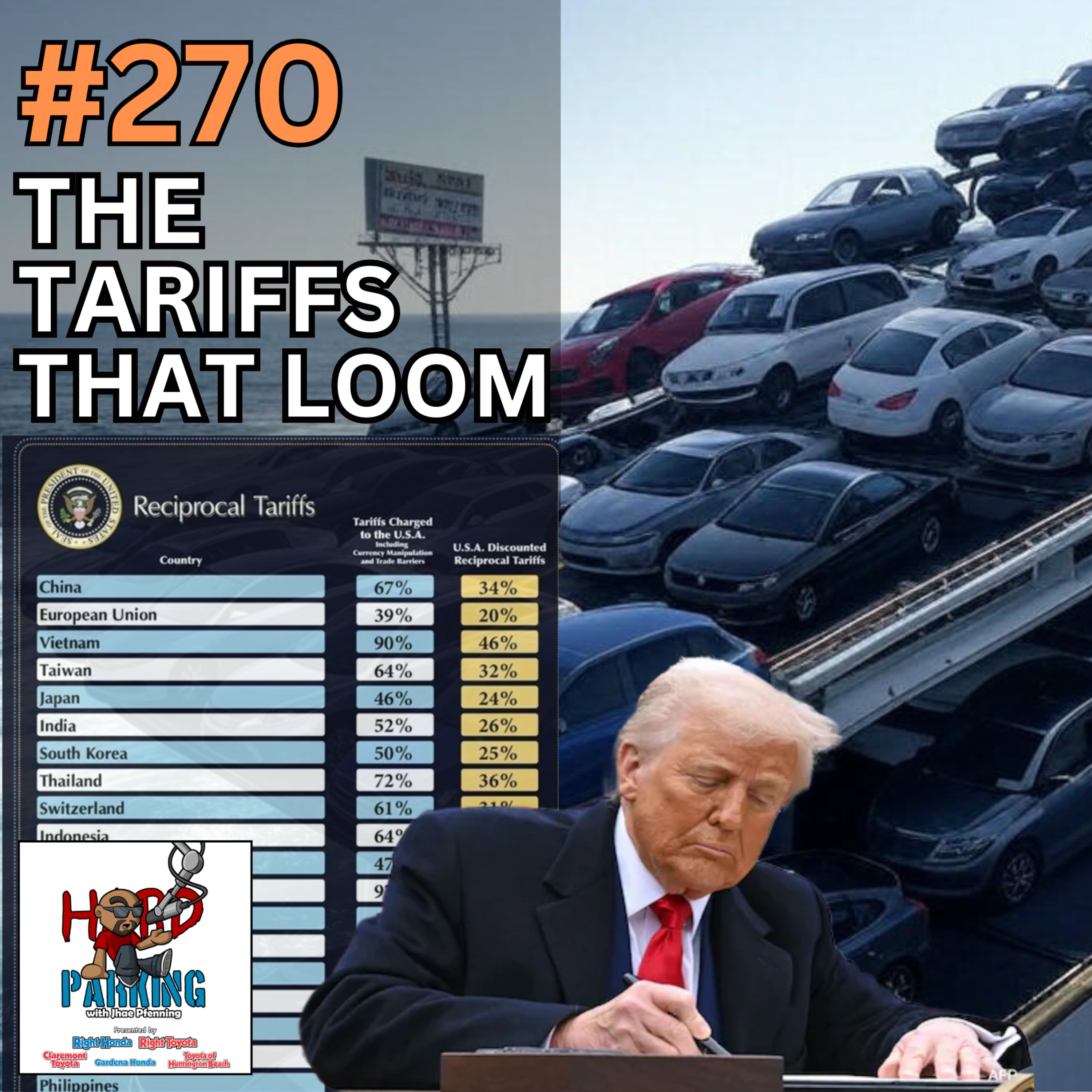
out, since then, before he came out with a list of the tariffs other countries are charging us and what our reciprocal tariff will be to charge them. Reciprocity is what it's called
as the term. If country X is charging a 60%,
well then we're going to charge them 30%.
Kind of meet him in the middle. Some of it is 10 percent, 10%.
If you don't want to charge us, then we're not going to charge you. That's one thing that I think
most people, including myself, before all this started, didn't know is that we're getting raked over the coals from every other country. I saw Geraldo Rivera, he's
pretty much a Never Trumper. And he was talking about a trip
that they took to Japan and he noticed that there were no American cars in Japan. And that kind of opened his eyes
to all this. It's so expensive for us to send
cars to Japan. We can't afford it because they
put such a heavy tariff on us. I don't know if it's just cars
or whatnot, but that's why you don't really see American cars in other countries, because we get all their cars, but it's too expensive for us to produce cars and ship it to them because we pay, not them. So they could pass that on to
their people, to their population.
And that's kind of the weird thing about tariffs.
And now I'm not a tariff expert, but I listen to people that know exactly what they're talking about.
For every 3 economists that say tariffs is a bad thing, there's one really smart person that says it's a really good thing.
But everything has the work perfect in order for it to work out. And I understand that because
everything has the work or nothing's going to work.
And I think with this administration, their unique challenge is bringing productivity and everything back to United States. But it's going to kind of affect
our markets pretty bad. And we have to be able to
weather that storm. And if we can't weather that
storm, then it's all going to be thrown away and there's going to be a big, old, huge loss of time, effort and money.
In the end, we're going to go eat.
We're going to be right back to where we are right now.
It could be that way in another four years.
So we don't know until 6810 months down the road what this is really going to mean. Oh, and by the way, I have this
written down. A lot of our cars travel back
and forth between Canada and Mexico.
That's the USMCA agreement, which is a replacement of NAFTA, North America Free Trade Agreement.
So it's the United States, Mexico, Canada agreement.
And because of that, there's there, there's an exemption on tariffs as it relates to cars made in the US that may be using international parts. Because some cars start here,
then they go up north to Canada, then they come back to the US and they go to Mexico, then they come back to the US and they do this thing half a dozen times at least during their assembly life cycle. So none of this applies to the
USMCA. And that includes cars that are
not necessarily American made. So for instance, Honda, we don't
import most of our Hondas. We make them here or they're
made in Mexico or they're made in Canada.
A lot of Acuras, same deal. I would imagine there's a lot of
foreign cars that aren't actually made overseas.
They're made here. Hell, my NSX is made here in
Ohio. Design and made and assembled in
Ohio but one of the conversations about old cars and new cars and you know how how would it affect the average everyday consumer like myself like my friend, like many of you that have to buy car parts is exactly that car parts.
I've only bought 1 brand new car my entire life.
One. That's my current NSX.
Wes Hankerson buys cars all the freaking time for work.
But he's an American guy so he buys Chevy.
He's not going to have that problem.
But when I think back to my first NSX about that in 2012, it was a 1997 NSX. So nothing I would have paid for
that car would have touched me. Terrifies even if we had them
then. So see, my point is, all this
stuff effects most of us so little it doesn't matter as much as we want it to matter. So you can go die on the cross
for somebody else. Like what impact is that really
going to make? Because when you break it down
that way, it's much to do about nothing.
Same thing with my wife. We have an MDX that we lease
right now. American assembled, American
made my Infiniti outside. That's a 2009 Infiniti.
I bought that in 2021. No vehicle that I've ever owned
with the exception of maybe I have to fix it, but like, what are you buying, right? So my Infiniti I bought a new
radiator, I bought a radio on eBay for like 100 bucks and I could have bought an OEM one for 250 bucks $50.00 but why?
So instead of that costing me 100 bucks maybe it cost me one O 8. I'm still going to buy it.
And that's my my point. Unless you're buying a big
ticket item you're still going to buy it.
And if you didn't have any plans to buy a new car anytime soon or a certified pre owned car that started after this year where all the tariffs came, then it has nothing to do with you now.
If you own a car dealership, if you're in that world, it's a bigger deal. Tell me how I'm wrong.
However, on the other side of that, after Trump made that announcement, Ford came out and said family pricing for the next two months. Family price is a big deal.
I don't know how many cars are going to sell, but that's a big deal to come out and say, hey, for the next two months.
I mean, hell, I might start looking at Ford's for the next two months. I doubt it, but you never know.
And General Motors as confirm they have committed to ramping up production of their Indiana plant.
They're like, let's go American made.
Let's freaking go. And of course Canada now is
coming out. At least this could change.
They're just like Trump, man. The Canada people, they're the
Canadians are just as as as teeter tottery as our president.
They're like, we don't want to put tariffs.
It's bad for the American people.
The same guy who was threatening tariffs and cutting off all the electricity to everybody in New York and Michigan and all that stuff is said, well, if we won't do them, if you don't do them, it's still the the reciprocation, the reciprocity.
That's why it is. It's the reciprocity is causing
this. And so now it's your move.
So we're going to see how many of these countries decide as it relates to these tariffs, what they want to do.
And so hopefully in the end it works out, but it all has a work or none of it's going to work. Speaking of car parts, our good
friend Aaron Forster of TBR Imports that posted this on his Facebook page. He did the research.
I trust him doing the research. And this is as of three hours
ago. Here's the latest news about
importing cars into the US because a lot of people concerned because that's what we do now, import cars.
I have a friend who imports K cars all the time.
I've never met him in person, but we've had a lot of conversations online. We both have the Honda Z.
He has several Honda Z's. This is a communication for
multiple import brokers via the White House Tariff updates.
Update #1 It is unclear if reciprocal tariffs will be applied to the traditional 2.5%. If so, the UK currently has an
additional reciprocal of 10% on top of the 2.5%.
So that's 12.5% tariff. So he does TVRS which is AUK
only vehicle. And this is, again, he's in the
industry, this is his business is importing and selling TVRS.
So this could hit his pocketbook significantly.
With that being said, new and used vehicles up to 25 years old. So think about that, up to 25
years old, new and used. So that that covers a big range.
That's 2025 to 2020. Simple math, simple for me
because I suck at math. Subject to the addition to
subject to existing 2.5% duty rate plus an additional 25% ad
valorem tag. Tariff kind of sucks.
Used vehicles over 25 years old exempt from the new tariffs but still subject to current duty rates.
No changes here. So for those of you who like to
import the JDM cars, we have the 25 year rule.
We're fine for now. They have the current duty rates
and there's always a duty rate, but you're fine.
Car parts if under 25 years old. I mean I don't I wouldn't want a
25 year old car part, but if that's the case it must be for that 25 year old car that I didn't have to pay for import tariffs on anyway. If under 25 years old, these
will also be subject to the new tariffs effective May 3rd.
So they pushed it back a a month.
Existing duty rates remain based on the specific commodity code And then temporary imports, which I had to look that up.
No direct impact, but surety bond cost may fluctuate due to valuation adjustments. Makes sense.
So what's a temporary import? I see that as based on what I
read, seema cars that come over from for SEMA from Japan to be displayed for a week or two weeks.
Sounds like they're already paying stuff on it.
But these tariffs don't affect temporary imports.
And that is the car news. Some of it's my opinion.
The obvious stuff that's my opinion is obviously my opinion.
And some of that is fact as of April 3rd.
Because a lot of this stuff can shift and change, which just makes it super silly. Before I hit you guys with my
canned closing, I want to make sure I think we got a motive out of Winter Garden, FL, Pell construction of Conroy Michigan, Beak House Mahone designer of Ashburg, Virginia and Traverse City, MI shaping success with W Tankersley out of Boise, ID and automotive Specialty Tool out of Owings Mills, MD.
So everyone let me know what your thoughts are on all this tariff stuff. Try to keep it as down the
middle as possible. I don't need any die hard MAGA
extremists slipping into my DMS. I don't need any Tesla burning
die hard extremist leftist sliding into my DMS either, but I'm always down to have a conversation because like you, I'm just a normal everyday person.
An like you, all these different things find some way to affect us. Whether you like it or not, it
impacts all of us in some way, shape or form.
What makes for some really cool conversation.
Hey guys, I want to thank you for stopping by the podcast.
If you like what you saw today, go ahead and hit that like button. Hit subscribe.
Assuming you're watching this on YouTube, if you're streaming the audio, please consider subscribing and leaving a positive review. Believe it or not, that does
help the algorithm tremendously. If you're in a position to help
the podcast upgrade, please consider joining the patreonpatreon.com Hard Parking Podcast.
For as little as $3 a month, you can get access to bonus audio as well as Patreon exclusive swag and free show swag.
Also, special thanks to the main show's sponsors, Right Honda, right Toyota, Toyota, Huntington Beach, Claremont Toyota and Gardenia, Honda, Arcus, Foundry, Auto Cannon, officially licensed Honda, and accurate gear. Your support makes all the
difference in this show. And if this is your first time
checking this out and if you truly enjoy this show, share it with the world and I will talk to you all next week.
Now it's stripping time. Ain't nobody got time for that.
Shut up.
About this episode
Tariffs are a hot topic in the automotive world, and this episode dives deep into their implications for the car industry. Host Jay Finning discusses the recent EU fines for major automakers, the potential 25% tariffs on non-American-made cars, and how these changes could affect consumers. He also shares personal experiences with Facebook Marketplace, including selling wheels and the frustrations of buying equipment. The episode features a lively debate on the impact of tariffs on both new and used vehicles, and how they may influence car buying decisions moving forward.
In this episode, various topics related to the automotive world. The show kicks off by exploring tariffs and their implications for the car industry. EU fines automakers $496 million for recycling program collusion.
The potential impact of a 25% tariff on non-American-made cars and car parts.
What's up with Facebook Marketplace? Wins and frustrations. Is it time to replace the Infiniti FX? In addition, the episode touches on the political dimensions of transgender athletes in sports and rounds off with a conversational section on car news and industry updates.
00:00 Introduction and Today's Topics
00:05 Facebook Marketplace Experiences
00:37 Transgender Athlete Controversy in Fencing
04:02 Gas Prices and Consumer Habits
09:01 Car Buying Decisions and Market Trends
10:57 Tariffs and the Car Industry
22:01 Impact of Tariffs on Car Imports and Parts
24:46 Conclusion and Final Thoughts Contact Hard Parking with Jhae Pfenning