CHINA: Chinese OEMs Lead In Software, Shanghai EV Exports Grow and GAC Launches AION UT In Milan | 15 Apr 2026
EV News Daily - Technology and Business of EVs
CHINA: Chinese OEMs Lead In Software, Shanghai EV Exports Grow and GAC Launches AION UT In Milan | 15 Apr 2026EV News Daily - Technology and Business of EVs · Apr 15, 2026
Capital One is a big financial company. In this segment, they’re using AI to help people shop for cars and also handle things like financing and trade-in estimates.
It’s like having several little AI helpers working together instead of just one. They can coordinate to do different parts of car shopping, like answering questions and helping you book a test drive.
Chat Concierge is an AI chat tool that helps you shop for a car. It can also help with practical steps like booking a test drive and getting financing pre-approval.
Trading value is what your current car could be worth if you trade it in. Estimating it early helps you understand how much your new car might cost after your trade-in.
Alex Partners is a consulting firm that produces industry research and surveys used in automotive strategy discussions. In this segment, it’s cited as a source for survey-based claims about software investment and capability gaps.
S&P Global Mobility is a company that tracks automotive industry data. In this episode, they’re cited to back up the idea that the gap between regions is growing.
It means the car’s important features are run by software. If the software improves, the car can often get better through updates instead of needing new parts.
Concept
Shanghai Ports exported more than 400,000 EVs in Q1
This is basically saying a huge number of electric cars are being shipped out of Shanghai. It shows China is moving a lot of EVs to other countries.
Concept
EVs made up 70% of total vehicle exports from Shanghai
Most of the cars leaving Shanghai are now electric. That means the whole shipping and export system is increasingly built around EVs.
Car
GAC has launched the ION U2
GAC is introducing the ION U2, an electric hatchback meant for Europe. It’s designed to be practical for city driving.
They’re referencing a big car show in Paris. The point is that GAC talked about its Europe plans there before the AION U2 went further into production and sales.
LingQui is a BYD brand focused on cars for taxis and ride-hailing. BYD made it separate so their “regular” car brands don’t get associated with fleet taxis.
Car
LingQui E7
BYD is launching a new electric car called the LingQui E7. It’s meant mainly for taxi and ride-hailing companies, not just private buyers.
They’re claiming you can charge the battery to 70% in about five minutes. That matters for taxis because the car needs to get back on the road quickly.
BYD’s “DM-i” name includes an “I” that means “intelligent.” In this context, it’s about the system working in a smarter way to use energy more efficiently.
A 1.5-liter turbo is a small gas engine that uses a turbo to make more power. In a plug-in hybrid, it may not drive the wheels all the time—it can also help generate electricity.
The “45 kilowatt-hour” number is basically how big the battery is. Bigger batteries usually mean more miles you can drive on electricity before the gas engine has to help.
A plug-in hybrid can be charged like an EV. It still has a gas engine, but you can drive a lot of miles on electricity alone before the engine needs to help.
A test drive is when you actually drive the car before buying it. The point here is that the app helps you set that up quickly as part of the buying process.
The Beijing Auto Show is a big car event in China where companies reveal new cars. They’re saying the MG4’s launch lines up with that event, which is when a lot of announcements happen.
Wheel size (here, 17-inch) affects ride comfort, steering feel, and tire availability. The segment notes new 17-inch wheels at the rear as part of the MG4 update, which can also influence efficiency and grip depending on tire choice.
That’s the company’s claimed distance you can drive on a full charge. Your actual range can be lower or higher depending on how you drive and the weather.
A competitiveness gap just means one company is falling behind others in things like cost, new ideas, and how fast it can build new cars. Renault is saying it wants to catch up to Chinese EV brands.
DC fast charging is the quick-charging type for EVs. Instead of charging slowly at home, it lets you add a lot of range in a shorter time at compatible stations.
an electronic column shifter and some soft seats up the front
featuring across the range, the new infotainment system,
the operating system, it has AI voice commands,
what they call CarPlay, CarLife, and remote vehicle control.
360-degree panoramic cameras inside it as well.
And what about the battery options?
Well, the motor is a 65 kilowatt motor.
That's almost 90 horsepower.
That's a 30% increase over the standard Bingo.
Two LFP packs are your choice, either 32 kilowatt hour LFP pack
or 38 kilowatt hour.
That's up to 403 kilometers on CLTC.
They say it's got vehicle to load, rated at 3.3 kilowatts.
That's enough of an outdoor power supply for most.
And this is a car that, like I say, starts at £6,600 or $8,500,
and it's not even the bug-in-basement version.
This is the larger, more luxurious trim,
if you like, of their bug-in-basement car.
Inside, the pictures they've shown on the launch model
with a dual two-tone, two shades of brown.
Call it if you'd like, maybe tan and beige if I'm being more kind,
but hey, very good specs for very little money.
The original Bingo, I think last year when they launched it,
had 55,000 orders in the first 48 hours.
This one has a lot of expectations around it.
And that's your podcast for today.
Thanks for listening. See you on the next one.
About this episode
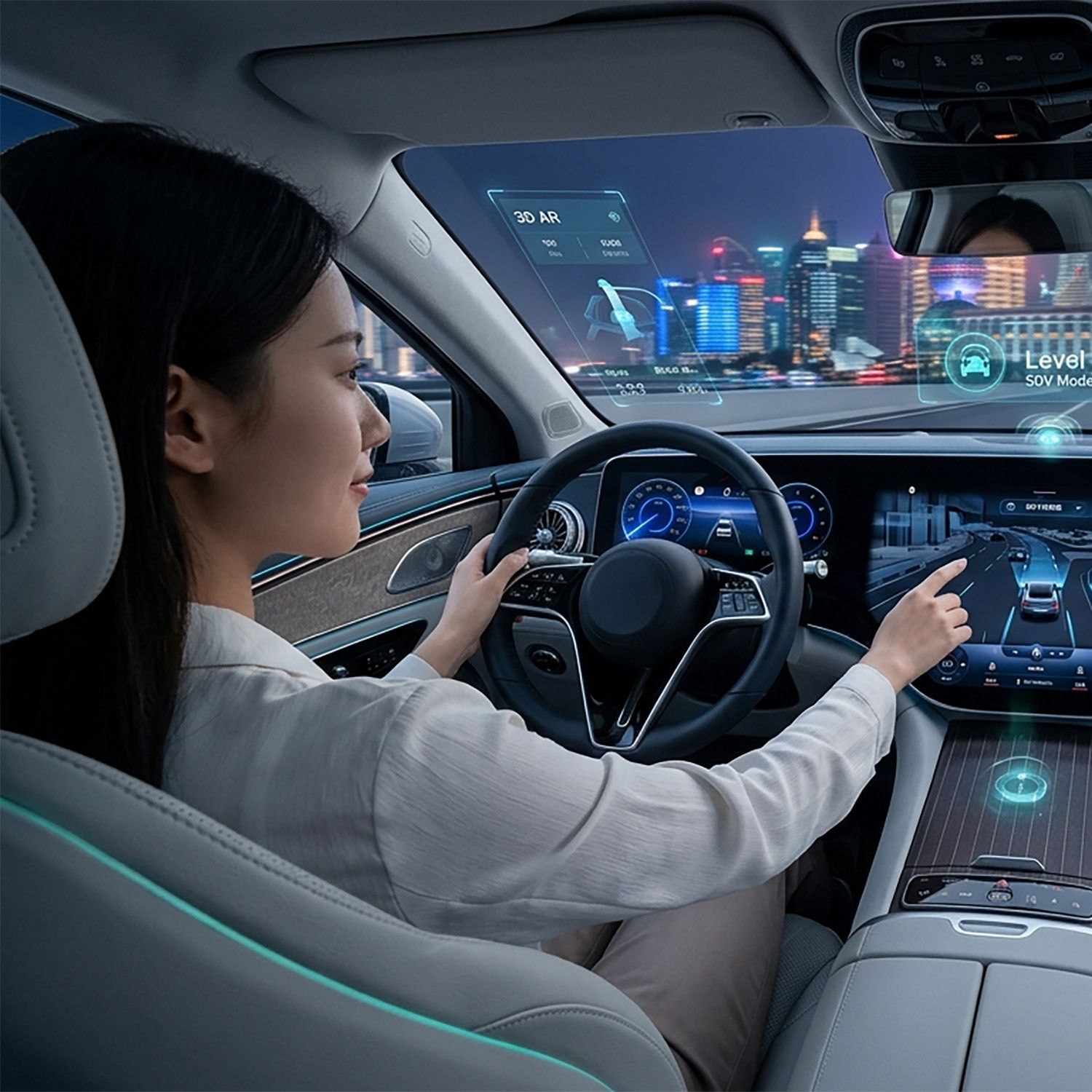
Software is the battleground: a survey of ~1,000 executives argues Chinese OEMs are pulling ahead in core in-house software, heavier software R&D investment, “clean slate” decoupled stacks, and faster central/zonal architectures. Shanghai’s EV exports topped 400,000 units in Q1, helped by green-channel customs processes. GAC debuts the ION U2 in Milan for Europe with a localization push. BYD expands with the LingQui ride-hailing E7, the SEAL 08 cabin reveal, and SEAL 08 DMP plug-in hybrid details. Elsewhere: a refreshed MG4, Renault cutting engineering jobs due to China pressure, and SGMW’s Bingo Pro launch.