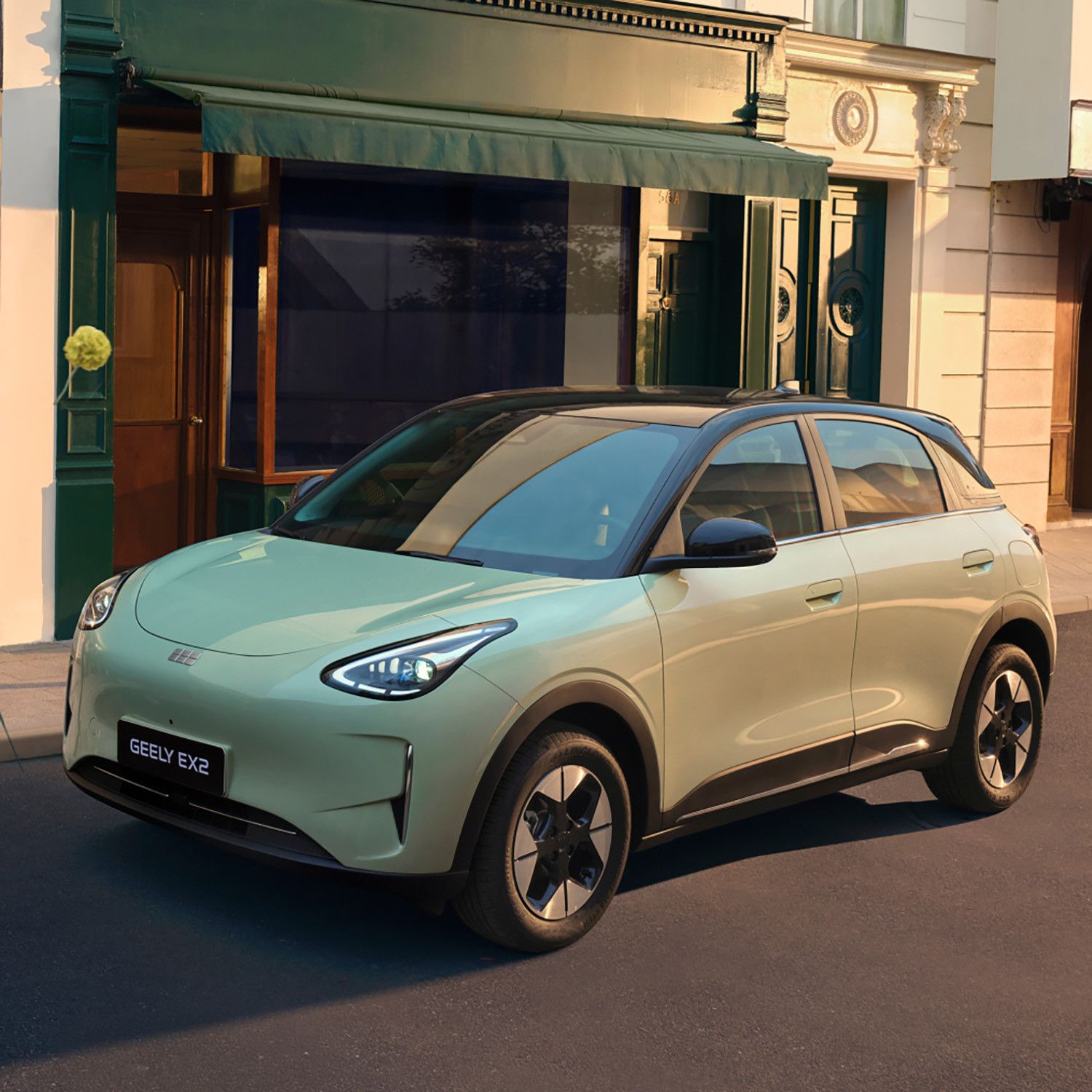
New energy vehicles are cars that use energy sources other than traditional gasoline, like electricity or hydrogen. They are designed to be more environmentally friendly.
EV means electric vehicle, which is a car that runs on electricity instead of gasoline. They are better for the environment because they produce less pollution.
Car
Luxead R7
The Luxead R7 is an electric car made by the brand Luxead. It's part of a growing trend of electric vehicles that are becoming more popular.
The drag coefficient tells us how easily a car can move through the air. A smaller number means the car is more streamlined and uses less energy to go fast.
The Xiaomi Y-U7 is an electric SUV made by Xiaomi, a company that usually makes phones and gadgets. This car shows that they are trying to make a name in the car industry too.
The Tesla Model Y is an electric SUV that is popular for its technology and how quickly it can go. It has a lot of space inside for passengers and cargo.
Term
active grille
An active grille is a part of a car that can open and close to let air in or keep it out, helping the car run more efficiently and use less fuel.
Company
X-Pung
X-Pung is a company that makes electric cars in China. Instead of just lowering the price of their cars, they are offering better loan deals to help people afford them.
Battery electrics are cars that only use electricity to run. They don't have a gas engine and are better for the environment because they don't produce exhaust fumes.
Plug-in hybrids are cars that can use both electricity and gasoline. You can charge them like electric cars, but they also have a regular engine for longer trips.
The Chevrolet Spark EUV is an electric version of the small car called the Spark. It's designed to be efficient and is part of Chevrolet's move towards more electric cars.
The BYD Dolphin Mini is a small electric car made by a Chinese company called BYD. It's cheaper than some other electric cars, making it an attractive option for buyers.
Battery electric vehicles are cars that run only on electricity, using batteries instead of gas. They are better for the environment because they don't produce pollution from exhaust.
Car
D19
The D19 is a new electric SUV that Leap Motor is planning to launch soon. It's built to be safe and stable, even in tough driving situations.
Leap Motor is a car company that makes electric vehicles. It's supported by a larger company called Stellantis.
Term
stability systems
Stability systems are features in cars that help keep them steady and under control, especially when the road is slippery or when making quick turns.
Concept
die casting
Die casting is a way to make metal parts by pouring hot metal into a mold. It's used to create strong and lightweight parts for cars, especially electric ones.
The Chrysler Voyager is a type of family car called a minivan, which is built to carry many passengers and their belongings comfortably. It's known for being roomy and convenient for families, making it easier to travel together. The discussion about it suggests that it's becoming more popular or available soon.
Car
Voyager Dreamer
The Voyager Dreamer is an electric car model that is part of the push for more electric vehicles in China. It's designed to be more environmentally friendly.
The Dongfeng 007 is an electric car made by a Chinese company called Dongfeng. It's part of their push to make more electric vehicles as the market grows.
The Dongfeng 008 is another electric car made by Dongfeng, similar to the 007. It's part of their effort to create more electric vehicles for consumers.
The EV market is the part of the car industry that sells electric vehicles. It's growing fast because more people want to buy cars that are better for the environment.
Company
FAW Group
FAW Group is a big car company in China that makes many types of vehicles, from regular cars to trucks. They are one of the largest car manufacturers in the country.
Hong Chi is a luxury car brand from China that makes high-end vehicles. They are known for being the first luxury car maker in China to sell over two million cars.
Solid state batteries are a new kind of battery that uses solid materials instead of liquids. They can store more energy and are safer than older battery types, making them important for electric cars.
The Renault Twingo E-Tech is a small electric car made by Renault, perfect for driving around the city. It's designed to be efficient and easy to park.
EV development is how companies create electric cars. It involves coming up with ideas, designing the cars, and then actually making them. Speed is important so they can keep up with other car makers.
The Dacia Spring is a small electric car that is designed to be affordable. It's great for people who want to drive electric without spending too much money.
A joint venture is when two companies work together on a project while still being separate businesses. In cars, it means they might share factories or technology to make cars more efficiently.
LIVE
Welcome back to EV News, China.
Today, Geely wants more overseas clouts.
We'll talk the Luxeade R7 and the X-Pung Cheap Credit Line.
Plus, stay tuned.
Later in the show, I'll tell you why Renault's
gone to Shanghai to learn all about China's speed.
Welcome to EV News, China, the podcast dedicated
to the world's largest electric vehicle market.
Each day, I bring you the latest headlines, insights,
and analysis from the heart of China's booming EV industry.
And decode how fast moving developments in the east
are shaping the global EV landscape.
Geely will kick us off today.
They sold 4.12 million vehicles last year,
up 26% on the previous year.
Things are going well at Geely.
New energy vehicles, what the Chinese call EVs,
did more than half of the heavy lifting,
2.29 million units up almost 60% year on year.
The group now wants to turn domestic scale into overseas power.
By the year 2030, Geely targets 6.5 million global sales,
three-quarters of which will be EVs.
It expects international markets to supply more than a third
of the total and wants global revenue to top $144 billion.
It also aims to rank among the world's top five car makers by 2030.
The Geely brand itself, Geely Auto, in 2025 sold 3 million
of the 4.12 million, beating its 3 million target just and growing by 40% year on year.
Exports at 419,000 vehicles rose as well, a sign of opportunity,
but also friction as Chinese firms push into overseas markets,
worrying about overcapacity and subsidies at home.
For this year, Geely set a sales target of 3.5 million vehicles and 2.22 million
new energy vehicles.
That assumes EV models keep driving the growth,
even as China's EV market is even more fierce and price pressures bite.
If Geely reaches 6.5 million global sales by the end of the decade
and 75% EV, it'll have turned a domestic tilt into a broad international footprint to be
truly one of the world's biggest car makers.
Now, let's talk about the Luxead R7, Pure Electric Ultra.
This is a car from HEMA or H-I-M-A.
And this is an interesting story because they claim,
and while they have the data to back it up, they say,
they claim this is the lowest drag SUV in China,
has a drag coefficient of 0.217.
They say it's been certified by the China Automotive Engineering Research Institute,
the CAERI, and it's the lowest SUV production car in the country.
In a market where Xiaomi's Y-U7 is 0.245, Model Y is 0.22,
and Envo's L60 is 0.229.
Aerodynamics sit at the center of China's new EV arms race.
Central government has told them to play nicely in terms of pricing.
Focus has to move elsewhere.
Why would you buy one brand over another?
An efficiency is turning out to be a big storyline.
The R7's coupe-like silhouette and fast back shape push it towards being almost a sedan,
where the most efficient shapes are normally sitting,
yet the form is only part of the story.
HIMA or HEMA sites more than 20 drag-cutting features, active grille that shuts or opens,
according to cooling demand, a 3D-curved front-wheel winds deflector,
and a front spumper air curtain that clean up airflow.
Flush door handles, frameless mirrors, low-drag wheels,
and a streamlined ducktail spoiler all do the same thing.
Reduce drag.
Engineers also reworked the front lip and air curtain channels.
All about cutting turbulence.
The Luxead R7's energy consumption is on average about 3.5% below the industry average,
and that promises gains not only in range, but things like high-speed stability
and noise vibration handling performance as well.
Now, let's talk about X-Pung.
Deciding that the next battle in China's EV market will be fought not on the outright
sticker price, but in the loan agreement that you sign.
X-Pung is the latest to be offering a seven-year low-interest finance across its lineup.
The headline offer is on the Mona M03, that's a sedan.
The car starts at US$17,000, equivalent to $120,000 RMB,
and they say the buyers who put down 15% will pay $195 per month.
X-Pung also wants to deliver up to 600,000 vehicles this year.
So that's a 28% growth, maybe even more actually.
And long loans will certainly help achieve their math, if not margins.
Others have shown the way in the last few weeks.
Tesla rolled out a seven-year plan on the 6th of January,
pitching savings of almost US$5,000 on a vehicle, rates of 0.98%.
That is much less than the money that they would be borrowing to lend to you.
And so this is very much a hard cost to their business.
Xiaomi and Li Auto then followed, and now X-Pung.
Regulators would like all of this to look like orderly competition and nothing else.
Chinese government bodies have warned car makers against disorderly price wars,
and have encouraged more financial support for consumers, rather than crude discounts.
All right, let's talk about BYD.
They now sell seven of every 10 EVs and plug-in hybrids in Mexico.
It nearly doubled its local sales last year.
Legacy car makers say the market is too small and too early to really matter,
but BYD respectfully disagrees.
Battery electrics and plug-in hybrids are 9% of new car sales in Mexico.
Most global brands have skipped this slice of the market, even as demand is growing.
Chinese firms are paying attention, though.
Their share of Mexico's new car market reached 20% last year, up from nothing five years ago.
Imports of Chinese EVs and plug-in hybrids rose from, well, in 2021,
there were fewer than 500 for the whole country.
Last year, over 100,000.
Price and finance in Mexico do the work.
BYD's Dolphin Mini sells for $2,000 less than the battery-powered Chevrolet Spark EUV,
which you can get there.
But not the Spark you might be thinking of in your head.
BYD dealers say the firm will absorb most of the cost of new tariffs,
up to 50% on products from countries without free trade deals,
which took effect on the 1st of January.
They expect price rises to stay around $852 equivalent, about 15,000 pesos.
BYD offers loans at 7.9%, below the market average of 13-14% in Mexico on auto loans.
Almost 63% of Chinese cars sold in Mexico in at least the first 10 months of last year,
probably for the whole year, were bought on credit.
So this is really important.
Battery electric vehicles and plug-in hybrids also avoid a federal purchase tax,
qualify for an income tax deduction, and skip annual fees,
at least I think in some parts of Mexico.
I'm pretty sure of that.
Mexico grants EVs, and plug-in hybrids bought between 2025 and 2030
get a tax deduction of up to 86% of their value.
Let's talk about getting really, really cold.
A Chinese branded EV just landed in Antarctica.
And the reason was to go beyond mere publicity stunts,
but to mark China's shift from being a follower to an innovator and then to a rule maker.
China has had a 20-year-plus plan to be a dominant player in the global automotive industry.
And one of the ways they want to do that is to dominate standards,
as its EV and intelligent technologies in some cases pull far ahead.
To show that its EVs can handle the world's harshest climates,
the China Automotive Technology and Research Center, CITARC, bought a built an Antarctic system
of 30 items like development and verification things in five areas.
Driving reliability, functional safety, comfort, intelligent control and thermal management.
The ultra low temperatures in the Antarctic, strong winds, blizzard conditions,
and intense UV radiation provide a proving ground for equipment performance under extreme
conditions. The test feeds straight into the development and iteration of domestically-made
EVs, sharpening their adaptability to cope with harsh environments.
Technical self-reliance anchors the push, though.
China has replaced foreign electronic control simulation and the test benches with its own
domestic ones and developed China's first industrial-grade simulation software for EV R&D.
It's also moved into foundational work like domestically-developing crash test dummies
and testing protocols. China has set up a new center in Geneva, signalling a wish to sit close
to the rule makers. So far, 35 Chinese standards covering safety battery and charging are being
adopted globally as Chinese EVs gain buyers, trading partners, and now adopting their standards.
All right, take a break. We'll come back and more to talk about on the podcast.
All right, welcome back to the podcast. One Chinese SUV has driven through the same-side
tyre blowouts on ice and snow and motorway speeds without spinning out or deviating from its course.
We're talking about Leap Motor, the company backed by Stellantis, and its upcoming D19.
They say it passed two extreme winter tests that simulate a dual failure on one side,
a double blowout on one side of the car. In its first test, the firm detonated both tyres on
the same side. They were driving 80 kilometers per hour on ice and asphalt. The flagship SUV D19
held its line and stayed stable with its electronic control. No loss of driver control or deviation.
The second trial was then done at 120 kilometers per hour on ice and snow. Again,
dual blowout, no fishtailing, no lane departure. These tests are being done to burnish Leap Motor's
safety and chassis credentials ahead of the D19's launch. That should be in April.
The SUV carries its stability systems which are tuned for these kind of events, as well as
precision low-speed manoeuvring and tight radius turning. Unveiled last October,
the D19 team will come in both Bev and EREV versions, six and seven seat layouts,
thousand volt architecture, 540 kilowatts of combined output, 115 kilowatt hour battery pack,
the EREV version pairs all-wheel drive and an 800 volt fast charging system as well. So even the
EREV version is better than most of our purebevs over here. Sell to chassis design on the EREV 80.3
watt hour pack. I mean, you'd never put fuel in the thing. And 500 kilometers of fully electric
driving. They've got the new platform, new Qualcomm chips, loads of computing power,
and a three motor setup as well. Now, let's talk about die casting. And China, again,
moving production for Dongfeng has begun production of a new 16,000 ton die casting
plan in Wuhan, turning out its first product, a battery casing, on the 21st of January.
The site houses what the firm calls the world's largest die casting lines,
one 16,000 ton machine and a 10,000 ton unit. The factory targets large integrated die cast
structural parts for EVs, with an early focus on things like battery castings for models like
the Dongfeng 007, 008, and the Voyager Dreamer. Mass production will start in April,
in China's crowded EV market, where price is important, but increasingly
range and efficiency. Then these big casting machines could actually deliver lighter vehicles,
lower energy use, and well, more range. Construction began in November 2024, finished
in October 2025, output should be 200,000 components for the automotive industry,
a planned second phase adds four production lines, and goes to 600,000 automotive parts a year.
The 16,000 ton die casting machine was designed and built entirely in China,
marking a domestic push as it moves up the value chain. Alongside it, the 10,000 ton machine,
they run a two-mold system. What happens is molten aluminium at 720 degrees celsius gets
injected and formed within two minutes under intense high pressure. Now, let's move on.
FAW Group sold three million vehicles last year and booked more than 541 billion yuan
in revenue at its 2026 Hong Chi supply chain partner conference two days ago. The state-owned
group set out how it wants to turn that scale into an edge. The focus being the Hong Chi brand.
Luxury brand annual sales were 460,000 last year, eight years of growth with that brand,
the first Chinese luxury car maker to pass two million cumulative owners. For this year,
they've set some targets of another half million vehicles. Hong Chi has to hit 550,000 units.
The general manager there said this is the start of a vital five-year plan.
Of course, they just rolled out their first solid state, pure solid state, not semi-solid state,
batteries in vehicles for validation testing, and so some really interesting technology there as
well. And finally, Renault no longer builds fuel-powered cars in China. It picked Shanghai
as the place to learn how to work at China speed. On January the 19th, the boss of Renault in China,
Francois Provost, set a blunt target at their China Development Center in Shanghai,
cut EV development to 16 months for the new things like the Twingo E-Tex, and compressed new model
development from concept to start of production in less than 100 weeks. The aim is to match China
speed and then now grab a growing share of the European market from these Chinese car makers.
Opened in October 2024, the Ampere Development Center sits inside China's rapid-fire EV supply
base. It does more than just style a vehicle for the Chinese market. They run engineering, purchasing,
and cost control through it. It scouts innovation and partnerships as well. They wanted to deliver
China speed for Renault's global business, but nothing to do with combustion,
which the French group stopped making in China when it shut down its joint venture with Dongfeng
a few years ago. The center's first test is the new Twingo. So the Twingo E-Tex designed in France
and built at Renault's plant in Slovenia. It was unveiled in Paris last November.
Now the Chinese center leads work on two derivatives, one badged for Dacia and one badged
for Nissan, Renault's ally in the Alliance. The car will go on sale in Europe this year.
It'll be under 20,000 euros, that's maybe 19,000 pounds, and aimed at the mass end of the market.
We have so much choice between, say, 12,000 and 20,000 here, and Renault has a three-way
joint venture with Dongfeng and Nissan in China, making small volumes of the Dacia
Spring subcompact car in China. They do export that to Europe, but its bet today in Shanghai
is less about volume and more about learning how to get these vehicles to market with faster
model cycles and speed becoming the latest edge in the EV business. And that is your podcast
for today. Thanks for listening, and I'll see you on the next one.
About this episode
Geely aims for global dominance, targeting 6.5 million sales by 2030, with a focus on EVs. The Luxead R7, touted as China's lowest drag SUV, showcases innovative aerodynamics. XPeng shifts the competition to financing, offering low-interest loans to boost sales. BYD's success in Mexico highlights the growing market for Chinese EVs, while Leap Motor tests its D19 SUV's stability under extreme conditions. Renault's Shanghai center aims to accelerate EV development, reflecting the urgency to adapt to China's rapid pace in the automotive sector.