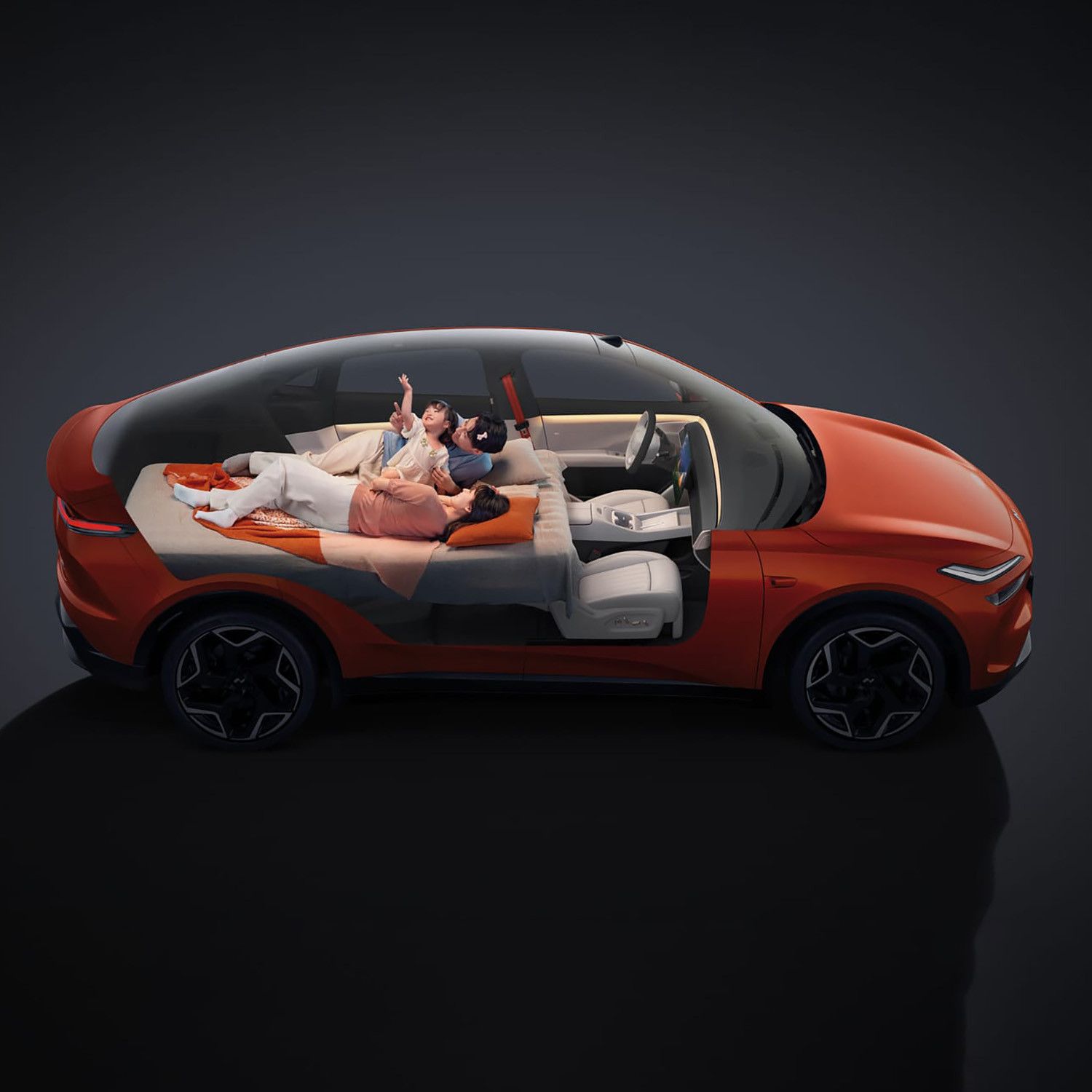
The NIO ET7 is a type of electric car made by a company called NIO. It was released in 2021 and is known for having a long battery life and advanced technology that helps with driving.
Orin X chips are powerful computer chips made by NVIDIA that help cars process information quickly. They are used in self-driving cars to make decisions based on what the car sees around it.
Urban performance is about how well a car can drive in cities, where there are a lot of cars, traffic lights, and tight spaces. It shows how good the car is at handling city driving.
Lane changes are when a car moves from one lane of traffic to another. In smart cars, this means the car can do it safely by checking the traffic around it.
Car
X-Pung 2026X9
The X-Pung 2026X9 is a new electric car that can carry seven people. It says it can go very far on a single charge, more than any other electric car that can hold that many passengers.
An MPV is a type of car that can carry many people and their stuff. It's great for families because it has lots of space and different ways to arrange the seats.
A 5C battery can charge very quickly, meaning it can fill up its power much faster than regular batteries. This is important for electric cars that need to recharge quickly.
The China Electronic Architecture is a new system that helps cars use technology better. It makes cars smarter and more connected, especially for drivers in China.
The Volkswagen ID UNIX 07 is a new car model from Volkswagen. It's a mid-sized sedan designed for everyday use and is the first to use a new technology system called the China Electronic Architecture.
Zonal Electronic Architecture is a way car manufacturers design the electronics in vehicles. It helps different parts of the car's computer talk to each other better and makes it easier to add new technology later on.
ECUs are like little computers in cars that help control things like the engine and brakes. Fewer ECUs mean the car can work better and more efficiently.
Over-the-air updates let car companies send software changes to your car through the internet. This means you can get new features or fixes without going to a repair shop.
Tesla is a company that makes electric cars and is known for using advanced technology. Elon Musk is the CEO and is very influential in the automotive industry.
Embodied AI is a type of smart technology that helps machines, like cars, understand and interact with the world around them. It makes cars smarter and more capable.
Car
i6
The BMW i6 is another electric car from BMW, but it's not as famous as the i8. It's part of their effort to make more electric vehicles.
Li Auto is a car company from China that makes electric vehicles, especially SUVs. They are trying to compete with other electric car makers like Tesla.
EVs stand for electric vehicles, which are cars that run on electricity instead of gas. They are better for the environment because they produce less pollution.
Vertical integration means a company does many different things itself, like making parts and assembling cars, instead of relying on other companies. This can help them save money and work faster.
Chery is a car company from China that makes different types of vehicles, including cars and SUVs. They are trying to grow their business in other countries.
The electric transition is when car companies start making electric cars instead of gas-powered ones. This helps reduce pollution and is better for the environment.
Geely is a car company from China that makes various vehicles, including electric cars. They own other brands like Volvo and are working on new technologies.
Car
EX-5
The EX-5 is an electric car made by Geely. It's designed for city driving and is part of their efforts to create more electric vehicles.
LIVE
The number one resolution for people last year was to save more money, but nearly half gave up by February.
Don't let that be you.
Download RocketMoney to reach your financial goals this year, track your spending, cut waste, and automate savings in one simple app.
RocketMoney shows you all your expenses and categorizes them, so you know exactly where your money is going and where you're overspending.
From there, the app cuts waste by canceling your unused subscriptions and lowering your bills.
No customer service needed.
With that money freed up, the app will automatically set some cash aside for your goals.
Whether it's an emergency fund, paying off debt, or saving for vacation, RocketMoney's got you covered.
Users love the app, with over 186,000 five-star ratings.
And, on average, users can save up to $740 a year when using all the app's premium features.
Make saving money a priority this year!
Go to RocketMoney.com slash cancel to get started.
That's RocketMoney.com slash cancel.
RocketMoney.com slash cancel.
From Taco Night in Tulum to Sushi in Tokyo, make every bite rewarding with gold from Ennex.
Wherever you die, four times membership rewards points at restaurants worldwide are piling up.
Learn more at AmericanExpress.com slash explore dash gold.
Terms and points cap apply.
The number one resolution for people last year was to save more money, but nearly half gave up by February.
Don't let that be you.
Download RocketMoney to reach your financial goals this year.
Track your spending, cut waste, and automate savings in one simple app.
RocketMoney shows you all your expenses and categorizes them so you know exactly where your money's going and where you're overspending.
From there, the app cuts waste by canceling your unused subscriptions and lowering your bills.
No customer service needed.
With that money freed up, the app will automatically set some cash aside for your goals.
Whether it's an emergency fund, paying off debt, or saving for vacation, RocketMoney's got you covered.
Users love the app with over 186,000 five-star ratings.
And on average, users can save up to $740 a year when using all of the app's premium features.
Make saving money a priority this year.
Go to RocketMoney.com slash cancel to get started.
That's RocketMoney.com slash cancel.
RocketMoney.com slash cancel.
Welcome back to EV News, China.
Today, Neo pushes an updated ADAS system, the X-Pong X9, and VW's China platform.
Plus, stay tuned because later in the show, I'll tell you why one highly regarded battery expert says Europe is 20 years behind China.
Well, welcome to EV News, China, the podcast dedicated to the world's biggest EV market.
And every day, you hear the latest headlines, insights, and analysis right from the heart of China's booming EV industry.
And I decode it and tell you how fast moving developments in the East shape the global landscape.
Let's start with Neo.
They released Banyan 3.3 software today, deploying the second Neo World Model.
That's their ADAS system.
They're assisted driving and they sent it to 460,000 cars in China.
The update reaches back all the way to 2021 models that like the ET7 fully using up the power of their four Orin X chips.
Banyan 3.3.0 represents Neo's largest overhaul since first generation software launched in July 2025 for their ADAS system.
When owner feedback proved cautious and then development slowed, this release, though, tests whether the world model architecture can improve at scale.
Autolab reports urban performance now matches China's other leading systems with steadier decision making and smoother control.
The system judges gaps, executes safe lane changes and maintains tidy speed and steering during overtaking maneuvers,
while staying behind slower vehicles when upcoming turns require it to.
On tight city roads, the car reacts more prudently to upcoming two-wheelers, backing off and steering away without stopping.
Battery swap automation extends the functionality of course of Neo vehicles.
Voice commands can now navigate to stations, handle things like the entry gate, queue management, swap parking and resumption of the navigation.
Though U-turns in heavy traffic still show minor steering adjustments.
While the upgraded world model employs what they say is closed loop reinforcement learning, connecting perception, planning and control,
improving routekeeping, junction handling, traffic flow avoidance and efficiency-minded lane changes.
The founder approved the higher cloud computing spend and at least three major assisted driving updates will come this year as the system improves.
Now let's talk about X-Pung opening pre-orders for the 2026X9.
This is all electric.
It's an MPV and it claims the world's longest range for a pure electric 7-seater.
They say it's 750km on the China cycle and the battery is 5C charge rates.
Well, it's 5C.
C-rate is just a multiplier isn't it of charge and discharge but calling it a 5C battery implies it charges very quickly.
The model targets China's expanding family hauler segment where range and charging speed are some of the things that buyers look for.
The 5C battery enables very high rate fast charging, putting Chinese makers at the forefront of rapid charging technology.
Pairing the big range and the big charging battery in real world raises the performance bar for large electric vehicles and opens the question once again that
do you really need to carry around an engine for an e-rev because this is all electric and it will do it just fine and haul the whole family.
X-Pung equips the X9 with three Turing AI chips reflecting how Chinese car makers now emphasize computing power alongside battery capacity.
This processing capability powers advanced driver assistance and in-car services as local buyers expect increasingly high spec electronics in everyday family transport.
Active rear wheel steering typically reserved for premium models enhances maneuverability.
The feature gives long wheelbase 7-seaters some practical advantages in cities.
While independent test data awaits the combination of big range fast charging, loads of AI chips and some high tech stuff like rear wheel steering
should mean that another everyday people carrier enters the competitive market in China and that raises the specifications of everything.
Now, Volkswagen Group China announced its new architecture.
It's called the CEA, the China Electronic Architecture, entered its delivery phase by the end of last year, marking a big leap in localized development.
The first car to get it is going to be the ID UNIX 07.
This is a sedan, mid-sized sedan, so it's about 4.8 meters long, 2.8 meter wheelbase.
Not huge, became the first model running the new architecture at their Inui plant.
CEA emerged from that joint venture collaboration between Volkswagen and Cariad, their software business and X-Pung.
Following a $700 million investment for a 5% stake in July 2023, this new architecture reached mass production just 18 months after Conception,
the fastest deployment in Volkswagen's history.
The system represents the first Zonal Electronic Architecture, which is all the right buzzwords to be saying,
deployed at scale across battery, electric and hybrid models as well.
CEA's Zonal Control Layout, and I don't want to make light of it by the way, by saying it, all the rage in the buzzwords,
it's actually incredibly important because it allows central computing platforms to reduce the amounts of ECUs,
the little brains in the computer that previously were scattered, couldn't really talk to each other.
You can reduce the number by 30% and you enable hardware-software decoupling, and you can build vehicles virtually in a much better way as well.
Do a lot more work in the computer before you ever have to stamp a piece of metal.
Development efficiency in China improved 30%, costs for key models dropped 50%,
the architecture supports AI-driven smart dashes and cockpits, advanced drive resistance,
and of course over-the-air updates, five battery electric models using the new architecture will launch in the A and B segments this year,
including the first pairing with Volkswagen's CMP platform.
Volkswagen plans over 20 EVs for China, all powered by this architecture.
Li also is next in the news, they sold 406,000 vehicles last year, that was down 18.8% on the previous year,
the only major Chinese EV maker with negative growth, the company is now restructuring to try and reverse course.
The firm will split its R&D into three units, the base model team, software ontology, and hardware ontology.
The most significant change targets autonomous driving with the former team folding into the software team.
The previously senior vice president of auto autonomous driving now leads the hardware division,
so focusing on robotics development, anyone would think this is a Tesla news story, no longer running autonomous driving.
And the base model team integrate things like their in-house chips, and the founder and CEO Li Xiang told staff
the reshuffle addresses a new round of competition which AI focused, he positions embodied AI.
The chief executive of Tesla talks about physical AI, whereas Li also talk about embodied AI as the core skill for a car company over the next decade.
Cars should be thought of as robots, that frames their next revenue venture.
The restructure follows struggles with the pure electric Li Auto Mega, that's the large people carrier, and disappointing performance on the i8 and i6.
A tighter integration between how they make their chips, the cars, the software, and their robotics business should translate into their embodied AI ambitions.
Still not sure I fully understand what a car company is these days, but we'll see.
China is the toughest competition to Tesla, according to the chief executive Elon Musk, because it leads in artificial intelligence and robotics manufacturing.
That pairing proves decisive as EVs evolve into rolling computers, where firms controlling the code and the production also control the pricing, the standards and the market direction.
China built the advantage over two decades through supply chains, consistency of policy and domestic demand, and manufacturers treating vehicles like a data product.
Chinese firms already undercut Western rivals on cost, while accelerating cycle time, they can bring things to market very quickly, they're vertically integrated.
A lot of companies like BYD do most things themselves, feeding vast streams of driving and user data into their systems.
Local companies hold the connectivity, they hold the payments services, and all the other services through their super apps or their own clouds.
For Tesla, China represents not only a massive growth market, potentially, and also the biggest threat.
Policy reinforces this lead through support for the Chinese battery supply chains, the Chinese charging networks, and intelligent vehicle pilots, of which Tesla is not one.
Tesla is pinning their future on autonomous driving, and yet in China, there is very little chance you'll see a so-called robo-taxi from Tesla anytime soon.
Musk's assessment signals the EV contest's next phase, less about how big is your battery, more about what's your AI integration.
Chinese manufacturers demonstrate that combining next-gen software and knowing how to make things is a compelling formula for whatever a car company turns into in the future.
We'll take a break, we'll come back, we'll talk cherry and geely and more, stick around.
Five years ago, I was paying $65 a month for my subscriptions. Today, those same subscriptions cost $111, and I don't even use half of them anymore.
That's why now, I use rocket money to manage my subscriptions for me. The app gives you a list of all of your subscriptions and reminds you of upcoming payments, so you're not hit with any surprise charges.
On top of that, it also sends you alerts when subscription prices go up, so you always know the price you're paying.
If you decide you no longer want a subscription, you can cancel it right from the app. No customer service needed.
And the best part is, rocket money even reaches out and tries to get you refunded for some of the money you lost.
On average, people that cancel their subscriptions with rocket money, save $378 a year.
And overall, rocket money has saved its members $880 million in canceled subscriptions.
Stop wasting money on things you don't use. Go to rocketmoney.com slash cancel to get started.
5 years ago, I was paying $65 a month for my subscriptions. Today, those same subscriptions cost $111, and I don't even use half of them anymore.
That's why now, I use rocket money to manage my subscriptions for me. The app gives you a list of all of your subscriptions and reminds you of upcoming payments, so you're not hit with any surprise charges.
On top of that, it also sends you alerts when subscription prices go up, so you always know the price you're paying.
If you decide you no longer want a subscription, you can cancel it right from the app. No customer service needed.
And the best part is, rocket money even reaches out and tries to get you refunded for some of the money you lost.
On average, people that cancel their subscriptions with rocket money, save $378 a year.
And overall, rocket money has saved its members $880 million in canceled subscriptions. Stop wasting money on things you don't use.
Go to rocketmoney.com slash cancel to get started. That's rocketmoney.com slash cancel. Rocketmoney.com slash cancel.
Alright, welcome back to the podcast. Now, let's talk a little bit about Cherry.
I mentioned this on the EV News Daily main podcast, Britain wants more car making.
And Cherry seeks a European base. Could those two be a match made in heaven?
Well, the interests could be converging on Jaguar Land Rover's underutilized production lines.
The British government is backing talks that could see Cherry use spare capacity of Jaguar Land Rover delivering manufacturing to Great Britain.
The approach reflects a broader pattern as Chinese car makers are looking for not only investment overseas because it can drive more profit,
but also asset light assembly close to where the cars will eventually be sold.
The UK is of course outside the European Union now and all of the industrial schemes that add things like tariffs.
So for Tata owned Jaguar Land Rover, that deal could be a sweet one financially helping to make some money during its electric transition.
Sharing factories with the Chinese partner would mark a significant shift for Britain's premium brands like Jaguar and Land Rover,
sparking a debate over things like technology and branding. No binding agreement exists yet, but talks are ongoing.
Several Geely EVs have arrived in Europe for cold weather testing, running some routes from Gothenburg to Nordic proving grounds.
The convoy of EX-5s and other Geely vehicles demonstrating the Chinese commitment to proving its battery technology in harsh northern winters.
Gothenburg serves as Geely's European engineering hub through Volvo.
Testing of the galaxy branded vehicles in the EX-5 through Scandinavian white-out snow and ice,
benchmarks the Chinese hardware against Swedish engineering that's been doing this a very long time in cold climates.
Nordic trials set things like battery thermal management, cabin heating efficiency tests, charging performance,
and even the software that controls stability performance in slippery conditions.
For EVs built for China, where buyers demand all year round reliability, and China has its fair share of cold climates if they want to define them at home,
subzero validation is essential. Publicizing European testing also addresses scrutiny and tariff discussions,
running galaxy models and the EX-5 between Swedish locations aligns their products with European use cases.
Let's say the optics are very good on it. Proving the galaxy cars and the EX-5 perform equally well on Nordic ice to a Chinese city road,
strengthens its appeal and maintains its exports appeal as well.
Now, Huawei and GAC are also doing the same thing as temperatures in parts of China have plummeted below 30 degrees negative Celsius.
Huawei and GAC are using the cold snap to run winter testing on their Qixing branded wagon.
The vehicle is under wraps, but the test campaign signals where it's going. China's EV market is moving past things like
the blunt tools of heavy subsidies from central governments, from local regional government, and also blunt tools like just very low pricing.
And moving into a more nuanced era where businesses have to actually make money and survive, and also which models perform better with AI,
with self-driving, with extreme conditions, hot or cold. Low temperatures, though, really stress batteries, the power electronics, the thermal systems.
So the Qixing must cope with this northeast winter to compete with established brands. Again, it's minus 30 degrees Celsius,
and it suggests they want more than just some basic compliance testing. They're looking at range, fast charging, cabin comfort, and the rest.
The wagon style, the biggest state car, also implies they've got their eye on family use, maybe fleet use as well,
where they're expected to serve many purposes, and that could be cold weather use too.
Now, China has sold 233,000 electric heavy-duty trucks in 2025. That's a hundred and twenty-two percent increase on the previous year,
and now EV trucks are 21% of the market. This is according to the China-Yiwei Institute of Economics and EV tank.
This rate of adoption sets the global benchmark and gives Chinese suppliers a technology, and I would say scale advantage as well.
Heavy trucks generate significant emissions, making electrification essential.
The segment now ranks as the fastest growing new energy category after passenger cars.
The group leading it is XCMG, a head of SAMY Group and FAW GFANG, the top three manufacturers captured between them 43% of all sales.
They use prismatic LFP cells in 99% of commercial heavy-duty trucking installations, low cost, very durable, very safe.
Total battery capacity for the sector is 96.7 gigawatt hours.
Now, let's talk a little bit about that final story.
Europe's battery gap with China. Europe's EV sector lags China by two decades in battery technology.
That's according to Professor Ferdinand Dudenhofer from Germany's Centre for Automotive Research, very well-known figure in the industry.
Chinese automakers captured 10% of Europe in December last year, and 100,000 monthly sales for the first time.
By last year, 70% of batteries in the European area in EVs were from Chinese suppliers.
As Chinese suppliers benefit from 30% lower production costs and 50% faster development cycles compared to its counterparts, European battery makers struggle.
Things like Sweden's Northvolts spent a lot of money and faces bankruptcy.
France's ACC has paused its expansion.
Chinese battery leaders CATL, BYD and the rest now manufacture in Europe through partnerships.
CATL makes the batteries for BMWs in Germany. BYD collaborates with Stellantis on LFP batteries.
And China controls 75% of global battery production capacity.
In Europe, it costs 50% more and 80% dependency on imported critical materials, lithium, nickel and the like.
Well, the tech gap extends beyond batteries into things like autonomy and smart cockpits where Chinese firms are doing very well.
Now, the professor in Germany emphasises that European-Chinese cooperation represents essential progress,
potentially transforming Europe into a tech hub that collaborates with China rather than runs behind it.
And that's your podcast for today. Thanks for listening. See you on the next one.
Thanks for watching.
RocketMoney.com
About this episode
NIO's latest ADAS update, Banyan 3.3, is a significant overhaul for their assisted driving system, enhancing urban performance and automation features. Xpeng introduces the all-electric X9 MPV, boasting impressive range and rapid charging capabilities, while Volkswagen unveils its new China Electronic Architecture for improved vehicle efficiency. The episode also highlights the competitive landscape of the EV market in China, including Li Auto's restructuring efforts and the increasing dominance of Chinese battery manufacturers in Europe, which is lagging behind in technology and production costs.