presales
Presales are when a company starts taking orders before the car is widely available. It helps them estimate how many people want the model.

X9 Xpong
X9 is an EV model name mentioned in the podcast’s China news segment. It’s brought up because it relates to what’s happening with EV sales and launches in that market. The transcript doesn’t give enough details to say more about its exact features.
oil shock
An oil shock means oil prices jump quickly. When gas gets more expensive, more people consider electric cars instead.
Global Data
Global Data is a research/analysis firm. The host quotes it to back up the export and market trend numbers.
Q1
Q1 is the first three months of the year. Here, it’s used to say exports were up by the end of that early-year period.
China Passenger Car Association
The China Passenger Car Association is an organization that tracks passenger-vehicle market data. The host uses it as the source for the export numbers mentioned.
export-focused factories
Export-focused factories are plants set up to make cars for other countries. The idea is that they’re better prepared to ship cars abroad when one region gets disrupted.
Tesla
Tesla is a major electric-car company. The host mentions its CEO because Tesla is part of the US delegation being discussed.
MG4
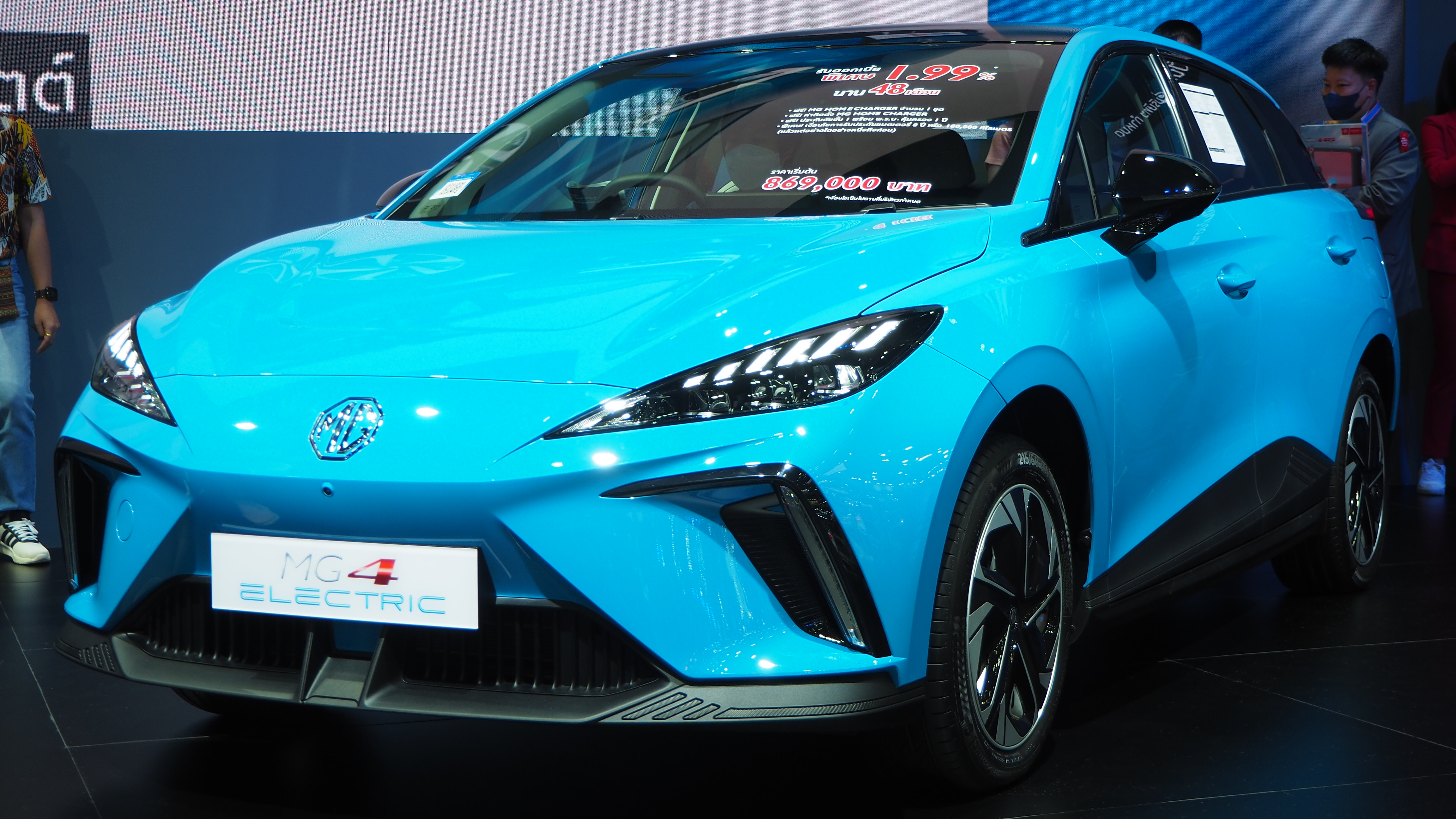
The MG4 is an electric car sold by MG (a brand owned by SAIC). In this segment, they’re talking about how quickly it’s selling and making it, and they also mention some battery and systems tech that helps it compete on price.
semi-solid state battery
A semi-solid state battery is an EV battery that uses a thicker, more solid-like material inside instead of a fully liquid electrolyte. That can help with safety and may help the battery pack store more energy over time.
cell-to-body structural integration
This is a battery design where the battery pack is built to help support the car’s body, not just be a separate component. That can save weight and make the car fit the battery more efficiently.
integrated thermal management system
EVs need to control temperature for the battery and electronics. An integrated thermal system is designed to manage that heat in a coordinated way so the battery works well and lasts longer.

Audi E7X
The Audi E7X is an electric Audi SUV that Audi is taking pre-orders for. This segment focuses on its “tech-forward” cabin—big screens and voice control features.

Audi Quattro
This “Quattro” is an Audi version that’s known for a lot of screens inside. The podcast says it has a very large display and, in the top version, many screens across the cabin. It’s mentioned because the interior technology is a big part of what makes it stand out.
Quattro version
“Quattro” is Audi’s name for its all-wheel-drive system. It helps the car grip the road better by sending power to more than just the front or rear wheels.
Audi Assistant
Audi Assistant is the car’s voice system that lets you talk to the car. Instead of only understanding basic commands, it’s described here as being able to handle more complex ways of speaking.
Bose Audio
Bose Audio refers to a premium audio system brand used in some vehicles. When a car includes Bose, it usually means the speakers, tuning, and amplification are designed as a coordinated package for higher-quality sound than base audio systems.
large language model
A large language model is an AI “language brain” trained on lots of text. In a car, it helps the voice assistant understand what you mean and respond in a more natural way.
reinforcement learning system
Reinforcement learning is a type of AI that learns by “trying things and seeing what works.” The system gets better over time at making decisions that lead to better outcomes.
level three autonomy
Level three autonomy means the car can drive itself in certain situations, but you still have to be ready to take control if it asks. The key point here is that Audi expects to add this capability through software updates.
over the air updates
Over-the-air updates are software updates that download to the car wirelessly. Instead of going to a shop, the car can get new features or improvements automatically.
900-volt electrical architecture
This is the EV’s high-voltage electrical system. Using a higher voltage can make fast charging easier and more efficient, which helps the car add range quickly.
ultra-fast DC
Ultra-fast DC charging is the kind of fast-charger you plug into that sends power to the battery quickly. It’s different from slower home-style charging and is designed for rapid top-ups.
BYD
BYD is a major Chinese EV and battery manufacturer, and the segment uses its export and sales numbers to illustrate how quickly Chinese brands are expanding globally. The discussion contrasts BYD’s April export volume with Tesla’s delivery figures and notes BYD’s growth both domestically and overseas.
Clean Technica
Clean Technica is cited as the source for estimates used in the delivery comparison. The segment notes that because Tesla doesn’t publish the needed monthly breakdown, these figures rely on estimates rather than direct company-reported data.
Corvus Energy
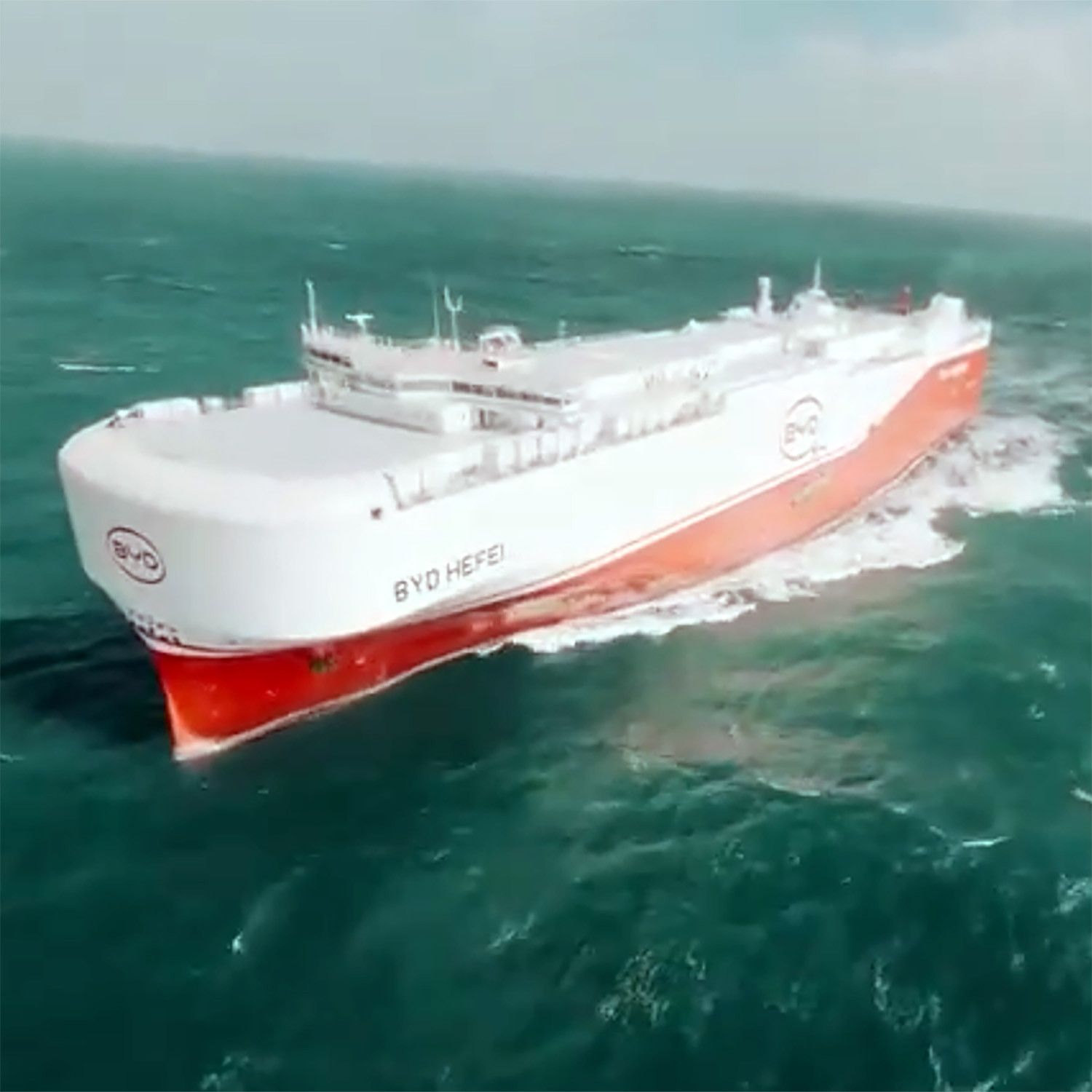
Corvus Energy is a Norwegian company that specializes in electric batteries for boats and ships. They’re teaming up with BYD to build and roll out marine battery systems.
marine lithium-ion phosphate battery systems
These are ship batteries made with a lithium type called lithium iron phosphate (LFP). They’re built for marine use, where safety and durability are especially important.
pure Bev
“Bev” means fully electric cars that run only on a battery. “Pure Bev” here means Norway is buying almost only fully electric cars, not hybrids.
maritime electrification
Maritime electrification means making boats and ships run on electricity instead of diesel. The idea is to reduce emissions, especially when ships are traveling in coastal areas or inland waterways.

Byd Shark 6
The BYD Shark is an electric pickup truck. The hosts say BYD wants to sell it in China, but they’ll use a specific BYD sub-brand name to do it.
Fang Cheng Bao
Fang Cheng Bao is BYD’s sub-brand used for certain vehicle models and marketing positioning. Here, the segment says the BYD Shark pickup will be launched in China under the Fang Cheng Bao brand, which signals a strategy for how BYD will sell the truck domestically.

Ti7 Fang Cheng Bao
Ti7 is an EV model mentioned in connection with plans for China. The podcast says it will be sold under the Fang Cheng Bao brand, and it links the idea to BYD’s earlier “Shark” development. The main takeaway is that it’s part of a China launch and branding plan.
EV pickup market is almost nothing in China
They’re saying electric pickup trucks are still rare in China. Part of the reason is that pickups are regulated differently than regular passenger cars, which makes it harder to sell them.
regulated differently to passenger cars
Pickups and regular passenger cars can be treated differently by regulators. That can make it more complicated to introduce an electric pickup compared with an electric car.

Ford Ranger Plug-In Hybrid
The Ford Ranger Plug-In Hybrid is a Ranger pickup that you can charge and also uses a gas engine. The hosts mention it as one of the existing options competing in the same space.

Xiaomi Su7 Ultra
The Xiaomi Su7 Ultra is the high-performance version of Xiaomi’s Su7. Here, people sued over an optional carbon-fiber front hood that was marketed as having real cooling benefits.
ducted hood
A ducted hood is a hood/bonnet design with openings meant to channel airflow toward a specific area, often for cooling. In this case, the optional carbon-fiber ducted front hood was marketed as improving aerodynamic cooling, but the complaint argued the air didn’t actually go anywhere in real-world use.
active intake grille
Some EVs use a grille that can open or close. When the car is stopped, it may close to reduce drag and only open when cooling is needed. That’s why tests done at the wrong time could look misleading.
wind tunnel report
A wind tunnel test is like putting a car in a controlled airflow setup to measure how air moves around it. Engineers use it to estimate things like how much the car is pushed down by air. The episode uses it to challenge earlier claims about airflow and cooling.
downforce
Downforce is the “air pushing the car down” effect. More downforce usually means better grip. They’re saying the tested setup didn’t add much of that benefit.
airflow extraction
Airflow extraction is about pulling hot air out of places that need cooling. It’s like helping the car “vent” heat away from components. The episode says the results weren’t as strong as the earlier claims.
auxiliary brake cooling
Auxiliary brake cooling is extra help to keep the brakes from getting too hot. That matters when you brake hard again and again. The episode says there was some benefit, but not as much as advertised.
Eagle Summit
Eagle Summit is a vehicle name mentioned in connection with a major car industry event in London. The podcast says that in China, the same model is sold under a different name. That usually means the company is using different branding depending on the country.
Xpeng Mona L03
The Xpeng Mona L03 is an Xpeng SUV that’s being introduced to Europe. In this segment, the focus is that it’s part of Xpeng’s Mona lineup and will be the first one launched overseas.

Xpeng Mona M03
The Xpeng Mona M03 is another Mona-series SUV/EV model that’s priced around 120,000 RMB in China. The hosts bring it up to show where the Mona lineup sits in terms of affordability. It helps explain what “entry level” means for Xpeng’s strategy.

Land Rover Range Rover
The Range Rover is a high-end SUV made by Land Rover. It’s designed for a comfortable ride and a premium interior. The podcast mentions a six-seat version being sold in China, but it may use a different name than the usual Range Rover branding.

ES9 Neos Es9
ES9 is a six-seat EV model mentioned as being sold in China. The podcast says it’s positioned like a luxury vehicle, but it may not use the usual Range Rover name. It’s brought up because it’s competing with other large, multi-seat EVs in the same market.
local manufacturing base
A local manufacturing base means making the cars inside Europe instead of shipping them in. The hosts say this can cut shipping and import costs and help comply with new rules that require more local sourcing.
Volkswagen
Volkswagen is brought up because Xpeng may look at Volkswagen’s existing factories in Europe. The idea is to make cars locally using facilities that already exist.
Greenfield site
A Greenfield site means building a brand-new factory from the ground up. The hosts are saying Xpeng is considering either buying existing factories or creating a new one in Europe.
tariff costs
Tariff costs are taxes added when products are imported. If Xpeng builds cars in Europe, it can avoid some of those import taxes.
local supply chain rules
Local supply chain rules are government requirements about where parts and materials come from. If Europe demands more locally sourced content, companies have to build and source more in-region.
spare capacity
Spare capacity is the extra manufacturing ability a company has beyond what it currently uses. In an EV transition, having spare capacity can become a problem if demand shifts away from existing models, forcing production cuts or plant closures.
EV transition
The EV transition is the move from gas cars to electric cars. It changes how car companies build vehicles and how much they produce.
capacity cuts
Capacity cuts mean a company plans to build fewer cars. It’s usually done when sales are slower than expected.