CHINA: SAIC Reports 1.64M EVs, Smart #6 and China’s NEV Market Accelerates In December | 07 Jan 2026
EV News Daily - Technology and Business of EVs
CHINA: SAIC Reports 1.64M EVs, Smart #6 and China’s NEV Market Accelerates In December | 07 Jan 2026EV News Daily - Technology and Business of EVs · Jan 10, 2026
Annotations will appear as you listen
0:00
15:43
Car
Smart Hashtag 6
The Smart Hashtag 6 is a new electric car from the Smart brand. It's part of the trend of more companies making electric vehicles, especially in China.
A plug-in hybrid is a type of car that can run on both gasoline and electricity. You can charge its battery by plugging it in, which helps save fuel and reduce pollution.
A kilowatt-hour is a way to measure how much electricity a battery can hold. It helps you understand how far an electric car can go on a single charge.
Car
Zika 8X
The Zika 8X is a new SUV that will be a top model for the Zika brand, known for being high-performance and premium. It will be priced around $61,500 in the US.
Car
Zika 9X
The Zika 9X is a bigger SUV compared to the 8X, and it costs more, up to about $600,000 yuan. It's designed to offer more space and features.
The Sustainable Experience Architecture is a type of vehicle platform that helps car manufacturers create eco-friendly cars. It allows them to build different types of vehicles, like electric or hybrid, using the same basic structure.
Fast charging is a way to quickly charge an electric car's battery. It uses special charging stations that can fill up the battery much faster than regular chargers.
An AI digital chassis is the main structure of a car that uses artificial intelligence to make the car smarter. It helps improve things like how the car drives and how it uses energy.
LiDAR is a technology that helps cars understand their surroundings by using lasers to measure distances, which is important for self-driving cars to avoid obstacles.
Geely is a car company from China that makes different types of vehicles and is involved in new technologies like electric cars and self-driving features.
A driver assistance suite is a set of features in a car that helps the driver with things like keeping a safe distance from other cars and staying in the lane, making driving easier and safer.
The X-Pong P7 Plus is a new electric car made by a company called X-Pong. It's an updated version of an earlier model, and it's designed to be more advanced and efficient.
Trial production is when a company makes a small number of products to see if everything works well before they start making a lot of them. It's like a test run to fix any problems.
Chang'an is a car company from China that makes various types of vehicles, including electric and hybrid cars. They are growing their business and selling more cars in different countries.
An extended range EV is a special electric car that can drive farther because it has a small gas engine that helps charge the battery when it runs low. This means you don't have to worry as much about finding a charging station.
Stellantis is a big car company that makes many different brands of cars, like Jeep and Dodge. It was created when two companies, Fiat Chrysler and PSA Group, combined.
Battery swapping is when an electric car's dead battery is quickly replaced with a fully charged one at special stations. This helps drivers get back on the road faster without waiting for their battery to charge.
CATL is a big company in China that makes batteries for electric cars. They are known for their innovative battery swapping stations that help drivers quickly replace their car batteries instead of charging them.
NEO is a company in China that makes electric cars. They are known for their unique battery swapping technology, which allows drivers to quickly change their car batteries instead of charging them.
LIVE
I didn't even realize I was wasting $415 a month until I downloaded Rocky Money.
I thought I had my finances under control until the app laid out all my spending and
categorized it for me.
Takeout, shopping, and unused subscriptions were quietly draining my account.
And as a result, my savings took a backseat.
But Rocky Money doesn't just tell you what you're wasting money on.
It takes action to save you money.
First, the app looks at your income and monthly expenses and calculates how much you can safely
spend each day to stay under budget.
Rocky Money also finds and cancels unwanted subscriptions for you and even negotiates
better rates on your bills so you have more money in your pocket.
On average, Rocky Money members can save up to $740 a year when using all the app's premium
features.
Users love the app, with over 186,000 5-star ratings.
It's time to simplify your finances and take control of your money.
Go to rocketmoney.com slash cancel to get started.
That's rocketmoney.com slash cancel.
Forget everything you had planned for this weekend because you are sitting on your couch
and winning from the comfort of your own home.
I'm here with SpinQuest where you can play hundreds of slot games, all of the table games
you love, and you can even win real cash prizes.
New users, $30 coin packs are on sale for $10 at spinquest.com.
SpinQuest is a free-to-play social casino.
Boydwear prohibited.
Visit spinquest.com for more information.
The number one resolution for people last year was to save more money, but nearly half
gave up by February.
Don't let that be you.
Download Rocket Money to reach your financial goals this year.
Track your spending, cut waste, and automate savings in one simple app.
Rocket Money shows you all your expenses and categorizes them so you know exactly where
your money is going and where you're overspending.
From there, the app cuts waste by cancelling your unused subscriptions and lowering your bills.
No customer service needed.
With that money freed up, the app will automatically set some cash aside for your goals.
Whether it's an emergency fund, paying off debt, or saving for vacation, Rocket Money's
got you covered.
Users love the app, with over 186,000 five-star ratings.
And on average, users can save up to $740 a year when using all the app's premium features.
Make saving money a priority this year.
Go to rocketmoney.com slash cancel to get started.
That's rocketmoney.com slash cancel.
Rocketmoney.com slash cancel.
I'm here with SpinQuest, where you can play and win from the comfort of your own home
with hundreds of slot games and all of the table games you love with real cash prizes.
Right now, $30 coin packs are on sale for $10 for new users.
It's all at spinquest.com.
That's S-P-I-N-Q-U-E-S-T dot com.
SpinQuest is a free to play social casino.
Boyd, we're prohibited.
Visit spinquest.com for more details.
Welcome back to the podcast.
Today, SAIC reports 1.6 million EVs, the smart hashtag six in the news,
and China's EV market accelerates in December.
Plus, stay tuned.
Later in the show, I'll tell you how large CATL's own battery swapping network has now grown to.
Welcome to EV News China, the podcast dedicated to the world's largest electric vehicle markets.
Each day, I bring you the latest headlines, insights and analysis
from the heart of China's booming EV industry
and decode how fast moving developments in the East are shaping the global EV landscape.
We'll start with SAIC Motor.
They sold 4.5 million vehicles last year.
That's up 12%.
It's self-owned brands accounting for 2.9 million units,
or 65% of sales in the group.
The numbers underscore SAIC's scale and growing appetite for international markets.
But what about EVs?
Well, new energy vehicles supercharged the growth.
The group sold 1.64 million electric vehicles last year.
A record for a single year.
The Wuling Hongguang Mini EV, a little diminutive powerhouse, contributed 436,000 units last year.
In fact, it's led its segment for 65 consecutive months and shows no sign of slowing down.
Though whether such dominance can last in an increasingly crowded market always remains to
The figures show SAIC fighting on two fronts at home.
Its own brands are scaling rapidly and gobbling up market share from legacy joint ventures.
Abroad, its reach now spans 170 countries.
Europe remains the prize, accounting for some 300,000 units last year.
Another five regions, including the Americas and the rest of Asia,
are each nearing 50,000 units each.
SAIC has found its rhythm now, like many of its Chinese competitors.
It must find its profit margins.
China's makers of new energy vehicles have met the state's five-year goals with room to spare.
We find out today that wholesale sales reached 15.3 million units in 2025.
That's a 25% increase on the previous year.
Yet the record hides a more frantic reality.
Monthly sales swing wildly as buyers chase at times shifting local or provincial subsidies.
Last December, sales rose by 4% across the country compared with the year earlier,
to 1.6 million units, the six-month in a row above 1 million EVs sold in China.
But volume was down a bit from November, about 8%.
Buyers were rushing to use up tax breaks before they expired at the end of last year,
while local trading schemes created a patchwork of demand across the country.
Today's data suggests that Chinese appetites are still wetted more by government handouts
than perhaps by organic desire in some parts of the country.
And this creates a headache for global firms supplying the batteries and the raw materials.
China very much wants to get away from handouts and subsidies and make supply chains more robust.
As China's demand becomes spikier, pricing as well becomes hard to predict.
The world's largest EV market is growing certainly.
It's also becoming quite hard to read as we kick off 2026.
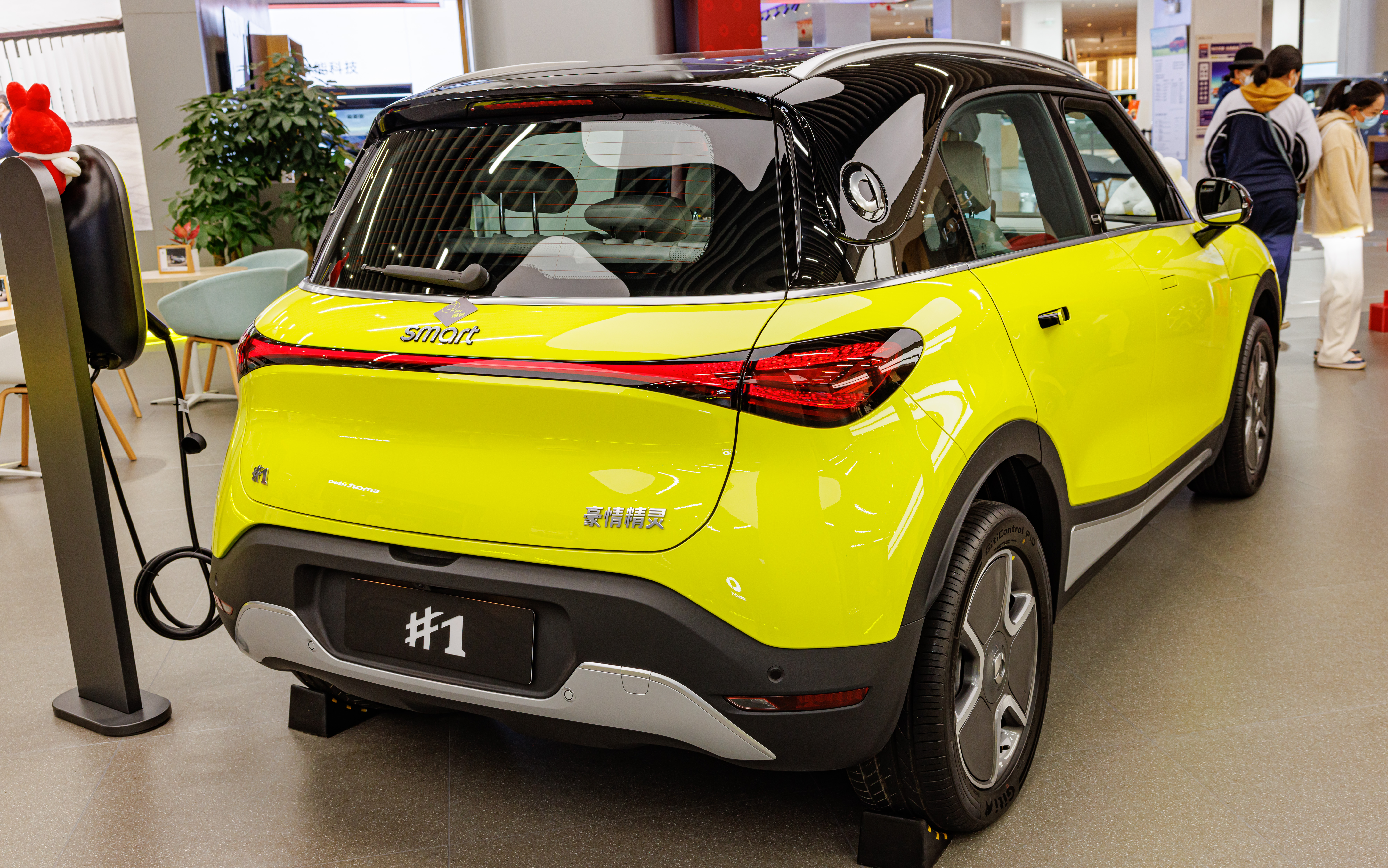
Now, let's talk about the Smart Hashtag 6, showing it's no longer the big short.
The regulatory filings out today and spy shots I've seen already in China
reveal the Smart Hashtag 6. This is the brand's largest.
And it's most unsmart-like offering to date.
And I say that because Smart was once famous, the purveyor of these diminutive two-seaters
that could park nose-to-curb just drive into a parking space.
No parallel parking for me, thanks.
But the brand is now chasing scale and a much bigger type of vehicle as well.
That's really interesting.
The new plug-in hybrid offers two battery choices, a 20 kilowatt-hour pack,
110 kilometers or 68 miles in that, and a 50, sorry, a 41.5 kilowatt-hour pack
that'll do 234 kilometers.
Inside, the cabin mimics a private cinema, a dual dashboard screen across the front,
bucket seats, thick insulation all around the car.
Suggests that engineers are concentrating now with the Smart brand on
more hush-hush than horsepower.
But it is also really quick.
The Smart brand are moving into performance too.
The Hashtag 6 has now cleared its regulatory hurdles with the Ministry of Industry and
Information Technology.
Smart scaling up its dimensions and its ambitions,
and it remains to be seen if it's outgrown its original appeal.
I think there's still many, many people out there who think they know what a smart car is
and might get a bit of a surprise next time they park next to one.
Now, Zika has confirmed that its next SUV will be called the 8X,
and they're hoping that 8X marks the spot for them.
It will sit as a high-performance flagship, with sales set to begin in the first half of this year.
Reports from China suggest a starting price of around 430,000 yuan.
That's $61,500 US dollars.
Yeah, this is premium.
But it's still less than the larger 9X.
That costs up to $600,000 yuan.
The 8X sits on, obviously, a Geely platform because that's what it is,
and so shared amongst the group, the Geely SCA platform.
This is the Sustainable Experience Architecture.
It's the SCAS platform.
So we've seen this upgraded already on some vehicles,
the China vehicles at least 900 volts electrical system.
And much of its plug-in hybrid hardware is shared with the 9X as well.
The three electric motors are 6C fast charging battery.
The promise is rapid charging under the right conditions.
A vital feature is the AI digital chassis.
The company claims that even in a crisis,
both tires on one side could burst on a wet road at 120 kph,
and the vehicle can intelligently remain in control and brake safely.
Off-road, the system recognizes seven surface types they say,
including deep snow or rock crawling,
and selects a driving mode without you intervening.
The 8X carries roof-mounted LiDAR,
and depending on the trim, Zeca offers Geely's G-Pilot,
driver assistance suite.
The most powerful version uses dual NVIDIA 4U chips,
providing massive processing headroom for autonomy.
Whether a 430,000 you-won ticket buys a genuine flagship,
or an over-armed pretender, we don't know yet.
Zecas are selling pretty well, getting good reviews.
It'll all hinge on how it works.
Zeca has the hardware.
It always needs the software to match,
and at times, thanks to the way that things work,
it hasn't always been smooth sailing from the very beginning.
You could say that for other Geely brands like Polestar,
that use the Zeca platforms.
The software has since been updated, and I think it's much better now.
Let's talk about some X-Pong news.
On 5 January, X-Pong completed trial production of its P7 Plus model.
That's the one they're making in Grutz in Austria.
This represents the company's first trial production run on European soil.
Joint Chinese-Austrian teams are now racing to finalize development
ahead of a simultaneous launch on 8 January in Europe and China tomorrow.
The new model largely retains the exterior of its predecessor,
though it features a split front and starring daytime running lights,
they say.
Inside the cabin, that's been overhauled.
New touches include a new 8.8-inch instrument cluster,
a vast 29-inch head-up display, microfiber suede surfaces,
all designed to polish the car's perceived quality.
There's the Power X badge on the rear denoting a range-extended variant,
rather than a full redesign.
For X-Pong, the stakes are high.
Local assembly in Austria would slash logistics costs
and allow the firm to respond faster to European demand.
However, all companies from China, this one no exception,
must wrestle with things like certifications across different jurisdictions
before you can start deliveries.
The P7 Plus design and having that continuity of design
undoubtedly reduces any kind of development risk and investment as well.
It also suggests X-Pong is betting on evolution of a successful formula,
rather than a complete revolution coming to Europe with that vehicle.
We'll find out more details later in the week.
Now, let's talk about Chang'an.
They will launch eight new models across Europe,
but the Vanguard will be plugging hybrid versions of the D-PAL S05 and the D-PAL S07.
These vehicles really neatly sidestep the EU's 20% tariff on Chinese electric vehicles,
at least it is for them, it's more for others.
A levee that has hammered some of its rivals.
The president of Chang'an, Wang Dong, said in December
that his plan is to flood the market with plug-in hybrids,
while the bureaucrats are still busy erecting barriers against pure electrics.
The expansion for Chang'an is broad.
It includes the Nevo brand, aimed at compact hatchbacks and SUVs,
and the Q05, which is extended range EVs.
The D-PAL mark will surge into vans and sedans, they say,
and the luxury Avatar brand, in which Chang'an owns 41% alongside CATL,
the battery supplier operates independently.
Chang'an's no novice at this, they sold 2.9 million vehicles last year,
and they want to get to 5 million by the end of the decade.
To support this, it's pledged to pour 2 billion euros, or 2.1 billion dollars,
into Europe, and to establish a thousand service points.
By diversifying the powertrains, it's like a hedge against
where the regulators go next.
The EU's tariffs were meant to shield the Germans.
Well, all domestic manufacturers really, the likes of Stellantis,
and the Chinese incomeors were taken no prisoners.
If Chang'an's hybrid move is successful, though,
all of those tariffs on EVs, which didn't include plug-in hybrids,
have achieved nothing, except, perhaps, to make drivers dependent on Chinese engines,
rather than Chinese batteries.
At least for now.
We'll take a break.
We'll come back.
More to talk about on today's EV news, China.
Stick around.
Welcome back to the podcast.
Now, Xiaomi is putting the pieces back together again,
a bit like a Humpty Dumpty car.
On the 3rd of January, the chief executive of Xiaomi,
Lei Xun, stood over the disassembled remains of a Y-U7 electric SUV.
Having spent hours live streaming a tear down
of his own company's electric vehicle,
exposing everything, including his internal architecture,
to the watching world, he then faced a skeptical audience.
The parts were impressive, but the pile of metal and wire
raised a question for many people watching.
What happens to it now?
The exercise was a calculated display of transparency,
and frankly, rebuilding lost trust.
Xiaomi's been hit by lawsuits over a bonnet upgrade,
which buyers paid for and then said when they got the car,
it wasn't designed underneath the bit you couldn't see any differently.
There was no movement of airflow to increase performance.
And Xiaomi said, well, I'll give you a couple of thousand Xiaomi points.
Please go away.
And they said, no, we'll see you in court over that one.
There's been a high-profile car fire last year that knocked buyers' confidence.
And there's been more stuff going wrong.
A brand that could at one point do no wrong,
thanks to a very high-profile chief executive that was,
and still is, very much loved by Chinese buyers,
particularly a tech audience.
But by taking the car completely apart on a live stream,
nothing to hide, Xiaomi used it to kind of squash speculation
about its manufacturing quality and preempt the rumors
that often plague Chinese carmakers.
Yet the stunt risk backed firing.
Viewers found the tear down hard to follow.
And the spectacle of a dismantled prototype
suggested a company almost better at taking things apart
than putting to them together.
Mr. Lei moved quickly, though, on social media
to regain control of the story.
He fielded questions from fans,
assuring them that the vehicle would not only be reassembled,
but then would undergo rigorous quality inspections
within days before going off to be sold,
but not to a member of the public.
Mr. Lei insists the car will run as smoothly as before.
It's a bold claim.
Reassembling a complex EV is obviously very difficult,
but reassembling public confidence may prove to be a lot harder.
And finally, in the bustling suburbs of Shenzhen,
taxi drivers no longer wait for an electric charger
to fill the battery.
They simply swap the floor of their car for a fresh one.
By the end of last year,
CATL had planted 1,325 battery swap stations in the ground across China.
The network, comprising just over 1,000 passenger car stations
and 305 truck stations,
demonstrates a rapid national sprint
towards a turnkey infrastructure.
NEO has redominated the conversation around battery swapping,
but CATL are fast catching up.
The firm vaulted from 700 stations in October
to 1,000 by the end of the year,
hitting its public target with, frankly, room to spare.
These stations utilize the Chocoseb swapping system,
standardized swapping electric blocks,
that's what the SEV is in Chocoseb,
designed to fit different models.
Such interoperability creates the network effect,
essential for swapping to become mainstream.
And just the done thing,
if lots of car makers all have the same swappable batteries.
CATL now aims for 2,500 stations by the end of this year.
Incredible expansion, with a goal of 30,000 long term.
It is bold, it's expensive as well,
and a very sophisticated tech move
for global dominance in battery swapping.
It is also one that depends entirely on its rivals.
Although CATL is a battery manufacturing company first,
agreeing to use their standard.
We'll see if they do that.
And that's your podcast for today.
Thanks for listening. See you on the next one.
you can afford it.
In a week, you'll forget you set it up.
In a month, you'll see real dollars piling up.
In a year, you'll be shocked at how much money you've saved.
Bonus challenge. Upload an internet or phone bill
and let Rocket Money try to lower it.
You only pay if they find you savings.
On average, Rocket Money members can save up to $740 a year
when using all of the app's premium features.
Users love the app with over 186,500 star ratings.
Make saving money the resolution you actually keep.
Start the 60-second savings challenge
at rocketmoney.com slash cancel.
That's rocketmoney.com slash cancel.
Rocketmoney.com slash cancel.
I'm here with SpinQuest, where you can play and win
from the comfort of your own home with hundreds of slot games
and all of the table games you love with real cash prizes.
Right now, $30 point packs are on sale for $10 for new users.
It's all at SpinQuest.com. That's S-P-I-N-Q-U-E-S-T.com.
SpinQuest is a free-to-play social casino.
Voidware prohibited. Visit SpinQuest.com for more details.
SpinQuest Social Casino.
The new year may be coming to an end,
but the excitement never does on SpinQuest.com.
With live blackjack, cracks, and so many slots,
and jackpots that don't need a countdown.
Your new year's resolution is more fun on SpinQuest.com.
New year and new players right now get $30 coin packs for just $10.
SpinQuest is a free-to-play social casino.
Voidware prohibited. Visit SpinQuest.com for more details.
About this episode
SAIC Motor reports a record 1.64 million electric vehicles sold in 2025, showcasing the rapid growth of China's NEV market. The episode dives into the impressive performance of the Wuling Hongguang Mini EV and discusses the competitive landscape as SAIC expands internationally. The Smart Hashtag 6 is highlighted as a shift towards larger vehicles, while Zeca's upcoming 8X SUV aims to be a high-performance flagship. The episode also covers X-Pong's trial production in Austria and CATL's expanding battery swap network, emphasizing the evolving dynamics of the EV industry in China.