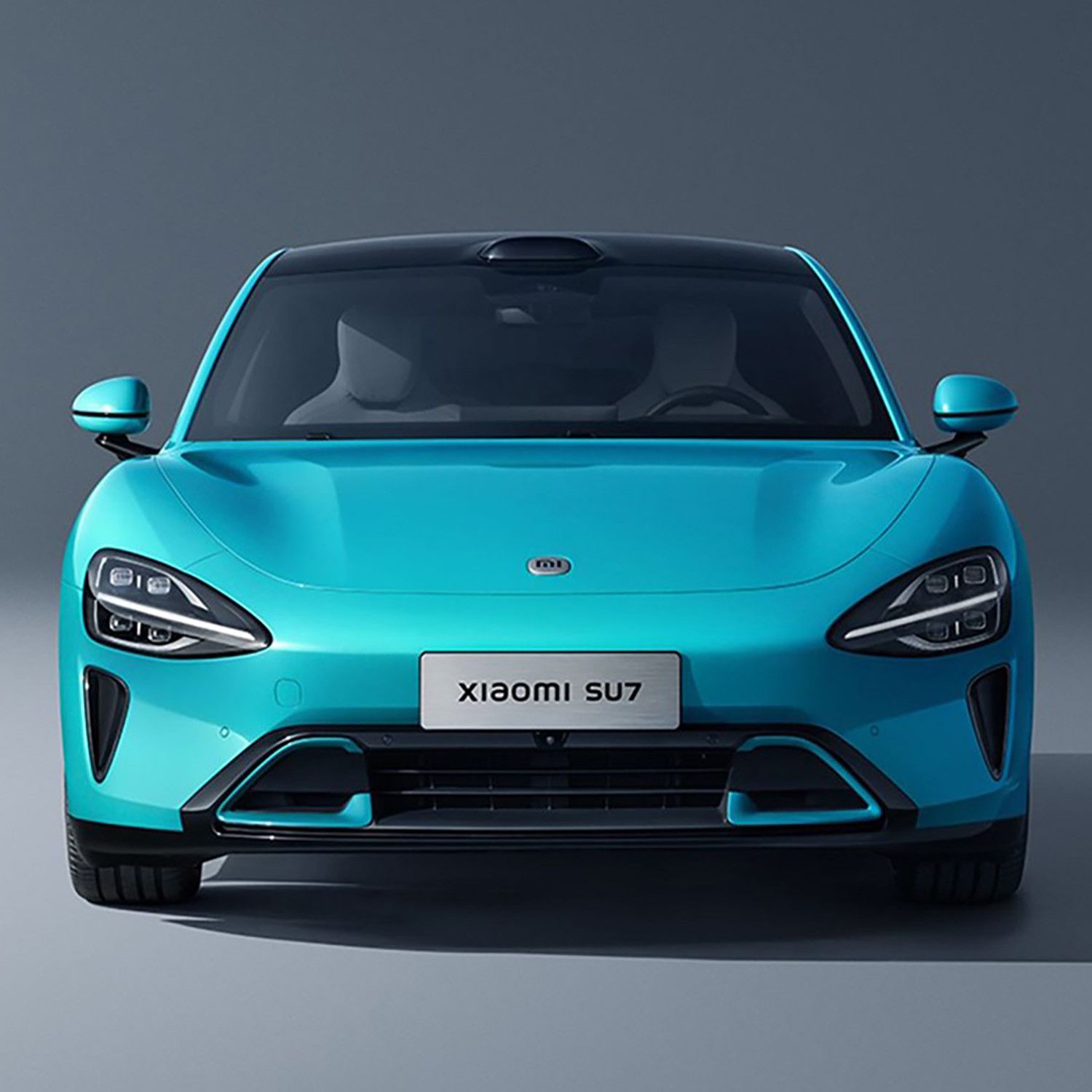
CHINA: Xiaomi SU7, BYD Targets Premium Foreign Brands and Tesla Dangles Incentives | 27 Jan 2026
EV News Daily - Technology and Business of EVs
CHINA: Xiaomi SU7, BYD Targets Premium Foreign Brands and Tesla Dangles Incentives | 27 Jan 2026EV News Daily - Technology and Business of EVs · Jan 28, 2026
The Xiaomi Su7 is a new electric car made by Xiaomi, a tech company. It's a type of car called a saloon sedan, which means it has a traditional four-door design and a separate trunk for storage.
The Tesla Model 3 is an electric car made by Tesla. It's a smaller sedan that many people like because it can go a long distance on a single charge and has lots of cool technology.
The Tesla Model S is a fancy electric car that doesn't need gas. It's known for being really fast and having a long battery life, which means you can drive it far without needing to recharge often. Many people are talking about it because it's changing how we think about cars and the environment.
Driving range is how far an electric car can go before it needs to be charged again. It's important for people who want to make sure they can drive long distances without running out of power.
The Mercedes-Benz EQE is an electric luxury car, like a smaller sibling to the bigger EQS. It's fully battery-powered with a modern interior and can go over 300 miles on a charge. Think of it as Mercedes' answer to the Tesla Model S.
Megawatt flash charging is a super-fast way to charge electric cars, allowing them to get a lot of power in a very short time. This helps drivers spend less time waiting for their cars to charge.
An incentive is a special offer or discount that makes it cheaper to buy a car. Companies or governments might give these to help sell more cars, especially electric ones.
Zero percent interest means you can borrow money to buy a car without having to pay extra money back in interest. It makes buying a car cheaper each month.
The NIO EL8 is an electric car made by a Chinese company called NIO. It's a type of SUV, which means it's larger and has more space inside, and it's part of their plan to sell cars in Europe.
An asset-light approach means a company doesn't own a lot of expensive things like factories or stores. Instead, they work with other companies to help sell and service their products, which can save money.
The NIO EL6 is also an electric SUV made by NIO, but it's smaller than the EL8. It's designed to be a bit more affordable and easier to handle in urban environments.
The Nio ES8 is a big electric SUV made in China that can carry a lot of people and stuff. It has some cool tech features, like being able to swap out its battery for a new one quickly, so you don't have to wait long to charge it. It's important because it's part of the trend of more people using electric cars instead of regular ones.
Steer by wire means that instead of using physical connections to steer a car, it uses electronic signals. This can make the car easier to control and allows for new designs.
The Cybertruck is an electric truck made by Tesla that has a unique shape and uses new technology like steer by wire. It's designed to be different from regular trucks.
EVs stand for electric vehicles, which are cars that run on electricity instead of gas. They are better for the environment because they don't produce exhaust fumes.
Battery swapping is when you take out a dead battery from an electric car and replace it with a fully charged one. This helps you get back on the road faster instead of waiting for the battery to charge.
Car
R08
The R08 is an electric pickup truck made by a company called RELY. It is priced at about $18,000, which is quite affordable for a new vehicle, especially an electric one.
Charging infrastructure is the system of places where you can charge electric cars. Just like gas stations for regular cars, these charging spots are important for people who drive electric vehicles to keep them powered up.
Light duty electric pickups are smaller electric trucks that are used for regular tasks, like transporting goods. They are lighter than bigger trucks and are designed for everyday use, making them a good option for many drivers.
Tariffs are extra costs added to products that come from other countries. When a car is imported, these costs can make it more expensive for buyers, which is something companies have to think about when selling cars abroad.
LIVE
Welcome back to EV News China, today the Xiaomi Su7, BYD targets premium foreign brands and
Tesla dangles incentives, plus stay tuned, because later in the show I'll tell you why
rivals will be closely watching China's first pure BEV pickup truck.
Hey, welcome back to EV News China, the podcast dedicated to the world's largest electric
vehicle market every day, I bring you headlines, insights and analysis from the very heart
of China's booming EV industry, and we decode how fast moving developments in the east
shape the global EV landscape.
This is a huge headline from China in the past 24 hours, Xiaomi's Su7, that's the
saloon sedan, not the YU7, the Model Y competitor, just pushed Tesla's Model 3 off the top spot
in China. Last year the firm delivered 258,164 units of its first saloon, that's about
50,000 more than Tesla Model 3's, according to this data coming out from the China Passenger
Car Association, that ends Tesla's five year run as the premium saloon leader.
This shift shows how fast China's EV market now proves and moves, because Xiaomi's been
around all of five minutes in the car industry, well it's actually almost two years, but
still in terms of you being able to get cars from them, how quickly a startup local brand
uses price, range, innovation and software to upset incumbents. Now the incumbents were the
German premiums, now the incumbent was Tesla for all of five years, and they've been dethroned.
Xiaomi was known for smartphones and gadgets with a very charismatic leader that is followed
passionately by a large user base in China, and the firm has used its vast user base and
tightly integrated digital ecosystem to sell the car as another node in its hardware and
software network. Price does the heavy lifting, the base SU-7 undercuts the entry level Model 3 by
9%, which is at night and day, and it still has more range than the Tesla, a mix that suits
budget conscious buyers who don't want to skimp on performance. Xiaomi's not standing still,
the refresh SU-7 announced for 2026 will have a driving range of more than 560 miles
on the China cycle, that's almost a thousand kilometers. Despite a price rise recently of
six and a half percent, which is significant, pre-sales for the new model, which started at
about 33,000 US dollars equivalent, that's about 230,000 RMB, had a hundred thousand pre-orders
within its first two weeks. Now, Xiaomi's on a bit of a rip, delivering 412,000 vehicles last year,
targeting 550,000 this year. China remains the arena for this contest, but I wouldn't rule out
those Xiaomi's leaving local shores at some point. Now, BYD will launch two new flagships,
the Seal 08, that's a sedan, and the Sea Lion 08, that's an SUV in the first quarter of this year.
The pair will anchor the firm's ocean network in the high end premium passenger segment in
China, where foreign premium brands still manage to sell some cars. The move pushes BYD deeper
into the premium EV market and long defined by the likes of Mercedes-Benz and BMW.
The Seal 08, a large sedan with a long body, is expected to be over 5.1 meters long and a
wheelbase well over three meters. The Sea Lion 08, an SUV counterpart, uses an upright structure
with streamlined design cues to a size and presence wise, both would be comparable to,
well I would say, think Mercedes-Benz E-Class, or EQE, and then for the SUV, a BMW X5,
probably. BYD also wants to shift the terms of the competition from the range of an EV,
which frankly the Chinese win anyway, to charging time, which frankly they're always going to win.
Both models carry roof mounted lidar for more drive resistance systems, which frankly they're
always going to win. This push into intelligent, fast driving, long range EVs is a massive headache
for the foreign brands because they can't compete. Recent spy photos suggest testing of
megawatt flash charging on these vehicles and parallel BYD is beefing up its station network
in urban highway locations too. Right, Tesla has dangled a new incentive in China to try and
shore up the Model 3, cutting the cost of getting into one, only if you're quick though,
because for a couple of weeks they are offering Model 3 variants with $1,100 equivalent, that's
8,000 RMB, of insurance. The sweetener covers the rear wheel drive, long range rear wheel drive,
and long range all wheel drive versions, it excludes the performance trim, no benefits and
subsidies on that, still $48,000 US dollars equivalent, still cheaper than buying it in America,
list prices for the eligible cars start from $34,000 US dollars equivalent for the rear wheel
drive. Financing, as I've mentioned, recently has been loosening to Tesla. Tesla now offers five
years, zero percent interest and seven year very low interest rates to get people into their cars
in China. The Model Y range qualifies for subsidies too, so you'll pay about $315
dollars equivalent per month to get into a Model Y in China. These moves, following
an earlier round of incentives in January, when Tesla rolled out its seven year financing,
this escalation underlines the pressure everyone's under in China. Last year, delivering 1.6 million
vehicles worldwide, still down 9% year over year globally, for the first time it fell behind BYD,
and as I told you already on the podcast, segment by segment, they're now falling behind
even startups like Xiaomi, which is a huge headache. They are being
attacked on all angles, which when you were the number one, of course, they was going to be.
Now, NIO handed over its first car in Hungary, the EL8, last week on the 22nd of January,
as it opened its first distributor run outlet in the country, the Auto Wallis Sherman Budapest.
The sale looks small, but think about the shift, that's not. After a bruising start in Europe,
when NIO entered in 2021 with the direct sales model, and nobody bought their cars,
NIO is switching to an asset-light approach built on national distributors, Hungary,
one of the first. The Budapest showroom will handle both sales and service for NIO and Firefly,
giving the brand some broader coverage. NIO currently offers four models in Hungary,
85 and 85 touring, EL6 and EL8, and so the EL6 and the EL8 are basically what is the
ES6 and the ES8 sold in China, just different badging. NIO already has industrial routes in
Hungary. It runs a battery swap station assembly plant there. The first station from the factory
was finished in September 2022. The new showroom extends the presence from infrastructure into
retail and after sales now as well. Okay, let's talk a little bit about NIO's swap stations.
Increasingly looking like mini power plant, this is always one of the things that's been
talked about with battery swapping, hasn't caught on outside of China yet. Six NIO
battery swap stations have just done what many Chinese coal plants still resist doing.
They sent power back to the grid on demand when needed. In a trial, the six sites were on standby
and delivered a peak output of 1,540 kilowatts, not huge, but it made up 15% of the total discharge
of the station. The little top up that was needed can come from battery power. It wasn't even the
whole battery swap station being taken offline to support an emergency or a situation. It was
just topping up the grid. What fossil fuels can't do in little dribs and drabs, you're either turning
them on or turning them off. The share is small in absolute terms, but the signal is really large.
Chinese policymakers want EVs and infrastructure to smooth out a grid. Rising wind is being added
to the grid, surging solar installation and some dominant thermal power as well. Swap stations,
of course, are full of batteries, either being charged slowly or discharged.
They can charge them at any speed, I suppose, but the point of battery swapping is that
you can get your full battery in a couple of minutes and then they can slowly recharge that
battery being nice and gentle with the pack, but also having a lot of stored energy, they can
discharge if they need to at scale. If you think about it, a broad fleet of hubs provide a very
flexible cushion for the grid. For now, the figures are coming from just a small controlled trial,
not a national rollout or anything. The 15% discharging share of the stored energy
at that battery swap station is just a reflection of what could happen in China's vast power system.
Commercial terms, grid rules and battery deg, of course, will all be part of the conversation.
China is laying down some new rules. This one's about steer by wire in EVs. You know what I find
fascinating? If you've been listening to EV News China, which we started as a spin-off podcast
for a month, last June or July, whenever it was, maybe before, let's do a month for China
and learn about it. We're still doing it daily. There's so much going on. The EV News daily
podcast would be 45 minutes long. No one wants that. You can dip into China, dip out of China,
you're still here. One of the interesting things that you've heard me talk about lately
is how China doesn't want to just now be known as the innovator. The high quality,
they've gone through that phase of just selling the cheapest with dubious quality.
Now they're coming out of that stage of innovation and quality. They've got that nailed.
Now they want to be known for setting the rules, because if you set the rules of the game,
then everybody else has to play to your rules. That's clever. It's a bit like, I don't know,
if you worked in, let's have a thing, like the satellite television back in the 80s or 90s.
You could launch a satellite TV channel, but it makes more sense if you re-put Murdoch and you
own the actual satellite in space. You control distribution. If you're China and you control
how the rules are set for EVs and then the world follows, which I think is a little bit inevitable,
then you control the game and that's very powerful. China is now rolling out rules for
steer by wire in electric vehicles from the 1st of July. There will be a mandatory national
standard for safety on steer by wire, detailed technical requirements and testing. This timing
is important. Steer by wire uses electronic controls rather than mechanical and hydraulic
hydraulic linkages sitting at the heart of EVs. It promises tighter control, better manoeuvrability
and more design freedom in an EV, but regulatory wise, hasn't really been thought about too much.
The market is predicted to grow. There are some cars on the market that the Cybertruck is steer
by wire, obviously, but a new standard in the world's largest car market would surely influence
what Western car makers do with steer by wire. Also setting rules for reliable operation,
the standard lays down safety requirements to curb hazards from any abnormal behavior,
a central concern when a cable is all that is be replacing a steering column, which has worked
for a long time and so and they're pushing tougher enforcement as well how to test safety
and ensure that it's stuck to this is again I think this is the next stage this is 2026 to 2030
are you and I are thinking about this stuff earlier than I reckon anybody else apart from
obviously if you work in the automotive industry in China you've been thinking about it for a long
time but this conversation that you and I are having I think the average person even the person
kind of curious about EVs or into EVs they own an EV maybe this is not even on their radar
at the minute like China is now going to be defining the rules of making electric vehicles
and you know what we're setting up shop in Geneva which I've talked about recently which
they've been doing they want to form those bonds with the west an influence interesting now
we'll take a break we'll come back we'll talk about EV battery swapping and why China's pure
Bev pickup market could be about to explode we'll find out stick around
okay welcome back to the podcast every new battery in a Chinese EV will soon carry a digital
tag much like the European Union's done the government will give each new energy vehicle
a unique identity code tracking it from the factory floor to its second and third life as
the battery gets used over the next 10 20 30 years the ministry of industry and information
technology announcing last Friday the move as officials brace for a wave of aging cells
over coming decades retired batteries could surpass one million metric tons by 2030 say
officials six ministries have issued interim measures that spell out just who must be doing
what and along the supply chain when they have to do it by car makers to recyclers and everybody in
between the digital identifier follows each pack as it's installed replaced vehicles get retired
battery pack gets recycled and perhaps gets reused officials call it an institutional
innovation and the aim is simple to turn what was a recycling problem a waste problem into an
orderly second and third hand market for where batteries go this isn't a problem for this year
but it will be in coming decades and they're doing the thinking about it now
again i hate to say i'm not here to promote china i'm just making observations you have the united
states making wild swings in policy sometimes overnight via social media accounts of presidents
and you have the european union being brow beaten by the car makers watering down its 2035 targets
trying to find its backside from its elbow sometimes and then this china very consistently
since 2005 doing the same thing and as an independent observer of these things it does seem
like a consistent strategy with a long-term plan i don't know could be the way to go i'm just guessing
i don't know right let's talk about how evs are driving china's car market more than growth
china's added 26.2 million cars last year and half of them were evs the actual percentage
was so shy of 50 last year ridiculous it was 49.38 percent of new cars sold in china had
a plug socket on the side of them so close we'll call it 50 we're all friends here
yeah total motor vehicle ownership in china is now 469 million vehicles on the road that's
366 million passenger automobiles but the pace of expansion is slowing by the end of last year
ev ownership was 44 million again if you want to be specific 43.97 million evs on the road
as a total that's over 12 percent of the car fleet in china and chinese roads are already crowded
license drivers are 560 million license drivers in china of whom 525 million have a license to drive
a passenger car an automobile license household ownership is 53 vehicles per was 53 vehicles
per hundred household that's going up in china as people become more affluent the middle class
grows and more people want mobility new vehicle registrations stayed above 30 million vehicles
for the 11th year in a row but transfers tell the real story authorities processed 41 million
motor vehicle transfer registrations including 38 million of those being passenger cars and automobiles
which made up 93 percent of the total used car registrations are outpacing new cars now in
and you might think that makes sense because as evs go into the fleet after three years or five
years coming off finance agreements or people just sell their old one and want a new one
as ev technology is changing so quickly you might say yeah it's common sense that the used market
is going to grow quicker than the new market but that's where some of the really good value can
happen let's finish off by talking about china's pure electric pickup truck that starts at $18,000
u.s. dollars equivalent it's the r08 and it's made by a company called really r el y the move
pushes electric power into one of the last holdouts of combustion power workhorse pickups
now it should be said that pickup trucks in china are regulated differently to say america chinese
car makers already turn out cheap saloons crossovers and microcars because they can
battery trucks are a niche held back by price maybe but also their weight and possibly if you're
using a truck for commercial reasons you might think about charging infrastructure as well but
being rolled out at 127 000 rmb which like i say about 18 000 u.s. dollars equivalent chinese brands
could see now a market to expand into in light duty electric pickups the price undercuts many
western electric pickups even before tariffs and shipping they could probably sell that truck
to a western buyer even with tariffs even with shipping for less money than we'd expect to pay
it also points to how chinese firms may export these models the r08 also matters at home because
provinces push for lower urban emissions and quieter delivery fleets once you get out of the big
urban centers electric pickup trucks could even in you know tier two cities and and downwards
could enter more city centers avoiding those license limits cutting running costs and it really
proves that a pure electric pickup copes with daily payloads and the charging obviously if you're
using as a commercial vehicle then i'm sure rivals will absolutely dive into that sector but as i say
it's not quite as easy because they get classified as a commercial vehicle a pickup truck is a
commercial vehicle and it comes with a whole bunch of regulations to do with maintenance and
uh and inspections and things like that which is not quite so simple in china but
it could be the opening of a new market we'll wait and see that's your podcast see you tomorrow
About this episode
Xiaomi's new SU7 sedan has overtaken Tesla's Model 3 in sales, showcasing the rapid evolution of China's EV market. The episode discusses BYD's upcoming premium models, the Seal 08 and Sea Lion 08, aimed at competing with foreign brands. Tesla is responding with incentives to boost Model 3 sales amidst increasing competition. The podcast also highlights NIO's expansion into Hungary and the potential of China's first pure electric pickup truck, the R08, which could disrupt the market. Additionally, new regulations for steer-by-wire technology and battery recycling initiatives are explored.
Welcome to EV News China — the podcast dedicated to the world’s largest electric vehicle market. Each day, I bring you the latest headlines, insights, and analysis from the heart of China’s booming EV industry — and decode how fast-moving developments in the east are shaping the global EV landscape.
Can you help me make more podcasts? Consider supporting me on Patreon as the service is 100% funded by you: https://EVne.ws/patreon