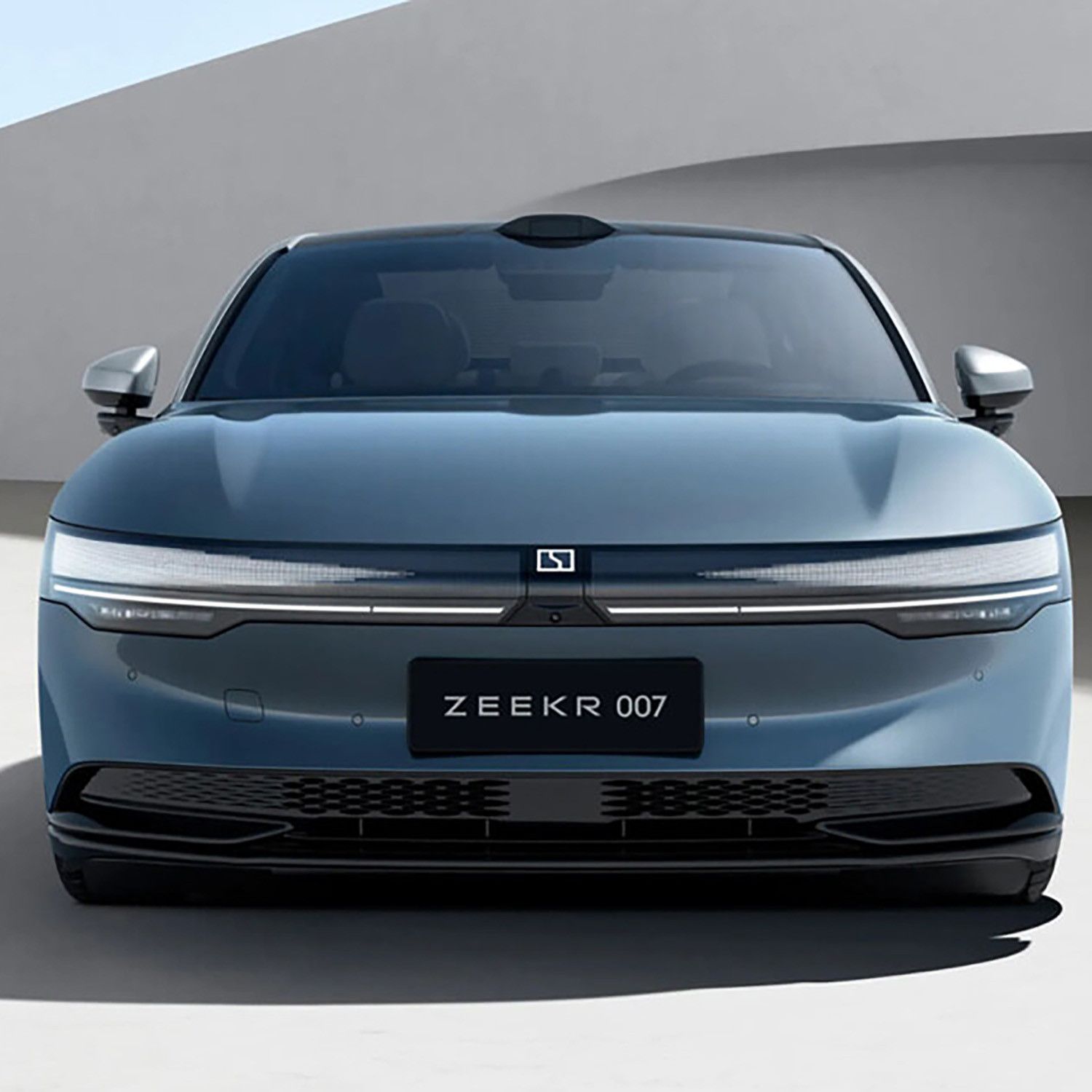
The Zika 007 is an electric car model that was introduced in 2025. It comes in different versions and is priced to compete with other electric vehicles.
NVIDIA OrinX chips are powerful computer chips used in cars to help them drive themselves. They process a lot of information quickly to make driving decisions.
LiDAR is a technology that helps cars understand their surroundings by using lasers to measure distances. It's important for self-driving cars to know where they are and what’s around them.
An 800-volt architecture means the car can charge faster and run more efficiently than cars with lower voltage systems. It helps in reducing the time you spend charging your electric vehicle.
An 800-volt platform means the car can charge faster and perform better. It's like having a stronger electrical system that helps the car run more efficiently.
A 900-volt architecture is a type of electrical system in electric cars that helps them charge faster and perform better. It allows more electricity to flow quickly, making the car more efficient.
Mercedes-Benz is a famous car brand from Germany that makes luxury cars and trucks. They are known for their high-quality vehicles and advanced technology.
All-wheel drive means that all four wheels of a car get power from the engine at the same time. This helps the car stay stable and grip the road better in rain or snow.
Front-wheel drive means that the front wheels of a car are the ones that get the power from the engine. This helps the car grip the road better, especially in bad weather.
Wind tunnel testing is when cars are tested in a special room that simulates wind. This helps engineers see how air moves around the car and make it more efficient.
Range anxiety is the worry that an electric car will run out of battery before you can recharge it. People are often concerned about how far they can drive without finding a charging station.
Ultra-fast charging means charging an electric car very quickly, so you don't have to wait long to get back on the road. These chargers provide a lot of power at once, making it easier to recharge your car's battery.
A kilowatt is a way to measure power. In electric cars, it tells you how much power a charger can provide to recharge the car's battery. More kilowatts mean faster charging.
Charging speeds tell you how fast you can recharge an electric car's battery at a charging station. Faster speeds mean you can get back on the road sooner after charging.
The Geely Galaxy V900 is a type of family car that offers more space and comfort. It's designed for larger families and is part of a growing trend in China for bigger vehicles.
The Galaxy V900 is a car made by Geely that uses both a small gasoline engine and electric motors to help it drive longer distances without needing to recharge as often.
A range extender is a feature in some electric cars that uses a small gas engine to help charge the battery, letting the car drive longer distances without needing to plug in.
The Buick Electra Encasa is a fancy electric car from Buick, known for being comfortable and luxurious. It's part of the trend of car companies making electric versions of their popular models.
Toyota is a famous car company from Japan that makes many different types of vehicles. They are now working on making more electric cars to keep up with what people want.
Car
GAC Toyota BZ7
The GAC Toyota BZ7 is a new electric car made by a partnership between two companies, GAC and Toyota, and it is designed for the middle range of the electric vehicle market in China.
Huawei's Drive One motor system is a technology that helps electric cars run better by combining different parts that work together to make the car move.
LIVE
The holidays are expensive. You're paying for gifts, travel, decorations, food, and before you know it you've blown way past what you were planning to spend.
Don't start the new year off with bad money vibes. Download Rocket Money to stay on top of your finances.
The app pulls your income, expenses, and upcoming charges into one place so you can get the clearest picture of your money.
It shows how much to set aside for bills and how much is safe to spend for the month so you can spend with confidence.
No guesswork needed. Get alerts before bills hit, track budgets, and see every subscription you're paying for.
Rocket Money also finds extra ways to save you money by canceling subscriptions you're not using and negotiating lower bills for you.
On average, Rocket Money users can save up to $740 a year when using all the app's premium features.
Start the year off right by taking control of your finances.
Go to RocketMoney.com slash cancel to get started. That's RocketMoney.com slash cancel.
RocketMoney.com slash cancel.
Rocket Money also sends you alerts when subscription prices go up so you always know the price you're paying.
If you decide you no longer want a subscription, you can cancel it right from the app.
No customer service needed. And the best part is Rocket Money even reaches out and tries to get you refunded for some of the money you lost.
On average, people that cancel their subscriptions with Rocket Money save $378 a year.
And overall, Rocket Money has saved its members $880 million in canceled subscriptions.
Stop wasting money on things you don't use. Go to RocketMoney.com slash cancel to get started.
So I'll tell you which Chinese automaker is already putting humanoid robots to work.
Welcome to EV News China, the podcast dedicated to the world's largest electric vehicle market.
Every day I bring you the latest headlines, insights and analysis from the very heart of China's booming EV industry
and decode how fast moving developments in the East are shaping the global EV landscape.
Zika will not leave its 007 saloon and 007 GT grand tourer idol.
In the second quarter of this year, it plans updated versions built around NVIDIA's next generation
Drive Thor U-Chip and a 900-volt architecture.
Full specs coming soon. The timing matters because current cars are already sitting near the very front of China's pack on powertrain and compute power.
The 007 first appeared on the 27th December 2023.
The 2025 model arrived last August, sorry, August 24 with four trims starting at 30,000 US equivalent.
Every 007 has LiDAR dual NVIDIA OrinX chips as standard.
Their in-house intelligent driving system is now on version two using what they say is an end-to-end large model.
On hardware, the 2025 007 sits on an 800-volt architecture.
541 miles or 870 kilometers on CLTC, 10-80 charge, 10.5 minutes.
In its fastest guise, it'll do the dash in 2.84 seconds.
Now the 007 GT version was launched last April.
It pushes the formula towards performance.
Touring cars, three trims, rear long or all-wheel drive performance.
LiDAR 31 sensors, the dual chips again 800-volt platform.
Two batteries, 75 kilowatts, so-called golden brick battery.
All the 100 kilowatt-hour Kirin pack from CATL.
So 513 miles on CLTC, 5.5C ultra-fast charging, even 60 kilowatt vehicle to load.
We never talk about that, do we? So you can even use the new 007 GT as a power source to charge another EV.
The plan shift, the 900-volt, and upgrading the NVIDIA chips keeps the raising of the bar, if you like, on an incredibly exciting EV,
that we should get soon in its current guise.
We will call it the 7GT, not the 007, and I can't wait to get that.
And they're already updating the one in China.
That's fine, I'll take the old one, I'm happy with that.
Mercedes-Benz is betting on China with its new van platform, new SpyShot, showing the VLE.
Now we do get an official debut on the 10th of March.
SpyShots in China show the van that matters.
Far beyond just having sliding doors, it's going to be built at the VLE by Fujian Mercedes-Benz on the van EA platform.
This is a whole new platform, it really, really matters.
It's the firm's new dedicated platform.
China gets to launch it before the rest of the world, showing how the group now treats China as its priority.
Its development base and its important sales market, they hire and VLS will follow.
The VLE is 800-volt architecture, front-wheel drive and all-wheel drive versions.
Cabin flexibility is the lead feature, seating for up to eight, fully reconfigurable seating.
Family buyers, ride-hailing, corporate shuttles, you get the idea.
Chinese outlet Auto Home reported that Mercedes-Benz has put the VLE through its wind tunnel work,
high-speed testing, extreme dynamic assessments and long-distance validation.
One benchmark stands out, a reported 684-mile journey, that's about 1100km journey.
They drove from Stuttgart to Rome in a camouflage vehicle and stopped twice for 15 minutes at a time.
Okay, let's move on.
And Asian firms control Europe's battery ambitions.
Europe is racing to build battery factories, but nearly all the capacity belongs to Asian firms.
86% of owners headquartered in South Korea actually for new-build battery factories in Europe.
That's according to the IPPR.
For Britain, which wants a big domestic EV industry, that matters too.
IPPR models a severe year-long disruption to battery supply, which finds the UK's reliance on import would put 90,000 jobs at risk, with the worst to happen.
A global scramble for sales would then expose how little of the value chain Britain controls and how little that we could get.
Battery demand is set to surge as EV adoption rises. Global demand will grow sixfold by 2035.
The UK says it needs a clean energy supply chain, but it's fragile.
The country has big battery recycling projects in the pipeline, but the weakest link is cathode production.
On current investment plans, 80% of cathode demand would still be met by imports.
Britain would assemble more EVs, but still depend on China.
As for the raw materials, the IPPR points out that China controls 80% of the world's battery recycling.
Talking of which, nice segue, China now wants a graveyard plan for its old EVs.
On 16 January, regulators set out new rules to tighten battery recycling and reuse.
Officials frame the move as preparation in preparation, so it's not happening yet, but for large-scale retirements.
China's been doing this longer than most, and it makes sense that cars will reach the end of their life later or sooner.
They project waste power batteries could be 1 million tonnes a year by 2030, but here's the important kicker on this.
They're not waste, obviously. Only the uninformed would think that you waste an EV battery.
And the trigger for it is early scale.
China produced and sold more than 16.5 million EVs in 2025.
That's 48% of all new vehicle sales there, and have been doing this for a long time.
The rules push producer responsibility onto automakers, and battery firm is becoming accountable for compliant collection transfer and end of life.
Manufacturers must build nationwide recycling networks, not a patchwork of the current pilot schemes.
They must also share the technical information needed for safe disassembly, narrowing the gap between battery design and recyclability.
Now, China's car makers pushed a bunch of over-the-air updates in December alone.
Last month, I've never reported on this metric, by the way, but it fascinates me.
Last month alone in December, Chinese car makers pushed 1,257 different over-the-air updates.
For a young software race, that is a crowded month.
The China passenger car association, with the research firm Waze, says 27 brands took part in deployments, driver assistance and voice.
Did most of the work. Across last year, the pace has been quickening.
Software now sits at the top of the pecking order in China's market, intelligent driving, and the updates that come with it take a smaller share of recent over-the-air updates,
yet they still ranked second in volume behind vehicle settings and controls together.
Intelligent driving and vehicle control modules made up 20% of all domestic brand updates over the full year.
The split inside the market is sharper.
Still, newcomer automakers delivered 216 updates in December.
That's a modest month-on-month rise.
Li Auto and X-Pung shipped major over-the-air updates.
Big optimizations there.
Envo's big package in December was end-to-end urban navigation.
Chinese local brands drove the surge.
They delivered over a thousand of the feature updates and increased their pace as domestic brands.
Go ahead.
Now, GAC bets on more than just cars, charges as well.
Well, GAC Energy entered 2025 with one of China's densest private charging networks and an unusual focus on the grid.
In its 2025 Ecological Service Report, the GAC Group unit cast charging, grid interaction, and operations as part of its plan to build a vertically integrated industry.
By the end of last year, GAC Energy ran 23,274 charging piles across 31 provinces and 211 cities, including over 17,000 DC charges.
It operates 1,956 charging stations as a whole.
They served 8.92 million users and their 1,000-volt charges.
As well, for an EV market where range anxiety has sometimes given a way to cue anxiety, having control of your hardware, your software, and the power flow does actually matter.
The firm pushed hardware.
It upgraded the ultra-fast charges to 640 kilowatt charges.
It's just so crazy.
With, what they say, single-gun capability possible of 720 kilowatts.
That's an 800 amp limit, by the way.
Rolled out at scale.
This sets a technical ceiling for current charging speeds.
Yes, we know that BYDs will do a megawatt charging and things like that with two guns or two plugs, two sockets.
No, the sockets on the car, isn't it?
But this is 720 kilowatt single-gun capability.
Is blowing my mind somewhat?
We'll take a break, we'll come back, we'll talk lots about Gillian, Toyota, and Lee or so.
Stick around, back in a moat.
Your subscriptions, your upcoming bills, your due dates, everything.
Step three, tap a subscription you don't use and cancel it.
Boom, that's money back every single month.
Step four, create a financial goal for something you want to save for,
whether it be a vacation, a retirement account, or a pet's birthday.
We don't judge.
Now let the app automatically move small amounts of cash towards your goal.
In a month, you'll see real dollars piling up.
In a year, you'll be shocked at how much money you saved, similar to the over 10 million members on the app
that have saved up to $740 a year when using all of the app's premium features.
Use the savings challenge as one step closer to feeling better about your finances today.
At rocketmoney.com slash cancel.
That's rocketmoney.com slash cancel.
One more time, it's rocketmoney.com slash cancel.
I didn't even realize I was wasting $415 a month until I downloaded RocketMoney.
I thought I had my finances under control until the app laid out all my spending and categorized it for me.
Takeout, shopping, and unused subscriptions were quietly draining my account.
And as a result, my savings took a backseat.
But RocketMoney doesn't just tell you what you're wasting money on.
It takes action to save you money.
First, the app looks at your income and monthly expenses
and calculates how much you can safely spend each day to stay on your budget.
RocketMoney also finds and cancels unwanted subscriptions for you
and even negotiates better rates on your bills so you have more money in your pocket.
On average, RocketMoney members can save up to $740 a year when using all the app's premium features.
Users love the app with over 186,000 five-star ratings.
It's time to simplify your finances and take control of your money.
Go to RocketMoney.com slash cancel to get started.
Geely is moving further up market in China's family vehicle wars with the Galaxy V900.
I've talked about this on a few recent podcasts.
A premium mid-to-large MPV.
It was unveiled yesterday.
It comes in three trims.
With list prices starting at $44,000, that's $310,000.
The Galaxy V900 is a range extender, 1.5-litre engine, dual electric motors.
Two battery packs, 43 or 50 kilowatt hours, up to 260 kilometers electric only CLTC.
Add together both and you get 1,220 kilometers.
Inside it, Geely leans on comfort to justify the premium pricing.
Cloud-sensing spa seats.
Sound delightful.
They offer heating, ventilation and massage.
A 17.3-inch screen serves the second row alone, turning the rear cabin into an entertainment space.
I don't like my kids enough to give them a 17-inch screen in the back.
When they get older, they can drive me around in one of these.
That's amazing.
A 9-litre fridge, so they also do kind of heating in them as well.
A 27-speaker sound system makes this a rolling lounge, not a workhorse van.
China's premium MPV segment is crowded.
I would have any of them.
This is the Galaxy V900.
E-rev.
Nah, I'm not sure I'll have a range extender.
I don't need a range extender.
It's just oily bits to go wrong down the line.
They're popular now when they're brand new and shiny.
Come back in ten years' time when all the oily bits are falling apart and you're having to pay for service.
That's when I think E-revs don't work very well, because that's why I got rid of my combustion stuff.
The Denzer D9, the X-Pung X9, the Voya Dream, there's the Buick Electra Encasa, the Auto Mega.
These are all big luxury barges.
Fantastic.
Now, Toyota needs to lean on China to make EVs, the Japanese Juggernaut.
They shouldn't need anyone else's help.
They've got the money and the people to do it.
Can't make a good EV for trying.
So that's why they have to go to the Chinese for help.
GAC Toyota joint venture will launch a new saloon called the BZ7.
In March, aiming at a price of $28,000 US equivalent or $200,000 yuan, the car enters China's fierce segment, mid-market EVs.
Built around local software and local services.
I'm not trying to pull you into Toyota.
It slots into the Chinese system.
So the car runs on Xiaomi's smart home platform and Huawei's Harmony operating system.
A nod that domestic tech beats what Toyota can do.
They lean on Huawei for the hardware too.
The BZ7 uses Huawei's Drive One motor system and pairs it with the Memento AI model for driver assistance.
Is there anything Toyota have done for this, apart from sending them some badges for the front?
The powertrain follows the local pattern as well.
It's a dual motor setup.
Batteries come from CATL using LFP packs with pack sizes of either 71 or 88 kilowatts hours.
Could be a good vehicle.
Nothing to do with Toyota, although it's called one.
Now let's talk about Li Auto.
They are dangling the credit like the others.
Li Auto in about as many days.
First of all, it was Tesla.
The next day it was Xiaomi and the third day it's Li Auto.
Now offering seven years, zero or low interest finance across China.
The deal covers the EREVs that Li Auto makes, the L6, L7, L8, L9, the battery electric Li 6 and I8 SUVs, the Mega MPV as well.
Buyers put down 15% and for a brand built on well-heeled family buyers spending more than 40,000 US equivalent,
this pushes demand forward rather than makes the business stronger or better margins.
Anything like that, Li Auto just need to sell cars.
The strain shows in the data.
They delivered 44,000 vehicles in December, but that's down 25% year on year.
It was the seventh straight month of falling deliveries.
I'll be pulling the hair out at Li Auto and doing whatever they can, which is to follow Tesla with seven years of low or interest free finance.
They're the big major player in EREVs by the way, Li Auto.
Demand for EREVs after a bit of a crazy year has already softened.
It's newer BEVs at Li Auto are trying to fill the gap, but heavy finance subsidies will have to prop up the volumes in the short term.
Now, Buyer is racing ahead with their new factory.
They will push one car off the line in Yanfeng every 40 seconds by the end of the year.
The state backed brand has begun a capacity upgrade that will take the plant to firstly a line speed of 90 vehicles an hour,
as China's premium EV contenders scramble to match output with their ambition, frankly.
The Yanfeng plant anchors what Buyer builds as China's first fully localized NEV production line with in-house control of software, hardware and control systems.
Full stack control matters in a market where domestic brands want to do it all themselves and not rely on the outsiders.
On the shop floor, engineering matches that strategy in stamping the flexible steel aluminium line aims to hold assembly precision within 0.1mm.
Who said panel gaps?
Not me.
Tracked in real time with millisecond level blue light measurement in welding, adaptive spot welding and digital monitoring of electrode cap maintenance keeps the weld quality steady
and they want a 100% pass rate for every weld point.
In final assembly, they're tightening the tools and managing 3,600 tightening points and they say a torque precision again of 0.01Nm.
Buyer wants to be green as well.
The golden factory has 45,000 photovoltaic panels generating 20 million kilowatt hours a year, cutting CO2 emissions by 11,600 tonnes.
And finally, X-Pang is rolling out its first humanoid robot and putting it to work on the production line.
It's something that the founder and chief executive, He Xiaoping, calls automotive grade robotics, but is a turning point on the way to large scale production this year.
The firm insists it will reach mass production of humanoid robots by the end of the year, a target it's been repeating.
For a Chinese EV maker locked in a bruising price war just to sell cars, the push into humanoid robots is a bit more than a side hustle, isn't it?
It signals a bet that in-house robotics, backed by what you know about building cars and hardware and software, will give them the new growth story.
Lots of talk this year, about 2026 and going forward being the year of dark factories, which sounds ominous and foreboding.
All a dark factory is a factory with no lights in it, where it can be utterly pitch black because there's no humans inside it.
And everything gets done by our robot soon to be overlords by the sounds of it.
And so that is obviously where lots of people who want to remove the labour part of the equation want to move towards.
Now, it adds a humanoid spine, bionic muscles, flexible skin and a 3D curved head.
In a live demo, its movement looked human enough to fool many people in the audience.
So much so that they thought, hang on, are you trying to fool us again?
Like we've seen before, when Tesla just put somebody inside a skin tight suit, they weren't even trying to fool us.
It was bizarre.
To rebut the inevitable, that's doing a Tesla.
Suspicion, Mr. Her opened up part of the outer covering to show the mechanical hardware inside.
Incredible. That's your podcast for today. See you on the next one.
Find out how much is safe to spend for the month so you can spend with confidence, no guesswork needed,
get alerts before bills hit, track budgets and see every subscription you're paying for.
Rocket Money also finds extra ways to save you money by cancelling subscriptions you're not using and negotiating lower bills for you.
On average, Rocket Money users can save up to $740 a year when using all the app's premium features.
Start the year off right by taking control of your finances.
Go to rocketmoney.com slash cancel to get started. That's rocketmoney.com slash cancel.
Rocketmoney.com slash cancel.
About this episode
Zeekr is gearing up to launch its 900-volt architecture and upgraded NVIDIA chips for the 007 saloon and GT models, showcasing impressive specs like 541 miles of range and ultra-fast charging. Mercedes-Benz is prioritizing China with its new VLE van platform, emphasizing cabin flexibility and advanced testing. Meanwhile, the European battery market is heavily reliant on Asian firms, raising concerns about supply chain vulnerabilities. China is also implementing new battery recycling regulations as EV adoption surges. Additionally, GAC is expanding its charging network, and X-Pang is introducing humanoid robots into production, signaling a shift towards automation in the EV industry.