Four-wheel drive means that all four wheels of a car can get power from the engine at the same time. This helps the car grip the road better, especially in bad weather or rough terrain.
All-wheel drive means that a car can send power to all four wheels at once, which helps it drive better on slippery roads or in bad weather. It's different from four-wheel drive, which is often used for off-roading.
The Nissan Rogue is a type of SUV that is popular for families and everyday use. It can handle different weather conditions, especially if you choose the all-wheel drive option.
In a front-wheel drive car, the front wheels are responsible for both steering and moving the car. This design helps with traction and can make the car easier to control in certain conditions.
The rear differential helps the back wheels of a car turn at different speeds, especially when going around corners. This is important for keeping the car stable and easy to drive.
The transfer case helps send power to the front and back wheels of a vehicle, especially when driving on rough terrain. It can adjust how much power goes to each set of wheels to improve traction.
This means that when you drive, most of the power goes to the front wheels, while a smaller amount goes to the back wheels. This setup can help the car handle better in different driving conditions.
Traction is how well the tires of a car stick to the road. When a car has good traction, it can move and stop more easily, especially on slippery surfaces.
A clunking noise is a sound you might hear from your car when something isn't working right, like when the wheels are turned and you try to switch out of four-wheel drive.
Term
4L
4L means four-wheel drive low, which is used when you need extra power to get through really tough conditions, like deep mud or steep hills. You usually switch to this when the car is not moving.
A snowflake dial is a button or knob in some cars that helps them drive better in snow or ice. It makes the car safer and easier to control when the roads are slippery.
The Cadillac Optiq is a new electric car that Cadillac is making, which means it runs on electricity instead of gasoline. This car is important because it's part of a trend where more companies are making electric cars to help the environment. The Optiq will likely come with lots of cool features and a comfortable interior, just like other Cadillac cars.
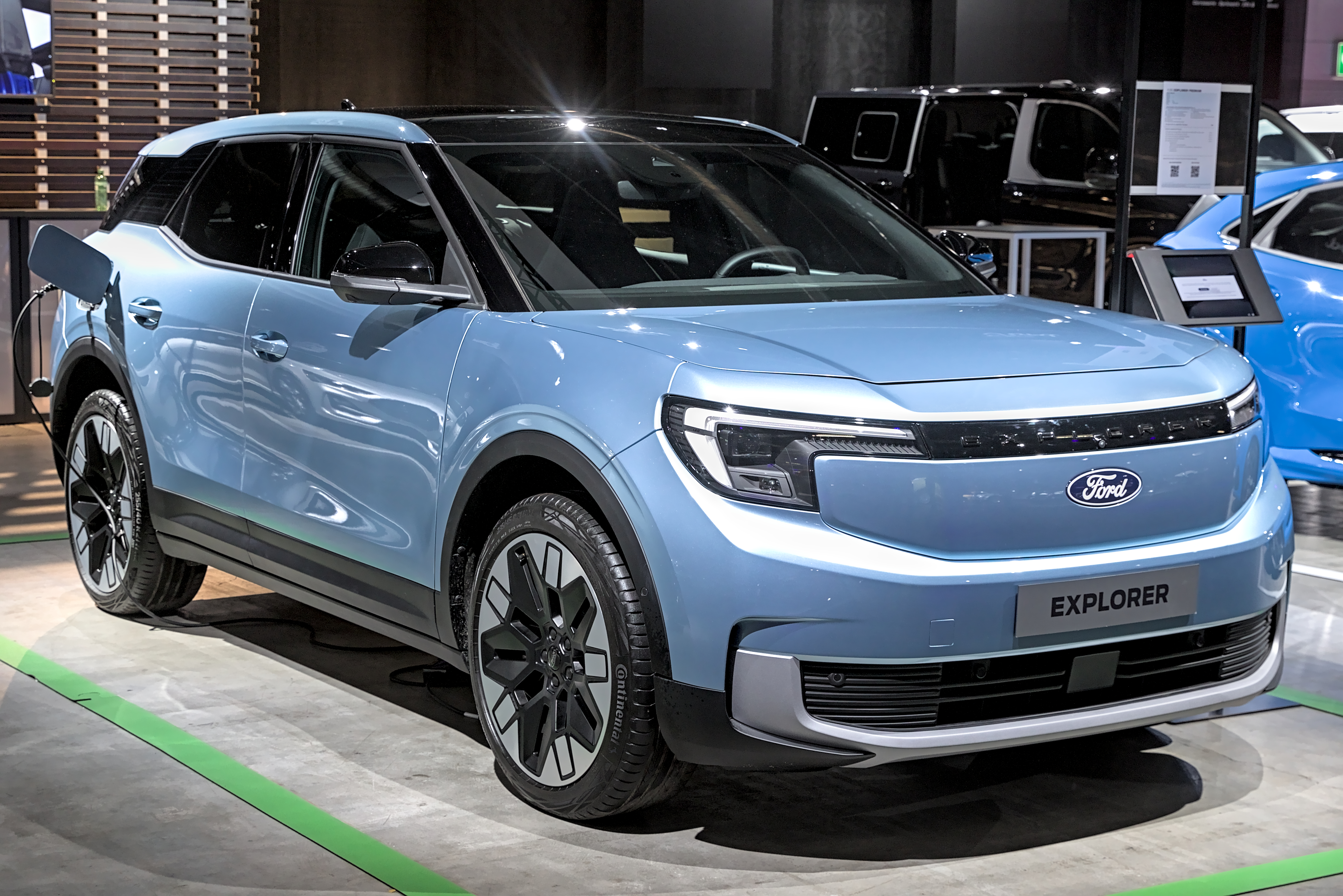
The Ford Explorer is a popular SUV known for being roomy and good for families. It's often used for everyday driving and has different versions to choose from.
Body panels are the flat parts of a car's outside, like the doors and fenders. They help shape the car and are usually painted to match the car's color.
The bumper cover is the plastic part that you see on the front and back of a car. It helps protect the car from minor bumps and can be replaced if it gets damaged.
The Chevrolet Camaro Z28 is a special version of the Camaro sports car that is designed for better performance. It's known for being fast and fun to drive, making it a favorite among car lovers.
An 'as is' sticker means that the car is being sold just like it is, without any promises that it will work perfectly. If there are problems after you buy it, you have to fix them yourself.
A factory warranty is a promise from the car maker that they will fix certain problems with the car for a certain amount of time after you buy it. This helps protect you from unexpected repair costs.
Minor damage means small problems with a car, like scratches or dents, that don't make it unsafe to drive. These can usually be fixed without too much trouble.
The front fascia is the front part of a car that includes things like the grille and headlights. It helps the car look good and can affect how it moves through the air.
Suspension components are the parts of a car that help it ride smoothly and handle well. They connect the car to its wheels and help absorb bumps in the road.
LIVE
Hey folks, this is Lenny Lawson, the cargo route.
You know, it's just hilarious to me how people just kind of lose all of rationality when
it snows really deep, it gets slick outside.
Then all of a sudden, we've got to get a four-wheel drive.
Well do you really?
I mean, think about it, what are the normal conditions where you live?
I mean, if you have snow and pretty significant freezing and ice, like for three or four months
out of the year, okay, I get it.
Or if you are a nurse or your career requires you to be at the job, or if you're taking
care of older people.
I mean, there are good logical reasons why you need to get around and spend more money
on a four-wheel drive.
Or all-wheel drive.
Well, what does that cost anyway?
Well, like for example, on a Nissan Rogue, it cost about $2,000 extra to get four-wheel
drive, or all-wheel drive.
To me, that's a no-brainer.
I want to be able to go when I need to go.
And I don't know about you, but $2,000 is not going to break me, especially if I have
to finance it for 60 months.
It's worth it.
But a lot of people, they say, hey, you know, I don't need to get out.
Two-wheel drive is fine for me.
Okay.
I mean, as long as you've applied a little bit of logic to it, you're good to go.
And I have no problem with that, and you probably don't care if I do.
But there are those people that, pardon the French, they lose their minds when something
like this happens.
They're the people that, like, I don't know what it is, but they just raid the grocery
store.
Buy as much bread as they can.
What is it about bread that they have to have that's so crucial?
I mean, we went to the grocery store, there's no bread.
And it's because they were forecasting, I think they got up to, like, 15 to 20 inches
of snow here in East Tennessee, and all the bread disappeared.
I mean, really, do people eat that much bread?
Well, I guess they do.
I mean, everybody's going to do what they think they need to do, right?
So you ought to leave some bread for those of us who don't eat that much.
I mean, I don't eat the white stuff anyway.
My wife makes me eat the bread that has, you know, that it's really dark.
It has all kinds of seeds in it.
I've gotten used to it, though.
It just makes it hard to spread the peanut butter.
Oh, well.
And there's so many different options out there, as far as all-wheel drive and four-wheel
drive.
What's the difference anyway?
Well, most vehicles have all-wheel drive.
You don't have to do anything to get it to go into all-wheel drive.
They're usually front-wheel drive vehicles, and they have a transfer case, and they have
a rear differential so that when the front wheels start to spin, it automatically, there's
a computer there that sends power to the rear wheels.
And normally, it's about a 60-40 split on a front-wheel drive vehicle.
60% of the power is going to the front, and 40% is going to the rear.
What does that really do for you?
Why do they just climb hills so easily?
I don't know.
It's physics.
When you have four wheels that are doing the work, you're bound to have traction on one
or two of them.
And these cars are smart.
I mean, if the left front wheels start spinning, it sends power to the right front.
And if it's spinning, it'll send it to the rear.
I mean, that's a good thing to have.
It's not just when it snows and when it's icy.
All-wheel drive is a pretty good thing to have all the time, because when it rains,
and it rains after it's been dry for a long time, there's a lot of oil that builds up
on the street.
You know what I'm talking about.
You've experienced it.
And all-wheel drive will help maintain control for the vehicle when you're moving down the
road and you're going around a curve, and it just does a beautiful job.
Now, what is four-wheel drive?
I know it's just really confusing.
Four-wheel drive vehicles, the terminology is used to designate a vehicle that you have
to physically move a lever or push a button to get it into four-wheel drive.
I have 150, for example.
It has, let's see, three different choices.
I can push 4A, which is automatic four-wheel drive, so it will, if it senses any slipping
from the rear wheels, it'll send power to the front wheels.
Automatically, I don't have to push a button.
I don't have to do anything.
Just keep steering and keep my foot on the gas.
As a matter of fact, I can keep it in that setting all the time, even in the summer.
But I'm not going to do that because there's a chance that the vehicle could get confused,
like in a parking lot or something I'm turning, and it would make it very difficult to turn
very sharply because in four-wheel drive, the wheels will kind of, the front and the
rears will work against each other.
And it's a weird feeling.
Have you ever felt that?
Well, you'll feel it when you're in four-wheel drive and you're on drive pavement.
And it just, it feels like something's holding you back and jerking the vehicle back and
forth.
If you feel that, then look down at the settings or at the switches and just take it out of
four-wheel drive and then it will stop.
If your wheels are turned when you do that, you might hear a clunking noise.
Or if you have a lever that you have to pull like in a truck, then it might be difficult
to pull out until you have your wheels straightened up or your front, your steering wheel, straight,
going straight down the road because they get in a bind when they're turned.
I don't know why they just do.
Now what's 4-H mean?
That's four-high.
That means highway speeds, you can be in four-wheel drive and it will stay in four-wheel drive.
It's not automatic where it's switching back and forth.
It is.
The front wheels are pulling, the rear wheels are pulling, okay?
What's 4L?
Well, that's, you only go into 4L, that's low when you're at a dead stop and you're driving
through a wet field or a mud or you are stuck.
That's what 4L is for because it sends more power to the wheels with the same throttle
response.
It's the car, the maximum speed of the vehicle when you're in 4L will probably be about 30
or 40 miles an hour.
I won't go any faster than that because it's geared down too low, but it's great for getting
out of a stuck situation.
Just don't leave it there.
Now on most SUVs, there's going to be another dial.
It is superfluous, not needed because most people will never, ever get into situations
where they need that, but it's a dial that it might have a snowflake on it.
Well, that's supposed to be your setting when you're in snow.
There's one that looks like ice.
There's one that looks like a, has a cactus on it.
I guess you use that in the desert.
Those are basically worthless, but they're there.
The engineers thought they would be really cool and it gives the marketing people something
to talk about.
All you need is 4L, 4L and 4 Automatic.
And life is good.
I'll be back in just one minute.
Okay, I am back.
Have you ever known anybody that's colorblind?
You may be colorblind.
I've never really understood that, but apparently they can't distinguish.
I guess there are other different types of color blindness, but from what I've always
heard they can't distinguish red and green.
And that can be an issue, especially at a traffic light, I would think.
You're just going to know which one's on top and which one's on the bottom.
And if everybody else starts going, then you go.
I guess that's how they handle it.
I had an uncle that was colorblind and that's kind of what he said.
He saw gray when he saw those other colors.
I don't know how you experience it, but I'm not colorblind.
But according to my wife, I am at times because we don't see the same colors.
I don't guess anybody does.
I'm not a doctor or a microbiologist of any kind, but I tell you what, we all see something
different.
We're all different.
Our eyeballs are different.
The receptors in our OPTIQ nerve, our brains process the information differently.
But they're close enough because we're humans, but sometimes color can be an issue.
Like the other day, we had one of our employees was backing a car out of the detail garage
and unfortunately backed his, well, what he was driving into the door, the rear door of
a Ford Explorer.
And I hate it when that happens, you know, because now you got to take a picture of it.
You've got to stick it in a glove box and you have to disclose that to a customer when
you sell them a car.
Well, we do now.
Most dealers won't and I'm not bragging or anything, but it's just a fact.
They say what the customer doesn't know won't hurt them, but I believe what they don't know
now they might find out and I'd rather go ahead and disclose it up front.
I'll tell you about that here in a second, but anyway, so he backs into this, this Explorer.
So we got to send it to the body shop.
We get it back.
My nephew, Max, who's my general sales manager said, Lenny, come out here and look at this
thing and see if you see what I see.
And I said, what am I supposed to see?
He said, I'm not going to tell you.
So we went outside.
It's kind of a light gray color.
And so we stood away from the vehicle, backed off of it, the light was kind of a shaded area.
The sunlight was not right on it and I said, well, what am I supposed to be looking at?
He said, I'm not going to tell you.
But he said, do you see a difference in color on any of these body panels?
And I looked at it and I said, well, the rear bumper cover, which is made out of plastic,
looks like a little bit different color than the rear quarter panel.
He said, yeah, well, they're all that way.
And that's true.
I mean, if you ever put a park of car in the sun or in the shade and you look at it from
the side, the bumpers are going to be a slightly different shade than the rest of it.
That's normal.
It hasn't been wrecked.
So I kept looking and I did notice that the rear door on the driver's side was just a
hint darker.
And I mentioned that to him and he said, yep, do we need to paint it again?
And I said, yes, you do.
Because if I can notice it that easily, then it's going to be very noticeable if somebody
buys this vehicle.
They may not notice it, but if they try to trade it, then some car expert's going to
see it and he's going to say, has this ever been wrecked?
No, it's never been wrecked.
Well, the door's been painted.
What?
You know, and then we have a problem.
So I just decided in my old age, I don't want any problems like that.
And so we're going to send it off, have it repainted again.
The body shop is not real happy.
They think it matches fine.
They're wrong.
Sometimes body shops are wrong and color's tough though.
I mean, when you take your vehicle to a body shop and they paint the whole side of it,
it's not an issue.
But if they just paint the door or the quarter or the front fender and don't paint the rest
of it, don't blend the paint over on the door, that's a technique that they use, then it's
going to be noticeable to people who notice things like that.
Maybe you don't, but I'm kind of a perfectionist when it comes to paint finishes and the way
it looks.
So this body shop is going to paint that door again.
And I hope they get it right.
How do they do that?
How do they get it right?
Well, it helps to have a body shop guy that really knows color and has good eyes and can
see it.
And so they mix the paint and they do a spray out on a piece of paper and they hold it up
to the body and they just adjust it, add a little bit more black or a little bit more
green or whatever it needs.
And they eventually get it to where it's spot on and then they spray it, take it outside,
look at it, look at it in the shade, look at it in the sun.
And if it's imperceptible, is that the right word, that there's no visible difference, then
it's good to go.
Then you just have to watch out for tape lines and things like that to make sure that the
customer is happy.
But color is definitely an issue.
Well, I wanted to tell you about what happened.
We had a salesperson, this was 1986, and had a salesperson who had, we gave everybody
demos back then, which was an ignorant thing to do, but that was the standard of the industry.
So all of my salespeople had brand new cars to drive.
And that was very expensive.
And we decided to stop that because of things like this.
He wrecked it.
It wasn't a bad wreck.
It was a foggy morning.
He couldn't see where he was going and he drove the front end into a ditch.
And so he brought it to the dealership.
It was drivable.
He actually backed it out.
It was a Camaro Z28.
And so we repaired it and we put it out there in a lot and we put an as is sticker in it
like we always do with used vehicles or demonstrators.
It had a warranty on it from the factory.
But as is means there's no dealer warranties, you know, that my dealership is not applying
anything extra to this vehicle.
And they got a prospect on it.
I was sitting in my office and the salesperson came to my office and he said, Lenny, we got
somebody on the Camaro Z28.
I said, well, make sure they see the damage, the estimate, and we'll be good.
He sold it to him.
And they said that they never saw that.
Six months later, they show up at the dealership and they want their money back and I talked
to the salesperson.
I talked to the sales manager.
They said, yeah, we told them.
I mean, they saw everything.
Of course, they were lying.
I didn't know that.
And so I said, well, sir, I can't give your money back.
I mean, I'll do something for you, but I can't know.
He was insisting that we give him his money back and take the car back.
And I refused to do it.
That was a big mistake.
I should have given his money back.
That was a valuable lesson because I went to court and we lost.
And not only did the jury decide to give him his money back.
They find us $20,000 in punitive damages for lying to the customer.
Did I lie to the customer?
Lenny Lawson?
No.
One of my employees did.
That's the same difference.
If your employee lies, you're lying.
We appealed it to the state appellate court and they still sided with him, but they took
off the punitive damages.
They said, you cannot award a punitive damages on a right of rescission case.
Well, he appealed to the state supreme court.
And they said, oh, yes, you can.
We're going to change the law.
We're going to say that on a right of rescission case, there's no reason why there shouldn't
be punitive damages if they're justified.
And so if you look up case law, Lawson Chevrolet versus, I'm not going to say the guy's name,
about punitive damages on right of rescission cases in the state of Tennessee, there's going
to be Lawson Chevrolet up there.
So you're welcome.
We changed the law for you.
No, it wasn't for you.
It was for that guy.
And so I had to give him his money back and I had to pay him $20,000 in punitive damages.
I got the car back, which we sold and lost a bunch.
And, you know, we were wrong because my salesperson and my sales manager, who I fired, don't work
for me anymore, but they did then.
And so what comes out of their mouths, I'm responsible for.
And I don't disagree with that.
I wish it.
You know, sometimes I wish it weren't that way, but, you know, I've had customers in
the service drive many times and say, you know, you lied to me.
And I said, sir, I've never met you before.
I didn't lie to you.
Well, your salespeople heard your servicepeople did.
And I said, well, apparently they did.
And I apologize for that.
And then we do what we have to to make it right.
I'll tell you one thing.
I hope I never have to go in court again.
I never have since 1987.
I think that, well, no, I think the case was actually ended in 1988, but that was stressful.
I mean, sitting there on the plaintiffs, no, let's see, defendants side and that there's
jurors up there and they were just eyeballing me like crazy.
And I had to get up on the stand and I was young.
I was 32 years old.
I'd never been through anything like that.
But you know what my dad did?
He made me do it.
He made me do the whole thing.
He didn't even go to court and he was just hoping for the best, but the worst happened.
And it was all because that we didn't disclose to somebody that a vehicle had had minor damage.
We did, we had to replace the spoiler, which was plastic and paint the front fascia there
around the bumper.
That was it.
And you know how he discovered it?
He saw some overspray on one of the suspension components or one of the frame horns, I think
underneath the front end.
If it hadn't been for that little bit of overspray, I'd be in the clear.
But so anyway, that's what happens when you don't disclose things.
So we disclose and you know what?
Customers appreciate it.
And normally it won't kill the deal.
Sometimes I've had to, you know, if we had damaged on the lot to a vehicle, then we'd
tell them about it, then we have to make a little adjustment or give them a little bit
of warranty on the paint.
Of course, the paint has a lifetime warranty, so that's not an issue.
But yeah, it just pays to do the right thing.
Okay, I'll be back in just one minute.
So we just had a couch recovered and a chair.
My parents bought this couch and this chair in 1955.
I wasn't born until a year later.
So this couch and this chair have always been a part of my life.
As a matter of fact, I proposed to my wife on this couch, gave her the ring that I paid
$900 for, and that was a whopper for me.
So this couch has been sitting in storage since my mom passed away in 2021.
And it took some convincing, but I had to convince my mom, honey, I'm not getting rid
of the couch.
I would like to have it in our house.
She finally relented.
She said if we recover it, then that's okay.
And she picked out a color for the chair and a different color for the couch, and she's
very happy with it.
Well, the guy called me just the other day and said, Hey, they're done.
I said, send me some pictures.
I want to see what it looks like.
So he sent me the picture and I responded on the text message.
Perfect.
Then I forwarded the pictures to my wife.
Look, honey, she was very upset.
Those are not the colors that I picked out.
And I said, let me call him back.
So I call him back.
I said, are those the colors we picked out?
He said, yes.
I said, would you please take pictures of the color swatches and send those to me?
He did.
I sent those to her.
She said, those aren't right either.
I said, I'll be right back.
So I called him again.
I said, would you lay those color swatches on the couch in the chair so that I can compare
the fabric?
He sent those pictures to me.
I sent those to her.
She said, well, they match the swatches, but they're still too light.
And I'm just thinking, really?
So I called him back.
He said, Lenny, the colors are, they're right.
The camera makes the colors look brighter.
The chair is not yellow.
It's gold.
The, the couch is not light blue.
It's denim blue.
And I said, okay, bring them on.
So they came to my house.
My wife and I were standing in the garage.
They dropped the door on the trailer and she breathed a sigh of relief.
They were the right colors.
So the moral of this story, if the colors aren't right, you might end up sleeping on
the couch.
Well, thanks for listening to this edition of my car guru.
If you have any questions, send me a text 423-552-2020 or send me an email to Lenny Lawson
2020 at gmail.com and I'll see you next time.
About this episode
Lenny Lawson humorously discusses the irrational behavior people exhibit during severe weather, particularly the rush to buy four-wheel drive vehicles. He breaks down the differences between all-wheel and four-wheel drive systems, explaining their functionalities and when to use them. The episode also touches on the quirks of color matching in car repairs, sharing a personal anecdote about a mishap at a body shop and the importance of proper paint blending. Lenny's engaging storytelling and practical advice make for an informative listen.