The idea that when you buy a car, you should have the freedom to fix it yourself or take it to any local mechanic you trust, rather than being forced to go to the official dealership and pay their high prices.
A boxy, tough SUV made by Ford that is designed for driving off-road. You can take the doors and roof off to enjoy the outdoors, similar to a Jeep Wrangler.
This is a very expensive, large luxury SUV made by a British company. It is designed to be extremely comfortable inside while still being able to drive through tough outdoor terrain like mud and snow.
This is a large, fully electric pickup truck made by Chevrolet. It does not use gasoline, has a battery under the floor, and features a large cargo bed in the back.
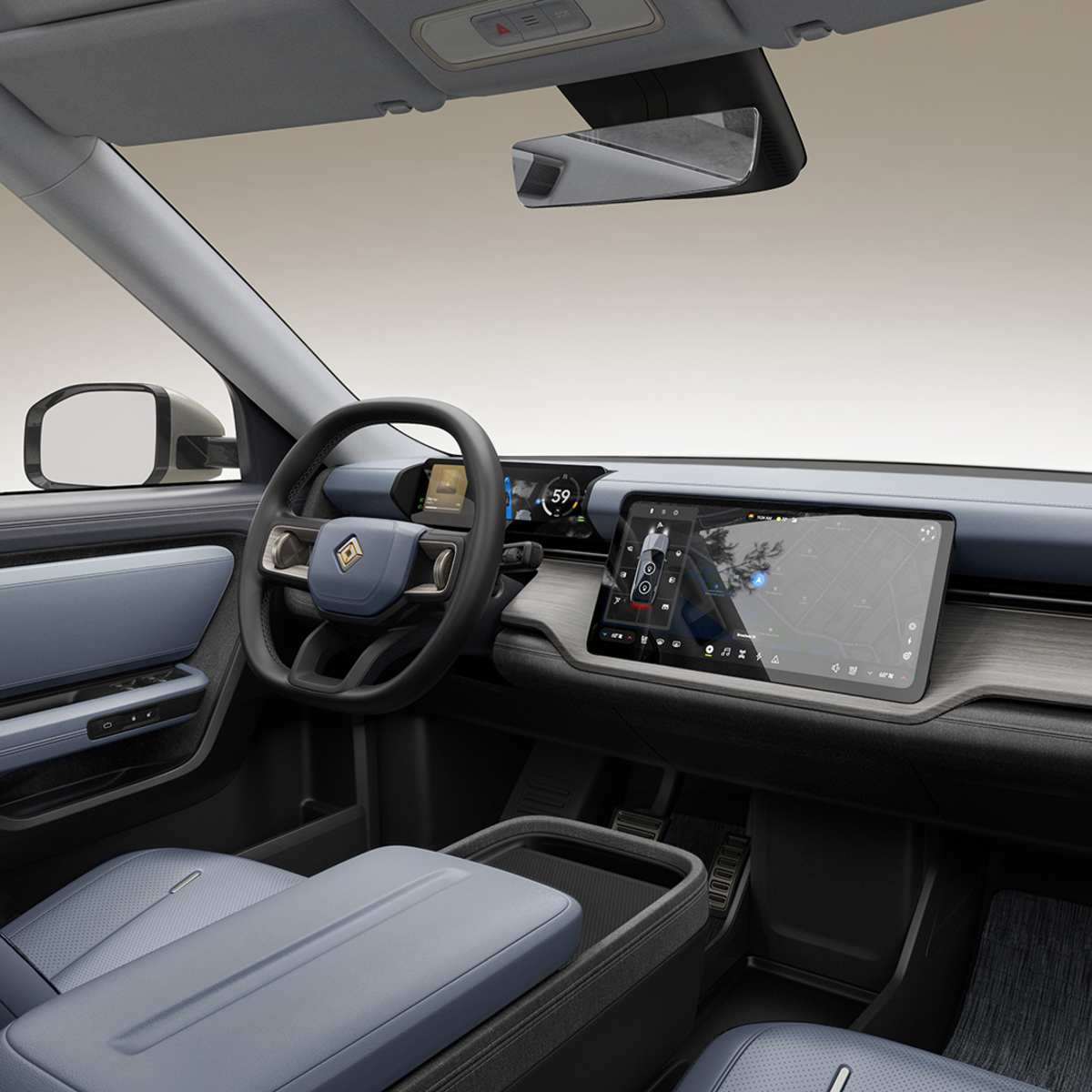
This is a medium-sized electric SUV made by Rivian, a company that specializes in electric outdoor vehicles. It is designed for camping and road trips, running entirely on battery power.
A classic version of the BMW 3 Series sports sedan built in the late 1990s and early 2000s, loved by car fans for how fun and responsive it is to drive.
This is a mid-sized family SUV made by Jeep that runs on gasoline. The 2015 version mentioned has a larger, more powerful eight-cylinder engine, which helps it pull heavy loads easily.
A standard plug located under the dashboard of almost every car made since 1996. It lets you plug in a small computer to find out exactly why your 'Check Engine' light is on.
This is a fully electric family SUV made by Tesla. It runs entirely on battery power, has a minimalist interior with a single large screen, and does not use gasoline.
This is a smaller, four-door electric car made by Tesla. It is powered by a battery instead of gas and is controlled almost entirely through a large touchscreen in the middle of the dashboard.
This is an extremely expensive, rare, and fast two-seat supercar made by Ford. It was designed primarily for racing and looks like a futuristic spaceship.
The collection of smart safety features in modern cars, like automatic braking or lane steering, that help prevent accidents using cameras and sensors.
This is an electric version of Ford's highly popular F-150 pickup truck. It looks like a normal truck but runs on batteries, has a large storage space under the front hood where the engine usually goes, and can plug in to power household items.
This is an older, luxury four-door sedan made by the German company BMW in the late 1980s and 1990s. It was known for being comfortable, well-built, and sporty to drive.
This is a medium-sized pickup truck made by Ford. It is smaller than a traditional giant truck, making it easier to park while still having a bed in the back to carry cargo.
The internal communication network of a car that allows different computers (like the engine controller and the window switches) to talk to each other using very few wires.
This is a small, budget-friendly hatchback car made by a Malaysian car company called Proton. It was designed for everyday driving in Asian and European markets.
A new way of organizing a car's electronics where nearby parts (like the front-left headlight and wheel sensor) plug into one local computer hub, instead of running long individual wires all the way to the dashboard.
This is a large, luxury electric pickup truck made by GMC. It runs completely on electricity, has a very fancy interior, and can steer with all four wheels to make parking easier.
This is a high-performance, two-seat sports car made by Chevrolet. Unlike older versions, the engine is located in the middle of the car behind the seats rather than under the front hood.
A safety system that automatically steps in if your car starts to slide or skid on ice or wet roads, using the brakes on individual wheels to help you keep control.
This is a vintage two-door sports car made by Mazda in Japan. It is unique because it uses a special type of engine called a rotary engine, which works differently than standard car engines.
A high-performance electric car from Hyundai designed to feel and sound like a loud, shifting gas-powered race car on a track.
LIVE
Hello, everyone, and welcome to The Drive Cast.
I'm Joel Fetter, Director of Content and Product at The Drive.
And I'm Andrew Collins, Executive Editor at The Drive.
And The Drive Cast is our weekly podcast, giving you an inside look at the biggest stories,
controversies, and people shaping the automotive industry.
Today, we're talking about your ability to fix your own car.
Literally.
Yes, sir.
And it's not just about your right to repair your own car, but also about your right to
choose your own mechanic if you don't want a DIY.
This is a topic that you may have heard before, but it's in the news again, well, for a lot
of reasons we're going to get into.
And a story I wrote recently about it, citing some comments from Ford CEO Jim Farley, really
irked a lot of people and with good reason.
And it's not just Farley either.
President Trump walked himself right into the issue now as have other members of our government
at various levels in recent years.
Indeed.
As cars have become more computerized and corporations have become more fixated on
data gathering, this has become an increasingly hot topic.
Cars are now honestly just rolling computers.
Yes, even the gas-powered cars.
A bad line of code from an over-the-air software update could probably brick a gas-powered
car at this point.
Forget trying to change out a taillight and having it not work with your car software,
which by the way is plausible in today's timeline.
But it's just literally even where you can have your car service.
So today it's all about the right to repair where we are today and what comes next.
By the way, if you like what we're doing here, do us a favor and hit us with a five-star
review on Spotify or Apple Podcasts.
It really does help get the drive cast in front of more people.
Okay, let's go.
All right, Andrew.
So the timing of this topic is kind of ironic, hilarious, whatever, however you want to call
it.
So in like recent times, right, you've driven like a base base Bronco with a manual transmission,
which we arguably ostensibly might consider a pretty basic car, right?
Yeah.
Like power windows or whatever, but the doors come off.
And then recently you drove the electric GMC Sierra pickup truck and you've driven the
electric Hummer EV, the latter of which has like 8,000 or 6,000 or $9,000 LED taillights.
And then right now I have a Range Rover, which is a sensibly rolling computer, despite having
a twin-turbo V8 engine under the hood.
But I've driven the electric Silverado EV Trail Boss, which is the sibling to the cars
you drove.
I've also driven the Rivian R2, like we are in such interesting times in terms of whether
it's a gas car or a electric car, how much they rely on electronics to run, despite what's
power in them.
So the topic is really interesting, but I want to give everyone some quick context real
quick in terms of repairing vehicles and wrenching on vehicles.
And I know you and I are at different levels, to be clear, you are far at the deeper end
than I am.
I don't know about that.
But let's give everyone a sense real quick before we dive into this topic on our background.
So you have a fleet of vehicles in various working orders and capacities at your house
and you wrench on them yourself to a level, to a level.
Yeah.
I have a pretty good crop of old and new-ish vehicles, got a couple of carbureted things.
I have an old international scout, got old Mitsubishi Montero, a bunch of carbureted
lawn toys.
And I do like to tinker with them.
I like to wrench.
I do my own oil and brakes and suspension and exhaust and basic stuff.
I get a little scared when it comes time to go deeper than the valve cover inside the
engine, but I'll pretty much do whatever.
The main thing is that it takes me forever to do things because I get really interested
in subsystems and mission creep, right?
So I've got my old E46 BMW in my garage right now and I brought it in to change the oil.
And once I got it up on Jax, I started seeing some stuff, other stuff I didn't like, little
leaks and I've been cleaning it all up and dismantling it.
And so I don't know when it's ever coming out of the part again, but how about you,
Joel?
Similar, but different, like I'm all about doing my own oil change.
And now we're at the point where the money I spend just to buy the oil and the filter,
I'm very confident it's almost break even just on the parts to then just have like my
mechanic do the oil change.
It's no longer about saving money for doing my own oil change.
It's like, I enjoy doing it.
It only takes me 30 minutes, but something I get to do with my hands, which isn't something
I get to do very often on cars anymore.
And it's not hard.
I've taught my son how to do it, not that it'll matter probably in the future.
But so I do my oil changes not to save money, but I've done breaks before.
I did not enjoy it.
And it's annoying.
And like so right now we have my wife's daily driver is a WK2 2015 Grand Cherokee with a V8.
And like that car has a very specific bolt that requires a very specific tool that is
for that job that you need to own just to do the breaks.
And so like a buddy sold his Grand Cherokee, he's like, do you want the tool?
And I'm like, honestly, I'm just going to pay my mechanic.
Like there's a time value equation.
I'm just going to pay the mechanic to do it.
Like, could I do it?
Sure.
Don't want to do it.
Not really.
Like I want to join it.
Like I'd rather spend time detailing it and like taking something that's imperfect, like
detailing a car and make it perfect.
If I'm going to spend my time doing it because I take joy out of that.
Like I find, I find that to be therapeutic.
Yeah.
The economics of having somebody do an oil chain or doing your own oil change
rather or not necessarily that great, because yeah, it is basically cheaper to
have a put, pull it into a shop.
The kind of the difference is, you know, if I do it, I know that the drain plug was
not tightened with an impact gun.
And I know that I can get the filter off next time.
So it's kind of that factor.
And another thing is just old stuff.
Like a lot of shops don't want to deal with 20, even 15 year old vehicles.
Like so, and I got a lot of old hardware.
So kind of got to be my own help sometimes.
But that brings us as we're talking about old cars and wrenching to today's topic,
right to repair.
And, you know, let's just get into it.
First off, start with the basics.
Andrew, what is right to repair for people who don't know?
Yes.
So I'm going to start with the kind of broad conceptual definition because slightly
different ways of phrasing it have made their way into various pieces of legislation.
Broadly speaking, right to repair is talking about the consumer's right to
basically understand and diagnose their own car.
I mean, we typically talk about it in terms of cars, especially since this is
a car site, but it absolutely also applies to home electronics, tools,
technology, I mean, everything, it applies to everything.
And one of the most important things that I really want listeners to understand
and everyone, everyone to understand is that this is not just about you and me
tinkering on our old nineties vehicles in our shops.
It's about independent mechanics existing, basically, and being able
to fix your late model car.
I mean, if OEMs own every aspect of vehicle diagnosis, then they're going to
be the only game in town when it comes to servicing them.
And I don't think anybody, any consumer wants that.
You certainly should.
Well, I mean, it overlays about modern cars and whether it's gatekeeping itself
for a mechanic, and I'm sure we're going to touch on that today.
You know, I remember there's a shop here, we're not going to start naming names,
but there was a shop here who had to make a life decision.
We're going to spend X number of dollars so we can basically license and have
access to one of the German automakers' tech systems so that they can actually
work on modern cars in this German automaker.
And eventually they were like, that ROI is not there for us.
We can do oil changes and all basic stuff without that.
So we're going to invest in that, which means that certain things for that German
car, if you owned it, you couldn't go to this third party.
You would have to literally go to the dealership, which actually that part of
it is something we're going to talk about, but it's gatekeeping.
So, so given that context, Andrew and the Braun conceptual definition, we just went,
yes, how do we get where we are today with talking about, you know, Jim Farley
and obviously President Trump, but it goes even before that, right?
Like this has been the news on and off for years.
Yeah, absolutely.
So I'll give you kind of the run up before we talk about what's happening right now.
I mean, we could go back to the dawn of industrial economics, really.
But we've only got an hour here.
So we'll fast forward to let's start with 2013.
This is kind of the first time that people really heard the phrase, right?
To repair in the news.
My home state of Massachusetts passed a law that basically said all vehicles built
after a certain year had to have had to be diagnosable with non-proprietary
technology, kind of trying to avoid the situation you were just describing.
And standardizations did exist before that.
You know, we had things like OBD2, which is where all cars made after 96 had
to be scannable with a certain kind of computer.
But that Massachusetts ruling was really when, when the American public
started first started hearing about this right to repair term 2013.
Okay.
So then shortly after that 2014, after market and auto industry groups got
together and joined a voluntary agreement that kind of codified the same thing.
Again, voluntary.
Codified the same concept, but their concession to OEMs was they would back
off trying to push right to repair on a state level and try to do it federally.
So we're, this is 2014.
Okay.
This is now a long time ago and an automotive technology has changed a lot.
I mean, the Tesla Model S was still brand new back basically back then, right?
So critically, that kind of voluntary agreement doesn't mention anything
about vehicle data and telemetry.
And this is going to become very important soon in this part of the story.
So now we get to why this legislation is kind of on people's minds again,
and why we just saw executives from Ford and GM meeting with the president
in the White House.
So now there's something being debated called the Repair Act.
And that stands for right to equitable and professional auto industry repair.
Okay.
That's being tucked in to something called Build America 250 Act.
This is also known as the Surface Transportation Reauthorization Act,
or commonly known as the Highway Bill.
This is currently being actively debated.
Now, stay with me here.
So very recently, there was language in the Repair Act that covered that data
and telemetry stuff.
So this data and telemetry, this is very important because modern cars collect
a lot of data, they use a lot of data.
The data that lives inside their car computer brains becomes important
to diagnosing them.
OEMs want to keep that for themselves.
Independent mechanics are like, hey, I need this.
I need to be, we need it to be able to diagnose modern cars,
which I think I agree with personally.
So the reason this is being debated again now, and I'm talking now now,
like as you're listening to this, this is currently, this is happening.
The language was removed about data and telemetry to go back to this
2014-era kind of language to get it into this Highway Bill that is in front of Congress now.
So you've got people on smaller business, smaller business advocates are trying to get
that reversed.
Matter of fact, an organization called the NFIB, which is the National Federation
of Independent Business.
That's actually the largest small business association in the US.
They sent a letter to Congress, basically pleading to reinstate that language about
data, making sure that an independent mechanic should be able to access
vehicle data, basically.
And there are some other spurs to come off of it.
But basically, that's where we're at right now is there's two sides to the coin are.
You've got consumers and independent mechanics and small operations on one side.
And then big corporations and shareholders on the other.
It's really that simple.
Tale as old as time.
Exactly, yeah.
But now, but now in modern times.
And as you were saying something about all this stuff, and you mentioned 2014,
all that, I was just thinking, what happened around that era was the first real
electric car that we all would know came into real mass protection, the Model S.
So it came in around 2012, 2013, and then it started picking up.
And then after that came the Model 3 and the Model Y.
We had the second end of the leaf.
And now we have really truly connected cars.
But even a RAV4 is a connected car now, right?
We just did the story about that guy ripping out the Bluetooth and the GPS and the sat radio
just so his car couldn't be tracked, which is the podcast we did last week about being cars
being tracked via license plate readers and signals from the numbers on all of your smart devices.
We live in a connected world.
So now it's in the news again.
Thanks to President Trump and Ford CEO Jim Farley.
Take us behind the scenes on what the latest is on this.
Yeah, I actually, yes.
So basically there was a meeting with Mr. Farley and one of the GM execs,
maybe Mary Barra, might have been someone else in the White House, and they all left.
And there were some follow-up questions.
Of course, people wanted to know what, like many things that come out of the White House,
it was quite murky about what was actually decided.
And someone from the Detroit Free Press caught Jim Farley at another event,
and they asked him point blank, like, so you don't want people preparing your own vehicles?
And you can watch the video on FRIP's website.
It's, he kind of does these like homelander eyes and is like, well, you know, no, it's a safety
issue. You know, I could work on my old Bronco, but I wouldn't want to work on a new Bronco.
And as I was listening to that, I was thinking like, what a weird car to pick.
Like if he had said Ford GT or like even Mustang Mach E, I might have been like, yeah, okay, I guess.
But a freaking Bronco, man, that's like caveman technology.
But I mean, I will concede, there's some stuff, you know, there's ADAS.
There is some stuff that I wouldn't want to touch as a private citizen,
but certainly independent mechanics would want to be able to mess with that.
And his comment, you could just watch the body language and the very careful way he phrased,
he phrased, he was trying to make it about safety.
And this is what you're going to hear auto execs talking about this
for the next, as long as this is being debated in the coming weeks and months, it's,
they're going to say it's no, it's not safe for people to work on their own cars.
But like I said earlier, this isn't about people working on their own cars.
It's about these companies hoarding all this data and information from us.
When they sell you a car, it should be your car to tinker with as you see fit.
And so all this to bring it back to the, of course, I wrote that up on the site.
And I will, I will say, I feel a little bit bad about using Mr. Farley's name because
it's really not a Jim Farley issue or even a Ford issue.
It's an industry wide issue.
He just happened to be the guy who had the juicy quote and people really resonated with people
because it is infuriating.
You know, I'm sorry for Mr. Farley.
If he had any annoying meetings with his PR staff, I'm sure he did after that.
But yeah, it's, it's an industry wide issue.
And, you know, we're going to, we're going to keep, keep seeing it.
You know, the couple of things you said that are interesting is, is, and I'm just going
to try and go in order.
I don't remember everything, but like one, it was interesting that Farley would choose,
like you said, the Bronco versus like a Maki, right?
Like, or a Lightning.
Like, like if he had picked an electric car, we probably wouldn't have bad in eye because
like, you know, high voltage batteries and whatever, but like, pick the car that you
can unbolt the doors.
So, but, but let's let in the defense, let's in the defense of Mr. Farley.
Even a Bronco, even a Bronco.
So, and let's just sidestep the ADAS stuff.
By the way, ADAS is like adaptive safety equipment, right?
So forward automatic emergency braking, automatic headlights, you have forward collision warnings,
et cetera.
If you, let's just sidestep that, which by the way, that stuff is really important.
And if you take some of those sensors out, they need to be recalibrated.
So like when you, if you crash a car and you go to a repair shop, you need to either A,
go to a certified repair shop or B, a shop that can bring in a certified person or take
to a dealership to calibrate that stuff.
Otherwise, it really could like screw your car up.
If you were to like be in traffic and you thought it was going to be an accident, you
weren't going to be an accident and then it, then it hit the brakes or whatever.
But that's not the point.
So like even a Bronco, the days of like when you would modify a car, probably even not
truly in my lifetime, because like electronic control systems came in play in like 90s.
My E34 and five, which was a 1991 car had electronically controlled powertrain through
a first generation board.
Okay.
And we can talk about that in our time, whatever.
But so a modern car, like a Bronco, the powertrain is running off electronics, right?
So you used to like cam the crap out of a car or you would modify all these other elements
to the actual engine.
Now you plug it in computer and you just give it a software code that's an employee's
a new tune that modifies the turbo or the boost or any of this other stuff.
And, and suddenly you have more power, right?
Yes, you can still increase like the size of the turbo and the boost pressure and all
those things that's mechanical, arguably, but you can literally plug in one of those
summit tuners.
Ford approved this by the way, it's like a $1,300 option on the Ranger, the 23
turbo Ford that's on the Ranger and the Bronco.
And suddenly you have more power.
Like you just pushed a button and that takes software and code, which is what that powertrain
is running on.
Now, if you uploaded a bad piece of code, you could break your car.
You could just not start like that car runs off electronics when you push a button.
That's how the car starts.
So, I mean, and I'm not trying to defend him.
It's just like there's so many electronics running through every piece and every element
of the modern car at this point that you got to ask yourself, I mean, I don't know how to
code like I couldn't do.
I wouldn't know what piece of code I'm putting in the car is bad.
Would you?
It's actually not as hard as you might think, not to contradict, but I mean,
you know, I had an eighth generation Honda Civic and, you know, that was home coded.
I mean, it's, I basically had a fuel map that was running off a software called Hawn Data
and I had to talk to it with a laptop and I would email the car's information to a
to a professional who knew how to read it.
He would give me settings.
I would input the settings and we would go back and forth emailing each other and we
could refine, you know, things like throttle response and even power delivery.
But all this just, so I agree with you in one sense that.
But you just, but you just said the same thing.
You had to email the dude who was the expert or whatever.
Yes, yes, yes, yeah.
So, so like you had, you still had to rely on someone, someone that knew how to code
and make the tunes for you.
And yes, it was collaborative or whatever.
But like, I guess, I guess actually, if I wanted to argue your point, I could just go
to Claude and say, I need a code.
But then again, what if I load a bad code and like I misfire my engine or I whatever.
But we're kind of straying from right to repair here.
I mean, you're like stuff like, like modding and I mean, that's been around for a while.
And it's like, even again, like it's not really about the home, the home tinker.
It's about like the whole, the OEM owning this information and walling it behind their,
their garden.
I mean, yeah, of course, like in the broad sense of should just anybody be dicking around
with their car and their driveway.
No, I mean, absolutely not.
Like, you know, it's, they are dangerous pieces of equipment and you do need to be
careful with them and treat them with respect.
Absolutely.
But the safety comment really disappears when you're talking about like independent pro
mechanics.
Like that's who I'm the most nervous about losing access to this, this information.
And I mean, you know, I'm already feeling this frustration with my freaking lawnmower.
I've got a Cub Cadet zero turn electric lawnmower that I bought some new blades for.
And I bought them directly from the manufacturer and I went to put them on and I couldn't find
the spec anywhere, the torque spec.
I mean, this is, this is a blade that's going to be spinning on a very powerful motor.
And they said, no, you need to have it installed by a certified Cub Cadet person.
And I'm like, well, I live in a rural area.
I like, I don't have a, I don't, they have no way of executing that.
And so I basically had to like convince the customer service person.
I was like, look, I'm going to bolt this blade to this motor and it's the bloodest on your
hands if the spec is wrong.
And they ultimately did give it to me, but I don't want to count on that for like all
my future stuff.
So yeah, I guess that does bring it back to the driveway tickering.
But like, I mean, I suppose like, what if the gate keeps like an oil change?
I mean, that wouldn't be a thing for an EV, but like, you know, like, so in our grand
jerky, the, when you change the oil, there's the oil maintenance minder on the gauge cluster,
right?
And to change that, you've got to go through like this, this touch your nose, wiggle your
wiggle your finger, whatever.
Like I never, I never remember the sequence.
I have to go to YouTube and look it up every time because you got to put it into run, tap
the brake three times, hit the gas, blah, blah, blah, then turn the car off again.
Then you turn it on and then it, it does it.
And I'm like, all right, this is insanity, right?
Yeah.
I mean, it, it, they're so complicated, truly.
Yeah.
Yeah, they are.
Yes.
And, and I'm not, yeah, I'm not disagreeing that like modern cars are complex and heavily
computerized.
Absolutely.
And you know, the other thing is like, you were talking about stuff like the modern
Hummer.
And I mean, with Canbus, another layer of complication is everything is so interconnected
within the car.
Like in some vehicles, like, like you're talking about a light bulb can break the vehicle
because it's getting the wrong signal from the tail light.
So it won't activate some ancillary system that you wouldn't think is connected.
But yeah, the days of like, just having an old spool of wiring connected an ignition
to a starter, that's over.
It's all, it's all interconnected now for sure.
Well, I didn't mean that's an interesting topic, right?
Because, I mean, you went to the Rivian R1 Gen2 launch and you saw where they took from
17 ECUs to 17 ECUs and made a zone architecture and it's a northwest, southeast thing.
They took all this wiring out, which takes weight and complexity out.
But also, now the entire car systems are running on seven ECUs, seven computers, right?
And like, if one of those ECUs goes out, you're not going to, like to your point about the,
you know, the headlights are running on one wire and this wire and whatever, like that's,
those days are gone.
Like this is, they're stripping as much out of these cars as they can and trying to have
everything do everything.
It saves weight.
It saves costs for them.
Yeah, the Rivian one's an interesting example.
And electric vehicles in general, honestly, because I really like them.
I love the EV Sierra.
I like the Rivians.
I honestly am enjoying the Hummer much to my own surprise, quite a bit.
Electric propulsion is awesome.
Like I really like it.
And I love the idea of Rivian, you know, reusing their wire usage and simplifying.
Feel a butt coming out.
No, no, well, the butt is like, I just want to still be able to get the specs to fix it.
If like, I'm going to have Rivian and the motor fails in 10 years.
I want to be able to not necessarily, like if Rivian goes out of business, I want the
aftermarket to be able to build the part, right?
Like I want things to, to keep going on.
That's, I mean, this is another thing that is connected to right to repair very much.
So is if all these, all these, if a company like, let's use Honda, for example.
Fisker, Fisker, Fisker.
Yeah, okay.
Perfect example.
Right. Let's use a real example.
Yeah, Fisker, you know, all their stuff is locked down.
And once the company goes away, there's like, well, now these cars are giant paperweights.
It's like, well, if, if the aftermarket like was able to step in and supply things, that
might not be the case.
But yeah, so right to repair is really going to affect your ability to keep a car for a long time.
Like once you get past 15 years, like, you know, I just had this problem trying to find
a freaking windshield cowl for my dozen three beam or BMW doesn't make it anymore.
They're not interested in building it.
So you got to go to the aftermarket.
And if right to repair doesn't pass, that won't happen anymore.
Like you won't, there won't be an aftermarket.
This is like, this is what's at stake.
It's interesting too, because so that 300ZX is in our garage.
Nissan doesn't make a lot of parts for that car anymore.
It's very annoying.
And during our interview with Pons, he's the VP of Nissan North America.
And he was on the drive cast a couple of months ago.
He, he, he announced we broke the news that they're going to, he's got a guy in place that
over the next, I don't remember what it was, 12, 16 months, they're going to literally spin
up a program that is going to bring parts that are for defunct cars back into production
and support the aftermarket, blah, blah, blah.
I was like, cool, I'm going to need like a blue dashboard or whatever.
Right.
Like I was like, I need some blue plastic clips, man.
I need some plastic clips.
But the point is to your point, like that.
So that car is 30, 25 years old, 30 years old.
Yeah.
25, 1990.
And math is hard.
But and, and the average car on the road today is I don't remember what, 12 and a half?
Something like that.
11 or 12.
Yeah.
So to your point about 15, and, and we're actually coming up, we're coming up on that
with the original OG model S, right?
So the model S launched in, I mean, I think really low volume in 2012, but like 13 was
like when we really started getting numbers, like 12 was like low.
But, but that puts us at like 13, 14 years old on the original OG model S's and they're
still out there with, with a lot of them with original battery packs and impressive range
for what they are at this point.
They've held up much better than we ever anticipated.
Maybe not so much for their digital gauge clusters that were bleeding.
But that's because they didn't use automotive spec parts.
Nobody believed they were going to be a real company at that point.
They improved that car as the car went on and time went on.
Point is you're probably not replacing that digital gauge cluster in the model S yourself,
right?
Like you're not or, or, or maybe you are a headlight.
Like I don't know how complicated it is, but we are getting to that point now where
certain early EVs are hitting the 13, 14, 12 year mark, right?
That average age of car on the road.
It'll be interesting to see how this plays out as whether it's independent mechanic
or do it yourself or, or what, what, what, what's going to happen to these cars as the
first model threes start really aging out, right?
Yeah, I don't know.
There's probably some total EV nerds that would love to get into that, but I don't,
I mean, I would like to see them still mobilizing.
I mean, why the heck not?
If the bet, if they still work, then keep them running.
Well, on a battery pack is probably a lot less expensive than a new car.
Right, exactly.
Yeah, I know that's, it's a throwaway culture, man.
It's in everything.
We do live in a throwaway culture, right?
Like how old do you really live with your iPhone?
I don't think I've kept an iPhone ever past three years, three and a half years.
You know, it starts feeling slow and the battery isn't as good anymore.
Like then you get a new one, you're like, wow, the camera is so amazing.
Exactly.
You know, we live in a throwaway culture.
Yeah, it's, it's, it's deeply unfortunate.
It's funny.
I mean, I was just bringing it back to the Hummer I'm driving.
I mean, it's got carbon fiber wheels and I'm thinking to myself, I mean,
they're super cool.
But like, if you, if you scratch that off road, I mean, you're not,
that's not repairable.
I don't think nobody's taking the carbon fiber wheels on the Hummery.
They're going to Starbucks.
I guess.
But I mean, I don't know.
I was just, I was looking at that and like the body's all luminous.
I mean, it's really cool, but it's like, man, this is going to be hard to fix.
I guess, you know, as I'm saying this, I'm like,
I mean, it's a Hummer, so it is supposed to be like a super car effectively.
So I'm like, all right, well, I guess that can be hard to fix.
But it's funny.
It's funny for us.
Throwaway is our society and even the automotive scene is becoming like,
if you look at the cars and I want to say that we grew up with, but I really
think actually it really goes up beyond our age range of like cars before our time.
You know, cars didn't last then.
And I'm someone's going to email, even someone's going to email me and be like,
you know, back in my day, these cars lasted forever.
We had to push the thing for the headlight.
It was like, yeah, but guy, they rusted.
They rusted out.
They did not have the paint protection.
They had single stage paint.
Once we even got like, we are in an era where cars don't rust as quickly.
Cars literally start when it's negative 10 below every time, even diesels, right?
That didn't exist when I was a kid.
You didn't always know your car was going to start when it was 20 below zero.
And that's how it is today.
So I think that I think we forget about this and the modern conveniences.
And cars do last a lot longer than they ever did.
Yeah, it's totally true.
Despite the throwaway culture.
Despite the throwaway culture, yeah.
They may be on their fourth owner, but they last longer than ever.
I'll just take a quick like since, you know, since this is an enthusiast site,
I mean, I always, I think personally that like 95 to 05 is kind of like peak automotive technology.
It's like it was early traction control.
It was like things were easy enough to work on and computerized enough to be reliable,
but still simple enough to be basically maintainable.
That's my little soapbox.
I would actually, I would mostly agree with that.
And I would also add like appointed because I grew up and I'm sure people that have listened
to every episode have a pretty good understanding of my background and automotive from Datsun,
Nissan to Mopar to the German specifically Audi with WMW Mercedes in there.
So I will always tell you when we talk about specifically, let's say Audi, right?
I will say Audi's peak era.
Peak era was late 90s and very early 2000s.
So it's like the B5, A4, C5, A6, D2, A8.
And I will also emphasize that in 2001 was the model year that Audi introduced
electronic stability control.
So there are certain things in history you look at that were like really modern marvels
that maybe enthusiasts were like, why do I got to wear a seatbelt?
Why do I need that?
I know how to drive, but they were really impactful and important.
And I would say like seatbelts were one of them, airbags were one of them,
ABS and traction control.
And then legitimately, the more modern in my lifetime, your lifetime, the ABS,
but then electronic stability control was like a life changing thing for people.
And then after that, I would say automatic emergency braking, right?
Like these are things that legitimately saved lives.
I don't care the hill you're going to die on of like,
I know how to drive, blah, blah, blah, blah.
Yeah, guys, it saves lives.
It does.
We had a 2000 Audi and then we had a 2001 Audi.
And the 2001 Audi had the ESP, electronic stability control.
And my dad drove it and was like, I might need to trade in my car.
Like legitimately it was that life changing that it was because it's not that you didn't
know how to drive.
We live in Minnesota in the winter.
We run hunk of politas, but like the difference between ESP and no ESP is
dramatic when you're driving around with your kids.
Yeah.
Oh, absolutely.
Oh, yeah.
I guess I should interject.
Like I definitely, I mean, I understand that like my 1975 international scout is objectively
terrible in so many ways.
It's a death trap.
Like, yeah, exactly.
Oh, absolutely.
And so, yes, so they're right.
So, but I'm not going to say like, we need to go back to 70s technology.
That is not at all what I'm trying to say here.
Just for the wreck.
No, you're just arguing that we should, gatekeeping.
And I agree with that gatekeeping.
This goes way beyond automotive, right?
There are so many court cases in different countries.
Let's just use Apple and the iPhone and the app, the app store and the ecosystem and
siloing apps and all that.
Same thing, different fruit.
Ironic Apple fruit.
Yeah, yeah, perfect.
It's literally just gatekeeping.
That's what it comes down to.
And the idea that someone that is a qualified mechanic can't work on a Bronco.
Crazy, right?
Even Rivian have Rivian certified repair centers for it now.
They do it for collision.
They don't have their own in-house collision, but they have their own service service, right?
So, like, you know, I don't want to get into because I don't know for sure
whether you could third-party independently work on a Rivian itself.
I know you can for body repairs.
But, I mean, again, gatekeeping.
Like, can third-party mechanics work on Teslas?
This is, it's a real issue as we go forward, truly.
As cars are more software defined than ever,
this is an issue that we're no longer talking about breaks.
We're talking about, can you...
Do you remember changing our head units when we were teenagers?
Of course, yeah, of course.
Yeah, like, just changing our head unit.
Forget doing that these days.
Have you been to crushwood.com in recent years?
Like...
Right, no, no.
That era is long over.
It's...
Remember when you used to walk in a Best Buy?
You could see all the stereos on the wall.
Yeah, I used to walk in that, yeah.
Yeah, yeah, so many explode speakers.
I had the 8-bit Dolphins in my, in 1989, RX7.
The, like, animated Dolphins.
I didn't have the Dolphins.
That wasn't that cool.
I had a pie in your head unit in my XJ,
but it was not cool enough for the Dolphins.
Yeah, well, that's...
I would say there's still time, but there is definitely not.
I don't know where you'd even find that anymore.
I don't know where you'd buy that.
Anyway, so final thoughts on where you think we're going and what...
And by the way, if you're a consumer and you wanted to be an advocate or fight,
like, you know, what would you tell somebody?
I would say definitely look into this Build America 250 Act
and specifically dive into the Repair Act.
That's just Repair in all caps.
If you Google Repair Act, you'll find what you're looking for.
And again, that stands for Write to Equitable and Professional Auto Industry Repair.
There are a lot of groups, consumer advocate groups,
rallying, trying to make things happen.
We are going to be covering this a lot more on the Drive Trust.
When after I posted that story about Mr. Farley's comments,
I got so many emails, including some from like political consultants
and people at SEMA, true experts in the industry.
And I will absolutely be following up on that
and talking to them and getting their perspectives
and bringing that to the drive.com in the near future for sure.
Yeah. I mean, you can obviously, when you do research this email,
your congressman, senator, anything like that,
like this is a national issue at this point, right?
I mean, the president was waiting...
A hundred percent.
Yeah, a hundred percent.
And I will also close as a call out, like we ran a story,
this is I think last year about, when we got a tip,
it was a tip from someone about like the Hyundai Ioniq 5N
and how it was being gate kept from being able to change your own brakes.
This is a Trek car, right?
And we ran this whole story about it.
And then we talked to Hyundai, we investigated it,
we reported two different stories about that topic.
So if you know of an issue, there's some things being gate kept from
being able to be prepared, worked on, et cetera, definitely hit us up.
Tips at thedrive.com.
We will definitely investigate, look into it and report on it, you know?
We appreciate the tips, a lot of stories come in that way.
So I think that's about it.
Okay. Yeah. Good combo. That was fun.
That's it for this week's episode of The Drive Cast.
Thanks to the Trump administration and Ford CEO Jim Farley
for bringing this topic back into the spotlight again
to Andrew for his reporting insights on this important topic.
Thanks to our editor, Tyler Mark.
And thank you for listening.
We'll be back next Wednesday.
Be sure to check out thedrive.com for our full coverage on this topic
and a whole lot more.
Subscribe to one of our fine newsletters.
They're free, by the way.
Follow us on Instagram, Facebook and TikTok.
And subscribe to us on YouTube,
where we've got a lot of cool videos coming up.
We'll see you next week. Bye, everyone.
About this episode
Modern vehicles are increasingly becoming rolling computers, raising critical questions about who actually has the right to fix them. Hosts Joel Fetter and Andrew Collins dive into the evolving battle over the Right to Repair, exploring how vehicle data and telemetry are sparking intense debates in Congress. From the history of Massachusetts' landmark 2013 law to the current Repair Act, they discuss how manufacturer gatekeeping threatens independent mechanics and DIYers alike. They also share personal wrenching stories, illustrating the stark contrast between classic project cars and modern, software-dependent vehicles.
Who's allowed to fix the car you own? Who's allowed to choose the mechanic that wrenches on the vehicle you own? As cars have become more complex and computerized, and corporations have become more fixated on gathering data, the topic of right to repair has become more intense. It's been thrust back into the limelight with recent comments from automaker CEOs and the White House.
The Drive's Director Of Content And Product Joel Feder and Executive Editor Andrew P. Collins break down what right to repair is, what's happening, how we got here, and what it means for you.
Stories mentioned in today's episode:
Feds Might Flip the Script on Right to Repair Vehicle Emissions Systems
Ford CEO Jim Farley’s Right To Repair Comment Should Make Every Car Owner Uncomfortable
Want To Stop Your New Car From Transmitting Your Personal Data? It’s Possible
Replacing Brake Pads on a Hyundai Ioniq 5 N Requires a Professional Mechanic’s Login
00:00 Intro
06:05 - What is right to repair?
07:53 - How did we get here?
10:49 - Why are we talking about this? Where are we now?
12:44 - Ford CEO Jim Farley claims it's about Safety
21:14 - Modern cars are complicated and computerized
22:49 - The future
32:32 - What can consumers do?
Learn more about your ad choices. Visit megaphone.fm/adchoices