DAILY: BMW iX3 Starts Strong, Lucid Gravity Disappoints and Porsche Cayenne EV Range Test | 19 Oct 2025
EV News Daily - Technology and Business of EVs
DAILY: BMW iX3 Starts Strong, Lucid Gravity Disappoints and Porsche Cayenne EV Range Test | 19 Oct 2025 EV News Daily - Technology and Business of EVs · Oct 19, 2025
The BMW iX3 is an electric version of BMW's X3 SUV, meaning it runs on electricity instead of gasoline. It's designed to be environmentally friendly while still providing the comfort and space that people expect from an SUV.
The BMW Neue Klasse is a new line of electric cars that BMW is creating. It's meant to be more efficient and use new technology to make driving electric cars better and easier for everyone.
The BMW 3 Series is a type of car that is both sporty and comfortable, making it great for driving and everyday use. It's been popular for many years because it combines fun features with a nice interior, which many people appreciate.
Rear wheel drive means that the back wheels of the car get the power from the engine. This can help with driving and handling, especially in fast cars.
EPA range is how far an electric car can go on one charge, according to tests done by the government. It's important for knowing if a car can meet your driving needs.
A 123 kilowatt hour battery pack is a big battery that stores energy for electric cars. The bigger the battery, the further the car can drive before needing to recharge.
In-house electric motors are motors made by the car company itself. This means they can design them to work perfectly with their cars for better performance.
Miles per kilowatt hour is a way to see how far an electric car can go using a certain amount of electricity. The higher the number, the more efficient the car is.
The Porsche Cayenne is a fancy SUV that offers both speed and comfort, making it a popular choice for those who want a powerful vehicle that can also carry passengers and cargo. It's known for being stylish and fun to drive, just like other Porsche cars.
The Porsche Taycan is a high-performance electric car that can charge quickly and has features to keep its battery cool, making it a popular choice among electric vehicle enthusiasts.
400 kilowatt charging means that an electric car can charge its battery very quickly, which helps drivers spend less time waiting for their car to be ready to drive again.
EREVs are cars that can run on electricity and also have a gasoline engine to help charge the battery. This means they can drive longer distances without needing to be plugged in all the time.
Kilowatt hours (kWh) tell you how much energy a battery can hold. A bigger number means the battery can power the car for a longer time before it needs to be charged again.
A plug-in hybrid is a type of car that can run on electricity and gasoline. You can charge it by plugging it into an outlet, which helps save fuel and reduce emissions.
The Tesla Model Y is an electric SUV that is known for being eco-friendly and having a lot of high-tech features. It's spacious enough for families and has a long battery life, which means you can drive it for a long time before needing to recharge.
Level two AC ports are special charging stations for electric cars that charge the battery faster than regular home outlets. They are often found in public places so you can quickly charge your car while you're out.
Chargeway is an app that helps people with electric cars find places to charge their vehicles. It shows where charging stations are and how much it costs to charge.
The Ram 3500 is a big truck that can carry and tow a lot of weight, making it great for work or heavy-duty tasks. It's built to be tough and reliable, which is why many people who need a strong truck choose it.
Plug-in hybrid powertrains are systems in cars that use both electricity and gasoline. You can charge the battery and drive on electric power for short trips, but when you need to go further, the gasoline engine kicks in.
The BMW i3 Rex is an electric car that has a small gas engine to help it go further when the battery runs out. It's designed for people who want to drive electric but need a backup for longer trips.
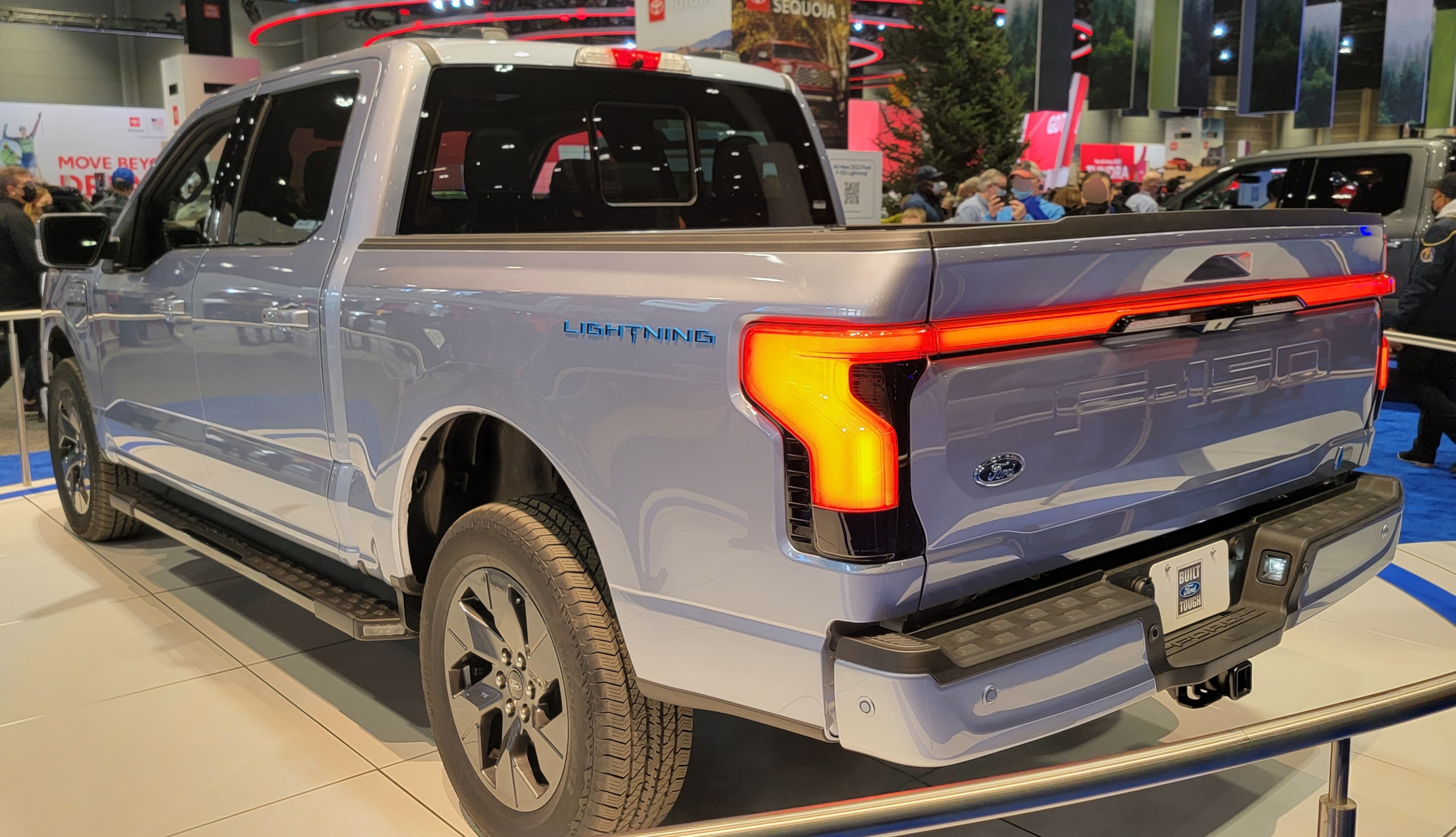
The Ford F-150 Lightning is an electric truck from Ford that is based on the F-150, which is one of the best-selling trucks in the U.S. It's designed to be powerful and useful, but it might not be as good at towing heavy things as some gas-powered trucks.
LIVE
Welcome back to the podcast. Today, BMW iX3 starts strong, lucid gravity disappoints
and the Porsche Cayenne EV range tested. Plus, stay tuned. Later in the show, I'll tell
you one of the most interesting pickup trucks around, just got more… well, interesting.
We'll start with news of BMW saying the iX3 has collected more than 3,000 orders in Germany
alone in the six weeks after debut, outpacing orders for the combustion X3. And that eases
BMW's concern about meeting expected initial volume. The iX3, the new one, bundles new motors,
new electronics, new batteries, I guess that's why they call it the Neue Klasse. BMW is saying
it's the most efficient and advanced EV they've ever made, and that for its size as well in
the marketplace. Production will begin at the new facility at Debrezen in Hungary, established
for the Neue Klasse vehicles, with first European deliveries beginning in spring, US in the summer
next year, BMW's prepping the Mexican plant as well, but that may be for US deliveries,
that may not we don't know, it might come from Hungary. So far, BMW has revealed only
the dual motor iX3, 50x drive, that's 463 horsepower, it's 62 miles an hour in 4.9 seconds,
and the battery pack is 108 kilowatt hours. It's WLTP range, 500 miles, 805 kilometers,
which BMW says is the longest range EV in Europe, I'll tell you why that's not true in a moment,
and the German starting price is 68,900 euros, that's 80,000 US dollars equivalent,
but bearing in mind that that German price would have to be the out the door price,
because we don't advertise prices over here without taxes and extra things like that,
you have to advertise the price with VAT, and that's the price you would pay. So a starting price,
which is high but not unreasonably high for that kind of vehicle, unlike the BMW 3, until the BMW
3 series launches rather, with the same package and the same engineering, but in a smaller
lighter car, which could go further, for now the iX3 wins, it is a long range EV and 500 miles is
nothing to be sniffed at WLTP, but bearing in mind, we do have the Lucid Air, now in fact Germans
have the Lucid Air, I can't buy a right hand drive Lucid Air, but you can get it in left hand drive,
Germany's one of the markets they sell it in, now the Lucid Air is obviously a vastly different body
style than a BMW iX3, but it is available here now, and in its cheapest version, the rear wheel
drive air pure trim, that's 516 miles on its smallest wheels, but it's 89,000 euros, so it's
you know it's 20,000 euros more, but again it's a whole different segment of vehicle, it's a slippery
sedan, where the grand touring, I believe, goes up to 597 miles rated WLTP, if you run it on 19
inch wheels, and so it's huge, Lucid's not selling a lot over here in Europe right now, I'm sure they
would love to, but they do technically have the longest range electric vehicle on sale, but I get
BMW's point, now let's talk Lucid, because their other car, their new car, their SUV, the Gravity,
just got a new range test by the best in the business, and that would be my friend Tom
Logany from State of Charge, now there's no doubt the Lucid Gravity is highly impressive, it's a
three row, properly three row, not all will stick a couple of you know seats in the back for people
with no legs, large SUV, Lucid rates, well the EPA rates, although the EPA lets car makers submit
their data and they go with that, Lucid rates the Gravity grand touring at 450 miles EPA,
helped by a 123 kilowatt hour battery pack, I believe that's 123 gross, not usable, efficient
in-house electric motors, compact packaging, and a highly aerodynamic body, the grand touring is the
sole model on sale, it starts at $96,000, however on a recent 70 mile an hour highway range test,
things didn't go to plan, State of Charge host Tom Logany ran his standard 70 mile an hour highway
range test on the New Jersey Turnpike, very little elevation, and he does a loop as well,
it's very windy, but he does a loop and he ran it down to 0%, he pulled into the charger at 1%
but then it ticked down to 0, tyres at manufacturer pressures, the smallest aero wheels, ambient
temperatures in the 50s, it was a nighttime run because he wanted to do exactly 70 GPS and traffic
is busy and so he finished at 3.32 in the morning I think, now the Gravity posted, and the number is
the number by the way, 345 miles, 345, yeah I just told you EPA at 450 miles, that's a significant
difference, and there's lots of mitigating factors in this, it averaged 3 miles per kilowatt hour,
but it's more than 100 miles short of the EPA estimate and Lucid's efficiency target of 3.6
miles per kilowatt hour, Lucid air will do easily 4 miles per kilowatt hour and more at those speeds,
at 3 a.m. with the car at 0%, Tom couldn't start charging at the Tesla Supercharger that he started
at, considering it's the same charger that he'd just used and the car wouldn't initiate a charge
on any of the, I think he did three units on the Supercharger, so with the car showing battery
critically low on the dash, he crawled to an Electrify America station one mile away and it
saved him, who'd have thought Electrify America to the rescue, it's one of the oldest stations in
New Jersey as well, but it's a fast, it's a 350 kilowatt DC fast charger, he needed like five
minutes of charging to get home on the gravity, but the Tesla Supercharger simply wasn't playing
ball, but we think it was the car, so luckily Tom bought his CCS to Nax adapter, because the
gravity has a native Nax port, he charged, he got home, afterwards he contacted Lucid, now the
engineers, because it's a connected vehicle, were able to go through the data of the range test,
they say they found a problem with the rear drive unit, it's not all bad news, the car will do
naught to 80% in 30 minutes on a massive battery, but it's all about the efficiency as well, so
you're going to add 280 miles of range in 26 minutes of charging, which is why Tom needed
like five minutes to get home, however, a couple of questions, Tom has many questions, go and watch
the video, link in the show notes if you want to spend, you know, 40-50 minutes of Tom Malogny
brilliant of doing range testing, and there's no wonder why car makers send their cars to him
to do that repeatable range, a proper range test, 70 mile an hour highway range test,
but it was cold, it was windy, but that accounts for a little bit, Lucid say that he left the
rear climate on, that'll be a few miles, he turned it off, but it was on,
but the more concerning is the rear drive unit issue, but this was a press car that they
shipped to him, now I'm not saying that they should fettle every press car or even worse, tune
them differently to what would be a customer series production car, you want something
that is just representative of what a customer would buy, but the car drove fine and seemed fine,
but Lucid say no, we have an issue with the rear drive unit, which is what stopped it starting a
on the Tesla supercharger at 3.30 in the morning, but that didn't flag up anywhere, so if you'd
spent $100,000 on that vehicle, presumably you'd be driving around with it, and there is apparently
an issue, they came and collected the car the next morning, it was gone, he didn't even get to
finish his week he had with it, because they're like don't use this vehicle, we'll get you a new
one, so yeah some questions around that, because well if the car is broken and wrong and they don't
have been shipped in the first place, why wasn't the issue identified, and you know it's complex,
it's difficult, they're a startup company, they've been around a long long time, Lucid has a big
history, and this is a new vehicle, and I'm not pretending it's not harder than it is, but it's
not ideal is it, and so they'll get him a new car in the next, well I'll say a few months he'll do
it again, but that gets really cold where he is on the east coast, so maybe some warm weather,
range testing, and by the way I'm fully aware that it's 350 miles or 345 on a big three row SUV,
and it sounds like I'm belly aching about it, and I'm really not, it's a very impressive result.
Another range test done, Porsche's third all-electric model, the Cayenne Electric, logged the big
number 353 on a 70 mile an hour range test, however they want production vehicles, they're
nine months away from series production, very very kindly, and you know Porsche, it's very very open
with the YouTubers who did this, and so again my friends, Tom Logney, State of Charge, Kyle from
OuterSpec, also Mac Hogan inside EVs, were invited by Porsche to come and drive these
camouflage cars in the US, 70 mile an hour range test, lots of variable speed though,
it wasn't perfect in traffic, and also lots of elevation on the route they chose, but still,
these are journalists, and they don't owe Porsche anything to fake the result or whatever, well
there were Porsche engineers in the vehicle, so again the vehicles were heavier than typically,
you know you normally do a range test with one person in it, it had luggage and stuff inside the
Porsche Cayenne, these aren't finished vehicles, the engineers were using the drives as well for
some validation stuff, so not a pure range test on a vehicle that isn't going to be made for six
to nine months, but the Cayenne absolutely smashed it, now the Cayenne uses six battery modules
rather than the McCann's 12, integrating the modules on the Cayenne as a structural part
of the vehicle, rather than a battery box or tray, that reduces mass, it adds a second,
a top battery cooling plate, an heating plate as well, alongside the bottom plate for better
thermal management, Porsche expects the charging to be materially better than a Taycan or a McCann,
so 400 kilowatt charging, fantastic thermal management, and you know if you are 70 mile an
hour in a Porsche Cayenne after 350 miles, and it would have gone further because the batteries
weren't even at zero when they ended it, then charging at 400 kilowatts with a great charge
curve as well, I think it's fine, like physically you need a break as a driver, and to go and get
some refreshments and on off you go again, and so they went down to 2% state of charge to get
353 would have gone further, maybe 360, 365 wasn't a perfect range test, but that Porsche Cayenne,
which is a long way off from serious production, looks deeply impressive already, now China's
extended range electric vehicles are now 10% of their NEV market in the second quarter of this
year, a market that until now has been EVs or plug-in hybrids, EREVs are plug-in hybrids, but
there's no official definition, I think we can define them as a battery and traction motors,
which are electric, and gasoline engine which charges the high-voltage battery never connected
to the front wheels or rear wheels, that's not a perfect definition because some can connect to
the wheels at highway speeds, because it's not a traditional gearbox, but they can anyway, it's
normally their extended range EVs means a gasoline generator, and so they're becoming a little popular
in China because the car makers are advertising the total range, so they're a 2,000 kilometer vehicle,
yeah the battery, they're big batteries as well in the Chinese one, 70, 80 kilowatt hours,
and an engine, and you just, it's kind of overkill to be honest, now the European group Transport
and Environment published a new study this week arguing that when EREV batteries are depleted
they're just as bad as conventional gasoline vehicles, emitting just as many pollutants,
the principle justification for EREVs is that you plug them in and do everything you want to do
electronically or electrically, but plug-in hybrid studies in Europe show owners seldom plug in
and instead drive primarily on gasoline, producing equal or greater emissions and higher fuel
spending, plug-in hybrids have been one of the great cons of so many emissions reductions stories,
because many plug-in hybrids were bought because of tax benefits through fleets and business purchases,
and yet the owners didn't put a plug charger on the wall of the house or whatever,
they just got it because it was the cheaper version, and they never plugged them in,
and so they're just as bad as combustion cars, and of course plenty of plug-in hybrid owners
do charge them to 100% and do most of their miles on electric, it's not everybody,
but if you don't charge these vehicles there's no point carrying around a really heavy massive
battery, now in China that's not the case because there's a thing called utility factor,
it's the share of driving that you do in electric mode, and EREVs in China have at least 70%
utility factor because people in China plug them in and drive them as electric vehicles,
so they do have climate benefits, lower running costs, no range anxiety, contributing factors cited
for the outcome include China's big charging infrastructure and socio-technical environments
where electric driving is more established and it supports owners using EREVs as intended with
massive batteries, again by something like an 80 kilowatt hour pack in, if you live in a country
that's got good charging and you're not towing, I'd argue just get the pure Bev and avoid oil changes,
but still, yeah, if you don't, outside of China there is not a culture of plugging in plug-in
hybrids and a lot of the car makers are now looking at EREVs and going, ooh, we could make those.
Let's talk about how many plug sockets there are in chargers in the US and London, Australia,
and we'll talk Model Y in Texas more when we come back from a break, stick around back in a mo.
All right, welcome back to the podcast, now some plug stats for your weekend, the US public
charging network now has 170,000 level two public AC ports, up 15,000 since the start of the year
and averaging about 1500 new AC stalls a month, according to the AFDC. California leads with
45,000 level two AC ports, followed by New York, Florida, Massachusetts and Texas. At the lower
end, Alaska has 109 AC ports, but you know, places where there's some more people, North Dakota,
Wyoming, South Dakota, in the hundreds of AC charging level two ports. Looking forward,
a cautious forecast projects publicly available AC charging ports in the United States to exceed
173,000 by the end of this year and 175,000 sometime around the middle of Q1 next year.
TFL, so London, Transport for London, TFL, their latest EV strategy plan shows London now has over
25,000 public charge points, comparing to 9,000 from 2021. Last time they did this report,
London has also experienced a growth in ultra rapid and rapid charging hubs to support fast
charging electric vehicles. And then Australia, the fast charging network is now 1272 locations
and three and a half thousand charging plugs, according to the Electric Vehicle Council,
the EVC. That is a 20% rise in locations and 22% increase in charging capacity versus last year,
based on the first half of this year's data. New South Wales leads the way. The EVC also
notes that the charge at large app provides a good real-time status updates for the networks.
Now, the Model Y standard is now in production at Gigafactory Texas, at least according to one
YouTuber, the longtime Gigatexus watcher, Joe Teggmeyer, confirming on the social network X,
Model Y standard production is well underway at Gigatexus, he wrote and says the outbound lot
holds numerous freshly built Model Y standard units, along with some cyber trucks as well.
The Model Y standard is 321 EPA range rated, by the way, but they do delete around 20
some useful, some not so useful features. For what is a still a very expensive car,
heading towards $40,000, the only car in the United States with manual mirror adjustments,
which seems saving a few cents for the sake of it, but if it helps you get an EV,
then it lowers the price, doesn't it? Now, Chargeway is an app, now Chargeway is adding
real-time pricing to its map ahead of Electrify Expo in New York. Chargeway announced Chargeway
Plus subscribers get real-time pricing for half of North America's public charging stations,
with price per kilowatt hour embedded into the app and station level pricing in your own details
and your mapping, so it's both cost and grid conscious drivers being able to make informed
choices. I hadn't thought about this actually, yeah, when you pull up to a petrol station,
you've always got today's prices on the big board outside, lit up in big lights, and those prices
can change daily, weekly, in some cases, multiple times a day, I've been reading, and so we don't
really do that for electric vehicle charging, but this Chargeway Plus integration shows the
electricity rates and how they change during the day and actually what it will cost to charge your
electric vehicle. So if you say, right, I'm going to arrive with a 5% state of charge,
I'm going to go to 80%, this is the car I drive, and I'm going to go to a Tesla supercharger
in this location at 2 o'clock in the afternoon, and the app says, great, so your fill-up will
be this many dollars. The CEO, Matt Teske, says drivers can see total cost and time to charge
and decide where to navigate to based on total cost. That's really interesting, it's a good way of
looking at EV charging, isn't it? Not just what's available and what plugs are there, but you might
think, well, I won't go to the 350 kilowatt charger, I might go to the 150 kilowatt charger,
because my app is telling me it's a $10 difference on the charge I'm going to do. Now,
historically, some networks even build by the minute, but most of the time these days it's per
kilowatt hours delivered. Utilities and time of use pricing encourage off-peak charging,
and Chargeway now monitors the dynamic pricing, this is US only for now, and half the public
chargers, actually North America, are now added, and so EV-related uncertainty for new buyers,
and even I would love this as well, so right, I'm going to arrive in this town or city,
I don't mind where I charge, but here's where I want to go, and here's, you know,
what it's going to cost me. Really interesting. The Canary Islands, Teneree, Lanzarote, etc.
The Canary Islands is launching a 1.8 million euro subsidy for some electric vehicle adoption.
The program is aimed at professional passenger transport operators, so local transport companies,
taxi and bus operators, commercial transport licenses as well, in places like Gran Canaria,
Lanzarote, Teneree, and Fweta Ventura to go EV. BEV, or BE.EV is the company name,
they're a charge point operator here, they have now lowered their pricing to 39 pence per kilowatt
hour on their subscription tier, which is $9.99 a month, it's 10 quid a month, 120 quid a year,
but if you charge a lot on public DC charging and you are using the BEV network, then 39 pence
per kilowatt hour is very cheap. Now this is only the 7pm onwards rate, by the way, so there's,
yeah, a few hoops to jump through here, but it's 12 pence per mile on the average EV,
that's half the average cost of DC fast charging here, which is, you know, around 52 pence,
450 kilowatt charging, 76 pence on the motorway, 90 pence or more, that's what,
$1.10 for my US listeners on the more expensive DC fast charging we have, yeah, we pay a lot.
And finally, BYD, make one of the most interesting vehicles out there, the BYD Shark 6 is a plug-in
hybrid, it's an E-rev, actually, big battery, but the engine can technically drive the wheels
up at highway speeds, it will do a mechanical connect. BYD is now developing a 2-litre plug-in
hybrid Shark that'll be rated for 3,500 kilograms, braked towing, and that matches anything that
diesel can do like a Ford Ranger or Toyota Hilux. Fleet-oriented variants are planned,
and a high-performance version, the Shark 6 MEG, would take on the Ranger Raptor. A cab chassis,
Shark 6 is due next year for fleets, with increased towing capacity next year, the current 1.5-litre
plug-in hybrid remains on sale with a 2,500 kilogram brake towing limit and 790 kilograms
payload. BYD identifying that the limit on towing is a weakness compared to diesel vehicles in the
sector, and we'll remedy that with the 2-litre DMO off-road powertrain. We find this in the
Denzer B8, 550 kilowatts of power going in a Shark 6. Now, the global utility vehicle segment
is a big challenge to enter. It's a market where brand loyalty is high, diesel powertrains have
been the industry standard for a long time. High torque and good range. Key models like the Toyota
Hilux and Ford Ranger have established 3,500 kilograms as the required braked towing capacity,
and if you can't do that, you are a second-class truck or ute in Australian parlance. Any vehicle
falling short might not even be considered, and so now BYD says they're developing a 2-litre version
of that EREV Shark 6 in Australia to match that. The choice of plug-in hybrid powertrains is
pragmatic, I think, for a working vehicle. Wouldn't be any good for me. I don't want to be doing
servicing and oil changes and belts and pulleys and catalytic converters, but if you need the
benefits of electric, because you drive on electric power, but with internal combustion,
silent, zero-emission operations most of the time, but having that range extender
for any range or towing limitations. I can't believe we're still talking about this,
because this was BMW i3 Rex 10 years ago, plus. However, if you have a working vehicle and you
know, you're towing a lot and, you know, big towing, and it's not so much the weight, it's often
the size and the aero that affects towing more than having that range extender. Wouldn't be for
me, not for many people, but is a pragmatic, I think, approach for working vehicles. And we,
you know, come to a vehicle to load and all those kind of things for tools and external equipment,
not particularly common on diesel trucks. And so there are many benefits to this. I find the
BYD Shark 6 one of the more interesting vehicles on the market, because it tends to, I think,
head off at the pass some of the criticisms aimed at the US trucks that are all pure, you know,
the likes of the Cybertruck, which isn't a working vehicle, and the Ford F-150 Lightning, which,
you know, all Bev trucks can suffer if you're towing, you know, a really large load. And so, yeah,
fascinating, I think fascinating stuff. Now, thanks to our premium partners, the podcast
Porsche of the village in Cincinnati, Audi of Cincinnati East and Volvo cars of Cincinnati
East, national car charging on the US mainland and the Loha Charge in Hawaii and octopus
Electroverse global public charging made simple with one app and one map. Have a good
and cinema. And remember, there's no such thing as a self charging hybrid.
About this episode
BMW's iX3 is off to a strong start with over 3,000 orders in Germany, showcasing its advanced technology and impressive range. Meanwhile, the Lucid Gravity SUV faces criticism after a range test revealed it fell short of EPA estimates, raising concerns about its efficiency. Porsche's Cayenne Electric also underwent testing, achieving a notable range but still months away from production. The episode dives into these developments, along with insights on charging infrastructure and the emergence of extended range electric vehicles in China.