DAILY: Breakthrough Battery Claims, Slate Spotted Testing and Kia Brings PV5 To Canada | 24 Feb 2026
EV News Daily - Technology and Business of EVs
DAILY: Breakthrough Battery Claims, Slate Spotted Testing and Kia Brings PV5 To Canada | 24 Feb 2026EV News Daily - Technology and Business of EVs · Feb 24, 2026
Rear wheel drive means the engine powers the back wheels of the vehicle. This can help the car handle better, especially when carrying heavy loads or driving fast.
All wheel drive means the engine powers all four wheels of the vehicle. This helps the vehicle grip the road better, especially in rain, snow, or rough terrain.
Off-peak charging means charging your electric car when fewer people are using electricity, like at night or early morning. This can make charging cheaper and easier for everyone.
A plug-in hybrid is a car that can run on both gas and electricity. You can charge its battery by plugging it in, so it can drive some distance using only electricity before using gas.
A CCS connector is the type of plug used to charge many electric cars quickly. It lets the car get electricity from charging stations faster than normal plugs.
Level 2 means the car can help drive itself a bit, like staying in its lane and controlling speed, but the driver still needs to watch and be ready to take over.
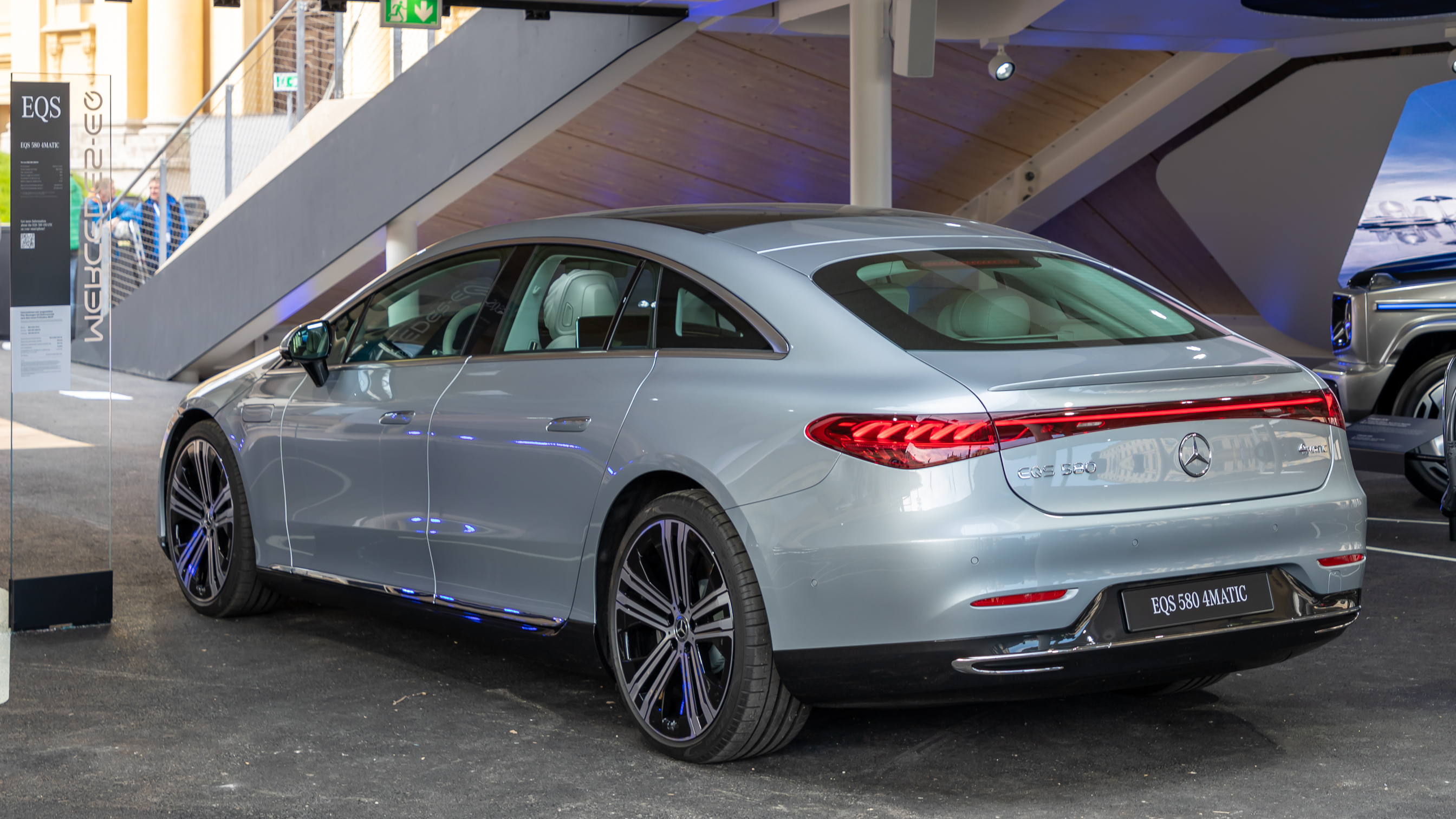
The Mercedes-Benz EQS is a fancy electric car that started selling in 2021. It can drive far on a single charge and has smart features to help the driver, making it very comfortable and high-tech.
The D9 is an electric car made by a company that works with Mercedes-Benz. It's designed to be comfortable and easy to drive while using electricity instead of gas.
The Ford Mustang is a famous fast car from America that people love for its speed and style. Recently, Ford made a new electric car called the Mustang Mach-E, which looks different but uses the Mustang name to show it's sporty and modern.
The Dodge Ram is a big truck that people use to carry heavy stuff or pull trailers. The Ram 2500 is a stronger version that can do tougher jobs, like helping with work or moving big things.
The BYD Shark 6 is the part inside some electric cars that helps them go fast and drive smoothly on highways. It makes sure the car stays steady and safe when driving at high speeds.
DC cables are the thick wires that bring electricity from a fast charger to an electric car's battery so it can charge quickly.
LIVE
Welcome back to EV news daily today breakthrough battery claims slate spotted testing and Kia brings the PV five to Canada and stay tuned later in the show I'll tell you why solar powered sheep for the future of farming on
EV news China today we're talking about Geely topping China sales Beijing adding EV quotas and BYD recalling hybrids let's kick off with three different bits of news actually about battery breakthrough claims the Dallas based company oh
MI a supplier to Holly Davidson claims its proprietary cathode material LNFP enables a 20 C charge rate that is 120th of an hour or roughly three minutes to a full charge of its cell.
The material is nano engineered and iron based designed to enable rapid lithium ion transport while preserving structural integrity in thousands of charge cycles.
OMI claims it performs under road conditions and removes the cobalt from the cathode entirely which could reduce costs and simplify supply chains the claim comes via press release rather than peer reviewed research.
OMI is targeting small scale US production next year in discussions with venture capital to fund their scale up and expects demonstration vehicles in that same window.
Secondly a company that made a recent splash company finish company called doughnuts a lab has published their first independent results for what it claims is a solid state cell they commissioned a highly rated long standing.
VTT technical research center of Finland state owned very highly regarded one of Europe's leading applied science organizations so they took their cell to VTT for testing.
It's interesting in the VTT report they published a PDF of it as well it says the client called it a solid state battery and of course the media because of the needs to get things out quickly and for things to be clickable because lots of media organizations make their money through clicks.
I'm lucky I have patreon and you guys and and I don't need to do that all went with donut lab solid state battery charges quickly.
There's no evidence that this is a solid state battery apart from the company claiming that they've invented one.
However, the tests were deliberately they say worst case no active thermal management passive cooling via compressed aluminium plates.
They charged it at five C and they got to an 80% charge in 9.5 minutes and 100% in 12 minutes with zero measurable discharge loss.
They pushed the charge rate to 11 C rate the donor lab says would destroy conventional lithium ion cells.
It reached 80% in 4.5 minutes and fully charged in seven minutes.
You may recall that donut lab claimed a fully charging battery in five minutes not 10 to 80 but 0 to 100% in five minutes.
Well, this first test is already out by two minutes, but OK.
Traditional lithium ion cells typically up to about three C rates.
We see five, six C batteries in China.
So this is not alien technology by any means.
What is alien is about the donut lab claims, which it loses no performance down to minus 40 degrees Celsius that it charges in five minutes to 100% with no taper.
And then it charges for 100,000 cycles and that's the bit that can't be verified yet.
They've put this test out and all it really shows is an individual cell, a 26 amp hour cell charging at a high rate.
But that's not unusual for individual cells and they could have even pulled it out of something that they bought.
I'm not saying they did, but you can purchase them and have a cell like this.
What is extraordinary about their claims is all of the different claims stacked together.
They say that they will prove it in time, but they were also looking for investment, which was previously not part of their story.
Because people said, why would it be a scam because they're not asking for money?
Well, now they are in order to scale it.
So we'll wait and see.
And finally, a company that has proven themselves over decades.
And so we know it's not a scam.
Samsung SDI in collaboration with Columbia University has tackled lithium metal batteries longest standing problem.
They lasted a few dozen charged discharge cycles, which blocked commercialization despite offering 1.6 times the energy density of a nickel cobalt manganese cell.
The team develops a fluorine based gel polymer electrolyte and that forms a protective layer on the anode.
And that suppresses dendrite growth.
Now dendrites are little tiny microscopic needle like crystalline structures that if they what appears the separator leads to 90 degraded lifespan of the battery, but also a safety failure.
This research was published in dual, a peer reviewed energy journal.
You know, actual science and peer reviewing with co-authors, including Samsung SDI's R&D centers.
Also Professor Wang Yang of Columbia University and Samsung SDI's R&D head describing the publication as academic validation for a technological safety concern that's been blocking lithium metal for decades.
You know, actual proof and things like that.
What a novelty to have.
They of course are not asking for private equity money and funding.
So that's interesting.
Our first story today.
Nice little combination of some breakthrough battery stuff.
All right, let's get into actual vehicles.
Slate the maker of the cheap pickup truck.
A reader of the website Electric, a popular EV blog has spotted a slate auto electric pickup in Hancock, Michigan in the upper peninsula.
Testing suggests a midwinter test session.
The truck is blacked out on charge.
The sighting fits a recent pattern.
Slate prototypes have been surfacing with regularity across Michigan and California, and this one carried the usual signs of development work.
A pipe like piece protruded from above the windshield looking like data collection.
The bed also held a large industrial looking rack that wouldn't match any of the body kits shown that they would sell.
So Slate frames the vehicle around its blank slate idea.
No screens, no speakers and manual window rollers.
Of course in the US there is regulations around reversing camera screens.
So it'll have something.
It plans to sell the base truck and then let owners add hundreds of accessories on their configurator.
This Hancock truck sighting offers a hint of a hardware.
The person accompanying it claimed, again, believing the claims, confirming that the truck that they were testing was a rear wheel drive.
But this person is said to have said there'll be an all wheel drive variant.
I think Slate have also said that and said maybe that's not news.
But either way, Slate's configurator shows no powertrain options.
So this person wouldn't have been authorized to talk to anyone filming the vehicle.
But either way, I think the picture is real, doesn't look like AI or fake.
And it would fit in the timeline of Slate releasing the trucks.
Now Kia use the Canadian International Auto Show in Toronto to debut the PV5 electric van.
It aims the PV5 at Canada's urban logistics and last mile delivery.
Canada's compact van segment has largely collapsed with the Ford Transit, Ram ProMaster and Nissan NV200.
Gone PV5 lands with 5,000 litres of cargo space, focusing on work and lifestyle.
Under the skin sits on the EGMP version of the architecture.
It supports multiple PV5 variants, cargo vans, passenger people, carriers.
They're leading with a wheelchair accessible variant, which I was delighted to see.
Chassis cabs, global markets already receive a broader range of PV5 body styles than Canada at launch.
Starting with the cargo variant only.
A 71.2 kilowatt hour pack, front wheel drive.
Overseas testing puts the range around 260 miles, that's about 420 kilometres.
The battery sits integrated into the chassis floor, lowering the centre of gravity and freeing up interior space as well.
It supports vehicle to load capability to power tools or equipment.
Business focused features like a removable front passenger seat, which extends cargo capacity.
And if you are doing maybe a delivery route, that means that you have to get out of the passenger side vehicle
so that you're not stepping into the path of traffic.
That means that's a safety feature, or maybe you can go through to the rear of the van to get the parcel
and then exit out the passenger door, read the way.
These are all very useful systems.
It comes with a J3400 charging port as well.
More on that in a moment.
Let's talk a little bit about a LEGO, the charging network.
They've done a deal with Uber to give half price charging in the Netherlands for Uber taxi drivers.
The offer promises discounts of 50% per kilowatt hour in off-peak hours, which is outside of 10am to 5pm, which is the winter peak hours.
And so as long as it's outside of those hours, you get half price charging for Uber drivers.
And that's great because obviously an Uber vehicle works all the time.
And if they can be nudged, incentivised to go to those charging stations when they're not busy, it helps the rest of us.
And when I say it helps the rest of us, what I want to be very clear,
in case you think I'm sort of editorialising my opinion here,
anyone with an EV that can charge has a right to use a charging station.
Plug-in hybrids with a tiny battery, but with a CCS connector, and there's plenty of those from the likes of Mercedes and more,
they're equally as able and have a right to charge as any full-bath owner.
Now, is it slightly inconvenient if someone's sitting there with a really slow charging plug-in hybrid
when they don't need to on a motorway service area?
Because they should be relying on the petrol, because that's the car they bought?
Then that's an argument you can have amongst yourselves, and Uber drivers as well.
And cab drivers.
Well, you could say that they are blocking charging stations, and Uber should build their own facilities.
But again, that's another argument.
If you can nudge behaviour, if you can gently push and pull with pricing,
which doesn't stop anyone charging if they are desperate, but is much better if you can do it when their chargers aren't busy,
I love these kind of schemes.
BMW will scrap its Level 3 automated driving system on the new BMW i7 facelift when that comes in April.
They launched Personal Pilot in 2024.
It was 6,000 euros, and it lets the i7 take full control,
up to 37 miles an hour, or 60 kph, steering, speed, distance.
And when active, a BMW took on the liability, because it's a proper Level 3 system.
You had to be in the driver's seat, ready to take over, but you were legally allowed to do something else.
Whether it's look at your phone, I mean, depends on what country you're in.
We're not allowed to touch any device in this country, whatever it is, a phone, an iPad, anything.
A sat nav, we're not allowed to touch a device.
You can have it on your windscreen, and you can set it on a stand or something, or a clamp on your windscreen,
and you can set your sat nav before you leave.
But once we are driving a vehicle in motion, we are not allowed to touch a device.
It's a criminal offence, it's a six-point and a fine on your license.
And so, different countries will say different things, but at least with these systems,
the driver was allowed to do something else.
It needed a LiDAR, worked on motorways in low speed.
BMW will now revert from Level 3 to Level 2, and they will replace it with Motorway Assistant,
which were launched on the new iX3, the Neuer Classeur Technology.
The new system targets a wider slice of motorway, used up to 81 miles an hour, or 130 kph.
It'll execute lane changes, and it will require a glance from the driver and a confirmation.
The move tracks Mercedes-Benz, and they're doing the same thing with their Drive Pilot.
They've been offering it since 2021 on the Mercedes-Benz Electric EQS, up to 59 miles an hour, or 95 kph.
They replaced Drive Pilot with MB Drive Assistant Pro.
No longer Level 3, they're backing away from autonomy,
whilst other car companies are betting their entire future on autonomy.
At least the Germans say we would rather have a very well-established Level 2 system,
or as Mercedes-Benz call it, Level 2 plus plus.
I would point out there is no such thing as a Level 2 plus plus autonomy system.
I won't change the outro of this podcast, there's still no such thing as a self-charging hybrid.
But it's either Level 2 or it's Level 3.
The car companies can add pluses as much as they want.
It's like Level 2 exclamation mark!
There's no such thing.
However, they're trying to indicate that it's a very good Level 2 system.
But it's still Level 2.
Shall we take a break? I'm getting giggy.
Giddy, I told you!
We'll come back with Ford and Denzer and more stick around.
Alright, sensible mode re-engage, no more giggity.
Ford will go up Pike's Peak once again this year with a new Super Mustang Mach-E,
that is frankly not a Mustang Mach-E.
It's a custom-built race car that they've called the Mustang Mach-E.
Driver Romain Dumas previewed the changes in the social media video.
It's longer, it's larger than the previous last year's winner.
It drops to a lower ride height with more downforce.
They've reworked the suspension and they've learned more from going up Pike's Peak.
And I love this because Ford has a history in making fast Fords,
but they leave the powertrain alone.
1,600 horsepower from three six-phase motors developed with STARD,
STARD, advanced research and development, 50 kilowatt hour, lithium polymer,
Pirelli P-Zeros, and it generates almost 7,000 pounds of downforce.
That's over 3,100 kilograms of downforce.
Now, Denzer has launched in Australia with a weight problem and a price tag.
The Denzer B8 tips the scales at 3,290 kilograms.
It launches as officially Australia's heaviest passenger SUV.
It weighs more than anything else. It's on the tubby side.
With one exception, you can buy a Ram 2500 heavy-duty Ute,
but still, this is a passenger car.
The B8 uses a plug-in hybrid system,
two-litre engine, 36.8 kilowatt hour LFP pack
for 100 kilometers of electric-only range.
The petrol engine's a generator, but it can drive the wheels at high motorway speeds,
but like that new Shark 6 powertrain.
In fact, it's on a platform that combines body on frame
and electric skateboard like the BYD Shark 6
with a locking rear differential, two-speed gearbox,
like a low-range transfer case,
and hydraulic active suspension is a three-row big boy now.
A University of Melbourne study,
we'll stay in Australia,
puts the price of health on Australia's trucks and buses.
And the price of Australia's health is $6.2 billion a year.
That's $4.4 billion US.
The Electric Vehicle Council says a number
this number should force urgent government action
to move to zero emission freight and public transport.
But will it?
Cameron Remington, EV Senior Policy Director for Heavy Vehicles,
says electric freight now counts as a public health emergency,
not a distant climate ambition.
He says this new University of Melbourne data
says the research gives diesel's annual harm
an actual number on healthcare.
A University of Melbourne expert position statement
argues public health has sat outside of heavy vehicle policy
for decades,
linking pollution from trucks and buses to premature death.
That always puts a bit of a downer on my day personally.
Heart disease, childhood asthma, and lung cancer.
The statement defines heavy vehicles as those over 4.5 tonnes,
generating a quarter of on-road transport emissions in Australia
and ranking as a major source of nitrogen dioxide.
Researchers describe NO2 as a pollutant
that triggers cardiovascular and respiratory disease.
They found no safe exposure level
and said that even Australia's relatively low
average pollution levels still cause chronic harm.
I still find it an interesting chapter
of the book that we're writing on humanity
that many leaders and politicians,
and I'm looking at you America right now
and your leadership or lack of it,
that is willing to trade the lungs of our children
for the profits of oil companies.
It continues to be something that surprises and saddens me
when we have a solution.
It's a solved problem.
It's not like, would it be great to invent an EV?
It wouldn't be so cool to invent an electric car, right?
The work's done.
Never mind.
Alright, let's move on.
Phoenix Contact has unveiled its new J3400
and CCS Type 1 charging cables for North America
aimed at ultra-fast charging at 500 kilowatts.
The move extends the German cable specialist's portfolio
beyond AC into high-powered DC charging in the US.
The timing tracks the market shift.
NACS or NACS was once Tesla's proprietary plug.
They opened it up to a standard of wider use.
SAE then ratified it,
so it's now called SAE J3400 since December 2023,
but many still call it NACS or the Tesla plug and whatnot.
Phoenix Connectors, oh sorry, Phoenix Contact's
J3400 DC cables are rated as 1,000 volts
and a peak output of 500 kilowatts in boost mode,
sustained 375 kilowatts.
Phoenix says the J3400 plug uses an ergonomic separate handle
that thermally decouples the user's hand from any hot surface.
The J3400 DC cables carry certification for UL2251.
The same again for the CCS cables to delivering over 600 amps.
A little bit of fast charging, don't we?
And finally, love this story.
That's why I've put it into the podcast.
It doesn't mean anything about EVs,
apart from the fact that we recharge our EVs on renewables.
Let's go to New South Wales and near Dubbo.
Australia has the best place names, by the way.
Australia always wins place names.
Let's go to Dubbo in South New South Wales.
A sheep farmer named Tom Warren turned his land
into a joint solar and agriculture site.
Mr. Warren runs 30,000 solar panels in 50 hectares.
That's 124 acres on the outskirts of Dubbo.
That's about 250 miles west of Sydney.
He operates the project with the French renewables firm Neon.
The site generates 20 megawatts of power,
meeting a slice of the local area's energy needs.
Mr. Warren first feared what the panels would do
to his grazing business, but his sheep made the case.
They rest in the shade and they graze in the shade.
They no longer have to huddle under trees.
He says the panels actually shield the grass
from the extremes of Australian weather.
They actually produce a more consistent pasture.
He links that to steadier feeding of his sheep
and that is 15% better wool quality
and more gross revenue from his wool business
since he added solar panels.
Who knew that solar sheep would be finishing off the podcast today?
Well, there we go.
It's a story that I love to report on.
These nice little things that we get to talk about.
I put a link in the show notes, by the way.
There's more.
There's also more about a farmer near Wellington
that runs 6,000 sheep and solar panels as well.
Hey, it turns out all those tinfoil hatters
and never bevers that hate solar panels.
Hey, it turns out that you add them to your sheep farming business
and it benefits everybody.
That's your podcast for today.
It's been a strange podcast today.
Thanks to our partners National Car Charging
on the US mainland and Aloha Charging in Hawaii and Test EV.
Avalu's trusted partner for independent EV battery health testing
in Australia and New Zealand.
Have a good and see you tomorrow.
And remember, there's no such thing as a self-charging hybrid.
Thank you.
About this episode
The episode dives into recent breakthroughs and claims in battery technology, including rapid charging cathodes from OMI, controversial solid-state battery tests by Donut Lab, and Samsung SDI's peer-reviewed lithium metal battery advancements. It covers Slate's electric pickup truck spotted testing in Michigan, Kia's launch of the PV5 electric van in Canada targeting urban logistics, and innovative charging incentives like Uber drivers receiving discounted rates in the Netherlands. The show also discusses BMW's decision to downgrade its i7's autonomous driving system from Level 3 to Level 2, reflecting a cautious approach to autonomy compared to other automakers.