DAILY: EV Enquiries Jump Again, US EV Sales Get ‘Reset’ and VW Says Lessons Learned | 13 Apr 2026
EV News Daily - Technology and Business of EVs
DAILY: EV Enquiries Jump Again, US EV Sales Get ‘Reset’ and VW Says Lessons Learned | 13 Apr 2026EV News Daily - Technology and Business of EVs · Apr 13, 2026
Chat Concierge is an AI chat tool that helps you with car shopping. It can help you line up a test drive and start the financing process, and it can estimate what your current car might be worth.
mobile.de is a popular car-shopping website in Germany. If it sees more EV inquiries, that suggests more people there are starting to consider electric cars.
The Volkswagen ID.3 is an all-electric hatchback. Instead of using gasoline, it uses a battery and an electric motor. The podcast mentions it because people are searching for it a lot, especially when fuel prices rise.
AutoScout24 is a website where people browse and search for cars. If their EV demand rises, it usually means more shoppers are actively looking for electric cars.
The federal tax credit is a government discount for certain electric cars. When people think it’s going away, they may buy sooner—then sales can dip after it ends.
The Alpine A106 is an electric car model. The podcast talks about it in relation to people buying EVs quickly because a government tax credit was about to end. That timing can strongly affect which EVs sell during a short period.
Cox Automotive is a big auto-industry data company, and Kelly Blue Book is a familiar name for car pricing and market info. When they say the market needs a “reset,” they’re describing a change in buying behavior.
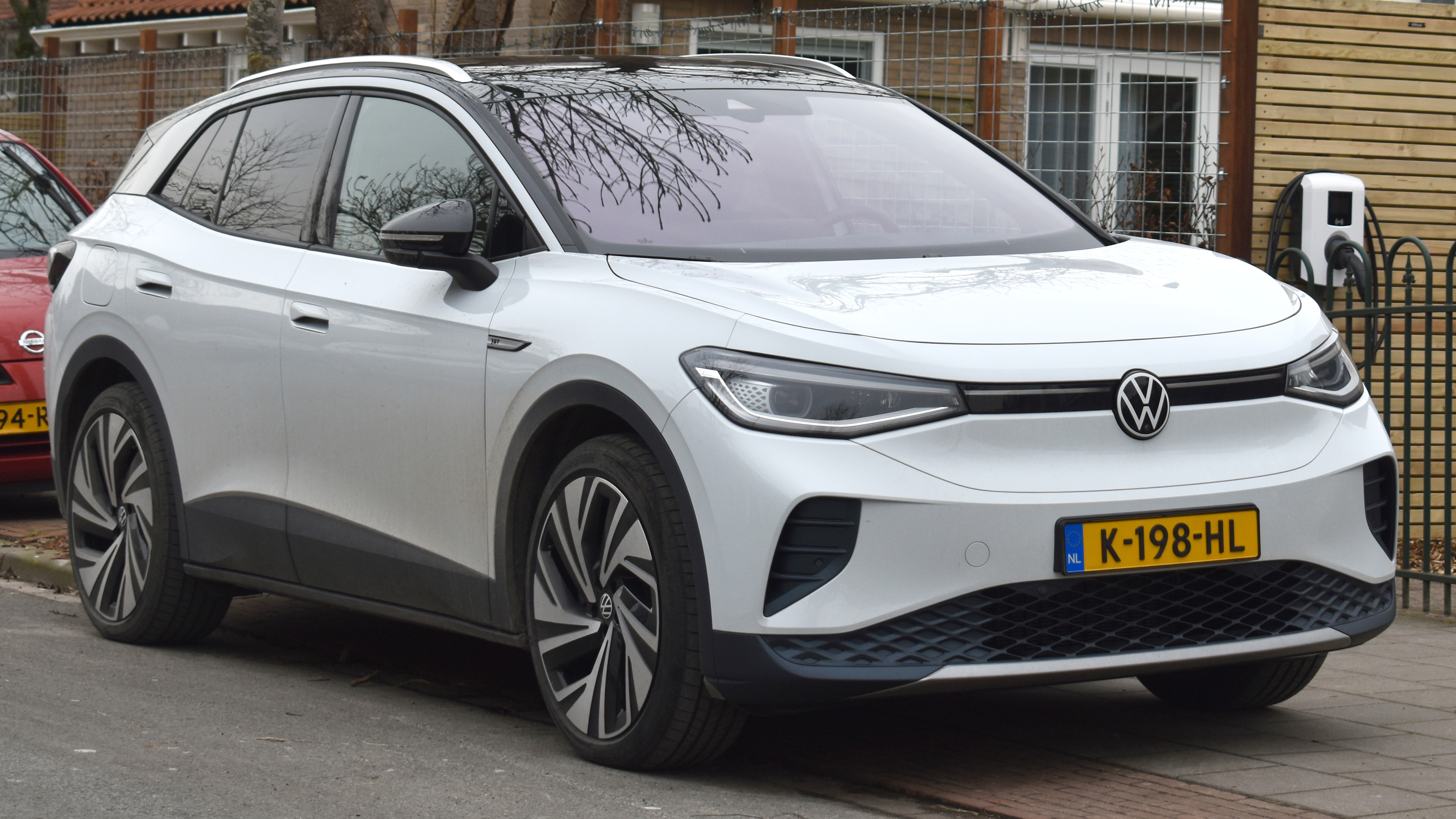
The Volkswagen ID.4 is an all-electric SUV. It runs on a battery instead of gasoline, and it’s designed for everyday driving and family use. The podcast mentions it because it’s been selling well for Volkswagen.
The Volkswagen Polo is a smaller VW model that many people recognize. It’s included here to show that VW has famous model names across the lineup, not just one model.
“Dieselgate” was a major scandal involving Volkswagen and emissions rules. The speaker is saying VW used that moment to change direction and branding as part of rebuilding trust.
A plug-in hybrid can drive using electricity like an EV, but it also has a gas engine as backup. You can charge it at home, but you’re not limited to only electric range.
The Volkswagen Tiguan is a popular compact SUV. The discussion here is about Volkswagen’s EV strategy and how they’re still using the “ID” name on future versions.
The Tesla Cybertruck is Tesla’s electric pickup truck. They’re talking about how many were sold recently and noting the drop compared with earlier periods.
Xiaomi is best known for phones and other electronics, and it’s also getting involved with EV plans. The interesting part is how a tech company’s approach to products and software could influence how EVs are built and sold.
Xiaomi is saying it plans to start selling cars outside China in 2027. That matters because it means they’ll need to set up distribution and support in those countries.
Synthetic fuels are made using renewable electricity to create a fuel you can burn in a regular engine. The debate is whether they should be treated as “zero emissions” even though the car still burns fuel.
Polestar is the electric-car company in this story. They’re talking about how many cars Polestar delivered and which countries are doing well for them.
Q1 deliveries means how many cars were delivered in the first three months of the year. It’s a way to measure real sales momentum.
Car
Polestar 7
Polestar also plans to add the Polestar 7, which is described as a small electric SUV. That’s a different body style that usually appeals to people who want more space and a higher driving position.
Battery health testing checks how worn out an EV battery is. It helps you estimate how much range you can still expect and whether the battery is in good shape.
LIVE
Capital One's tech team isn't just talking about multi-agentic AI.
They are already deployed one.
It's called Chat Concierge and it's simplifying car shopping.
Using self-reflection and layered reasoning with live API checks, it doesn't just help
buyers find a car they love.
It helps schedule a test drive, get pre-approved for financing, and estimate trading value.
Advanced, intuitive, and deployed.
That's how they stack.
That's technology at Capital One.
Capital One's tech team isn't just talking about multi-agentic AI.
They are already deployed one.
It's called Chat Concierge and it's simplifying car shopping.
Using self-reflection and layered reasoning with live API checks, it doesn't just help
buyers find a car they love.
It helps schedule a test drive, get pre-approved for financing, and estimate trading value.
Advanced, intuitive, and deployed.
That's how they stack.
That's technology at Capital One.
When people turn to healthcare for weight loss, they're looking for real support.
That's why more people are choosing OrderlyMeds.com.
OrderlyMeds connects you with real doctors and access to proven GLP-1 medications like
semaglutide and terzepotide.
No guessing, just a more supportive experience.
And all ship directly to your door in discrete packaging.
Do your research, ask questions.
Then visit OrderlyMeds.com slash podcast for an exclusive offer.
That's OrderlyMeds.com slash podcast.
Individual results may vary, not medical advice.
Eligibility requires a site for details.
Welcome back to EV News Daily.
Today, EV Inquiries jump again.
US EV sales get resets and VW says lessons learned.
Plus, stay tuned because later in the show, I'll tell you why.
EV car rentals are seeing a surprising turnaround.
Over on EV News China today, that podcast, we're talking about BYD wanting 6,000 overseas
charges, Cherry wanting Euro partners and Neo wanting industry standards.
Let's get into the show then.
European interest in EVs continues to rise.
This developing story over the last few weeks after the US-Israel war on Iran began on 28
February.
As petrol prices around the world climb and in some countries, we see fuel
shortages and in the case of Australia, not because of a shortage of fuel, just kind of
human behavior.
Online car marketplaces in the United Kingdom, Germany, France and Spain have all been talking
about how more people are looking for electric vehicles.
Take Germany, mobile.de, the country's largest online car market place.
They recorded a greater than 50% jump in EV inquiries last month in March versus February.
The chief executive said high fuel prices were a catalyst for the E-Auto Boom, the Volkswagen
ID.3, the most searched battery electric vehicle on the site.
Diesel prices in Germany are two euros fifty, that's two pounds fifteen pence.
Berlin offers a 6,000 euro subsidy, that's about 5,200 pounds for EVs.
Here, CarWow reporting a 30% increase in EV inquiries between February and March.
A big jump, that's on their UK, Spain and German businesses in the UK.
EV searches were up 23% between February and March.
France saw a sharper swing, La Central, the platform there, reporting a 160% rise in EV
searches between the start of March and the end of April.
Deputy Chief Executive, Julien Henri Blanchet, said drivers reacted immediately to the war,
seeking BEVs as used car alternatives and AutoScout24 reported EV demand up 40% in Germany, Austria
and Italy.
It said petrol and diesel sales were down or flat in some markets.
Search data, of course, shows how fast buyers react to their future purchase intentions.
Registration data will move a little bit slower, but I think it's a very interesting story
to lead on the podcast today.
Now, let's go to the United States, where US EV sales were down 27% year on year in
the first quarter of this year, an estimated 216,000 units in the same time last year,
296,000.
In Q3 last year, buyers were rushing to secure the federal tax credit before it expired,
driving EVs to a 10.6 share of new vehicles last quarter in Q1.
That had dropped from a 10.6 to a 5.8 share.
The smaller quarter on quarterfall between Q4 to Q1 suggests the post-incentive contraction
has stabilised Cox Automotive's Kelly Blue Book, called Q1 a necessary reset.
The Cox Automotive Director of Industry Insights, Stephanie Valdez-Streety, said Q1 reflected
a market in transition.
And I need to eat some humble pie on this one, because the US was a 10.11 share of EVs,
and Ford's CEO said if you get rid of the federal tax credit,
when you're going to see the EV share fall to 5%, he said.
And at the time, I didn't believe that the EV market in the US would collapse
in half.
Well, clearly Ford have some better analysts than I am, because well, it's a 5.8 share,
but I'll give that one to him.
You're absolutely right.
Yeah, the US has seen a huge contraction as EVs explode in China, in Europe, and the rest of
the world.
We are now seeing this geographic split where different places are going at such different
speeds to the EV transition.
I mean, everyone will get there at their own pace.
We know that everyone will be driving EVs in the future, unless a new technology is invented.
But the speed at which different countries do it in different regions, and it's fascinating
to watch, isn't it?
The US has some catching up to do.
No doubt they can do it.
Volkswagen, they say their current EV range drifted from what buyers expected at a media
event in Hamburg.
The CEO, Thomas Schaefer, said Volkswagen had, and I quote, lost its core with its EV lineup.
Mr. Schaefer said the problem ran through the whole package.
The naming, the design, and the interior design not delivering a Volkswagen experience.
He said the ID3 and ID4 ranked among Volkswagen's best-selling EVs, but they neither captured
the special Volkswagen feel or gave customers what they expected.
The Volkswagen plans to redesign their EV range.
The refreshed ID3 Neo makes their its debut.
It should be within days, actually.
Schaefer set out a fix.
That's why we're bringing back real buttons, he says, usability, and also real car names.
Now, clearly nobody's seen a Volkswagen listens to this podcast.
They say they've done it with lots and lots and lots of driver data and focus groups and
research.
But what are we in?
Like, 2018, I started this podcast.
I have pretty much consistently banged the drum for existing car makers to use the name
plates that they have spent countless amounts of money building up.
So the Chinese can come in with technology.
The Chinese can come in with low prices because of their market.
The Chinese can come in with what they can't come in with is a Volkswagen Golf.
And the Chinese can't come in with the Volkswagen Passat or a Polo.
And so the idea of Volkswagen binning an entire company history of name plates,
it was bonkers to me at the time.
It remains confusing.
I get it.
I get why Mercedes went EQ.
I get it why VW went ID.
They were drawing a line in the sand post dieselgate.
They wanted to move forward.
I understand those arguments.
And I'm delighted to see Volkswagen going back because the next stage of the EV adoption curve,
the next stage of people, probably not you and I talking about you listening to an EV podcast.
You know, we're a certain breed, you and I, but I think the next mainstream wave
are going to be much more comfortable buying a Volkswagen Golf.
What have you got?
The plug-in hybrid version or the electric version?
No, it doesn't really matter.
It just moves forwards and backwards.
And it's a Golf.
And also on the usability thing.
Yeah, I've been talking about that for a long time as well.
We still have in the driveway and running never use.
We still have a 2010 Volkswagen Golf diesel.
So we should never use it and we never got around to selling it.
And it's 20 quid a year to tax.
So we just sort of sit there.
And when we got the ID three, admittedly in base spec, my wife goes, oh, is this a polo?
Well, it's just like 12 grand, 14 grand.
No, it's like 35,000 pounds.
We didn't buy it.
We had it to drive.
And it felt so much worse than a Golf from 10 years ago.
The plastics were horribly in here.
They fixed that all now.
But yeah, at the time, those early base model ID threes really didn't feel very Volkswagen-y.
So they're fixing all that, they say.
And the naming, which is why the ID four becomes the Tiguan.
Brilliant.
I mean, it's still got the ID Tiguan, which, okay, they can't quite admit a wholesale change.
Big companies don't tend to admit they got it entirely wrong.
So they're keeping ID.
I just, I'd been that, too.
It's the Volkswagen Tiguan.
And what's the powertrain?
Who cares?
Tiguan.
And also the ID cross is coming.
That's the T cross crossover.
It's due to follow the polo and the polo GTI spy shots of the Tiguan show the Tiguan.
They've got rid of the curvy, friendly face of the ID four, which was very aero and they've
gone with a squared off from the sales figures around, by the way, the Q one financial results.
This is not a financial podcast.
So we ignore a lot of that kind of stuff.
I'll give you the headlines though.
ID four ID five led Volkswagen in Q one, which only 5000 units ahead of the ID three and ID
seven Volkswagen group delivered 2.05 million vehicles in Q one down 4% year on year.
Damage being done by China and the United States.
All right, let's talk cyber truck.
A new data coming out today showing Tesla sold only 3519 cyber trucks in the entire first
quarter of the year.
The weakest U.S. quarter for the model since 2023 ever actually.
The drop was steep.
U.S.
Cyber truck sales fell 45% year over year and they also fell 15% quarter over quarter.
The decline sits at the top of a very poor 2025 as a whole.
Tesla selling 20,000 cyber trucks last year in the U.S. down 50% from 2024.
This total equals a poultry 8% of the 250,000 cyber trucks that Tesla will make every year,
according to the predictions made by the chief executive in 2019.
That one, I think we can now say the cyber truck missed the mark in terms of mass appeal.
Impressive vehicle, impressive technically, very impressive, but that'll be chalked off
as a curiosity.
I'm sure Tesla will kill that off once they get rid of the supply chain contracts and whatnot.
They're going the cheaper version, which will come out later this year.
They've got a few months of orders to fulfill.
And then I think cyber truck will quietly go away as they become a robot company or something.
Now Slate also has closed a funding round of $650 million and the company says the
cash will give it the capital to get through to vehicle launch CEO Peter Faracy saying the round
keeps Slate on time and on budget.
The company targets late this year for customer deliveries.
The Slate electric truck is a tight timetable.
Pre-orders open in June this year.
They'll reveal official pricing and the add-on options.
The base model, the blank slate, will be priced in the mid-20,000s.
Slate has pitched the truck on flexibility as much as the low price.
Its flagship model uses a modular platform that can convert from a two seat pickup to a
five seat SUV, small battery, big battery, wind down windows, no radio.
Obviously, there's some US regulations around reversing cameras.
They will have a screen, but using your device and things like that, the new funding speeds
up work at their indie factory as well.
The company plans to invest $400 million in Slate's projects and the plant will make
2,000 new jobs and add $39 billion to the economy over 20 years.
That's quite a prediction.
Let's sell a truck first before we predict 20 years in the future.
The president of vehicles in her new position, Chris Barman, said that Slate aims to deliver
trucks at half the cost of the average new car sold in the United States.
They say their team is made up of largely industry veterans with hands on experience
of scaling vehicle production and doing the hard yards.
We're getting the car from the design stage into driveways.
Right, we'll come back.
We'll talk a little bit about Xiaomi and Germany and Kia at a big milestone.
Stick around back in a moment.
and deployed.
That's how they stack.
That's technology at Capital One.
Personalize compound versions when appropriate.
So you have choices backed by clinical oversight, not guesswork.
It's a simpler, more supportive telehealth experience designed around people who want
clarity, care, and confidence in their weight loss journey.
And your medication is delivered directly to your home in discrete packaging.
So your experience stays private from start to finish.
Do your research.
Ask the right questions.
Then visit orderlymeds.com slash podcast for an exclusive offer.
Again, that's orderlymeds.com slash podcast.
Individual results may vary, not medical advice eligibility required.
See site for details.
Are you trying to get weight loss support through telehealth,
but it feels overwhelming and rushed?
Check out orderlymeds.com now orderlymeds.com was built to be different.
Here you connect with real doctors who take the time to understand your goals,
review your eligibility and guide you through a plan that's right for you.
Orderlymeds provides access to proven GLP-1 medications,
like semi-glutide and terzepatide, including both name brand options
and personalized compound versions when appropriate.
So you have choices backed by clinical oversight, not guesswork.
It's a simpler, more supportive telehealth experience
designed around people who want clarity, care, and confidence in their weight loss journey.
And your medication is delivered directly to your home in discrete packaging.
So your experience stays private from start to finish.
Do your research, ask the right questions,
then visit orderlymeds.com slash podcast for an exclusive offer.
Again, that's orderlymeds.com slash podcast.
Individual results may vary, not medical advice eligibility required.
See site for details.
Spanish Prime Minister Pedro Sanchez
toured the Xiaomi Beijing headquarters earlier today.
The first stop on a three-day official visit to China.
Xiaomi CEO and co-founder, Lei Xun, hosted the visit.
Visit Sanchez toured the factory looking at the Xiaomi Y-U7, that's the SUV,
and was presented with a red SU-7, that's the sedan, the new one,
or the updated one, I should say.
The visit obviously serves a clear purpose.
Mr Sanchez, using it to pitch Spain as a manufacturing and logistics partner writing
on X, that Spain offers a competitive industrial and logistical ecosystem
for high-level technological cooperation between China and Spain.
That was Sanchez's fourth visit, by the way, to China in just four years.
Over the period, he's been more than any other Western leader,
and the Xiaomi stop suggests that Spain wants a place.
In EV expansion, and Xiaomi hasn't sold any cars yet in Spain,
but Spain knows the brand.
Xiaomi holds the biggest smartphone market share.
The company's also fixed a date for its next step.
Vehicle sales outside China, 2027, they say.
So we could well see some Xiaomi's appearing in Spain.
And yet another Western leader, courting China as the new administration,
we're not so new anymore, but the current White House administration,
severing ties with long-standing allies like Canada and Europe through many things.
But economically as well, we see many of those Western leaders almost being driven into the arms
of China, and making overtures, we see Canada doing the same with China,
and many of the Western leaders, our own Prime Minister, Sir Kiyostama,
doing a big official visit to China to do trade deals as that kind of tight bond with America.
And Europe is a bit weaker than it used to be,
and China is certainly picking up the slack by the look of it.
Well, Germany's ruling coalition, led by Chancellor Mertz,
wants the European Union to loosen vehicle emissions regulations yet again.
Berlin says it wants to ease pressure on its own car industry.
After talks yesterday on the 12th of April in Berlin,
Mr. Mertz confirmed the government's line.
They want full technological openness on power trains,
and doesn't want a cut-off date for gas guzzlers, highly polluting vehicles that harm health,
and frankly are much worse than electric vehicles, but do make Germany lots of money.
The Finance Minister and Vice-Chancellor Lars Klingbeil of the SPD,
backing the position, saying he believes the future of the automotive industry is electric,
but the route needs flexibility.
The European Commission revised their framework only two months ago,
maybe three months ago, wasn't it, at the end of last year,
softening the 100% ban on highly dangerous combustion fuels.
For health reasons, they've already walked that back for Germany's
after the big arguments there from Germany, and now they want even further concessions
because their car makers can't compete.
The current framework allows a limited share of combustion, even after 2035,
under the rules that Germany now wants softening again.
The remaining 10% can be offset through other things, like green steel and renewables,
but Berlin wants more relaxation in those kind of workarounds, if you like.
They also want artificially made combustion fuels, which are still combustion fuels,
by the way, but using loads of renewable energy to make them,
which is very inefficient, like hydrogen, enormously inefficient.
If you're going to move a vehicle one meter down the road,
then it'll take a lot less electricity in an EV than if you try and move the same
distance via either hydrogen, powered with renewables, or these so-called synthetic fuels
that many people think are the saviour of combustion, and they want them counted as
zero emissions, even though they're combustion fuels, if you make them with renewables,
which is, I mean, you know it's nuts, and I know it's nuts, but anyway,
Berlin wants to stop any further changes of the plug-in hybrid utility factor as well.
So again, you and I know that plug-in hybrids, the way that the official lab tests are done,
don't match real well. Yeah, a lot of people who get them as company cars are not plugging them
in to 100% every single night, and Germany is now pushing back on changing what's called the
utility factor, that's just the name it's given, the utility factor, they're pushing back on that
now reflecting the real world usage of plug-in hybrids, which we can do from real-time
onboard data, we can see when people, how people use them, we can see how much emissions
actually come from plug-in hybrids, they don't want that taken into account, they don't want
them reflecting real world, they want it to stay as it is, which really benefits the amounts
that we presume they're driven on battery. Spain and Sweden, though, argued against
Germany's position, they say weaker rules leaves Europe behind China, member states and the European
Parliament will vote in coming months. By the way, if they disagree over this 90%, you know this,
I didn't realise this, this, you know, this 90% softening, what we can do, still do 10% combustion
after 2035. If the member states can't agree, it defaults back to the old rules, so all this
fighting, if they don't all agree with the new rules, it just sticks as we are, which is a complete ban.
Don't poke the bear, Germany. Maybe be grateful for the concessions you've got. Anyway, moving on,
this is great news. Kia has become the first Korean car maker to do 100,000 EV sales in the
United Kingdom. It did it on 11th of March, they say a customer bought an EV5 GT line in
iceberg green. I'm always slightly dubious when they pick out the exact car that was exactly
number 100,000. I think car makers have a little bit of leeway to pick the car to say more about
their current line up in their press release, the car they pick says a lot, maybe it genuinely was,
I mean, who knows. But anyway, Kia picking out the EV5, which is a very good car,
as their 100,000th EV in the UK. The pace isn't slowing, by the way, at the beginning of this month,
cumulative sales 105,000. In March last month, fully electric models 30% of Kia's business in
the UK. The story began for Kia back in 2014, the first generation Soul. E-Soul? No, here is
Soul EV, other countries it was E-Soul. But here is the Soul EV, 13 dealers at the time
took a punt and stocked it. The range, all these years later, is now 11 electric models,
and much of the early volume came from the Nero. Now discontinued, sadly. It's half of the EV sales
they've sold was the Kia Nero. It remains in plug-in hybrid form. But there's the EV3 on sale
now and has been for a couple of years. And frankly, that is a much better Nero. But the EV3,
my car of the year last year in 2025, awesome vehicle, sold 15,000 in the UK, car of the year,
and world car of the year last year, cracking vehicle that does nearly everything really,
really well. If you have one car in your driveway, you should test drive the EV3, see what we think
of it. Kia also filled up the lower end of the range. UK pricing for the EV2 came out, that's
going to be below 25,000 pounds, with almost 300 miles of range on the big battery version. It'll
be made, it's a European car for Europe, made in Europe. The EV2 is made in their Slovakian
plan. Now Polestar delivered over 13,000 cars in Q1, their strongest first quarter to date,
deliveries up 7% year on year. Still below their all-time quarterly record, but the chief exec,
Michael Loschler at Polestar, saying strong performances from Australia, Germany, Sweden,
South Korea in the UK, pushing them forward, they can launch the Polestar 5 Gran Turismo soon,
an additional body variant of the Polestar 4, a wagon version, and the Polestar 7, a small electric
SUV. And finally, Europe car, the car hire company, logged half a million, 500,000 EV rental days
up 93% on 2024, their own EV fleet grew 70%, and EVs are now 15% of the Europe car fleet.
And the mix of cars widened too, they had Polestar's and Hyundai's and BYD's demand came from
business users. Accounting for 86% of all EV rentals, Europe car helped that shift by equalising
pricing on business rentals, they cost the same, whatever powertrain you're going to buy,
rent rather, petrol, diesel, DV, it all the same, the firm also cut some of the usual friction.
They have a partnership with Octopus Electroverse, former sponsor of this podcast, giving EV
renters access to a million public charges, and they say that EVs are a low-risk way of EV drivers
even trying electric motoring if you don't want to take a punt on buying one. To support that,
they've got EV specific vehicle handovers and dedicated self-help resources for EV renters.
Interesting, many of the European car rental firms have had a lot of success with EV rentals,
they continue to add them to their fleets, and in Germany as well, here in the UK,
a lot of EV rentals have worked very well, it didn't work so well in the US, which is interesting.
You can obviously hire electric vehicles in the US, but there's been more of a wobble,
I would say, and that's your podcast for today. Thanks to our premium partners National Car Charging
on the US mainland and the Low Heart Charge in Hawaii, and Test EV, Navaloo's trusted partner
for independent EV battery health testing in Australia and New Zealand. Have a good one,
cinema, and remember there's no such thing as a self-charging hybrid.
Check out OrderlyMeds.com now. OrderlyMeds.com was built to be different. Here you connect with
real doctors who take the time to understand your goals, review your eligibility, and guide you
through a plan that's right for you. OrderlyMeds provides access to proven GLP-1 medications,
like semi-glutide and terzepetide, including both name brand options and personalized compound
versions when appropriate, so you have choices backed by clinical oversight, not guesswork.
It's a simpler, more supportive telehealth experience designed around people who want
clarity, care, and confidence in their weight loss journey. And your medication is delivered
directly to your home in discreet packaging, so your experience stays private from start to finish.
Do your research, ask the right questions, then visit orderlymeds.com
slash podcast for an exclusive offer. Again, that's orderlymeds.com slash podcast.
Individual results may vary, not medical advice eligibility required, see site for details.
Capital One's tech team isn't just talking about multi-agentic AI. They are already deployed one.
It's called Chat Concierge, and it's simplifying car shopping. Using self-reflection and layered
reasoning with live API checks, it doesn't just help buyers find a car they love. It helps schedule
a test drive, get pre-approved for financing, and estimate trading value. Advanced, intuitive,
and deployed. That's how they stack. That's technology at Capital One.
When people turn to health care for weight loss, they're looking for real support.
That's why more people are choosing orderlymeds.com. Orderlymeds connects you with real doctors and
access to proven GLP-1 medications like semaglutide and terzepatide. No guessing, just a more supportive
experience. And all ship directly to your door in discreet packaging. Do your research, ask questions,
then visit orderlymeds.com slash podcast for an exclusive offer. That's orderlymeds.com slash
podcast. Individual results may vary, not medical advice, eligibility required, see site for details.
Capital One's tech team isn't just talking about multi-agentic AI. They are already deployed one.
It's called Chat Concierge, and it's simplifying car shopping. Using self-reflection and layered
reasoning with live API checks, it doesn't just help buyers find a car they love. It helps schedule
a test drive, get pre-approved for financing, and estimate trading value. Advanced, intuitive,
and deployed. That's how they stack. That's technology at Capital One.
About this episode
EV News Daily tracks a surge in EV interest tied to higher fuel prices and geopolitical shocks, with UK, Germany, France, Spain, and parts of Europe showing big jumps in online inquiries. In the US, EV sales fell 27% year-on-year in Q1, prompting talk of a “reset” after federal tax-credit-driven demand. Volkswagen admits it “lost its core” with its EV lineup and plans a naming/usability overhaul. Tesla Cybertruck sales look weak, while Slate’s funded EV truck program pushes ahead. Elsewhere: Xiaomi courts Spain, Germany debates looser emissions rules, Kia hits 100k UK EV sales, and EV rentals rebound in Europe.