It means the water system is working and pressurized while the robot is inside it. That makes the job harder because the robot has to operate safely in a tough, constantly “on” environment.
“Potable water” means drinking water. So “potable water infrastructure” is the underground pipe system that brings safe-to-drink water to homes and businesses.
“psi” is a way to measure pressure. Higher psi means the water is pushing harder inside the pipe, which makes the environment tougher for equipment to work in.
Tuberculation is buildup inside water pipes—often rusty deposits that grow over time. It can make the pipe narrower and eventually cause flow problems.
The Toyota Supra is a sports car made by Toyota. It’s designed to be fast and fun to drive, with a focus on performance rather than comfort. People may talk about it when discussing how a car is built to fit its parts and still drive well.
They’re talking about using computer “smarts” so a robot can sense what’s around it and make its own movement decisions. The goal is to reduce how much a person has to control it directly, especially in tricky conditions.
“Full autonomy” means the robot can do the job by itself, without someone constantly steering or directing it. They’re saying today’s tools can help, but the long-term goal is complete self-driving behavior for the task.
Accelerometers are sensors that detect how something is speeding up, slowing down, or changing direction. In this case, they help the robot notice when the water flow is pushing it around.
LIVE
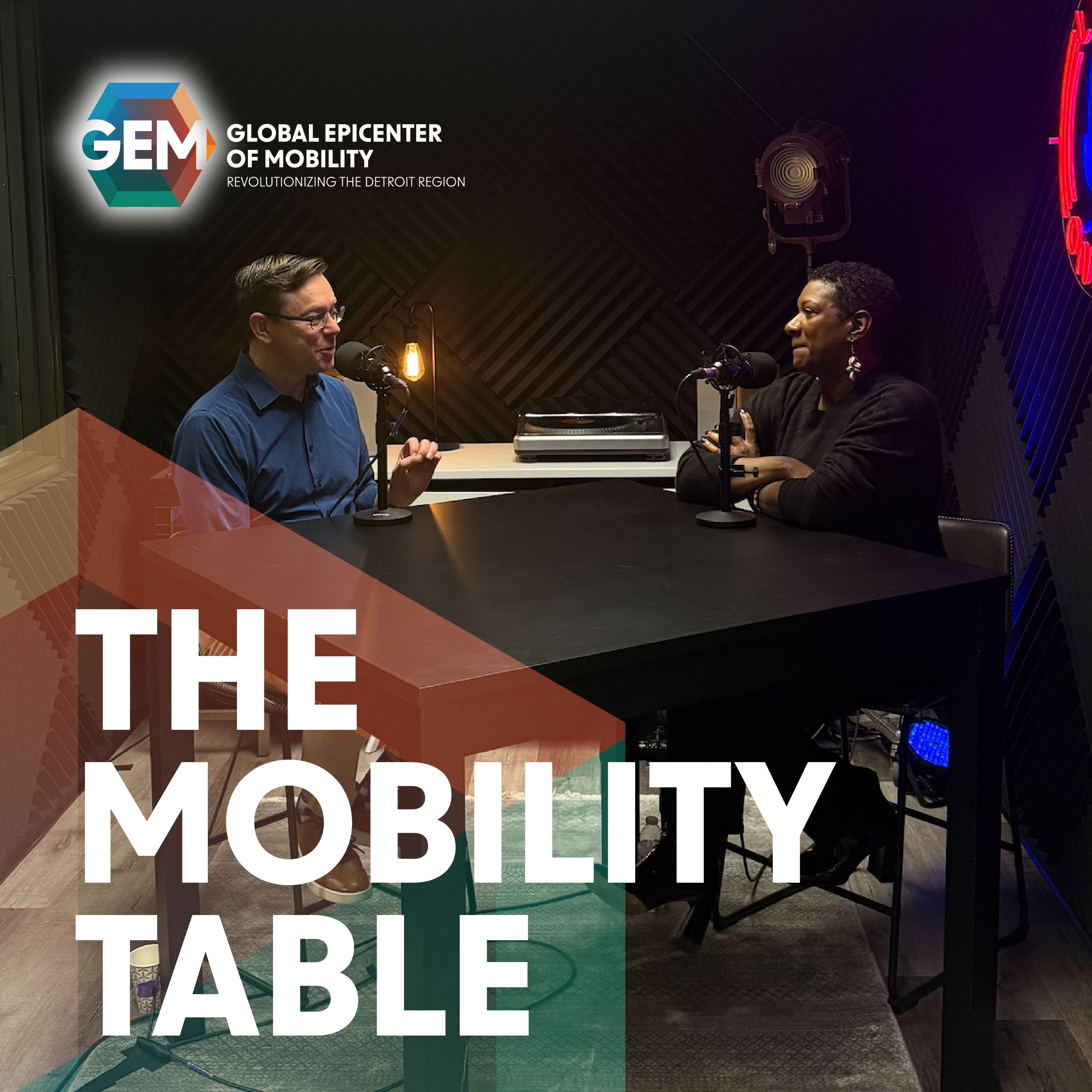
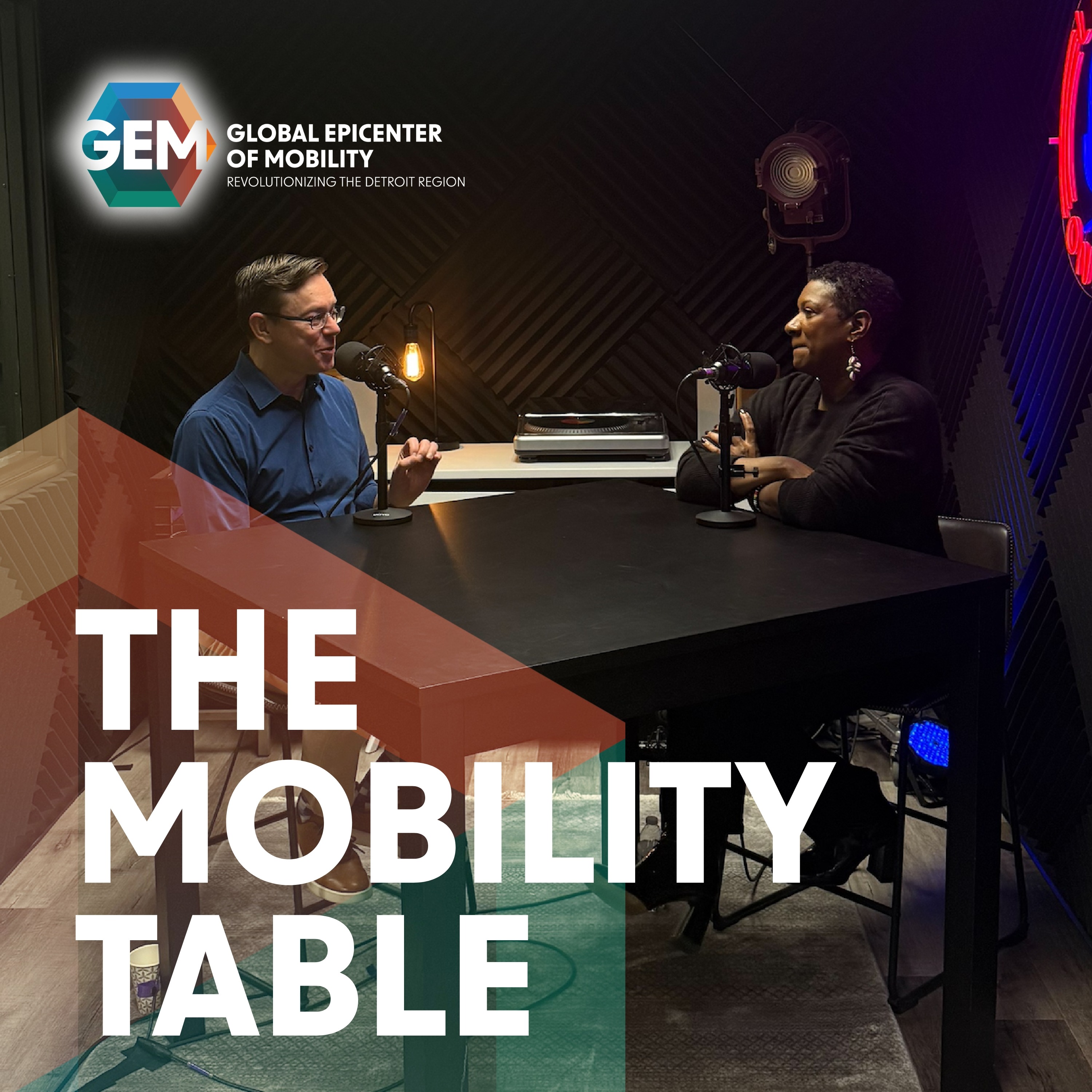
Welcome to the Mobility Table podcast powered by Gem.
I am Bernard Swicky, VP of Mobility and Research at the Detroit Regional Partnership,
home of the Global Epicenter of Mobility or Gem. I'm joined by my co-host Janine.
Hey everyone, Janine Gantt, Mobility Engagement Officer for the Global Epicenter of Mobility,
and we are again happy to have this opportunity to bring to you all things that are cool and
interesting happening in Detroit's advanced mobility ecosystem. Today, I'm excited because
we're really going to be focusing in on innovations. Bernard, I'm curious,
what are some innovations that you've seen that you're pretty excited about?
I think right now, things that don't have a driver are really picking my interest, and we
tend to think of them very much as things that fly drones and the like, but we've got an interesting
technology we're going to be highlighting with Mott Mott, which is a human controlled but remotely
robot that goes under water well out of sight, and it's such an expansion of the definition of
mobility because we're moving neither people nor cargo, but we're solving problems. We're making
the world a better place, so we're still deploying this technology for the general good, but I love
how unconventional it is when we talk about mobility here at the mobility table. Well,
I agree, but you and I had a conversation last week, and you talked about driving a vehicle
from the back seat of a van using a remote control. Correct. I believe that was a company
called Lone Eagle, and yes, the way back, the third row of a minivan at the American Center
for Mobility, and I can tell you, I was there visually seeing what happens, but with this
remote in your hand, and by the way, Lord bless the good people in that van, who put their trust
in me, but just that challenge of, it was very difficult to do even when you're there and when
you're seeing it, but I can only imagine how difficult it is, any extra challenge of being
in a pipe underground, far away, in the dark. It's a very different environment,
and I love the fact that right now in Detroit, our core competencies line up with such things.
Absolutely, and I think our region has seen so many different types of new innovations and
technology, so I'm excited about what's happening in Detroit, and I imagine that as people move
around our region, they begin to see all kinds of different kind of technologies happening,
from things like Waymo to, I've seen recreational vehicles out there on the road as well, so
really interesting types of technology, and I do think that this one we're going to be talking
about with MOTMOT is something really different for people to begin to learn about and explore.
Yeah, absolutely, and it's also obviously a new company, so it's also a chance for the Detroit
region to kind of flex its muscle in terms of startup support, and helping the founders actually
build, capitalize, and launch, and it's another really cool, not new competency in Detroit,
or in the Detroit region, but it's one that's getting beefed up, strengthened up,
and it's getting exposure in the world right now. Absolutely, I think we have one of the best
ecosystems for startups in the country, if not globally, and one of the things we talked about
is really how do we ensure that not just the technology grows, but the business grows,
like how do we find businesses that are interested in building here, manufacturing here, creating
jobs here, staying here to really help grow our region, and I think this new technology
and our guest is going to help us really think through what's possible here. Yeah, absolutely,
and it's, you know, watch out Silicon Valley, right, because we've known we've got the capabilities,
right, the actual technology capability, but now it's also, you know, we talk about ecosystem,
and helping that fledgling company succeed with all the startup support that goes into
those early stages, we're now getting known for that, we're in that same conversation,
and I don't think that was necessarily true when we started Gem, so it's exciting to be here at
Mott Mott. Tim, thank you for joining us, and first of all, let's start off by learning a
little bit about you. What led you to working at Mott Mott? Well, thank you very much for having me,
this is super exciting to be here. So what led me to Mott Mott, I think I should start with
what Mott Mott is, like who we are as a company, because I think once I explain that you'll
understand like why this is so exciting to me. So Mott Mott is a robotics and software company
where we develop robotic platforms that enter into some of the harshest environments,
you know, on the planet right now. So we actually build technology that goes into
active, highly pressurized water infrastructure, this is potable water infrastructure, so when
you turn on the faucet, when you fill up your water bottle, we're in those, those pipes that
actually feed that network. And so in order to do that, two things, number one, highly, highly
pressurized, we're talking somewhere between typically like 50 to 80 psi of pressure, sometimes
even higher up to 100 psi. That's equivalent to depths around like 180 to 200 feet deep water,
right? So the environment is difficult that way. It's dark, there's no lighting, right?
In many cases, that infrastructure might be old, it might have what's called tuberculation,
which is almost like a plaque type of a buildup. That doesn't sound good at all. Well,
tuberculation, you don't want it in the water supply. Right, so but it's natural, it does happen.
You don't want it to get to the point where it starts to clog a pipe and create, you know,
issues in that way, kind of similar to your arteries in your body, right? So what we do is
we are able to access that infrastructure as small as six inches in diameter, which is a unique
challenge, right? Making a 90 degree turn in six inch infrastructure. Right, because when you talk
about your technology, we're talking, you know, not something sort of nefarious, it's a robot. Yep,
it's an actual physical little robot that goes in there and it's got adorable names like R2B,
D2. No. That is our internal name for our R2D2 robot. Yes. So, but yes, so we have to be able to
make these turns of stuff so you have this compact piece of technology that has to have lighting,
it has to have cameras, it has to have a variety of different sensors, and have the capability to
propel itself, right, into these environments. So these environments don't turn off. So it's a
really, really difficult challenge. We've got over 2 million miles of water infrastructure,
underground water infrastructure that's supporting these portable systems across the U.S. alone.
In many cases, this infrastructure is already past its useful life. In some cases, tens of years,
sometimes, you know, 50 plus years past its useful life. We have water infrastructure in the city of
Detroit, that is pre 1900. You know, I don't think a lot of folks think about that. Like,
and you know, we talked about this, you kind of see the infrastructure of bridges and utility
poles and so forth, but I don't think we really think about what's underground. Well, most people's
experience of water infrastructure is I go turn on the faucet, I wash my hands, I clean off, you know,
my fruits and vegetables at home before I cook. I turn off the faucet, I'm done, right. It's
something that we very much take for granted, but we're lucky enough to be able to do so.
But as this infrastructure continues to age, we're seeing more opportunities for
water main breaks across the country. By the resources that I've read, it's somewhere between
200,000 and 300,000 water main breaks on average per year. It's been pretty steady over the last 10
plus years in the U.S. And so what that means is that these entities that are operating this
infrastructure are constantly playing in a very kind of reactive mode. So what we're able to do
is go in and get data that can allow these entities to start shifting from being very reactive to
very proactive. When you're reactive, everything's more expensive, right? When the water main breaks
is, you know, you got to rush people down there, you're potentially paying overtime, you're expediting
supplies and equipment. Plus, you're disrupting the community and that's causing expenses and
other issues down the road as well. Yeah, so for example, my son was home from school the last
two days because they had plumbing and water issues at the school, right? They couldn't wash
their hands, they couldn't flush the toilets, they couldn't operate. So when water infrastructure
issues happen, everything stops, right? It's not like a road closure, okay, I can drive around it,
right? Oh, my power went out so I can go and I can, you know, work from the library or I can go
into the office or if the office powers out, I can work from home, right? Like, there's no flexibility,
right? Water's out, everything stops. So that's really what led me to Mott Mott in terms of like
the unique challenge, what I'm going to call a critical need in our nationwide infrastructure
that supplies water, the resource for life and what got me so excited to take this opportunity.
I've been in government for a little over 20 years, government and government adjacent roles.
Right, because you're coming most recently from the city of Detroit.
Correct. Mobility and innovation office, right? Yep, yep, so I was the chief of mobility
innovation for the city of Detroit for a little over four years under Mayor Duggan.
Fantastic experience, but it was funny when he hired me, he specifically told me, Tim,
the day you start acting and thinking like a government employee is the day I fire you.
It's a true story, right? And so I joke with people, I'm the most non-government government
employee there ever was. And so it's always been my dream to get back into the private sector to
really just build something, right? Do something that is of critical importance that helps to move
our society forward. And so I can't think of right now a better opportunity in place for me to be
then right here with Mott Mott trying to address this very unique challenge, you know, that is
something everybody should be paying attention to because it's your tax dollars
that are paying for this infrastructure, right? And if the infrastructure has to be replaced at
the most expensive method, i.e. we wait for it to break and then we dig it up and replace it
emergency, then it's going to mean more of your tax dollars have to go to it. If we can get in
front of that, we can collect the data, we can get into more of a proactive type of approach,
we can reduce those costs and we can spend those dollars more effectively and we can do more with
that money as well. Great point. So one thing I don't think we asked and just to kind of ground
this conversation a bit as well, but Mott Mott is from here. This is a Detroit region. Well,
I think Michigan State University technology. Talk a little bit about like its origin, how it came
to be. Yeah, so a few co-founders from Michigan State University that were going through their
MBA program, you know, had kind of identified this technology in one of the labs at MSU.
Talked to the individual who was leading those efforts and found a great fit. They pulled in
another co-founder from the University of Michigan that has depth of experience in industrial
operations and other things in that space. So we've got a really strong team focused on the
technology side of this. And again, what better place to really try and focus on water issues
than, you know, the state that literally, you know, has 20% of the world's natural water
resources on our borders, right? So they started this company just shy of two years ago, if my
timelines are correct. And they've done amazing work to get to this point. I'm a recent hire on
the team. Again, very, very lucky to be there. Very excited to be part of the team. But they started
this with, you know, a number of different, you know, small business grant opportunities,
number of different small resources that existed through like MSU and other programs. We've
leveraged opportunities from GEM itself. So we were very fortunate to be part of your mobility
talent resource network program. You know, you talked a little bit in your opening here about how
we can kind of, in this region, try to really provide those full wraparound support services
to help, you know, not just technologies develop, but businesses develop, right?
Yes. We talked about the business piece of it is really critical, especially as we think about
new innovations that can build and not just scale here, but build here, create jobs here,
create manufacturing opportunities here. So I'm glad you're talking about the business and the
things. Yeah. So again, your program, that mobility talent resource network really helped us. It set
us up with an HR consultant that helped us work through our employee handbook, our hiring policies,
a number of different things, you know, from an HR perspective that, you know, we as a team,
we just didn't have a real depth of strength then, to be honest with you, right? It was one of our
gaps if we're being honest with ourselves. And so the ability to leverage that program, you know,
through GEM was extremely helpful to us. And honestly, we actually just launched the fruits
of those efforts internally, right? So I just signed my employee handbook recognition this week,
right? So yes, timing wise, perfect. But yeah, no, it's, it's really, really exciting to be
building this type of stuff here in the Southeastern Michigan, you know, region, because, you know,
these these resources are now available to us, right? And they're helping us move faster,
helping us move smarter, helping us spend our dollars better, right? You know, we do have
some venture funding. And so we got to make sure we're being really good stewards of those dollars,
you know, and obviously aiming towards becoming a scalable business. I think we're really,
really close to that. And, you know, be able to provide a return on investment for those investors,
right? And in the dream there is, hey, if we're a success story here in Southeastern Michigan,
we can help draw more attention to all the great stories that are happening here, right?
Plus all the jobs you provide, absolutely, right? It really is one of those unique opportunities
where it can be that rising tide that lifts all boats. Nice, nice. No, Tim, and I'm really curious
about this. As a company for MATMA, you've got this wonderful technology and these cool robots that
have these amazing capabilities. What is the product? Is it the technology, the robot, the
physical thing we can touch? Or is it the service that the company provides in terms of helping
the municipalities and the regions have those optimally functioning water systems?
Yeah, so right now the answer is yes. I'll be both. Yeah, so I mean, we joke sometimes and
truly, we say we're doing some NASA stuff, right? Because we're entering a really tough
environment. We're doing something that largely hasn't been done before. You know, we're kind of
at that stage of like, it's not the best analogy, but like the iPhone before the iPhone was really
a big thing. There were cell phones, right? Everybody knew that they wanted a cell phone
with more features, more capabilities, but you didn't really know that you wanted an iPhone
yet when it came out. So what we're doing right now, we're talking to our customers, right? So
municipalities, utilities, anybody who owns, operates, or has some responsibility for this
underground water infrastructure, they know that they want the data, right? They're like,
we need resources that help us move from being very reactive to being very proactive, right?
So they know they need that, but they don't necessarily know what that looks like yet or
what the best flavor of that is. And so that's kind of what I'm trying to say here with those
analogies I'm using. We are at a place where we can provide news types of data and new types of
information that can allow them to move that. And so, you know, we're really excited to take
that and today provide the technology, provide the service, and then at the end, so we'll go out,
we'll do an inspection of this infrastructure, we'll collect video data, we'll collect acoustic
data, we'll collect a few different other types of data while we're down there, we will then
take that back, we'll process all that data, and we'll come up with what's referred to as a
conditional assessment report, okay? And so what that does is it tells the owner, operator, that
infrastructure, hey, here's where we saw things that looked abnormal. Here's where we saw things
that looked, you know, maybe concerning. There is a scoring matrix, you know, based on like the
criticality of a certain section. So if this section of the water main services a hospital,
high criticality, right? If it services, you know, a dog park, right? Low criticality.
You know, some of the dog parents might not think that, but I hear you. I love my dog,
but I can take my dog somewhere else to get some water real quick too. So, but yes, I definitely
have what you're saying. So the point being though, like there's a factor with the criticality,
and then there's a factor of what this is serving, what the customers are. And then there's a factor
for the condition, right? And then you do a multiplication to kind of say, hey, here's,
here's, you know, kind of a rat. We're, we're ultimately trying to get to
something closer to a probability of failure, okay? We're kind of on the cutting edge of trying
to push industry to come up with some, some models that will work for that too. But so today,
we provide everything. Longer term, what our goal is, is to be another tool in the toolbox of
entities that are out there doing this type of work already, right? So there are third party
inspectors. In some cases, I'll give you an example. You might find a community that pulls
water from one of the Great Lakes. And so what they have is they have an intake out in the Great
Lake. It typically is, you know, a few hundred feet offshore. You know, it goes maybe 60 to 100
feet down the ground, and then kind of comes all the way out into land underground and pops up into
a pumping station. Today, they'll use divers to go down there, right? So long term, we might be a
technology provider to the company that's currently diving, so that they maybe do diving for some
instances, but for others, they deploy our robotic technology, right? Please. Yeah. No, no, and in our
preparatory conversation, you talked about a recent example where that robot was in another state,
but it was remote controlled. Yeah. And I'm curious what that could look like. Does that
diver need to be on site with this? Or by the way, where I'm going with this, can we ultimately
turn the Detroit region into kind of a hub of monitoring these remote robots, which could be
all over the country? Wow. So you talked a little bit about, you know, what excites you in your
intro again, you know, taking the driver out, right? And so the example that you're talking about,
we just did a job down in Florida. We had a very quick turnaround time. We put our robot on a plane
with a team member. He went down there. He set it up. But our driver, our best driver on the team,
was not able to make the trip, right? There were some other commitments and some conflicts. But
what we were able to do is because of our technology stack, we were able to have our team
member go down to Florida, set up all the equipment, and then our driver actually remotely operated
the robot from Detroit, which was a really cool experience, right? Proving that technology out.
We have field camera kits as well. So we set up a field camera kit so we could actually see live
what was happening in Florida, you know, at the site where we were deploying the robot.
And the driver had access to that, the live feed of the camera of the robot itself
while he was in the infrastructure. And so, yeah, longer term, you know, there's either an opportunity
for us to remote pilot from, you know, Detroit to anywhere in the world, potentially.
Or potentially, you know, it's more of as we move further and further down the pathway,
we are looking at ways that autonomy and AI can help us. I can talk a little bit more about that
if you'd like me to. But, you know, we could potentially have an operation center in Detroit
that monitors if we are in kind of an AI and autonomous operation or robots in the future.
We monitor those. So if any issues get flagged, similar to autonomous vehicles on the roadways
today, right? We have someone who will pull that up on their computer really quickly,
potentially take over to manually maneuver, address the issue, and then set it back into
autonomous mode, if you will, right? So, yeah, really cool stuff. We're super excited about.
And again, part of the reason why I chose my robot.
Yeah, yeah.
Awesome. No, and I'm curious. So you touched on it, AI and autonomy. And I have to say,
I saw a demo of that robot and it looked so tricky to get it to go through a certain pipe to make
those turns. And I'm curious, is there an opportunity for AI or automation, especially when the water
is murky, when it's moving at a high rate of speed under high pressure? Can your job be made
easier by some of the autonomy capabilities that we know exist in the Detroit region?
So I love the way that you framed it right at the end. Can the job be made easier?
Right? And that really, I think, is the nearest term opportunity,
and kind of our progression path towards a potential future of full autonomy.
So let's talk a little bit about that water infrastructure again, okay?
If either of you have ever operated a jet ski or a boat, you know that if I turn, I only actually
turn in that direction if I'm applying force, right? So if I've got the motor and the impeller
running and pushing me, if I turn that off and I turn the wheel on the boat or the jet ski,
it doesn't do anything. So similarly in the pipe, right, I'm floating in this environment, right?
It's, you know, astronauts will go into pools and stuff to simulate zero G, right?
Because it's three-dimensional as well. You can go up, down, left, right, not just like a car going
down the road where, you know, it will not lift up off that road. Right? Exactly, right? So why is
that important, right? What am I really getting at? What I'm getting at is these are active live
water mains. So there is flow, right? People open up a faucet to wash their hands or they
flush a toilet or, you know, they fill a pot of water to cook, right? That is causing flow in the
pipe. And so what's happening is there's little turbulences that are that are all surrounding
our robot that can cause it to start to, you know, reorient and kind of move in all different
sorts of directions. So we've got accelerometers and things like that that can sense those.
And one of the best ways that we can get assistance from this type of technology today
is allowing our camera systems to provide feedback. So we've got a technology that'll try
and find the center of the pipe, okay? And then if the robot starts to sway in any direction,
we can use that to actually communicate with the motors to say, hey, I'm starting to sense that
I'm shifting a little bit to the right, like apply the right motor to force that end forward so I can
center myself again, right? We're looking at how we can use that same type of approach to allow
us to take turns inside of a pipe, right? We built our robot to the largest possible size
because we needed to pack a lot of technology into it in order to make those six inch
bends inside the infrastructure, right? Really difficult to do if I'm being honest with you.
Sounds like it would be. Yes. And so, you know, now not every piece of infrastructure underground
is six inches, but the way that we get into the system to access it is through fire hydrants.
The standard measurement for a fire hydrant is six inches. So we need to be able to fit through
that infrastructure before we get to any of the bigger infrastructure. And so ways that that
technology, the ability to use AI to find where the pipe's at, to help us kind of reorient ourselves
and make those turns easier is something that we're really working on too. The last thing I'll
say is sometimes we get a lot of sediment in the pipe, right? So this can be all sorts of
different types of materials. Sometimes we'll get air bubbles in the pipe. These things can actually
disorient us as we're trying to drive through. So our ability to train our AI and other systems to
identify that, okay, I know where the motors moved, like this was, you know, a straight center,
but I'm feeling accelerometers move a little bit, like it can sense other things that we
can't visually see as a driver with our own eyes, right? We're not in the pipe. We can't see that
it's rotated. So we can use those types of sensors and tools to help us figure out, you know, what
true north, true center looks like in the pipe environment again.
It's really amazing. So we should not be fearful when we see someone taking the
top off of the fire hydrant and dropping in some kind of little robot thing. This is just
Mott Mott doing his thing. I can say that for Mott Mott. If you see Mott Mott logos,
Mott Mott vests, right, and we're the ones out there, yes, you don't need to fear.
So, but yeah, I mean, it's, I think this is something that's that you're going to start to see
far more common occurring over the next few years, right, is communities starting to invest in these
types of services. And we believe we can offer them at a rate that makes a lot of sense, right?
You know, we're not, we're not, you know, fully there in terms of our final pricing
for this yet. But what I can say is we've looked at some of the competition that's out there.
And we are priced significantly lower than those competitors. We believe we offer a much
higher quality and value of service. You know, we offer, you know, more sensors. We offer the
actual camera inspection. We offer our post processing. So we've got a number of value
ads that we think makes a ton of sense. And again, our long term goal from a customer standpoint
is to allow them to shift resources from that reactive budget, right, over to the proactive
budget. Because again, when you do that, every single pipe replacement that you do is less
expensive because you're not rushing to get it done. You're able to schedule it in advance. You're
able to, you know, put it on a certain timetable to pay the lowest prices for all those types of
services. Makes great sense. What do you see as the, what's next for Mott Mott, you know, in terms of
its growth and where you see it in the next, I don't know, four or five years? Well, I mean,
I'll be honest with you, the dream in five years is that we're a unicorn, right? We're a unicorn
company here in the Metro Detroit area. You know, that's a very ambitious goal, right? Very,
very few companies reach unicorn status. So, but you got to be able to dream, right? And if you
don't have that North Star you're going after, then, you know, you're kind of, you're just bumping
around and hoping to get somewhere. But in the short term, you know, I see us finalizing our
commercial product this year, getting out and deploying in a number of communities, starting
to educate communities on the availability of this type of information, a service,
working with, with other customers, engineering consultancy firms that might be under contract
with municipalities or utilities to manage this infrastructure today, potentially third party,
you know, inspectors that do other types of services, like I mentioned, the diving and that
sort of thing, and kind of growing our market. Right now, we're laser focused on the potable
water systems. Our technologies have a number of direct application, you know, to other types of
services. We've talked about in open waters, do we inspect ballast tanks on, you know, ships and
things that come through for invasive species, right? Do we inspect, you know, other types of
infrastructure? Maybe it's not potable water, but maybe it's sewer systems. You know, so there's
a number of other aspects that we can get into. But we think that this is kind of our best opportunity
today in that that potable water systems market, where, you know, we've got a significant advantage
over our competition. And there's there's a massive need, like my biggest concern when I first joined
the company was whether or not like we really had a strong customer base. I sat in three customer
discovery meetings my first week. And what I can tell you, as soon as we started really, you know,
informing our customers on what our capabilities are going to be, their immediate response was
how fast can you get out here and show us in person? Like, can we get you out here next week?
We're like, well, not not quite. Right? Let's put some time in the calendar a little bit, you know,
down down the road. But, you know, we're getting really, really close to that commercial product.
And so we're going to need to scale, we're going to need to build more and more of these units,
we're going to need to hire teams that'll go out and, you know, at least initially be providing
the field services. Those team members will have opportunities then, you know, transition to other
roles inside the team, right, because they'll have the full experience of what it's like to go out
there and help the customer. Maybe they'll be trainers of the trainers, right. So like I mentioned
that in our conversations earlier, where we would actually train, you know, the local utilities staff
on how to operate this infrastructure or this this hardware software solution, you know, to inspect
their own infrastructure, right. We have, you know, models around that. So there's there's a lot of
really exciting things happening over the course of the next, you know, one to two years. But yeah,
we're striving to try and make this business as successful as possible and really centered around
Michigan. Thank you. I love it. For me, I love what you said. Look, you got to be able to dream.
And I think if anyone can have a dream and the place to do that is certainly here in Detroit,
in our new kind of Detroit Regional Advanced Mobility Ecosystem, like this is the place to
do that. Thank you so much for joining us. We wish Mott Mott the best of luck. And we do hope to
continue to see, you know, great things coming from you in the future. Yeah, it's been a pleasure.
Love to see you succeeding in Detroit. Love knowing that Jim was part of that journey as well.
So, Tim, thank you so much for joining us on the mobility table. Thank you both and thank you,
Jim. And that's the end of this episode. We look forward to seeing you at the next mobility table.
About this episode
Detroit’s mobility ecosystem sets the stage for motmot’s in-pipe robotics and data-driven approach to water infrastructure. Tim Slusser explains how proactive, information-rich maintenance can reduce replacement costs compared with emergency repairs. The team’s robots operate inside pressurized potable-water pipes, handling tuberculation, tight diameters, and sharp bends, while using sensors and AI to navigate disturbances. Inspections generate conditional assessment reports with scoring matrices and probability-of-failure modeling, and deployments can be remotely operated with live camera feeds.
Tim Slusser joined Jeannine and Bernard at the Mobility Table to explore the application of mobility technologies on aging infrastructure for maintenance and inspection purposes, the resources available for organizations working to create advanced mobility technologies and the potential for AI and greater autonomy in motmot’s technologies.
Tim Slusser is the operations director at motmot. He previously served as the chief of mobility innovation under Mayor Duggan. Throughout his career, Tim has occupied a variety of roles across business development and mobility.