A carburetor is a part of an engine that helps mix air and fuel so the engine can run. It was used in many older cars before newer technology took over.
Twin H power is a special engine setup in some Hudson cars that uses two carburetors to make the engine more powerful. It was a popular choice for better performance.
A flathead straight six is a type of engine where six cylinders are lined up in a row, and the valves are located in the block instead of the top. This design was used in many older cars and is easy to work on.
Early NASCAR success means the wins and achievements of cars and drivers in the first years of NASCAR racing, which started in the 1940s. It helped make stock car racing very popular in the U.S.
Car
Crosley Super Sport
The Crosley Super Sport is a small car from the early 1950s. It was designed to be easy to drive and was popular among new drivers.
The SVO Mustang is a special version of the Ford Mustang that was made in the 1980s. It has a turbo engine, which gives it more power and makes it fun to drive.
The Volkswagen van is a roomy vehicle that people often use for traveling or camping. It became famous in the 1960s and 1970s because it represented a carefree lifestyle.
Car
450SS
The 450SS is a special sports car that was made in very few numbers, making it a rare find. People who love cars often want to own one because of its unique design and performance.
Term
340
The 340 is a type of engine made by Chrysler that is known for being powerful and is often used to make cars faster.
Vintage car sales involve selling older cars that are considered classic or collectible. People often buy these cars for their historical value or as a hobby.
Car
Pagaso
Pagaso was a car brand from Spain that made special sports cars in the 1950s. They were known for being fast and having unique designs.
An auction is a place where people can buy things by offering money, and the highest offer wins. For cars, it means people can bid on them until someone pays the most to take it home.
Amateur restoration means that someone who isn't a trained expert worked on fixing up the car. It might look good, but it may not be as well done as if a professional had done it.
Bidding is when people offer money to try to buy something at an auction. Each person tries to offer more than the last until someone wins by offering the most money.
A concept car is a special type of vehicle that car companies create to show off new ideas and designs. They usually don't make many of these cars, and they're more about creativity than selling to customers.
The Avanti is a unique and stylish car made by Studebaker in the 1960s. It stands out because of its unusual shape and was one of the first cars made with a fiberglass body.
A small block engine is a smaller, lighter type of V8 engine that is often used in cars. It's popular because it can provide good power while being easier to fit into different vehicles.
A flathead engine is a type of engine where the valves are located in the block instead of the head. This design was common in older cars and is simpler to work on.
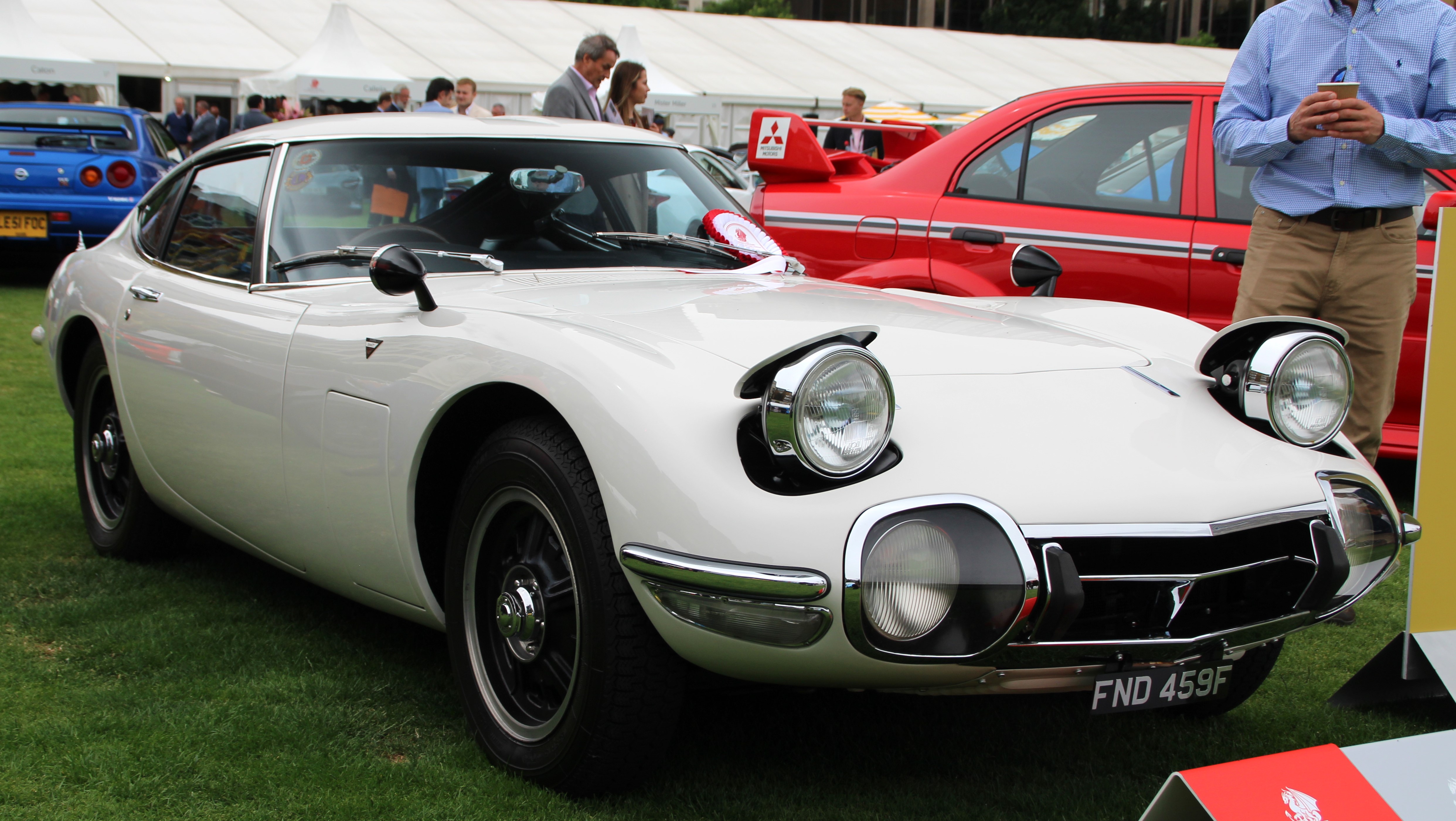
The Toyota 2000 GT is a famous sports car from the late 1960s. It's admired for its beautiful design and was one of the first Japanese cars to gain international recognition.
The Chevrolet Corvette is a famous sports car from America that started being made in 1953. It's known for being fast and having a unique look, making it a popular choice for car enthusiasts. People talk about it because it represents American car design and performance.
The Ferrari Daytona is a famous sports car from the late 1960s known for its beautiful design and powerful engine. It's a favorite among car collectors.
The Jaguar E-Type is a classic sports car that came out in 1961 and is known for its beautiful shape and fast speed. Many people admire it for how it looks and how well it performs, making it a favorite among car lovers. It's often talked about because it's considered one of the most attractive cars ever made.
Car
Kord 1936
The Kord 1936 is a classic car that stands out because it was very different from other cars of its time. It was made by a company called Kord and is famous for its unique design and technology.
Shelby cars are special versions of Ford cars, especially Mustangs, that are made to be faster and more exciting to drive. They have a racing background and are popular among car enthusiasts.
The Citroen 2CV is a small, simple car that was made in France from 1948 to 1990. It's known for being very affordable and easy to drive, with a quirky design that includes a soft top. People talk about it because it helped many people in France own cars for the first time.
LIVE
Hello, everybody, and welcome back to the Bring a Trailer podcast.
Alex Porter coming to you once again from Bring a Trailer headquarters in San Francisco.
Joined by a BAT stalwart, Rafi Minasian, a designer, a prolific BAT seller, a professor
of young people, kind of an all-around lifelong car guy, a person who has two listings live
right now on Bring a Trailer.
So we've got to dive into all of that, Rafi.
But first off, thanks for doing this and thanks for doing it in person.
Well, thank you.
It's a pleasure to be here.
And it worked out really well because I'm here in San Francisco, so I have the opportunity
to come do it in person.
It's so much better when we get to do these with somebody like right across from the table
and you even refuse to wear the headset.
So we're like really just having a conversation except that we have these microphones on
the face.
So Rafi, you've been a BAT user for over 11 years and I want to know how you found the
site and everything.
But over 220 listings under your belt as a seller, two live right now, like I mentioned.
But Lifelong Car Guy 2, and you're also an occasional poster of BAT content, which we
love here.
And people love the car stories by Rafi that we post from time to time.
We've got some amazing ones to dive into.
But what I know about you from those is that you're born into this.
Yeah, my dad was really interested in cars.
He wasn't particularly mechanically inclined, but he sure did like to pick up orphan cars
and they would show up at the house from time to time.
And oftentimes, even as I was a young kid, my dad would leave a car in the driveway and
a note for me on the table that said, something's wrong with the Hudson.
Please fix it.
And so the first time I got the note, I called my dad at the office, I said, dad, I got the
note.
What's wrong with the Hudson?
I'll fix it.
And he would say to me, if I tell you what's wrong, I rob you of the most important part.
Oh, yeah.
Right, right, right.
The diagnostic part.
And I don't know.
I was 11 or 12 years old.
I just had my first set of tools.
And he'd go, go out there and see if you can figure it out.
And that's how I started learning.
I was really quite young when I started, but my first experience with cars, I can remember
it still very vividly because I was about four years old.
And there was this giant black car that had pulled up in front of our house and it was
shiny and had huge chrome bumpers.
And I don't know what it was to this day, but as I walked up to it, I could see my shape
changing inside.
Oh, that's sort of so great.
You know, going up and down, bouncing and I was transfixed by the fact that this metal
object that had all this power and authority could reflect me.
So it was so compelling and I kind of committed to it at that point that I was going to figure
this relationship out, that that would be my thing is to figure out how to shape the
car and how the car could shape me.
Yeah.
And that's how I came to it.
And that's showing an early interest in design as well, right?
Yeah.
That's almost what attracted you for the very, even before the mechanical part of the history
or anything, it's the design itself.
Yeah.
And I discovered that with drawing, I could convey my ideas, my sort of conceptual notions
about what cars could look like.
So I started drawing at an early age and I worked really hard to get good at it.
But I remember that one day, working with my dad, he'd taken the back of the television
off and I looked inside and I saw all these tubes and it looked like a miniature city
and I thought, oh my gosh, I had no idea things existed on the inside of stuff.
Yeah, yeah.
And so I asked my dad, is that how cars work?
He goes, oh yeah, let's go look at one now.
And we went out, I don't know, six, seven years old and we're looking under the hood
of the car and I just had no idea that that's what it was.
And so after that, I just stopped drawing and started taking things apart, taking the
alarm clock apart, upsetting my mom and trying to figure things out.
That's how it all got started.
What was wrong with the Hudson, Rafi?
It, like most things, it was carburetor.
Yeah, of course.
Was it Twin H?
Did it have the two big, oh man.
Yeah, there's actually a funny post I did on Hudson about a Twin H and Twin H power
and those air cleaners.
It's a beautiful engine.
It's gigantic.
It's about a 300 cubic inch flathead straight six.
I love those cars.
Yeah, it's like a truck engine.
Yes, totally, totally.
And kind of early NASCAR success.
I love those early Hudson's.
What else was around the house?
Do you remember any of the other early cars?
Well, the car I learned to drive on was a 52 Crosley.
No kidding.
A hot shot?
It was a super sport, which is hot shot, but they came.
The super sport had the doors.
Yes, that's right.
And so I learned how to drive on that.
I was so short.
My dad took me and my brother to a vacant lot and he duct taped chunks of wood to the pedals.
So and, you know, I sat on like a phone book and and he taught me how to drive and how to
shift because it wasn't, you know, manual.
And he would run alongside and say, now shift, shift.
And then, you know, clutch, clutch, clutch.
And, you know, you know, that's amazing.
That's how I learned.
And my dad was so enthusiastic about everything, anything that involved discovery.
And I think that's sort of what infused me with my curiosity about cars, my curiosity
about design, how things get put together.
And was he an artistic guy too?
Was he also drawing and sketching that kind of stuff?
No, not like that.
He was a he was a lawyer.
And he did approach law from an artistic perspective, sort of the philosophical.
He was always when his kids, my older sister, my younger brother and myself, we would set
up these mock courtrooms in the house and we would have to defend certain things.
And my favorite was when they started carpool lanes in California.
He presented the pregnant woman pulled over from driving in the carpool lane.
Is she, you know, within the law, so to speak?
And so we would, we would have.
Were you on the defense or the prosecutorial side of that one?
Yeah, we had to do their trial this way.
And then you could learn both and that was sort of.
By the way, my dad was a municipal court judge and I'm almost positive.
He told me that somebody came in and fought a, this would have been in those late 70s
or early 80s, fought a diamond lane ticket because they were driving a hearse.
And they had a corpse in the back.
Yeah, I don't want to swear to that, but I'm almost positive.
He told me that story when I was a kid.
And I think the, the idea behind my upbringing was just constant curiosity
and a willingness to cultivate empathy with anything that you had a relationship with.
And that included objects because I have a pretty deep object based empathy for automobiles.
And I think most of Bringer trailer folks have that were drawn to them
for a number of different reasons and they can be truly transformative
in a number of different ways.
And that's a big part of how when I work with young people in the automotive arena,
I try to introduce them to the automobile as a vehicle for understanding your life,
not just a car, because it can be truly transformative.
And I've experienced that with various groups that I've worked with over the years,
watching young people find their place because most young men are three dimensionally inclined.
Yes.
But all of that gets diminished when they go through traditional Western based education.
So they don't have the opportunity to really present their way of thinking
because so much of our learning is linear and two dimensional.
And so when they come into programs like this, they're all of a sudden rewarded
for their intelligence in that area and they become completely different people.
Yeah.
And I see that happening with my 15 year old son right now.
I mean, he's like, you know, he can see everything in his head,
but he has a hard time when he's reading it, you know, and regurgitating it via writing,
you know.
Because myself included, I was very frustrated by the linear based methods of thinking in
classroom. And I always wanted to be more creative with things, always wanted to try
new things. And, you know, we would have spelling tests and I tell the teacher,
what if we have like three different versions of a word?
Can we spell it three different ways?
You know, it was just part of, again, from my dad's perspective, having that,
you know, anchoring to being creative about things from my mom's side.
My mom was very spiritual and very, what is the earth about?
What is the world about?
So these two together really came together quite well.
Wow. That's amazing. And this is all in Los Angeles, isn't that right?
Yeah. I grew up in Southern California. I was born in Anchorage, Alaska.
Wow.
Yeah. Because my father and mother homesteaded, as my dad used to say,
as Alaska was first admitted into the union.
So 1959, right?
Yeah. Yeah. And my sister was born there and then I was born there.
And we lived there for a few years and then moved to Southern California.
Do you have any memories of that or you were too young?
Too young.
Yeah. Okay.
Yeah. Okay.
I've been back a few times and I love it. It's a fabulous place. And surprisingly,
there's some great cars back there.
Interesting. We list cars occasionally. We just, what did we have?
Oh, we had a SVO Mustang. I kind of have a hankering for an SVO Mustang that was in Anchorage.
And I thought how fun it would be to drive it back. But I don't even know if you,
there's the Alcan Highway, but I don't even know if you can drive. It's dirt some of the
ways, isn't it? Can you drive or is there paved from?
Yeah. Back in the 50s and 60s, there was portions of it.
Right. Okay. That's what I thought.
That were, but now it's a pretty safe straight through drive. And there's places to stop for
gas and things like that. But back when my parents did it, they loaded up that Volkswagen
van and they had tanks of fuel. They had tanks of water and...
True homestead. Some of the last true homesteading you could do in the United States.
Yeah. Absolutely. Wow.
Again, that sort of spirit of adventure. Yeah.
That kind of thing where, you know, you have a flat tire and you've got to take that tire off
the rim at the side of the road. Totally.
And that's not an easy thing to do.
Anyway.
Was he already an attorney at that point?
Yeah. He was an attorney.
So he's kind of an adventurer too, a little bit.
Very much so. My mother as well. My mother was an amazing linguist and she loved playing with
words. And so we would always play with words. And that was something really interesting because
I would form sentences, you know, as a young kid and start to say things. And she'd say,
say that again, but differently. And I'd say it again. It's just one more time, this time,
poetically. Yeah.
And so she taught me how to measure down and just pick the least amount of words to say the
thing you want to say. And it's interesting because people do ask me on Bring a Trailer,
they'll ask me periodically. I see your posts and when you post, how do you stay so calm?
Yeah.
Because sometimes things are blowing up. How do you deliver that? I go, it's very simple.
I answer the question exactly as if I was telling my mom.
Oh, that's interesting.
So I hear whatever the question is and I think I want to respond respectfully. I want to respond
intuitively. And I also want to respond thinking in the back of my head. My mom will say,
how will you say that differently? How can you say that differently? And what she's saying when
she said that to me was, how can you say it in a way that includes everybody into thinking about
the answer? Yeah.
So because most people...
But also cogent and simple and straightforward too. It's so hard to speak plainly, especially
about cars, which are complicated, right? Because you're talking about history, but also mechanical
components. It's really tricky to do that.
It is. And you never know. I try to be sensitive as to, okay, I look sometimes at the commenter
and I'll go back and I'll see their comment history. Okay, this person's super technical-minded.
Yeah.
My response to him has to acknowledge he's technical.
But it could be somebody who doesn't know anything about cars. And I hate when people
disclude people like, those people should be welcomed into our hobby, right? People who are
just starting out. It's their first collector car or they don't know very much. That's fine.
Right. The best person in a car show is a person who knows nothing about what's going on.
I love to walk around with people like that because they'll go, why? Why are there mirrors
under the car? This is ridiculous.
What is this? Are you kidding me? This one has this and this one has that. Why? Why do people care?
And it's so interesting. And I learned so much because it causes me to think about it and go,
yeah, why do people care?
I mean, it's actually a valid question. You walked into the office, Rafi, and you said,
I wish I could sum it up. So I'm going to ask you to say it. But you said, you have a
bizarre set of skills that's applicable almost only perfectly on bring a trailer,
like the ability to write, the ability to talk, the ability to go about cars, take a picture.
Yeah, for the most part. And there's no way I could have orchestrated it to all fall into this.
It's a bizarre set of skills that somehow come together. I can take pictures, I can make a
video, I can talk about cars, I can engage people in an inclusive way, and I can tell an
interesting story. So those things individually or independently, sure, but I'm not going to be
a photographer. I'm not going to be a filmmaker. But I can put all those things together and I can
corral them around my passion. And one thing I've learned is that if I'm passionate about
something, there's always going to be other people that have similar interests. And that's
been the great thing about bring a trailer. The reason why I came to bring a trailer in the first
place 11 and 12 years ago is because I thought, well, this is a great community to connect with
people who geek out over the same things that I geek out of. Totally. And that's how it really
started for me. And so that confluence of skills just landed on my front door. And one day I thought,
as you guys were starting to do auctions, I thought, you know what, I'll give this a shot.
You saw your own car for some or something? I was going to ask because you're often representing
people, other people. That's right. But was it your own car as the first time?
My own car was the 450SS. Oh, man. My own car. Yeah. And I had bought it about a year earlier
and I love that car. Just love it. I can't wait to own one. And they only made 50s, some of them.
So they were hard to find. And I found this one, brought it home, started working on it.
It's a Chrysler motor in those, is that right? Yeah.
Chrysler powered. Yeah. And I just didn't enjoy the driving experience.
Interesting. Why? It's too much of a big cruiser. It's not that sporty, right?
It's a big car. It's a heavy car. It's steel. And it's underpowered if you keep the stock motor,
which is why so many people put in a 340. I just, I wasn't having fun with it.
And so I gave it a year and I kept track of, you know, using it and all that. And I said,
you know what, it's time to sell it. So I put it up on Bring A Trailer and I thought, well,
how hard can this be? And little did I know, it's really harder than most people think.
So I took the pictures, put it all together. And back then you didn't have to do a video.
You didn't have all the things you do now. And so...
We used to beg people for like 30 to 50 pictures and we thought that was really
thorough because that was in the days of auto, you might get one photo of the car, right?
Right. And it sold. And it sold beyond my expectations.
And so I had told a few people in my community that that was what was happening.
And when they saw what happened, literally within a week, a buddy of mine said,
hey, can you list mine? I said, sure. And so...
That's how it starts.
So we took some photos. We talked. We went to lunch. He bought my lunch. And okay, yeah,
let's go. Let's get a gun. And off it went. And it did well. And before I knew it,
like people were coming up to me and saying, hey, would you do mine? And then I get an email
from somebody who's so-and-so is the widow of such-and-such. And she's got three cars.
And do you think you could sell those? And I go talk to the widow. And before I know it,
I'm selling multiple cars. Of course. Of course.
And it just built from there.
I remember this car, but when it came back the second time, so somebody sold it again on the
site. Do you remember that? Here's the yellow one, right? Oh, man. I remember this. This was a
big deal in the early days of Bring a Trailer. This was a big, big car and like a big...
Yeah. And I think I'm not 100% sure. Most of what it sold on Bring a Trailer up to that point
were $20,000 to $50,000 cars. Correct. So this was one of the first to go over 100. Yes.
And so I was pretty proud of that. Yeah, of course. You should be.
Yeah. And then as I started to do more, I got to know sort of the back end and back channel and
got to meet Randy and got to figure out some of how this sort of was working. And I remember
telling a friend about four or five years into it, this is the future of vintage car sales.
It was dawning on you about the same time as us. Yeah. Yeah. And what I was keen about with it,
and there are many features that really work, there's a really interesting transparency,
but at the same time, it's curated. Yeah. It is so well curated that you have no idea the
pandemonium that is going on behind the scenes while these auctions are going on and there are
multiple auctions happening. There's all this sort of... And you look at Bring a Trailer and
when you look at it, and I've talked about this with other people, it's calming. Yeah. It isn't
social media agitating. That's right. It's a calm experience. You're in control of it,
you're in control of the scrolling, you're in control of the clicking, you're in control of
all of that stuff and car people love control. Yes, that's right. We do. So that whole thing,
it's not addictive, it's a pleasant connection. And so that builds with people who want to look,
that builds with people who want to buy and it builds with people who want to sell.
And that whole confluence really is what excited me about continuing to work with it.
Well, and one thing you didn't mention, although it was apparent by what you were saying, but that
you bring to it that is so important for being successful and for enjoying it is the empathy
piece, right? That these are like-minded people and that we're in a civil corner of the internet
and we're trying to like... It's actually totally fine to ask questions and point things out about
a car that you might be curious about or that you might think haven't been explained correctly.
That's part of the magic, but doing that politely and empathetically, which is hard sometimes,
is so important. But you already kind of mentioned how you think about the type of person who might
be asking you questions and gosh, that's so important. Yeah. And some people would say,
well, that's such a kindness. And I think, okay, if that's how you want to proceed,
but I also think that if you frame it around being kind, you lose the opportunity to embrace
it as a natural tendency. Yeah, that's right. And so I just prefer to just be me with stuff.
It's also just the way it should be done. I mean, sure. Yeah, right.
But we could have broader conversations. Well, I'm a big believer. I may be seething
in anger towards somebody behind the scenes, but I'm a big believer and always be as polite
as you can be. Politeness greases the skids of society, right? Absolutely.
Always try to be polite to people. Nothing bothers me more than somebody who's
mean to a service worker. They're just trying to make it through their day.
Absolutely. I don't want to leave. We're already turning on a BAT and I wanted to end with that,
Rafi, because I don't want to leave your childhood quite yet. Your dad had some amazing cars too,
and we'll link to it in the post of this podcast, but your dad had a Pagaso at one time.
And that's one of my favorite cars. And it's not even one of the normal Pagossas. It had one of
the more kind of wild bodies on it too. Yeah, so it was... Tell us the story of that car. There's
a post that you wrote about this too, but... Yeah, so a touring bodied Pagaso 1953, the Paris
autoshow car. Those are the ones with the big bubble rear windows, right? Yes, that's right.
God, they're cool. And this was reportedly built as a gift to Evita Peron. Oh, interesting. And so,
it had to be this beautiful car. And Federico Formenti from touring had done the design for it.
It was exceptional. There was nothing really like it at the time. And it didn't look like any other
Pagaso. So it was really rather unusual. My father and I, by the time I was 14, 15, 16,
we were looking for cars. And we liked cars that were unique, not multiple production type cars,
but stuff that was one of a kind or two of a kind or just a few built, that sort of thing.
Once you really get into cars, and especially after you've had a few, that's what everyone's
looking for. You want the car that's like, it's the only one, it's a conversation piece. It opens
up all the doors. And yeah. Yeah. And the draw to it for both my father and myself was, what's
the story? Of course. What compelled this person to make this. And so we found this car, the fellow
that owned it, Bill Miller, was completing it to have it go to an auction. And it was going to go
to a Christie's auction. Was it already in the United States? Has it already come up from South
Bill? Bill had imported it. So he'd restored it. And Bill's restoration was an amateur restoration,
but it was the best someone would do in the late 70s. And so we tried to buy it before he
committed to the auction, but it didn't happen. So at the auction, I remember we were there,
and my dad is bidding on the car, bidding on the car. And I can see at one point,
he's looking around, getting anxious and getting nervous. And the auctioneer comes to him and
one more time to you, sir. And he goes like that. And I'm like, yeah, yeah, good job. I want way
to go dad. And he goes, I'm sold to you. And I look at my dad and I can see this like dread
phase. And I said, dad, what's wrong? He goes, that's more than we paid for the house.
And I went, uh-oh. So that was like our first big car. And so we brought it home. But the best
part about it was I got to meet Bill Miller. And at this time, I think I'm 16, going on 17 years old.
And Bill, he had these ideas about maybe making a car of his own. And so when I met him, he said,
I'm going to use some of the money to make a car of my own. I said, you know, I want to do a car too.
He said, well, come on over. We'll work on it together. And that started the five-year process
building a Picasso of our own. No kidding. And so I worked. I did the design work. I did the sketch
work. I worked with Bill on the- We were already interested in going to design school at this
point? Yeah. Yeah. Okay. Yeah. But I was in high school. Yeah. And so all my days were spent working
on that car, building the buck for it and building the fiberglass molds and, you know, learning about
how to do two and three part castings and things like that. It's just
wonderful, wonderful experience. And then I started at UCLA. And while I was at UCLA,
I worked to get my degree in product design, always wanting to work in automobile design,
and built that car and completed it, took it to the LA Auto Show and had a, you know,
showing of it there in 1983. And I had the wild notion that we were going to build these. And so
we took orders. We, 12 people had an interest in that. And of course, it was ridiculous because
it was way too prohibitive to build. The best part was I had that experience of making a car.
And at that time, the head of art center had come to the show and seen and he's looking at the car
and he's looking, he's trying to figure it out. Can I answer any questions? He goes,
what the heck is this? I said, well, it's a concept car that I designed and we built.
And he said, you designed. I said, yeah. He said, do you have formal training? I said, no.
He goes, come to art center. He says, let's get you some formal training. And so that's
what I did. Amazing. That after getting out of art center, I started my professional career.
And it's pretty much always been car design, but I've opened up and expanded around that because
I'm interested in transportation design. I'm interested in boats. I'm interested in anything
that moves. And some people have asked me so. Toys too, right? Toys as well. You know, just
anything that has dynamic engagement. And ultimately, toys are that. And the reason
I love toy design is because we forget how to be children. Yes, that's right.
And there's so much that can happen when you just separate yourself from that idea that
adulthood is somehow better. It's just really not. Because childhood has so much honesty and so
much value and so much joy. And it's so genuine. And so I encourage people. I said, periodically,
when you're having a bad day, just get on the floor and put your head down and look up from a
child's perspective. That's what your world looked like before. You know, what is the underside
of the desk look like? You know, turn upside down and look at the ceiling and imagine if that was
the floor. And this was, you know, this is stuff you do when you were a kid. And that's how creative
ideas unfold. It's so important. I have relatively young kids. And so I'm seeing the world through
their eyes. And it's reminding me what it was like to be a kid. And you really do lose touch
with it. It's a, it's a damn shame, honestly. It is. And that's one of the best things about,
again, playing with cars. I like cars because they remind me of what it's like to love something
with no, there's no substantiation at all. You're a kid and you don't know why. Why am I having such
a good time? It's so much fun. You don't stop and go, let's analyze. There's actually objectively
a lot of problems with cars. And so it is, it has to kind of be a really pure thing. My dad says
this to me all the time too. He's also a big car guy. I don't know. I don't know why I like,
I can't help it and just lean into that. You know what I mean? And it's a magical dream scape
that's there for your adherence, you know, just allow it. And that's one of the key problems
people ask me as a designer. What's wrong with modern cars? Why don't I feel the same thing?
And I said, well, because they're appliance. It's an appliance. Yeah, that's right. You know,
how do you feel about your refrigerator? You never think about, you know, your feelings about the
refrigerator, even though it's sustaining your entire family. That's its job. It wants to please
you. But it doesn't matter. The car, same job. But there's more of an exchange with it.
There's more of a visceral sensation with it. Although less and less so.
And that's why I think vintage cars, people say that's the end of vintage cars. People don't care.
People still ride horses. Absolutely. They still ride horses. They're still blacksmiths.
There's all kinds of things like that. And it's because people are passionately engaged
with the dynamism associated with these things. And, you know, mankind, we love the things that
we make because we're designed to look at the future. That's right. And so it's okay to be
enchanted by this stuff. It's okay to, you know, people say, I spend an hour in the morning on
burning a trailer. I go, good for you. That's what you're supposed to do, you know.
It makes you happy. Yes, exactly. It makes the world a better place. And there's connection
there too. It's not as great. I mean, we love in-person connection too. So we're always,
we have events all the time. We're always trying to, I mean, the main thing we want people to do
is buy these cars and use them and meet somebody, going out with a club or something.
Right. And that's what's great about the whole field because, okay, you can't afford a car.
Well, they're scale models. So you can get into that world. I spend a lot of time,
both professionally and personally, in that world. Okay, you have a passion for cars. You
don't have to buy one. Go out to the shows. Absolutely. You know, everybody is welcome
at a car show. That's one of the things that's so exciting about it. You'll see all kinds of people
from all sorts of walks of life. And everybody's there on this unified umbrella. We all love the
idea of being able to move throughout our geography in this magical device. And cars are really
incredible in that regard because every material, every system, everything, all comes together
in an automobile. When you were designing scale model cars, was that like die cast metal cars?
Some of these get really intricate. I bought a couple recently. They're beautiful with all the
details. So I was design director for Franklin Mint. Oh gosh, incredible. We sold the Franklin
Mint 240Z. Do you know that? I think maybe even twice we listed it, which was the one that you...
Oh, okay, great. Yeah. Yeah, okay. Were you around when that project was being done? Yeah,
amazing. Oh, roughly. That's wonderful. Yeah. And I did Franklin Mint models. I probably did
probably 75 to 80% of their entire model line because I was design director for five years.
And then after that, I was contracted exclusively with them for 11 years.
Wow. And so I did pretty much all their entire model line. Did you have a say in what was going
to be done too? Oh man, what a dream job. And it's funny because you can see, like if you go back
you to see where I started, you can see, oh, well, they did a model of the Avanti.
They did a model of a yellow bastard. They did a model and you just go through them.
Well, those are all Rafis. Uh-huh. Sure. So yeah. And it was one of the best.
How about a 450 Gia? Did you do one of those? No, we didn't. I wanted to do one.
But dual Gia, I hope there was at least a dual Gia. Yeah. And over the years, I've worked with
probably a dozen other model car companies, including the one who does your... Oh, yeah.
Our own models. Yeah. Yeah. So I've worked with so many of them over the years. And
I love scale because, again, it reminds you of when you're a kid. Because when we built those
model cars, we had the vision to be able to look inside and get the detail and feel the
excitement of putting this together. And I love to be able to take all those parts and
turn that box of parts into a... Oh, that's my favorite. I'm a big Lego guy my whole life. So
I love that stuff. Yeah. Yeah. I saw recently an advertisement for... I think it's a Japanese
company. They make a functional small block. They also make a flathead that's miniature. Yeah.
Have you ever been around one of those things before? Oh, yeah. Okay. Yeah. And there are
quite a few companies that make them. And they're actually... You can kick off...
Some of them run on alcohol, I think. Yes, that's right. Oh, gosh. I was thinking,
what a fun project that would be with my son or something like that. Because it also... It's
that spatial thinking you're talking about where you can see... It's a simplified version,
but you can see all the things and how it works in a... Yeah.
Taking apart a real engine is kind of a frightening undertaking for some people. So
doing it in miniature is maybe an approachable way to do it. And it's part of the way of learning
how to rebuild a real engine if you do that. It's a great way to go. The other thing I recommend,
because people will ask me, is, well, my kid's really interested in that. How can I get him
started? I said, you know, go buy an old lawn mower. 100%. A Briggs and Stratton or something.
You've got your one cylinder and you just take it apart. And you can't make any mistakes on it.
Most people will give them to you if they're not running. Yes, that's right.
So it's got interesting things. It's got a chain. Sometimes it'll have, you know,
have a spark plug and all that stuff is there and you can take it apart.
And you can really do a bad job of rebuilding it and put it back together and it'll still run.
And if it fires, it's such a... What a sense of accomplishment.
I'll never forget the first time I did it and it worked. And I was jumping up and down like I'd,
you know, solve world peace. Totally. Did you have go-karts when you were a kid?
Oh, yeah. I built several go-karts. Yeah. What part of LA were you in?
Santa Monica. Oh, man. Okay. Very different era. That's a different place than it was back then.
Yeah. Back then it was just sort of a sleepy beach. Yes.
And so... Some of the beach cities were a little rough. Like I grew up in the desert of Southern
California and Venice was always where you locked your doors and stuff. Yeah. You didn't...
There was beach lines. If you went down to the beach, you didn't go past the pier.
Sure. Because it was sketchy. Yeah.
But yeah, grew up and skated back when skateboarding was first starting to get like super popular.
Carrying pools. Yeah. Absolutely during the drought.
Amazing. That's how we got started in it. Wow.
Because those pools dried out and people were like, don't fill your pools.
Of course not.
We would hop fences and, you know, do ridiculously stupid stuff with stiff boards, you know,
those flexible boards had started coming out. Right.
You know, and urethane wheels had just started in the 70s.
Yeah. And no helmets.
Oh, no. Of course not.
No. You wouldn't mock if you were a helmet. Of course.
And so you're just banging your head and clutching the pool coping and trying to hang on.
You're truly all things mechanical, Rocky. How about boats?
Boats as well. Had a Kris Krav. Stupidly bought a Kris Krav wooden hull boat with the idea that...
Oh, that's what everyone says. Yeah. You don't want the wood ones, right?
We have a Kris Krav fry live right now that has a hard top on it that I've never seen before.
That's gorgeous looking like a 50s era.
It's a very cool boat and it's a rare boat with the... I think it's a fiberglass shell.
It is a fiberglass shell.
But I'd seen them. We've listed a couple Coronados. I can't remember who made them,
but they have the sliding top and they've got like a 50s interior.
And I think they're maybe wood on the sides, but fiberglass on the very bottom or something.
It's like they're a composite. They're like a mix of fiberglass and wood.
Yeah. That's an interesting period too in transportation design where wood had been
such a stalwart in the whole construction of cars. And that transition, the post-war transition with
the emergence of fiberglass started to challenge people. And you can see this, for example, in the
Eames chair, a steam bed plywood chair, which was the peak of technology in the late 40s,
early 50s. And that transition after sales work, they go, oh, we're going to do it in fiberglass.
And next thing you see is Eames designs. The beautiful, we have them around our,
or around our thing. We have the old raw fiberglass ones. They're so cool.
People ask me, I don't know anything about cars, you know, what is this? I said, well,
look at anything else. You can get the same experience of understanding by listening to
music too. Because you can literally mark in automotive design where music shifts
significantly in popular culture and cars shift in popular culture as well.
Because the oral cadence of what happens in our transportation geography
is influenced, of course, baby Mozart in the carriage listening to clip, clop, clop, clip,
clop, clop the waltz. And so that four by four syncopation of the pop, pop, pop, pop, pop of the
train. And then you said, well, where does jazz fit in all that? Well, that's, that's the rural
engine, the two stroke rural engine that is not firing right. So all the plantation workers,
all the people that are out and hearing this and getting involved in sort of their, their cadence
is syncopated because they can hear pop, pop, pop, pop, pop, pop, pop. Man, I've never heard that.
It's never heard that before. It's not running right. Yeah. That's the music that starts to inform
because you hear those and you go back to play with your friends because music is something that
you commune by and you, well, let me try this for you. And then it's got a syncopated rhythm.
He said, well, what's that? It's like this and drag time emerges and all this other stuff comes
from it. And so that also sort of is inclusive of that fascination. You see these even fashion
prompts, of course, in the shapes of cars, the upright grill for the wealthy, because the wealthy
stood upright. The workers in the field were hunched, they had hunched backs, they hunched
over. So the wealthy elite cars had this upright stance, the tall roof, the tall vertical grill,
all of that was very wealthy oriented. And it isn't until you see the sporting elite where
post-war people are wealthy and they're playing tennis and they're doing things that does not
fit inside the confines of traditional upright wealth. And so then sports cars start to embrace
that visual architecture. So it's fascinating to see the broadest scope of transportation in that
vein. The car is so infused into American culture, you can see it anywhere. I went to grad school
for history. And so I love the idea of a lens through which to look at anything in the car is,
at least in American history, is as valid as anything else as a way to look at all parts of
society. Absolutely. By the way, is this what you're teaching in your classes? Yeah, okay,
because you spoke about that like a true professor. Yeah, I do. I try to cover history's design.
Yeah, so that the broader perspective on what we've done and where we're going can be seen
in a more unified way. American car design, and this is I think one of the most important
aspects of American design that often gets overlooked, is American car design is unafraid
of popularization. Yeah, that's right. And so it just flooded the market with some of the most
unbelievably ridiculous things to be popular. And there they are, these giant artifacts,
these ridiculous looking, futuristic things, but they're magnificent. They're magnificent in
their willingness to just embrace that popularity. I completely agree. I've been having a debate with
a couple of friends recently. Is the 50s the best for American or is the 30s the best? I've boiled
it down to, I think it's probably one of those two, right? The late pre-war or kind of early
post-war. Those are, there's two eras for magnificence. I love cars from both eras. Yeah. Or maybe I
should ask, what's your favorite? You can't really say if one's greater than the other, but...
So my favorite period for automobile design in both American and European is 1953 to 1969.
That's it. Yeah. And there's... That encompasses a lot, right? Including some really big sea changes.
And some amazing changes. And I'm willing to extend it to 1970, 71 just to include a couple cars
because I like those cars, but that's where you see the broadest acceleration of conceptual
enthusiasm. And while cars from the 30s have their own unique sort of sensibilities, they were still
tame by comparison, even though they were innovative and they were doing very innovative things.
When you look at it conceptually from what was going on post-war, post-war was an explosion
of ridiculously amazing things. And so... Technology as well as design is both, right?
Yeah. Yes. And so that period to me captures that. And it also captures an honest competition
between American and European design. Yes, that's right. So you see things like the Italians,
you know, going, we look on this too. And then the Americans are like, we're gonna work on that.
And then the Germans are involved, and the English, and then you get...
And emergence of Japanese cars. Yeah, the 60s. And you think, well, what's Japanese aesthetic?
And you study it, you go, wow, there really is one. Yes. And Toyota 2000 GT, my favorite car of all
time. That's in your window there in 1967. Yeah, just one of my favorites. So that's the period to
me is 53 to 69 because amazing things happen. If you look at a 1953 car, and it's a completely
different car from 1951. Yes. That's right. Different.
Well, still kind of pre-war designs coming back out again in the late 40s, right?
Not a lot of innovation until the mid 50s or early 50s. Yeah.
And you see the leaders, Exner and Earl. No, the first Corvette is stunning, right?
Yes. Really, I love Corvettes, and I've gone back and back and back. And now my favorite is,
in fact, you had one of my favorites of all time, you had a 55 with the 265 V8. That's
still the original, beautiful. It almost looks like a fiberglass special. You know,
it almost looks like a Bo-car or a Kelesin or something, right? Or a Kaiser Daren.
But then when they put the 265 in, it's got the big V in the Corvette. Oh my God, I want one of
those so bad. People, why is the Corvette so bad? Because the Corvette has no business
being made. Of course. None whatsoever. It's like a concept car.
The Corvette was the same motivation to most of corporate America, to General Motors. It was
the equivalent of the American Revolution against the Brit. And then all of a sudden,
boom, it appears that everybody goes, what the heck is that? Totally. Including Zora. Yeah.
And you know, a couple hundred people, and then a thousand, and then they go, well, wait a minute,
this is actually a thing. Yep. And it becomes this thing. Amazing. Amazing stuff. So now I begs
the question, Rafi, what are those cars in 70 and 71 that you need to include in?
So I got to include the Ferrari Daytona. Oh yeah, of course.
Because if you look at the 275, the GTB4, that's the car before the Daytona. You look at that car
and you go, oh, it's beautiful. It's gorgeous. And then you look at it's the next design, you go,
wait a minute, what's in between? Totally. There's nothing. And you can see the way the Daytona
influences almost every, you know, it's like a, it's a thing that, you know, it's something you
trace back to the Daytona, right? That styling language. When you get that level of remarkable
in a concept and the vehicle is produced, it's just, it's off the charts. The Mura is that.
Yes, of course. The Mura, all of a sudden just appears.
Of course. It's like it landed from outer space and people are like, what is that? You know,
same thing with the E-Type. And I think also same thing with the 53 Studebaker, the 63 Avanti.
These cars, they came out of nowhere and they landed. And so they had no true conceptual
genealogy. They just appeared. And you know, they're like the octopus. No one's really
completely understand. I just drove my 1936 Kord a bunch the other day. And that's like another
car that kind of like there's nothing else, no predecessor to that, right? Kind of unique
unto itself. Yeah. Now, is that your car? Yeah. I had a 36 Beverly custom. Oh, did you? Oh,
wonderful. Mine's kind of a ratty Westchester, but it's the original design. It's got the outside
pipes and we redid all the mechanical stuff so that it drives really well. And I was driving
that car almost 90 miles an hour the other day. You know, it's like, it's so modern for
mid 30s, almost 90 years old. Yeah. And that's the other thing too that's fascinating about
automobiles is the majority of the automotive history is you can make it, you can build it,
you can fix it, you can do anything. There's only two things that will ever go wrong with a car
built before 1982. And that's fuel and electric. Yeah, that's right. That's it. That's right.
That's right. It's so simple. That's the magic. People ask, what's the best
vintage car I can buy for my son? I want him to, you know, have a, it's a 65 or 66 Mustang.
Yeah. Because you can do no wrong. Yes, that's right. It's folks wagon, folks wagons are really
good for that too. Ropes wagons are also very good, but they're a little bit quirky. They are.
You know, and that it won't fit. There's a very specific channel for people that love
Beatles. And then there's a specific channel for people that love American muscle cars.
Yes, that's right. And I think that broader channel opens up all sorts of different other
things you can do from there. The Beetle opens up the channel to the Porsche. And
it's the gateway drug. It's the gateway. The Beetle is the weed to the hair. No, I shouldn't
say that. No, you could say that's fine. My first car was a carbon gear, so I'm very partial to
them. And it was a car that was very easy to do things on, right? Like you could buy the
Dummy's book for a type one engine and do a lot on. And so for me, it was a gateway drug into all
cars really, honestly. And see, that's the unfortunate thing about contemporary automobiles
is there's no gateway or a young interest. You've got to buy an old car.
You've got to buy an old car. And so in that regard, there's always going to be people that
want old cars because there's always going to be a desire to connect with the thing that
moves you around like that and to have a sense of it. You know, my grandfather, I would invite
him out, oh, we'll go for a drive. This was many, many years ago. And before he'd get in the car
and he would wave his cane, you must check the tires. I said, why? He says, because you must
make it road worthy. And I go, okay, so I'd walk around the car and check the tires. And then he
explained to me when we got in the car, he says, I never had a car. I had a horse. And you learn to
bathe the horse. You learn to, you know, when you bathe them, you touch the musculature to see and
he'd go on about all that and look at the hooves and everything and look. And it occurred to me,
holy cow, this is all automotive behavior. Of course. We got it. Of course. You lift the hood,
you look at the teeth. Of course. Of course. You're checking the tires, you're looking at the hoof.
Makes perfect sense. Yeah. Oh, man, amazing. I'd be remiss if we didn't talk a little bit
about your selling on BAT. You mentioned how you found the site and how you kind of got going.
How the heck did you get to 225 listings, Rafi? That's so freaking many.
Yeah, it's quite a few. The surge, of course, occurred in 2017, 2018. I'd been selling them
fairly. I would say maybe a dozen. The word of mouth is spreading, basically. You said that
that's kind of how it got going, right? Yeah. And then people started contacting me from my local
community. And I was going to say, you're up in the Seattle area, okay. And surprisingly,
Bainbridge Island, if you're a car person, this is an amazing amount of car people there with
substantial collections. And so they would come to me and say, do you think you can sell this
for me? Absolutely. So that began to grow. And then before I knew it, more people would contact
me. And by the time we experienced it. Do you have to say no? I mean, do you ever get to the
point where you're too busy to do it? It's not for busy that I say no. Okay. I will say no if a car
is not up to a certain level where I think it should be. Where you feel comfortable
representing it, basically, right? Yeah. Right. And what I'm looking for... Some of that is the
person, too, obviously. Yes. And I'm not arrogant about the condition. I don't mind a car that's
a project car. I will sell project cars. But I want that car to be honest. Yeah. And you want to be
able to speak factually about it confidently. Yeah. Yeah. Yeah. Yeah. So sometimes I do say no.
Yeah. And sometimes I'll tell someone, I'll say, look, this car needs a little bit more work.
It's worth $50,000 if you get this done. Yeah. We get this done, get this done as well. And
sometimes people will say, well, I don't have the money for that. And say, well, if you're not going
to do that, we should at least do these things. Yeah. And it'll return. So sometimes these things
take a little bit of time. Of course. But during the pandemic, as you know... I mean, our business
exploded, too, obviously. Obviously, nuts. Yeah. Because... And I explain this as well to people
that your classic car will never give you COVID. Yep. And so people would wake up in the morning
and go, well, you can't go anywhere. Go for a drive. Let's go for a drive. So you're going to
all of a sudden, you're in your 68 Mustang and you're having a good time and you come back and
you think, you know what? I always wanted a Shelby. I'm going to, you know, amp it up. Totally. And
the 68 Shelby needs to be bought. Yes, that's right. So that's where Bring Your Trailer comes in.
And you can't go to a dealership at that point. Right. Yeah, we were awfully well positioned for
that. Yeah. So that exploded. And before I knew it, I was doing 25, 30 cars a year.
Geez. And then that started building up and building up to where it really occupied me
to where I had to build a system to manage it. So I started to put together some methodologies
associated with it, you know, a shot chart, you know, video standards so that I could,
okay, it's only going to be three minutes. It's only going to be this. Otherwise, you just go nuts.
Yeah, that's right. And so build things into a framework that makes sense from a time commitment
and then also that makes sense to get the person's car listed as soon as possible.
So I built some framework for that and tried to stick to my scripts on various things.
And that's where it's been. And like this year has been a very, very strong and building year
because along the way, I've also heard from dealers. Of course, dealers have asked me,
can you help me with my listing? Can you help me with how do I do this? How do I get on Bring
Your Trailer? So I've helped do that for folks. I've helped purchase cars for folks as well
and helped guide them on their bidding on the phone. No, no, not yet. Not yet. Now. And, you know,
that kind of thing. And pick your number and pick your car, that kind of stuff. And then,
of course, building the backup network to that. I have to have transport people available, of course,
because people are always curious about that. They want to know this. And of course, I have to be
an expert on every vehicle. And to do that, I have to keep copious notes on all sorts of cars.
And I frequently update them so that I can pick what I call the hotspots. So the hotspots on,
for example, a Z28, 69 Z28 here are the hotspots. Everybody is going to need these. You've got to
get them. Here's what people are going to ask about. Here's what you've got to know for sure.
And what do you show at first? And what do you continue to pepper in slowly through the week
of the auction to keep your audience engaged? So those kinds of things turned into methodology.
And I like a good methodology. It makes me very happy to see things work well.
I can tell.
Actually, that's a good segue into another thing that we should talk about before we close out
here, which is you're kind of ongoing teaching. You teach here in San Francisco, which is why
you're down here at the School of Design. But then you're also very focused on mentorship of
designers coming up. And now that we've talked about your story more, I understand why, right?
You're paying forward some of the mentorship you got when you were young.
Yeah. And my frustration with traditional Western-based education is that they're very
little and there's even less now. It's hard to get a music program.
AutoShop, which was like such a lifesaver for me when I was in high school and they're not investing
in that. No. And it's unfortunate because these kinds of skills are directly transferable into
real life, problem solving skills. When you work in a shop, the best part about a shop is that
it begins with discipline. You have to understand this machine is going to eat your hand.
Right.
So you have to pay attention. And then you can create this thing that rewards you for having
paid attention. And so as a young man or woman, but it typically does skew more towards young
boys, they get lost in the educational world when they can no longer kinesthetically exercise
their thought process. So they have to move. They have to move. You see kids fidgeting,
their legs are going all the way. They need to move.
My legs fidgeting right now while we're talking. Yeah, totally, totally.
And so being able to transfer all that fidget-based energy into a mechanical device,
because mechanical devices don't animate themselves until they're fidgeting.
Right.
You know, fidget, fidget, fidget, fidget, fidget, boom, it starts. And then it comes alive. And
that's a young boy. It needs to fidget to come alive. So I work with young people and I try to
unwind their anxiety and their tension associated with not being able to succeed in traditional
schools. So I put them in front of mechanical objects, talk and encourage that. And I work
with kids. There's a group up in Maryland. You're doing this at the high school level,
is that right? Or even younger? I do it in the K through 12. I introduce young kids to give them
confirmation around weird things like drawing. I'd go talk to kids in schools and I'll bring
drawings and talk about car design and things. I'd talk to kids in first, second grade and I'll
say, okay, show of hands, how many of you are artists? And pretty much every hand goes up.
You get to seventh, eighth grade and no hands go away. And there's one guy nudging another guy,
dude, you can draw. It goes, shut up. It doesn't want anybody knowing that they draw.
And so drawing is that opening to expressing your creative ideas and the fact that you can
draw in three dimension. It's a sign that your learning modality is three dimensional.
Same thing with music. Musicians have oral learning methodology, but very little of that
is in school. Kids who are musically inclined, they'll listen to a professor lecture and they
can remember all sorts of stuff. But if they have to read a book, they're gone. They'll get three
sentences in and they'll go, what am I doing? So Western nation education doesn't necessarily
reward these things. And so a lot of people get left behind a lot of very, very smart people.
And it's unfair. So my job is to try and capture those young people and reassure them that there
are places for them to exercise their intelligence, that the world is filled with objects, automobiles,
airplanes, boats, all kinds of things. And the more you think about those methodologies,
the more you think about how you can actuate in those worlds, the more you can solve any problem
out there in this world. Any problem. Oh, that must be a rewarding thing to do.
It's very rewarding. Even if you just get a kid here or there, it must be amazing.
Yeah. And like you said, you only need a couple of them. In 2008, the Mary'sville superintendent
of schools, they awarded me a teacher of the year because of my contributions to this particular
charter school that had an automotive-based program. And I helped build a curriculum to
teach them all the math, all the English, all the history, all of those things with automotive
subject matter. And so we brought in clay models. We talked about restoration. We talked about
how restoring a car is sort of that outer example of restoring yourself and learning to understand
that certain parts of you are subject to neglect. And so young kids who get neglected by their parents
who are neglected by the system, they are that car. And how can you restore yourself as you restore
that car? Oh my gosh. And boy, like on a selfish level, we need those people out in the automotive
industry. I get worried about that. Who's going to fix my cord? And we need them in 50 years.
You know what I mean? In every industry. That's actually, that's correct. Yeah.
People who are thinking creatively and who can solve problems in different ways. Yeah. You're
totally right about that. And that's the magic of cars. That's the magic of the community around
cars. That's the willingness of people who are comfortable with play. Yeah. And ultimately,
when a kid is engaged in car stuff, it's work. They are working, but they don't think of it that way.
Yeah, that's right. And they're also exercising their intelligence at extremely high levels,
but they don't think of it that way. Yeah. Well, it feels intuitive if their brain works that way.
When I went and spoke at McPherson College, McPherson College is the college that has the
only four-year accredited graduate program in restoration.
We work closely. You know the Piston Foundation? We work with them a lot. They give scholarships
to a lot of kids to places like McPherson schools where people can learn these skills.
I remember the first time I went there. I just thought, oh my gosh, I wanted to go there.
I already have a battery. So I spoke to the kids about design. I talked to them about
how design is a key part of restoration and how it's back and forth and understanding what the
designer was looking for in shaping the metal and unifying all of these components into something,
you know, as a judge for car shows and things. You look for that premium, that pinnacle where
you can see that all of the excellence has come together in that. And it's so rewarding to be
able to see it at that level, especially with the young kids. Of course. Of course. One last thing
we should talk about, Rafi, before we break, is the trailer you sent me and your kind of other
thing that you're pursuing. We actually probably won't surprise people now after they've heard
you talk about what a renaissance band you are, but you are also an actor and you sent me a trailer
for, is it a pilot or is it a whole series that you've done? It's a pilot. And I was laughing my
ass off, in particular, the role you were playing, which is probably something you're familiar with,
kind of sleazy used car lot guy with the Bluetooth piece. Have you always been interested in
performance and acting or is this something new for you? Well, I've always liked performance.
And in a way, teaching is performance, design is performance. Musicality, of course.
And I also enjoy comedy. I enjoy a good laugh. And so I began working with a partner as we wrote
this sitcom. And the whole thing along the way was like, well, let's do this. Well,
let's try this. Let's see what happens next. Are you doing it for grins or what was that?
Yeah, for fun. And then we thought, well, maybe we could make this. Yeah. And so we put it out
there. And we got funding. And so we built the pilot. And then we tested it with audiences. And
I, you know, I did the table read for the character and everybody filled out their forms. And they
said, have that guy play Tony. So I played Tony, the Smarmy used car guy. You had most of the
laugh lines in the trailer that I watched. Yeah. And Tony gets a lot of hits when we do tests
and we do screenings and things like that. So it's been a hoot the whole way. And we won some
festival awards with it and had a great time with it. Because again, it's completely outside my main
wheelhouse. But at the same time, it just, it reminds me of that, you know, the magic of what
my mom and dad really encouraged me is just be curious, continue to be empathetic, enjoy the
things you do because, you know, it's a really astonishing thing when you think that we get to
live this kind of life. Oh my gosh, you're an inspiration to me. You're inspiring me. I mean,
with all of this, what a wonderful outlook on life. Tell people the name. Does it live somewhere?
Can somebody stream this? Yeah, you can look at it. It's a lot is the name of it. It's a
used car lot. Yeah. And they can find it online. You can put the link in. Yeah, we will. Yeah.
So there's a preview. The full episode is not available because we're still holding it for
hopefully to get some support to build the entire series. Then if it doesn't get picked up by a
streaming service or a network, we'll put it together as a YouTube series. Great. So we'd love
that. Well, we'll definitely put a link in. I want people to watch the trailer. What else should
people know? Rafi, what are the parting shots? What should people know about? What's coming up in
your world? Well, coming up, I've got two listings on Bring a Trailer. Yeah, you do. A lot of fun.
They'll be closed by the time this is live, but maybe you'll have another one. I'm working on a
couple of custom builds for clients. Interesting. Anything you can share? Not yet. Okay. All right.
Yeah. So I still do that work. I also do projects that take sometimes four or five years to
completely reconstruct and recreate vehicles that have either been lost or completely read it.
And so I continue to work on that. Some of that stuff will be coming out hopefully within the
next two to three years. Wonderful. Yeah. And then I guess the parting thing would be to encourage
people. If you're into cars and you have a passion about cars, get out there and share it. Talk to
people, get enthusiastic about it, and ask yourself why it matters. Yeah. Why does it
matter to me? And then make it something that you can share with other people because that's
the fun of it. The thing that I enjoy more than anything about the profession, the most rewarding
thing both professionally and personally is I've met some great people. Of course. And those people
have made everything I've done going forward just that much more enjoyable. I mean, I couldn't agree
with you more. I mean, in the end, it really is kind of about the people. And sometimes I wonder
when I'm thinking about buying another car, I'm like, do I actually want this or I just want to
talk about it to a lot of people, right? I think about that a lot. Yeah. Yeah. I completely relate
to that, especially building a scale model. Of course. I used to work for six months to a year
on a scale model. And I think, gosh, I really want this car. I really want this car. I should go
buy one of these cars. And then I'd be finished with it and it would go to production and I'd
see it. Okay. What's the next one? Yes. 100%. Some of my favorite cars are the memories I have of
them in the photos. And I actually don't want the car back. It's just thinking about it,
being able to talk about it. Yeah. I equate it sometimes to when you have that one band that
you really love listening to and you listen to their records and you have great memories and
you go, oh, they're playing live and you go hear them live and you go, oh, disappointment.
Totally. Never meet your heroes. Isn't that what they say?
So I can't wait to buy that Shelby and you get it and it's like, oh, what was I thinking?
Oh, gosh. Not that there's anything wrong with a Shelby. No, I want one badly. We could talk
about that off live. We're great cars. Love Shelby's, love Kooda's, love all of that stuff. And
again, people will ask, what's a car you'd never own? And I go, oh, you know, I think I'd pretty
much own it. Never say never. I think this is part of why Bring a Trailer has been successful,
but it's certainly how I feel too. I like all of it. Like you get me excited about things I never
thought I would have been excited about, particularly if there's a story behind it or
interesting person that's, you were talking earlier about automotive passion. Passion is
contagious, right? So somebody gets excited about, oh, God, I was watching a video the other day.
Oh, the really early Citroen 2CVs with like 12 horsepower and wicker seats.
Somebody was talking about how much fun it is to drive them around. I'm like,
it's not a car I ever thought I'd be interested in. All of a sudden, I'm like, gosh,
should I go out and buy one? That is what they had a couple of weeks ago. They had a convertible
you go. There you go. I never even heard of that. How did it, how did it, and you go, wow,
look at that. Or anything by Malcolm Brecklin, for goodness sakes. Of course.
You know, it's like, look at the whole thing, the history, the stories, and then the micro
stories that go with the people that have owned it since. Of course. All of that stuff is just
fascinating. Fascinating. Never ending. Never ending. There's always something I think about,
like the idea, the metaphor of the trailer. You bring a trailer. The trailer,
it's only empty for a short period of time. That's right.
And eventually something's on it. Yeah, you can't help yourself. Yeah.
Well, what a treat, Rafi. Thank you for coming in. We may have to do another one. There may have
to be a part two. We barely scratched the surface, I feel like. I'm happy to do it. I appreciate it,
and I've enjoyed it very much as well. What a treat. And thanks to all of you for listening.
As always, please feel free to send feedback, questions, concerns to podcast at bringitrailer.com,
and we will catch you next time.
About this episode
Raffi Minasian, a lifelong car enthusiast and designer, shares his journey from childhood car repairs to becoming a prolific seller on Bring a Trailer. He discusses the importance of empathy in automotive design and education, emphasizing how hands-on experiences can transform young people's lives. Raffi also reflects on his unique upbringing, his passion for storytelling through cars, and his recent foray into acting with a sitcom pilot. The conversation highlights the deep connections between cars, creativity, and community, encouraging listeners to embrace their automotive passions.
Please help us extend a warm welcome to one of BaT's favorite designers, teachers, sellers, and all-around renaissance men: Raffi Minasian, known in these halls as @raffi. He talks with Alex about his father's "trial by fire" mechanical training program; the roots of his obsession with car design; learning to drive in a 1952 Crosley (with doors!); human- and object-based empathy; a novel way to stay calm in the BaT comments; accidentally becoming a star seller for other people's cars; the odd calmness that 1,200 live BaT auctions can provide; his unorthodox, Pegaso-centric introduction to Art Center College of Design, his future alma mater; his 16 years in die cast design at Franklin Mint; insights into shifts in popular culture; embracing the ridiculous; and the Beetle as a gateway drug.
The pair close out talking about Raffi's efforts in nontraditional, hands-on education for young children, his recent foray into TV writing and acting, and his numerous, fascinating upcoming projects.