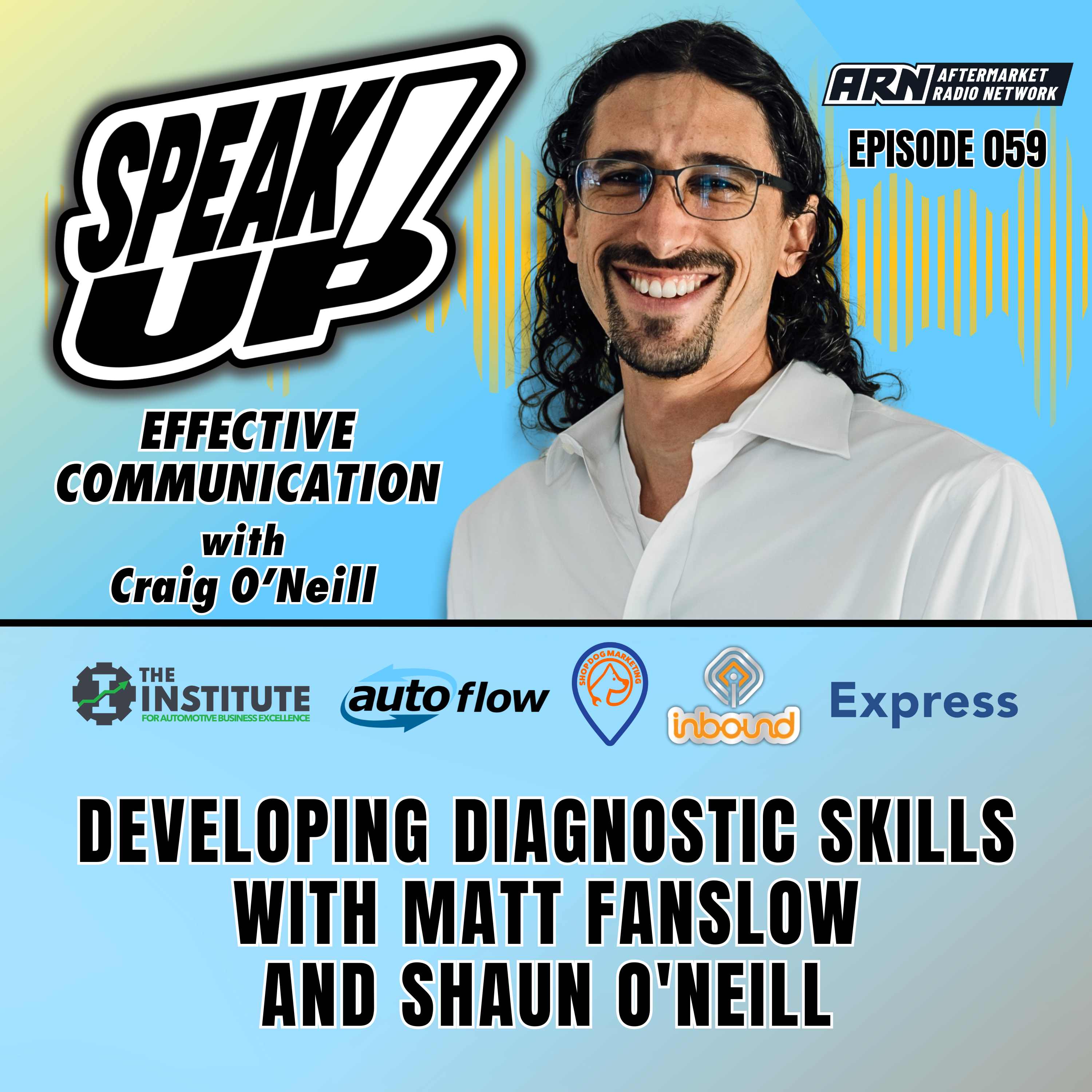
Welcome to another episode of Speak Up Effective Communication, the show on the Aftermarket
Radio Network focused on our communication and leadership skills.
And I have in our episode today two special guests joining me.
One of them, my brother, Sean O'Neill, the other, Matt Fonslow, fellow host on the Aftermarket
Radio Network.
Both of them are diagnostic technicians, specialists, if you will.
And they have a lot of interesting insight, well, on a number of things, but we're going
to try to talk about the role of diagnostics in our industry and how to help people
get started on a road that I hope leads to mastery.
So we'll hear from Matt and Sean on their earlier days in the industry while they were
learning some of their skills.
And we'll get to hear from them directly.
Before we introduce our guests, I do want to introduce a word of the day.
The word of the day is nebulous.
And we'll define that word for you after we hear a word from our sponsors who make
this show possible.
With the institute's coaching, leave a legacy that endures, foster careers and drive
community impact.
Start your journey today at www.wearetheinstitute.com slash business dash assessment.
Autoflow is your partner in technology.
With Autoflow, enhance your client interactions in a single thread before, during, and after
the visit.
To see how Autoflow makes it simple, visit autoflow.com.
Your trusted companion, Shop Dog Marketing, is right by your side, attracting the
best customers and building long-term growth.
Call Shop Dog Marketing today or visit www.shopdogmarketing.com.
Unlock your communication insights with Inbound's AI-powered call analytics for all repair shops.
Learn more at www.callinbound.com.
Are you passing along credit card fees to your customers?
No one likes that.
Express is the only 0% fee alternative to credit card surcharging.
Visit www.myexpress.io.
Okay, we're back and before we introduce our guests, we'll review the word of the day is
nebulous.
It is a formal word and adjective used to describe something that is difficult to see,
understand, or describe.
In other words, something indistinct or vague.
Diagnostics, understanding the true workings of an automobile and troubleshooting.
It seems very nebulous and difficult and challenging.
And so are the people who master it.
So we'll introduce our guests now.
Thanks for joining me.
Matt and Sean, you are my guests today.
This is a real honor to have you guys take some time out of your busy days to join
me on the podcast you're talking about communication in our wonderful aftermarket.
And we've been in this for a while now.
You two have been inspirational truly to me, dragging me into the whole network really of
people that I now can call friends.
So you're the one that stole them.
They used to be my friends.
I haven't talked to these clowns in a long time.
Matt, you lose.
See, this is the thing.
It has been too long.
I had all these friends and then, hey, this is Sean's younger brother, Craig.
Your friends are with him and not me.
Yeah.
Well, here's the thing.
You two were friends before I did.
So I'd like to start out first off, a lot of people don't even know I have a brother.
I mentioned him all the time.
I mentioned him more than you do.
You do?
That's cool.
At the end of my show.
At the end of the show.
Oh, yeah.
Good.
Yes.
I've heard those.
Yeah.
There's some friendly ribbing.
I think it's friendly.
I don't know.
I'm not there.
I guess.
I don't know.
Oh, it's not about you.
Oh, everything usually is.
Yeah.
You're the hero in the tale.
Honestly, it is fair because I wouldn't have ever gone to vision with Eric Ziggler
one year and gotten to know each other.
I wouldn't have gone to Apex one year.
And it was the first time ever at Apex.
Got plugged in with Matt.
You were there, but Eric Ziggler pulled me into that dinner.
It was a special dinner for a number of reasons.
Harvey Chan was there.
Is that the one where I got she was ready to throw me out the window?
That could be any dinner with you.
Yeah, it doesn't really narrow it down.
Yes, it was.
I think that one was the one where you're picking on the waitress
because she had a very high pitched voice.
I held the wine glass up and Harvey looks at me and he's like,
what are you doing?
See if you can just see if she can shatter it and it just slayed the table.
Yeah, then she was threatening me with a knife.
I don't think it was really threatening.
I just think she was holding it and then was making a decision.
First time I remember going out to dinner with you, Matt,
we celebrated your birthday, even though it wasn't your birthday.
Gibson's steak house.
Yeah.
Yeah, I misunderstood speaking.
Yeah, we all did.
Yeah, speaking of communication, I misunderstood how that ended the song.
They were saying happy birthday to you with a lot of emphasis on the to you.
And it sounded like something else to me.
Sounded angry.
It did. A lot of anger, a lot of pent up frustration from certain patrons, not me.
But that was the best non birthday I remember.
This is the thing.
There's some familiarity here, which I think is important to draw out.
Like, you guys have known each other quite a long time now,
but the way you actually first got connected,
it wasn't even at an industry event, as I understand it.
There were some early events, of course, but there was a Skype, the Skype days
before like social media ever took off.
There was that.
Yeah, the reality of that is that all started on IITN, IITN chat.
That was the birthplace.
And I think we talked about it before in either posts on social media
on other networks and other podcasts where IITN, when I first started,
it was like the creme de la creme because you had the people seeking other.
I hate to say same thinking, more like same wondering,
same searching type of people that they really wanted.
Yeah, I mean, it was loaded.
We could name drop for an hour, the people on there.
One of the benefits, I guess, or features of IITN
was a chat room.
And in there, you know, one day I was just messing around in the chat room, right?
And that's where I ended up hanging out a lot,
like a lot of my time after work was spent in there.
Well, OK, IITN gets popular.
It's a powerful tool.
There's a ton of information in there and they have this tech help section,
which is kind of email driven, where you submit a request for help.
Hey, guys, got this car, VIN number, year make model, blah, blah, blah, blah, blah.
And people would comment like, check this, check this.
I bet you it's this.
This is how you would test this, blah, blah, blah.
And you could search is a very powerful tool.
It was kind of like I identify in some regards, but also less expensive.
So you have people going around preaching the word.
You've got to get on IITN.
You've got to get on IITN.
Then it starts diluting the pool, which sounds like a major dig.
But it's just the reality.
That's how everything works like that.
If you have a professional sports league and you start out with four teams,
those four teams are stacked.
But if you make it 20 teams, it gets diluted because it has.
Right. That doesn't mean the 20th or the last man on the roster
on the every team is just not worth being a professional athlete.
It's just it dilutes the pool.
It has to. And that's what IITN happened.
Well, that's what social media is becoming to these days.
It's so easy to find.
It's it's not a challenge to find it.
It doesn't take the effort as much to reach out and look for that.
And otherwise, you're learning to diagnose.
And that's where I really think that this is an interesting story
for both of you, is that you and your earlier days of learning
to become truly masters at diagnosing using oscilloscopes,
understanding waveforms, those sort of things happened in a vacuum
for a little while.
Like people were isolated and could not easily get help.
And the network of support, that's what I witnessed when I was seeing
Sean start to really dive into the diagnostics.
And once he found that network of other people
that are learning as well, that's when things really took off.
And Sean, how did you get introduced to it?
Even before IITN, I don't know, Craig, you might remember him.
Jay Meiring, I don't know if you know of me, he sold master tech
scan tools, and this is like late 90s.
I was still in a different place.
Vutronic sales rep.
Yeah, Vutronic sales rep.
And he had a once a month on Master Tech Club would get together.
I think we used to get together at the community college
and he would buy pizzas for a group of guys.
And I mean, he was selling without selling, but he would show
the Vutronics Master Tech tool, which is very similar
like a Tech 2 or something as far as capability.
And it would we never owned one.
We never bought that because it was still an aftermarket tool.
It was powerful on Asian stuff, I remember.
So he would run through some examples of bidirectional controls
and he would pull out an amp clamp and he would show us fuel pump.
Current ramping.
I mean, we're talking late 90s here.
He's like, this is valuable for testing, you know, fuel pumps.
And I was like, I'm still in high school.
I'm just an idiot.
I didn't know anything, but it took a few years of going to those
and him kind of beating that drum for to sink in that.
You can see a lot without there's a lot going on electronics
that you can't can't see, obviously.
And there's a lot more to it than just the digital readout on a DVOM.
That led to like Matt was saying, IETN and other people talking about it,
which leads to, you know, you see people locally to you on IETN as well.
I didn't do too much of the chat like you did, Matt, but it was a lot of
initially I was posting under our dad's name
because the account was under his name.
And eventually then I switched to my own account.
You know, the tech help was fun.
The forums were a big spot where I spent a lot of lunch breaks and after hours.
But then Ryan Coyman, who was a tech at the time before working
at standard motor products now, was just like the top tech in the area
and introduced me to some more like minded guys, some were local,
some were all over like you, Matt.
And that led to the Skype group.
And I don't remember the problem initially.
It was some sort of caravan with the crank sensor issue.
And I wanted to prove the issue and all we had at the time
was a DRB3 and DVOM.
I think we had like a snap on a graphing multimeter as well.
And I wanted to get away from it.
I was like, well, the signal puts out this should be a square wave.
How do I get a square wave?
I didn't know how to set this up.
So led to some forum searching.
It led to a local instructor that did some one-on-one training
that we decided to pay for.
Roland Trowbridge, I would meet him at like five in the morning
for like four days a week at the shop.
We would cover mode six and the emissions like stuff that as a
transmission guy, we don't talk about ever like drivability, secondary,
primary waveforms.
And, you know, we talked about lab scopes and you know, a routine of,
you know, things to check.
And so that led to a bigger world of automotive and just
transmissions and understanding electronics in general.
So he was instrumental for that.
And that just opened the door to more questions and guys like Matt
and yeah, Harvey, back in the day when hybrids started coming on
scene and five gas analysts and all this other stuff that was just
you can go as deep as you want in the industry.
If you find the right people and curious people and guys that have
the same questions and better yet answers and that can lead you
to some resources, this guy's the limit.
Interesting how it's still a handshake business at the
beginning of the story, too, with Jay coming in like that.
It's easy to forget about those components, too.
All of a sudden you start traveling and your network grows
exponentially. Once you're out of conference, become friends with
a few people and then it just explodes.
But we'll call meal fashion, but it beats Facebook or I mean,
I'm not even on a lot of social media.
So those real connections where anyone can share a screen,
they can get on a computer and talk, but, you know, having this
guy hook up to a car in front of us, dropping pizza underneath
the hood of a car or something and just, you know, looking at
things and getting real with it was way more tactile and
beneficial than, you know, just some chat room.
So Matt, your initial for raise into this, too, like I know you
as a trainer and I think most people who know you now know
you as an expert on there, but there was an I listened to your
episode when you were interviewing John Thornton, part
one and part two.
Do you like a tech or something?
How do you land that? That's amazing.
Lots of money.
Oh, hearing John's stuff on the presentation, too, I was
listening to that as like, oh, so good. I would have to
interview him on the same topic, but you did so good.
I won't have to if he'll talk to you do it because that was
important to me because I just don't feel many people really
understood the effort, but also historically put into his
presentations, his education style, just the intention
level. And then I mean, honestly, you have to really
appreciate his wife and kids for allowing him the gift of
his time to us. So he missed out on a lot of stuff to give
us the opportunity to be way better. I don't know. I think
about that and that hits pretty hard. I'm ecstatic that he is
where he is and is able to enjoy it now.
Yeah, I feel remiss and not mentioning him, too, because
there's been a lot of nights and his classes over the
years. He could teach the phone book and you would learn
something. What's his style? His style. The bar I hold all
trainers are truly impressive, but a mentor in those early times
too, Matt, is what I was hearing an absolute mentor. I had read
his articles. He had a column shared a column with Gary
Goms of our service magazine. They called it diagnostic
dilemmas and they would take turns every other month. And
it got to the point where I'd quick look to see who wrote
it. And if it was John, I'd catch it. And if it was
Gary's, I didn't. And that's not a dig on Gary. It just wasn't
my thing. And I know a lot of people with his stuff, Gary's
stuff, and it was very instrumental. So that's
great. Johns, I would read those over and over and over and
over. And one time, I don't know if it was his doing the
magazine's doing. They accidentally put his email
address in there.
The AOL one?
Yep. I had a Chrysler Conquest, which is a rebadged
Mitsubishi Sterion, kind of a sporty car turbocharged, looks
mean, like fast mean. It's killing me. It was just
killing me. And I broke down and emailed him. And he was
so nice to kind of walk me through the process. He
didn't give me the answer. He knew what was wrong with
it. He knew it. He'd seen it before, but he walked
me through the process and I think my wanting to go
through the process helped. So then he helps me
I want to repay him. I asked him if he's doing those
training classes that if I could get him up there, there'd
be a way to get some money in his pocket. And he said
he did. And he came up to Minneapolis. And at that
time, he taught on the south side of the Twin
Cities, Minneapolis, St. Paul, and on the northern
side of the Minneapolis, St. Paul. And he did that
for a few years. And I, of course, went and asked
him to lunch. And he said yes. And a friendship
formed, you know? And man, that's just one of those
surreal things when somebody refers to you as a
friend. You don't want to ruin the chance of a
friendship by saying you're a friend. It's like Sean,
right? I don't go around telling people Sean's
my friend because he'll tell them like, I'm
going to be friends with you for your image. Yeah,
are you kidding? Yeah, it's like the first one
to say I love you in a relationship or something.
Thank you. Right. But yeah, and that's what
happened. And before the friendship really even
just sitting there at lunch talking about cars
really and being working in the bays and then
him just kind of looking at me and going like,
you should really find a way down to Indianapolis
and go to this Linder Technical Services
class. You should go to Guru's school. It's
like a domino effect or a snowball or however
you want to, where just one thing leads
to another leads to another. And it's like
Sean's saying like between IAT and chat,
which evolved into a Skype group and meeting
people going to events and just forming
these friendship zones almost handshake in an
open door handshake in an open door. And then
I get cursed by being introduced to you.
I've always wanted to go to Linder Tech
because I would read the books like
Roland gave me some of the old manuals
like this is amazing training. This looks
great. And I went to go sign up and it
was like they didn't do it. I just missed
it by a year. I think the last one
that's when Bob White kicked off the
Cairn conference was because they stopped
doing the Linder Tech. Yeah, they
reconditioned fuel injectors and it was
a I think a booming business for a while
and then they just stopped using those
injectors and stuff evolves. It doesn't
break the same way and they don't
break hardly at all. And the prices
dropped to where you just replace
them. So all of a sudden that dries
up and you know he was at that age
too or I think it's a lot of work
put together all the events and he had
other interests like racing at the salt
flats with his flathead Ford. That was
his passion. I'm a little more fun than
cleaning the injectors. So yeah, it was
just end of an era but you got an
attempt to reboot that by Bob Hype
and ASA Illinois with the Chicago
Area Networking Conference Cairn Conference.
Sponsored by the EPA or whatever
they were called. Oh, air care, right?
Yeah. Illinois air care, I think. The top
shops in the industry don't stop at
one location. At the Institute we work
with shop owners who want to expand
whether it's opening a second shop
acquiring new businesses or building
systems for long-term growth. Some of
our clients are aiming for hundreds of
shops and we're helping them get
there. Ready to scale? To get started
visit we are theinstitute.com slash
business dash assessment. Hey friends, as
you know, I'm a proud member of the
auto flow team and let me tell you
we've changed how business is done for
auto shops everywhere. We support your
client experience before, during, and
after the work is done. Imagine this
timely update sent directly to your
clients branded digital vehicle
inspections and seamless communication
from start to finish. That's why
shops love auto flow and hey with
those five star reviews rolling in
you'll wonder how you ever managed
without us. Take an important next step
and take your auto shop to the next
level. Visit www.autoflow.com. Get on
board with an auto flow trial. Ready
to boost your auto repair shop
success? Shop dog marketing is here
to help you. We put customers first
using AI to create standout content
that ranks. Harness the power of
mobile first and voice search and
let our expert team help you sweeten
your revenue with more car count.
Shop dog marketing offers a free guide
on using AI to drive more repair
orders. Get your guide today and watch
your auto repair shop thrive.
Visit www.shopdogmarketing.com. Inbound
has exclusively served independent
auto repair shops with expert
communication solutions for years.
Now our robust VoIP platform
ensures you stay connected while our
industry leading AI analytics take your
business to the next level. We provide
the tools you need to understand your
customers and optimize every
interaction. Choose inbound for proven
expertise and unmatched innovation.
Visit www.callinbound.com and discover
the difference we can make.
Credit card surcharging sounds
effective but is this single most
damaging action to your shop in
the last decade? If you're surcharging
you're tarnishing your reputation and
losing customers as we speak. Express is
the only zero percent fee option to
surcharging that your customers
already know how to use. No tricks, no
hidden fees, just a smarter way for
auto shops to keep what's yours and do
right by your customers. Book a free
consultation with Express today by
visiting myexpress.io and see how
the most successful shops in the
country are flipping the script on
credit card processors. I see a lot of
shops, they're still struggling to have
technicians stay or even come to their
facilities that have the skill set that
you have. I think you guys can
probably legitimately troubleshoot
just about anything that goes down the
road. I don't know if I could, Matt
could for sure. I'm well out of
practice. I can't troubleshoot people.
Matt is working in a repair facility.
Yeah, Matt actually works. Yeah, Sean and
I both have cushy stay-at-home
jobs now. Well Sean, you're managing a
team. How many technicians now? 56 right
now. Two more set to start within the
next month. It's mobile auto solutions.
How many, it's like a lot more states
than it used to be. I have Michigan,
Ohio, New York, Pennsylvania, and Maryland
right now. Wow. Yeah, I just remember
when, hey, you're going to be the
Michigan manager. That was it. I think
I know somebody that lives in
Maryland. Oh, could use someone in
Baltimore, man. Mike Marshall?
He's in Maryland. I thought he was
New Hampshire. He's New Hampshire. That's
so close over there. That's an inside
joke. Oh. It was kind of like Brian
Pollock and. He would drive. Yeah. It's
like an inside joke. I don't know why.
Yeah. I think you have a lot of those.
I just entertain myself behind the
sleeve. Well, here's the thing and
this is what I'm seeing because when
I'm working with shops, it's usually
on like software and all those sort
of things, but I get to meet a lot
of members of the team and I see
a lot of shops have, they're really
good techs, but they don't get to
develop the skills the same way I see
you guys having started out and I
think it's a shop problem. I really do.
I think like we can send people to
these events. They can meet people
like you now. They can go to courses.
They can learn a lot of really great
stuff in there. You can even equip
yourself with the tools, but I don't
see the shops creating the space
for you to practice the new skills
because time is money and money is
time and it's a hit on
productivity when we have to let you
learn. I was going to say it was a time.
Never mind space, but what's the
motivation for the tech to do it?
You start getting into like case by
case situations and stuff like that
basis is that I don't know
everybody's the way they're operating.
You know what I mean? Everybody's a
little different, but a lot of them
are the same. And are they running
really thin margins? And even if they
aren't, then is it, I want to be
careful how I say greed because I
don't want it to necessarily come
off nefarious. But you're trying to
make the most you can, you know, make
hay when you can make hay. And as quick
as you can. I empathize with that, but
it's also a short-term thinking in
that there has to be a certain level
of investment for tomorrow and the next
day and the next day. And that is
empowering them to kind of do a little
bit of research, try different things
like okay normally I would diagnose
this circuit with this test tool,
you know, but I really do need to learn
how to use this other tool. So normally
we use a tesla and a voltmeter.
Fine, that'll work, but I need to learn
how to use an oscilloscope because
down the road someday that is going to
bail me out. That is going to be the
way.
Yeah, we learned that slow. I was on
the wrong end of that curve. Initially
when I was service advisor and Sean
was trying to learn those skills,
you can empower a technician all you
want to go learn these things, but if
you don't emancipate him
from other responsibilities or other
pressures,
that stuff won't happen. And I feel like
we were just so bad at it in the
early days and it caused a lot of
frustration.
And there has to be a mutual respect
for it. The tech has to respect the
time. Like you can't sit there and go
I'm on hour number three messing around
and messing around, maybe not the
right word, but still. We're
practicing on productive
three hours. Please understand that is
taking advantage of what they're trying
to gift you here.
So now can we find a happy medium where
this is legitimate time spent to try
to learn how to access this ability
or
is there a way to compensate
to come in after hours or stay a
little bit later? Well, I feel like
that's what he ended up doing right
Sean couldn't do anything eight to
five.
Oh, it was terrible. I feel like we
didn't recognize this early on to family
business dynamics, but your wife and
kids too have felt it.
Roland had a saying and it was
an hour extra beyond your working
day. An hour extra you could learn
something new or maybe kind of
maintain what you have and grow a
little bit. You know two hours extra
a day
you start to progress and
become more proficient and expert in
something. But if you spend three
hours a day or more on something on a
topic and learning it
then you can truly master it and
I guess the moral of the story is it
takes time of your own initiative to
do something then
and we have to be fair to the
customers. Like it's not fair to
expect the customer to pay for our
learning on the job either.
So what do we do and
we both hit it already. I mean really
it is an investment.
Every business is in the business of
being a business so they have to make
money. I get that
but you know we like to compare
ourselves with the medical community.
We're practicing working on colors
too. You said practicing, right?
But you know we don't have
malpractice insurance and when we have
a comeback on something you know it's
coming out of our pocket.
So where's the middle ground?
Look at these poor guys that are
flat rate working at a dealership.
You know they get
point whatever point three to
diagnose a intermittent
whatever on a new car that's under
warranty. So there's no carrot
there for them to
necessarily and spend the time.
What's the payout for them to
become a master of figuring something
out quickly if they're only going to get
three tenths for it? Problem somewhere
in this assembly we can just replace
the assembly having easy sell there.
Yeah that's so common.
As a boss or a manager or a shop owner
do you want a bunch of idiots working
for you either? I mean I don't think
so. So you have to give them room to
grow and equipment to succeed and
then hopefully just hire people with
a drive that want to
better themselves and spend that time.
You guys have always heard it said
all the time too. What happens if I
train them and they leave?
Yep. What happens if you train them?
What if you don't next day?
Yeah exactly.
It gets back to short-term thinking
and even as a tech your pay plan is
probably based heavily on production
so the reward is crank it out.
Okay well if you're doing some
dyag and you do like doing dyag
that could be a very short window of
opportunity because if you don't
continue to train yourself some way
somehow both you know through a
learning situation either online or
in person all that like education
itself and then on the job like
putting this stuff into practice.
I don't get an opportunity to use the
my scope a lot but when I do I need to
take advantage of that or I need to
take a few minutes to try to do that
and start to assimilate this into my
process and get better and better at it
and I know I keep picking on scopes
but there's so many other things
like just paging through scan data
just scrolling through scan data just
looking at it and trying to figure out
what it all means and how it all
works together and are you going to
figure it out on that car? Probably
not but over time and then also your
own time interacting with people like
Sean or however many other people or
you that's important. So one the
short term thinking is if I don't do
that my window of cranking out the
hours on dyag is short because in
the future I won't be able to because
I don't have the skill set I will
be heavily reliant on databases or
people bailing me out or guesswork
or we just ship the car and keep the
stuff I can do trying to come in but
those numbers keep dwindling so it's a
short term plan. The other thing is
back to that respect thing where the
business management needs to respect
the tech and the future while future
planning as well as the tech has to
understand what pays the fricking
bills. So right profit that's all
there is to it however that's
generated and at what level all
that is case by case. But there's
ancillary benefits you know
customers trust you and getting it
right the first time less spending in
parts and other things too so there's
an upside in taking a little more time
to figure out. But as a manager
can I have the awareness of this
person is worth like I see that spark
I see that thing right that they want
to learn that that drive. They've got
the initiative. The initiative, the
desire, the passion, tenacity
whatever I see that the
determination why don't want to squash
that out how do I perpetuate that and
is it having conversations and I want
you to take time to do a little bit of
this not a lot can afford it but we're
going to do what we can and then if
you're going to spend time after work
doing these things you're going to
bring that car back in and read
diagnose it in a different way or
you're going to sit on platforms
whatever that may be actually
learning maybe it is Facebook maybe it
is online training from whatever
vendor map auto tech something like
that that I understand you're taking
your personal time to do this and I
want to respect your personal time
so can we meet somewhere in the
middle because you probably should
invest some of your time to be
better at what you do but I don't
want you to invest all of it
because I also respect that and you're
helping me in the long run and I
want you to be a part of this
long term now is it hey take a few
hours off early on Friday
you know or every other Friday leave at
noon or whatever it is just come to an
agreement it doesn't have to be
specific you two can come together and
understand what it is and then maybe
some of the other techs are going like
oh hey that seems like a sweet deal
why do they get that
well look what they're doing they're
coming in after hours they're staying
till six seven o'clock at night
re-diagnosing a problem to learn
how the system works better
so I want to perpetuate that
and then they're like yeah I'd rather
just go fishing well that's fine too
it's not a dig
yeah the lunch is yeah Sean I know you
were doing that a lot too
yeah I'll eat my lunch at my desk
watching a video or some just in
time training or whatever
two birds one stone you got to eat
and might as well take something in
while you're doing it
and Sean and I were so spoiled
spoiled to have the access to the
people we had access to like
right there Harvey Chan right there is
Aaron Kepin right there is I mean
our phone call away Thornton
manna like it the name goes on and on
above we had access that Coyman
that was a terrific resource for
soul long bomb heart like it just
keep going spoiled
drop the names just bring back some
memories spoiled well that's the
thing I feel like that sort of
culture is still there
I think that it's just
somehow we aren't as deliberate
in cultivating it the way that we
had to be in the past and this is
actually one of those things that
were technology will atrophy some of
those muscles for us and this is a
communication podcast right we talked
about this all the time and
deliberate communication versus
this automated or the easy access
or you just happen to scroll because
we're doom scrolling and then maybe
you found something helpful
but how many times you go on facebook
to learn and then you end up
wasting two hours I mean like
things are good until they're bad
I deleted facebook recently
while we're talking about
communication straight up you got
large language model chatbots that
are getting better and better and
better about taking like the first
wave of customer contact
and yeah oh the upside is now my
service advisor doesn't have to deal
with that they can focus on this
other stuff and I get that that's
reasonable but also you're paying
a price you're going to pay a
steep price and the same goes where
when we start seeing probably not
large language models but
machine learning probably a little
more into diagnostic those specialized
models yep exactly it'll be trained
for that purpose yeah correct and
that's an important designation or
a thing to understand is that they
are very focused they're very good at
what they do that one thing
well they're going to see more and
more diagnostic decisions taken out
of people's hands and therefore that
muscle that ability starts atrophying
so we already see that with training
on whatever using a lab scope
people if they don't get to do it right
away after class
at atrophies well the same thing's
going to happen if you don't have to
figure anything out anymore
it walks you through the process or
gives you a probability map
and you just replace parts based off
that
now the systems doesn't work it does
no idea what's wrong with this car
and you haven't had to figure
anything out for six months now
what yeah nothing's even unexpected
anymore
so you're watching people using the
large language models for
communication at the front desk
yeah we're already getting worse at
writing emails now because it does it
for it
they can't be what they mean
not to use it for that
all the mistakes are mine in an email
those are
those are genuine
yeah that's how you know what's
yeah you don't you hit me on the
apostrophe here for the yeah it's like
who you want to put the apostrophe
it's like i don't know it's an extra
keystroke
god's comma man
to have my grammar quick guide here to
know when to even use it so
now i think you're hitting it right
though matt because i'm already starting
to hear people like yeah well why would
i want to invest so much in learning
that skill when pretty soon this is
going to do it for me why would i want
to
bother
it's such a misnomer you know i see so
many people and actually people that
are looked up to because of either
their
educators presenters trainers or uh
even in the industry itself as
they're just looked at as experts
and they're spouting off that
what pick your large language model
chat gbt gem and i rock
yeah so many of them
it's like oh they're like google on
steroids like no no no they're not
they're not even a little bit
i mess with the gems and gem and i
and we have to you have to feed a lot
of information to be able to do what
you are hoping it can or turn it
into so it's a process to educate ai
even into shaping what you want
the prompting requires some talent
itself
in this stage yeah you can spend as
much time trying to feed it enough
information to write whatever it is you
wanted to write it just wrote it yourself
yeah dude i ran into this the other
day working with it
chris challenged our team to leverage
ai more because it will be a necessary
skill set for a modern workforce to
know how ai tools work
but it's not easy and it's not always
fun and sometimes it's a little
heartbreaking when it does things
that you enjoy doing better than you
no i refuse to let it communicate for
me that communication needs to be
intentional for sure
can't automate relationships is what i
keep hearing no
i mean
automating google apps scripts by all
means i'll write some software with it
because i can't write software and it
can
you know if it screws up i'll feed it a
better prompt to do what i want to do
but i don't want to
this is not ai generated conversation
you know i that scares the hell out
of me someone being a deep faked
and
and
or video called or
whatever it's a legitimate fear
i have
yeah i can't explain it's here
i've tried to explain to my parents
that someday they are going to get a
phone call from one of their kids or
grandkids
who are in dire straits
yeah it's really a terminator they
need help they need help
fast and they need money
they're so sorry
it will sound just like them
Sarah Connor and they're yep and my
and explain to my parents you're
going to have to hang up
and call them back or text them like
is everything all right
yeah that's a real good tip
one of the things i wanted to bring
for this conversation was
where you guys are at right now
matt you're teaching in front of
classrooms of really skilled
technicians
very rarely
ah i see this all the time
at the events i go to
all the time at those events
it's because matt's not done work
all the time 10 of the time
at least every march
they keep having me back i don't
know they
have to raise
raise their standards
yeah and shawn
you're working with people daily
you're doing it from your home
you don't have to really travel
we never see you at events anymore
we do need to fix that
i should be don't say that
my boss here is i should be traveling
more and getting the stores
but it's
i mean i live in spreadsheets
and we try to get the industry
we fight industry issues all day
and trying to get places to
understand the complex technology
that we're trying to address
and fix it in a manner that is
safe for everybody
it's a constant evolution
and constant conversation can be
had
that's
it's the world i live in now
i'm not arm pit deep into some
tranny fluid anymore
although some days
you still miss it right
like sometimes
some yeah of course
yeah
then we go visit dad for a minute at the
shop and
yeah i don't miss dealing with the
general public
that's for sure
being on the bench was great
you know if someone comes in
and you have to go take a road test
and you're trying to
you're
in the middle of the valve body
you know yeah
that's like tough
are you still mentioned mad
or getting a scope
yeah
but you as a tech get
to work on one thing at a time
finish that thing
oh that's great
that's very fulfilling
that's more immediately fulfilling
than anything else
instant gratification of problem
fix solution
and happy customer at the end
hopefully
so that's
yeah are you still wrenching mad
at all
or hooking up a scope
i mean i haven't
so
wrenching very minimal
but on cars every day
for the most part
the reason i hesitate to say all
day every day
is just because you guys saw my
makeshift laboratory
we saw the microscope behind you
yeah
that segment of my world
is growing
i don't want to blow it
out of proportion
like i don't want to sound
like i'm on certain levels of
like a tommy aliva
and those guys that are
really doing this a lot
but the module level type stuff
has been growing
making used modules work
on different cars
repairing modules
or instrument clusters
which i mean their modules
at circuit board level type
stuff has been growing
because there isn't a new one
available
or the new or reman
is cost prohibitive
something of that nature
that has grown exponentially
i still don't want to imply
it's even every day
last week was every day
every day i had
something to do
this week
maybe not so much
every day
but a couple times already
so i'm doing stuff on cars
and fixing cars
or are diagnosing more so
i'll figure it out
and then somebody else
fixes it
and then more of the electrical
but i think that's cool too
i like to think that's where
i would be if i was still
actually attack
but especially in transmission
world because that's where
we do a lot of it
yeah and a lot of our industry
is very at least
our company
you know very oe centric
and but we did a lot
of aftermarket fixes
at the transmission level
to shift kits
and other
sonics modifications
and everything else
to try to improve
or fix a problem
short of replacing
something with brand new
so you know i used to think
back in the early 2000s
that you'd have a
2002 four tourists
it's like
all right
it's just a car now
someday somebody's
going to want to restore
this thing
like that 55 bell air
that somebody brought in
although a tourist
is not a bell air
i'll give you that
but what's someone
going to do
if they want to restore
this car in 30 years
and you can't because
nothing's real
it's just everything
it becomes junk and scrap
unless
unless somebody can
take a chip out
swap a module around
and make it work again
and we're seeing it
on cars that are
like 78 years old
yeah it was just scary
right so
really does a 30 year old
car
i forgot to mention
not like it's a big deal
but
shan probably get a kick out
of it is
i'm probably doing
three to four
eight us calibration
and i mean cars
good for you
per day
so some cars
are a single calibration
summer
you know
yeah well when you want to
do that full time
all the time
you let us know
i'm sorry i'm always
hiring just of it though
isn't it shan
because the
the type of people
that you are trying to
hire
in the line of work
you're in with
it's clean work
high tech work
eight us work
and that sort of stuff
the demand is so
significant that
you always need
someone there
and the skills
are not always
currently there
is that getting
easier yet
or to train someone
from scratch
or is it still
you need this
it's getting
longer to train
someone from scratch
which because
there's just a lot
of nuances
especially when
you take into
consideration
collision repair
there's a lot
different than
mechanical repair
yes
but you're beholden
to a lot of
procedures
that the OEMs
want you to do
that don't seem
related to
maybe
the loss
or the repairs
that brought
the car in
so
you know
a car could have
a rear end hit
and the structurally
repaired
well that might
trigger front end
calibrations
or maybe an alignment
triggers
other calibrations
so
you know
in the mechanical realm
we took something
off we put
something on
that required
programming
or that requires
a relearner
or what
you know
it's very
related to what
we touch
and the collision
world it's harder to
teach that
because you have to think
big picture
you have to the
pull a lot of information
pending on the OEMs
because
no similarity
or common ground
between OEMs
and there's different
documents
and resources
so
you have to pull a lot
of information
on every car
that you're working on
and consider
the repair
and the loss
and
repair plan
effectively
so that
it's tough
but I'd prefer
to take a
mechanical tech
any day
someone that
can diagnose
someone that
think their way
through a problem
maybe knows
how to read
the repair
procedure
yeah
if you can read
service information
and you can
follow steps
I mean the
the calibrations
are just procedural
but you need someone
that can think
at a
high level
to take it all
in
big picture
and
put it into a
repair plan
follow that through
so
that takes a long time
to teach somebody
that
even when they're
an ATEC
master certified
mechanical tech
which not everybody
is
which is fine
but
you know
we have
the world
at our fingertips
there's
so much service
information out there
and resources
that
you just have to know
what questions to ask
and you can find the answer
if you can ask
the question
yeah
then you just ask
chat GT
and then
and then
and then
you would
no
yeah
yeah
yeah
Sean
I'll probably reach
through the screen
and choke me
but
a lot of
like the calibrations
themselves
when they go
well
go normal
go as expected
they're easier than ever
oh yeah
when things don't go well
yeah
now what
now you gotta
kind of understand
what it is
that is trying to do and
I'm telling you man
ADOS
the auto repair
business or industry itself
is kind of the wild west
but ADOS
is the wild west
like
major wild west
there's
there's a lot of companies
doing it
it was
it was the new and sexy
thing for a while
and
you know
when there's new and
sexy and
unregulated
you know
the world's
their oyster
for making money
and
eventually the insurance
companies catch on
as we've seen
invoices from
vendors that charge
crazy amounts
for
no real proof
to what they're
doing with things
so it's scary from that front
but
back to the mechanical
you know
we see ADAS
technicians
we've hired
technicians from other
ADAS companies
and
it's harder from that perspective
because they're
you know
the keyword in ADAS is systems
you know
advanced driver assist
systems
so that's why
I love
hiring
techs with a mechanical background
because most of them at least
have some sort of systems
understanding
their drivability guys
yeah heck even if you're slinging
brakes and doing heavy duty
under car work
you still know more about the systems
that are interacting
with the front radar for
you know
they're applying brakes
they're applying power to the engine
or cutting power
I mean
these things truly work with
every other system on the car
so
you have to understand the systems
it's not
just the radar that we're
worried about calibrating
it's how is it working with
the whole car
is everything working the way it
should
because you have a problem
in one system
the customer complains
that their safety systems are
disabled
well
it's that evap code on the Subaru
that just disabled the eyesight
and then park assist
and everything else
so
I mean it's a
task-cating system
of failures
so you have to understand
we've done some
weird crazy
diags on
complaints that were
ADAS related
but had nothing to do with ADAS
at the end of the day
yeah it's rather nebulous
yeah
active drill shutters
yeah well
it'll be in airtimes
and
yeah yeah
but these stuff will throw a wrench
in typical shops
day
all the time
that they're typical
maintenance shops
maintenance repair
and service
and they have these sort of things
I see it so often
they're just chasing their tails
on it
and no one's there to
do it
except maybe they have a mobile guy
they call
great
and that's great business
for those guys
point is
sky's limit right now
for the guys who understand
the whole systems
and I think
it's opportunity
yeah
and
we're barely
barely scratching the surface
on stuff that
so very many
have no idea
they have no idea what's coming
they have no idea what's already here
well and how old are some of the cars
that are
that people struggle with
here's
struggling on
three four five six
real cars at times
try doing a calibration on a vehicle
or justifying the calibration
with an insurance company
on brand new
twenty twenty five
twenty twenty six models
and the manufacturer
hasn't updated
their repair manuals for the car
yeah
I mean that's the kind of crap
that's
that
shops body shops
some mobile text
and you know
mechanical stores
that are
working closely with body shops
and see
brand-new cars
that's the kind of crap
people are feeling
well are a critical
calibration or measurement
that's buried
in service info
like the manufacturers themselves
even for their own
self-interest
don't make it
widely
known to their texts
and the public
I think it would help
the image of everybody
if they would be
very open about
any collision
that's beyond cosmetic
these things have to be done
and
sure radar calibration
camera calibration
we have to measure
the steering column length
sometimes that's
readily available
and easy to show somebody
that this is required
sometimes you have to sit there
and dig
and dig
and find it
right
I had a shop ask for that information
one time
one time only
it's brutal
why not make some of this
very
easy to get to
not just for me
of course I wanted accessible to me
I wanted accessible
to the vehicle owner
so they can go to the
car manufacturer website
and see like
oh
they weren't lying
okay
they're not trying to pull one over on me
this is required
by the manufacturer
I can see it there
plain as day
a mission statement
or something of that nature
yeah
transparency has been the issue
that we're talking about all the time
I deal with digital inspectors
are showing people
their actual condition of the car
or like
what about transparency
and that sort of data
so that we can communicate
regarding the complexity of these systems
and the things that we need to deal with
yeah
100%
I feel like that is a job for AI
right
like this data needs to be somewhere
train the AI
how to access the data very very quickly
and
that'll free up some time
that's where it'd be pretty
that would be where it's good too
it would be
but we should all be able to prove
whatever we're doing
like I
from believer
prove it
like my favorite customers
back in the day
were
you know
I had two customers ever that says
well
prove it
how do you know
that this needs this
you know
all right
one guy had a worn down
Camel
well I can show you the
insulator
transparency
I can show you the waveform
and explain it
you know
people that say
prove it
I love that
and
we in the
collision industry
you know
a lot of
people will bag on the insurance companies
because they're pushing back on stuff
well
they should be pushing back
a little bit
they're just saying
prove it
why is it needed
there's nothing wrong
when someone says
prove it
we should all be able to
prove something
yeah
see
see that's what I was trying to say
back in the day
when you said it
it was a bad computer
and you were still learning
how to diagnose
and I said
what are you going to check
if it's not the computer
yeah
what's next
well I don't I
I don't know
I don't know
let's start here
if we want to sound really
professional
we would say
it's evidence based
yeah
what's the evidence
evidence
the current information
I have right now
I need a new part
to make sure that this part's there
yeah
justifying your findings so
yeah
that's what
factory service
manually replaced
with no good part
that's the step I'm at
we have to be honest
sometimes
it is cheaper to just slam
the new part in
than it is the test
it just
that's the reality
I saw how to misfire the other day
I told him
to swap the coils first
see if it moves on the cylinder
and
hey that gets you going quick
in the right direction
Swaptronics
is a test
that helps with park assist
sensors that help with coils
that is a test
move it
did the fault move or not
it doesn't fit everything
but when it does
why bash it
it's legitimate
that's where the beauty of
of knowing
you know
not
you know
trouble trees are trouble
at times
right
in the end results
always the same
you know
replace part
and
but
once you have systems
understanding
you create your own
trouble trees in your own head
so
there's shortcuts gain
there's lessons learned
and you're a fool
if you don't apply all those
so why wouldn't you swap
those coils
why wouldn't you swap
that park assist
sensor
see if the fault moves first
why would you go
testing
for different signals
that every
kind of at the connector
and every connector
related to it
or compared to
no good
and when
you have no good right here
just
no
that's a valid
it's valid
we got to be efficient
and that's the thing
is like
and I think you guys
hit this really well
I think
shop managers
are in the middle
of a difficult scenario
of client expectations
and technician needs
that's tough
and it feels like
oh sometimes
you're going to create
some conflict in the shop
just because we aren't
really making a plan together
on how
I can even package
and present what you want to do
in this particular scenario
complex or not
with this client
and make it in a way
that's fair and easily
repeatable
whatever it is
this is where the
time and the effort
really has to go
and my advice
has always been
managers
service advisors
should go
to tech training
with the techs
on occasion
not every time
it gets expensive
but I think they need
to understand it
some of my
you know
the biggest
mechanics are mechanics
technicians are technicians
you know I
it's
some people are
good with dealing
with people
and some are
but
you also can't have
somebody who's just
a great communicator
blowing a bunch of smoke
up someone's butt
just because
they're dealing
with the public
and they're a great public
speaker
you need to
take the complex
and make it simple
and John Thornton
was a great example of that
I mean
he was teaching
a bunch of
newbies
and
guys who didn't go to
college
or maybe didn't graduate
high school
how to fix a modern
high tech car
because you could take the
complex
and make it simple
that's not easy
you have to understand
something very deeply
to be able to do that
and relate it to people
and and I think if more
service advisors
could do that
communication would be
a little more effective
reviews would go up
because
oh this way
this person explained it
wonderfully to me
they could prove it
and either
I feel very safe
and comfortable with
you know
Matt Vanslow
fixing my car
you know that
kind of thing
it's
nobody says that
yeah that's not really how
everybody says that
yes absolutely they do
I'll drive them in the
apolis just so you can
change my oil for me
you might forget to put
the new stuff down there
I know you know more
about viscosities
and oil ratings
than I do
I can rattle off
all that stuff
I don't understand it
thanks for doing this
with me today guys
it's been great to have
you guys in
well sort of like
at least the same virtual
studio
if not the same room
someday
we'll have to remedy that
we will
not a dinner
that's just awkward
with Matt
only if it's his birthday
and it always is
I want that free dessert
Matt always brings the free desserts
keep me entertained
so I don't try to
entertain myself
and then
that's the problem
that's good stuff
awesome
well Matt
as a fellow
podcaster on the channel
thanks for taking some time
about your busy day
to join me
and as I happen to
return the favor
sometime
when it's convenient for you
Sean
anytime
I think we do need to
talk about actual
broadcast
because you used to do
the radio
showing some amazing things
yeah
I know
I don't know if I could answer
too many
technical problems anymore
yeah that was the auto talk show
so it was a call-in show folks
and the one thing that we try
not to do on the phone
or the shop
they tried to do on the radio
we talk about
what the problem
could be on their car
yeah
there's a real
dichotomy and
personality split
we have to enforce
yeah
worked out well
yes
you guide them to a good shop
we can refer
and it wasn't always our own
but some of the ones in the shop
then the area
people smell that BS a mile away
I know I would
you can't be self promoting
now always works better
when you can
can point to someone else as an expert
nice stuff
you just ripped that off from
Miracle on 34th street
nice
any final words for today guys
fabulous
I thought
yeah
yeah it's a might as well end
it the way we started
full circle
no idea what we're talking about
yes you do
awesome
well hey thanks so much guys
and thanks everyone for listening
to the show
I'm sure you enjoyed Matt
and Sean
if you have something to add
please reach out
speak up at
Craig O'Neill dot net
we do appreciate hearing from you
and we do appreciate hearing your
topics that you'd be interested in
hearing on this show
and remember to listen up on the
other shows on the aftermarket
radio network
Carm Capriato is a remarkable
results radio
then there's this one
diagnosing the aftermarket A
through Z with Matt Fonzlo
and because he's here today
I'll be nice
it's a good show
I gotta actually tune into some
podcasts I think
I'm missing a lot
yeah F is for Fonzlo
in his show
but then that's a good one
I'm gonna use that
ah you should
then business by the numbers
with Hunt Demerist
the auto repair marketing podcast
with Brian and Kim Walker
who I will see next week in Utah
looking forward to that
and coach Chris Cotton
on the weekly Blitz
thanks again to our sponsors
make this show possible
thanks Matt
thanks Sean for joining me
and to our listeners
get out there listen up
speak up and hey
listen to your texts
especially
you've been listening to speak up
effective communication with Craig O'Neill
on the aftermarket radio network
follow Craig on your favorite
podcast listening app
and on his youtube channel
let him know what you'd like him to
speak up about
Craig is all for advancing
the automotive service aftermarket
About this episode
Matt Fanslow and Shaun O'Neill share their journeys as diagnostic technicians, discussing the evolution of their skills and the importance of effective communication in the automotive industry. They reflect on their early experiences, the role of networking through platforms like IITN, and the challenges of mastering diagnostics in a rapidly changing environment. The conversation highlights the need for shops to create space for learning and the balance between productivity and skill development. Their camaraderie and mutual respect shine through as they explore the complexities of modern automotive technology.
Many of our loyal listeners have heard me mention my older, little, brother Shaun, or you have heard me jesting with host of Diagnosing the Aftermarket A-Z, Matt Fanslow…
Today you get to see us sit in the room and have a genuine conversation!
I notice in my day-to-day interactions with aftermarket professionals, that many of the businesses I interact with are lacking a real diagnostic specialist on their staff.
A diagnostic specialist is one who can troubleshoot complex electrical, mechanical, or hydraulic issues using advanced tools, resources and experience. The value of their knowledge to ensure repairs are done right the first time, earn the business revenue based on knowledge, and save your clients money by preventing unnecessary repairs, is undisputed.
Why are there not more of these types of specialists in our industry?
How might communication skills play a part?
Are networking skills a critical factor in developing other skills?
When you hear Matt and Shaun talk about the investment in time, both in the shop, and outside of it - to develop their skills - some will be energized, some may feel dismayed - but the path is a bright one for those who are willing - and we will hear in this conversation what worked for Matt and Shaun as they began their journey - and we get to hear a bit about where it has brought them now.
In this conversation you’ll hear:
Times of sacrifice outside the normal hours
The need for creating space to practice new skills in balance with demands of business
The impact of mentors
The value of adopting a learning mindset
Some valuable caveats if you find yourself at a dinner with Matt Fanslow
Shaun always trying to hire people to join MAS - because he just can’t not.
The WOTD is a fitting one for the diagnostic backdrop:
Nebulous.
adj.
A formal word used to describe something that is difficult to see, understand, or describe—in other words, something indistinct or vague.
I know you’ll enjoy listening to Matt and Shaun! Because of their early friendship, I was led to events and networks I would likely not have found on my own.
I’m grateful for the opportunity to share this conversation with you now!
Sincerely,
Craig O’Neill
Thank You To Our Partners The Institute, AutoFlow, AutoLeap, Shop Dog Marketing, In-Bound, Express:
The Institute at WeAreTheInstitute.com. "Stop stressing over your business, you deserve a good night's sleep. The Institute’s coaching helps you achieve success and financial peace.
AutoFlow at AutoFlow.com. Your partner in technology, Autoflow consolidates your client interactions - before, during and after the visit to a single thread. Learn more at Autoflow.com
Shop Dog Marketing at Shop Dog Marketing.com. "Want to see your auto repair shop thrive? Let Shop Dog Marketing be your guide. Our customer-first approach, combined with AI-driven creative content, ensures top rankings.
In-Bound at CallInBound.com. Cover your communication needs and revolutionize your auto repair business with AI-driven call analytics from InBound.