A Ram Air car has a special air filter that pulls in cooler air from the front of the vehicle, giving the engine more oxygen to burn fuel. This can make the car feel faster and more powerful.
B‑body is a name GM used for certain cars from the 70s and 80s, like the Camaro. When they say "B‑body convertible," they mean a car that can fold its roof back, built on that older GM platform.
Restoration means fixing up an old car so it looks and runs like new again. It can involve changing parts, repainting, and making sure everything works right.
The Camaro is a famous American sports car. The B‑body version from the 70s/80s could have its roof folded down, and it was used in movies like "Tommy Boy."
A factory custom hot rod is a special version of a car that the maker built with extra power and cool looks, like a custom car but made by the original company.
A barn find is a car that was left in a dusty place, like a barn or storage, and people love finding them because they can be fixed up into something special.
SEMA is a big auto parts trade show. When people say "SEMA cars," they mean cars that are shown there, usually with cool custom parts or still being worked on.
This is a special version of Buick’s 1970 muscle car, famous for its big engine and fast performance. It’s a collector’s favorite among classic car fans.
It’s a 1955 model of the Chevy truck, popular for its simple design and strong performance. Many people restore them for shows or personal use.
LIVE
All right, ladies and gentlemen, automotive enthusiasts and people who dig old cars and
cool stuff, no matter where you are, anywhere on earth, it happened once again, your finger
got led astray and you touched a magical part of your device which launched yet another
Kevin, another Ariat episode of V8 Radio. Ariat episode. Is it A-R-I-A-T? A-U-R-E-A-T-E.
Or Ariat. Ariat. I have no idea. What does Ariat mean? Golden. To be golden. Ooh, like
A-U, like gold, the atomic symbol for gold. Yes. Well, that's for darn sure. This is yet
another Ariat episode of the V8 Radio podcast. I'm your host, Kevin Ostey, joined as always
by our esteemed co-host, Mr. Mike Cuball-Clark. What's happening? Oh, just loving this winter
wonderland we're in today. As we record this on a nice, shiny Saturday morning, there's
snow falling in our neck of the woods, and that just means I have more work to do after
we're done recording this. And it happens fast. I mean, you know, last week it was like
nice out, and here we go. Yeah, exactly. It was great. My wife was saying, we need to
get some things done before the snow falls. Let's go, let's go, let's go. I'm like, okay.
All right, you're right. We do. Oh, yeah. Oh, yeah. Well, before we get into all that,
before the individual listening, we know that you tune in partially because of the automotive
trivia question. It's a fun mental gymnastics challenge in which we throw out a question
at the beginning of the show, and we guess and most likely get it wrong and find out
at the end of the show. Have you prepared an automotive trivia question? I have, and
I mostly get it wrong. You mostly get it right, but it'll probably follow that same suit today.
But got a nice, easy one for you. What is the year make and model of the Sanford and
Son truck? Ooh, now that's in my head, man. You're right. You're welcome. I'm going to
say the Sanford and Son truck is a red 1950 Ford F1 pickup truck. Ooh, those are cool
trucks. That's what I'm going to say. Ford F1. Final answer? Final. All right, brother.
That's what it is in my head anyway. Duly noted. All right. Okay. Well, I'll reciprocate
with an easy peasy one for you. Okay. Yeah. All right. We recently had the pleasure of
attending and working and being a part of the Muscle Car and Corvette Nationals. We
sure have. And what a show that was. It was a dynamite show. Center of the muscle car
universe. Oh, yeah. And I'm sure we're going to share some stories about that on this show.
But you had a pivotal role in the unveiling of a very special car. I did. A 1967 Pontiac
GTO in starlight black, right? Oh, my gosh. Yes. Oh, that thing was beautiful. Yeah. Yeah.
You should have seen him, Mikey, up there interviewing Gary Riley, the restorer, as
they pulled the cover off this fresh restoration. And it was really hard to understand, Mike,
with all the drool. Indeed. I tried to remain professional, but sometimes it just goes out
the window when the emotions take over. The city of Rosemont now has a cue balls drool
pond installed that you can rent a gondola boat on and go for a ride. Right in the Stevens
Center. Yeah. Oh, yeah. Well, tell us a couple of things about why that car was special.
Oh, heavens to Betsy. Why was that car special? Well, it was a Ram Air car, a legit Ram Air
car, which is very rare. Oh, golly, what else was special about this car? Well, it was from
Ohio, which is also where I'm from. And a very funny situation right there, too. And
we both have issues. Yeah. Gary had pointed out the car came from Ohio and the body had
issues and it was kind of worn out when he got it. And Mike's like, well, I'm from Ohio.
And I have issues, too. Yeah, that was great. Yeah. But what else was special about that car?
Good Lord. I mean, I love that show, but by golly, it's such a blur. One of the things you
mentioned being a Ram Air. So that's a functional hole in the hood, right? Correct. Yeah. The
snorkels on the hood of the 60, well, 65 through 67 GTOs use the same hood and they
had the dual snorkel intake on top. And most of those cars that that intake, that snorkel
was closed off. There was a there was a an insert in there that prevented any air from
coming in. So it was really for looks. But if it was a real Ram Air car, it had a if
you open the hood, it had a sheet metal tub with a foam seal on there that when the hood
was closed, it would seal off that intake area. And that snorkel was open and functional.
So there was some debate on how functional that really was, is like a quote, quote, unquote
Ram Air effect, because that hood, that snorkel was not raised very high and was probably
in the boundary layer of how when air flows over, there's not a lot of flow in that area.
But it did get fresh air to go in. But I, the jury is out as how far of a Ram Air effect
it really had on those cars. Yeah, I think definitely got cold air, which is cool. Exactly.
Yeah, fresh outside air in there. And that's a 400 three deuce car. No, it's 400 four barrel
car. There were no three deuces in 67 anymore. Only the Corvette got three deuces in 67.
But it was a 360 horsepower engine for the Ram Air car as well, where the stock, the
quote, unquote lower optioned cars were 335 horse. So therein lies my trivia question.
How many 67 GTO 400 Ram Airs were built?
Boo. He said the number 250. I don't, I honestly don't think he did. I don't remember that he did.
Okay. It was a very low number. It was less than a thousand, I believe. I think it was
like, oh gosh. To all my brethren in the Pontiac community, I'm very sorry. I want
to say 768 Ram Air cars produced. 700. You want to think about that? Is that where you're at?
The answer will only get more wrong if I keep thinking about it. So 768 is the answer.
768. All right. Well, we will, we'll find out at the end of the show. And that was a very first
foray into what I'm calling kind of an interactive trivia question. Oh, groovy. I mean, you got to
tell us all about the car and everything. And yeah, you know, we just threw that in right there
at the end. Yeah. Gosh, darn it. That car was beautiful. I mean, we got really, we were really
fortunate when we walked in on Saturday morning, the covers weren't on the, you know, reveal cars
quite yet. And we walked right into that 67 Starlight Black, 67 GTO, man, that stopped me
right in my tracks. I just, I had to say, hold on, we got, we have to look at this for a minute. I
know we're busy, but stop. Well, that car was stunning. And it was, you know, double black,
black interior, four speed buckets, the white, white painted pinstripe on the body and the white
pinstripe on the tires. It had your favorite wheel on it. Yep. So enough. Yeah. I didn't,
I think I mentioned to Gary and I mentioned to you as well, if, if I were ever to repaint my
67 GTO in a different color, it would be that car that we unveiled at the Muscle Car Corvette
Nationals. It would be a Starlight Black, 67 GTO, black interior, black top, all of it. That's what
I would do. So Gary was, uh, you and him were chatting about it. Gary Riley from Level One
Restorations, who we're talking about, they, they restored that car and they do a lot of very
correct, accurate muscle cars. They seem to find all the original parts. They do too. I asked him,
I said, Hey, where do you find all the trim for all these cars? Where do you get this? He's like,
oh no, we restore all that. I'm like, oh, okay. Yeah. Oh yeah. All right. No wonder it fits so
great. It takes time, you know, and, uh, but in those type of cars with that type of customer
that needs that a hundred percent accuracy, that's the way to go. For sure. Um, you and
him were chatting about your gold GTO and how, um, the gold was one of the more popular colors,
but Starlight Black was not correct. Yeah. Yeah. There's a lot of my, my first GTO was a gold 67
with gold interior. Um, and this, and it happened to be that this second one was gold as well. So
yeah, there, I think there was a lot of gold GTOs running around out there. And Gary's got one in
iris mist or no, uh, uh, it's, um, um, the purple color, um, plum mist, plum mist. Yeah. Iris mist
was a 65 only color. Um, it was a lighter, almost lavender kind of color and it was marketed toward,
toward the ladies. Um, but it wasn't a big hit. Consider me a lady. Yeah. I didn't realize 65
was, uh, it was a one-year color because later in the macaquine show that 65 was one of the
invitational years. Celebrating the class of 65, this being 2025, they, uh, they subtract,
you know, 40, 50, 60 years back and highlight that particular year. So 1970, you know, being 55 and
1965 being 60 years ago, we're both featured and there was an iris mist GTO in the class of 65.
In the class of 65. No kidding. I missed that one. Oh, it was ridiculous. Black vinyl,
black interior. Yeah. Um, yeah. Uh, three 89 tri-power car. Yeah. Beautiful. I mean,
they look, they look really nice. They look great. Uh, they just didn't sell.
Chevrolet had Chevrolet had the same color available on impalas that year. Ah, what did,
and I don't know if I've seen it. There's a brother's collection has a, has a, uh, a 65
Malibu at Malibu in that color also. Oh, really interesting. Yeah. That car is not an SS. It's
just a Malibu. I think it's a two 83, four speed convertible, but the GM, I forgot the
Chevrolet version of that color. Good, good tribute question there. Yeah. Yeah. What was
the other Chevy color name for that? But Gary had or has a plum mist. Yep. 67. So you guys
are like, uh, you know, you were geeking out on GTO stuff. Yeah. Well, that's cool. And that's,
you know, one of the, one of the few places you can really do that is at the muscle car
Corvette nationals. You know what I mean? That's, that's all you talk about. Exactly. Exactly. Yeah.
Yeah. It was, gosh, dang it. I love that show. My gosh. Uh, so there's so much going on there.
God, where do you start? I mean, you walked right in there and you saw Hertz 65, uh, uh,
Shelby 66, excuse me. Uh, Shelby GT three 50 Hertz car with 250,000 miles on it for crying out
loud. Yeah. Uh, what did he, I think he's up to two 56 or eight or something. I mean, a lot of
miles and, uh, owners had it since 71. Is that right? Yeah, I believe so. So that particular
car, um, we shot a feature on and is going to be coming out on a muscle car of the week episode
soon. So that's fun. Um, yeah, so I mean the theme, the kind of the overall gist of the muscle
car and Corvette nationals, you hear, you hear the term nationals thrown around a lot. And I don't
know that there really are like nationals that have significance with the term nationals,
because it used to be like the NHRA nationals. And it was like the world series of,
you know, the East coast, the Eastern divisions and the Western divisions came together in the
middle of the country and they had a brawl and that was the national event. Um, and now it's like
anybody who throws a car show is like, yeah, it's the, uh, you know, the K car nationals
Durand, Illinois, you know, whatever, but the muscle car and Corvette nationals is certainly
an event that, that, that not only draws the cars from everywhere, but draws the pinnacle cars from
everywhere representing, and I'm going to shift this a little bit, but representing the muscle
car nation. Hmm. Actually nations, since we had a, the Canadian contingency there again this year,
right. Our maple leaf muscle display. Well, I read this morning. So as we record this,
this is one week after, uh, the big Saturday of the muscle car and Corvette nationals. So like
one week ago, right now, you know, you were getting ready to, to unveil that GTO. Are you
getting tingles already? You're just thinking about it. Indeed. Yeah. Well, I just read on
the Facebooks that, uh, a gentleman just returned home to Western Canada, like a few hours ago.
Oh wow. From the show. And he drove 2,200 miles each way, pulling a car to be part of that show.
So that is the muscle car and Corvette internationals. Yeah. At its best. For sure.
Holy cats. So he was a week in transit ahead of time and then however many days he was there.
Yeah. And then another week on the way back. I mean, that's, that's a lot. Oh my gosh. That's
a big trip. Yeah, definitely. But worth it, I think. Well, yeah. So the, kind of the, you know,
you get hit right in the forehead the minute you walk through the door every year with the red
carpet display. Right. And this year's red carpet display, uh, you know, the organizers and Bob
Ashton and, and by the way, this is a, it's, it's a multi team effort because it's not like
one guy says, Hey, this year we'll have this. And then just kind of
waves the magic wand. And here they are to get these cars together. It takes an unbelievable
network of enthusiasts and restorers and people in the business and, and other event promoters
and the principles of the show to make it happen. And it takes several years to get them to happen.
Because some of these cars, you know, for example, the red carpet display,
they try to get as many of a particular unicorn cars, they can and the nicest ones.
And so what that means is turning over all the rocks, talking to all the people,
finding out where all the cars are, and then you might find one that's like, Ooh, yeah, you know,
I need another six months because it's not finished yet. It's not restored yet. So there's time
factors that come into play. And then there's the, you know, I'm going to call it the certification,
the vetting, the vetting process, if you will, um, that red carpet display,
they really only want legitimate examples of whatever that featured brand is going to be.
And what I mean by that is this year, it was the Mopar Hemi B body convertible display, right?
So these were cars built between 1966 and 1970, that are kind of not full size, but medium size,
Mopars, your Coronets, your Roadrunners, you know, the RT cars, and they all had to have
a factory installed 426 Hemi, and they all had to be convertibles. And they didn't make many of
those. No, they did not. That was that was an expensive option, that Hemi. It was $864, I think,
in 1969. So the Hemi could have been, you know, available from 66 all the way to 69 in the street
Hemi. Right. So yeah, it was an expensive proposition. And not only that, it's a convertible.
Right. And as they say, when the top goes down, the price goes up. Nice. Yeah. So again,
speaking with Mr. Riley, he had prepared one that he brought out owned by Phil Mitchell,
that was a 69 Coronet RT Hemi convertible. And he said, there's four known, and three of them
were there. That is insane, dude. That's insane. And they had 28 of them total.
Right. You know, what was interesting on this year's red carpet display, typically,
it's a legit red carpet going down that main drag when you first walk in. And it's maybe what,
maybe 12, 15 foot wide aisle of red carpet. And there's cars divided by stanchions on either side
of that carpet going all the way down to the end of the end of the carpet, which is maybe,
I don't know, 50, 75 feet or so. This year, there were so many cars that they had that same
row, those rows set up, but there were cars also set up on the red carpet itself,
just to be able to fit everything together, which was a first, I think, for this show.
I think that happened once before. There was 27 or 28 Hemi e-bodies there. And that was the
Kuda Challenger 7071. And I believe that also ran the middle. Oh, did it? No, maybe it didn't. No,
it didn't. Because I think that famous picture of Bob Ashton standing amidst all those cars,
I think the carpet was open. So yeah, it was jam-packed. And there were also
at least one, but maybe two other B-body convertible cars that were not in that
display that were in other parts of the show. So it was amazing. So that's what they like to
do is, you know, you come in and you see this, not only is it, you know, the featured car is
just amazing and rare and something you don't see very, very often, but now here's more of
them than you can possibly take in and in every color. And they're all beautiful. They're all,
some were original, you know, survivors, some were fresh restorations.
There was an unveiling there of a super fresh restoration, the Tommy Boy movie car
convertible was there, you know, and that wasn't a heavy car, but that was,
that was there. So I think just that display alone is a show worth going to see. And that's
in the first, you know, one 25th of the show. Right. That's your first look right there.
Yeah. And there's so much more to go. It's a big haul that these cars are in. But I think you
told me there's 640 cars. Yeah. Yeah. 640 cars on display this year. And the show's only open
Saturday and Sunday. So it takes the day to check it out. And, you know, one of the challenges is
that if you don't know what you're walking into, you could walk through that show easily many times
in a day and not really know like all the intricacies of what you're looking at. And
this is why I recommend getting on their mailing list at mcacn.com. You can get the free magazine,
which previews next to your show. And that comes out pretty close to the event. Right.
When did you get yours? Oh, it was a couple of weeks before.
October. Yeah. Maybe two, three weeks before. And that has a rundown of all the feature displays.
It'll have a rundown of all of the, you know, the red carpet and the other, you know, the class
of displays, like we were mentioned before, the 65 and 70. Next year, it'll be 66 and 71. Right.
And then stories behind the cars of what they are. And a lot of times you'll see photographs
of these things as they were found or during restoration or, you know, in their previous life.
And you get some insights. So I highly recommend getting your hands on that
macaquine magazine and it's free, which is awesome. Yeah. And get yourself up to speed.
So when you go, you're not flying blind on this thing and you can really get a better depth of
understanding and appreciation and go, oh, I read about that. There it is. Look at that.
Yeah, definitely. Actually, that helped out our own Brian Wibbenmeyer. He went out there with his
dad and his brother and his brother, Kyle. And I was talking to him about the show. And because I
had read that macaquine magazine, I mentioned that there was going to be that 65 Z16 Chevelle
in the display. And he's like, he said, oh, really? That's that's great. Because my dad
loves those cars. Well, that'll be worth a trip right there. So he wouldn't realize that until
he maybe stumbled upon that when he got to the show. But he had something really to look forward
to when he got there. Yeah. Yeah. And, you know, if you don't get a heads up on it, you can certainly
still enjoy the show because they do a really great job. And the world just has finally caught
up and social media that if you are in any of the muscle car groups or follow the muscle car
and Corvette Nationals or follow V8 TV or follow Muscle Car of the Week or our V8 Speed and Resto
Shop page, we share photos and videos and so many people do that, you know, you can then find out
later what you saw. Yeah. And that's that's a big thing, because now, you know, the thankfully my
feet has been flooded with this stuff and it's like, yep, saw that. Yeah, that's cool. Didn't
know what that was. Oh, they only made this many of those and whatever. And, you know, sometimes
that's a double edged sword because you look back and go, oh, I wish I could have taken a
minute to look at that in person. Right. But at least I could say I was there. Mm hmm. Yeah,
that is cool. They also had a what was kind of special to me was the overhead cam
display, overhead cam six display Pontiac from sixty six through sixty nine.
Put an overhead cam straight six in the Le Mans Tempest Firebirds. And I used to have a sixty six
sprint six Le Mans a long time ago. And so to see these coming back and being displayed and
featured was was really, really cool. And they had a really pretty the Chevy color would be
butternut yellow. Sixty six sprint six convertible Le Mans there. And boy, who that thing was
pretty hot. It was really, really pretty and, you know, restored perfectly. And it made me really
miss my sixty six. It was the nicest car I ever had growing up. But it was really cool seeing
that. And there was also a sixty seven Tempest that was getting their the vintage certification
done to a four door overhead cam Tempest that was there as well, which is pretty cool. Yeah,
that was cool. Yeah, I think the Oldsmobile color is saffron. I don't remember what the
Pontiac color is that I know. Sixty five. The color was Mayfair Maze, but I forget what they
called it. They changed it in sixty six the color name, but I forget what that what that name was.
But yeah, so that was one more of those invitationals. The Z 16 display you're
talking about was ridiculous. And I just love those cars. A really unique time period for
Chevrolet because 1965 was the first year that their new big block came out in the in the Malibu
and the Chevelle. That's right. You could get it and they created a special car all the way around
it. They only made 200 of them and it was option code Z 16 and it was a 325 horse. No, 375 horse
396. And it came with bucket seats. It came with a four speed came with the console came with an
AM FM multiplex radio. It came with sport wheel covers. It came with positive traction rear end.
It came with bigger drum brakes. It came with special trim on the taillight panel around the
taillights and between the taillights. It came with special badges on the fender.
It came in three colors only again that same butternut yellow, black and red.
And then they only made 200 of them. And those cars obviously are rare by the number but they're
they're like a factory custom like a factory custom hot rod, you know, because they had that
different trim that was exclusive to that car. So that trim didn't come in anything else. And
they only made 200 of them. We think about that. That's crazy. It is they don't. A lot of times
you'd see a low production car like those Hemi, you know, B body, Coronet RT convertibles. What
was special about that car was the combination of parts. So the 426 Hemi, the four speed,
the convertible, and maybe the color, but it didn't have special trim just for that car.
Right. And the Z 16 did and a great performer and a lot of more drag race,
but it was not a stripped down, you know, like rubber floor mats, that kind of thing.
No, yeah, full carpet, bucket seats, luxurious, sporty, classy looking car,
expensive car new and it still is. Boy, Audi. Yeah, but they had, I don't know, 12 of them
probably at least. Yeah. All, all lined up in various states. One at the end, the far end was
like a barn find in the dust and a couple of fresh, you know, correct restorations and some
survivors in the middle. And again, all the different colors and just a, just a treat to
see that. Yeah. And again, worth, worth going to a show just for that display alone. Most definitely.
Yeah, that was, I never thought I'd see that many. I mean, I don't think I'd ever seen one
up close and personal before. And now I saw that many at that show.
Yeah. And they did a Z 16 display a few years ago, but it was probably six cars.
This time it was like, it was huge. A lot more. So Bob Ashton, you know, who kind of runs the show
calls these shows within the show. And that's the best way to describe it.
And he and I have talked for a long time about about ways to get that story of the show out
or the cars out better. And, and we're seeing it now we're seeing some of the,
the sign boards and things where people are putting more of the details, you know, about the car
there. And it really just kind of comes down to manpower, but I always thought it was cool.
It'd be cool if there was a, they have those big vertical signs that say like Z 16 and invitational.
Oh, right. And if there was maybe a thing on that, you know, with some bullet points of like,
why these are special. Oh, sure. Or maybe a QR that went to maybe one of our videos,
it was Z 16 that we've done. Cause we've done several on muscle car of the week.
I like that idea that people could go check out. And, uh, and it's funny though. I, I,
I would not want you to do that there. I would not want you to check that QR code
in the building. Wait till you get home, watch the video later, see the car with your own eyes
in person and then, and then see, yeah, really soak it in, in person, not through your phone.
Yeah. So, you know, a lot of unveilings we did, um, in groups from Saturday morning
all the way up until probably two 30 Saturday afternoon was nothing but pulling covers off
cars and having the builder and owners and a lot of great cars. I really liked how Bob had
the unveiling set up this year. Uh, so in years past, they were just kind of all over the building
and you would have your assigned number assigned cars that you would have to
unveil and you would finish one and you'd have to rush over and find the other, find the next one.
And hopefully you can find it before it's time to rip out the cover. Uh, this year they had
everything in group together. So like for instance, that Gary Riley, um, 67 starlight black GTO, um,
was in another group of four total cars that we unveiled all together. And so we did one and then
waited a minute or two and then did the next one and so on and so on. So it kind of kept the crowd
there and it helped the crowd grow throughout and it was easy logistically to get to all of these
unveilings. Yeah. Cause there's a mobile audio system that gets moved from one to the next. We
got a microphone and a PA and the whole thing. And, and, uh, yeah, so those particular with the
starlight GTO, then we had a 69 judge, uh, four speed bench seat car in orbit orange, super rare.
Yup. No, it was a carousel red, sir. Oh, carousel red. Sorry. And then it was a, uh,
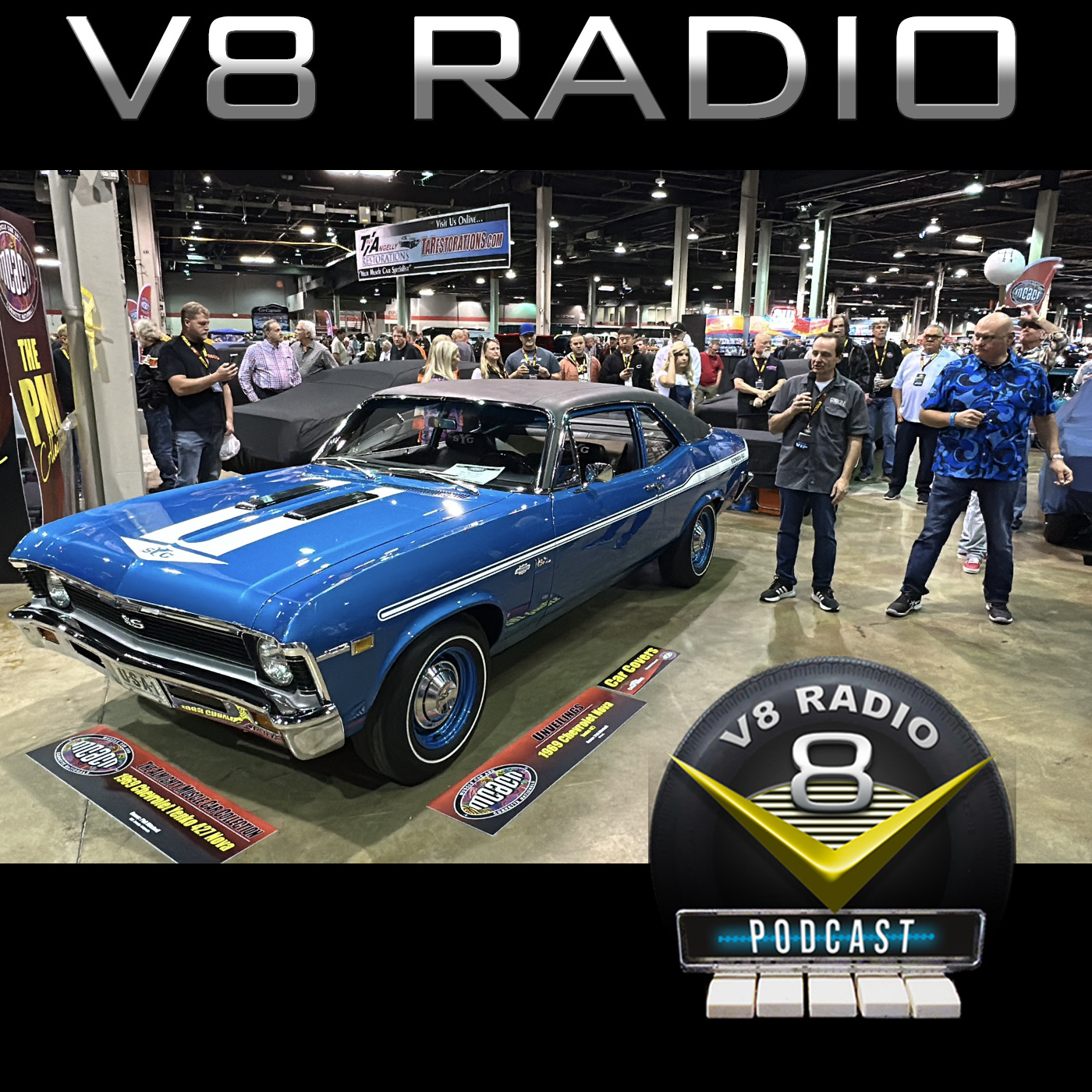
a four 27 Yanko Nova. Yeah. The Yanko Nova insane with the, uh, with the, uh, the headlight bezel,
the, the, the talk about headlight bezel. So I'll tell the story. Oh, I'm not afraid.
I don't want to get an extremely worded letter from Gary Riley. Yeah, right. No. So
it was funny because this Yanko Nova is a very rare car. I think they made nine of them.
And, uh, there was actually two of them on display this year at macaque and one in the
Mecham auctions display that you could get, Mike, you could buy that one if you want.
Oh, that's yeah. I'll take two of them. I'll take them both. I don't know about that.
Take them all. Well, the other one's not for sale yet. I don't think it will be. So the one that,
um, Gary brought out belonged, um, again to Phil Mitchell and it was LeMond's blue
black vinyl top black interior bench seat, four speed blue steel wheels, hubcaps,
white striped tires, uh, you know, with the four 27 Yanko installed the four speed, uh,
12 bolt rear end, just, just a street race extraordinaire, but a classy looking car with
that color scheme and the vinyl top crisp, straight, beautiful, stunning, stunning car.
And, you know, people say that all the time. Oh, the car is stunning. That, that one literally,
like you said before, kind of stopped me in my tracks because I think when you have,
if it was all blue, it would have been great, but that the vinyl top and the trim and the color
echoing off the wheel and the white stripe, it all, it just gave your eyes so much to do,
you know, when you look at the car. Yes, exactly. Yes. And there was one little detail that, uh,
that didn't get finished before the car was unveiled. And that was a, uh, the Novas have,
you know, the grill has horizontal slats and, and the headlight bezels have these slats that
are kind of cast into them, uh, the trim and they're, they're black in between the raised,
uh, the raised reliefs, if you will. And so that last detail, when they restored the car,
didn't get painted and somebody snuck in to the macaqued show, uh, and, and got in front of the
crowd and took a picture of the unpainted bezel and put it online and called out, you know, Gary
called out the show called out, you know, everybody who ever even thought about liking a muscle car
was under scrutiny. This is BS and the show's BS and it's not a real car. And this is a reproduction
part and this is all junk and, you know, yeah, good God. And so a, that kind of behavior is not
condoned ladies and gentlemen, uh, that doesn't help perpetuate the culture and everything else.
Um, these attention seekers that, uh, you know, keyboard warriors like to do that kind of stuff.
So what Gary did, it was classic. Um, after hours, he actually, uh, painted those inserts,
the correct set in black that they're supposed to be so that by the time we unveiled the car,
it was all perfectly correct. Just like it's supposed to be. And some pictures got out and
Gary was like, why did you, why did you Photoshop out the black paint? Cause it's here. Are you
just looking for attention? Were you not hugged enough as a child? Yeah, exactly. That's what I
thought was hilarious. Yeah, that was great. Gary Riley gaslighting a whole community.
Beautiful. Exactly. Well, in retaliation for being MF in this public spotlight, which,
you know, uh, I thought that was fun. I thought that was great when he did that. That was beautiful.
Yeah. And it was the correct piece and the, you know, the, the colors, right. And all that stuff.
It's just a little detail that, you know, slid into home plate, right. As the pitch crossed
right. The ball, the ball crossed, right. And the catcher just got it in time. Yep.
That was beautiful. That was awesome. Hats off to Gary Riley for that. Yeah. And these things
happen, you know, and, and I think a lot of people, people talk about, uh, uh, SEMA cars
not being finished or being worked on in the trailer on the way there and all that. And the
same thing happens with, uh, with the macaquette show, any deadline big show where you're finishing
up a car for it and you're going to have that kind of stuff. Sure. Definitely. As it, as it
should be. It's that's the fun part, right? Yeah. Yeah. The guys at apex autosport, same thing.
They were, you know, I was following the build of a, of a Hemi Cuda they were building for the show.
And a month ago, a month and a half ago, it looked like there was no way this thing was going.
It wasn't bodywork. And, uh, and they unveiled it here finished. And I said, holy nuts, you know,
what happened? And, uh, he's like, well, you know, we called the owner and said, my, my lead body
painter guy, um, moved. He left his family, relocated different part of the country. And
I just don't have the hands to get this done. And the owner was like, yeah, okay. You know what I
mean? I understand, you know, things happen. And so the pressure was off. Well, like, you know,
two days later, the owner called back and he's like, Hey, you know what? That car is going to
macaque. And so figure it out, do what you have to do. Yeah. Because it's a big deal, you know?
And when you promote a car is going to be there for, especially one of the featured unveilings
and all this stuff, um, you really want that to happen. So he was able to outsource, uh,
some of the, the body and paint work to a friend of his at a different shop, which, you know,
that's a whole nother thing, a level of trust and, and, uh, to be able to do that because
once it leaves your shop, you don't know what's going to happen to it. Um, but this individual
had an opening and was able to make it happen. And here it is, you know, it was, it's pretty
remarkable. Uh, there was also a Buick in the GS display, the 1970 Buick GS four 55 invitational.
Oh, right. Uh, that our buddy Adam Martin was finishing up and found himself up against the
wall. Um, and another member of the Buick enthusiast community took time off and drove
several States over. That's right. And said, I'm going to work with you and we'll put this together.
And they did got it, man. That is what it's all about, man. I'll tell you what, just people
helping people getting these projects done, getting the deadlines met, um, and being very
selfless about it. That, that, that I love to hear. Yeah. And it's, it's a, in those types of
situations that can happen when, I mean, they, they had what they needed except for the manpower,
so they had the parts, they had, uh, um, the resources, you know, sometimes you can't physically
can't, you're, you know, what it's like, you're waiting on something apart isn't here or the
motor's not done or, you know, whatever. Um, but fortunately for those guys, they were able to pull
it off. So good deal. I mean, you did that to, to, uh, to a certain extent with, with my engine,
you came up and helped me put that engine back in the GTO a few years ago. Yeah. Yeah. You stopped
by the, the Randy Burge, uh, invitation only garage and, uh, help get that thing in there and
going on, uh, on your way back to, uh, back to, uh, Waterloo. So I appreciate that. Well, it is
fun. You know, if you get the chance, the time to be able to go and ranch with your buddies, um,
yesterday, as a matter of fact, as you mentioned, uh, we were trying to get ahead of this
snow storm and I had my 70 Riviera out of storage for the past month or so driving it around. I
hadn't driven the car in a year. And, um, the guy who stores it for me, he's like, you should just
take this home for a little while, just, just drive it around. Uh, so I did and, and put miles
on it and, you know, had fun with it. And then I see the weather report and I'm like, Oh boy.
So ran it through the carwash and, uh, dropped it off. And when I entered his facility, there
was probably 20 guys, mad thrashing on like a 55 Chevy pickup truck. Really? And, uh, yeah,
they'd ripped the front end off. They were welding up a Mustang two front end. They're
putting a rear end in this thing. Whole bunch of guys got together and we're building this thing
just for fun, you know, and right on man, the hobby is alive and well. Oh my gosh. Yeah. Yeah.
Without a doubt. And whoever says it's not is out of the tree. You're right. Yeah. They have
their head buried in the sand for sure. There's so much going on and so many cool things going
in every direction. Um, but I don't want to leave the macaque and show yet because there was a whole
bunch of other cool stuff there. So it's funny when we talked about the, the guide, the magazine
of like, Hey, this is what's going to be here. Um, every year I'm fortunate enough to do these
unveilings. Um, but I also kind of started a tradition of doing a walk around video. Yes,
you have where Saturday night after the crowd's gone, you know, you and I will kind of regroup
and you know, take a minute to, uh, to breathe and then start off on this journey of walking
through the entire show and trying to shoot a video in motion of all the stuff. And that,
when I look back, that, that undertaking would be a good day's work on its own.
But by the time we shoot that you and I have already been through all the unveilings.
Plus the second half of a full day of shooting cars and interviewing people and doing stuff.
And then it's time to go. What feels essentially like the third shift,
the walkthrough video, you know, you, you were off shooting footage of that Mustang, that, that,
that Shelby GT three 50 car, um, and a Camaro race car we've we're featuring.
And I started the, uh, the walk around. And honestly, as I was driving up to the show this
year, I thought I had pre-publicized that I was going to do this because again, a lot of what I do
because I like doing this as little self-serving, uh, I wanted to document that, you know, for
myself so that I could watch this later. Yeah, for sure. You know, see what was there kind of relive
it. Yeah. But I had shared that, you know, on Saturday night, I'll be shooting this thing. And
a lot of people online and on YouTube had commented or like, Oh, great. You know,
and we're looking forward to it. Um, which was cool, but it also made, you know, a little
pressure. Like I couldn't, uh, I couldn't drop the ball on that one. So I got a little nervous
thinking like, all right, I read the magazine to a degree, but I'm not sure what's there.
And I don't know if I'm going to be able to walk through this thing and speak with any,
I don't even want to say the word authority, but any accuracy at all about what I'm looking at.
And I've seen a lot of other walkthrough videos of the mechanic and show, which are cool, but
nobody's talking. It's just the camera just kind of flying through, right. You know, they're walking
from car to car to car and you just get to look at it. And that's great. But you know, I, I try
to share like, whatever it is I know about these cars along the way, which sometimes it's a few
facts. Sometimes I don't, if I don't know anything, I'm not going to stop and talk about it. Uh,
I don't need to, uh, to spread misnomers or whatever. Right. Um, but the beauty of being
able to do these unveilings is we get the story directly from the restorer during the unveiling.
And that's like a great cheat sheet for me. Ah, gotcha. Interesting. And I hadn't really
remembered that until like, we're getting through the unveilings and somebody asked me about one of
the cars and they're like, Oh yeah. Um, and I think it was that, uh, that 69, uh, a Torino, uh,
GT 428 convertible. And they, they asked me a question about it. I'm like, Oh yeah. Yeah. Well,
there's, you know, only a couple left and you know, blah, blah, blah. And it's like, I learned
that because I just interviewed the guy that restored it. So it was pretty cool to have that
front row, uh, interview ahead of time and then to be able to go walk through and just kind of
regurgitate all that for everybody else on the video. So
very cool, man. Yeah. That is a, that is a nice mechanism that you, that you put in place there
to be able to remember that stuff. So, and that's a cool walkthrough. I mean, for people who don't
necessarily get to go to the show, they kind of in a way get to see what the number one, see what
they're missing, but they get to see everything that's there. And it's in, it's set in a environment
where you're not walking around people and you're not having to fight people to get a look at
something. And the noise level is gone. And, um, it's just, it's just you in the cars and you get
to present it in a nice light. Yeah, we shoot it after hours. So it's not, the show's closed
and it is quiet and it is smooth and easy. So yeah, that, that's really, it's a private show,
a private tour. Yeah, for sure. And maybe I should relabel that one, a private tour. Cause
that sounds more exciting to watch. There you go. Right. Like, Ooh, I want to see this. Yeah.
And fortunately there are also a lot of cars that I know stuff about also. So it's not like,
I don't know anything going into this thing. Um, but the, the, uh, unveilings definitely bolster
that. And then I pepper that in with the stories that I already knew. And next thing, you know,
it's 45 minutes later and I'm about to collapse. You do put, you do spend some time on that. I'll
tell you what. Yeah, this one, this current one's 45 minutes long and there is normally I don't
edit them. I just start in the beginning and I walk all the way through and then I'm done. Um,
but this time I had snagged, uh, Bob Ashton along the way and I had him tell us about the
red carpet display. Uh, so I cut that in. So there was a little bit of editing, not, not much.
Yeah. I caught the peppered in a few, a few little things in there. Yeah. Peter Brock was
there too. And, and, uh, I dropped in a couple of shots of his, uh, the Corvette that he had
on display and, and teased the fact that we're going to have an interview with the legendary
Peter Brock that was out there. That was a pretty cool interview. That was, Oh, he's,
he's awesome. He's such a great guy. And as a designer, you know, he, he penned the, uh,
C2 Corvette starting back in 57, uh, when he worked for GM and Chevrolet and Bill Mitchell.
And then he went on to work as the designer for Shelby and, and refined the arrow on the,
on the, uh, uh, the Shelby Cobra and then designed the Shelby Daytona.
And the Shelby program came to an end very abruptly. And Carol basically just fired
everybody and said, go home. Oh boy. Cause they, well, they lost their funding for Ford. Ford did
everything they wanted to do at Lamont. And, uh, and they came to Shelby and said, that's it.
And, uh, so the, the racing program was ended. I don't know if you've ever heard this story,
but you familiar with the Shelby Daytona coupe that I'm talking about? Uh, I believe so. Yes.
So it's kind of a, it's a different looking car, uh, because aerodynamically it's,
it's astounding, but it, it's a long nose kind of chopped looking coupe, like a bubble top. It's
got the Gurney bubble for the helmet and the roof, you know, cause Dan Gurney was very tall.
Um, another trivia question. Uh, and, uh, a big glass or plexi, but a big green house, open
visible rear window almost looks like a, like a hatchback kind of, but then the tail panel
was an inverted bubble. It, it, it curled inward and it had these little tail lights and the,
they're blue, you know, with the white stripe. Um, and the stripe went through that inverted
tail panel. Right. And do you know what I'm talking about? Yeah. Yep. The design, the design
was essentially stolen by the C4 Corvette. If you look at a profile of a C4 Corvette,
the tail panel, the first, the first ones curved inward like that. And the theory behind it is the,
the, the air that slips over the car. Um, ideally you would taper the shape of the car back to a
point behind the car, the same way it starts as a point in the front of the car. And then as the
car went through the air, it would just kind of separate the air and put it right back where it
came from. Yeah. But because you can't extend the back of the car, um, you need to do something at
the back and Brock as a designer and an engineer and a racer, he's also a racer. He knew that you
could trick the air to kind of have a trip over the back of the back of the car. But before the
air fell on the car surface, it falls into that cutout and it doesn't stick to the car. It just
kind of tumbles, tumbles off on its own and the car slips through without the aerodynamic drag.
And that's what the term drag is the air sticking to the car, dragging, dragging it down. Oh,
gotcha. So he caught a little flack for it, but, uh, but it definitely improved the top speed
and made these cars super competitive. And I don't get me wrong. I think they made six of them.
If I'm not mistaken. And there was one prototype that was even more, more outlandish than the race
cars, that car, the prototype lives in the Broder's collection and it's, I've seen it in person. Oh,
pretty cool. Uh, yeah. Um, but anyway, at the end of the racing program, when the money was done
and Shelby famously just sent everybody home, those cars were in England. Cause that's where
they was for the chassis were made and they were shipping them back to the U S and Shelby literally
just wanted to push them off the boat into the water. Oh my, he literally was just going to say,
say this, this program's over to sink them done. Oh my. Oh, wow. And fortunately that didn't
happen. I got, I got to learn that story better. I, I'm not going to lie to you and tell you,
I know everything about it, but it's, it's a fascinating, uh, uh, adventure, but anyway,
that was Peter Brock's doing of that, that race car. Um, and when, when Shelby, uh, sent everybody
home, he was pissed, you know, he's he dedicated and that you want to talk about dedication.
The Shelby team was tasked with doing unbelievable feats of competition with limited resources and
just having to figure it out. So in road racing, it was the GT three 50 and then the Cobra and
then Lamont and beating Ferrari, you know, the Shelby team made that happen. Um, so these guys
were, uh, you know, completely tied together, uh, a tremendous team. They, they, they lived and
breathe, you know, Ken miles and the whole thing. They, they, they, they were a band of brothers.
And then for Carol to walk in and go, Hey, you know what? You're all fired. See you later.
Thanks for stopping by. Yeah, exactly. So, so what did, uh, Peter Brock do?
Man, he took revenge and he, he went out and paired up with, with Dotson at the time and
went road racing and ended up beating, um, all the Shelby stuff that was still on the road.
Yeah. And, and I think Carol continued to race after that time period and he, and Peter beat
him. And the, and the funniest thing about it was Dotson had come to Peter Brock and said, Hey,
we want to, we want to race. We want to do road racing. I don't know if it's going to be
SCCA Trans Am or whatever. Um, and we have this really cool little car. It's a, it's a new car
for us at two 40 Z it's a slick little sports car and we think we can, we can beat everybody.
And Peter Brock said, yeah, yeah. What, what's the goal? And they're like, well, if we win,
we'll sell cars. And Brock says, yeah, well, you know, I'm sure you will,
but that car isn't going to have a lot of problems, you know, because it's a sports
car and it's a limited market. And, and people kind of expect that to be a race winning car by
looking at it. But you got this little five, 10 sedan over here. It's this little box,
you know, if you beat everybody with that thing, then you're going to be on the map.
And they're like, well, how the hell are we going to beat people with a five, 10 sedan?
And that's what Brock did. We got flying brick for pizza. It is. And, and, and if you look back
in the early seventies of, of, uh, Brock racing and the red, white, and blue team of those dots
and five, 10 sedans, that's what that's all about. And it's just an incredible story. Uh, amazing guy.
And eventually, uh, uh, he, Peter had told me that story in person at the SEMA show
five years ago, maybe, um, or six, probably 19. And it just blew my mind because a lot of times
designers are designers, engineers are engineers, races are racers, and he's all of them. You know,
he's a driver, he's, he's everything. So whenever I get a chance to see him and chat with him,
I totally take that opportunity because, you know, we throw these terms around, you know,
these legends and everything else, but this, this guy is definitely one of them. He's legit.
No. Yeah. And a super nice guy. Just great. Great to talk to. So long way of saying his latest,
uh, Corvette design was there, which is a C3 that is modernized a little bit. Um,
but it incorporated design elements that he wanted the first one to have that he couldn't
put in because of the, uh, you know, so like, for example, on the, on the B pillar, if you will,
behind the door on the vertical, on those cars, there's a, a gill kind of a, a little, um, vent,
and there's a relief that looks like a vent on the factory cars, but they're not functional.
But on the one that he did this year, it's functional and bottom of the fender area on
the front and the nose, there's cooling ducts that are there to pull hot air out from under the hood
and they're functional on his, and they're not on the other one. It's a custom car, you know, but
beautiful and I'm fortunate that he was able to chat with us a little bit about it, um, at the
macaque and show it's Corvette. So it belongs. Yep. The muscle Corvette multinationals.
Indeed. Yeah. We got a, we got a petition, Bob, to change the name, update the name rather.
Yeah. Yeah. And then, uh, you know, the other, not the other and other cool aspect was that
Buick GS display. I'm a huge Buick fan. Oh, that was right up your alley, dude.
Oh my gosh. And I had the GS that you need to own there.
Yeah. Well, so the display was a kind of a double, a double header. So it was a 1970
invitational, which went hand in hand with the other class of 1970 displays that were there.
But it was also Buick GS, um, coupes and convertibles that, uh, uh, a guy named a
Josh is in, in the Buick world very prominently. And he helped put this together with a bunch of
other guys, but the arrangement was one that hadn't been done there before that we're all
scratching our head saying, why not? And what he did is a coupe and convertible arranged in a V
like a herringbone in which they were matching colors. So the lead two cars were a silver
70 GS four 55, I think a stage one, uh, four speed, uh, convertible next to a coupe
of the same color combination, silver, black. And then the one right behind it was the next
matching color scheme, but you know, in a, in a red. And then after that was all the way down the
line and they had a lot of the colors. You could get a lot of different colors in 1970. So they
didn't have all of them, but they probably had 10 different colors. Yeah. Um, Aqua mist, you know,
some of the, the, the forest greens, the burnished Browns. Um, and then right in the middle was the
bamboo cream. How about that? The bamboo cream, 1970 GS four 55 convertible
four-speed car. So tell us all about it, Kevin. Well, and I think we've talked about it here
before, but this particular car is very special to me. Um, cause it belonged to our good friend,
Mr. Dave McClelland voice of the NHRA voice of drag racing voice of Kevin Ostey and Kelly
Ostey's wedding for sure. Yeah. And, and, and one of the voices in my head
in that respect, he lives forever. Well, he really does. And he and I spent a lot of time together.
Um, when I was producing hot rod magazine TV, he was our on-air host and, and the magic of
that experience was, you know, he would, uh, he would deliver his lines, which took five minutes,
but then we would have a half an hour or an hour long setup of cameras and lights for the next one.
And in those times, that was the magic because Dave and I got to share stories and, you know,
talk about our families and, you know, I, you know, I got to learn so much from him between takes,
right? Sure. So he owned this car. And I remember one day we were looking for a car for the set
of the TV show. We always had a couple of cars on set and he's like,
well, I got my Buick dialed in. You want me to bring it down? And I said, uh, you're Buick.
Oh yeah. My, my GS. And he shows up in this car. It's this bamboo cream convertible four-speed
white gut bucket seats, a four-speed console. Uh, Dave, I didn't know you had this thing.
And he's like, oh yeah. So I knew the car. I've probably known her for 27 years
and, uh, I've driven it and I've gotten rides in it and I know the whole story behind it and the
whole thing. Um, and then a few years ago, unfortunately, Dave had passed and I didn't
know, I didn't really think much about what happened to the car. I thought his family had
it, his son, Kevin or somebody, his son, Michael. But, uh, one day, you know, my, uh, on our, our,
uh, um, trip to Chicago for, for going to the opening baseball game at Wrigley, uh,
two weeks after the opener and not at the ballpark. Right.
Go to visit our good friend, Mr. Dan Vasek at the Hearst garage, you know,
Joe Spagnoli's collection. I come around the corner, there's the car. It's right there.
That's crazy. Chicago of all places. It blew my mind. And I found out then that another one of
the principals of the macaquette show ended up owning it. And Dan Vasek was doing some detail
work on it. And, and, uh, that's when the conversation started that Dan's like, he could
tell, he's like, you know, this car, you know, he was, he's looking at me like, uh, you know,
like a Jedi, you know, this car. Yes, I do. I guess I know this car. Yes, it is. You've driven
this car. So, uh, so he's like, you need to own this car. And I'm like, oh yeah, sure. Right.
Whatever. And, uh, so the owner today and I have talked for well over a year now about, you know,
me ending up with this car and it's, uh, rightfully so it's not a cheap car because
it is what it is. It's not an original motor car and it's got a couple of mods,
but it's air conditioning and everything. And interestingly, bucket seats are not
standard on those GS convertibles. Interesting in 70. Um, but this one being a four speed,
it's got buckets. Um, and the four speed didn't make buckets mandatory either.
There were bench seat, four speed cars, but, uh, anyway, so there it is. And, um,
and, um, I'm not saying I'm going to end up with it. Uh, it's kind of fun that again,
the voice of McClelland pops into my head whenever this car comes up because, uh, I think what,
what would he, what would he tell me? Right. And I, he would say either one of two things. He would,
he would either tell me you need to own that car, son. Life is short. Uh, or he would say,
you've got better things to spend your money on son. It's like the good Dave and the bad Dave on
your shoulder. Yeah. He's in a white tuxedo on one side and a red tracksuit on the other
red satin tracksuit. But I got to spend some time with the car and, uh, at the show and
shot a video on that too. So you can hang out on muscle car of the week,
the YouTube channel, and you'll be able to see that video soon, which is cool.
Good deal. Good deal. Um, another one of our good friends of the show, Mr. Jim Hall
had a, uh, had his car there. It was a 20 year restoration. The, uh, the 1969 Baldwin motion
Camaro, um, that he spent 20 years building. And, uh, it made his debut there at the muscle car
nationals. It was actually also at the seam show, uh, this year. And so, and that's interesting
because I think it was, it had a motion badge on it and Baldwin was a dealer in New York, right?
I believe so. Yes. And motion was the performance upgrades,
Joel Rosen's motion Chevrolet performance parts. So motion was like similar to Nicky Chevy
back in the day or Yanko, uh, as a dealer. And so it used to always be Baldwin motion,
but today I think they're just motion really. And I think the name ownership is legit.
Like the, they, there's a, there's a thing there. So I don't know if it's correct to say
Baldwin motion, or I think it's just motion. I'm not sure. Um, but that particular car, uh,
it, it's a custom, it's a speedster narrow. So it's a convertible without a backseat and, uh,
and the raised molded headrests and all kinds of tricks moved by work and LS performance and
a custom dash suspension. And I believe that was a Hermans design. Um, and I remember that car
coming together on lateral g.net 20 years ago following, following the bill. Oh yeah. Uh,
for years followed the build. And finally, like yourself, I got to meet Jim and, uh,
talked to him on the phone and great guy, a huge, huge supporter of the hobby and,
and the culture. And I'm so happy to see that the car was finished off. Yeah. It looks dynamite.
It looks like it was designed today. Yeah, it does. It looks great. It looks amazing.
So yeah, I know he was really proud of that and real happy to have that done and got to
share it with everybody. And, and he's like a, like a little kid again. So good for you, Jim.
For sure. Yeah. And, uh, he, he actually listens to this fiasco. So that's cool.
He does. Thanks, Jimmy. Thanks for being our listener today. Yeah. Yeah. Well, and then, uh,
you know, just on and on those, those stories. So I feel that it's my responsibility that sometimes
I have a little more of a front row seat to some of these cars and, and to share them out with
everybody. It's just, uh, it's just so much fun, you know, and to do it through video or do it
through the show or whatever this podcast, but, uh, bottom line is you need to go to Macaquen.
If you've never been for sure. And if you can't then watch the private tour. Yes.
So what you do, Kevin, you do important work. You're good for the hobby. You're good for the
industry as you've been told all weekend. You know, that's, that's another thing that,
you know, you bring that up. That's kind of funny because fortunately we have a very gracious
audience and, and on our YouTube channels and on this for the, on Spotify or on Facebook,
people are generally very, very nice when they comment. And even if I, if, if, you know, when
I get something wrong, not if, cause I, I do often. Uh, but a lot of times it's like, no,
I think there was five of those and not like, you know, when they grilled Gary Reilly, you idiot,
you know, this guy doesn't know. And believe me, that does happen sometimes. Yeah. And the,
to me, there's been a couple of great examples where, um, I've said something in a video and
the image didn't match, but then it does match up later. So one of them was, we did a piece on,
on Hemi cars. I think actually it was the top 10 of 70, I think top quickest cars in 1970,
a muscle car of the week episode. And one of the cars was a Hemi Kuda. Um, but
the image I showed was a four 40 car because I didn't own an image of the video of a Hemi Kuda
at the time or a Hemi Roadrunner or something. And I showed a four 40 engine instead of the Hemi.
And in the voiceover, it says, you know, one of the fastest cars was the four 26 Hemi. Meanwhile,
you're looking at a four 40, right? And I can't tell you how many people stopped the video
immediately right there and like this guy's an idiot. That's a four 40 doesn't know what he's
talking about. But if they let the thing play like another 15 seconds and say, yeah, and I'm
showing a four 40 here. Cause I don't have the footage of the Hemi in this Roadrunner or whatever
it was. Yep. Yeah. People are quick to jump, man. It's, it's insane how people must feel so badly
about themselves that they have to jump all over other people just to make themselves feel better.
Yeah. And I think that's what a lot has to do with that. And I'm the first to admit,
if I get something wrong or if I'm ambiguous, I was ambiguous when we did the video on that
four 21 Pontiac, a four-door car. And the description of the car, if you run the VIN
and you run the window sticker, I think we had a copy of the sticker on that one.
And it said deluxe wheel covers that it was, that it was supposed to come with.
And today it's got eight lugs. And I was trying to describe what the car was, was
ordered with, which was deluxe wheel covers. But in the image, it shows the eight lug bolt on
aluminum, high performance, bigger wheels, which is what it's supposed to have.
But I wasn't clear about that. So I got barbecued on that one too. Those are eight
lugs, dummy. That's not deluxe wheel covers. You're an idiot. You know, it's like, okay.
To the extent that in the Facebook muscle car of the week page in the description,
it says, and yes, I know, we know these are eight lugs, but you know, this is quite sad.
People won't believe that.
And we're still getting, those are eight lugs, those are eight, you know, you're a dummy.
But we don't get it very often, which is good. Most of the time people are like,
hey, didn't you mean to say, you know, or whatever, right. Or, or it's like,
thank you for making this video. Cause it connected me with a car I used to have,
or I've always wanted to see this, or I never knew about this. And, and that's the vast,
vast majority is nice, positive commentary. Sure. And in fact, somebody said on the, on the,
uh, the walk around video from last week of macaquine, um, one of the best comments was
finally proper coverage of this show. This was the best event coverage of any car show ever.
Cause they really appreciated that exclusive one-to-one, you know, walk through conversational
style. So that was really awesome. You know, and I really appreciate when people are kind about that.
Yeah. You know, that's what it's designed to do. That's what you're meaning to do is,
is be able to bring that and show in more detail than you normally would be able to see. Like if
somebody was there during power hour and they're trying to get a video of something and look at
this cool Camaro and, and you got all kinds of noise and, and people are all around and you
can't really get a good shot and you can't really get your thoughts together properly.
But when you do it, it's nice and quiet. Like I said before, it's nice and quiet.
And you can really focus in on what you really want to see.
Well, and it's all about the cars for sure. So I'm not the guy that's going to be wearing some
goofy helmet and I don't have tattoos from head to toe. I don't have an image of, you know,
I don't wear orange pants and, uh, you know, a yellow shirt with lightning bolts on it or
something and, and stand in front of the camera for half an hour and show you two blips of the car.
Hmm. That's not what I do. It's about the cars. Sure. And I think people appreciate that too.
If you're in, if you want to see, you know, personalities and influencers and all the rest,
there's a million of them out there. Enjoy it. It's just, you know, now, now what we do,
right. So, um, some of the feedback and we got it, you were there, we get, we got it more than
once was, Hey, what you're doing is actually important because, because you're sharing
information in a manner that is, it's a document of what these cars are and you're sharing the
info that people are using as research and people are learning about the cars and it's not just
entertainment. And that was pretty heavy, you know, to hear that because I know, I don't claim
to say that these are, you know, research grade documents that we're putting together. I'm
collecting facts and things from other people just try to be accurate as much as I know. Anyway.
Um, but, uh, several people said, Hey, I'm here because I watched your videos and I got
into these cars because of that. Yeah, that's right. Yeah. We, uh, interviewed a guy who did
say he got into cars from watching your muscle car of the week videos. Yeah. And now owns a
whole bunch and now owns a whole bunch. See you affected changing people, man. It's not my fault.
I mean, you, you, you infected people with, with these, um, I'll score the week videos in a good way.
Yes. Um, and that's, that's awesome. And, and that, that's something that you want to happen.
You want, you want people to go, Hey, that's pretty cool. I didn't know that. I want to be
part of that. Yeah. And we showed him a doorway to be able to be part of that. And again, they
were very kind. And, uh, but, but starting to throw some terms around, like, you know,
it's your responsibility to do more muscle car of the weeks for the industry and for the hobby
and for the enthusiasts, they need this stuff. It's not just, you know, so yeah. Who talking
about cars. So yeah, you started this now you got to keep doing it. Yeah. Yeah. Yeah. Well,
good. You know, I'm glad to, to do something that I enjoy doing. And it's not like,
if this was like some God, awful, horrible thing, that'd be a different story, but
it is a lot of fun. And, and so out of those conversations came some pretty cool,
some pretty cool opportunities. I think that, uh, to, to grow muscle car of the week and return it
to a more frequent, we got access to a couple of great collections and we're just kind of putting
some details together. So I'm just doing my responsibility here, friends. Hey, you know,
doing this for the greater good. I'll try to enjoy it along the way.
I won't make any promises that I'll love doing this, but I'll, you know, it's for you people.
That's right.
So that was pretty wild. Yeah, that is, that is, that's really great.
So outside of the, uh, Starlight GTO, what was, uh, was there a Q's pick of the show?
Ooh, boy, a Q's pick of the show. If, if I can't pick that Starlight GTO, I'd probably pick that,
uh, that Sprint 6 Le Mans convertible that I saw, um, in the, in the light cream yellow
color just because I miss my, my old Sprint 6. Yeah. So yeah. Yep. That'd be it.
Definitely. I would, I, uh, I made the bamboo cream car, my, my official pick of the show.
They let me, they let me pick one for the, for the record, I guess. Yep. Um, so that was cool.
There, but there was a bunch of others too that, uh, that I was going crazy over. Oh, sure. Uh,
that Blue Yanko Nova for sure. Um, that, uh, Hemi Kuda that Apex did for sure. Uh,
uh, Brock's Corvette, um, definitely is one. Um, but then there was some other,
you know, kind of oddball cars here and there that, uh, there was a, I think it was a Seabody
Mopar, the big, uh, uh, Dodge two-door that was in their springtime display with all of the
Panther Pink and Moulin Rouge. Oh, right. And Sassy Grass and Green Go Cars.
That was a, this, this 70 Polara, I guess, two-door giant car. Oh my. In pink. Oh gosh.
Factory paint, only one. You know, I'm like, that's actually really cool. Yeah. The fact that
it's only one is, yeah, it really makes it cool. Normally you wouldn't think of a, of a Polara
as something, you know, hot to look at, but, uh, I'm sure it really caught your eye in,
in, uh, what was, so was it, was Dodge Panther Pink or was Dodge Moulin Rouge?
Dodge was Panther Pink and then Plymouth was Moulin Rouge. Okay. And then Dodge was Sassy
Grass Green. Okay. No, Plymouth was Sassy Grass Green and Dodge was Green Go. Green Go. Okay.
Yeah. They did have some pretty cool colors back in the day. They high impact. Yes.
Oh, awesome stuff. Yeah. Yeah. Really cool stuff. That whole show is just like I told you before,
uh, when we were leaving, I'm like, I, I, I hate that. I'm only going to remember
like 2% of what I see here, uh, over the weekend because everything is just coming at you so fast.
And it's such a blur with, you know, with what we're running a gun in the way we do and
just so much. It's just, it overloads your memory for crying out loud, overload your,
your senses. It's, uh, it'd be nice if that show went for a whole week. That'd be great because
you can go through it for a whole week and probably still not really see everything.
If you spent time and learned about a lot of these cars, I mean, you can, well, really it's,
it's the greatest muscle car museum in the world. And it's a pop-up. Yeah, for real.
It's there for a weekend and it's gone. So that's crazy. Hats off to, uh, to Bob Ashton
and all the principals that, that run macaque and, um, and, uh, and all the volunteers who do the,
the theme displays and the invitationals and, and the workers that get the cars in and out.
It operates smoothly and just thank you so much for the opportunity to be part of it.
Yeah. And all the car owners for participating, for wanting to be part of that and,
and take using their resources to get their cars there and get them all set up and,
and sharing them with everybody. That's huge. Yeah. So a couple more previews again, that,
that Buick GS, the, uh, Peter Brock Corvette is a video coming. The, the Hertz 66, uh, GT 350 car.
Uh, we also did a walkthrough with our friend Clifton and from Canada and the whole Maple
leaf muscle display, which was, I don't know, 25 cars. Yeah. Something like that. Yeah. And we,
we walked through that, that whole display. Uh, we shot, uh, Joe Spagnoli's 1970 GSX Buick that
was brought up by Dan Vasek and achieved legend status and the vintage certification 19,500 mile
car. Crazy. We shot a feature on that. Um, we shot the, uh, 1967 Z 28 drag car built by Fred Gibb.
Yeah. A little Haas. So that's coming. And then we featured one of the B body, uh, convertibles,
um, a 69 Coronet RT Hemi four speed convertible. Yeah. Uh, what else? What was that color?
Uh, like bright metallic turquoise, I think. Yeah. It was cute. Q5 or Q9. Q5. Q5. That's it.
A swimming pool. You could drive is what the color was.
That sounds about right. Yeah.
So we shot a bunch of cars, got a bunch of features coming out. So make sure you subscribe
and, uh, don't miss any of those. So, so here we are. People want to know the answer to your
riveting trivia question. Riveting. I could tell. All right, Kevin. So I asked you, what was the
year making model of the Sanford and son truck? And, uh, where did this come from? By the way,
did you see an episode recently or no, actually it's, it's funny you say that I was looking for
something else completely. Um, and I happened upon a picture of that Sanford and son truck.
And actually this question came up probably five minutes before we started recording this,
because I had a whole nother question on tap, ready to go. And when I saw that, I'm like,
this guy over prepared. Yeah. I'm like, wait a minute. That's a trivia question right there.
So I just threw that one in there instead. Um, and then I asked you, what was the year
making model of the Sanford and son truck? And you said it was a 1950 Ford F1 pickup,
a red 50 Ford F1 pickup truck. And in actuality, Kevin, it was a 1951 Ford F1.
Heavens to Murgatroyd. Just throw me out with the bathroom. That's right. That's,
I'm coming to see Elizabeth coming to join you on it. Um, but yeah, 51 Ford F1. So close,
but I mean, it was pretty close. Yeah. Yeah. You were right there. It was a great show.
Uh, Sanford son, not only because of the goofy, funny show that it was, but there,
I don't know if you ever heard any of the, the story behind that whole thing. Um, so red Fox,
you know, played Fred Sanford. First of all, it was a huge car guy and ended up owning the
Barris, uh, little red record truck. Oh, really? Custom sixties custom that,
that he renamed red Fox's record. And, uh, there's video of him driving that thing around. If you,
no, it's a crazy sixties custom, you know? Yeah. Record trip. A lot of those George
customs were just out of the, out of their, out of sight, man. Yeah. It's like a, you know,
similar to a Tom Daniel car or a big daddy at Roth card. Yeah. All that kind of stuff.
A life-size hot wheels car. Yeah. But, uh, red Fox was extremely loyal. He was a St. Louis native.
And, and a lot of the people that he had working on that show were people that he'd worked with
over the years that he just brought with them to, to grow and, and, and get better gigs. And,
and, um, the gal that played, uh, uh, on Esther that he always made fun of, um,
was a fantastic actress. And, and she, he brought her in and said, you can do this. And she said,
she'd never done television before and didn't think she could do it. And, uh, he's like, no,
you can do it. And, and she pulled it off and was just one of the best characters on the show.
Yeah. And, uh, and the, the, you know, the comedy is, is edgy today. It was super edgy. Then
it's actually probably edgier today now that our society has become more sanitary with what you can
say and what you can't say. Um, but they were all great friends and, and they're all, you know,
that whole cast was like a family, even though when they, they did the show, it seemed like they
were at each other's throats sometimes. Uh, but, uh, great, great show and a 51 truck. Now we know,
now we know. All right. Yeah. All right. Well, I had asked you all about that 67 starlight black
GTO with the 400 Ram air. And how many of them were there? And your answer was
seven 68, less than a thousand. I think it was like, oh gosh, sorry to all my Pontiac brethren.
I'm sorry. I think it was seven 68. And you know what? You are right there. Seven 51.
Oh man. I was close. All right. All right. All right. I'm not too ashamed of that answer then.
No, not at all. All right. I kind of think we almost both won. I kind of think so too.
As close as you can possibly get with, uh, with not quite being right in our horseshoes and
hand grenades. Yeah. You know what? It's close enough. I think, you know what I'm declaring
is both winners. Hey, write it down. Yardley. We're both winners. That's right.
Uh, fantastic. But you know, the real winners are those who listen to this show because, uh,
they, we appreciate their support and, uh, I don't know what they want, but I,
that just felt like the right thing to say.
You're the real winner. Listen, you're the real winner. You got to butter them up a little bit.
They won't come back. Please keep them coming back for more.
Oh my goodness. So on that note, if I, uh, if I can be so bold as to make a preview,
I think our next episode might be, uh, or one of the upcoming is going to be, uh,
the latest from the PRI show and Indy. Ooh, yeah, that is coming right up this time of year, man.
It's SEMA, McCacken, PRI. Yeah. The Holy Trinity. Or as you like to say, boom, bam, pow. Boom, bam, pow.
We made it through bam and boom. Pow is coming up. Stay tuned for all the boom. That's right.
So, uh, on that note, that's about all I got. Make sure you subscribe if you dig this show
and you want to hear about pow next time. And, uh, for Mr. Mike Cuball Clark, I'm Kevin Ostey,
reminding you to, uh, keep the shiny side up, get that McCacken magazine,
subscribe to VA radio. And, uh, we will talk to you next time on VA radio.
About this episode
A recap of the Muscle Car and Corvette Nationals (MCACN) 2025 highlights, featuring a stunning 1967 Pontiac GTO in Starlight Black and a rare Hemi convertible display. Hosts Kevin and Mike share their experiences unveiling cars, including a unique Yanko Nova and a Buick GS display. They discuss automotive trivia, the importance of community in the car culture, and the excitement of seeing rare vehicles. The episode captures the essence of the show and the camaraderie among enthusiasts.
Dig the latest V8 Radio Podcast – Kevin and Mike recap the muscle car magic from the 2025 Muscle Car and Corvette Nationals, share trivia triumphs, and geek out over rare rides like that drool-worthy Starlight Black GTO!
🔥 Topics we revved through:
MCACN extravaganza: 640 cars, Hemi B-body convertible invasion, Z16 Chevelle showcase & the epic red carpet display!
1967 Pontiac GTO Ram Air unveil – black beauty with buckets, 4-speed & rare pedigree
Overhead Cam Six Pontiacs, Maple Leaf Muscle from Canada & survivor stories like the 256K-mile '66 Shelby GT350H
Personal picks: Kevin's Bamboo Cream '70 Buick GS 455 4-Speed Convertible (Dave McClelland's ride!) & Mike's Sprint Six LeMans convertible
😂 Funny moment: Mike's epic drool over the Starlight Black GTO leads to Kevin joking about installing a "Cue Ball's Drool Pond" with gondola rides at the convention center! 💦🚣♂️