You know what I realized? The hardest part about building a website isn't making it look good.
It's getting what's in my head onto the page. But I've been playing with the new Wix Harmony Editor,
and I'm impressed. You can literally just tell it what you want, or if you're picky like me,
jump in and move things around yourself. The nice part is, you can hop between AI and hands-on
editing so you end up with a site that actually looks the way you pictured it.
Tried out for free at wix.com slash harmony.
From the great halls of their house, there are assembled three who hope to one day be
the world's greatest driving heroes. Created from the cosmic legends of the universe comes our
team captain, the vision, Bill Fisher, their soon-to-be wonder woman, Vicky Fisher, our captain
marvel and head flight trainee, Jennifer Scribchock, and our Batman, the master of tools, gadgets
and all things mechanical, our mild-mannered soon-to-be billionaire, Alan Danvers. Their
mission to fight injustice, share what is right and wrong, to get you out of your house
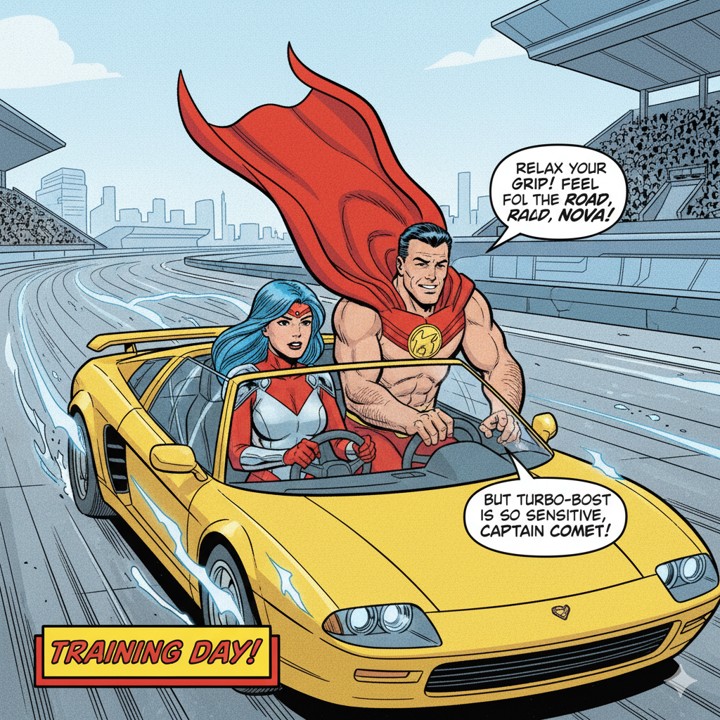
and come out racing with them and serve all mankind. They are the Garage Heroes in Training Team.
Dominating with Dawson. Let's dominate. Ben Dawson, Ben Dawson, I need me some Ben Dawson.
Lucky for me you're here. I'm right here. Let's do it. All right. Mr. Dawson, we had
somebody right in a couple times over the years, and I think we haven't covered it perhaps as well
as we should because I was in the paddock the other day, and somebody brought it up to me again,
and so I thought, hey, I think that would be a great question for Dominic with Dawson. So I
wrote into myself. Right. And I said, self. So code name, Bill. Traction control. It's on
most modern cars. Some of them are good. Some of them aren't so good. However, when you're relatively
new to the track, when do you turn it off? And when do you leave it on?
I mean, I think most people who come to the track have some sort of context to know that,
you know, that you hear people talk about, oh, you know, I still got the nannies on or,
you know, I want to turn the nanny systems all off. And I think most of these people have seen
Jeremy Clarkson complaining about it on Top Gear or something like that, to have some sort of context
to buy their own traction control. I'm fortunate I've been driving really analog vehicles for most
of my time on track, you know, in the mid 90s, Miata with no kind of traction control. And then
we, you know, race the E30 racing E36. So we're talking about cars that don't really
have any kind of action, active traction control. But I've been in plenty of participants and
students cars that have that. And, you know, I think, I mean, it's all relative. If you have all
that stuff turned off, you know, high horsepower car, it's gonna, you're gonna find the limit
faster, you know what I mean? You're gonna, you're gonna find a limit by overstepping,
you know, you're gonna kick the tail out or do all the things that the vehicle's trying to
stop you from doing. If you have it on, it might mask some of the errors that you're
making. It might kind of keep your car hunkered down, even though what you should have been,
you know, if you had also turned off, you would have been having a wreck, you know what I mean?
Right. So it's a, it's a, it's a thorny question for me because I want
people on track to be fully driving in control of their vehicle. But I also don't want anybody
to get hurt. You know, I had a student one time, like this is the mid 2000s,
uh, ZR1 Corvette that had the, you know, one of those ones that had the glass bubble in the hood
and like a million horsepower. And he's got like, yeah, you know, I've done the circle track race
and stuff like that. I said, all right, great. Let's, let's, let's go on that, let's go on
down pit lane and get on out of here at VR. And, and, uh, as we're going down pit lane,
I'm like, you can go ahead and go because he was just kind of, he was just kind of
bobbling down pit lane. I'm like, now it's go time. This guy just nails the throttle and
they car turned completely sideways on us. But I mean, luckily from his dirt track experience
or whatever, he kind of whipped it right back in and got going on track and we had a great day,
you know, but that might have been one where if he had his traction control on or something like that,
it might have caught it a little faster. Um, but, uh, you know, I'm, I'm such a, such a dumb
down on these kind of things. I don't really know what all goes into traction control and how it
works. I know that there are levels of it that you can turn some of it off. You can think
you have it all turned off, but then there might be some embedded in the code that you
can never really get all the way off. So thankfully I've only been driving like Fred Flintstone
kind of cars. I don't have it at all because I, I don't know how to go in and, you know,
deep program it or turn it off all the way or have it partially turned off. Um,
I can tell you, I was fortunate enough to drive Danielle trips, uh, Mustang at a track event one
time and, uh, we thought we had it mostly turned off or all the way off. And that thing,
you know, when I, when I did something, you know, at Ben Dawson speed, that thing,
yeah, you can like snatch, just, you know, snatch the car around it and like knock me
off line. You know what I mean? I was like, that's where I was trying to go. You know, I was
trying to do that. And this thing is that the traction control was so disruptive on there
by 2014 Mustang GT that, you know, it yanked me offline. So it's, I, I think, I think I'm kind
of coming around the idea that if you're able to, I think it's better to turn it off,
just have it off, learn to drive. What do you think? So the correct answer. All right.
All right. I've driven
a ton with first timers, brand new, relatively new, uh, because most of the, most of what I do is
like the HPD one entry groups. And then, you know, uh, a small fraction will be like HPD two and
another about the same fraction will be three. And then I even drive with fours. Um,
you know, just, you know, we tag in with each other and see what it is.
If you, if you don't need it, this, this, this conversation is not aimed at you. I'm,
I'm talking strictly for the, the new, strictly for the uncomfortable, strictly for the,
you know, maybe they're a little scared, maybe they love their car and they don't want to let
go. So if it's your first day on track, let's say you're going to an event that's a two
day event. I have zero issue with you having traction control on for your first time around
the track. Okay. And then you can start to make a decision. And a lot of people,
they just love their car and they don't want to have anything happen to it. So they just
leave it on, which is fine. You can learn. If you start to think about
turning it off, like Ben said, there's stages, right? There's, there's full on, there's kind of
usually like a half on and then there's like a mostly off and then there's off off. Any of those
can be done. And, and you got to look at the track, look at the consequences of messing up,
look at, you know, some tracks, you can just turn it off right from the beginning. You,
you basically, the only thing you've got to hit is grass or a cow. There's no,
there's no, uh, then there's other tracks where if you go off, you are
going to be paying a bill for your car and maybe for the track. So take that into consideration,
take into account how much of the car you like and how much performance the car has,
but don't ever turn it off off off to the point where your ABS doesn't work.
If you're brand. Yeah. Well, I think anybody, anybody, if you're, if your car,
if you're lucky enough to have ABS, keep it on because you can use it as a, as a, as a
competitive advantage. So I would never, I would never ditch ABS. If your car hasn't used it,
because also it's, it's your braking system is designed to have that as part of,
as part of the, the braking components. So I would never go around ABS. If you have it,
keep it on all the time, whether you are, keep it on in the race,
keep it on in the track event, keep it on the street, keep your ABS on.
I've driven cars without ABS. It's not as much fun. Because when it goes back,
it's harder. It goes really, really hard. And then the other thing is take into account the conditions.
Like is it raining? Is it snowing? Is it raining at what mid Ohio used to be? I don't know that
it's better now, but it used to be an ice skating rink. Leave it on. Just leave it on.
And I'm talking like first weekend, first day, you know, I would say leave it on
until you know you don't need it. Now what I would say is if you leave it on, try to get to the
point where either you or you and your instructor are paying attention to when it intervenes,
because that'll tell you without your car getting out of control, when you would have
got the car out of control without having any of the risk. So a lot of people that I've dealt with
turn it off like second day after their warm up or a couple of people like to have done it
first day, like third, third run, but there's nothing wrong with going through your first
weekend and leaving it on. Yeah, I don't, I don't disagree with that. I think it's a
that's okay, especially if you're just getting your sea legs out there. But yeah,
eventually I think it's ultimately going to make you a better driver to have those things turned
off and to feel the limits and the natural way that they would occur between your tires and the
track and whatever, whatever grip your suspension back as well. Yeah, the other factor you got
to look at about taking into account is what car am I talking about? Am I talking about a
you know, a 90s car? Or am I talking about a 2020 car with 3, 4, 500 horsepower monster tires and all
that good stuff? And while it is a surgical weapon on the track for somebody with experience,
if you don't have experience, you can get into stuff real fast, real bad, and it won't be good.
So if you've got a high performance car, especially if it's one that you like,
keep it on for a while and you know, you'll know when it's limiting you and your instructors will
know. And if the nanny like I drove with one guy, he had, I'm not going to say the car,
let's just say north of 500 horsepower. And every turn, every time he went to the gas,
you could see the light come up, traction control, and I'm just like, he's like, I think I'm ready
to turn off. I'm like, dude, you haven't had one turn where you haven't hit it on at least three
times. This would not be good right now. You are, you are too much of a blacksmith and not
enough of a surgeon. You are just, you know, when you hit the pedal, you hit the pedal.
And this car is like a nuclear weapon. And you are not being gentle and it will bite you.
So I did say it is your car. I think you need to leave it on.
Well, Bill, how about this? How would you change your approach if you got in with that student
in the next session and said, hey, I turned everything off. You know, you got to ride
with that person. Suddenly, it's more of a game of survival. How do you coach that person
and their right foot to say, all right, well, let's, let's go do it. But you know,
how do you set limits? How do you, what would you do to express to that person that here's
how we're going to approach this now that you got the traction control off on this
600 horsepower monster or whatever? Yeah, it was, it was like 4,000 plus pounds, 600
horsepower. I was like, oh my God, this is, this is not the car I want to be in.
We backed up our brake markers because he did turn it off. Yeah, he did.
Okay. Back up our brake markers and then worked our way forward. And I told him to,
I wanted him to be as smooth as he could with turn in. And I really wanted him to feel
like a nice, gradual application to the throttle.
Yeah, sure. Yeah. I mean, I would be all, I would mostly be talking about the throttle
in that situation. So we got to go. It was also, you know, that, that that's going to teach that
I'm sure you ultimately taught that person to be a better driver. But one thing that to
consider in that situation too is as they get better and better and more refined that
approach, they're going to get faster and faster down the straightway. So having that person
back to brake sup to begin with, and then you can walk them up a little bit further.
But that's it. That's it. That was a really smart strategic move to say,
all right, we're going to start braking way earlier because you're going to need
this a little later. And then we'll kind of work it up from there.
Yeah. I mean, we were, for the good or for the bad, we were the lead sled that was the fastest car in
our HPD1 group. I mean, this car was just a beast. Great car, but maybe more than I'd want to see
for somebody on their first day on track. But then it was, it was interesting. It was,
I mean, he did fine. He did everything safe. The brake pads actually got toasted
because the car weighed so damn much. But he did fine. It's just your first day, your first weekend
is not the time to show that you're out in the center. You know, just learn the track,
learn the fundamentals. Don't sit there and try to break a track record,
because the only thing you're going to break is your car for you.
That's a fact. Yeah. I can't tell you how many times I pull up to a track about doing
the instructor's prayer, please no Hellcat, please no Hellcat, please no Hellcat.
Yeah. Or you drive in and you see somebody sitting over in the Hellcat and you're like,
that better not be my guy. Please don't be my guy. There's a whole bunch of those. It's like,
please don't be the Hellcat with the drag wheels, right? Please don't be a caged car with
slicks in HPD1. Please don't be that. And you know, there's a couple cars where I'm
like, I don't know that I can fold up in those cars for an entire weekend. They're really small,
you know, because I'm not the smallest dude. And, you know, getting the NA Miata sometimes can be
a bit of a challenge towards the end of the week, especially if they have the hard top.
You know, and it's like, oh, this is going to be tough. Yeah. Yeah, that's a rough one.
They assigned me somebody with a Miata and a hard top. I used to drive a Miata in the
hard top, but this person had like an aluminum, quirky seat as a passenger seat. It was set way
forward and it was for a size for about a nine-year-old child. Because their structure had been a
bigger person than me. And I mean, I'm six foot something, not svelte. They were like,
hey, this guy can't get it right. Can you try this? Like, I remember trying to like
rotate my hips sideways in that child seat. I think, dude, I made it one session. I was
like, this is miserable. This person is fine. I love to drive by themselves.
Yeah. Yeah, you uh, there's a whole bunch of stuff. I remember one time a friend of mine,
he was instructing and a guy had a like an old cobra, like the 60s.
Oh, man. I got one of these too. Yeah. So it had the hoop behind the, the drivers,
but no hoop on the passenger. And he comes up to me and he's like,
what do you think? I'm like, I ain't getting in that car.
That was literally my first student. So after I went through NASA instructing school,
I couldn't say that we can add that. I can just, I can do the school. I couldn't stay the weekend.
So then the SVT cobra club was lucky. It was nice not to let me instruct from my first time
with them. Like the guy, this guy, Tony Sorrentino was like, Hey, everybody's
got to start somewhere. You're officially qualified. So we need instructors to go
for it. I get there and my student is this guy who's older than the Thuzila in 2010.
Whenever I started, this guy was already a hundred million years old.
And we go, all right, let's go check out your car and welcome. This is beautiful cobra replica.
Hoop for him. None for, none for B. I was like, Nope. We're not ready. He was like,
Oh, that's no problem. I got my 20, 20, 2010 Z 51 or something. Like,
you know, he had his, he had his brand spanking, like brand ass new Corvette.
He's like, we'll just ride this. I was like, yeah, the Corvette with the seatbelts and the
fucking top, you know, he was the worst student there, a witness to a thing I told him to do.
It was a horrible. I was like, is this what it's directing is? I quit. It's terrible.
It was the worst. It was the worst like intro to a stroke. He's like,
let's get in this car that's going to murder you. Like, no, we're not doing that.
And I think eventually we had to go like a bunch of a song trying to put that
cobra up on his trailer. So we all went to help them because he was like getting
all slewed off to the side. We eventually had like put the jack up under the back and
slide it over on the trailer for him. Like it was, it's got to not have any business
being at the track with his old ass. It was terrible.
You know, we should have a time in the Dawson with bad instructor stories.
We need a couple of friends to come on and yeah, some of the best things.
I could, I could tell you, I'll tell you another one, just another bonus.
I think my second ever instructing experience with this kid who had built
an Acura Integra with like a 700 or something like 600 horsepower turbo engine.
Oh no.
And it like, like intermediate tires, okay, brake pads, like sport brake pads.
I mean, this thing would get up to like 160. He used to have 170 on the straightaways.
I was like, and you could feel like he had, he had standard like seat belts,
like standard shoulder belts. And I didn't know, I didn't know.
I didn't understand my agency as an instructor well enough this time to go,
okay, here's your limit. You can drive up to, you know,
5,000 RPM and we got it back up. Whatever, I didn't set any limits for this guy.
I just thought I had to ride, just thought I had to ride this missile and try to do my best
to help him be a better driver. But luckily he was, his nannies would come on,
like his, his engine management system would go like too hot or whatever.
So we'd make it half a lap and then it would like limit his RPMs down to like
2,000 RPM. I was like, oh man, what a bummer that came on again.
He got limited here and limiter came on again.
Well, we'll just have to work on the line and not dying because if I could see,
like when that guy would get that thing up at full song,
I could see my helmet buffeting. I could watch my helmet in his,
in the passenger side of Ruby, I could see my helmet buffeting outside the plane
of where the window was. So I was like, oh, this is where my head's going to be more
flippant. You know, I was just like, I'm going to die this little bachelor's car.
He was, okay, driver, but man, every time that every,
every time those nannies came on and slowed it down, I was like,
thank you, Jesus. In like the last session of the weekend,
he lost his power steering pump or something like that.
And all this smoke starts pouring out the vent. So I was like, oh, oh no.
Well, pull off over here, pull up down in Texas. Right. I guess that's it for us this weekend.
What a shame. Man, that really is a bummer. And I'll be bail out.
And they're like, oh God, give me a cue here for this kid.
I think we've all had one or two of them. Oh, Lord, I got scared of crap out of me.
That was way before I was waiting for my kids. For sure.
All right. So you know what I think we should do, Ben?
Turn the traction control off immediately, no matter who you are. Is that what we're saying?
That wasn't where I was going, but I, I was, what do you have?
I was skewing off towards where we just went.
All of our fellow instructors, please write in with some instructor stories.
I think we should have an instructor's story time.
We should. We can even have an instructor conclave where we have several
favorite people to instruct and get together and we can all just talk.
So I mean, I already told some of my best ones, but I can tell them again.
Yeah. We can tell them with lies.
We can make more stuff. I mean, we could make them bigger.
Garage, heroes, and training at gmail.com.
Can't wait for those instructor stories. That'd be fun.
Yeah. Turn the traction control off, get busy, wreck that car, whatever.
No, we should do that.
We should not have Vicki on because she's going to be an instructor this year.
We don't want to scare her.
Hey, that's awesome.
Don't want to scare her.
I don't want to tell her.
I'm a, I'm a extremely scary stories from the beginning.
I start to, hopefully, hopefully that's a, hopefully that's an uncommon experience.
I think I encourage anybody who wants to instruct a look into it because
we need more people in our sport.
We need more cool people showing other folks, other folks how to do it.
You know?
Yep. Because some of the people,
we don't want them showing.
There are some instructors out there.
There are some real turds, you know?
Yep.
Luckily, not us, but, you know, whatever.
It's definitely not.
It doesn't apply to me at all.
But yeah, there are definitely some people out there doing it for the wrong reasons
and wish they were good, but aren't or whatever.
So it's always an ever rotating pull because people have kids,
people get divorced, people be like, screw you.
I don't want to do this anymore.
There are always more instructors needed.
So if you have a colleague or you feel like it might be fun, check it out.
Some of the most fun, I love racing.
I'm a racer through and through, but also instructing has been extremely rewarding
and a fun pursuit.
And it helps you get better, too, because you have to actually think
about what you're trying to tell you, as opposed to just doing it.
Yeah. If you're able to instruct without your analytical side ever coming out,
then I don't know what's wrong with you, but yes, you're right.
It forces a lot of introspection and self-evaluation, too, which is a good byproduct.
I can't remember if it was the end of my first year or the end of my second year.
I was just looking back on, I did not know all the ways you could screw up a turn
that I have now seen.
I'm like, I don't think I was this bad.
But they are coming up with more and more ways to make this harder
that I never even thought about.
I mean, I'm sure I did other things wrong, but I was just like,
what are you, where did that come from?
You really build up that muscle, that muscle that makes your voice go,
bring, bring, bring, bring, bring.
That muscle really will get very prominent.
I have not had too many of those.
I've only had twice where I had to get on the break, guys.
So I've had some great instructors.
Thank you for all the associations for steering me clear of some of the nightmares
that I've heard.
But Nightmare Stories, Garage, Heroes, and Training at gmail.com.
Coming soon.
All right.
Thanks, sir.
Thank you.
you
you
you
you
you
you
you
you
you
you
you
you
you
let's dominate
About this episode
Ben Dawson and Bill Fisher dive into the nuanced topic of when to turn off traction control on the track, especially for new drivers. They discuss the balance between safety and learning vehicle limits, sharing personal instructor stories about high-powered cars and challenging students. The conversation highlights the importance of gradual progression, keeping ABS on, and understanding your car's capabilities. They also touch on the rewarding but sometimes daunting role of being a driving instructor, inviting listeners to share their own instructor tales for future episodes.
DwD 0733: When to Turn Off Traction Control When On Track - Plus Instructor Storytime
We review when to turn off traction control when on track, as well as several of the other driver aid systems (nannies). We then meander into a few fun stories about when we were instructing.
Do you have any instructing stories? Please let us know at [email protected]
A link to the episode is: https://tinyurl.com/NanniesAndInstructingStorytime
We hope you enjoy this episode!
If you would like to help grow our podcast and high-performance driving and racing:
You can subscribe to our podcast on the podcast provider of your choice, including the Apple podcast app, Google music, Amazon, YouTube, etc.
Also, if you could give our podcast a (5-star?) rating, that we would appreciate very much. Even better, a podcast review would help us to grow the passion and sport of high performance driving and we would appreciate it.
Best regards,
Vicki, Jennifer, Ben, Alan, Jeremy, and Bill
Hosts of the Garage Heroes in Training Podcast and Garage Heroes in Training racing team drivers
We hope you enjoy this episode!
If you would like to help grow our podcast and high-performance driving and racing:
You can subscribe to our podcast on the podcast provider of your choice, including the Apple podcast app, Google music, Amazon, YouTube, etc.
Also, if you could give our podcast a (5-star?) rating, that we would appreciate very much. Even better, a podcast review would help us to grow the passion and sport of high performance driving and we would appreciate it.
Money saving tips:
1) Enter code "GHIT" for a 10% discount code to all our listeners during the checkout process at https://candelaria-racing.com/ for a Sentinel system to capture and broadcast live video and telemetry.
2) Enter the code "ghitlikesapex!" when you order and Apex Pro system from https://apextrackcoach.com/ and you will receive a free Windshield Suction Cup Mount for the system, a savings of $40.