The PART Act is a law that helps deal with the problem of stolen catalytic converters, which are parts of cars that help reduce pollution. It aims to create rules to make it harder for thieves to steal these parts.
Catalytic converter theft is when someone steals a part from a car that helps clean the exhaust. This has become a big problem because these parts contain valuable metals that thieves can sell.
The exhaust system is the part of a car that helps remove gases produced by the engine and makes the car quieter. It includes several parts that work together to clean the air before it leaves the car.
The manifold is a part of the car that helps collect gases from the engine and sends them out through the exhaust system. It's important for making sure the engine runs well.
Platinum is a valuable metal that is used in some car parts, including catalytic converters, to help clean the exhaust gases. Because it's worth a lot of money, it can be attractive for thieves.
Rhodium is a very valuable metal that helps clean exhaust gases in cars. Because it's so expensive, it can be attractive for thieves to steal it from catalytic converters.
A VIN, or Vehicle Identification Number, is a special number that helps identify a specific car. It's like a unique ID for each vehicle, containing details about the car's brand and features.
OEM means Original Equipment Manufacturer. It's a term used for companies that make parts that are used in cars when they are first built. These parts are made to fit the car exactly as intended by the car maker.
A federal offense is a serious crime that breaks national laws. These crimes are handled by federal authorities and can lead to harsher punishments than local crimes.
Car
Porsche
Porsche is a famous car brand that makes sports cars and luxury vehicles. Some of their parts, like headlights, can be stolen because they are expensive.
A tow hook is a part of a car that helps it get pulled or towed when it can't drive on its own. Thieves sometimes steal them if they're left attached to the car.
The Hyundai Venue is a small SUV that is easy to drive and park, making it great for city living. It has enough room for your stuff and is usually less expensive than bigger SUVs.
The Honda Odyssey is a big family car that can carry a lot of people and their stuff. It's known for being comfortable and reliable, making it a great choice for parents who need to drive kids around.
Ford Motor Company is one of the largest car manufacturers in the world, famous for making cars like the Mustang and F-150. They have been around for over a century and are known for innovation in the automotive field.
The Ford EcoSport is a small SUV that offers more space than a regular car, making it good for families or those who need extra room. It's designed for both city and light off-road driving.
Reconditioning prep fees are charges for getting a used car ready to sell. This includes fixing any issues and cleaning the car so it's in good shape for buyers.
A Carfax report is a document that tells you about a used car's history. It shows if the car has been in accidents, how many owners it had, and other important details to help you decide if it's a good buy.
The Volkswagen Eos is a small car that can turn into a convertible, meaning you can drive it with the top down on nice days. It's stylish and fun to drive, but it's not made anymore, so finding one might be a bit tricky.
Recalls happen when a car company asks people to bring their cars back for repairs because there might be a safety problem. It's important for keeping drivers safe.
Mobile repair means that mechanics come to your location to fix your car instead of you having to drive to a shop. This is handy for quick repairs or recalls.
The EOS process is a way for businesses to work better together and reach their goals. It helps them organize their plans and improve how they operate.
A general manager is the person in charge of running a car dealership. They make sure everything is working well and that customers are happy.
LIVE
Hey
I'm your host, Sam Darkin. Welcome to the space where all automotive comes together to learn,
to share, and most importantly, we are here to execute. Thanks for choosing to be here on this
Wednesday, January 21st, Frigidae, across much of the country. Coming up today, the problem of
catalytic converter theft and what NADA is doing about it. We'll talk AI search, right to repair,
and why don't we throw in a little right to sell, speaking of which we'll bring up the
scout motors debate for good measure. But first, let's hit today's industry headlines.
First up today, speaking of open AI, they've announced that it's preparing to introduce
paid advertising inside chat GPT. That's going to be fun. Creating a new channel for brands,
including automakers and dealers to reach shoppers. I think there'll be a race to get involved in
that. However, according to open AI, the ads won't change how chat GPT answers questions.
They'll simply appear in clearly labeled boxes below responses matched to the topic of the
conversation rather than embedded into the answer itself. Open AI also says it will not
sell user data or share conversation content with advertisers. Interesting. And users will be able
to opt out of ad personalization without losing other features, similar to some other
social media platforms. The initial rollout will be a test in the US, starting with chat GPT's free
subscription tier. What's the big picture here? Well, the key ingredient with open AI will be
trust. If users suspect that AI is steering them towards paid placements instead of real answers,
the entire format could be devalued. However, for dealers who get in early,
this could be a rare chance to show up at the exact moment shoppers are asking high intent
questions. And that's pretty powerful. We here at the Cardiola Ship Guy will follow this evolution
closely and bring more of this content along with how to's in coming episodes. Because I know
this is going to be a topic I'm super interested in, in my CO role here at the Ziggler Auto Group.
Next up today, auto insurance rate increases are finally cooling off after years of double
digit growth. Average rates are expected to rise just 1% nationwide in 2026. That's the smallest
increase since 22 according to Value Penguin. More than half of all US states are expected to see
insurance costs fall, led by places like Iowa, Minnesota, Arkansas, Missouri and Illinois.
But New Jersey, well, it's a clear outlier with rates projected to jump more than 10%,
followed by Nevada, California, New York and DC all in the 5-6% range. Essentially,
auto insurance is still a real affordability wildcard and even modest premium hikes can
derail deals. Although this deceleration could signal a more favorable market cycle is on the way.
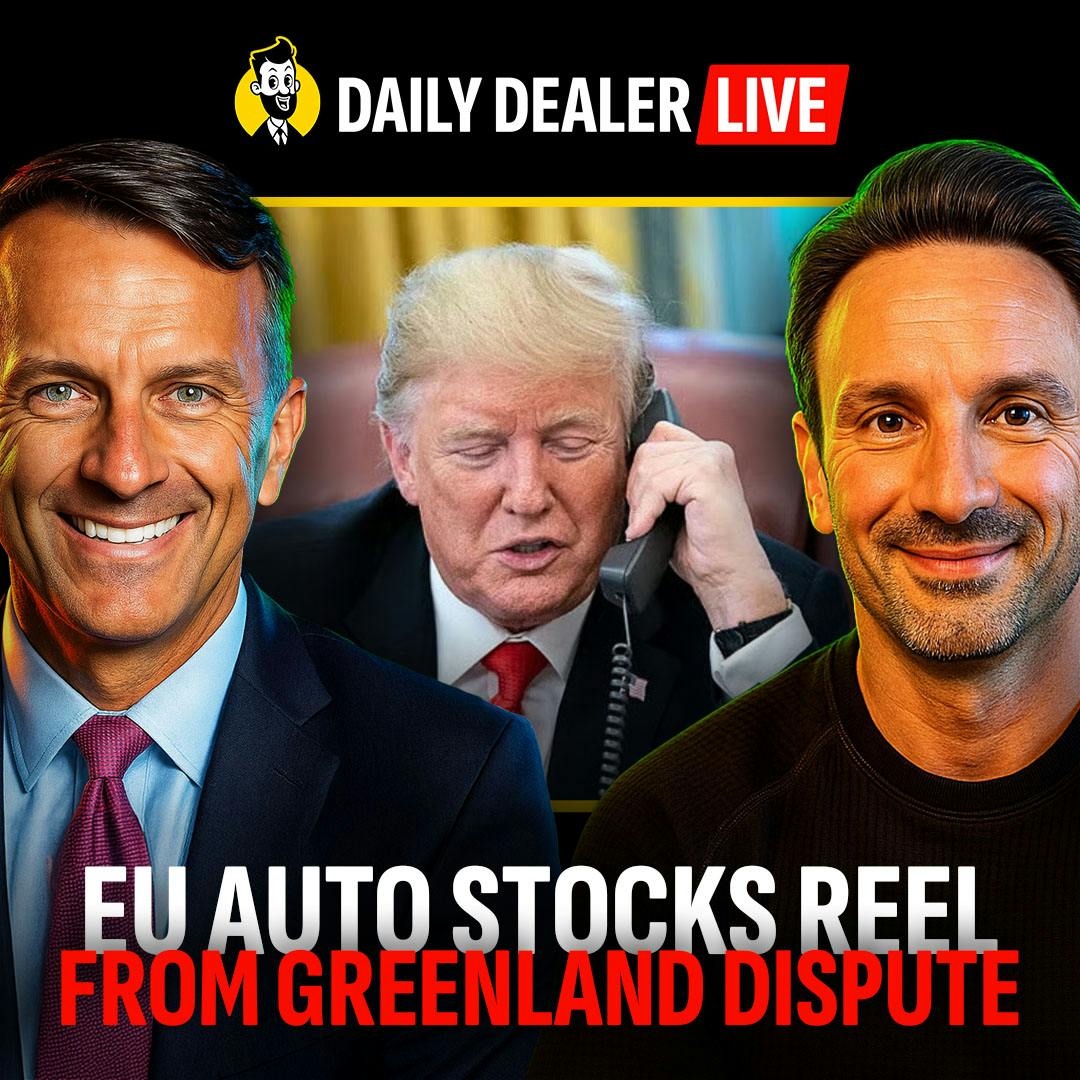
Next up today, let's turn to President Trump who has escalated his Greenland push
by threatening new tariffs on key European allies, tying trade penalties directly to whether
they interfere with US efforts to bring Greenland under American control.
The proposal would slap an additional 10% tariff on countries including Germany, France, Sweden,
Denmark and the Netherlands by February 1st, rising to 25% by June if no deal is reached by then,
and that's on top of tariffs already in place. Markets reacted quickly after the announcement
yesterday, shares of Volkswagen, BMW, Mercedes-Benz and Stellanus all slid, showing how exposed European
automakers remain to US trade policy shifts. But President Trump, well, he's not backing down.
Speaking today at the World Economic Forum in Davos, Switzerland, he said he would not use
military force to persuade and pursue Greenland, but made no such retreat on tariffs, reinforcing
that trade pressure remains his primary level. Lever, lever, lever, lever. Last up today,
used vehicle sales surprised in December, climbing 1.34 million units. That's up 3%
year-over-year and 2% from November, during a month typically known for slowing down according
to Cox Automotive. That late year strength capped off a better than expected 2025 for used cars,
helped by loosening auto loan access and the growing affordability gap between new and used
vehicles. Used inventory levels are higher but still controlled. Dealers started January with
about 2.2 million used vehicles on lots, 5% more than a year ago, while days supply sat at 49,
essentially flat year-over-year and tight by historical standards. Looking ahead,
economic pressure and constrained supply are expected to weigh on used sales as 2026 progresses.
That said, there's a near-term bright spot. Cox expects Q1 to benefit from larger than
expected tax refunds this year. Much of automotive is waiting for tax refund season and the sales
that come from that. And with that, that's a wrap on today's industry headlines.
Yuli, welcome back. We got an action-packed show. All right. Monday, I came to you from the whole
of a boat thanks to Starlink. Today, I've got a little bit of a different background. On Friday,
I'll be back to the normal. But it's proof that no matter where we are, the news doesn't stop. The
conversations in automotive, Yuli, do not stop. And today, we've got one of the coolest conversations,
I think, in all of automotive as we talk about the PART Act, which we're going to learn a little bit
about what that is, what the cost is, ultimately to dealers, to consumers, to everybody else.
What did you think of the ChatGPT Convo there? Like, as soon as you hit the nail on the head,
this is going to be that cool inflection point, right? Like, get in there. This could be super,
super interesting. I've always thought about how does a dealer get in there organically to get
served up? So now, if ChatGPT or OpenAI is able to monetize that, it's going to be very interesting.
Every room I've been in, whether with our leadership group, whether with our GMs,
with other dealers, everybody's like, okay, Google, that's interesting. We've all kind of figured
out how to show up in Google search and how to get digital leads that way. What makes less sense is
OpenAI and people value OpenAI search more than Google search. I would say more than most searches
because it pairs back your own personality to the information you're requesting. And this
ads thing just adds a whole different layer. So maybe we can ask some of our guests about it
today a little bit. But let's start up with the PART Act. So Charlie, Senior Manager,
Legislative Affairs at NADA and Greg York, President, CEO of Van York Auto Group. Welcome to the show.
Thanks for having me. Charlie, I gave it my best shot. Is it Jack?
Jack? You're pretty close. It's Diane Jack. It's a tough one. I know.
All right. And Greg, I got you, man. Greg York. Welcome. Welcome to you both.
So all right. First off, Charlie, would you tell us a little bit about what is the PART Act
and why should dealers, why do we care about catalytic converter theft? What is the PART Act,
Charlie? Yeah. So the PART Act addresses catalytic converter theft at the federal level. So right
now, there's a couple of state laws on the books because, I mean, theft skyrocketed during the
pandemic and has continued since. We believe that there's a need for a federal framework,
because a lot of these thefts, these guys are transporting them across state lines, right?
There was a giant ring in Northern Jersey that was getting shipments from Oklahoma, California,
so not even neighboring states, right? So we need a federal framework to sort of blanket the nation
and protect consumers and protect our guys, too, right? And you said the bill is currently
being considered both at the House and at the Senate. And what does the timeline look like
for passing it before we talk about the specific components of that? Actually, you know what?
Before we go there, though, Greg, what is the cost of catalytic converter theft? Like in our
auto group is the price of vehicles have gone sky high. We're seeing more catalytic converter
theft. We've actually had employees' vehicles have the catalytic converters cut out of it while
they're sitting in an open parking lot, Greg. It's crazy. Yeah. First of all, thanks for having
this on. Thanks for NADA for taking this on. I mean, it's not the sexiest issue, but it's
an important issue. And it's an expensive issue, not just for dealers, but for the consumer. I mean,
it depends on how good the thief is. Are they good? Can they just cut off the catalytic converter
and cost $2,500 or up to $4,000? Or do they completely destroy the exhaust system and get
the manifold and get to that? And then you're up to $5,000. So it is very expensive. I think
any dealer will say they've had in the past year probably had had catalytic converter stolen.
We've had it. We've had it. But here's the people that don't understand. We'll have an instant.
We'll have a group come in and steal eight catalytic converters, four will be from your inventory,
but the other four are customers' cars for service or employees. And those are the toughest ones.
That's when it starts costing the consumer money. That's when insurance starts going up.
It's just a cascade of problems involved in it. Why are thieves targeting catalytic converters?
I've never understood. What is it about a catalytic converter that makes it so appealing
for somebody to sit under a car, cut it out and run off with it? Well, it's easy to get. And then
the minerals and the core value and the resource in there are very, they can turn them into cash.
I think Charlie can tell you talked about that closer from a national standpoint. That's the
easy thing. Easy access and they can turn into cash without any kind of being tracked. Charlie,
is the market more liquid? And is that part of the problem with the current state of legal catalytic
converter theft? Yeah. So scrap facilities right now, record keeping is done on a state by state
basis. So some states have got great laws in the books. Others not so much. So it's easier to sell
these things. And it's the precious metals that are included in catalytic converters that are really
skyrocketing the price of these things. So platinum, palladium, rhodium. At one point,
rhodium was touching $30,000 an ounce. So you're telling me 90 seconds of work. I can get about
$200, $300 worth of precious metals under my arms. Sounds like a pretty great deal.
So those are two main components. And then the third one I'd say is a lack of traceability.
Right. So these local law enforcement guys are pulling these these these over with, you know,
ten of these things and better their truck. They can't prove that one of these converters
came from an affected vehicle down the street. So they don't have a case. So they have to let
them go. So that's a big component to that just makes a step a little bit easier for the guys on
the streets. This is part of the reason we want Greenland, by the way. So rare earth minerals.
Is this one of those rare earth minerals? Or does this have nothing to do with Trump wanting
Greenland? I don't know if Greenland has anything to do with catalytic converter.
So so give us the in plain English, if the part act passed tomorrow, what would change first,
who would feel it most immediately? Because as I understand it, you want a VIN, you want to make
these catalytic converters traceable. So as soon as that employee's catalytic converter is stolen
off a vehicle, the police could immediately identify that it should have been on vehicle A
because of basically a VIN, right? Yeah. And so not necessarily a full VIN, right? So when the
sponsors drafted this bill, they wanted to make it as easy for OEMs to comply with as possible,
right? So a lot of OEMs out there right now, they have unique serial numbers on a catalytic converter.
So as long as they can tie that unique ID back to a VIN, that's as good as the VIN, right? It's
still a tribe that establishes that chain of custody, and they can trace that pretty easily.
So that's the first part of the bill is putting some sort of unique identifier on catalytic
converters of new vehicles. The second part is a grant program. Dealers are specifically listed
as entities that can receive funding to market vehicles that are currently on the road.
That way these these markings start to permeate into the fleet a little bit. That way it's not
just newer vehicles that have these markings. These are smart. We'll hear about that. They'll
just move to start hitting older vehicles, right? So you want to permeate that into the fleet a bit.
Third, it increases scrapkeeping requirements at a federal level. Like I said before, it's done
at the state level, but this would just be a floor of what is necessary across the country.
And then lastly, it increases federal penalties associated with that. So you'd get up to five
years for the trafficking of converters. Again, that's just a deterrent factor. Hopefully you guys
hear that and say, you know what, Feds are getting involved. I'm staying out of this.
Yeah. It's interesting because as you described this, it is additional record keeping. It's
additional oversight. Greg, I don't know if you've had this experience, but in some of the states
we do business in, we have a hard time getting the cops to go after the stolen cars, let alone
parts of the cars. Like giving federal oversight into the catalytic converter theft, how who's
going to enforce this? And what's what are the expectations from a police standpoint of actually
being, you know, recovers? Well, I think right. Like in our state, I'm in North Carolina and they
have had, we have passed state legislature legislation, which was not allow people to
possess catalytic converters unless they're in the auto industry. So that is, but, but still,
they still are concerned because there's no way to trace it back to, to prove that what car that
came off of. So I think that, I think this is more, as Charlie pointed out here, this is more
an attorney. If the Feds are involved and they know that the catalytic converters are getting
marked and there is a way to trace it, I think it'll be deterrent for people taking them off cars.
That's our hope. So Greg, for you, where has this catalytic converter theft hit you the hardest?
Is it, you mentioned customer cars, service owners, inventory. What kind of disruption
to dealer operations does that look like day to day for you? You know, I think we look back this
year, we've had 30, we've had 30 catalytic converters stolen. That's a light year for us this year.
And so I mean, half that's customers, half that's inventory. And I think the, you know, our inventory
or our, our own cars, that's, that's an easy, that's an easy situation. It's when you have a
customer's car who gets, who gets the catalytic converter stolen off that car's down. We're
trying to track down parts. We're trying to make sure we get it repaired. So it complicates a lot
of things. And it complicates our relationship with that customer.
Yeah. So Charlie, NADA has pointed out these thefts can turn violent quickly and pull law
enforcement away from other priorities. I mentioned sometimes it's tough for us to get vehicles
back, let alone the catalytic converters. How does, how does this law specifically help with
let's get these parts back, let's prevent the theft, but, but also keeping law enforcement
focused on the things they need to. Well, it makes prosecuting these cases a lot easier for
the world. Yeah, yeah. It's a federal offense. Just giving them that traceable element. I mean,
this could turn a case that usually would take them, you know, a couple of days into maybe just a
couple hours, right? Because now all they have to do is punch in this serial number into whatever
database they have for this, find out exactly where the car came from. And there you go. Now
they have the case. So this frees them up to address other local issues. And hopefully get
some of these guys that are, you know, turn in violent as well, like you mentioned off the
street, these bad actors, right? Yeah, you're getting a lot of comments online. Igor Kay online
says three big things that are being stolen right now. Catalytic converters headlights,
especially from Porsches. And I'm also seeing thieves steal tow hooks if it's left on the car.
So I mean, anything I think the common element here in a lot of these thefts is anything that
can easily be converted into cash quickly, thieves are willing to take a risk on and
catalytic converters because these minerals in there are easier to turn into cash. And you're
just trying to prevent you're trying to put up some blocks and obstacles that make it less easy,
right? Exactly. You know, it's been around for millennia, right? We're not going to put an end
to theft as a whole. We're just hoping to stomp down a bit on catalytic converter theft because
that's especially prevalent over these past few years. So it's interesting to our daily
deal live audience, dealers, GMs, other people within auto dealers. Have you seen a catalytic
converter theft? Love to see it in the comments. I think most probably have. For those dealers,
Charlie, that want to support the effort, want to get involved, want to help make sure that this
goes from bill to law. What can we what can we do today, January 2026 to help help you in your
efforts? Yeah, so I mean, it's as simple as contacting your members of Congress, right?
So you're your member of the house and then your two senators. And you know, NAD is always happy
to make those connections. If you reach out to us, we're happy to put you in touch with those folks.
But at the end of the day, they want to hear from you guys. I can talk to their offices to
blue in the face. But once they hear from guys like Greg, who are on the ground, who have seen
it firsthand, they actually listen. So we're always happy to put you guys in touch with those folks.
It's gained some good traction on the hill. We had a hearing last week in which three different
members touched on the bill, all supportive Democrats and Republican. So it's got momentum
behind it. And we're hoping to get across the finish line this year. By the way, until today's
political environment, how unusual is it to get bipartisan support for anything? Like,
that's actually pretty cool. How did you achieve that? Were you able to bring both sides of the
aisle together in support and concept of a bill like this, preventing catalytic converter theft?
You know, it's one of those things that it almost sells itself. You walk into the office and you
say, Hey, are you against catalytic converter theft? And 10 times out of 10, they're going to
say yes. So it's an easy sell. And there's a lot of bipartisan bills out there. They just don't
get as much limelight as they should. So Greg, you've spent a lot of time dealing with this type
of theft at all levels, employee, customer, and your own inventory. For those dealers watching
today, even before this bill passes, we obviously want it to pass props to NADA for your efforts to
make this happen and turn this into law. Is there two or three steps you could recommend to help
protect your inventory, your customer vehicle, and your employee's vehicle against catalytic
theft today, January 2026, Greg? Well, you know, right now we have a big fleet order sitting here.
We had to hire someone to watch that fleet order because, you know, big trucks, fleet
or trucks that it's so easy to get the catalytic converters out. So, you know, one of the things
we had to do in one of our stores, because we had it got hit twice was start pulling customer cars
inside. There's not a whole lot you can do to prevent this. You know, cameras are always a
great idea, except many times you just end up getting a video of somebody stealing a catalytic
converter and watching through it. You don't really, I don't think there's a lot of, right now
there's not a lot of teeth and bills to try to, to try to legislate or try to arrest people and get
them and get them prosecuted. So there's not a lot you can do except maybe the cameras. And if
you have to, if it gets severe enough, you have to start pulling things inside for your customer's
cars. Yeah. Yeah. Well, we appreciate the tips, the suggestion for our audience.
Hey, Charlie and Greg, as promised as we wrap up today, one question. So we had the ATAE of
Virginia Auto Dealers Association on, we teased it in the intro. Another big legislative topic
today in automotive, in franchise circles, particularly is Volkswagen's in road into scout.
They got approval in the state of Colorado to sell direct to consumer. And is that a big deal?
No deal. What's your take on it? What should dealers be doing when they think about scout today?
You know, this is one of those things that all the, all my co-workers out in Tysons are working on.
I know we got, I mean, some fantastic folks out there on the IR team and our fearless leader,
Mike Stanton. And I'm sure they'd be happy to apply on this a little more than I would.
You're, you're passing. Greg, any, any thoughts on it?
Yeah. The best, the best, the best system for consumer and for factories and for deeders is the
deeders, is the, is the dealer model. It works the best. It's working for you. It's worked for
decades. It's the best consumers. You know, it's just the best way to market and sell vehicles.
I am a major support of the franchise system. So I will leave you with that.
All right. Very good. Dealers should be involved in that. I'm going to give you both.
Charlie, I know there's a different department that's handling that right now, but
we had Don Hall on. Nobody's more passionate than him about this one topic. And he actually
said on the show, he said, some dealers think that they may not be impacted because they're not a
Volkswagen dealer. What starts in one state eventually spreads in another. And that's why
the legislative efforts of bodies like NADA and others are so important because you're
representing the entire deal abroading nationwide. And you're able to go after this and have
conversations that need to be had. I do believe this franchise auto system that we have in the
US is unique in all the world. And it provides the consumer a competitive advantage unlike
anywhere else. So and we'll leave right to repair to our third guest unless Charlie,
you got anything you want to add on that? You know, it's another one of those issues we're
working on constantly in this office. And I'm excited to hear Josh talk about a little bit
further too. Charlie, what's one thing most people don't know about being involved in legislative
affairs in Washington DC at NADA? I think you got the coolest job. Greg, you and I are in very,
you know, we both work in the car business. Charlie, you're there on Capitol Hill. What a
cool gig you got, right? What's something that would surprise most of our audience about what
you do every day? You know what? I always say it's not too different from what our members are doing
really. It's all it's a people business. And instead of selling cars, we're just selling
our members ideas and making sure everything's going all right with them, right? Which I mean,
with a membership like ours, it's pretty easy to do. So it's not too different from what a lot of
your members or listeners are actually doing on the day to day, just different venue. That's all.
Well, senior manager legislative affairs at NADA, Charlie, Jack, we appreciate you being on.
And Greg York, president, CEO of Van York Auto Group, North Carolina base. Thanks for
joining the show today, sharing your perspectives and creating awareness around this topic. Thank you
both. Thanks. Thank you. Yuli, I don't want my catalytic converter stolen and it's happening. It's
a big deal and we see it all across automotive right now. I love that there are dealers and
that there are associations like NADA that are combining forces to help dealers win in this.
Yeah, my two cents also on that would be don't park your vehicles near any tree lines. That's
something that's huge. Why a tree line? Because I've had in my experience vehicles that have had
their cats stolen and they've been customer cars, they've been inventory, but anything near the tree
line if a bad actor, we'll call them, can walk through the woods and seek out and crawl underneath
and cut out. It doesn't matter what camera system you have. When you go and start up that car the
next day, all of a sudden your Honda Odyssey sounds like a race car and you're like, uh-oh.
Yeah. Yeah. All right. Well, let's talk in Pell for a moment today's episode is brought to you by
Impel. Impel Sales AI is the perfect tag team for your sales staff handling lead qualification
responses and employment scheduling around the clock. So your reps step in only when it's time
to close. We appreciate Impel sponsoring today's comments, supporting today's content, including
this cool conversation on the PART Act. If you want to learn more, you can scan the QR code there
in the Zyglauda group. We actually have several stores that use Impel through CDKs, CRM,
ELEADS, and it's been a very cool and efficient effective tool. So props to Impel for supporting
today's content and for sponsoring the show. So thank you Impel. All right. Next up today,
let's go from part theft. Let's talk data. You know, it's fascinating. We talked with our next
guest in the green room and you know, when you sit and you think about a car, how much data gets
collected in the car. We all know that NPI non-public information data is a burden. It's huge
advantage if you can collect it, you can aggregate it and you can use it effectively. But to anyone
that collects it knowingly or not, it also creates some liability. And our next guest up
is here to talk about that. Cheryl Nins, SVP head of US dealer sales at Privacy for Cars. Cheryl,
welcome to the show. Thank you for having me. I'm excited to be here. Cheryl, welcome. We're
going to start with our signature question, how's biz and privacy for cars? But as you're letting
us know how things are going, tell us a little bit about yourself and what your company is doing
for the automotive industry. Yeah. Well, thank you. Really, I got started in automotive at a
very young age. I think from the garage, my 13th year birthday party, I got a oil wrench from
my dad and had my own creeper since I was seven. Somehow that translated into a career as
on a high school, he had a couple of guys that he knew and I went to work at Jiffy Loop and became
service manager there all through college. And then I had a professor that encouraged me to
interview with Ford Motor Company. And so I spent most of my career there calling on dealers all
over the West Coast. And then I launched two vehicles. My husband likes to call me the small
car killer. The Ford Fiesta and the Ford EcoSport. But I don't think that was just me.
And from there, I joined Comply Auto the last four years where I really became interested in
consumer privacy and then how dealers comply with that. I think dealers have, you know, so much
that they have to worry about, including catalytic converters. But what does it do with consumer
privacy? And I think an area where it's really often overlooked is on your car lot. Dealers are
doing a great job about knowing that they have to do cybersecurity or their phishing tests or,
you know, protecting customer information inside the dealership. But what about consumer information
that's right there and their dealer lots? And is there even an opportunity for revenue to help
protect that information? So that's what privacy for cars is, is really helping dealers streamline
in a very accountable way to delete customer data.
Cheryl, I have a question. When you rent a car at an airport, do you connect to the Bluetooth in
that rental car and connect your phone and do all the contacts and all that stuff based on what you
know in the world? Yeah, I do. I know privacy, but I also had a sister that worked for the
federal government. So I also know, I don't know if there is privacy. But that is something that
you have to think about. We heard a story recently about a woman who went to a rental car and she
did connect her car and didn't delete it. And I know I'm very good about deleting it, but I know
there's also times that I'm late to my flight and I haven't done it. And there was a bad actor
that was able to get in, see her call log, use all those phone numbers to be like a scammer and call
scam, call her parents and contacts and say that she needed money. And fortunately, they figured
out what it was and where it came from. But I mean, it's got easy.
I want to paint a different picture because I have personal experience with your company and
my organizations, but we talk often about protecting consumer privacy laws in the showroom,
like you just said. Paperwork, things like that, nothing can be out. We have triple security checks
on our computers. Everybody has feathers now, right? Exactly. But why is no one thinking about the fact
that someone can buy a pre-owned vehicle, get into it, click home on the nav,
drive to someone else's home and use the garage door opener to get into someone's house? This is a
pretty big deal. So I guess if you could bring the light, how does your company solve for that?
How does that help dealers like us? Yeah, I mean, you make a great point. Like,
think of all that information out there and hopefully we don't all have stories. I'd like
to see what your listeners, if they tune in and mention stories. I had my own friend from
high school when I posted that I came to work for Privacy for Cars. He mentioned that they bought
an EV, a recent EV, and it was a pre-owned and that had the customer's information in there.
So not even from super scary privacy or even security aspect, but what about the consumer
experience that you get into a new pre-owned car? We all want it to feel as new as possible.
And you have other people's data on it. I mean, it's kind of like moving into a new house and
have someone else's trash there. And so that's what Privacy for Cars does is it really helps dealers
by every event. I mean, there's no master control or delete on cars. I mean, do you know how to
clear every car everywhere and do it right every single time? And I think it really starts in the
reconditioning department, but I think there's other opportunities for everyone to get involved.
And is there a little revenue? Like in New Jersey, they have the new state vehicle data clearing law
and you can charge for a little revenue for that. But further than that, I think it's just
look back at electronics and consumer products that we use. I mean, I have an Apple 15 right now.
I need to go in and get the 17, but when I trade this in, I would never expect them not to show me
how to clear data. And so I think that's where the perception is to the consumer and other retailers
are doing a very nice job of that with like reconditioned products. And that's where we have
to get to in the car dealers. So I think consumers are really expecting us to do it. And that builds
that consumer trust for your dealership. For sure. And walk us through from the dealer level,
where does your technology fit in? You know, for someone that doesn't know about Privacy
for Cars, where does your technology fit into the deal flow? You know, taking, selling the car,
starting out trading the car, reconditioning the car, putting enough for sale and then
ultimately selling it to its new owner. Yeah. Well, consumer trust should live in all departments,
but it's very easy. It's just an app. So we can start with at the trade in process. This is
something your sales team can do. It's an app. Everyone can do it with their own phone. And
while the customer is, you know, talking with F and I, hey, I went out and cleared your data and
then I have a certificate to prove it. So then it can live in the deal jacket. So it's traceable,
attractable. But then, you know, reconditioning and prep, you know, this is going to be like a
checklist in your reconditioning department. And now you're not having your team members try to
figure out how to do this. You know, you may know like the manufacturer you have in the most recent,
but, you know, all of them, I mean, there's thousands of events and really differentiates
between then number with the trend type of what infotainment system they have in there.
So in less than a minute, your team can figure out how to go in and do that and clear that car
and then prove that it was done and it's trackable. So it mitigates risk. It, you know,
really helps with consumer trust improves the CSI. And then if there's even a revenue piece for it,
but then don't forget your service and fixed ops for your loaners. Like we mentioned,
if you have your own rental cars. So if a dealer is asking, where's my real risk here,
you know, where does that risk show up first, you know, legal exposure, customer trust,
brand reputation? Yeah, I mean, I don't want to be the big scary, like a lawyer is going to
knock on you. I think everything starts with consumer trust. Most consumers are expecting
this and yet four out of five cars still have customer data on this. And I don't think like
consumers know how to articulate that. So it starts with the consumer and you're doing what's
right for them. So it's really improving consumer trust, your brand reputation. Can you imagine
if something happened? We had a story where a dealer, you know, took in a trade and they didn't
get the title or the spare key. They only got one key. And the customer that bought the new
pre-owned car, they just got frustrated and they went in the navigation went to that customer's
previous owner's home, knocked on the door and asked for the title with me. So just one incident,
you know, can snowball and really, you know, that's a detriment to your brand reputation.
And then it's even to be a differentiator for your trade acquisitions. Come to me, I take care
of your data the right way. So Cheryl, a question online, DNC says, wonder if the dealer has any
liability, financial or otherwise, like are there cases where dealers have been held responsible
in court for not clearing the data, not having it taken care of. So he says, wonder if the dealer
has any liability if they don't clear out the data and a consumer experiences a fraud. What does
that look like in your experience, Cheryl? Yeah, so that's an area that's definitely like growing
and we're trying to see what the precedence is. But under the FTC safeguards rule, there is a lot
about, you know, NPI, non-public information. Now it's specific originally to financial
information. So I would argue, depending on some of these, you know, EVs that you have to connect
your credit card to charge, that has an aspect. But then the FTC has come back in a lot of cases
and said like geolocation data is protected or can count as like part of a data breach.
And I know about you about geolocation, like where have you been? It shows where your kids are,
your doctors, you know, what church you go to. So that's a lot of confidential information in your
vehicle. New Jersey's taken this pretty seriously. I'm not up to snuff with the rest of the states
on how they're doing it. But I know in New Jersey, we're required to have a document and have the
customer sign off on the fact that, you know, either they have to opt out and take it on themselves
or they give the permission to the dealership to wipe that information for them. And we are
able to charge them, you know, a very small nominal but steady consistent fee to do so.
Yes. And, you know, what is a nominal fee? I'm not going to say what it is that, you know, that,
you know, 20 bucks, 50 bucks, 100 bucks for, you know, one minute of work, but then think of
like what it also does for that trust building and like having that customer come back. And other
states are looking at it, but then not to forget about the states, 19 states have consumer privacy
rights. And so a lot of that data could fall under that. I mean, two, three years ago, we had two
states that had data privacy rights laws. So this is really where I think it's a growing aspect and,
you know, consumers are going to be concerned about and come to dealers asking for it.
No, I don't want to reveal here because I know the answer, but this is obviously a very important
thing for the consumer. Does your company do something different to, you know, let the public
know that, hey, I'm treating your cars better than anyone else. Your trade-ins are safe with me.
Your private data is safe with me. Yeah, we do. We have an entire consumer site. And so we let
anyone, even dealers, anyone can have a free vehicle data privacy report. So you plug in your
van and it shows what kinds of information your car is collecting. So first of all, you're knowing
what is being done. And then second, any consumer can go on and we show them how to do it.
Hopefully, you know, a lot of them still, they have the tools in their hand and they don't do it.
Like, I bet I can figure out how to clear my Apple, but it's easier to do it at the store.
And that's what customers are going to do. But yes, we have a lot of consumer tools.
We're also big advocates. You know, I think this is an area where, you know, there's real
repercussions like domestic violence. We've heard like some women have tried to get away and then
their husband was able to track them afterwards. So there's a huge safety aspect to this. And we
help support consumers in that way for free as well. So for dealers that are trying to modernize
their operations, you know, how does treating data deletion as a formal process change the
conversations with the customers? Yeah, I think, you know, just making it part of your process.
I actually challenge you both because Sam, I know you have a few stores like, hey, go out first and
audit, like go grab cars, pre-owned and see if you can find customer data left out there.
And then that's really revealing. And then like, okay, let's start documenting the process and like
putting it into like our reconditioning step. But then going further, how do we document that?
How do we make it really objective where we can, we know every then and then it's done properly
and then prove that to our customer? Why aren't, for franchise dealers, why aren't the OEMs just
doing this? Why isn't there like some sort of a reset process as part of the CPO or
are OEMs engaged in this? Are they thinking about it or is it the franchise dealer that
needs to be forward on this effort? Well, it's the same thing like when we have a data breach and
it's like some other customer or third party, who is your customer? Like who is collecting that
information? And so really, when it leaves the OEM lot and becomes on yours, it's really the dealer's
responsibility. You know, it's interesting, every time I get in a rental car, I have that thought
every time because it'll offer to connect you up on Bluetooth and you can see the option to
download your contacts and you see like eight people on every rental car. I feel like I'm helping
doing my parts. No, I think, yeah, and I think you're right. Like this is an area where people
just aren't quite thinking about it. You know, their comply auto kind of came into its own. I
want to make the argument on the heels of the CDK outage, right? Because everybody and maybe
win casinos and maybe some of the other outages that happened, people really were like, oh,
you know, we need to really tighten up our processes as it relates to data control on that
outage. It was kind of the canary in the coal mine for everybody else. What do you think will
happen in this privacy space with customer vehicles that'll kind of be that same event for
clearing data and used vehicles? Because to your point, there's not a lot of focus on it right now.
Logically, you think about it and you're like, you know what, we probably should think about it,
but getting money spent on the problem won't happen until probably a bigger event or
liability is super clear cut. What do you think is, what do you foresee happening that kind of
shakes the industry up and says, you know, rental cars need to clear data, dealers need to clear
data, people need to be responsible for this data that gets collected, Cheryl? Yeah, and I think that
is going to be through legislation or like a big incident like that. But I really encourage you,
though, because whether it's a big incident or a little incident at your store, we had an episode of,
you know, a dealer told us about a loner that they had. The porter thought, hey, this girl's kind
of cute, went in and found her address knocked on the door. Hey, you want to go out? So the dealer
got a call from an angry dad and a lawyer and like, do you really want that to be the thing or
legislation? So I just really encourage dealers like, hey, reactive can be very troublesome,
headaches and expensive. Proactive can be quiet, maybe generate you revenue. We have a lot of
dealers doing it or even helping with your trade acquisitions. We have Premier Auto Group uses us
and it's right on their homepage to show as a differentiator, hey, come to us, we care about
you and we want you to trust us and this is what we do. So last couple of questions we go here.
What type of revenue and so I do see a huge benefit in being an industry leader in this space to
cleanse a consumer's vehicle, give them that peace of mind, you have your own peace of mind,
not having to worry about one of those scenarios you just talked about happening.
From a revenue standpoint, you have dollars per unit that can be generated on average at some of
these other groups that are doing this that are engaged in it or making it part of their value
proposition to their customer. Yeah, we have a few dealers that do it and they charge reasonable
fee, it's all different. Some dealers don't, they use it more as the trade acquisition,
but let's say it's $100 on trade ends. So we have a small fee where five, six hundred bucks a month
and then so to break even, you only have to sell five or six used cars to clear it. So if I charge
$100 a month or $100 a vehicle, excuse me, and then maybe you spend a service loaner,
hey, when you return the car, one of our fees is $15 to clear the data. And then in reconditioning,
you have like reconditioning prep fees, this can be another fee that's on top of that. And so
that's where the revenue is. And so it's, no, 4500, 5000 bucks if you sell 100 cars.
So does the certificate of cleansing, does it create, does it have some sort of an insurance
product that backs it up? Or it's a certificate based on the process that you put in place,
I would assume, right? Sure. Yes, it is. And it can also be like a car fax report. So on your vehicle
display page, you can use our badge and then it's clickable where the consumer can see that that
has already been done and cleared and see that certificate. So and you, you know, it can live
in your GIL jackets as well. So it's trackable as well. Cheryl Nintz, SVP, head of US dealer sales
at Privacy for Cars. Thanks for joining the show to share really this topic that I think a lot of
dealers aren't thinking about. It's a great opportunity to be a difference maker in the
industry by protecting consumer data. By the way, if you want to see Cheryl NADA, Privacy for Cars
will be at NADA booth 6528N. So you can learn more, you can extend the conversation. I'm sure
you'll get a lot of our audience just curious about more of this. And listen, I will always,
when I see a rental car, I'll never sync it for that exact reason. So maybe if rental cars started
using you and your thought process, maybe it would give everyone a little bit of peace of mind
to go ahead and sync up to it because right now I just don't trust it, right? So thanks for being
on the show. I have an app that can start my car. And when we turned in a new car recently,
I forgot my sunglasses. I had the app. I went in and locked the door. I got my sunglasses. I could
have started the car. So there's a lot of liability there. Cheryl, thanks for being on the show.
Thank you. Come on in. See you soon. Bye-bye. Julie, it's an interesting comment. Eager says,
once you connect your Bluetooth to the car, even when you clear it, it's still there on the hard
drive and can still be recovered if someone really wants to do it. Good food for thought. So if I
accidentally connect to a rental car, I'll never upload my contacts for that reason, right? Like,
there are contacts in my phone that I don't want sitting in a rental car and then other people
to have access to it. This issue of data privacy is fascinating. Eager says data never disappears
completely. The hard drive never forgets about it. That's like an Ocean's 11 type scenario, right?
Like, if we know that you have $30 billion worth of jewels at your house, then we're going to
sit there and hack your hard drive and see what Bluetooth connections you have. But for the average
consumer, I think this is low hanging fruit. If you have some bad actor that gets into a car,
they're going to do path of lease resistance. All right. Last up today, Josh Johnson, CEO of,
by the way, the coolest auto group name in the world, Don Johnson Auto Group, props to Miami Vice.
But you're not in Miami. You're in Wisconsin, Josh. Welcome.
No, the weather's much different here. Welcome, Josh. Thank you.
So I just learned, I think it's cool as heck, 100 plus year old auto group up there in Wisconsin.
You're just north of us, the Ziggler Auto Group in the Chicagoland and Michigan. So
100 plus years, that's quite an accomplishment. What brands do you have, Josh?
We represent GM Ford and Stellantis. Okay.
From five locations in Northwest Wisconsin.
Yeah. Yeah. All right. So we'll ask the traditional question. I don't want to get
into a couple of industry topics before we talk EOS. So how's business this January, 2026, Josh?
You know, business has been great. Mother Nature's gotten in the way a little,
it's 20 degrees below zero. So that keeps the service department stopping, keeps vehicles
breaking and consumers are consistently upgrading because of that. But very optimistic. I think
it's going to be a great 26. So if the three OEMs that you have, we'll put you on the spot and say,
who's winning this January of 2026? Who are you most bullish with?
Well, I think GM's got a great go to market strategy right now. Incredible product.
We're really excited about the new team at Stellantis, the reintroduction of the Cherokee
going forward. I think that's going to be a game changer form and Ford is just a steady
moving ahead. So I think it's going to be a positive year with a solid SARS for all three.
Yeah. So in your marketplace, I would imagine mobile repair is a big deal. Ford put a ton of
money in it. And with their recalls this past year, a lot of groups have capitalized on that. Do
you do mobile repair at your Don Johnson Auto Group? We have been doing mobile repair when it
comes to recalls for Ford. It gets a little bit challenging at 20 degrees below zero. We're not
doing a lot in driveways this time of year, but come the summer months or being able to service
commercial facilities, we've been able to take full advantage of that. It's a great resource.
So you and your group have engaged in the EOS process. We definitely want to talk about that.
But you also heard us speak with NADA about a couple of topics that are big in automotive today.
So Scout just got approval in the state of Colorado to sell direct to consumer. It concerns a
lot of Volkswagen dealers. Big deal, not a big deal. What's your take? It's a huge deal. Absolutely
inexplicable why Colorado would approve this. Yeah, I think we can go back to 2024 Oliver
Wyman study that to look at, take a look at every distribution model, manufacturer direct agency
model franchise and hands down the franchise model provides the most value for the consumer.
It allows us to provide bespoke services that best match consumers needs with what manufacturers
produce on a consistent basis. And we can help balance supply and demand that no other model
does. So why a manufacturer would want to pursue it in the first place just doesn't make sense to me.
And the fact that Colorado has allowed this to go forward is just inexcusable. Thankfully NAD is
on top of it. They're participating in legislation and litigation both in California
and Florida and we're very confident we're going to get this one shut down. Yeah, what to other
dealers listening that maybe are just starting to understand and realize this topic. What advice
would you give to another dealer ahead of another auto group to you know, should we engage in this?
Should we fight it? Should we work with NADA? Should we write a letter? What do you do? Absolutely,
there are two things I think one we need to be in constant communication with our legislators.
That's just step number one. But step number two and I think this is an important one.
If you are a franchise automobile dealer and you're not actively involved in the NADA pack,
it's time to do a self-assessment because either we're going to have a seat at the table or we're
going to be on the menu. NADA pack is what makes sure that we get into the room. We get to have
those conversations to make sure situations like this don't occur. Yeah, yeah. Well, we appreciate
your thoughts on that and with the NADA conference coming up in Vegas, will you be there by the way?
Absolutely, I'll be there an entire week. Good. Well, it'll be fun to potentially meet up with
you and say hi face to face. So let's go into EOS. So you've had an increase in sales this past
month. You guys are winning. I would imagine part of this is the EOS process that you've
engaged in. For our listening audience that's unfamiliar with it, explain what EOS is and
what made you decide to engage with EOS? So EOS stands for the entrepreneurial operating system.
If you look across a dealership or any business, we've got operating systems for literally everything
we do, whether it's managing our inventory, managing repair orders, doing the accounting,
but what most businesses lack is a people operating system. And at the end of the day,
we sell commodity products and services. So what differentiates us, what allows us to provide
those bespoke services, is the strength of our people. And EOS gives us a system for communication
and meetings to make sure that we're clearly identified and aligned in our goals and objectives
and we're giving every member of our team a seat at the table so we can proactively identify
issues, opportunities, barriers, anything that's standing in between where we are today
and where we're going to go together. And because of that, we're always moving forward.
You know, I think what a cool time, you know, there's ebb and flows in our business. COVID was
an odd time. What a great time to commit to a people process, kind of coming out and engaging
into kind of this new norm, whatever you want to call it. How long have you been engaged with EOS and
what did the first 90 days look like for dealers looking outward in trying to implement this
people operating system? So we're about four years into our EOS evolution. The first 90 days
is really education, trust building and cultural and values alignment, making sure that we're
able to articulate across all 165 team members who we are and what we stand for, what's acceptable
and what doesn't work in our organization. Because when that becomes the foundation
that we can all align on and agree to, we can stand shoulder to shoulder and work through
anything together. So what was the trigger for you four years ago that said, so in our auto group
Ziggler, we have a Ziggler Academy, we've committed to doing a lot of internal education through
LMS, we've got different leadership classes courses, we've really leaned into people and we
get some dealer groups outside that are like, look, that doesn't, you're not selling cars when
you're engaged in that, like you can't directly tie the expense of that education back to a car
sold. What was the trigger for you four years ago to engage in this people development process
without a direct tie to a car sold? Yeah, really our journey started far before that as a fifth
generation family business. I finally became a father and I had children and as I looked around
me, I said, I need to make sure that we're creating an organization and a culture that will surround
my children if they choose and have the, earn the opportunity to become part of this family business,
that will make them better versions of themselves. And so for years and a decade, we looked at all
of the different ways that we could help define our culture, enhance our people and grow together.
And then several years ago, we came across the entrepreneurial operating system and it was like
a light bulb went off, we said, that's the way we can systematize and be intentional about who we
want to be and what we see more. That is so, so, so you have kids eventually, it will be gen six.
Gen six, like I said, if they choose to be and if they earn it. What are the, what are the odds of
that in automotive? I know gen one, they build it. Gen two and gen three oftentimes are challenged,
but gen six, what, for those dealers looking at what you've continued into the sixth generation
over a hundred years in business, what advice would you give to dealers looking that we talked
succession planning last episode, it was fascinating, but you've got a great seat over a hundred years.
We've been so fortunate. It really comes down to people and anything you do and staying close to
that values alignment. It's so easy to become short-term focused, particularly when reporting
to manufacturers who talk to the public markets on a monthly basis, but to make sure that we're
always balancing those short-term objectives with our long-term goals and our patients and we just
can't ever step away or sacrifice our values or our integrity in anything that we do.
Both yoga cars online says gen six never heard of it in automotive. Like you've got to be one of
the longest running. I can't, I can't, I can't quickly think of too many gen sixes. So EOS is
big on issues. What are the most common issues as you engaged in the process and you've gone
through it that keep resurfacing in dealerships and then how do you prevent, you know, a game of
whack-a-mole to deal with those issues, but make it part of your culture that it's, it's overcome
before it comes up. That's right whack-a-mole is a great analogy for, you know, really everything
comes back to communication. 90% of issues they have are either internal communication, communication
with our vendor partners or communication with our guests. So that's exactly what EOS helps to
proactively address because we've got a system in place for holding meetings, giving our team venues
to proactively put out, reach out and identify those issues, those opportunities, those barriers
and put them in front of everybody in the department, everybody in a store, everybody in
the organization, then we can work on them together to stay ahead of them. So as you made this
investment four years ago and you continue it today, are you able to somehow, like do you have
some sort of, you know, a quantification metric? Are you able to say, hey CSI is higher, our net
sales, our retention maybe is higher? What, what are the key levers that have gotten better as a
result of this process? Since we've implemented this, our employee turnover, our team member
turnover is a fraction of what the industry stands for. Every single year since we've done this,
we've been a member of Automotive News top 100 best dealerships to work for and this past year
we had four of five locations that, that fell into that, that bucket. Our net promoter scores
have never been higher and I think really what speaks to it is that when our guests visit any
Don Johnson Motors facility, they say that they can feel a difference and that's a hard one to
quantify but when you hear that consistently, you know that there's magic that's happening.
Yeah. So Josh, you're in the North territory to your point, negative 20 degrees below zero,
much of the U.S. this week is going to be hit by colder, chillier temperatures, certainly.
In fact, I think I even heard like it, there's parts Tennessee and others that are about to get
hit by two feet of snow. How do you and your team continue to sell cars and service cars and
deliver your best to your customer every day, every day, regardless of weather and regardless of
temperatures? What's your strategy there? We do whatever we can inside number one but
it's a team effort. It is really what it comes down to. The weather conditions that we experience
in Northwest Wisconsin are atypical. Some of the biggest extremes you'll find anywhere in the U.S.
So vehicles break. They have to be proactively maintained and it's more important than ever
that we collectively do a wonderful job interacting with our guests to understand what
their specific needs are, what their travel patterns are so that we can put them in a vehicle
that's going to be able to handle that variety and travel the best distances that we do. But
it's all for one and one for all. Yeah. Yeah. Very cool. I can't tell you how much respect that
many generations. In fact, we're getting a ton of comments in the comments here. Paul
Salisman says, Don Johnson Motors is proof that franchise dealers have the long expertise
to sell and service cars better than direct sales. An important understanding,
I predict a scout will learn the hard way. We talked about that actually several episodes ago.
There was an experiment way back in the 90s with Ford where they actually tried to go direct with
a bunch of stores in the West. And it just, you know, there's some advantages, I suppose,
in the direct model. And, you know, one of the interesting parts, I think, when you look at
some of the direct to consumer Tesla and others, you know, they don't spend the amount of money that
some of the OEMs require of bigger facilities, right? So they're more modest facilities. And I
wonder if that, you know, scout may learn a thing or two, and that might end up being one of them.
Maybe they'll transition across to Volkswagen. And our own CDG's Hannah Farmer says,
Blizzard's are coming to Nashville. So, Josh, you've given us advice on that, you know,
how to do that. You know, use car acquisition is a huge topic is actually, you know what,
the producers are telling me we're actually right here at time. So they're going to kill me if I,
if I go any, with this EOS process, just the last question, how do you define the right seat
for a general manager? We've been talking a lot on the show lately. Toughest job to hire for an
automotive used to be technicians. Many dealers now are saying sales managers and GMs are the
toughest jobs. How do you find that right person? And how do you determine the right traits? Final
question for today. When we're looking at our team, we really ask three questions. We call it
GWC. Do they get it? Do they want it? Do they have the capacity to do it? Does the individual
understand what's required to be successful in that role and what success looks like and the
scorecard they will be held accountable to? Do they want it? Is it a role that lights a fire in
their belly that water can't quench? So that Monday morning is the best part of your week versus
that alarm going off and you're counting down the minutes or hours until Friday at five or six.
And then do they have the capacity to do it? We all have different strengths.
Are they aligned with what makes them successful or what they do better than anyone else or any
of their peers aligned with the roles that are needed for that specific job? And when we bring
three of those together, it's an equation that can't be beaten. I love that point, Josh, because
there are people that you would say and look at, oh, they would be a great leader. They'd be a great
GM. They don't even see it themselves. But they may simply not want it. Like, it's a complicated,
complex job. And if you don't have that fire to do it, you're probably not going to be great.
It's not something you can go in lukewarm, Josh, right? So. Not at all.
Josh Johnson, CEO of Don Johnson Auto Group, 100 year plus organization. Thanks for being on the
show and sharing your perspectives on all things EOS, organization, people development. And then
a little chat on the side about direct to consumer. Appreciate you being on the show. And we'll see
you at NADA. Thanks for having me. Look forward to seeing you. Thanks, Josh. Thanks. Yeah, you know,
do you want it? Like, not everybody wants it, Julie. So true. Learn that the hard way. Yeah,
yeah. Hannah Farmer, our own says, Blizzard's coming to Nashville. Grocery stores are already
sold out. So if you're in the Nashville area, you're about to be hit by a couple feet of snow.
I mean, you know what? By the way, the great thing about automotive is we're going to find a way to
win in any environment. And a little bit of weather creates some fun. It creates some excitement.
And it creates a shifting environment where there's need. So going back to one of our best
of episodes from last year, Grant Cardone, you can do you can do that. Igor K says,
don't hire GM who sells well, but hire GM's who are great problem solvers. Igor, I agree with
that. And thanks for being a longtime listener, longtime poster in the show. We got a bunch of you
today. Lauren Klein, Dan C, Igor K, yoga cars, the entire daily dealer live listening audience,
plus all of you watching for all of you watching. Thanks for watching daily dealer live today,
where we break down the biggest moves in the car business as they happen. Don't forget,
we are here every Monday, Wednesday, Friday, one PM Eastern. We'll be back this Friday,
one PM Eastern. So if this is your world, hit like, hit subscribe, turn on those notifications
so you never ever miss a beat. And we'll see you next episode, everybody. Thanks for being here.
Thanks, guys.
About this episode
Catalytic converter theft is a growing concern in the automotive industry, prompting discussions around the PART Act, which aims to establish federal regulations to combat this issue. Guests Charlie Jack from NADA and Greg York from Van York Auto Group share insights on the financial impact of these thefts and the importance of traceability. The episode also touches on AI's role in automotive advertising, the cooling auto insurance rates, and the implications of direct-to-consumer sales models, particularly with Volkswagen's Scout Motors. Additionally, Cheryl Nins discusses consumer privacy in vehicles and the need for dealers to protect customer data.
Today's show features:
- Charlie Dyjak, Senior Manager, Legislative Affairs at NADA
- Greg York, President/CEO of Vann York Auto Group
- Sherryl Nens, SVP Head of US Dealer Sales at Privacy4cars
- Josh Johnson, CEO of Don Johnson Auto Group
This episode is brought to you by:
Impel – Your sales team should be selling—not answering the same questions after hours or chasing low-intent leads. Impel Sales AI works the inbox 24/7, qualifying every lead, responding with intent-aware, personalized answers, and booking showroom appointments automatically. With Agentic Response, Impel interprets context in real time and hands off only ready-to-buy customers—complete with full conversation history and smart summaries—so your reps can step in at exactly the right moment. See how we turn your BDC into a powerhouse at NADA 2026, Booth #4331W and at https://impel.ai/sales-ai
The Rawls Group – For over 50 years Rawls Succession Planners have advised high-net-worth dealer groups on leadership, alignment, and growth strategy - long before succession becomes urgent. Our work helps owners build organizations that perform today, develop future leaders, and stay strong whether they're expanding, transitioning leadership, or planning what's next. Visit our website at seekingsucccession.com. To receive a complimentary signed copy of “Help! I’ve Got Family in the Business,” email Hugh Roberts at [email protected]
Check out Car Dealership Guy’s stuff:
CDG Circles ➤ https://cdgcircles.com/
CDG News ➤ https://news.dealershipguy.com/
CDG Jobs ➤ https://jobs.dealershipguy.com/
CDG Recruiting ➤ https://www.cdgrecruiting.com/
My Socials:
X ➤ https://www.twitter.com/GuyDealership
Instagram ➤ https://www.instagram.com/cardealershipguy/
TikTok ➤ https://www.tiktok.com/@guydealership
LinkedIn ➤ https://www.linkedin.com/company/cardealershipguy/
Threads ➤ https://www.threads.net/@cardealershipguy
Facebook ➤ https://www.facebook.com/profile.php?id=100077402857683