An investment is when you buy something hoping it will be worth more later. In cars, some people buy special cars thinking they can sell them for more money in the future, but it's not always a sure thing.
A collector car is a special type of vehicle that people buy because they love it and think it might be worth more in the future. However, the value can change a lot, so it's not always a safe investment.
Car
Mazda Protegé
The Mazda Protegé is a small car that Mazda made for several years. It's known for being a good option for people looking for an affordable and reliable vehicle.
Ritchie Bros. is a company that sells things like cars and equipment through auctions. They let people bid on items, and the highest bidder wins, with no minimum price.
Auction consulting is when experts help people figure out how to buy or sell things at auctions. They give advice on how to get the best prices and make the process easier.
The Volkswagen Beetle is a famous small car with a unique round shape. It was first made in the 1930s and is known for being very popular and recognizable.
Car
H1 Humvee
The H1 Humvee is a tough vehicle that was first made for the military. It's built to handle rough terrains and is also available for regular people to drive.
The hammer price is the price at which an item is sold at auction, marked by the auctioneer's gavel coming down. It doesn't include extra fees that the seller or buyer has to pay.
The Batmobile is Batman's car, which has been shown in many movies and shows. It's known for its unique design and special features that help Batman fight crime.
DC Comics is a company that makes comic books and stories about superheroes, including Batman. They created the Batmobile as part of Batman's adventures.
LIVE
If you don't surround yourself with the right people, you're just doomed and you can't be
alone.
You can't do it alone.
I don't care what you say, you cannot do it alone.
You're listening to Femmecanic Grouch, the podcast that features women in the automotive
and motor sports industries, a community that elevates, empowers, and evolves by smashing
stereotypes and breaking down barriers for women.
I'm your host, Jamie Blossmann.
Buckle up for the ride, Femmecanics.
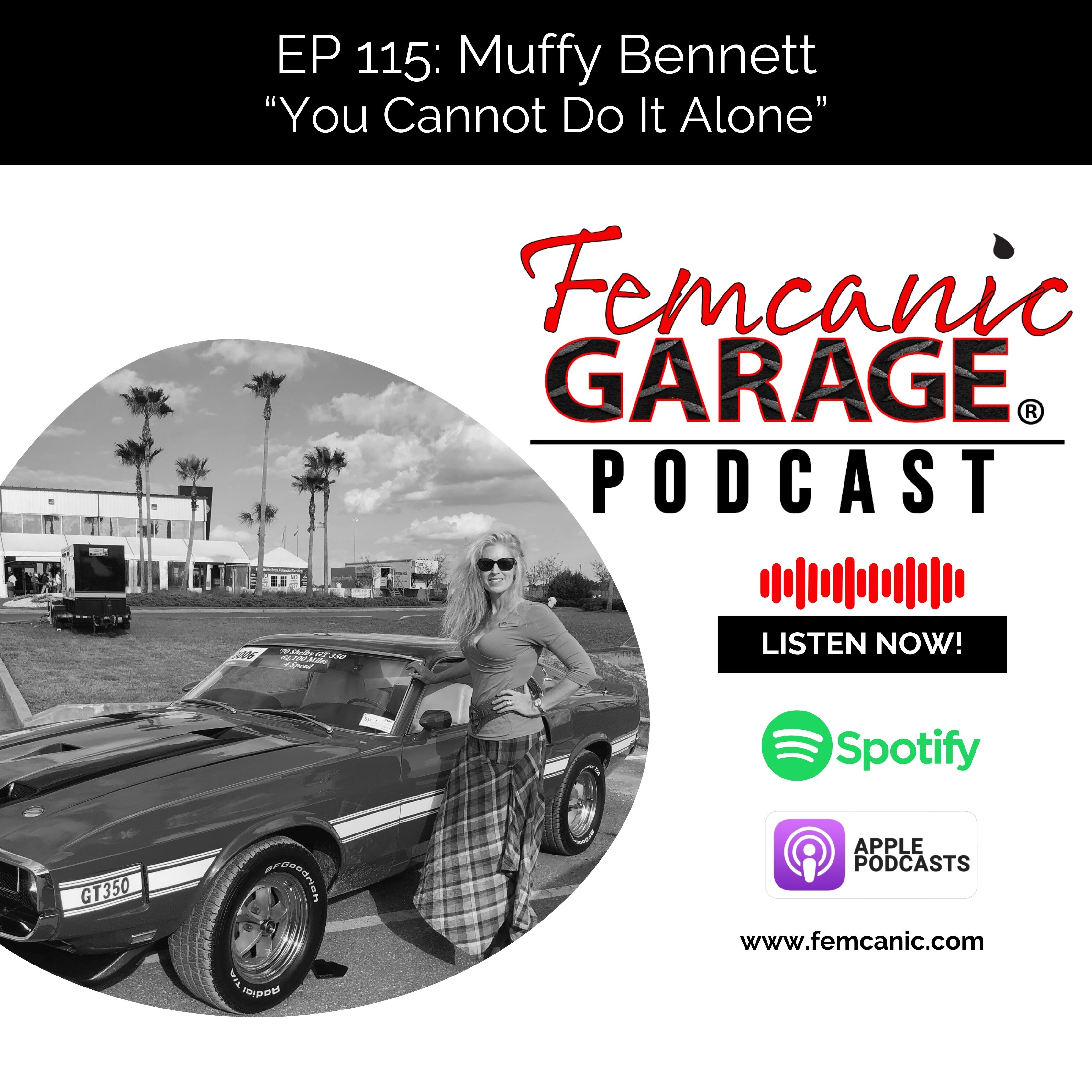
Muffy Bennett is in the driver's seat today.
Muffy is the first lady of collector cars in the CEO of Bennett Automotive Specialist.
After a fulfilling 17-year career as a paralegal, Muffy took the wheel in the world of cars and
auctions.
She became the operations director at ASAA Auction Company, and in 2013, Muffy was called
upon to open a retail facility for Barrett Jackson collector car auctions.
Then in 2017, she led the charge at Richie Bros. Auctioneers, the world's largest auction
company, launching them into the collector car auction niche.
Now, let's sit back and enjoy the ride.
Hello, Femmecanics.
This is Jamie B. coming to you, and I have Muffy Bennett in the hot seat today.
Muffy, I am so glad that we were able to connect.
I know we had some family challenges come up, but thanks for making it a priority to get
this interview recorded so that we can capture your story the Femmecanic way.
So I appreciate you and your time.
It is all my pleasure, Jamie.
Thank you very much for having me on the show here to learn more about me and chat with your
audience.
Truly, the honor is mine.
I don't do social media stocking, but I do enough research to figure out if a woman is the right
fit for the Femmecanic Garage podcast, and you obviously fit the bill.
But in that research, there are some things that surfaced that just intrigued me greatly.
You have an interesting story, and it stands all the way back to your 20s.
I mean, I want to let you get into it, but you always had a passion for cars, trucks, motorcycles.
I did.
But anything with wheels, you've always had a passion.
So I'm making an assumption here.
Did you always know you would end up in the automotive industry in some way?
No, I did not.
I had hoped that I'd be in the industry, but it wasn't something that I really explored because
I unfortunately didn't have a whole lot of support from, say, my parents because I didn't
understand that passion.
Not their fault, it just is what it is.
But I actually started out on a restaurant world as my first jobs, and then I migrated over to
the legal world, graduated to a paralegal, and then used that as a segue into the collective
car auction world.
And it's been a hell of a ride.
It really is.
Why paralegal?
Just out of curiosity, what drew you to that?
I was going to school, and I had two jobs at a couple local restaurants at the time,
and I needed to consolidate those jobs or I was going to burn out and not succeed.
So I walked into a law firm, and they were looking for a receptionist, two-man law firm,
and they grilled me, and grilled me, and grilled me.
Now I had the basic skillsets.
I could type, I could answer the phones, you know, I'm not stupid.
I walked in the door after they were grilling me, and I said, you know,
you're talking to me like I'm an attorney here, and this is just an entry-level role.
I'll tell you what, I'll work for you for two weeks for free, like nothing.
And if you don't like me, you can kick me to the curb.
No harm, no foul.
They gave me a shot, and within five years I was managing the firm.
I was drafting almost all of their legal documents.
I had this drive with them, because I didn't want to be an entry-level individual.
I wanted to be something more, but I really didn't know what the heck that was at that point.
But it was a really good way to start off, and I have built upon that ever since,
which is, it's really benefited me, especially the business law and the contract law.
I have to pause for a moment, and I have these insight moments or aha moments.
When I listen to women, when I interview them, there's these little nuggets that each woman
shares, and sometimes they don't even know that it's like golden nugget knowledge.
And what you just said that I found very interesting, and what seems to be a very
common theme with some of the most successful women I have ever had the opportunity to
pick their brains and ask questions. You are not the first woman that I have heard at some point
in their career when they were trying to get their foot in the door, so to speak, somewhere.
And maybe they're doing a career change later in life. Maybe it's their first job.
But this theme is that they offer to work for free or practically nothing to prove themselves.
Now, not an infinite amount of time, right? But a finite amount of time that's defined,
I just find that fascinating. What made you think to do that?
It wasn't fascination in the grand scheme, it was desperation. And sometimes I...
Even though desperate, working for free, right?
Yeah, and it's sad because we have to do it in the industry generally speaking,
and I do it to this very day. I have to prove myself. And it's okay, you know,
but that was one way to get their attention. One way for them to understand that I'm their
world deal and that I'm not just some 19-year-old kid who has a mediocre work ethic. I wanted to
prove to them that I'm something different and that I do have the ability to excel and figure
things out and I didn't need constant supervision. But you're absolutely correct. I mean, I'm not
surprised to hear that. We do sacrifice some of ourselves to get ahead and sometimes it's necessary,
it's disappointing, but it's necessary in order to get to the next level, if you will, to excel,
to reach that next rung in your ladder, whether it be career or your personal life. And it can be
a real challenge and it can be devastating in your self-esteem, but at the same time,
if you don't take any risks, you don't get anywhere, you know?
Yeah, not to kind of go too far down the rabbit hole here, but what's interesting about it to me
is that you are betting on yourself. And there's something to be said for that. I would love to
see more women do that. Like, take a risk and make an offer like that, an offer that they can't
refuse. I mean, any business owner that is being offered basically free labor, it'd be kind of
silly for them to turn down, honestly. Well, yeah, it's not exactly legal. Like, I want to see more
women get in the proximity of the next level mentor or person. And one of the fast track ways of
doing that is sometimes offering your time and service for free in order to get in that proximity.
I think it's brilliant. And for you to do that at 19, I mean, if that wasn't an obvious
sign that you were going to be legendary, I don't know why I said you had that figured out at 19.
Well, I was just being proactive, really. And to your point, you're right. Sometimes we do have to
have some guts and take the first stand and do what we got to do. I've always said that that
ship's not going to come in to get you, so you better get ready to swim out to it. And that's
pretty much the way that I've always been. And it's also interesting, a lot of employees, when
they depart a company, the company, they won't necessarily celebrate that person leaving. It'll
be like a quiet, maybe, maybe there's a cake. Well, you know what, if I have an employee or a
co-worker or a team member, whatever that was leaving, I'd like to celebrate that because
it means you're going on to the next chapter. And it's okay that this was just a partial stepping
stone to where their goal is. It's important to me to see others grow. Mentorship is paramount in
my world. I spent a lot of time talking to men and women about the industry that I'm in, the
collector car auction world, and the collector cars gym, and giving them guidance, because
there's a lot of people out there that make a lot of mistakes. I mean, simply because they don't
know. I spoke to an attorney this past weekend, and he was asking for guidance in regards to
the car. He was concerned and was paramount that it not lose money. And I said to him, you know,
if you're buying a car as an investment, I said, please don't do it. This is not a game
you want to play. Now, there are some cars that will go up, but the whole industry generally
speaking is very fickle. If you're going to buy a collector car, buy it because you love it.
Buy it because you're passionate about it. Buy it as if it's the last one you're ever going to own.
And if you lose money when you sell it, that's just the cost for the memories and the fun that
you had. I'm telling this to probably, I don't know, 55-year-old attorney who's been doing this
a long time and just doesn't really understand because there's some parts of the industry,
and I understand why they do it, that tout these as investments. I mean, let's face it,
you got no ender on stock, but you do have a car in the garage. So talking to people and going out
of your way to help them is paramount in my world. And I wish there was more of that, especially in
this particular sector. Women's racing and in the motorsports generally speaking, irrespective of
their role. It doesn't matter what their role is. I mean, it could be down at the track doing
something relatively mundane, their job is still important, it's a stepping stone, and you just kind
of give them some guidance and sometimes a shove. I mean, let's face it, you don't go anywhere if
you're just sitting in your same old spot doing the same thing day after day. You've really got to
get outside that comfort zone. You've got to get uncomfortable. I'm kind of curious and I'm kind of
let the cat out of the bag, which is good, like where you are now in this journey. So you start
with this 19 year old, it's like, hey, I work for you for free. And you start in my spot, you become
paralegal. What was next? Like you hit that point where it's like, okay, my time here is done.
Well, it's really interesting that you go down this avenue because I'm the girl that once lived
in her car. And now I went from homeless into evaluating some of the greatest car collections
and greatest cars in the world for say liquidation or auction or whatever the case may be. Our
services vary. So now you said kind of fast. And I think the average person when they listen to this
might miss it. Just to be clear, there was a point in time in your life that you lived in your car.
Yeah, really briefly. But I did live in my car. I was married to an individual who wasn't
particularly nice. And I was young. And I was very meek. And I was very mild. And I had a tendency
gravitate towards men who were more controlling. And after a while, this man took away my identity.
And I love him. It starts out slow in the beginning. And this happens to men or women. So just keep
that in mind. I married him, moved to England, moved back. The first time he laid a hand on me,
I told him, you touch me again, and I will leave. The second time I let him go to bed, I took $247
or so give or take my dog a handful of clothes. And I jumped in my Mazda protege and I left.
And I didn't go back. And I left him everything in the divorce. And I was so embarrassed and so
mortified at this particular chapter, because everybody saw about me, and nobody had the
guts to say something or pull me aside and say, Hey, you know, we're kind of concerned about you.
And I think a lot of people are scared to say something. But I am now of the opinion,
if you see something that isn't right, make an inquiry, you know, be careful with the way you
phrase it, but make an inquiry. So I was I think that is because I saw the post that you did on
LinkedIn and is this domestic violence awareness month? That was actually I wrote that back in
November of last year. That was domestic violence awareness month. Okay. But with that being said,
why do you think that is? I mean, there's shame around it. I think that's why I mean, I know this
shame with breeds more shame is silence. Yeah. And soon you find yourself all wrapped up in this,
I don't know, this altered reality, and you're just terrified to ask for help. And I didn't
want to ask for help. And only until my coworkers figured out I was living in my car in the parking
garage with a dog that they all get together and they put a deposit down on a small apartment that
took animals. So me and my dog had somewhere to live. One gave me some dishes. One gave me a small
love seat. I about lost my mind when I got my first bed because I was sleeping on the floor.
But I got out of my car as a result of the people that I worked with. And I didn't,
I didn't have the guts to ask him. And I don't like to talk about this particular chapter of my
life. It's not that it's embarrassing. It's now what's important when you go through something
like this is you learn and you grow and you push yourself even farther into your future.
Because we're the sum total of our experiences. And I wouldn't change it for the world. It has
made me more humble. It has made me more self aware. It has made me more strategic in my thinking,
generally speaking. And it's it really did take me to the next level. Now I'm not saying that's
the only experience that's done this. I mean, but I am forever working to improve myself.
Because I believe that if you just stay still, you die. You always got to push forward. And it's
important too that you what would you tell other women that may be in that current situation,
like knowing what you know now. Women and men are in the situation. But women most notably,
don't be afraid to ask for help. And you got a plan. And if you're not happy, find that next
chapter. You know, it's terrifying. Don't get me wrong. I was absolutely, I mean, I stayed with
them for way too long. You know, I should have left after the first time. But I didn't have
anywhere to go. I didn't have anyone to rely upon at that point in my life. Now I do. But back then,
I was, you know, pretty much flying solo. It's important that you you just push yourself, you
know, and remember, it's scary, but it's not the end of the world. You know, and I am forever
grateful for doing that. It really did show me the importance of friendships and camaraderie among
the women that I work with, because they saw me drop down to 99 pounds. And they saw me
waking up and going to bed. Sorry. Okay. Anyway, it's important that you rip out the weeds in your
life and cultivate the lows and surround yourself with great people. That may help you rip the weeds
out with you. Exactly. Yeah. That's that sisterhood in community. It is. It is. When I listen and I've
heard some pretty difficult stories. I've done over 100 interviews. I've heard stories where the
first time that they shared their story was on the Femcanae Garage podcast. I didn't know it at the
time. And the way that their parents found out about it was by listening to my podcast. Oh,
my, I offered to take it down. They didn't want to because they felt and there was more than one
that the story needs to be told and people need to hear it. And it goes back to bringing me,
Muffy, it's like, there's this notion that women are caddy. Women always compete against each other.
They're always at each other. And I'm not saying that doesn't exist. It does, right? But it exists
for men too. It just may look a little differently, right? But it exists. It's not just women. But when
I hear stories like this, Muffy, we need to get out of our own way and focus on the community
and lifting each other up and being there for each other and focus on the ways in which we are
more alike than different. Then we all get further ahead faster. Yeah, I'd have to agree with you.
One of the challenges that most of us face are gender generals speaking is our logic and our
emotions are all kind of involved into one. And we have a tough time separating them at the risk of
being right over the coals. I liken our brains to that of like spaghetti, you know, logic,
emotion all involved together. And then men's brains tend to be more like a waffle. So you can
pour the syrup and control where it goes and every single little square there. And that's the way
that they think. I'm kind of wired somewhere in the middle. I'm able to extract the emotion on of
it for the most part. And we don't not always have that gift. So if you stop and you take a step back
and you look at the situation that you're involved in, sometimes you're able to compartmentalize a
little better, which I found has been really helpful. But if you don't do that, don't rely upon
other good people to give you the guidance that you need, that you're never going to get to the
next chapter in your life successfully, whatever that is. At least this is just my, my importance
about the subject. And if you're right, we don't ask for help, we're just stuck. And I wouldn't be
who I am today if I didn't have friends. We need to get out of our own way and be open to asking
for help. Like I'm not saying it's easy. Like I'm not misindependent to the, or ever since I was a
little girl. So asking for help, it was more about, no, I'm going to prove that I can do it. And the
older I get, Muffy, the more I realize that the highest form of self love is one, setting boundaries,
healthy boundaries. And two, asking for help, because when you're good people, you're just a
good person, whether you know it or not, you're influencing and helping people. You may never
know it, they may never say it, maybe they do, maybe they don't. But you're actually robbing
the people around you by not giving them the opportunity to help when maybe you legitimately
need some help. Because that, for some people, the act and art of giving is some of the most
fulfilling things to people. And by us not opening ourselves up to ask for help or get help,
we're basically shutting off that line of connection.
You know what I mean? One thing that I've noticed people don't do enough of is recognizing your
friends while they're still with you. I have a creed that was found amongst my grandfather's
items when he passed away. And it talks about the importance of sending flowers to those that you
care about while they're still alive. Because the flowers mean absolutely nothing but to console
your regret after they've passed. And it's important that you let people know that we're
here for them and lift them up. I mean, it takes no time whatsoever. It's easy as can be. I mean,
it's my favorite thing. Especially now in today's day and age, text, email. I mean, there are so
many ways for you to drop a two to three sentence line that says, hey, that thing you did, I really
appreciate it. And I appreciate you. You know, it doesn't take a lot. And when you're dealing in a
career like I've been in, I have had so many hurdles. I swear to God, if I don't have haters,
I know I'm not doing it right. That's a great measuring. So just to kind of push forward,
you get out of that. Is that when you started getting into the car world? I actually got into
the car world when I met my husband, Gary. I had gone out one night for a motorcycle ride. And I was
angry because the individual I was dating whom I had just introduced to half my family left me
for a married woman. So I'm sitting at this biker bar with my Diet Coke and I've got my nachos.
And all these motorcycles are parked in front of us. They're backed in and mine is over on the
other side because I don't normally back in. And this guy comes out of the bar and it's got a V8
car engine in it. This bike is just huge. It's not like a Boss Haas bike. It's obviously a custom
that someone has built love and care and attention to detail. The guy comes out and gets on the thing,
fires it up and blows racing fuel and dirt all over me and my nachos and my Diet Coke.
I am just at wit's end at this point. I look at the security guy at the end and I'm like,
what a jerk. And he's like, yeah, well, I don't think you saw you were there. And I went, that's
fine. All good. So the guy leaves and he comes back 15 minutes later. Same dude. And he comes down
and apologizes for screwing up the dinner. And I found out that he worked at a really large
collective car auction company. He was a general manager at the time. They had 12 employees. It
was Baron Jackson. And we got to talking and I told him that I absolutely love cars, but none of my
girlfriends ever really want to go to any of these car shows with me. I was at car shows every
weekend. I mean, I was so entrenched in the culture. I just loved it. Then he said, well, you know,
we'll have an auction into time. Got one coming up in California. Maybe you'd like to join us
and join. Yeah, you got any openings? So I ended up clerking at the auction block and we've been
together ever since. We're like bookends, peas in the pod. I mean, he became one of the vice
presidents of Baron Jackson Auction Company. I used to oversee their dealership division. But
before that, I used to buy cars and do light restorations and then turn them, resell them.
And I needed a dealers license. So I started up a company in 2006 called Bennett Automones
Specialists. I started to sell cars under that name, usually privately, not in the auction
world. I graduated to that. After a while, I got myself a dealers license and I got entrenched
in the collective car. What was that license you just said? A dealers license, a used motor vehicle
dealers license. And we've had a couple of hiccups. COVID happened. We had both left Baron Jackson
and we were asked by Richie Brothers to come out and start up a collective car sector for them.
And we had, I think it was seven core employees and had an $18 million sale before COVID shut us
all down. So since then, I have rebuilt Bennett Automones Specialists back up again. We catered
to high net worth celebrity individuals. We also do auction consulting. We help folks liquidate
cars. Gary finished a seizure not long ago. We sent $12 million worth of vehicles that a guy
had pledged for a loan and defaulted on that loan. So we sent him all the auction and that's how I
got into it. I mean, it was kind of by accident. I was so desperate to get out of the legal world.
I just, oh, there's nothing more boring in my world than driving a desk all day. And I like
it to having a Ferrari type brain with stock Chevy brakes. I got to keep going. Yeah. I have
something to do and I have to be perpetually challenged or I'll just, I'll go nuts. Yep.
In the paralegal world, while it's a great world, it paid the bills, paid the mortgage,
enjoyed it. That's some amazing people. It just was not really for me. And so I launched off into
the collective car world and it's been nonstop ever since. There's so much to do in this industry.
And that's how I got here. There's a couple avenues that you described that is very unique.
Like being a female dealership owner is one thing. That's unicorn in itself. But you are in a very,
very specific niche. And as a female in that very specific niche, I can only imagine
some of the stories you have. And would you be willing to share any of them? Because it helps
put things in perspective because some people, they know about motor sports and the challenges
women have. They know about skilled trades and the challenges that women have. But what you do
is so specific that there's not a ton of people doing it in general, not alone females doing it.
Yeah, you're right. I think I might be one of two perhaps, maybe three that I'm aware of.
I love what you call yourself on your Instagram profile. Go ahead, share it with the audience.
The First Lady of Collective Cars. One of my girlfriends gave me that nickname,
The First Lady of Collective Cars. I love it. I saw it and I'm like, that is badass.
Oh my gosh, thank you. I thought it was cute. So I just thought I'd use it.
As far as the challenges and some of the things that I faced in this industry. Oh,
it has been so funny. I mean, I almost revel in snarping back to these folks. So I once had a guy
who had a Volkswagen Beetle. Now here's your background information. I at one point held a
racing license. I ride a motorcycle. I drive an H1 Humvee. At the time, I had a Corvette.
I don't remember what else I was driving. I think I might have had my first line for eating that too.
And this guy told me he wouldn't sell me his Volkswagen Beetle because the engine was after
marketing had too much power for a woman. And you ever like take a moment and try and digest
someone's statement and wonder, how the hell do I respond to that? I remember looking at him and
I called him the F-bomb. And I said, I don't think you understand who you're dealing with.
I suggest you sell that car to another male chauvinist, much like yourself. And that's nothing.
I mean, I used to approach people with a gender-neutral email account. And sometimes I still do.
So you don't know that it's a minute at gmail.com. You don't know if it's a male or a female. So you
reach out and you're looking to buy a car and you use this gender-neutral account. And I remember
showing up at someone's house. And this is when I used to deal with cash. I don't anymore. But
I would show up in my H1 and I'd have cash on me to purchase a vehicle. And at the time,
it was, I want to say it was a 57 Chevy or 56 Chevy, something like that. And that guy looked
at me and said, oh, where's Mr. Bennett? And I said, Mr. Bennett's at home. I said,
I'm Mrs. Bennett and I'm here to look at and potentially purchase your car. And he said,
I'm not selling my car to a woman. Flipped in the bird, walked away. That's fine. That's okay.
You can just f off and die. People believe that that doesn't exist.
Well, I can give you story after story after story after story. But it does still exist.
And especially in this industry, I don't know about other industries. I can't speak to them,
but in this particular industry, my business partner and I had about 10 or so cars in an
auction. And I will get there if I'm selling part auction. I will get there and I will
represent that car and answer questions by any prospective bidders. From the time those gates
opened at that auction to the time they closed. And I remember having a guy walk past me and looked at
me and said, oh my God, those car models are getting really old and haggard.
I remember I looked at his wife and I said, I own these cars. Somebody forgot his F and filter
today, didn't he? And sure enough, his wife like ribbed him and said, oh my gosh, he owns them.
You know, and he like apologized and he wasn't going to apologize. But stuff like that,
it makes me roll my eyes thinking about some of the folks that we deal with and it is alive and
well. And honestly, it doesn't bother me anymore. It used to really upset me. There was another
gentleman that came walking around the car and I had a really exclusive vehicles in 1957,
supercharged from the factory, Ford Fairlane Skyliner. Some say they made 14, some say they
made seven. Nobody really knows. The records are destroyed. But a guy walked around the corner and
said, wow, is this yours? And I said, well, yes. And he said, well, you really screwed it up by
adding a supercharger. And I said, well, actually it came from the factory that way. No, it didn't.
Yes, it did. No, it didn't. Okay, sir, have a nice day. I'm not going to bother proving this to
you. I don't have that kind of energy to expend or waste on something like this or on someone like
this. I'm not going to argue. You can just keep on trucking. Yeah. And it happens constantly,
constantly, but you can't let it bother you. If I let it bother me, I swear to God, I'd be in the
closet, pulled up in the ball crying. You got to let it go. Otherwise you'll just go nuts.
And you said that at one point in your career that it would get to you. So for the women that are
in that space and navigating, okay, how do I not let this bother me? How do I get to the other side
so that I can get to that, you know, I'm plateaued. I know I need to get to the other side. And I
think this topic is one thing that can really get a lot of women stuck. And actually, I think
fast track a lot of women out of the industry altogether, to be honest. Yeah, it will. What
did you do? Like, was it like a defining moment? How did you get there? Was it just gradual?
It's like a bunch of defining moments. When people tell me I can't do something, I get angry,
I get ticked off. And then I use that as a motivator, that anger to push forward. It'll
cause me to be more reflective. And I think those experiences strengthen me into pushing into the
like you said, next hurdle for really speaking. There's nothing worse you can do to me than to
tell me I can't do something or that I'm not capable of something within limits, of course.
That's one way to get me to perform, if you will, through to the speaking.
I think that's sound advice. I mean, I'm very much the same way. I remember giving you a call.
Eliza actually connected us. And I wanted to talk to you about women's motor fest. And you and I
just hit it off. It's just like, I get you. There's a lot of similarities. I'm motivated the same
way. Go ahead, tell me I can't do it. Go ahead and doubt me. Go ahead and see what happens, right?
So I so connect with that. And I've also met a lot of women that maybe don't have that same
fire or maybe like the FU fuel. Like, we seem to know how to ignite the FU fuel. You know what
I mean? I'm always curious to try to figure out, okay, for the person who maybe used to be able to
ignite the FU fuel or maybe never have, how do we help those women get to that? And it's more
of a rhetorical question. But that's part of what I love trying to pull out through the stories of
women in these interviews is, is there those moments? What is their mindset? What is your
mindset? And that's what you've beautifully articulated here, where it's like, you have two
choices, curl up in a ball and cry in the closet like the analogy you gave, or you take it and say,
watch me. And do the best you can. That's all we can do, right? There's some people, and I mean this
for any gender, that will not use this as something to put power forward, use experiences, life
experience, generalize people and push themselves forward. And again, that there's some people that
just stall out their development. But that's dangerous. And it can be a real soul crusher,
because after a while, I think that depression would set in, I would imagine. And if you don't
have something to look forward to, and I don't care what it is, whether it be a next phase in your
career, or to be, you know, Friday, I'm going off, or no camping, whatever the case may be,
you got to have something to look forward to something to push towards. And I think that
by mentorship, you can help bridge some of that gap and push some of these.
And it doesn't have to be formal mentorship. Oh, exactly.
But it's something to get caught in their head, oh, I can't afford a coach, or, you know,
who would be my mentor? It doesn't have to be formal. I want to share a story with you, Muffy.
And maybe I shared it with you, but I don't think I've shared it with the listeners at all. But
in what you're talking about here in looking or having something to look forward to, it was an
eye-opening experience for me this past New Year's Eve, going into 2023. We kind of have this little
tradition that we're starting and have been doing for a little bit where we, meaning my kids and I,
we create vision boards on New Year's Eve, right? We get magazines, we get print offs of things we
want and take the time to create a vision board together. Well, my daughter had her boyfriend
over. He's a super great kid. His name's Kean. I just adore him. He's, he's just a good kid.
And he treats my daughter with respect and kindness, like all the things you would want
for your daughter, right? And he got his own board. My son and daughter were off to the races.
Half of its whole, and like, you know, my son was almost done. And I looked over and Kean's was
almost empty. And I could see him struggling a little bit. And I just paused. I walked over to him.
I'm like, I said, what's up, buddy? Is everything okay? He looked at me and he said, yeah, everything's
okay. He's like, this is the first time in my life I've really stopped and thought about what I wanted
for my future. There's very few moments in my life that I could say that I'm speechless or I am
without words. This was one of those moments where these little small acts by him sitting down and
doing a vision board and even thinking about it, even entering in that type of question into his
head, that's a form of mentorship. It doesn't have to be this big fancy thing. But now he's
thinking about that because a simple question in exercise was put in his head. It's always been
about survival, not about thriving. And that's exactly it. You know, I'm sharing this story because
it supports what you're saying and suggesting to the listeners. Always have something to look forward
to, no matter how big or little it is, but have something. Never stop dreaming. If you stop dreaming,
it's over. Every year I sit down and I think to myself, I don't necessarily write them out. Well,
sometimes I write out some goals that I want to achieve that year that are coming. Some of them
are small and some are grandiose. And I know it's probably more of a long term goal, but you got to
do it. And that's exactly the type of mentorship that people need. And I'm not going to ask for it
because they don't know because I've never had it before, just like in this situation. And when
did we stop dreaming? We need to ask ourselves, when did we stop thinking about, you know, when
you're little, you're a little girl, you want to be a ballerina, you want to be a mechanic,
you want to be an opera singer, a doctor, a lawyer. We stopped doing that. And I think it's really
important that we continue to do that because it's all we got. If you don't have something to work
towards, you know, you're just going to stay in the same place and deal with the same BS year in
year out, day in, day out. And why? I want to grow. I want to change. I want to explore. I want to
learn more about myself. You know, it's amazing how much you can change in five years. It's amazing
you think how much you change in 10 years. If you don't surround yourself with the right people,
you just doomed. And you can't be alone. You can't do it alone. I don't care what you say,
you cannot do it alone. My best friend and husband, Gary, is my greatest cheerleader.
That man has taken a beaten, battered shell of a woman and will lift her up into who she is today.
He's done it very strategically, just in the manner in which you just described too. So it's
important that you show on yourself with good people. Like I said, rip out the weeds, cultivate
the lovelies in your life, be willing to disfory pretty much anything that is an excellent
within reason. You know what I mean? To preserve yourself. And accept that there will be a grieving
process around that. I went through that the last 18 months. I've purged people's things, places,
jobs from my life that were no longer serving me. And doesn't make them bad or wrong. It just
makes it not the right fit for me and where I am and where more importantly, I want to go.
There you go. But there's grieving. It's not easy. There's a grieving process that happens around
that. Oh, yeah. Oh, yeah. I have a remarkable ability to just shut down sometimes though,
which is almost a gift in many regards. You know, it's a gift and a curse, you know.
Yeah. Yeah, it is. I mean, there's some people like, I can't listen. This has been fun. I gotta
move on. My psyche can't handle you. What are you most proud of? At the risk of sounding
self-centered. My self-sufficiency. I went from a little girl, as I indicated earlier, needed to
be controlled and needed to be told exactly what to do at every single turn to building myself into
who I am today, not compromising myself, being able to make mistakes, look in the mirror and go,
screw that up, pretty bad. All right, next. And not be so hard on myself. I think that's
what I'm most proud of. I mean, there's been career accomplishments along the way that have been
phenomenal. I came from nothing. And to see where I'm at today has been a real accomplishment.
I'm really proud of that. I mean, I drive amazing cars. I have great friends. And I remember watching
the Batmobile being sold. Oh, yeah. That's one of the cars that you were involved in consigning.
And actually, no, that was one that I sold after it went to auction. That gentleman that bought it
at auction had decided that he wanted to sell it. So I privately brokered that deal.
No kidding. I was actually on that auction block. I was in the car behind it that was being auctioned
off. And I remember the Batmobile, let me back up. So Gary comes home and he tells me where
all my cars are placed on the auction docket. And I only really care about one.
As for the listeners, this is the original Batmobile from the 1960s show, right?
Yes.
The real deal. And it was sold on Bear Jackson's auction. I remember sitting in the living room
with my brother and watching this and my judge is dropping it like sold for like $4.5 million or
something. That's not about it. I just sitting there like, I know, I know. So Gary comes home
and he's like, he tells me this is where your cars are placed on the docket. And I only cared about
one particular car. And it was that supercharged fair lane that I just told you about. Yeah.
I said, where is that one going? He said, well, I got you a number. We managed to place it on
Saturday. I said, great, awesome. What's it behind the Batmobile? Nobody wants to go behind
like a high profile car or a charity car because all the energy and excitement gets sucked out of
the room when that car sells and the Batmobile sold for over $4 million. So I looked at him and
I was like, do you want a divorce? This is a good idea. He said, what have I always said?
Yeah, yeah, yeah. If they want the car, they'll be there. Yeah, yeah, yeah. That's my car.
Anyway, the Batmobile sold. I am behind it in this fair lane and it's starting to overheat.
And so it sells for over $4 million, which was amazing. Mine sets a world record for the highest
hammer price at $330,000 or something, which was just, it blew my mind. I mean, I knew it was going
to do well. I just knew it was going to do that well. And explain what hammer price is because
here we're saying over $4 million for the Batmobile, yours is $330,000. Help the listeners understand
what you mean by that. Okay. So when the hammer's lens down at auction, that is the selling price.
And then there's an additional commission that me as a seller would have to pay in this particular
instance is 8%. And on the buyer's side, they have to pay 10%. So the auction house collects,
at least that auction house collects a significant amount of money on each transaction.
And so when mine sold, it sold for $300,000, but they registered the hammer price is $330,000
because that includes the buyer's premium. Anyway, so about six months or so later,
I get a call from the guy that owns the original Batmobile and he's like, yeah, I talked to you
a bit and I really want to know if you can help me sell this car. Well, it's kind of a really
narrow market, but I'll work on it. Long story short, he consigned it to the Barre Jackson
dealership and it didn't sell there. It sat there for a long time. It was a great
like point of pride for people come in specifically to look at that car. They loved it.
And then I think it was about a year after I left Barrett that I managed to sell it privately.
I privately brokered it for him and it did really, really well. That's the type of stuff
that I've been doing. I've been buying and selling on behalf of others and selling on behalf of myself
on occasion, not too much anymore. But yeah, the Batmobile was definitely a highlight. I mean,
how many times does someone get involved with a car? Just think if that thing could talk.
Just the stories that would tell. I mean, Adam West Grove, it came from the original show. It was
a concept car that George Barris bought from Ford for a dollar and turned it into the original
Batmobile. And now that is the most iconic one out of all of them, in my opinion at least,
of all the Batmobiles. I agree. I mean, there's the Monkey Mobile, but it's nowhere near like
that kicked it all off. That blew the doors wide open for creativity. It's insane. I think this
is a good time to launch into the red line round. It's just five rapid fire questions, no right
or wrong answer, whatever pops into your head is the right answer. Are you ready? Okay. Okay. Who
or what has been your inspiration throughout your journey in the industry? My husband Gary Bennett,
the ultimate car guy, 50 plus years worth of experience in the collective car sector alone.
How long have you and Gary been together? We have been together for 20 years. We'll be turning
18 years worth of marriage this month. Wow. He's the ultimate car guy. He's the ultimate car guy.
That man has forgotten more than I will ever learn. I will forever be a student as will he,
but I mean, he's just he's amazing. And it's not just about the collective car
auction industry. Generally speaking, it's about cars in general. Yeah. I mean,
you can tell you how many luggage pieces are in some of the vintage Mercedes if you ordered
it with a luggage. It's just crazy. I love it. So he's my inspiration on all kinds of levels.
I think it's cool. And you can tell you love and adore him. And it's so inspiring to know that
that exists. Do you know what I mean? In today's world with the divorce rates and all the craziness
that happens, it's a beautiful thing. I think it's cool. I've won the lottery in that regard.
We have the kind of relationship where he'll say, oh, I'm going to the grocery store and I'll be like,
okay, let me get my shoes. I mean, it's just not a matter of are you coming. It's,
let me get my shoes because I'm coming. We do everything together. Where do you go or what
resources do you use when you want to learn something new or you feel stuck? It all kind of
depends. It depends on what it is I'm trying to accomplish. I mean, if I'm looking for values on
a vehicle, there's like, there's about four different resources that I use. I'll use CPI guides.
I'll use asking prices on cars, tend to stray away from Wikipedia. I'll make phone calls to
other individuals who are experts in that particular field. I don't hesitate to reach out and lean on
them because they are the brilliant minds that are directly involved with whatever that particular
mark is that I'm dealing with. I mean, it all kind of depends. There's resources everywhere.
But first and foremost, I'll do my book work and then I'll lean on my people.
Ah, I love that. Muffy, what excites you most about what you do?
The people and learning from them. First and foremost, educating them. Secondly,
sometimes in a sick way, proving them wrong.
There's a little bit of that in me. Yeah, I'll admit. Yeah. I mean, I don't hesitate to
correct somebody. You know, I mean, gently, kindly, mind you, I'm not going to be rude about it.
I mean, we're all students as I indicated that, yeah, there you go.
What is a personal habit or practice that has helped you significantly in the industry when
you feel stuck or discouraged? A personal habit or practice?
I think it would be writing down my goals for the day and prioritizing same,
especially when it comes to things like to-do lists, because I get completely and totally
overwhelmed. It takes a lot of self-discipline to do what I do and I've got a lot of balls in the air.
So I think that organization is a key component of that. But first and foremost,
I've got to keep lists. I've got to keep notes or I'm just, I'm in trouble. I drop balls and I hate that.
And finally, what is your parting advice to other femcanax? Finding their way
in this glorious industry we're a part of. Oh boy, don't ever get discouraged. I mean,
you will, it's bound to happen, but talk yourself out of it. But first and foremost,
wake up every morning, look yourself in the mirror and phrase things differently.
Today, I get to put on my clothes and go to work. Today, I get to brush my teeth. Today, I get to
turn 40, turn 50, turn 60, whatever it is that's happening to you that day,
put it into perspective and realize how many people would love to be in your shoes,
would give anything to be in your shoes. I mean, how many people would love to have another
birthday and they don't because they can't. So it's all about putting things into perspective,
making sure you share on yourself with powerful, important, kind people that can carry you in
your journey. When you get weak and upset and hit a roadblock, whatever the case may be, you
lean on it. That is such sound advice. Where and how can people connect with you, Muffy?
Well, they can find me on my personal website, which is MuffyBennett.com. And although it sounds
very, very hokey, our other website, husbandandwifecarteam.com, we get a lot of business through
there. We're on LinkedIn. I'm most active on LinkedIn. I do a little bit with other social
media, but LinkedIn is probably my first and foremost go-to, especially for career.
There's Facebook, Instagram, Muffy.Bennett. I just started a new thread account, Muffy.Bennett.
Yeah, there you go. First and foremost is MuffyBennett.com. All my info is on that.
Muffy, thank you so much for taking the time to kind of go down memory lane and share your
insights throughout your career. It's invaluable. There's so many golden nuggets in this, but I
appreciate you. Well, I appreciate you and thank you very much. And best of luck to you and your
career, as well as all the other folks who are watching this and listening to it, whatever the
case may be. Remember, just keep reaching, guys. I'm MuffyBennett, the CEO of Bennett Automotive
Specialists, and I'm a Femme Mechanic.
About this episode
Muffy Bennett, the CEO of Bennett Automotive Specialists, shares her inspiring journey from a paralegal to a leading figure in the collector car auction industry. She emphasizes the importance of community and mentorship, recounting her experiences of overcoming challenges as a woman in a male-dominated field. Muffy discusses her passion for cars, the significance of surrounding oneself with supportive people, and the necessity of taking risks to achieve personal and professional growth. Her story highlights resilience, empowerment, and the value of pursuing one's dreams.
Muffy is the first lady of collector cars and the CEO of Bennett Automotive Specialists, Inc. After a successful 17-year paralegal career, she shifted gears to become the Operations Director at ASAA Auction Company. In 2013, she opened a retail facility for Barrett-Jackson Collector Car Auctions and in 2017, she led Ritchie Bros' Auctioneers into the collector car auction scene. Join us for her incredible journey in the world of cars and auctions.