The Tesla Semi is a large truck that runs entirely on electricity, which is different from regular trucks that use diesel fuel. It's designed to help businesses save money on fuel and be more environmentally friendly while transporting goods.
Off-roading means driving on rough surfaces instead of regular roads, like dirt paths or rocky trails. It's usually done with special vehicles that can handle tough conditions.
Tow capacity is how much weight a truck can pull safely. It's important to know this so the truck doesn't get damaged or cause accidents when towing something heavy.
Four-wheel drive means that all four wheels of the truck can move at the same time, which helps it grip the road better, especially in tough conditions like mud or snow.
A gooseneck hitch is a special kind of hook that you attach to the back of a truck to pull heavy trailers. It helps keep the trailer stable while driving.
GVW means how much weight a vehicle can safely carry, including itself and anything inside it. It's important for making sure the vehicle isn't overloaded.
The Tesla Model 3 is a car that runs on electricity instead of gas, which means it’s better for the environment. It's designed to be more affordable than other electric cars while still being fast and high-tech, making it a popular choice for many drivers.
A lift is when you make a vehicle taller by changing its suspension. This lets you put on bigger tires and helps the vehicle drive better on rough terrain.
Subaru is a car company from Japan that makes vehicles known for their ability to handle tough weather and terrain. They are popular among people who enjoy outdoor activities.
The Ford F-150 is a big truck that people often use for work or towing things. It's popular because it's tough and can carry a lot of weight, and now they also make a version that uses less gas and is better for the environment.
The Chevrolet Volt is a car that can run on electricity and gas, so you can drive it using just electric power for short trips and switch to gas for longer ones. It was one of the first cars to really mix these two types of power, making it a good option for people who want to save on gas.
The Ford F-350 is a really big truck that's built to carry heavy loads and tow trailers. It's often used for tough jobs, like construction, because it can handle a lot of weight and is very strong.
The BMW 5 Series is a fancy car that's designed to be both comfortable and fun to drive. It's a bit bigger than some other BMWs, making it a good choice for people who want a nice car for work or long trips.
Wix, it's where website creation meets AI, and where your boldest ideas become real. It just takes one platform to build a site that looks great, and does everything you need it to, and it just takes one person, you, to start taking care of business like a 10 person team. With AI tools for creating an entire website from scratch, or testing new ways to make money, Wix is there with you, from day one, try it out now at wix.com.
Surve pros got you. If disaster threatens to put production weeks behind schedule, Surve pros got you. When you need precise containment to stay in operation through the unexpected, Surve pros got you. When the aftermath of floods, wildfires, hurricanes, and other forces that are out of your control, have you feeling a loss of control? Surve pros got you. Simply put, whenever or wherever you need help in a hurry, make sure your first call is to the number one name and clean up in restoration. Because only Surve pro has this
scale and expertise to get you back up to speed quicker than you ever thought possible. So, if fire or water damage ever threatens your home or business, remember to call on the team that's faster to any size disaster, at 1-800-surve pro, or by visiting Surve pro.com. Surve pro, like it never even happened.
Guys, I have a fun episode of TFL Talking Trucks Podcast because we have a special guest in the studio. It's my new friend, Charlie.
Absolutely. Thank you for coming down. Glad to be here. I'm a downer. It's actually. I'm sorry. You're from Texas. So you did come up because you went north. Home is about 400 foot elevation.
Exactly. And you came up here to Boulder, Colorado, Colorado, where we're based out of. Yes. But you emailed me, what? Not even like 10 days ago. Probably. I think it was Tuesday or Wednesday. A lot has transpired in the last seven days.
You're a man of action, I would say. My wife and I are very much accused of we accept it and we own up to it of being spontaneous. That's amazing. That's cool.
But the reason why this is so special is because I get to learn a lot from you because you own your own towing and recovery company. You're basically you're based near Houston, right?
About an hour north of downtown. Yeah. So and you have a lot of cool toys. You got a lot of cool trucks. And you brought a couple of cool trucks here to Colorado with you. Yes.
And that's kind of a separate story because we've done videos off road with you. We've done video drag race with you. But on this episode, I kind of wanted to hear a little bit of a backstory about how it started and also some record stories.
Okay. You know what I'm saying? Like because I think all of us like to play you know in our mind when I was a little kid, you know, I liked a crane here, you know, pick up a toy and move a toy from here to there.
You have to help keep me on the on this straight narrow here because record drivers tend to like to talk about what they've done. So well, maybe that's why it's a podcast. There we go.
So and also I want to ask you about your fleet of trucks because well, TFL truck, we own our own, you know, several vehicles of our own, but you work your vehicles every single day.
So I wanted to learn a little bit from you about which trucks you have, how they behave, you know, how they work for you. So let's start with the backstory really quickly.
Yeah, I started in the record business in 2001, buddy of mine, I needed a job and he said, hey, want you want you come to work? I had a CDL.
I'd been hauling heavy equipment and just kind of in between jobs and being a young man at that point in life. And he said, he said, once you come getting this truck, I got to say, okay, let's give it a shot.
And he had a big freight liner flat bed that was open and available. Put me in the truck, put me to work. And I have been in the business almost every day since.
You just kind of fell into it and liked it, right?
Yeah, it's it's something that has that grew on me really quick. I've really enjoyed it through the years. And I have a hard time sitting in an office.
I just in transitioning into this part of ownership of a business has been a little bit difficult because I spend a lot more time inside in the office than I do out in a truck doing things.
But it's nice to see the guys be able to get out and go do their stuff too.
So what was your once you went kind of on your own? What was your first truck?
Yeah, I worked for somebody else for a long time. When I left, I had a huge, great big fancy truck, a 75 ton rotator.
And when I left, I started, we had a truck. We called it the water burger. Don't get mad. We called it the water burger truck. It was orange and white.
And it was a 91 international with the old home 750 bed on the back of it.
And it was just it was just a beast of an old truck. There was nothing new and fancy and shiny about it.
I worked on it every single day before I put it to work and after I got done working and from daylight till dark and it really paved the way for us to be able to grow and expand.
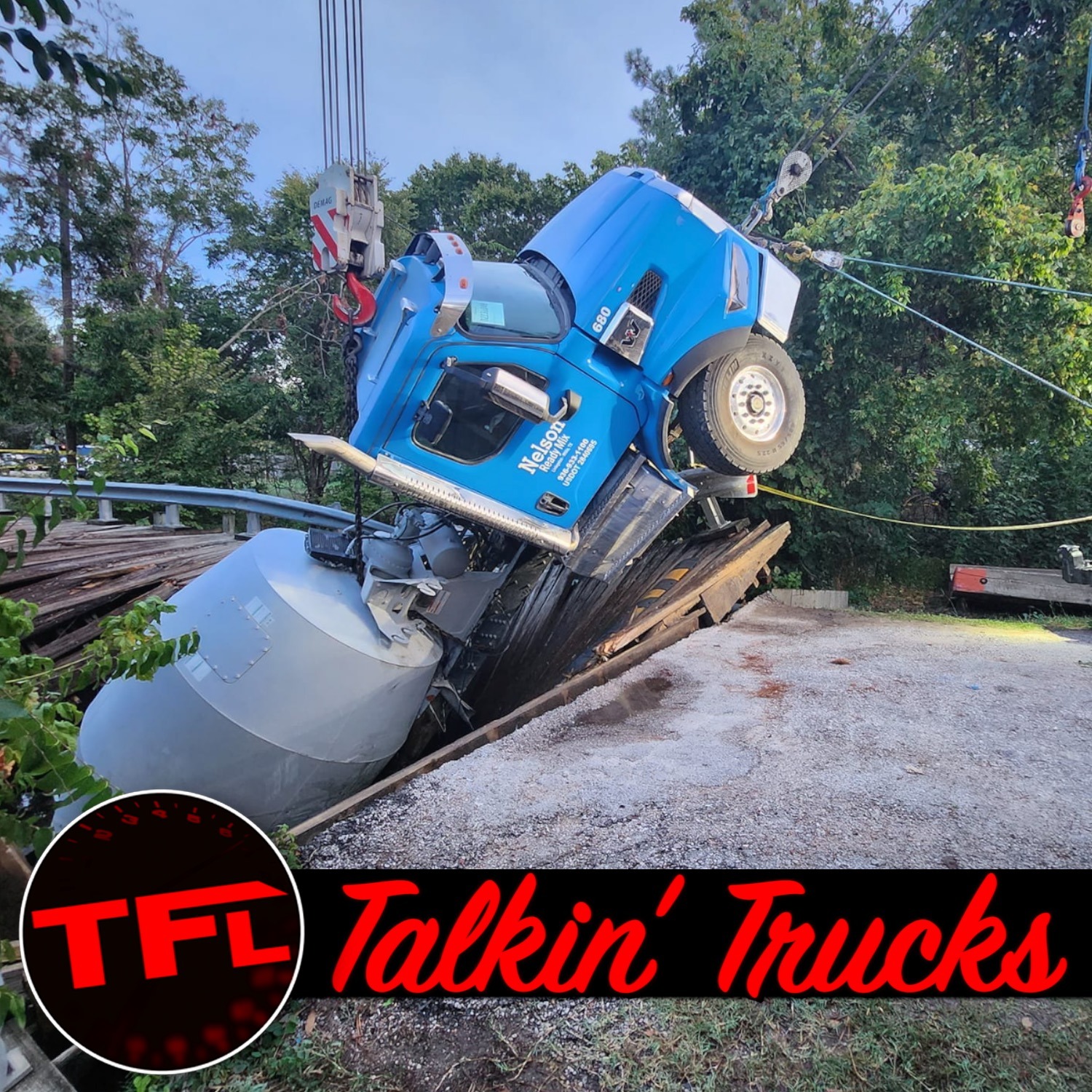
And it was a good truck at the end of the day already. So then we'll get to your fleet coming up soon. But we're looking at the picture here. This is one of your jobs that you participated in.
And when I first saw this, I was like, there is no way because a cement mixer truck, a giant semi, it's probably pretty heavy. How much did this guy weigh?
So this truck was around about 70,000 pounds.
So this cement mixer went through a neighborhood bridge, like a wooden bridge, which it didn't mean it didn't, wasn't supposed to cross.
And it fell through the bridge. Yes. And you were out on this job. So how do you even approach a job like this?
So I worked this job with a friend of mine. It's a company, their local called Gabby's Crane.
Talk to them and wind up bringing out our rotator to help their crane. And he did most of the heavy lifting on it.
You can see in the picture there are all the big snatch block with all the lines on them vertical lines.
Yes, all the vertical lines. Yeah.
And it was originally laid back the other way a little bit towards its roof a little bit.
Okay.
We use the record to pull it over and to help lift on it in that picture. And it's one of those.
It's a sheer drop off right there in the tailboard of the truck was literally planted in the silt in the mud that was underneath the bridge.
And this one, this one was a big job. This was definitely a big job.
Because like when I, when we go off-roading, we have small jobs, you know, maybe one of the jeeps or the Bronco gets stuck.
And we use maybe a stretch rope, you know, like a kinetic rope or maybe we'll win something out.
But when you get to a job like, oh my gosh, that's a big crane.
Yeah, when you get 100 or 110 ton. When you get to a job like this, you need to like figure out where to hook up your lines to.
You don't want to pull off of a bumper, for example.
You always need to hook on to something that's solid for sure.
Yeah. So tell me a little bit about it because every job is different.
Every job you go to.
That's what's kept me in it so long.
Keeps my interest out.
Yeah, that's really amazing. Holy cow.
They're picking up with a chain.
Yeah, it's a big chain sling. It's huge.
It's a lot bigger than it looks. I mean, in the picture, you can see the holes in the chain from here.
So it's a big chain. It's a big chain. Yeah.
Yeah. So yeah. So and finally, you guys, I guess you're a rotator or explain what that rotator tow truck is.
So a rotator tow truck is everybody calls it a crane.
It's really not a crane. It doesn't have cameras.
It's the red one right in the red one on the right.
Yeah. So you see on the crane, it's got a bunch of counterweights on it.
Yeah. And he we don't have counterweights on the tow trucks.
They're very capable. They'll do a lot of stuff that cranes will do.
But it's not quite the same thing.
And this thing is made to pick up something out of the ditch.
And if it's not drivable, then you hook up to it and take it down the road, too.
Whereas the crane's not going to do that.
The tow truck is designed. The crane is designed for a static lift straight up off the ground.
Yes.
Whereas the tow truck has multiple winches, multiple lines like this, particularly one has five winches on it.
And it's made to where you can pick something up that's on its side and roll that over and catch it all at the same time.
Whereas a crane is just made to lift.
Yeah.
So you need to know a lot of geometry and physics.
It takes experience for sure, too.
There are people that just jump in and go, but I would really advise against it.
Just assess the situation, right?
Yeah, approach, assess it.
Yeah. And training goes far.
There's...
There didn't used to be the best training in the world, but there's always been some kind of training.
And people that want to be in the business that want to be professionals will get the proper training.
Just as with any industry.
You know, our training isn't maybe as formal as some...
Other professions?
Yeah, yeah.
You know, but there is training that's available and operators should really take advantage of it.
Or maybe you could shadow also somebody.
Yeah.
You could support another.
Well, and that was how I learned early on was on the job.
You know, I was a young man working at a company, driving a big truck.
And I was doing towing.
And the older guys at the time said, well, you can come watch, but you're not going to make any money.
Okay, that's fun.
And then to learn.
And at some point one day, I was able to stand on my own two feet.
And I didn't have to call for the company more.
I was able to do most of those jobs by myself.
Not this, but most of them.
You know, plus you have now employees and other trucks.
Yes.
And you can...
If there's a big enough job, you can bring multiple vehicles towards you.
Absolutely, absolutely.
And you said you had a CDL.
So I have a question.
We see this, you know, I70 up here in the mountains.
Yeah.
It's a mountain interstate highway.
And that's where we do the eye gauntlet.
Absolutely.
And we see recovery trucks, including the rotator cranes, recovery trucks like this,
pulling a fully loaded semi truck with a trailer, you know,
just towing them down the road.
Just dragging it or pulling it.
Well, just rolling on the road, like just hooked up.
And it was recovered.
And now it needs to be...
Yeah, just pick up the front axle and just go down the highway.
But that truck and trailer supposedly weigh about 80,000.
A tractor trailer, yes.
Yeah, both.
Combination.
Yes.
But then...
So is the...
Is the rotator crane truck...
What is its capacity, really?
Because being in the mountains and pulling such a heavy load, it's probably a big deal.
So there are...
All these heavy dudes...
All tow trucks, period, should have a tag on them, a capacity tag.
I'll tell you how big the winches, how much the boom capacity is and the lift capacity
and the tow capacity.
So most of the heavy dudes that are out there, usually a 35 ton truck and most of them are all
80,000 pound tow capacity.
So it's meant specifically for that job?
Exactly.
To recover our semi-trailer, basically.
It's meant to pick that up and go down the road with it, absolutely.
Yeah.
Because it looks pretty impressive.
Because the semi-truck by itself is impressive.
Well, and you have to keep in mind, too, that the rotators,
that depends on what size they are, they might be anywhere from 60 to 90,000 pounds themselves.
By themselves?
Yes, yeah.
Before it's ever gets loaded with anything else behind it.
Just the truck the way it sits.
I do that I have today.
I think one weighs about 72 and one weighs, I think, right at 69,000, 70,000.
Yeah, so they're big boys by themselves.
Cool.
Maybe you can pull up a couple more images.
We can go to the gallery.
Oh, there's another image in kind of a top left, I guess.
Yeah, we don't have that truck anymore, but that's after a rolled over truck.
That's what I'm talking about.
Yes.
But going down like I-70 like this.
Right.
You know, that's a big deal.
Yes.
You don't just grab it and go.
So, we actually run brakes to the trailer.
Okay, so airlines.
Yes, we run airlines.
Okay.
The record, the tow truck, it'll have two airlines.
Usually everybody swaps it over from Gladhands to QuickConnect,
because it's easier for the industry.
And you hook up your QuickConnect and run your line back there to a Gladhands,
and hook up to the brakes on the trailer.
Gotcha.
And that's a safety.
You need assistance.
I mean, like you said, the tow truck may be $70,000 by itself,
you're pulling another $80,000.
You need to stop.
You need $140,000 pounds.
You need stopping power.
Absolutely.
Absolutely.
That's a lot of weight.
Absolutely.
All right.
So, before we do a little bit more record stories, how about,
tell me like, what's your, about your fleet a little bit?
Like right now.
So, currently we have, let's see, we have two rotators, three flat beds.
We have the 550 and we just bought a medium duty truck.
Okay.
Well, tell me about, well, you also have the off-road recovery truck
that you brought over here.
Yes.
Tell me about the 550.
Is there, let's go there first, called,
like the black one, right?
Yes.
The black 550.
There was one on the first neck trailer on it while I go.
Oh, here, here's one.
That's a picture of it at the tow show.
Okay.
Ever see an idea so clearly in your head, but struggled to make it real?
We've all been there.
With Wix, you can build a website for your business just the way you pictured it.
Get the best of both worlds with AI and drag and drop tools all in one place.
Stay in your creative flow and use AI when you want, how you want.
Create a website, your way.
Try it out at Wix.com.
Hey, Ryan Reynolds here.
Watching you a very happy half-off holiday,
because right now, Mint Mobile is offering you to give the 50% off unlimited.
To be clear, that's half price, not half the service.
Mint is still premium, unlimited wireless for a great price.
So, that means so.
Half day.
Yeah?
Give it a try at midmobile.com slash switch.
Up from payment of $45 for three month plan equivalent to $15 per month required.
New customer offers for first three months only.
Speed slow after 35 gigabytes of networks busy.
Taxes and fees extra.
See Mint Mobile.com.
So, first of all, why Ford?
Why F-550?
Why F-550?
I grew up in a Ford family.
And my dad always had Ford trucks.
We had Ford Mustangs.
We were just a Ford family.
Mom drove a Ford Bronco.
That was just who we were.
We grew, you know, holding a Ford family.
And it has stuck with me.
And that's what I've driven a lot of other things.
And not to beat up on the other ones, I just prefer these.
So, we've always had good luck, especially the late model stuff.
Like that truck right there does.
It's a 22 model.
That truck today has about 50,000 miles on it.
That truck I built it and bought for me to help out when the other guys were busy.
Somebody else drives that truck today, a driver named John.
But that truck is a very capable truck.
You can see that it's actually got knobby tires on it.
It's full wheel drive.
I built a goose neck hitch that added on to the back of it.
Run all synthetic rope.
All of our two trucks run synthetic rope.
And it's just a very, very capable good truck.
Well, tell me about this contraption.
You're carrying, there's some other images.
You're carrying a container basically like a shipping container.
So, what's going on here?
So, I am, that's a good picture right there.
So, I am very much of the mindset that I would rather have fewer trucks to do a lot of things
versus a lot of trucks that do specialized things.
I want to, I want to have each and every truck maximize the profit that that truck can make
as much as possible in the south we call it squeezing blood out of a turnip.
We want to do that as much as we possibly can for each truck.
So, if I could have six or eight or 10 or 12 trucks versus 30 or 35,
then I can be more profitable because my insurance is cheaper, my truck notes are cheaper,
I have fewer drivers, you know, and then that also benefits the drivers on top of that
because then the drivers have more capability with the one single truck.
And they can make money.
Something and out something into something else and switching trucks.
And then they learn a lot more and they can do a lot more and it helps them on payday
to help provide for their families as well.
And this deal here, I had designed, it's kind of hard to see,
but those are set of Collins dollies in the back that people are going to say,
oh, that's over capacity, it's not.
I actually towed that 220 plus miles from our house to the Texas tow show this year
and everything went flawlessly.
I've had a back injury, I haven't finished my stuff lately.
But this setup did really, really well.
And it's just one more tool in the box to be able to use a truck like that
to do more things that doesn't typically do every day.
So what are you thinking? Like if there's a semi truck
and it's got a container on it and it fell off, let's say on the side.
No, you could provide.
Typically that's going to be a loaded container.
Okay.
So this is for only for empty ones.
Okay.
I designed this to do 20s and 40s.
We are working on this system and another system similar to be able to do this.
This worked really well.
It's very simple.
It's just so a lot of people will have a set of these dollars on their truck
and then the piece that's on top of the dolly,
it's black, it's between the dolly and the container itself.
It has attachments on it to lock that in there.
And it sits on the dolly.
And you could be in the truck, pull these pieces out of the toolbox,
throw the dollies together, hook this thing up and go down the road
with stuff that you have on the truck every day.
Instead of going back to the office, getting in an 18-wheeler
that's got a big trailer, one of the slide and axle trailers
and having to go haul something like this
or putting it on a rollback, whatever.
This truck can haul these just as easily as a rollback can.
Maybe not as fast because you just pull it up on the bed
and go down the road, but it's just as capable to go down the road
as any of those are.
Versus two.
Yeah, that's what you're saying.
Versus two.
Versus two.
You said 50,000 miles on the Ford.
So you've had pretty good luck with all the power stroke.
So this was 50,000 miles.
And I'm probably going to jinx myself because I'm sitting here on camera today.
I don't know if there's any.
Is there anywhere?
I think this is a fake one.
We'll go with that.
I'm not sure.
So that truck has had zero chassis problem.
Okay, now we really have to knock.
Okay.
So I also have an F650.
So this has the power stroke and a 10 speed in it.
Okay.
I have a 2023 F650.
What does it look like?
It's white.
It's white with a black flatbed.
It may not be a picture of it anywhere close to here.
All right.
Can you just Google F650 really quick?
This is a bigger medium duty chassis, basically.
It is.
It's on 19 five tires just like this, but it has a 26,000 pound GVW.
Sorry about that.
Oh, that's okay.
It has a 26,000 pound GVW on the chassis.
And that truck is a gas truck.
Like this.
Yes.
Mine's a regular cab.
Yeah.
Low pro just like this truck.
Very similar to that chassis there.
And it's a gasser.
It's a gasser.
Okay.
And I wasn't sure about it.
I bought it.
So the being a Ford fan.
I wanted the Ford chassis.
But the Ford chassis since COVID has come in.
Messed things up for a while.
The Ford chassis is the bigger ones are much harder to get old.
To get exactly what you want.
So I needed a truck.
I needed to upgrade from a truck.
I call it a self loader.
It looks like you see the repo trucks.
It was that style of truck.
And so I needed something with a little more capability than that.
So we upgraded to a F650 flatbed.
And I was worried we'd be in the gasser.
But it has really been a good truck.
That truck as well.
I think that truck has about 80,000 miles on it now.
And that truck has been a zero issue truck as well.
So that's a lot.
Well, it's a good amount of miles.
Yes.
You said in 2023.
A 23 model.
Yeah.
So that's a decent usage.
Yep.
Yep.
It's been used quite a bit.
And it has plenty of time that it sits around to just like any other tow truck.
And but it's not a race truck.
You're not going to break your hand speed records in it.
It's not quick.
It's not fast on the top end.
But it's a go out.
Get the job done.
Light duty tow truck.
Nice.
Nice.
And okay.
Now let's bring up once again on your page.
They off-road recovery, the red truck.
Yeah.
For example, what's going on here?
There's your F 350 stock sideways.
Yeah.
So I was going out to rescue these guys in a Jeep.
They were having a hard time finding somebody to come get them.
And they were down in spring.
And I went down.
I picked my answer to the phone.
And I absolutely will come out.
No problem.
And they dropped mid pin where they were at.
And saw looked at the satellite images on the maps.
And saw where they were at.
No problem.
And I get out there and I was walking a fine line down the dirt trail there.
And somebody else said, I don't know if it was a skitter that come out.
Because you can see the ruts on the other side too.
Really big.
Big right.
Something came out and made some ridiculously massive ruts at some point.
And I got a little bit too close to that one.
And the whole truck slid over a little bit.
And it looks the picture looks terrible.
I shared the picture obviously on Facebook.
And you know, you could see on the actually in the comments,
I posted more pictures, you know, it says five minutes later,
the truck.
I had the truck out.
So you have a 12,000 pound winch in the front.
So you're trying to help yourself out.
Yeah.
I just left the other winches in neutral and sell for cover it up out of the hole.
I backed up a little.
You see I was a little too close slid off in the hole that he was in.
And I was able to pull myself out.
But by the way, it's really hard to see scale on some of these images.
Yes.
Because you're f 350.
You were kind of having, I want to say a little bit more fun with this build.
Right.
Your truck, your f 350 has a six inch lift in its own 42s.
Yes.
So that's that's a picture I took when that's at our house.
Coming out here.
The day we left to come here.
Sweet.
That's on Sunday morning when we were leaving the house.
That's the, that's the, what it looked like when we were leaving.
So tell me about a little bit about this f 350.
Okay.
Yeah.
Because you also wanted to go to the off-road games, right?
Yeah.
We did go to the match-off for games, not this year, but last year.
The previous year in St. Hollow.
It was a blast.
There's a bunch of pictures on here of that as well.
And that's what I'm talking about scale, right?
Because when you see a vehicle by itself, it doesn't look special.
Yeah, that's next to Matt's truck there.
Yeah, there you go.
And it just makes my truck look so small.
It's the tire.
It's the tire, right?
The tires on that truck are massive.
And see, it's not much taller.
It's not much taller than, than my truck is, you know, top to top of the truck.
But overall, that thing is just massive.
Matt's got a really impressive, very capable truck.
It's not as road worthy as ours is.
But it's a very capable truck by far.
Yeah, can you like click through his more images?
Yeah.
Just so we can see a little bit more.
Just the truck works.
There's Jeffy's diesel.
That's next to our truck.
That's HB.
That's Rick up there with his truck.
There he is.
That's my father along the front.
And we had a little San Hollow sand all over the truck there.
Oh, yeah.
Totally.
We had just got stuck.
And that's a good picture.
That's just, give you that, that's a six by ten American flag.
And the view of it kind of makes it dwarf the truck a little bit.
But the angle everything.
Yeah, because like, you know, I have a tundra, right?
And I put it on 34s.
And it looks okay.
And then I parked my tundra next to your F 350.
And then my tundra looks tiny, right?
Yes.
So it's everything.
Oh, there's a tiny cyber truck next to you.
Look at that.
Look at how cute it is.
A little tiny one.
So yeah.
So, but by the way, you said world worthy, right?
So you're F 350 with a 16-inch lift on 42s.
Yes.
You pulled a trailer a thousand miles to come here.
A little over a thousand miles.
Yeah.
So this is a usable vehicle you could use for maintenance.
Absolutely.
We traditionally, we don't drive it this far.
Yeah.
But I got a, you know, you get, you get to hear spontaneous.
Spontaneous.
Spontaneous.
Yeah.
You get to hear in the naysayers.
And then you and I were emailing.
And I told my wife, I said, you know what?
I said, let's go to Colorado.
And I said, she said, well, what are we driving?
I said, well, you're probably not going to like the nightmare
conditioning seats and stuff.
But it's a good comfy ride.
I promise.
She's like, what are you talking about?
I said, well, we're taking the red one.
She's like, really?
Yes.
That's the one we're taking.
So in the fantastic, you know, the, before we got up here to the mountains
in the flatter parts of Texas, I mean, the truck did really well at 10 miles,
a little over 10 miles of gallon.
And we were way in a scale ticket.
I waited a little over 16,000 pounds.
With the trailer.
Yeah.
Yeah.
The trailer loaded full of fuel.
Everything was a little over 16,000 pounds.
Yeah.
And that's a buck.
He's an emerald.
Yeah.
And you can see how tall, how upright this truck is.
Yeah.
Right.
You got a big kind of, uh, what's going to say?
Yeah.
So this is me standing in front of it.
You can't see me.
But this, I'm five nine.
And that's me holding a phone in front of my face.
And I leveled to take a picture of it.
You're basically looking at the top of the hood, basically.
Yeah.
So there's, did you know there's stickers on top of the hood?
No.
There's still, there's stickers on top of the hood.
That's how tall the truck is.
Yeah.
And you're about tall.
I'm six three almost.
Okay.
Yeah.
There you go.
Yeah.
That's a tall truck.
That's a tall truck.
It is very tall.
Hey.
It's Mike Chase here with Brad Preble from car Subaru in Viratin.
It's time for the 2025 Subaru share the love event.
We started thinking about all the stuff we've done this year.
We did the Subaru loves to learn.
We washed the cars for the Beaver Acres Elementary staff.
Thank you so much.
We still appreciate all the love from Subaru.
We're so excited you guys are here.
And to go pet rescue.
We had a puppy fest, a puppy marathon.
So people could come and meet these puppies and adopt their puppies and give them forever homes.
So we brought these lovely puppies to car Subaru to meet potential adopters.
It's all coming to a nice landing here at the end of the year with the 2025 Subaru share the love event.
The love is being shared with the Sunshine Division and Providence Child Center.
Subaru is giving 250 car Subaru throwing in another hundred bucks.
So with each lease or purchase, it's a $350 donation to both of those charities right here where we live.
And there's even some national charities that you can add your choice.
The perfect time to get a car.
The 2025 Subaru share the love event at car Subaru in Viratin.
With you all the way.
Every mile every day.
This isn't just a game.
It's a once in a generation event.
The Harlem Globetrotters 100 year tour.
Celebrate 100 years of high flying dunks.
A hundred years of showstopping moves.
And 100 years of changing the game.
Bring the whole family and be part of the legacy.
This game is once in a century.
Be there at Motor Center on January 24th.
Go to Harlem Globetrotters.com for your tickets to the 100 year tour.
So, let's see.
Can you go back to the gallery a little bit more?
What are some of the other stories?
Do you have another one at least?
Yeah, let's scroll through here.
Let's see what's going on with that space shuttle.
Are you telling a space shuttle?
So that's one of my guys that's his name is Chris.
No Chris for a long, long time.
And when he came to workforce, that was the road to do we bought for me that I ran myself.
And Chris come along and put him in that truck.
And this is the sort of thing that Chris does a lot of.
He holds a lot of these concrete pump trucks.
And these pump trucks are 120-130,000 pounds.
Those are big boys.
Those are big, yeah.
And this one just happened to be with a great backdrop.
With the shuttle on top of the 747 down by NASA on the south side of Houston.
I gotcha.
So yeah, you're not throwing the shuttle.
No, it's just in the background.
It's just in the background.
It was just posing.
But you could throw a shuttle.
Well, I mean the Tundra did.
If the Tundra did, we could shoot you.
I believe it in my home.
Yes.
You told me you told the plane ones though.
I did.
I told that was years ago when I worked for somebody else.
I told that it was a Gulfstream G6, I believe.
They had an airport in Houston.
Did it go off-roading in the plane?
They thought they wanted to until they did.
And it was a really bad experience for them.
They went off the runway.
They went off the taxiway trying to make a U-turn at the end of the runway.
And when that wheel hit the grass, they made it about 10 or 15 feet into the grass
before they found the soft spot in the landing gear on that side just went outside.
So you had to help out and kind of move it back.
They had a company that specializes in aircraft recovery, which oddly enough,
I don't share pictures on social media of this, but we actually do aircraft recovery as well.
Our guys were out just yesterday doing a aircraft recovery in Houston.
Like just near the airport at the airport?
Yeah, it's a small airport.
No, I'm not talking George Bush.
Come on, come on, come on, come on, come on.
They're not out picking up 747.
No, no, no, no.
But small aircraft at smaller country airports, you know, stuff like even small lear jets and stuff like that.
We'll go recover those as well.
We've done numerous of them.
I've done a lot in 20 plus years, and we still do them today as a small company in Texas.
All right.
Do you want to see some more images?
Check it out.
Let's see.
Oh, tell me about the Bronco.
You also have a Bronco, right?
But that's not for work.
No, not for fun, right?
Yeah, that's more for just for me.
My dad had a 69 Bronco, and it's a little further down.
It's a blue Bronco right there on the right.
And that's me out playing and talking on the phone at the same time.
Two things you should not do together.
And my wife had a Bronco at the same time.
She had a 22 model wild truck, four door, fantastic machines.
Absolutely great trucks.
And she was out in town one day, had one of our grandkids with her, and one of our daughters.
And I was talking on the phone to somebody about something at work.
And I come up this big sand hill, and I had made it, I don't know, six times before that.
And I was doing it one more time.
It's a pretty good incline.
It's hard to tell in a picture.
And I got to the top of the truck was moving nice and easy.
And I said, oh, I got it.
And I gave it more gas, and the bottom fell out.
And that was it.
And I said, honey, are you still in town?
And I said, you almost sent you a pen.
I need some help.
So my wife had to come rescue me.
So it was a Bronco Bronco rescue.
It was a Bronco won Bronco rescue.
And she's actually brought out that black F-554 to come rescue me when I was in the off road truck.
The red one.
Because I was stuck in somebody's backyard, and the bottom just fell out of one side.
Just as fast as you could drive into it, just grass.
You couldn't tell that there was something that was there, a hole.
And the bottom fell out of one side.
The poor old truck was leaning, and I was rather displeased.
And Mama came to the rescue again.
There you go.
That's why you own a towing company.
That's why we hope each other.
Oh, there's a trailer you're pulling too.
It's like a fifth wheel or something.
Yeah, so I was saying that I had built a goose snake attachments for the back of that truck.
There's another good picture of that too.
And that's towing a fifth wheel travel trailer with an adapter.
One of those cone-looking adapters goes to the fifth wheel to a goose snake ball.
And like I said, I like versatility.
So when you pick up a call, it could be a motorcycle.
It could be a trailer.
It could be in the airplane.
This little truck has the bed as a 20,000 pound tow rating.
So we haul e-holes and small box trucks, shuttle buses, shuttle vans, all sorts of things with this little truck.
And it's just a really good, that's the benefit to it.
It gets around tight spaces easy.
It's really small.
It's four-wheel drive.
It's not like the red truck, of course, is force capability.
But some of the slick dirt roads, the sloppy places that we need to go to to pick up a car and tow it out.
It's very good at that sort of thing.
Yeah, when we test pickup trucks here in Colorado, we usually get four-wheel drive trucks, right?
Unlone or the ones we purchased, obviously.
And I remember somebody was asking me, like, we're testing dualies, right?
With big goose snake trailers on top of them, doing a shootout on the Igunthlet.
And somebody was asking, why get a four-wheel drive dualie?
It was like, you're on the road, right?
You're hauling stuff from here to there, from one city to another city.
Why four-wheel drive?
And I'm like, it's that one day that you need on your in the dirt lot,
you're in the gravel lot, something happens.
It's that one time that you need it.
So real quick story about that, about self-recovery.
Yeah.
I first brand new truck I ever bought was a 2014 F-150 regular cab short bed.
Looks a lot like the other one.
Coyote motor, six-speed, fantastic truck.
I absolutely love it to this day, still have it.
And I parked in grass where I parked my tow truck at the time.
I parked in some grass behind it, a little shower came through that day.
It wasn't even a lot of rain.
It was just a shower.
And I had to use the record to pull myself out because that poor truck,
that one day I could have used the four-wheel drive that I didn't have.
And you didn't have it, yeah.
Because the truck just wasn't designed to be there.
I mean, it was just wet.
Grass was slippery clay stuff underneath it.
And that's why they're four-wheel drive.
You know, this truck, four-wheel drive, very rarely ever gets turned on.
But sometimes you see.
But versatility, right?
Yes, versatility.
Yeah.
If I can just go down a sloppy dirt road with this,
versus having to call out that other truck,
then the driver that's driving this truck doesn't have to call me and say,
hey, I need you to come do this for me.
I can't get it myself.
That truck now has the capability to go do that by itself.
Yeah, very important.
I mean, you're making that investment, right?
You're paying more for that four-wheel drive system up front.
Yes.
Maybe you upgraded your tires, like you said before, right?
I did.
But it's an investment that really pays back.
It is.
In the long run.
Yeah. And most of the miles on those tires that I put on
are pretty pinny for them.
Because it's hard to find off-road, worthy, 19.5.
Heavy duty, too.
Yeah.
And I found some.
And I said, I'm going to butt on my wife and I'm buying these for this truck.
And these tires were doing it.
I'm making it happen.
I spent the extra money on them.
And they go down the road.
It sounds like an old four-wheel drive.
It buys, buys tires.
It's on the road.
Yeah.
But it's fantastic.
They do a great job.
They won't last as long as these kind of tires do.
Better in that picture.
But when you need it, you need it because those right there
are good on the street and nowhere else.
You get into that gumbo kind of stuff.
We have it over the slick clay that they put down on this
base on roads.
And we have some of that too.
That thing will be sliding all over the place.
Even as a four-wheel drive.
It will be sliding all over the place.
And now with the upgrade on the tires, the truck can go on
and zone and do those kinds of jobs.
That's good.
So I want to focus on like, you know, Ford more than the big semi-trucks
because we're more focused a little bit on the pickup truck world.
So I want to hear a little bit about maybe some feedback from you
about the Ford trucks, something you want to improve.
We also want to talk about power trains, right?
Electric versus diesel versus hybrid.
Avondole.
Where do you want to start?
Do you want to start feedback or power trains?
Whatever.
Let's talk about power trains.
Electric diesel.
You said you've owned them all.
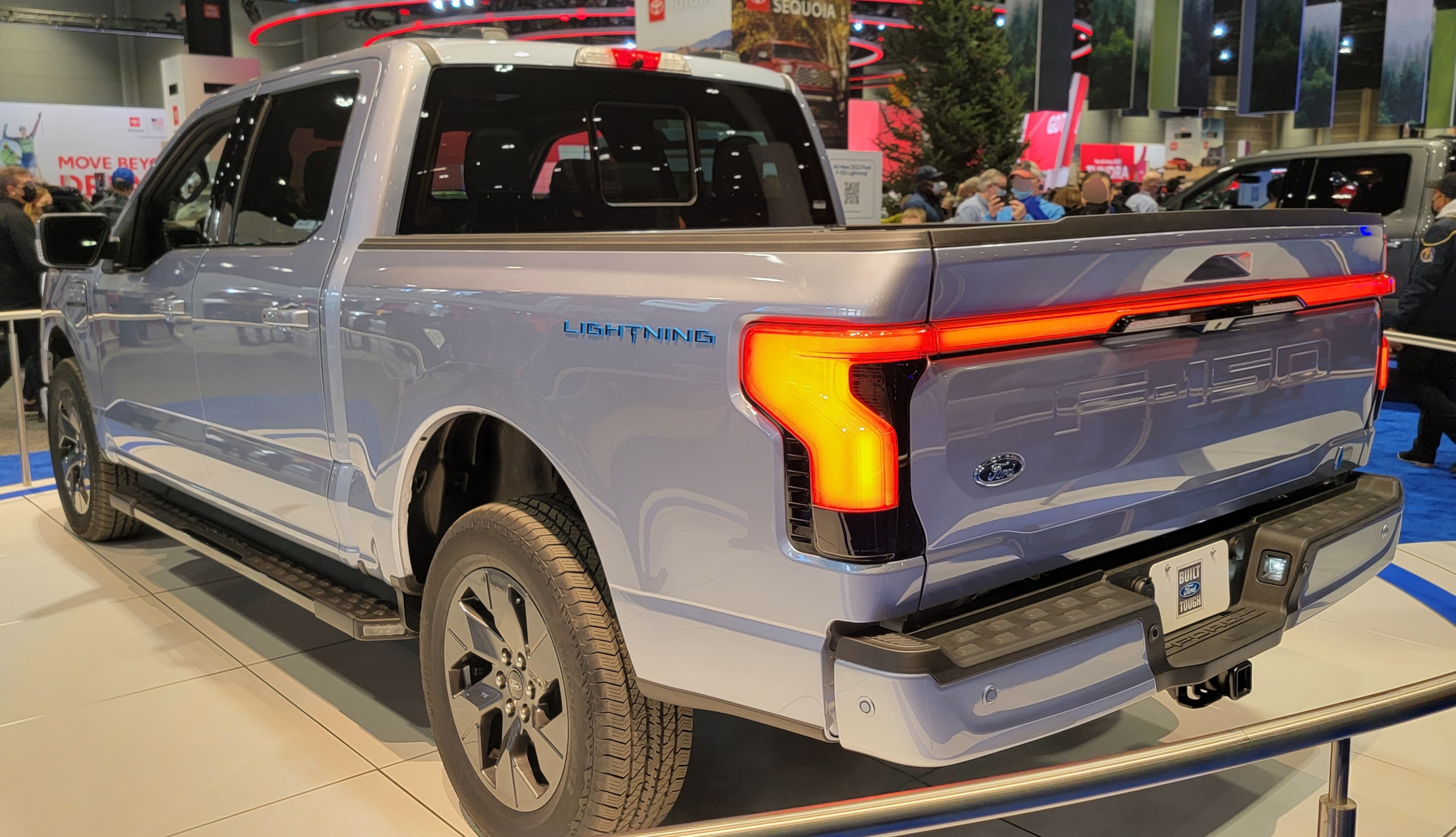
Avondole Ford Lightning, which is a great soccer mom car.
But that's about all that's good for.
You called it a car?
I did.
I did because it's just Ford.
I'm sorry.
I'm a Ford guy.
Don't beat me up.
Okay.
But it's just not a very good truck.
To me, a truck needs to be able to pull trailers.
Now does the Lightning pull the trailer well?
Absolutely.
From here about 50 miles down the road.
And then do you better find a place to charge it?
Because that's all you're going to get out of it.
Which one did you have?
Can you explain that?
I had a 2022 model.
That's when they came out.
Yeah.
I think it was a 22 model or an early 23.
It was a standard range lariat.
Couldn't find an extended range at the time.
Interesting.
They were all platinum fancy.
Yeah.
That's too much.
There's like 22 inch wheels on them.
Yeah.
And that was the platinum extended range.
It was almost $100,000.
Yeah.
I said, I'm not doing that.
I said, but I'm interested in this other truck.
And I went into it knowing watching some of y'all stuff
at the truck you had.
Knowing kind of what the capability was going to be.
Well, we had an extended range also.
Yes, but the one we had.
I think that part of the problem was the way that I was thinking about it.
I mean, I knew it wasn't going to be the same as having, you know,
like the trimmer that you guys have.
Yes, I've had one of those two.
And I knew it wasn't going to be like that.
But I thought that it would be better on range.
Even be in the standard range.
Because we hooked a trailer up to it.
Full charge should have been 230 miles.
As soon as you plug in a trailer,
you lost half of the range right off.
Well, that's what the computer estimates.
The computer estimates.
The computer estimates.
Boom half of it's gone.
Okay.
And this was a 6,000 pound trailer with a V-nose.
And I think it was eight foot tall.
So it's kind of tall, but it has a V-nose.
It's not.
And it's not a camper.
No, it's not a sort of great big travel trailer with a flat nose on it.
And I have another box trailer that's eight foot wide and 24 foot long.
It's not that kind of box trailer.
And it weighed 6,600 pounds.
We went about five or six miles.
It was a beautiful day outside in the 60s outside,
temperature-wise.
Not a cloud in the sky.
And it said, Ding, reduced range due to external temperature.
And I thought, maybe I should turn around now.
Because it reduced the range to 73 miles.
League 1 volleyball is back.
The world's best players together on American soil.
This is volleyball like you've never seen before.
Huge swings, massive blocks, jaw dropping digs.
A sport where every play is a highlight.
League 1 volleyball returns January 7th, 2026,
with teams in Atlanta, Austin, Houston, Madison, Nebraska, and Salt Lake.
To buy tickets, visit L-O-B-B.com-slash-i-heart.
For 100 years, Salem's Elsenor Theatre has been the stage for unforgettable nights.
Music that moves you.
Comedy that makes you laugh until it hurts.
Performances that spark conversation.
The Elsenor has attracted vast audiences bringing outstanding live entertainment
to the community and created lifelong memories.
Yours is next.
Step inside and make your own memory in a theater as beautiful as the experience itself.
See what's coming next at elsenortheatre.com.
That's elsenortheatre.com.
And you were trying to reach a job or something?
No, my wife and I every time.
Or you were testing it.
We do. Every truck that we get, if I own it, it's going to work,
except for the little black truck.
That truck only holds one thing.
A-S-H.
That's exactly right.
Okay, I'm sorry.
That's all that truck.
I was trying to figure that out.
We're talking about your supercharged truck, which is a...
Yes.
That's a whole nother world.
Which is a drag racing truck.
Yes.
Which we have a video.
That's a leisurely drive truck.
That's a different video.
Okay.
Okay.
So you wanted to test this lightning, basically.
Yes.
Because if I'm going to own it, I need to know, before something happens,
what the truck is capable of.
Before my guys are in a pinch
and I need to take something to them, you know, they're on...
There's a wreck somewhere and I need to take that trailer to them.
I need to know that I can get that trailer to them and get it back.
Because we're not just in the middle of city,
sitting in downtown Houston.
We're on an hour north of downtown.
It's kind of a rural area.
There's plenty of city around us too, but we cover a lot of territory
for a small company.
And I need to be able to get the tools that the guys need to them.
Whether that tool is in the middle of summer and ice chest with a bag of ice
and some water in it, or if it's a trailer with extra supplies in it,
or a skid steer, which we own a skid steer too.
Just to collect wreckage or something.
Yeah, just like if there's an 18-wheeler wreck,
we scoop up cargo or truck parts or whatever it is.
That was our first offered recovery unit.
It was a skid steer.
We bought a winch box for the front.
And there's some pictures of that on here too.
It has a 20,000 pound winch in this thing.
It's got a big blade on it.
And that was our first foray into offered recovery.
Was that thing?
Gotcha.
But if I own it, it's going to work.
So for your purpose, that...
Well, standard range, let's explain that.
It's a smaller battery truck, right?
So for your purposes, it didn't work.
In a plenty of power to pull the trailer?
It just...
Not long enough.
I did not keep it very long because I just couldn't pull with it
what I needed and wanted to do.
Okay, that's fair.
So we talked about diesel trucks already.
We talked about the gas or the 650 you had,
which both of them worked great for you.
Any hybrids?
Have you experienced any of the F-150 hybrids yet?
No, I have not.
We've owned a car that was hybrid, a Ford-based car.
Yeah.
That is fantastic.
We still own it today.
It's a great car.
But we have not had any hybrid trucks.
With that said, I am not against the hybrids.
I think the hybrids are great.
If I could have that Black 550 that's a super duty,
if I could have that truck or that 650 that was a hybrid,
a hybrid version of that and save anywhere 10 or 20% in fuel,
because most tow trucks that most of our stuff is in town, short trips.
We do plenty of rural driving too.
We do some out of town driving.
Obviously we're here.
But we do plenty of that kind of work too.
And most of the driving though is in town.
Red light to red light stop and go.
And that's really where the hybrid shines.
That's their wheelhouse.
That's where they're at their best.
And if I could have that capability plus the addition
like your hybrid you add at the onward power and all that,
if you could combine all that together,
that's fantastic in a commercial application.
But you don't see it yet.
I would start making orders today to replace trucks
if I could get forward.
Forward, are you listening?
Mr. Farley?
If you're listening to us, we're looking directly into the camera.
We're looking into your eyes.
No, let's me expand really quickly on this.
So I was really interested about hybrid technology too.
And we test trucks for living here.
So I ordered the F-150 hybrid as soon as it came out.
So I wanted to be one of the first ones as we always are.
And I don't know if I was the first one.
But I got it fairly early.
F-150 hybrid, power boost, they call it.
I got the 7.2 kilowatt onward power unit,
which also has 240 volt outlet.
And my buddy Dave and I, David, we welded off of that truck.
Right.
Which I imagine you may need to, you know, off-road recovery.
So think about it.
That off-road trucker mine, that big red 350.
Yeah.
That was a hybrid capable truck that had the opportunity
to have that onward.
They make off-road welding machine stuff.
But if it had that hybrid technology built into that truck,
then that simplifies things on repairs and capability
to be able to go do things.
Well, your F-350 off-road recovery truck
has a hydraulic crane on the bed.
Yes.
And the hydraulic pump is using the PTO, right?
It's a clutch pump on the front of the engine, yes.
Oh, okay.
We're kind of like an air conditioning compressor.
Oh, really?
When you hit the switch, the toggle switch is on the roof.
And you hit that switch, it's like a compressor.
It's that style.
Okay.
It has that kind of a clutch.
So it's not taking power off the transmission.
It's taking power off of the engine in the front.
That's great.
Where is that 650 that I have?
Yeah.
That has a PTO on the transmission.
And that's how you run the hydraulics on flatbed or whatever
you have you.
But, if you had 7.2 kilowatt, that's actually a lot of energy.
That's a lot of juice.
You could run many different things.
Maybe you could even charge an electric car that's stuck
on the side of the road.
Absolutely.
How about that?
Absolutely.
Absolutely.
So that happens.
Obviously, that happens a lot.
Very interesting.
So, yeah, I was quite happy with the F-150 hybrid I owned.
I didn't have any issues with it in about 22,000 miles as long as I kept it.
And, yeah, I've been thinking about this a long time.
Actually, I think I did a story on TiffelTruck.com thinking about hybrid heavy-duty pickup trucks.
Because it made a lot of sense to me.
And I'm glad that you are agreeing with me.
Yeah, I think it's a great idea.
Even if you don't get the ability right away to use,
because the onboard power would be great for a mechanic or road service technician,
or even if it's the plumber or the carpenter that might need that power
in that heavier application, the hybrid part of it, the stop and go traffic
for our industry would be fantastic.
Just that one thing alone.
Forget about the export power.
Yeah, forget about that part of it.
Yeah.
If I could just have the hybrid capability and get,
because the hybrid has been around long enough now, the technology has come along ways.
Whereas, full electric is still kind of limited in a lot of ways.
But the hybrid stuff has gone really well.
And the capabilities of it are great.
Yeah.
So, that makes sense.
You still take the truck on a long road trip and never have a problem.
You could have taken jet eco boosters to yours.
Anywhere you want to go.
I think it had the range of 700 miles.
Right.
That's what I could go forever.
Yeah.
So, that is quite interesting.
Yeah.
And I mean, electric truck can work for a plumber.
Maybe they make short trips.
Right.
Maybe they're not towing anything.
Right.
It can work for many different.
And they may care less about the hybrid, a few savings and more about the onboard power
for certain applications.
Yeah.
That might be just the biggest part of the benefit to them is the onboard power in that
heavier application.
I want to call it heavy due to the big trucks that heavy due to us.
But in the heavier application stuff, you know, the 550s and 650s, stuff like that,
that range of truck.
Gotcha.
All right.
We're almost done on this episode.
But I wanted to get maybe a couple of maybe three quick tips from you.
Like if somebody wants to recover, let's say your body is stuck, you're off-roading,
quick tips, like you were saying, you know, using a winch safely.
I mean, can you kind of describe a couple of helper tips?
Yeah.
So, you always, one of the biggest things that I try to make sure everybody learns is you
always want to hook to something solid.
Be careful what you hook to.
We've seen a thing here online recently.
It went all over the internet.
It went viral.
It's somebody lost their life because my opinion, it was poor technique in the way a truck
was recovered.
You never want to hook to a receiver hitch.
I mean, if you're pulling something across a parking lot that's not buried, then whatever.
Okay.
But if something is stuck in a hole or you're having to work on this, you're having to put some
of that kinetic force together.
Don't ever, ever, ever hook to one of those drop hitches.
It's on the back.
They make hitches for the receiver, you know, what do you call it?
Shackles or anything.
Yeah.
Whether you put a soft shackle on it or it has a screw pin shackle that's there.
There are applications.
There are things that are made to do that job.
Get the right tools to do the job.
Get the right tools to do the job safely.
Because the number one thing is to make sure everybody goes on.
And like you said, I think maybe you didn't say it, but we talked about this.
Don't hurry.
The instinct is the cement truck is in the river.
I got a hurry.
I got to get it out.
Right.
So what you see a lot of times and you'll see this in countless YouTube fail videos is that
the adrenaline gets going and we're men, right?
I got this.
I can lift it myself.
I can do that by man.
It doesn't always have to be that way.
It doesn't we have less to prove, get it done right the first time.
And let's all go on.
Without injury.
And also learn geometry, please.
And math.
Math makes a big difference.
Learn.
So here's the other thing.
People think, okay, I have a 12,000 pound electric winch of my truck.
I can pull 12,000 pounds.
Wrong.
What?
Wrong.
That's just the strength of the winch.
Okay.
The limiting factor, that winch is only as strong as the weakest point between the two vehicles
or whatever it is you're pulling.
So you have to look at what each piece is rated at.
Find out what your winch line is rated at, whether it's synthetic rope or wire rope.
Find out what it's rated at.
Find out what your attachments are rated at.
If you have a strap, find out what it's rated at.
If you use a soft shackle or a real shackle, don't buy the cheap junk that you find on the internet everywhere without calling out anybody particular.
Don't buy the cheapest junk you can find because it's just that.
It's the cheapest, crappiest junk you can find.
And that's the stuff that fails first.
If you're going to do this kind of job, whether you're a volunteer,
and there's plenty of like Facebook page stuff that go and help people, buy decent stuff and learn how to use it properly,
so that nobody gets hurt and you don't have that on your conscience.
Exactly.
That's really important because the older I'm getting, you know,
safety and kind of a measured approach becomes more and more important to me.
We're the same age.
We talked about this yesterday.
Yes.
And I don't heal as fast as I use to.
That's the honest and goodness truth.
I mean, either.
So if I can try not to get hurt, then I don't have to take quite as long to hear.
And that's important.
You could be more productive that way.
I could be more productive that way.
Yeah.
Because if I'm limping around for a reason,
at this point of life, I'm limping around a little longer than I used to.
Exactly.
All right.
Well, on that note, we'll close this podcast for this.
Thanks for coming out.
Absolutely.
I know it wasn't the easiest thing for you to do.
I mean, you went the long way.
You came up.
You didn't come down.
That's right.
That's right.
We'll make the trip back down home.
Yes.
It's all downhill from here.
It's all downhill.
Maybe I could even better feel mileage in my home.
Exactly.
Hey, maybe 12.
Maybe I'll let you know.
Hey, there you go.
So, thanks.
And we have more videos coming out.
So, we did an off-road video together here in Colorado.
We did the drag race together once again.
So, stay tuned for that because we had a lot of fun.
And it's all coming up very soon.
Sounds great.
I can't wait for it.
Thanks.
Your business is one of a kind.
So, your website should be two.
With Wix, it's easy.
Almost too easy to create a website that's perfectly yours.
Just tell AI what kind of site you want to build
or choose from thousands of templates.
Change whatever you want, whenever you want.
And get everything you need to start running your business your way.
No matter what you sell or what you aspire to be,
you can do it all, yourself, on Wix.
Shopify is a global commerce platform that helps you sell
at every stage of your business.
And sell more with less effort thanks to the Shopify magic.
Your AI-powered All-Star.
Sign up for a $1 per month trial period at Shopify.com slash Red Circle.
All lowercase.
Go to Shopify.com slash Red Circle now to grow your business
no matter what stage you're in.
Shopify.com slash Red Circle.
About this episode
Charlie, a towing and recovery business owner from Texas, shares his fascinating journey into the industry, starting from his first job in 2001. He discusses various towing stories, including the challenges of recovering heavy vehicles like cement mixers and the importance of using the right equipment. The conversation also delves into the specifics of his truck fleet, including rotators and off-road vehicles, and touches on the pros and cons of electric and hybrid trucks in commercial applications. Listeners will gain insights into towing techniques and the unique experiences that come with the job.
( https://www.alltfl.com/ ) Check out our new spot to find ALL our content, from news to videos and our podcasts! In this episode of TFL Talkin’ Trucks, Andre is joined by special guest Charlie, the owner of a wrecking company in Texas. Charlie gives us an inside look at his impressive fleet of trucks and what it takes to keep them running strong in one of the toughest jobs around. From heavy-duty wreckers to support vehicles, his operation is built to handle just about anything the road throws at it.
They also dive into what life is really like doing recovery work full time, from the day-to-day grind to the unpredictable challenges that come with the job. Charlie shares some of his craziest recoveries, giving a behind-the-scenes look at the wild situations truck operators face out in the field. It’s a fascinating conversation about trucks, towing, and the grit it takes to make it all happen.
( http://www.patreon.com/tflcar ) Visit our Patreon page to support the TFL team!