Pirelli is a company that makes tires for cars. They are famous for making high-quality tires that help cars grip the road better, especially in racing.
Sustainability means making cars in a way that is good for the environment. This includes using materials that are less harmful and creating cars that use less fuel or are electric.
The W1 Supercar is a very fast and advanced car made by McLaren, a company famous for building high-performance sports cars. It's designed to be one of the best in terms of speed and technology.
A cyber tire is a special tire that has technology built into it. This technology helps the tire communicate with the car, making it safer and smarter.
V2X means that cars can talk to each other and to things like traffic lights. This helps them avoid accidents and drive better by sharing important information.
The contact patch is the part of the tire that touches the road. It's important because it affects how well the car grips the road and how it handles while driving.
ABS stands for Anti-lock Braking System. It's a feature in cars that helps prevent the wheels from stopping completely when you brake hard, which helps you steer better and stop more safely.
Tire temperature is how hot your car's tires get when you're driving. If they get too hot, it can cause problems like blowouts, and if they're too cold, they might not grip the road well.
Tire pressure is how much air is in your car's tires. If the pressure is too low or too high, it can make your car harder to control and can even be dangerous.
Tire wear is how much the rubber on your tires gets used up as you drive. If you drive aggressively or on rough roads, your tires might wear out faster.
Stability control helps keep your car from sliding around. If it senses you're losing grip, it can apply brakes to certain wheels to help you stay on track.
Adaptive suspension changes how your car feels while driving. It can make the ride smoother or sportier depending on the road and how you want to drive.
Aqua planning happens when there's too much water on the road, and your tires can't grip the surface anymore. This can make it hard to steer or stop your car safely.
Battery range is how far an electric car can go before it needs to be recharged. It can change based on how you drive and the type of roads you are on.
Formula One is a type of car racing that features very fast cars and is held on special tracks around the world. It's considered the top level of motorsport.
Virtual simulation is when computers are used to create models that act like real cars. This helps engineers test how cars will perform before they are built.
Data transfer is how information about how a car is performing is sent to the team. This helps them understand what changes to make for better performance.
G acceleration is how we measure how fast something is speeding up or slowing down compared to the force of gravity. It's important in cars because it helps us understand how much force the car and its parts experience when driving fast or turning sharply.
The McLaren F1 is a super-fast sports car that is famous for being one of the best in the world. It's not just about speed; it also uses smart technology and materials to be more environmentally friendly, which is a big deal in today's car discussions.
The Mercedes-Benz A-Class is a small, fancy car that looks good and drives well. It's designed to be efficient, meaning it uses less fuel, and it has special tires that help it perform better, especially in winter conditions.
LIVE
The automobile is one of the most important inventions that revolutionize the modern world.
In America, the rich history of car culture runs deep as technology continues to shape
the future of the industry. Jason Stein is here to share the stories of people passionate about
cars from industry leaders and innovators to car obsessed celebrities. Buckle up as Jason takes
you inside the boardroom, onto the track and around the bend on Cars and Culture on SiriusXM
Business Radio. We welcome you to episode 229 of Cars and Culture with Jason Stein here on SiriusXM
Business Channel 132. Great to have you along for the ride again this week.
For more than a century, Pirelli has defined what performance feels like. From the racetrack to the
roadway, it has set the standard for grip, confidence and emotional connection. But a new era in
mobility demands more than speed. It demands intelligence, sustainability and innovation
at the edge of possibility. And today, Pirelli sits at the very center of that transformation.
The company's groundbreaking Pirelli Cyber Tire technology, the first intelligent tire capable
of detecting conditions that the only place a vehicle actually touches the world, has just been
honored with the 2025 AutoTech Breakthrough Award. It's a recognition that says the future of mobility
isn't just about sensors hidden deep within a vehicle. It's about the data coming directly from
the four hand prints of rubber that define every turn, every stop and every acceleration.
This is real-time awareness where it matters most, the road beneath us. Cyber Tire collects and
processes information like pressure, temperature, vertical load and surface conditions, then
communicates instantly with the vehicle to enhance driving dynamics, traction, safety systems,
EV range and even autonomous readiness. It takes a once passive component and makes it into an
active partner in decision making. And it isn't just a vision, it already has been chosen by top
performance automakers. But the innovation doesn't stop there. Pirelli is also setting new standards
in sustainable performance. Through its collaboration with McLaren on the W1 Supercar, it has developed
the first Supercar tires with more than 50% bio-based and recycled materials, all while
maintaining extreme capability. It's proved that responsibility and speed can coexist without
compromise. So what's next? How will intelligence at the tire level reshape mobility? What new
possibilities emerge when the tire becomes a source of insight, not just support? To explore
what comes next, we're joined by one of the most forward-thinking technical leaders in the industry,
Pierro Misani, Global Chief Technical Officer at Pirelli, the man helping the world rethink what
tires can do. He's my guest here on Cars & Culture. Hello everybody, I'm Pierro Misani and this is
Cars & Culture with Jason Stein. Wonderful to be with you on this program today. I know that you
have a lot of exciting news. As vehicles become faster and smarter and safer, they're also more
connected. What a pleasure to have you on the program, Pierro. Thank you, it's my pleasure to be with
you today. Congratulations, the 2025 Autotech Breakthrough Award, recognizing the cyber tire
as one of the most innovative technologies in mobility. We're going to talk about that a lot
today and this is no longer theory, this is now production, that the world, Pierro, talks about
cyber, it talks about AI, it talks about smarter versions of vehicles, but what does it mean to
have the recognition of and the validation of having this cyber tire receiving global recognition?
Yeah, that's a testification of the thing that we are moving in the right direction. You know,
connectivity is becoming one of the mainstream in the future of automotive. Sustainability and
connectivity are the two main topics we have to concentrate on and connectivity when it comes
to a tire becomes difficult to understand because everybody, when you speak about connectivity,
it speaks about the infotainment that speaks about these kind of things, but how can a tire be
connected to a vehicle or even to infrastructure because there are two ways to exploit connectivity
through a tire, both in vehicle and V2X, that means vehicle to vehicle, vehicle to infrastructure
and solace for it. The fact is that we are transforming for the first time a tire that
since many, many, many years has been able to transmit forces to a car, to a motorcycle,
to any vehicle, to steer, to brake, to control the vehicle. Today we are transforming this
object in something that still transfers forces, but then transfers also a lot of data.
Data that are collected by a sensor in the tire and then elaborated into the control of the car,
thanks in this case to algorithms that we are, Spirani has been developing since a few years.
The cyber tire in many ways, as you said, goes from a moment of force into intelligence.
What data matters most for vehicle safety and performance and what does the cyber tire actually
sense? That's a great question indeed. Let's start from the fact that the tire is the only
point where a car touches the ground. It's the only way to provide information is through the
contact patch of the tire, but tires are different. To make the story very simple, if you have a car
and you try to fit a winter tire, an all season tire or a sporty tire, these tires do have
dramatic different behaviors dynamically. Not only they exploit a different level of grip,
but they do behave differently in terms of driving dynamics. I take a very simple example,
ABS braking, for example. If you have to brake with ABS, ABS you know is working on the slippage
of the wheel. Basically when it comes to sleep, releases the hydraulic in order to stop the sleeping.
But it's a sort of trial and error approach normally today. With the cyber tire we are able
to provide to ABS the right information to, let's say, set immediately the calibration,
the parameters of the ABS to the proper value to optimize that very tire that is fitted there.
We call it the tire ID. This is something we have developed, especially after the agreement we
have had with Bosch last year. You know that we signed the development agreement together with Bosch
to integrate these data and algorithms into the controller unit of the car. The first application
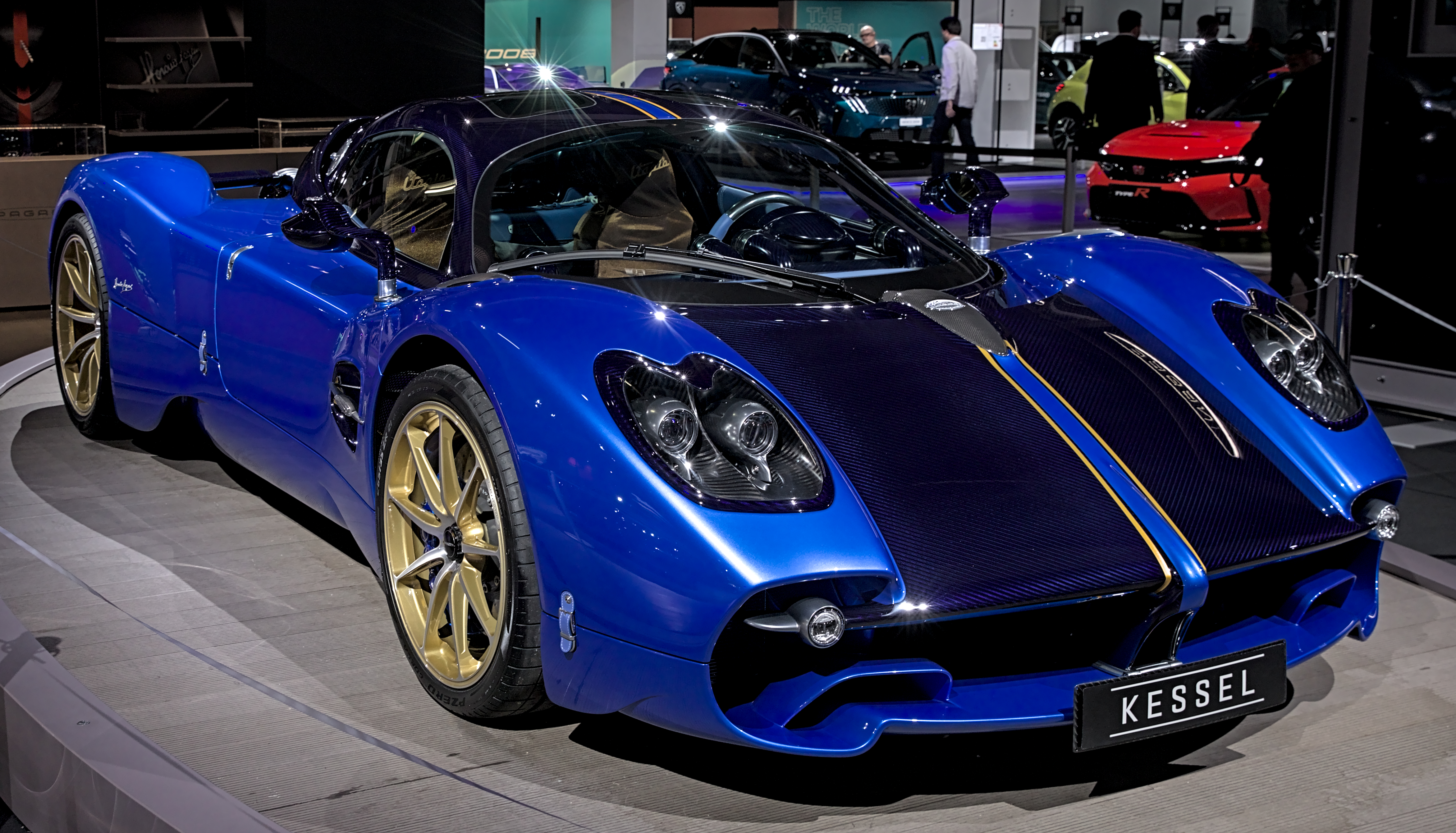
is the Pagani Utopia. It's not the first cyber tire application because the first
tire and cyber tire application dates back to a few years ago with the McLaren Artura.
But the active control, I call it, of the control of the car, the stability program of the car,
the ABS of the car, through tire data is being borne by the Pagani Utopia project.
Basically the tire transmits the tire ID. What does it mean the tire ID? It's a sort of the
small digital twin of the tire itself, the tire characteristics. If you know, for example, the
Mooslip curve, you know exactly the maximum level of friction coefficient at which sleep rate
corresponds. If I take, I don't want to go too much into the technical details, but if you take a
sporty tire, a P0 Trofeo RS, for example, that is fitted on a Pagani, to get the best grip,
the best level of friction coefficient and then adhesion, you need a two, three percent of sleep.
If you fit a winter tire, this sleep rate may go up to eight, nine percent. So you understand that
your ABS has to be set always at the highest level of friction coefficient. If you know from the very
beginning of your braking, which tire is fitted and in which range you have to operate your ABS,
you immediately get valuable advantages in terms of safety and braking distance shortening.
This is a small example. Then there are other parameters you may transmit. Of course, the most
simple ones are pressure and temperature, but apparently are simple ones, but are very effective,
because once again, the dynamics of the tire is heavily affected by pressure and temperature.
So if you have a tire that is under inflated, if you have a tire that is overheated or something
like this, these characteristics of the tire do change with pressure and temperature. And so you
have to know also these parameters to have an active control, not based only on the tire that
is fitted when new, but the tire that is fitted in that very specific moment. This is the integration
inside the car, but we have also developed algorithms to control like a planning. We have
developed algorithms to estimate the wear rate, taking us into consideration not only the tire
characteristics or the car characteristics, but also the driving style of the driver. Because
maybe somebody does not know, but the highest influence on tire wear is coming from driving
style. And it's easy to think if I drive aggressively, it's different than driving smoothly. You can
experience dramatic difference in tire life according to this. So there are many features
that we have developed and that are ready to be applied on the vehicles today.
In many ways, tire data is more accurate than what cars can typically measure through indirect
systems today, correct? Correct. You said the right word, indirect. I don't think that in the
future we will see only tire data or something like this. No, we are working indeed in the direction
of a sensor fusion. So trying to integrate these data coming from the tire with indirect
measurements, with visual, with virtual sensing, in order to have always a better understanding
of what is going on and then a better safety. So indeed, typically a car reacts to something
that has happened. So all the sensors and the controllers are reactive. What we can do is to
try and make this life simple, giving true tire data, true data about the current status of the
contact between the car and the ground. In many ways, all of the safety systems that are involved
with cars, whether it's ABS, stability control, adaptive suspension, feed directly into the vehicle's
control system. But the cyber tire does more than just gather data. It's feeding directly
into those vehicles' control systems. Do I understand that correctly? That's correct.
That's correct. Somebody thinks that cyber tire is a sensor. It's not a sensor. It's a system.
The sensor only gather some data. These data are then transmitted by antennas that are in the car
to a receiver and from the receiver into the controller. But the true heart is inside the
controller of the car. In this, in our case, is the controller that we have developed together
with Bosch generating. So these data are transformed into functionalities, we say,
through property algorithms and tire libraries. In this way, you give the controller the two
characteristics of the status of the tire in a way that the controller then actively controls the
vehicle. So we make the detection, they make the activation and control. I try to simplify.
But to do this, you don't need only raw data coming from the tire. You need to transfer this
into functionalities. But you mentioned another point. Another functionality we can measure,
for example, is the effective tire, effective mass distribution of the vehicle. So through
this sensor, we also know exactly on which individual wheel is the load. Think about an SUV car. As
soon as you jump on an SUV car and you turn the key on, you have immediately the setting. So you
also work on suspensions, for example, according to the distribution of the masses. There are plenty
of opportunities that we have in front of us. And this is only the part related to the in-vehicle
application. Then there is the vehicle to everything application. Let's talk a little bit
about that. What is the vehicle-to-vehicle capability? You know that the future is for
seeing that you can communicate from vehicle to vehicle. For example, aqua planning. I mentioned
aqua planning before. We can communicate to another vehicle that I suffered aqua planning and I
controlled aqua planning on my car. But there is also the possibility to communicate this also to
infrastructure. We are currently working on a project exactly in this direction to communicate
with infrastructure. And I think this is the base of the price that we have been awarded.
It's more related to the V2X than to the stability control of the car, let me say.
Because this opens up the future mobility, the smart cities, the smart roads. So we are not
only working on projects. We have already some projects running or contracts running. Last year
we started with the Italian Motorways. There is a company that takes care of the maintenance of
the motorways. And in the past, to measure the status of the road, you had big vehicles, slow
vehicles, extremely heavy, extremely expensive, running slow, that were mapping the roads on
a certain frequency. But these vehicles are disturbing the traffic because they are very
slow, heavy, and so on and so forth. And normally they map only the right lane. Because you know
that in Europe we are forced to drive right and just overtake on the left, not like in the U.S.
where you can use all the lanes independently. This was a limitation for, let's say, the complete
mapping and the frequency of control of the surface of the motorways. Today in the cyber
tie we have to keep the normal service vehicles, vehicles that have to move from A to B, not to
monitor the state of the road, but just to transfer people to make other services for other reasons.
These companies do have their own fleets that normally travel on the motorway. While traveling
on the motorway, they provide us some data. These data are collected by the cyber tire inside the
tire itself, transmitted this time not to the control unit of the car, but to our cloud.
In our cloud, we transfer this into valuable data for maintenance, typically the iso roughness
to measure, to mention one point. You know the wear rate of the surface of the tarmac
through the iso roughness of the surface itself. So in this cloud, we process the data, the raw
data coming from the sensors inside the tire, transform this into parameters that are used
then by the company that is managing the maintenance in order to have a clear mapping of the status
of the road. In this way you have an easier decision about priorities, an easier decision
when will be necessary to maintain. So with evident effect on efficiency and costs.
And this is already up and running, but we have also started another project
at the beginning of this year, this year in 2025. There is a region in Italy named La Puglia,
which is in the southeast of Italy. And on this region fleet, vehicles of the fleet of the region
are commuting equipped with cyber tire. They are doing exactly the same I mentioned before,
but in this case, we started to use the sensor fusion. So
together with the data coming from the tire sensor, we have also data coming from cameras
on the car. The camera may be a camera that is already existing on the car. In this case,
we have a dedicated camera from a phone that is on the cockpit, for example. And through the vision,
the vision and the data from the tire, we have a complete mapping. We say horizontal and vertical,
because in this case, we can map both the surface, but also the signs, the lighting of the roads.
And you can better give a comprehensive vision of the status of the roads. And this is already up
and running. So in many ways, the city of the future is a tire that's talking to the city
of the future, isn't it? Yeah, the tire, the vehicles, everybody will try to talk, basically,
for giving his own part. We can give some information that in other ways are possible,
maybe, to be gathered, but more complicated. In this way, you have a direct measurement
through the tire, for example, or through the camera inside the vehicle. That's for sure.
That's what we consider to be the future for the smart cities or the smart roads, up to the
point that you can control, for example, the speed limit. You can control the information to the
driver according to the conditions, aqua planning conditions, traffic conditions, whatever it is.
With aqua planning, for example, you can warn through the signs on the motorway that at that
kilometer, you have a possible risk of aqua planning. In the future of autonomous driving,
maybe the car will set automatically in a different mode, will reduce speed or things like this.
So we will see lots of things going on in terms of connectivity between tire, vehicle, and
infrastructure. So road hazard warnings, traffic flow improvements, maybe perhaps even EV range
optimization at some stage. That's for sure. That's another important point. You know that the
EVs are extremely exciting to drive, silent, but extremely not powerful, with a lot of torque,
a lot of acceleration that makes life very, very, very nice. It is a very nice experience,
but you have two points. One is the wear rate of the tire, for example, because the wear rate of
EV, the higher weight and the higher torque, typically wears the tire quicker than an internal
combustion engine car. And the second point that you have to take care when driving an EV is the
battery range. So how can you take into consideration data coming from the tire? The tire through the
driving style, for example, is able to provide the same data you can have also maybe directly
from the car with lateral acceleration, things like this. To inform the driver and to make the
driver conscious of the level of, let's say, of his own driving style to aggressive, he can for
sure experience a higher wear or a lower battery range. All these things are possibly something
that will happen in the future. In the cockpit, you may have, for example, a page displayed
displaying the tire data, not only the tire data, which is the tire, but how you have used your
tire up to this moment. This is something that we are doing with another car manufacturer presently.
After this short break, I'll continue my conversation with Pierro Misami, global chief
technical officer at Pirelli. To see more cars and culture interviews, visit the Cars and Culture
YouTube channel, subscribe, comment and check out hundreds of conversations with the creators,
collectors and culture makers who are driving the industry forward. The automobile is one of the
most important inventions that revolutionize the modern world. In America, the rich history of
car culture runs deep as technology continues to shape the future of the industry. Jason Stein
is here to share the stories of people passionate about cars from industry leaders and innovators
to car obsessed celebrities. Buckle up as Jason takes you inside the boardroom onto the track
and around the bend on Cars and Culture on SiriusXM Business Radio.
Welcome back to Cars and Culture here on SiriusXM. I'm your host Jason Stein.
Now the continuation of my conversation with Pierro Misami, global chief technical officer
at Pirelli. To see more cars and culture interviews, visit the Cars and Culture YouTube channel,
subscribe, comment and check out hundreds of conversations with the creators, collectors
and culture makers who are driving the industry forward. You're the sole tire supplier of Formula
One and there's so many great headlines, great breakthroughs, great achievements as a result
of that. How much did motorsport telematics influence cyber tires development?
Motorsport is always the pinnacle of technology, there is no doubt. Very often we say that Formula
One and motorsports give us the possibility to transfer technologies to normal production,
which is basically true. But not so often we say that what we transfer are not only
pure tire technology and materials, for example, tire construction, tire materials,
but design methodologies. From Formula One, the digitalization started first.
Let's say the virtual simulation of the tire has been developed in Formula One,
in the motorsports. The first simulator was made by Dallara, together with Pirelli.
So for us as Pirelli, we have been working the first time with Dallara and then we have
transferred this to the, let's say, everyday usage cars and tires. And also the data, of course,
are extremely important in Formula One, as you know, the transfer of the data are very important
to make all the simulation. So, always motorsport is a little bit ahead of what will happen in,
let's say, the normal business. And also in this case, we have been able to learn how to get data
from there. We don't use the cyber in Formula One, but we have made some tests also in Formula
Two, for example. We have been using it in Formula Two, collecting a lot of information and also
helping us to understand how to make this sensor more robust, because Formula Two, the forces,
the accelerations and so on are dramatic. One of the key points for a tire sensor is that it's
extremely critical because of the condition it's working, under pressure, under high temperature,
but also very high acceleration. Think about when the sensor goes under the contact patch.
You have hundreds and hundreds of instantaneous G acceleration. So, you know that the body is
able to stand seven, eight G. Here we speak about many hundreds of Gs. Of course, it's a peak,
but it's every wheel turn, the sensor will suffer this. So, it has led us to develop a robust sensor
today. Let's talk a little bit about sustainability. The McLaren W1 program proves that high
performance and responsible materials both can exist together and they can actually excel together.
How did that collaboration begin and why was the W1 the right car to showcase for this program?
Well, the W1 is the most challenging in terms of performance, of course. As I mentioned before,
the motorsport is always something that challenges us to the extreme of the technology. In this case,
W1 is probably the street car that hosts. It's mostly similar to the supercar on the track,
but we don't stick only to the W1, because of course we try to make this on many other projects.
How do we develop sustainability, for example, together with safety and performance? I say
safety and performance, because for me safety and performance are one word. If you have a
performing tire, you have also a safe tire. And this has to go side by side with sustainability.
We call it eco-safety design. We don't have making a sustainable tire a compromise on safety,
it never. Pirelli is a brand that is recognized for performance and indirectly then for safety.
Power is nothing without control, we always said, to highlight how the performance and the safety
are strictly connected. So we demonstrated the possibility to do the two things side by side.
Two years ago, we launched the P0E, the first tire in the UHP segment, which across the full line,
the full production line, the full range has minimum 55% of materials biobased or recycled,
certified, not told only by Pirelli, but certified by foreign body, of course. With JLR, we have made
already a project with over 70% to demonstrate that the path is there to make a sustainable
tire in terms of contact of material. And the second point to make a tire that has a very
low rolling resistance, making also a very high performance. We have been the first to
keep on the BMW, for example, a winter tire that has the A-class label providing the best
winter performance. So as you can see, we are committed on different projects. W1 was a very
challenging and tough project for the very high end, but then we have also some others
that show how we can really try to make sustainability live together with safety and performance.
And you used a lot of simulation technology right from the start. You're always using
simulation technology. Then comes physical testing. You did physical testing in Italy,
Spain, Sweden, validating performance in extreme conditions. What made that process so critical
to understand? Because when you move from simulation to pavement, I mean, things can change
remarkably, right? It's true, but it took us a few years to refine again the programs because
the point is you can buy a driving simulator, but it's not the driving simulator that makes a
difference. It's your capability of elaborating the specific functionalities of the tire through
algorithms, the way you simulate upper planning, the way you simulate wear rate, the way you
simulate noise. Recently with XTM and a new product we have launched in the US, we have
been able also to simulate mud traction, for example. Impressive. As you say, it's difficult
to correlate something that is simulation with something that is real life, but through the
time we have been able really to refine the programs and algorithms behind this. The driving
simulation is only a tool that is available for everybody, but the true core in the capability
of developing software today for us that allow us today to, let me say, to simulate more than
80% of the total environment of the tire performance virtually and then have practically
only a verification on the car. Then the driving simulation is very important because
you have absolute performance of the tire, but also relative performance, performances that
are related to the kind of vehicle, and you know that to get an homologation you have to
tune the tire for that specific vehicle. Then it's necessary, of course, to make
the session on the simulator, getting the black box of the car from the manufacturer in order to
get the best performance for that specific car. So there are two ways to use the
virtualization. To make a new product line, 80% of the performance, as I mentioned, is already
virtualized, but then anytime you have to make an homologation, you have to make a tune for the
specific vehicle. And in this case, the simulator is this key to reduce the number of physical
loops that you have to do while developing. Piero, let's talk about the future a little bit.
Where do you see the next big inflection point coming from? Is it raw materials? Is it manufacturing
innovation? Is it mass balance sustainability scaling or AI assisted development? Where does
the next inflection point come? Interesting, because all of them are key to us, because when we
speak about sustainability, we have to speak about three directions of sustainability. The
environment sustainability, which everybody recognizes, but we have a social sustainability
that means that we have also to be able to provide safety to our drivers and the economic
sustainability. The company must survive and here comes to the manufacturing efficiency side
that you mentioned before. We have more than 31,000 employees in Pirelli and we have a
responsibility versus them. So all these points are very important. We have to make tires that
have the best performance in a way that are manufactured in an efficient way in a factory.
This is the true challenge, but the most important change we have experienced today
is AI. I go back to the point of simulation. Simulation is based on physical models.
You have a physical model of the car and a physical model of the tire. You match the two
and you simulate how they work together, let me say, but it's based on multi-body concepts.
It's based on physical laws. Very good, but a tire is made of material, is made of compounds
typically and this compound you have also to describe into your physical simulation.
And to describe this material is very challenging because it's something far from what an engineer
studies. An engineer studies small deformations, linear behavior, and not too much temperature
dependent. A tire is exactly the opposite. It's absolutely temperature dependent and everybody
recognizes this through warm-up, over-eating, or things like this. It's non-linear, heavily non-linear
in the behavior and it's also characterized by materials that have a very big deformation.
We have deformations of 200% under the contact patch, which is an enormous deformation. To describe
a compound through physical model and chemical models is dramatically complex,
let's say, still today is very far from being realized. So what we have done is to try and
switch to artificial intelligence. We have made, to make the long story short, something similar
to what the pharma industry has made. Pharma industry is today developing molecules for pharma
on the base of AI. We develop compounds on the base of AI. What does it mean? We have a huge amount
of laboratory data on our materials, on our compounds, that has been collected through the last
years. We have been able to feed some dedicated artificial intelligence programs with this data
to train them, connecting the laboratory data with the physical, let's say, the
characteristic of the compound, the ingredients of the compound, in order to get the best way to
develop compounds, not through virtual simulation based on physical models, but based on artificial
intelligence. Fascinating world. Just a few more questions. When you connect the dots,
cyber, tires, intelligence, plus sustainable supercar, tire, innovation, what's the bigger message?
The tire is now a performance component, a sustainability component, a data intelligence
component, all at once, isn't it? Yeah, today is all in one. It has always been something related
to sustainability and safety. Today, we include intelligence. This is the true novelty of the
cyber tire. Yeah. When we look at one day, the tire in the future, could we see fully circular in
terms of materials and maybe fully intelligent in terms of real-time monitoring?
For sure. I do see both these possibilities. Let's start from the material side.
If you think that up to a couple of years ago, 70 percent of the tire was coming from fossil
based. This was the standard. Today, we have already proven that we can revert this. Less than 30 percent,
the project with JLR, for example, is fossil based. In a couple of years only, we have been
able to make it. Let's say some concepts. We have made a concept with Volvo, where we experimented
that is up to 94 percent bio-based or recycled. The path is there. The point would be the
capability of defining materials available at a reasonable price and at a large scale to be
produced at the industrial base. This is the true challenge today. The ideas we do have,
the point is to find a way industrially to make them on large scale and economically possible.
From the integration in terms of connectivity, we have already said this is only the first step.
We will see this integration both in car and to the infrastructure. I do believe we will see
a lot of changes in the future in this direction. This must be amazing for you. I know personally,
you were an aeronautical engineer originally. To have this kind of technology
living within tires is probably something you could not have imagined when you first joined
Pirelli in 1985. I have already more than 40 years of experience inside. That means that
it has always been challenging. It has always been providing, let me say, really challenging
satisfaction while working. This is indeed a huge transformation we are having in these days
through connectivity and sustainability. The true point is to try and match the experience
that I can bring in with the competencies that the young guys are providing, the young generation
that have been digitally born. We discussed about technology, but the true, let's say,
winning point will be to have the best people. The best people today are the young people that
are digitally born, no doubt. But you have to find a way to match also a little bit of experience
to let the old guys like me do their part. Who will be able to match in the best way
this experience with the digital speed of the new generations will be the winner.
So, all in all, we will go back to the point where the best people will make the best company.
And one of the most important things going forward is that you have to have
a set of tires that have different personalities depending on different cars.
I just think of a couple of examples, three bespoke tires, the P0R, the Trophail RS,
and maybe the Winter 2, each designed for different personalities of the car.
But you also have to ensure that they all maintained an over 50% sustainable content
without sacrificing quality. Is that correct? Absolutely correct. Not only,
it has to maintain the brand identity. So, of course, you have to provide the sustainability,
you have to provide the safety. But then you have to make tuning on the requirement of the
specific vehicle manufacturer for a specific car to be fitted. But at the same time,
your customer has to recognize I'm driving on a Pirelli tire because he has expectations
on the Pirelli tire. So the Pirelli values, the Pirelli expectation must be satisfied anyhow.
This is the way we work. We customize versus the customer, keeping an identity, a brand
identity, and the product recognition that is always the Pirelli product.
So that at the end of the day, the driver doesn't feel the tire, but the car feels the tire.
I always say the best way is to have a driver that enjoys driving, does not have to take care
about the car or the tire. At the end, he has to think about the tire, not while driving,
when he sum ups what kind of a good experience he has had while driving later on. Otherwise,
it means it has a problem while driving. While driving, only to enjoy the driving pleasure.
That's it. Yeah. What comes next for you? What are you most excited about going forward?
Today, the biggest challenge is coming also in the manufacturing side. I just mentioned very briefly,
but for me, the biggest change is the new revolution inside. The factories are connected
with IOT, artificial intelligence, digital twins. Also, there is a true revolution. In the past,
we have been working on the manufacturing side, always in terms of efficiency,
a lot in terms of delocalization, but now the world is going more local for local.
And you have to stress a lot the automation and you have to stress a lot the digitalization
in terms of inside the factories. And this is, again, another challenge that is coming to me
personally, which excites me quite a lot. Is intelligence the new competitive differentiator
in the performance tire market? Could be. Could be. But you have only to consider that
the physical tire anyhow is what we live off. And the physical tire has to be
the best performing tire to allow you to enjoy in a safe way. So drive safely, but drive with a lot
of, let's say, of satisfaction. At the end, we come always to the highlight. Power is nothing
without control. So we have to give power, but we have also to give control.
Well, congratulations on your 2025 Autotech Breakthrough Award and the Pirelli Cyber Tire
and a lot of really interesting partnerships. Can I ask one more thing? How much time do you get
to test these tires and what's the most fun that you've had where you've had the chance to test them?
Any time I jump on a car or on a bike, because most of my experience was on two-
Motorcycles. Yeah.
Motorcycles. Yes, I was managing also the business unit motorcycle tires inside Pirelli.
The fact that we are able to enjoy while driving is a sort of motivation. So the passion is also
a driver for us. I mentioned before that we need the best people, not only the best people,
but the best people that do leave this as a passion. You have to be passionate for automotive.
You have to be passionate for cars, for motorcycles. And that's exactly what I experience anytime
I jump on a car or sit on a bike. Can you tell your Lewis Hamilton story for one minute about
his 44 bikes? Yeah, you have also the possibility to meet extraordinary people. We were discussing
about Lewis Hamilton and I still remember. I was so excited when I saw how Woody is also on a bike
because he was making 44 pieces of the MV Agusta F1000 and he was testing personally this bike in
Vizzola on our test track in Vizzola. It was amazing to see such a car champion doing great
things also in Vizzola. Congratulations on your 40 years at Pirelli and you could not have imagined
40 years ago what we are talking about today, I'm sure. I will see you at a race track in North
America in the future or anywhere actually. I would love to see you anywhere, but congratulations
on the cyber tire and on everything that you've been able to do and on the award as well.
Thank you, Jason. I appreciate it. I really look forward to meet you. Maybe Miami since you're
living in Florida. Sounds good. It will be easier for you. Next May. Yes, exactly. That's right.
You know the calendar very well. Thank you, Piero. I appreciate it. Congratulations again.
Thank you, Jason. See you soon. A big thanks to my guest again, Piero Misani, Global Chief
Technical Officer at Pirelli. To see more cars and culture interviews, visit the Cars and Culture
YouTube channel. Subscribe, comment and check out hundreds of conversations with the creators
collectors and culture makers who are driving the industry forward.
That's episode 229. I'm your host, Jason Stein. We'll see you down the road.
About this episode
Piero Misani, Pirelli's CTO, discusses the revolutionary Cyber Tire technology that enhances vehicle safety and performance through real-time data collection. Honored with the 2025 AutoTech Breakthrough Award, this intelligent tire communicates vital information like pressure and temperature to the vehicle, optimizing driving dynamics. Misani also highlights Pirelli's commitment to sustainability, showcasing the development of high-performance tires made from over 50% bio-based materials. The conversation dives into the future of mobility, where tires not only support vehicles but also act as active participants in data-driven decision-making.