
Episode 416: 2026 Cadillac Vistiq, 2025 Toyota Prius Plug-In Hybrid
Unnamed Automotive Podcast · Aug 17, 2025
Annotations will appear as you listen
0:00
47:48

Car
Chevrolet Nova

Car
Cadillac XT5

Car
Cadillac XT4

Car
Cadillac XT6

Car
Cadillac Lyric


Car
Cadillac SRX


Car
Suzuki X90

Car
Rivian R1S

Car
Cadillac Optiq

Car
Dodge Charger

Car
Volvo EX90

Car
Bmw Ix

Car
Toyota Prius

Car
Toyota RAV4


Car
Ford Escape

Car
Volvo XC90
LIVE
Hello, and welcome to the Unnamed Automotive Podcast. My name is Sammy Hajafzad, and with me
as always is my good friend and fellow automotive journalist, Benjamin Hunting. Say hi to the people,
Ben.
Greetings, human listeners.
Greetings to everyone. If this is the first time you're listening to our podcast, thank
you for trying something new. I will reiterate Ben and I are a pair of automotive journalists,
but more important than that, we're very good friends. Right, Ben?
I just want to tell everyone out there who's listening right now not to adjust their volume
or their EQ because Sammy does have a little bit of a frog in his throat right now.
Yes.
So that's what you're hearing. There's nothing wrong with your system.
Somehow during the hottest summer known to man, I got a cold.
There's something wrong with his system, his internal system, his body system.
But you know what there isn't anything wrong with? Ben's working output because
you can find his work all over the internet. Ben, why don't you plug a couple of
publications that you recently were written for?
You can find my work at Hagerty, at Motor Trend, at Driving, and at Capital One Auto
Navigator.
And you can find my recent work at driving.ca and autotrader.ca.
Oh, and Sammy, I want to add one more because so...
Hit me.
Sammy and I both write for Driving, which is owned by Postmedia, which in turn
owns like 80% of the newspapers in Canada. But sometimes our work ends up being
published in newspapers and we have no idea. Like it ends up being syndicated out
into Canada. And over the past week, I've been appearing in newspapers again.
Like there had been like a break or maybe Postmedia just wasn't telling us.
And there have been two stories in the last make that have made it into print.
And it's been a long time since I've been in these particular papers.
So that was kind of fun. One was the province and the other one was I think
based in Nova Scotia. So that was cool.
Yeah. I mean, I always love seeing our stuff in new publications all the time.
Yeah.
Ben, we've got some cars to talk about this week. Are you ready?
I am ready.
I think I'm ready too.
After humble bragging about being in Canadian newspapers.
Yeah.
I realize how that sounds now.
After being in Car and Driver and Motor Trend and in automobile magazine or
whatever else you've been in. Yeah. Why don't we talk about the Canadian
newspapers? I actually still have some issues of the Toronto Star.
Are you saying Canadian newspapers aren't as good as the publications you just
named because... No, but I'm going to be clear.
I still have a couple of issues of the Toronto Stars wheel section that have
both you and me in it and a spread like me on one side and you on the other.
Yeah. That's how we've always fantasized that spread with look.
It's great.
I use the name Mike Honcho.
So you might not have heard about it.
Sure. Sure.
It got real weird.
Of course it did.
Then what are we talking about this week?
So I have a couple of vehicles I want to talk about this week.
The first one is brand new in the sense that neither of us has ever driven it
and it just kind of arrived in showrooms.
And that's the 2026 Cadillac Vistick.
Sammy, before you ask, yes, this is another electric Cadillac SUV.
Whose name ends with a Q?
I wasn't going to ask that, but what is the deal with this car?
Don't they? So first of all, actually, we've talked about Cadillac and their EV strategy.
They might be the only automaker with a with a complete, at least not in the terms of crossovers,
complete EV portfolio, right?
It's not only a complete EV portfolio, but it's one that is replacing its gas powered
portfolio.
Yes.
So up until the last couple of years, if you went into a Cadillac showroom and you
wanted an SUV, you could get an XT4, an XT5 or XT6.
You probably shouldn't have gotten any of those.
Well, they were all there.
They were all gas powered.
I mean, we recently drove an XT6 within the past year and I liked it.
Sammy, but I wouldn't call it a class leader in any way.
These vehicles were there and you could buy them and now they're gone.
The XT4 is on its way out.
The XT6 is on its way out.
I heard that it was maybe going to get a second gen or something or something was
going to get a new generation.
The XT5 has been pushed to the end of 2026, but the second generation that vehicle
from what I understand will not be making it to North America.
Oh, my God.
So I think they're just prolonging the production of the current one.
So these vehicles are all gone and Cadillac was not selling a ton of them,
but they weren't selling zero.
So the interesting move that they've made is to replace them.
So the OPTIQ slides in for the XT4.
The Lyric is the XT5 replacement and that actually came first.
That was available last year.
And now the Vistick is there to replace the XT6.
And wow, Sammy, is this a glow up for like anyone looking at a three row Cadillac?
Really?
Yeah.
This is much more modern.
Yeah.
Considering the XT6, there are other three row option.
Yeah.
Okay.
Fine.
I get it.
So I mean the Escalade is still in the mix.
The gas powered one.
But there's the IQ.
There's the IQ version of it.
And the IQ L version of it.
Which we talked about recently.
So the, but it's the only gas powered vehicle that's sticking around.
Like XT5 is essentially a dead SUV walking.
Like it's not in the future plans of Cadillac, I don't think.
The Escalade very much is.
Everything else though is this full electric lineup, which is a brave thing to do.
But it's not just a brave thing to do, but it is also a, oh, Sammy just sent me
a link that says the 2027 XT5 is coming to Canada.
Who knows what that means?
Does that mean it'll come to the United States as well?
Who knows?
That's really surprising.
It's a very, it's a very strange report that I read, but I don't know what's going on.
Well, I want to point out that this vehicle is built in, is it built in China?
The XT5?
The photos in the article are a Chinese market XT5.
No, it's not.
Yes, it actually says that.
Current one, no.
2025 Cadillac XT5 bracket Chinese market.
So, yeah, on this bottom one, OK, yeah.
So here's the thing.
There is a, the XT5, if you keep reading this article, it says, if geopolitics were different,
we theorize Cadillac could pluck the handsome China market XT5 out of Asia
and enroll it for duty on our shores.
Terrorists make that unlikely today.
That's because what there's like 100 percent tariff on Chinese vehicles in Canada.
Yeah, I don't know how that works with things like the Envision, which are sold here,
which is built in China.
Oh, yeah, I should go take a look at the price of that.
In the United States, there's also a lot of tariffs on Chinese vehicles right now.
So I don't know.
Like it's confusing.
That's not what we're really talking about today, though.
So that's kind of. Sorry, I just, I remember just hearing something.
My favorite thing to study about some automobiles are like one generation products
and the XT5 is definitely a one generation car.
And the funny thing about the XT5 that really caught me off guard is that
it replaced a vehicle called the SRX, which was a which was a sales leader.
Like it had a bajillion sales and the XT5 did not.
And it has been languishing on the vine for a really, really long time.
Anyways, go ahead, talk to me about this Vistik a little bit more.
OK, so the Vistik replaces the XT6, which is definitely leaving.
The the interesting thing about it is I mentioned it's so much better,
or at least I use the term more modern than the XT6.
That's because what Cadillac has done for its EVs is it uses
essentially the same platform for all of them.
It's called BEV3 and every vehicle, I think, except for the Escalade
IQ is based on this.
So you end up with a model that takes what was good
about the about the Lyric and the OPTIQ, which have really cool elements
and embiggins it.
Like it's this vehicle is about 18 inches shorter than an IQ,
a Cadillac Escalade IQ.
So it's not super enormous.
It's also a little bit narrower, but it is considerably larger than an XT5.
And to bridge that gap, it kind of looks like an Escalade.
And if you look at Cadillac's marketing materials,
they keep using the term baby Escalade, which is weird
because I think it's actually as big as a gas-powered Escalade.
So I see some family resemblance,
especially when you look at like the roofline and the front end,
which isn't quite as slanted as you have in like a Lyric or an OPTIQ.
But there's enough difference.
There's enough daylight between this model and the IQ
where you won't be thinking, I just bought a slightly smaller Escalade.
So you contrast that with the XT6 and even the XT5,
and they were very different.
Like it's clearly an older era of Cadillac styling.
And Cadillac never really took the effort to upgrade the XT6.
The interior was from another era as well.
The technology never really developed to the point
where the EVs had already reached.
So if you're if you were in an XT6 right now
and you went to a Cadillac dealership and said, OK,
I've had this for like four years, I need something new.
And you got into you got into a Vistik.
You would be shocked by how nice it is.
Yeah, I mean, I think that's fair.
The the vehicle lineup.
The like, come on, let's be clear.
They're crossovers that were not not electrified.
We're feeling we're feeling old and that in comparison,
all of these these EVs have gotten so much love over the years
and are coming in so fresh.
But I think the biggest thing is that you have pointed out
to me off podcast, off podcast that the Vistik has been
has been exhibited as a potential
alternative to the Escalade or or replacement even to the Escalade.
And I don't understand.
I don't understand that position and I don't understand that feeling.
And I don't know what you not understand about that.
The Escalade is an icon.
First of all, why are they because it's not for everyone.
It's very expensive and it's also overkill for most people.
I mean, look at it this way.
That's the point.
No, but I think you're pushing this from the wrong angle.
OK, Chevrolet has the suburban, but it also has the traverse.
Yeah, this is the Cadillac version of the traverse.
OK, the just because a vehicle is large and has three rows
doesn't mean it has the same necessarily the same customer
or even the same capabilities like an Escalade,
even an electric Escalade has to be able to tow quite a bit
and it has to be absolutely enormous.
Those are the two things that it's best known for.
But you can still there's still room to make a three row Cadillac
that does not push into flagship territory, right?
OK, yeah, fair. OK, I think about like a BMW five series is essentially
everything about it is as good as the seven.
The seven just happens to be larger.
But what I was what I was pointing at is that the Escalade is is an icon.
Like it truly is an icon in the luxury world.
But it's so it's not a replacement.
Let's be clear, it is not a replacement.
It is an alternative.
It's not even an alternative.
It's a replacement for the XT6 Cadillac already had this vehicle
in their lineup and now they have it in its electric.
Easily, that makes more sense to me.
And an XT6 replacement. Love it.
The XT6 was not really impressing a lot of people.
I think this is going to do a much easier job of turning people's heads
in a number of ways.
So tell me a little bit more about this design.
Is it does it work with you, this vistic design?
Sure, I think it's fine.
I think it looks pretty good for most angles.
Mine was like this, like a deep metallic blue
that I think would pretty good on it inside.
It's really I want to I want to point out one more thing before we talk
about the the interior.
There's that exterior garnish that is that is on the same
that is the same as what's found on the OPTIQ.
This weird like deep this deep pillar window
like applique. Yeah, it's like it's like an etching.
An etching. Sure.
What is their deal with this?
So this is like a this like a signature for their electric vehicles or something.
I think it's just detail. I think it's just styling.
It looks good.
Does the Lyric have this as well?
I got a double track.
I don't remember.
But anyway, the interior of the vehicle,
it doesn't really follow in the escalates footsteps.
This is where you really see the BEV3 platform.
Taking shape.
So it's like it borrows bits from the OPTIQ and the Lyric.
Specifically, the dashboard doesn't have the edge to edge screen
that you have in the escalate.
It has a 33 inch screen that curves towards the driver and only
it only very OPTIQ.
Yeah, it's it's the same as the Lyric.
It's essentially the same screen.
The center consoles are also different.
The seating is different.
Mine had captain's chairs in the second row.
And I actually think that there's more headroom
in the Vistick in the third row than there is in the escalate
because the roof is not quite as aggressively shaped
like it doesn't trail down to the same degree.
And there's also this like it's like a permanent.
So the there's a skylight inside the Vistick
that runs over the first and second rows
and you can like open and close it, etc.
But in the third row, there's like a portal or a porthole.
I guess you can say over the third row that you can't close.
It's it's tinted and it's there to basically make you feel
like you're not stuffed in the back of a very large vehicle.
OK, you're riding back there.
I think the first the first and second rows are very comfortable.
The third row, it's OK.
It's it's OK to get into as well.
It's not super hard, but it's mostly for kids or smaller people.
The biggest issue with it is when you have a full Vistick,
there's only like, I think, 15 cubic feet of cargo space available
behind the third row.
Yeah. And most of the front trunk.
There's no front trunk on this,
which is another big difference from the IQ, which has a massive front trunk.
If you fold the second row seats, though, you or the third row, excuse me,
you have 40 cubic feet, which is really good.
OK, perfect. And altogether, I think it's 80.
So it is a useful vehicle.
I mean, I think another thing to point out,
differentiating the escalate maybe or or just thinking about what a third row,
three row daily driver does is it's intended to fill a lot of roles.
Like if you think you need a third row,
it's because you probably occasionally drive seven people around
or six people or whatever.
But it's also probably because you have cargo needs
that would not be satisfied by a two row vehicle.
And I think that the Vistick does a good job of meeting those needs.
OK, that's that's a that's a pretty good distinction.
I like it because it it feels
like the three row segment of EVs at this level
is are really like the struggling to make an impression.
And this sounds like it's it's leaning more in the right direction
in all of these ways.
I don't know if they're struggling to make an impression
so much as there just aren't really any of them.
Like well, great.
There's the X 90, which I wouldn't recommend to anybody.
I mean, it just has the worst user interface ever.
It's a gorgeous car inside and out,
but you cannot drive like you just cannot drive it
without getting frustrated at the at the user interface.
It's awful.
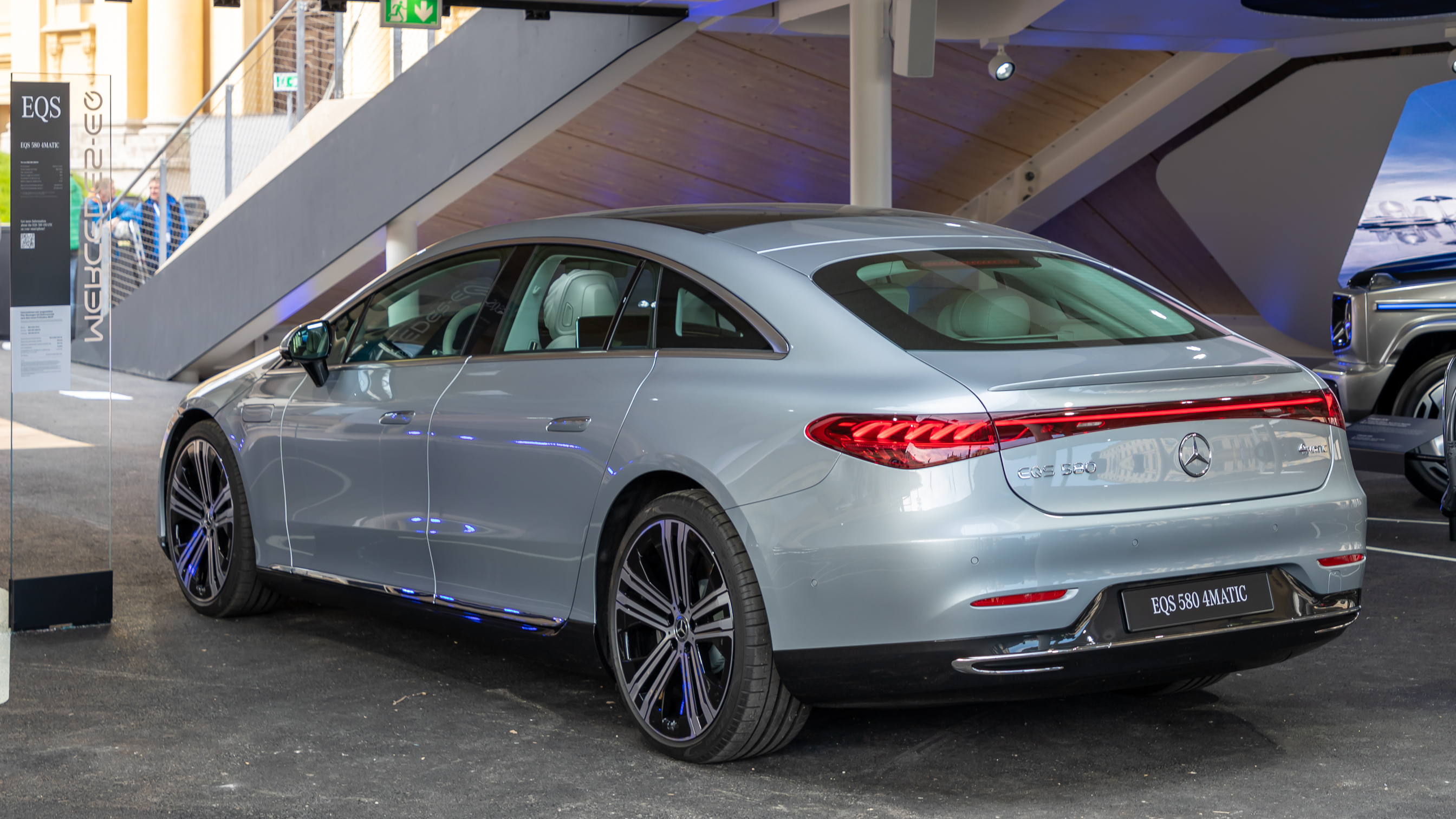
There's the Mercedes EQS, which is, I think, much more expensive.
It's more expensive
and it's not a true three row in the sense that you can get a two row version.
So it kind of has an optional third row.
It kind of has a jump seat feel.
So and I also don't remember it also.
I don't think it's very pretty.
It's smaller inside as well in general.
And I don't think it's very.
It doesn't leave you with like this wow factor.
It's not a vehicle I would recommend to anyone.
I mean, yeah, there's there's the Rivian R1S.
We haven't driven that.
But based on what I've seen, it looks like a pretty cool truck.
There are also many different versions of it,
which is kind of circling back to the Vistik.
There are different trim levels of the Vistik.
But as far as I can tell, they all have the same drive train.
So you get all wheel drive as standard.
It has it's a dual motor setup.
It has six hundred and fifteen horsepower and six hundred and fifty pound feet of torque.
Oh my goodness.
Yeah, that's a lot.
But the thing is you can only tap into that if you use the the velocity
max drive mode, which is the little V button
that Cadillac puts on the steering wheel of the vehicle.
Oh, OK, hold on. Time out. Time out. Time out.
There's a V button on the steering wheel.
Most electric Cadillacs have that.
I didn't drive that.
I didn't I didn't see that on my on my OPTIQ that I know.
I think they're coming out with a V version of the OPTIQ.
Yeah, they're making an OPTIQ V.
And I think they're making a Lyric V if I'm not mistaken.
But if you get the if you get an escalate, for example, there's a V button there.
So they're just throwing the into into stuff.
Like I think that some of the V series V series gas powered vehicles
had that as well to access like V driving modes.
So it's kind of like that's the thread line.
That's the thread that connects all of these vehicles.
But it's called velocity.
What now? Velocity Max.
So it allows you to tap into max power from the battery.
The reason for this is probably because if you tapped into
Max power all the time, it would be a heat problem.
Velocity Max powers.
Yeah, I love that.
So you don't want to have.
You don't necessarily want people to be romping on the accelerator
and generating crazy heat.
I can tell you that Cadillac is very cagey about saying how much
power is available in like regular touring or sport sport mode.
What if your butt dino say?
My butt dino says it doesn't matter.
It's pretty quick all the time.
It does three point six seconds to six channel some early rock charisma there.
It does three point six to sixty in velocity Max mode.
And it runs like a twelve second quarter mile,
which is totally crazy for like a sixty three hundred pound vehicle.
There's no need for that.
It's absolutely something you'll use once to impress your friends
and terrify yourself and then never use it again.
That's pretty much what these V modes are for.
That's too fast.
Yeah.
More importantly, it has three hundred and five miles of range
unless you get the nineteen point two kilowatt charger version,
which has three hundred miles of range.
That's weird.
Yeah, it is a little weird.
I'm assuming also comes with two charger options,
but they have the same range.
I'm assuming that that's for level two charging, right?
Like that's.
Yeah, I mean, if you can ask that's an unusual level to charger.
Like you'd have to have not many people have that at home.
So I'm assuming it's when you're out and you find a more dedicated
level to charger in any case, that's an option you can get.
The charging speed is capped at one hundred and ninety kilowatts.
It's one hundred and ninety is OK.
It's fine.
It's like middle of the road, apparently, for vehicles these days
at this price point. OK, look, we have cars.
First of all, two cars actually hit the three fifty that that electrify America.
No, I think that I think they max out around like two something to ninety, I think.
So you'll add 80 miles, which is about 130 kilometers of range in 10 minutes.
OK. On a on a plug in theory, like under the best conditions.
Yeah, if it works and it's 102 kilowatt hour battery.
So I averaged 400 kilowatt hours per hundred miles,
which works out to about two hundred and fifty five miles of driving recharge.
I was driving in very hot weather and I mean, like what I say, very hot.
I mean, like kind of record setting heat for for our area.
That probably had some kind of impact on it.
If you want more range, the Rivian R1S will do better.
The Volvo Ex 90 is pretty much the same.
So it's I'd say it's competitive.
I don't think you're going to look at that and turn your nose up.
I mean, three and five miles is like four hundred and ninety, five hundred
fifty kilometers, like in that area.
And it's that's more than enough.
I mean, what more do you need?
I do notice, though, that like a battery this size, 102 kilowatt hours,
when I plug it into my level to charger, it takes a long time to get to 100
percent or 80 percent or whatever.
Yeah, I remember you kind of being impressed by the 200
and five kilowatt hour battery on the on the escalator.
Yeah, it takes absolutely forever.
Like charging that and charging the Ford Lightning or the Chevy Silverado,
any of these like gigantic battery things, it's just nuts like nine to ten hours.
Yeah, maybe even more.
I think it might be a little bit more.
But yeah, my mind goes, my charger is probably like seven and a half kilowatt
hours or seven and a half kilowatt.
So what's 200 divided by seven?
You know, like it's like 30 hours, isn't it?
From zero. So, I mean, come on.
So, but at least it's interesting to see, look, my major my major criticism
with GM and their Altium vehicles is that they seem to really want
to push the size of the batteries or they're or they're utilizing battery
size as an as a way to showcase strong range on their vehicles.
But I also think that that comes with, you know,
there's like a level of diminishing returns.
Yeah, we talked about it quite a bit with the very large
battery in the in the in the escalator or any in the CV that much
battery start adding so much weight and the so much.
And then, as you mentioned, you even add even more time to charge the vehicle.
And I think a lot in a lot of ways, these things contradict each other.
The the Vistik, I'm glad they've reserved.
They've they've reserved the battery size a little bit.
They could have made a 200 kilowatt hour battery version of it, I suppose.
But they didn't 100 is probably the the max, which is probably
acceptable these days in a in a car weight wise, because this is probably a 60.
It's sixty three hundred, sixty three hundred pounds.
But I mean, you know, you look at like an Ionic five or on a six
and they have a seventy seven kilowatt hour battery and they do the same range
pretty much. Yeah. So that that tells you how the mass works out.
I mean, that's a battery that's about two thirds the size.
I driving wise for a large vehicle.
Yeah, it's fairly it's very comfortable.
If you're not on too much of a bumpy road, like or even a road that has a lot
of undulations, you won't really notice the heft of the vehicle.
If you if you drive it too quickly on a country road that is going to be
that has bumps, it'll move you around in your seat.
The vehicle doesn't feel out of control, but you know, you're being jostled.
Does that have air suspension or anything?
No, the steel springs on this model.
I drove the the sport, which is one up from base.
The the brakes.
I'm up two minds.
The first the first thing is they work pretty well in an emergency
situation or just a normal driving.
I had a I had a flock of turkeys, wild turkeys,
crossed the road in front of me while I was driving at maybe like
fifty five miles an hour, so like 90 kilometers an hour.
And I had to stop the vehicle myself because the collision detection
did not detect these creatures, which are roughly the size of a toddler.
So keep that in mind when you're using these safety systems.
Kids are out there and you need to pay attention.
Even though you have the safety gear, it's not going to cover every single situation.
In any case, I had to stop very quickly and it did no problem.
But there were other times where when I was driving in a parking lot
or I was using supercruise in stop and go traffic,
the there was a grinding a jerking and just like a general harshness from the brakes.
It was like they were catching and then releasing very quickly.
It was very unusual.
But I remember driving a first year Lyric last year
and having like a grinding metallic sound coming from the front of the vehicle.
So I'm starting to wonder if like first year
BV three platforms just aren't necessarily being tuned properly before they go on sale.
Interesting.
I was having a bit of a of a not grinding.
I was having a lot of brake squeal with the OPTIQ that I had.
Definitely not squeal.
This is like a physical problem with brake grabbing.
Thirteen inch vented discs, man, I was expecting.
And I will say the air suspension set up on the Volvo X90 was so good.
Ben, it was so, so, so good.
I cannot get over how well that car drove for how big and how heavy it was.
And it's a shame that Cadillac hasn't hasn't designed a ride.
I don't think it's a shame.
I don't have a problem with the ride on this car.
You said that if you're if you're not on an undulating road or a bumpy road,
you won't notice if you're driving a three ton vehicle very fast on a back road.
I don't think I think it's reasonable to expect some jostling.
And there is an air suspension, I believe, on higher trims.
OK, I don't have to be to be clear.
I'm not complaining about the ride on this vehicle.
I haven't even driven it.
The other the the other complaint I do have, aside from the clunky brakes
is the infotainment screen, sorry, not the infotainment screen,
the gauge cluster, which is part of that big one screen thing they have going.
There was only one configuration I could use where I could see the
the speed of the vehicle because of where the steering wheel was positioned.
There's no HUD in this model.
So I had to use the gauge cluster and the steering wheel
would block out the speed on everyone, except for the if I use the map setting,
which converts the gauge cluster into a navigation map.
And at the very bottom, it puts the speed.
So that's where I could see it through the spokes of the wheel.
Everywhere else, it was like either to the right or to the left
or in the middle at the top, all of which were blocked by the steering wheel.
That is frustrating.
I don't I don't like it.
I feel like I feel like speed should be a center line
display readout.
And you should test to make sure your steering wheel does not block it in any position.
Yeah, you know, obviously, I'm not some weirdo with a freak body
because they drive cars all the time and I have the steering wheel set up in those cars
and I don't want to answer.
Way to answer anybody who is about to message us about about your freak body.
Yeah, I headed them off.
You really got it.
Sorry, guys, you can have to try harder.
You really were so ready to make sure nobody comes at you.
The other thing that kind of sucks is there's no Android Auto and no Apple CarPlay.
Yeah.
And the systems inside the Cadillac infotainment system are not as good.
I mean, they work, but they're not as good as having your phone
being replicated there and just using apps that you already have installed
instead of giving yet another company access to your personal information.
The pricing for the vehicle is pretty good for this model.
It's for this type of vehicle starts at like the low the high 80s.
I think let me double check that.
Sorry, low 80 thousands and the top top spec is like a hundred and one grand
after you include delivery and all that stuff.
That's in the US in Canada.
The model I had was right around 100.
I had only had two options.
One of them was paint and one of them was that captain's chairs in the second row.
So it's it's expensive.
Yes, but it's in keeping with the rivals.
I think the only vehicle that's a lot more, as you mentioned before,
Sammy, is the EQS. Yeah.
It sounds like this is much more.
This is much more competitive than than the EQS.
I like it.
I think that if you need a luxurious three row SUV,
you've only really got three or four options.
This should probably be one of them.
Drive it, see what you think.
There's nothing about it that is a no go.
Like there's nothing about this vehicle where I was.
I mean, aside from the Android Auto Apple CarPlay thing,
which I think for some buyers will be a problem.
But you're going to run into that with Volvo as well, right?
And I think Rivian.
Yeah. So what are you going to do?
So the other question I have, though, is if you're looking for a large,
like, let's be clear, the three row option in a lot of these three
row vehicles is not super, not super useful.
As you mentioned, the moment you start filling people in the third row,
you basically run out of cargo room, which limits its use as a family vehicle,
meaning there's no opportunity for the stroller back there or something
like that. I don't know. Maybe you could put a stroller.
It would depend on how it folds.
And of course, yeah, you could probably you could also probably fold one of those seats.
Yeah, one of those seats down, right?
But if you were going to like I've often like encouraged people to maybe
think about a third row, a three row vehicle, but always keep that
that third row folded down because then you have a lot of cargo room
and you have a lot of good space in the second row as well.
There is one two row SUV EV called the BMW iX,
which I think is very good, but doesn't come with a third row.
There's lots of good two row EVs, but I think it's just size wise.
I think it's comparable and price wise and feature wise.
Yeah, but I really think you got to restrict it to three rows
because I really think the only reason you're looking at a vehicle
of the size is for the third row.
Like I don't I don't necessarily see someone as saying,
I just want a longer two row vehicle.
I think maybe there are people like that,
but I don't think there are a lot of them, if that makes sense.
OK, I think I get it.
I mean, there's the even even if you look at like a Tahoe,
you know, there's no two row Tahoe.
They always make sure to have that third row in there. Right.
OK, well, I was just trying to, you know, expand the search a little bit
because I don't think you can.
I mean, I think we're still like at the nascent level
or the nascent point for this segment.
I mean, we talked about how rare it is for a company to have
a fully featured EV SUV lineup period, right?
That's fair. OK, yeah, perfect. Good point.
So there's one more vehicle I want to talk about this week,
and I want to do it a little bit quickly because I drove it.
I want to say last year, is that possible?
Maybe it was two years ago.
And that is the I'm going to take a look right now.
That is the Toyota Prius plug-in.
Sammy, this is the this is the Prius
that made everyone lose their minds, right?
Yeah, listen, the Prius.
Last year, one car of the year, I think,
by a couple from a couple of publications.
So I drove it in October of twenty twenty three.
And I was I think we all we all came to it
wondering after it won that we all came to it wondering,
is it really like car of the year?
And and to me, you know, a lot of things,
a lot of things make a car the car of the year has to be desirable.
It has to make an impact on the market in a really strong way.
And I found that the Prius actually did everything it was supposed to do
and it went beyond whatever it was before,
which was kind of a vehicle that was focused on fuel efficiency over anything else.
It was kind of compromised in that way.
But now it's not just a car that delivers really good fuel efficiency.
It's good looking. It's comfortable.
It's fast. It's fun to drive. It's high tech.
OK, I agree with everything except fun to drive.
So it's more fun to drive than it used to be.
I I'm not trying to say it's like it's like a civic essay or something.
So I've never.
Well, it's interesting you bring that up
because we are going to talk about the civic essay, I think, in this context.
I never had a problem with how the Prius drove.
And I actually thought it was because it didn't have to drive well, right?
It drove fine.
And the current one also drives fine.
But I think one of the bigger knocks against the Prius was the generation
before this went full weird in terms of styling. Yeah.
And I'm there for that.
Like, I honestly, it was an oddball car.
And I think oddball cars can be cool
because they stand out from what everything else looks like.
And I just don't know if that served the Prius well
because the Prius was already kind of on the outside.
If you look at the Prius sales figures, there's a huge drop in the last five years.
And I think that's for a couple of reasons.
The first is there are many other hybrids in this in the Toyota showroom.
You don't just have to buy a Prius anymore, right?
In fact, you can get a Corolla hybrid, right?
Sure, you can get a Corolla Corolla Cross, a RAV4.
Like the RAV4 was a sales monster and to add a hybrid version to that.
And then eventually a plug in, you're just going to be
sucking in all those people who maybe were only buying a Prius
because they felt like it was their only choice.
And then you leave the Toyota showroom
and there's lots of other hybrids in other showrooms now,
which was not the case for a very long time.
So Toyota had to do something.
And the something that they did was they made the Prius look like a normal vehicle.
And they actually made it look like a like a hot hatch pretty much
like a sporty four door shaped like an arrowhead hot hatch.
Yeah. That being said,
I don't think styling is enough of a reason to buy a Prius
because last year or earlier this year, I drove the all wheel drive version
of this vehicle, Sammy, and I don't have you driven that vehicle.
Yeah, that's the only one I've driven.
Just the non plug in hybrid version of it.
OK, actually, that's the one that you were driving.
Yeah, I think I've also driven this vehicle.
I remember being underwhelmed by it. OK.
I just thought it was fine.
I didn't really feel like the all wheel drive really brought much to the equation.
It didn't seem like anything other than like a decent appliance.
But when I drive the Prius plug in, which used to be called the Prime,
they changed it to the plug in a couple of years ago.
I feel like it transcends the regular the regular Prius for a couple of reasons.
The first is it's essentially an EV for for most people.
I was getting like sixty three to seventy
kilometers on the battery and that's driving like at highway speeds.
That's driving up and down hills and stuff.
The the energy management is really great.
It's like a thirteen point six kilowatt hour battery.
It lasts forever.
It only took two.
It only takes two hours to charge on a level two charger.
I mean, you can charge it on a normal plug,
like even without a level two in a reasonable amount of time.
I think for most people, that's all they're going to need.
Like you're going to rarely use the gas engine
because of just how well managed the the EV powertrain is.
Two other things about it,
that EV powertrain is not super fast, but it's powerful enough
to not kick on the gas engine when I'm going up a steep hill,
which is something I can't really say about many other plug in hybrids.
I'm fine with that.
I mean, I think it I think it's fair that most other
I need to stop saying that this whole fair thing.
I need to stop this and you catch myself on this.
But I think it's a great point that you bring up a lot of other hybrids
struggle to to rely on the electric motor to do every day motoring.
And that's uphill, downhill, that's off the line acceleration.
Yeah, it's really nice to have a car just kick in that gas motor,
maybe on the highway.
No, not even half.
When did you really feel it coming?
If you log, if you lock it into EV mode, the gas motor is out of the picture.
I never had it kick in.
I think that the one of the big reasons is
this is the only subcompact plug in there is.
That's not it. That's not an SUV.
Like every other subcompact because it is.
I think this is Corolla sized.
I know, it's smaller than a Corolla.
No way for sure.
For sure. Have you seen the cargo area of this vehicle?
Yeah, the backseat. Yeah, it is.
I didn't mind the backseat.
I put I ended up putting a rear facing seat in there with no problem.
Sure, that's fine for kids.
But if you're an adult, that rear slope is going to impinge on your headroom.
Also, so vehicle segments are defined by passenger volume.
And I think that also pushes the
previous into subcompact status.
But in any case, my main point is, OK, forget subcompact.
This is the only small plug in that's not an SUV.
Small plug in that isn't an SUV.
There aren't any others.
The next closest in size to this is the Keoniro.
OK, yeah, I know that.
And then once you're past that, you're looking at like Ford Escape
and RAV4 and stuff like there's nothing else that's this size
that also plugs in.
And the reason I bring this up is because the big part of why
all of those other plugins have to kick in the gas motor
is because they're heavy.
They're these big, heavy vehicles and the Prius is not.
So it has that advantage and that advantage further plays out
when you do kick on the gas engine and you're in hybrid mode.
It still gets like an absurd amount of fuel mileage.
I got 63 miles per gallon in this thing.
I think that's like 2.7 liters per 100 kilometers, something absurd.
Sammy, I drove almost 400 kilometers in this vehicle
and I used five liters of fuel.
That's unbelievable.
That's totally crazy for American listeners.
That's one and a half gallons.
And that's because I was able to plug in every day.
So I love that.
If you can regularly plug in.
I did two like I did 260 kilometers of highway driving,
which is like 160 miles of highway driving.
And I still only used a gallon and a half of gas in a full week.
So that's very, very impressive to me.
And it's not that much more expensive than a regular Prius.
I think it's like three grand more or something.
So I totally think it's worth the leap.
I drove the base model, the SE, the equipment was fine.
I did not have any complaints.
I think this is perhaps the ultimate commuter car.
I think Toyota has finally created like a no compromise
commuter that is for everyone who wants to, you know,
have the benefits of commuting on EV power and not not have to buy gas.
But then if they want to leave the city for the weekend
or they have to go visit relatives for the holidays,
they can do that without worrying about range anxiety.
But just the space you're saying is the major concern of this of this car.
I don't know if it's a compromise.
I don't know if it's a major concern, but the cargo area is certainly tiny.
It's a little strange when you look at the official numbers.
There's 15 point.
Oh, I'm sorry.
I'm looking at the the wrong number here.
Is it 15 or is it 20?
I have the I have the figures here.
OK, there's 20 cubic feet of cargo space in the trunk, which is not huge.
That's like technically what you would find in like a large sedan.
But for a hatchback, it's not great.
The weirder part is if you fold the seats down,
Toyota tells you you only have twenty six point seven cubic feet.
Yeah, not useful.
But how does that make sense?
Like, I don't think that's right.
Like, but either way, the the determining factor
for what you could haul in this is your item can't be large enough
to hit that very sloped hatch area.
So even if you do fold those seats down, it's like a small tunnel
that you have to get through to get to the larger cargo area
of the passenger passenger space.
So, I mean, a Mini Cooper and a Mini Cooper is small.
Isn't there a plug?
Oh, there's not a plug in version of a Mini Cooper, just the contraband.
Yeah, but I'm just talking about the form factor.
I'm just thinking, I mean, you just made me remember
that there is a Mini Cooper out there.
Yeah, anyway, the Mini Cooper has 40 cubic feet of cargo space
to give you an idea of a car that is smaller than a Prius,
yet has more cargo space. No, thank you.
That's because the roof is taller.
So that's that's the real limiting factor on this.
In any case, I like this vehicle.
I think people should have it on their test drive list.
This is definitely like, I wouldn't say I'm a Prius convert
because I've always kind of liked the Prius,
but the plug-in is a very, very compelling model.
If I lived in a city and needed a car,
it would be hard to not, you know, join the cult, I think.
No, I completely agree with this assessment.
It is super, like I said,
I feel that it's not compromised in this generation.
And I think the price is fairly competitive.
I think the most difficult question you end up having is,
is it worth it to get the Prius over a really well equipped
Corolla hybrid? 100 percent.
I think I think it is.
I think there's something about the Prius.
One terms of design, it looks it looks really good,
both inside and out.
It doesn't feel as cheap as a Corolla does, even its highest trims.
And I truly do think that the platform works in this car
in the form of, I'm like, OK, I said fun to drive.
What I mean to say is it's way more responsive
than a cheap compact car like a Corolla.
It has 220 horsepower, which is 20 more horsepower than a Civic Si.
220? Yeah, 220.
So it has as much horsepower as, let's say, like,
isn't that what the hybrid version of the RAV4 makes?
It might be the same drivetrain.
I'm not sure how many different drivetrains they have for the plugins.
But the weird thing is, Toyota is like strange about torque.
If you look at their torque listing, it's a hundred and thirty nine pound feet.
That's the amount generated by the two liter four cylinder engine.
They don't have a total system torque rating.
So it is much quicker than the torque rating would suggest
because you have the instant on torque of the electric motors.
It is with in hybrid mode, it is much quicker than when you're on EV mode.
But what I really think it's also to get to your point about how it is to drive.
It's pretty quiet inside.
It's not thrashy with the CVT and it's comfortable on longer trips.
But for me, what really sells it is the plug-in aspect.
So like that would push me past a Corolla hybrid or a Corolla cross or whatever.
Just the plug-in thing.
That's that's the killer app for this vehicle.
That's that. I love that.
Yeah, it's it's nice to I don't know.
It's just nice to drive something that's like so well engineered
and completely understands what people want.
The the other thing I don't like other than the cargo area
is in the Prius, they push the gauge cluster all the way up to the windshield
and it's this tiny little screen on that screen.
There's like a bajillion menus for like safety systems,
especially and like vehicle info.
And you have to use a steering wheel controller to get through all of it.
And it's not obvious and it takes forever and it's it's a flaw.
But it's not nearly as enough of a flaw for me to say, don't buy this vehicle.
Like, yeah, you can learn to live with it.
Everything else about this, you can tell Toyota completely understands
what hybrid owners want.
So yeah, it's it's a pleasure.
We drive so many like vehicles that are built as you've said in the past,
saying to fill white space in the showroom or they're built
because a competitor has one and they feel like they need to have a rival to it.
But this this is a pioneer that has continued to pioneer.
And it's maybe it wanted the woods for a little while, but now it's back.
Well, I mean, that's that's a really admirable thing for Toyota to have done.
They could have just chilled out and just redone redesigned the outgoing model.
Yeah, they were selling like thirty five thousand, forty thousand units a year.
And now I think that for twenty twenty five, they might have already hit that.
Do you think that's because, well, yeah.
Is all will drive new for this generation?
All will drive is not available with the plug-in. So I don't know.
Oh, that's true.
You're speaking strictly on the on the plug-in.
It's hit that many. No, I'm talking about Prius in total.
Prius, OK, that all address been available for a little while.
It was available last year. OK.
So what I'm just trying to say is is they're doing a lot to make it better.
The Prius has always been a fuel efficiency first car.
And now it feels like the the
not only did they hit that mission, sixty three miles per gallon.
That's awesome.
No, when you said it in Lear's Brunswick kilometers, that's even more.
I'm pretty sure I'll do the conversion now, but I think it's two point seven or something.
I'm pretty sure it is two point seven, which is brilliant like that.
There is nothing you will never find something like that.
Well, I think this might not be metric.
Just a second. There's so many weird converters online.
You have to be really careful. No, it's OK. I totally.
I think it's three point seven.
OK, sorry. It's still pretty good.
Pretty crazy. Anything under four is very good.
Yeah. And I also think it's worth pointing out
that the non plug-in hybrid is also fairly good to drive as well.
I know you're you're speaking strictly of your experience with the.
Yeah, which has more power.
It's I think it's 20 more horsepower.
In the plug-in. Yeah.
And also, I'm not sure if the electric motors have more power in the plug-in,
but I don't know.
I think that it's a no it's a no brainer to upgrade.
Like the price differential is I'm going to double check.
I have the figures here, but it's really not that much more.
Let me check here.
So it's a plug-in and a non plug-in.
Yeah. So the plug-in starts in the mid 30 thousands
and you could pay 40,000 for it if you want in U.S.
I don't recommend doing that because like I said,
the base model is a compelling vehicle in Canada.
It's it's more expensive.
The base model I drove in Canada is 42,000.
That's a fair amount of money, but I don't think you need to spend more.
When I look at the pricing for do I have it here?
I was pretty sure that I had the the markup versus the the regular Prius.
OK, no, I don't have it.
I'm sorry. That's all right.
But from memory, it was really only a few thousand more.
Definitely within the realm of the possible.
Yeah, definitely. OK.
Anything else you want to talk about?
No, I think I'm good. I just want to say, though, I'm going on vacation next week.
I know Sammy is the one who is endlessly on vacation.
Yes. But next week I'm going on.
Endlessly. Yes. Endlessly.
Constantly. He's as an endless summer.
Sammy is the beach boy of this podcast.
I love it. He's just chasing the waves and the good vibes.
And, you know, doesn't let anything get to him.
Unlike me, who's just letting everything get to him
all every second of every day.
So to try and avoid that, I'm on vacation next week.
We will not be recording.
We will record when we come back.
And when we do that, I'm going to be talking about the BMW IX
that Sammy just brought up.
I'm going to be taking it on a road trip.
And I'm sure I'll have thoughts.
Sammy, what are you going to be talking about?
I'm going to get my hands on a couple of of Hondas,
but I'm for sure going to be in a Volvo XC90 plug-in.
Okay. All right.
So we'll see if it's as good as the Prius.
I mean, spoiler alert, I'm sure it's not.
But, hey, Hope Springs Eternal, right?
That's right.
If you want to listen to past episodes,
you can go to unnamedautomotivepodcast.com
or search unnamed automotive podcast on any podcatcher.
We are out there. We are easy to find.
There's also a few ways you can get in touch with us.
On the website, there's a contact form.
Fill that out.
Let us know your thoughts, questions, fears, strange ideas.
Click submit and it goes to our inbox
or you can find us on Instagram.
Sammy is at Sammy underscore ha, like you're laughing.
I'm at Hunting Benjamin
and you can email us the old fashioned way,
Benjamin, at BenjaminHunting.com.
Thanks everyone. We'll talk to you next week.
Bye.
Bye.
About this episode
The episode dives into the 2026 Cadillac Vistiq, an electric SUV that replaces the XT6, showcasing a modern design and impressive features. The hosts discuss its performance, spacious interior, and competitive pricing compared to rivals. They also touch on the 2025 Toyota Prius Plug-In Hybrid, highlighting its improved efficiency, practicality, and user-friendly technology. The conversation emphasizes the evolution of both vehicles, making them appealing options in their respective segments, while also addressing some drawbacks like cargo space and infotainment systems.
Original notes
Benjamin fires up the show with his take on the 2026 Cadillac Vistiq, an electric three-row crossover that seems to be replacing Caddy;s own XT6. With 102 kWh of battery on tap, and over 600 hp, this is a big player in the world of EVs, but what else makes it stand out? While the world of three-row EVs is relatively slim, Benjamin suggests that the Vistiq might have a chance to be the best in its class, if only GM could sort out some small teething issues first.
Then the show turns towards plug-in hybrids, as Benjamin and Sami quickly discuss the 2025 Toyota Prius PHEV. Formerly crowned as car of the year, the guys pinpoint what makes this Prius special compared to previous ones, and whether this plug-in variant is one of the best commuter cars on the market. Thanks for listening!

Unnamed Automotive Podcast
Unnamed Automotive Podcast
0:00
47:48