
Episode 8: Are Harleys Fast? And Why Do We Modify Them?
About this episode
Jamie and Lucas debate whether Harley-Davidsons are truly fast and explore the evolution of modifying them. Drawing on their racing backgrounds and high-horsepower street cars, the father-son duo compares older 60-horsepower twins to today's high-performance Milwaukee-Eight engines. They share stories of "Black Betty," their pioneering 2010 Street Glide drag bike, and discuss how professional bagger racing has brought track-ready technology like Brembo brakes and inverted forks to everyday street riders.
Are Harleys really fast? The answer depends on what you're comparing them to.
In this episode of the Fuel Throttle Podcast, Jamie and Lucas discuss one of the most common questions in the motorcycle world and why the answer isn't as simple as a horsepower number or quarter-mile time.
Drawing from decades of experience—from road racing and sport bikes to modern Harley-Davidson performance builds—they explore how our definition of "fast" changes over time. The conversation covers the evolution of Harley-Davidson motorcycles, why today's Milwaukee-Eight engines are capable of incredible performance, and what motivates riders to modify their bikes in the first place.
The discussion also compares modern performance baggers to sport bikes, muscle cars, and high-horsepower street cars, putting Harley performance into real-world perspective. Along the way, Jamie and Lucas explain why building a motorcycle isn't always about chasing the biggest dyno number—it's about creating a combination that fits the rider and delivers the experience they're after.
Whether you're new to Harley performance or already planning your next upgrade, this episode offers practical insight into why riders modify their motorcycles and what "fast" really means.
In this episode:
- Is a Harley-Davidson actually a fast motorcycle?
- How our definition of speed changes over time.
- Comparing Harleys to sport bikes and performance cars.
- Why modern Milwaukee-Eight engines have changed expectations.
- Why riders modify their motorcycles beyond horsepower.
- Finding the right performance combination for your riding style.
dyno
"Lucas, how many horsepower does your daily driver have? What without being on a dyno, hard seven, eight hundred, maybe tough to say."
A dyno is essentially a giant treadmill for vehicles. A car or motorcycle is strapped down onto rollers, and as the wheels spin, a computer measures how much power and force the engine is actually putting down.
Short for dynamometer, a dyno is a device used to measure an engine's torque and rotational speed (RPM) to calculate its real-time horsepower output, typically measured at either the engine flywheel or the drive wheels.
performance bagger
"I mean, the performance baggers that we're gonna talk about here, I got a Kawasaki H2 as well, besides the Harley stuff. So, and it does have bags on it, right? Is that's a performance bagger, I guess, right?"
This is a type of large touring motorcycle (the kind with big storage bags on the back) that has been modified with racing parts to make it incredibly fast and agile, turning a heavy cruiser into a high-performance machine.
A performance bagger is a touring motorcycle, traditionally designed for long-distance comfort with hard saddlebags, that has been heavily modified with high-performance engine parts, upgraded suspension, and lightweight components to improve speed and handling.
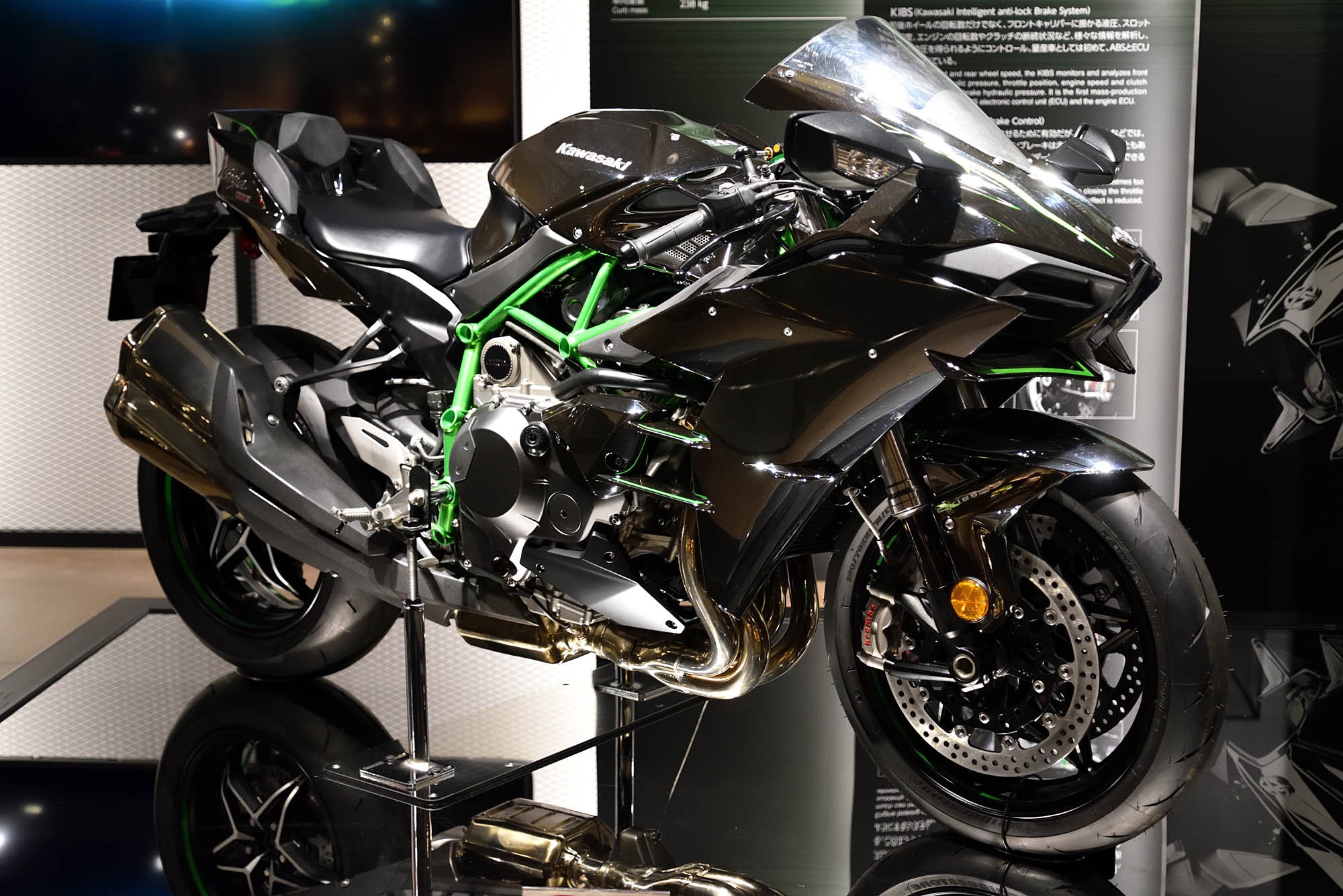
Kawasaki Ninja H2
"...I got a Kawasaki H2 as well, besides the Harley stuff. So, and it does have bags on it, right? Is that's a performance bagger, I guess, right? But that one's over 200 horsepower."
This is an extremely fast, high-tech motorcycle made by Kawasaki. It uses a special air compressor called a supercharger to force more air into the engine, allowing it to make over 200 horsepower, which is as much power as some small cars.
The Kawasaki Ninja H2 is a supercharged supersport motorcycle in the Ninja sportbike series. It is famous for its centrifugal supercharger, which allows its 998cc inline-four engine to produce over 200 horsepower in street-legal trim, making it one of the most powerful production motorcycles ever built.
big bore kit
"We have seen that in our 20-some years of business really change where we set our bar in our builds, like when 88 and 96 inches we started making those big boar kits and a lot of 107 kits for a long time."
This is a kit of parts used to make an engine's cylinders wider so they can hold larger pistons. This increases the overall size of the engine, allowing it to burn more fuel and make more power.
A big bore kit is an aftermarket engine modification package that increases the cylinder bore diameter. By using larger pistons and boring out (or replacing) the cylinders, it increases the engine's total displacement to generate more horsepower and torque.
inverted forks
"I mean, even just the standard CVO bikes have inverted forks and really good brake Brembo calipers, all that stuff on them."
This is a type of front suspension on motorcycles where the thickest, strongest part of the suspension tubes is at the top near the handlebars instead of down by the wheel. This makes the steering feel more precise and stable when cornering or braking hard.
Inverted forks (also known as upside-down or USD forks) orient the suspension slider at the bottom and the thicker outer tube at the top, clamped into the triple trees. This design reduces unsprung weight and increases front-end rigidity for sharper handling and better braking stability.
Brembo
"I mean, even just the standard CVO bikes have inverted forks and really good brake Brembo calipers, all that stuff on them."
Brembo is a famous Italian company that makes top-tier brakes for fast cars and motorcycles. Seeing their name on a vehicle's brakes is a sign of high quality and excellent stopping power.
Brembo is an Italian manufacturer of high-performance automotive and motorcycle braking systems. They are widely recognized as the industry standard for high-performance stopping power on racing machines and premium production vehicles.
ECU
"One cool thing too about the the bikes themselves, rider controls that the stock ECU has and the vehicles. You got different modes, different things."
The ECU is the brain of a modern vehicle. It is an onboard computer that constantly monitors sensors to decide exactly how much fuel and spark the engine needs to run smoothly and safely.
The Engine Control Unit (ECU) is the primary computer that manages an engine's fuel injection, ignition timing, and auxiliary systems. Modern ECUs also integrate rider aids like traction control, wheelie control, and selectable power modes.

Chevrolet Corvette
"...ke, why were people buying roadrunners instead of Corvettes? Right."
The Corvette is a famous two-seat sports car made by Chevrolet. It is designed to go very fast, look sleek, and offer the thrill of a race car that you can legally drive on public roads.
The Chevrolet Corvette is an iconic American sports car known for delivering high-end performance and striking styling at a fraction of the cost of European exotics. First introduced in 1953, it transitioned to a mid-engine layout with the eighth generation (C8) in 2020, cementing its status as a world-class supercar competitor. It is often discussed as the benchmark for accessible American performance.

Plymouth Roadrunner
"Right. Because a roadrunner was a cornet or you know, a base B-body car or wh..."
The Road Runner was a powerful, two-door American car from the late 1960s and 1970s. It was designed to be cheap to buy but very fast in a straight line, and it even featured a horn that mimicked the 'beep-beep' sound of the famous cartoon character.
The Plymouth Road Runner was a mid-size muscle car produced between 1968 and 1980, built on Chrysler's B-body platform. It was specifically designed to be a back-to-basics, affordable performance car, stripping out luxury features to focus purely on raw V8 power and speed. It is highly regarded today as one of the purest representations of the classic muscle car era.

Toyota Prius
"...t than sitting there watching YouTube videos of a Prius with a Hayabusa or LS engine in it doing that stu..."
The Prius is a highly fuel-efficient hatchback made by Toyota that uses both a gasoline engine and an electric motor to save gas. It is widely known for being incredibly reliable, practical, and environmentally friendly.
The Toyota Prius is a pioneering hybrid electric vehicle that became the global symbol for eco-friendly, fuel-efficient transportation. While traditionally known for its sensible, commuter-focused design, the fifth-generation model introduced in 2023 added sleek styling and significantly more horsepower. It is a frequent subject of extreme aftermarket engine swaps by enthusiasts looking for the ultimate sleeper car.
Road America
"This is a good area, and it's also cool since we've been talking about King of the Baggers, that we have a really good venue. There's lots of car stuff that goes on at Road America that's really awesome."
Road America is a very famous, historic race track in Wisconsin. It is known for being very long, fast, and challenging for both sports cars and motorcycles.
Road America is a legendary 4.048-mile, 14-turn road racing circuit located near Elkhart Lake, Wisconsin. Established in 1955, it is famous for its high-speed straights, dramatic elevation changes, and challenging corners like 'The Carousel' and 'The Kink'.
Request an Explanation
Heard something you'd like explained? We'll add it to this episode.
Sign in to request explanations for terms you heard.
Want to learn more?
Browse our glossary for plain-English explanations of automotive terms, jargon, and concepts.
Help improve this episode
See something that's not quite right? Our annotations are AI-generated and can sometimes miss the mark. Click the flag icon on any annotation to suggest a correction.