An electric vehicle is a type of car that runs on electricity instead of gasoline. This means it uses batteries and electric motors to move instead of a traditional engine.
A gas engine is a type of engine that uses gasoline as fuel to make the car go. It's more complicated than electric engines because it has many parts to control pollution and make the car run better.
Variable valve timing is a system in gas engines that changes when the engine's valves open and close. This helps the engine run more efficiently and powerfully depending on how fast the car is going.
The transmission assembly helps the car change gears, which is important for going faster or slower. It's a key part that connects the engine to the wheels.
An inverter is like a translator for electricity. It changes the type of electricity from the battery so that the motor can use it to make the car move.
This system helps make the car go faster by changing how the power from the motor is used. It slows down the motor's speed but gives more strength to the wheels.
The Tesla Model Y is a type of electric car that looks like a small SUV. It doesn't have gears like regular cars, which means you don't have to shift while driving, making it easier to handle. People talk about it because it's popular for being eco-friendly and having a lot of cool tech features.
Battery failures happen when the battery in an electric car stops working properly. This can make the car unable to run or reduce how far it can go on a charge.
ICE vehicles are cars that use gasoline or diesel to run. They have engines that burn fuel to create power, which is different from electric cars that use batteries.
A supercharger helps electric cars recharge their batteries quickly, similar to how a gas pump fills up a gas tank. It makes it easier for drivers to get back on the road faster.
Pre-planned maintenance is when you schedule regular check-ups for your car to keep it running well. This includes changing things like brakes and oil at certain times instead of waiting until something goes wrong.
Unit replacement means taking out a whole part of the car and putting in a new one instead of fixing just a small piece. This is common in electric cars where parts can be complicated.
High voltage means electricity at a level that can be dangerous. It's used in electric cars and requires special care when working on it to avoid getting shocked.
The stator is a part of the motor that stays still and helps create the magnetic force needed to make the motor spin. It's important for how the motor works in electric cars.
Modular repair means you can swap out parts of a car easily instead of having to replace the whole thing. It makes fixing cars simpler and cheaper over time.
Preventative maintenance means taking care of your car regularly to stop problems before they happen. This includes things like changing the oil and checking the brakes.
ICE means Internal Combustion Engine. It's the kind of engine that uses fuel like gasoline or diesel to run, unlike electric vehicles that use batteries.
Catalytic converters are parts of a car's exhaust system that help clean the air by changing harmful gases into less harmful ones. They are important for keeping the environment safe and are required by law.
Oh, by the way, I'm going to be out at the TST annual event, the TST big event on
Saturday, March 28th, 2026, Tarleton, New York.
Here from educators Andrew Fisher, Ken Zanders, Adam Roberts, go to TSTSeminars.org and sign
up for one day technician training.
And even here from the keynoter, I happen to know her, Tracy Capriotto, it'll be your
first keynote ever.
She thanks G for giving her this shot.
Hey, look, great show from a good old friend catching up with Pete Rudloff and that
comes right after a great word from our partner.
Hey, when customers choose a Napa Auto Care Center, they get more than a repair, they
get trust savings and peace of mind.
Want your shop to stand out, connect with your local Napa representative and get the
conversation started to become a Napa Auto Care Center.
Hey, let's face it, your shop management system is the most critical tool in your
shop and Napa Tracks will move your shop into the SMS fast lane with on-site
training, six days a week support and local representation.
Find Napa Tracks on the web at NAPATRACS.com.
Welcome Pete.
Glad to be here, Carl.
Oh my God, Pete.
I don't know why, but I was thinking about you and I really have a lot and then I
read this article that you wrote on lighting and I said, screw this, I'm just reaching
out to Pete.
I sent him an email and I said, I got to catch up with you.
What are you doing?
How's it going?
First of all, we recorded eight episodes together back in the day.
Me and you one-on-one and then you came on all these great panels with us and I found
out he says, oh, I don't have the shop anymore and I go, this may be an interesting
episode.
Because so many people, Pete, we call it the senior tsunami that's going on in
our industry.
They're all thinking about getting out or how do I transist, who do I give the
business to?
And you just said, screw it, I'm out.
What happened?
25 years in and you decided just to get out.
No, so it was always the long-term plan.
If I'm being honest, I missed my plan by a couple of years.
Early on as a technician working at a dealership, I knew that I didn't want
to be fixing cars full-time once I was past like 45.
So I'd set a goal to be able to retire by the time I was 45 and to be able to do
easier stuff, basically.
So I was always the plan was to be done by 45.
I ended up, I retired at 47.
Selling the shop was never really part of my plan.
So I was always the guy that rented a job and made a good living, renting a
job and like having my tools and equipment, so I still have all my tools and
equipment.
I built a workshop in my backyard at my house.
I got a 2,400 square foot workshop with three automotive lifts and a motorcycle
lift in it and like all my tools and equipment fits in there and I can do
whatever I want to for my own stuff and family, friends, or I've been working
on some research stuff as well.
It's the peat cave.
It is, yeah.
I didn't ask you when we talked the other day how big it was, but 2,400
nice little size there.
Side note, I built it myself.
You didn't call the Amish people to come up and put it up for you?
No, it's all steel.
So we built it out of steel.
It's a fully steel structure, the skeleton, the paneling, everything.
We did the insulation, the electric, the plumbing, the HVAC.
I did all that myself on the building.
Good for you.
What I find interesting, I don't want to belabor the thought that since he
didn't sell and he took all of his equipment back to his place, you
obviously plan this.
And I think that's one of the key components to this whole story
of peat is I knew I was going to retire at 45.
You said you missed it by two years, so you did it at 47.
You were 25 years in business, right?
Yep, 25 years in business, yeah.
25 years in business.
And you said, I was smart enough to know that I did not have to sell
the business or sell the equipment.
And basically, peat, everything I've ever known about you,
you loved what you did.
I did.
So I've never worked, right?
Like I've always, working on cars has always been fun for me.
The challenge of it and all that, I've always just enjoyed.
So it's never really felt like work.
The employee aspect was always work to me, having to manage employees
and that sort of thing.
That was the hard part of shop life, I guess you could say.
But now I don't have that to worry about because I have no employees.
It's just me.
So you did it.
You earned a great living.
I did.
Yeah, yeah, working on cars has been phenomenal for me.
I was a guy who never intended to get into fixing cars.
I got into fixing cars really by accident and stayed in fixing cars
because the money was good.
And fixing cars treated me really well financially.
So it's been a good career for me.
You wrote a lot of articles I know for Auto Inc.
Wrote a feature called Show Me the Fix.
I know a ton of people read those columns.
Were those your big challenges?
Those were jobs that probably appeared challenging.
So Leona used to ask me for different ideas of what we could do.
We thought it would be fun to take cars that the vehicle owner's perspective
was the car was hard to fix and figure out solutions for them.
So we would advertise on Craigslist for cars that had been to three or four
different shops and we would offer to fix them for free.
And we would bring them into the shop and we would figure them out
and then I would write an article based around it.
To say it was hard, it's not really hard.
It's just you got to know what you're doing and have a plan.
Just like anything else.
So it was really what it was about was having a plan.
And then for sure those were fun articles right
because you're unwinding a puzzle basically.
So then a lot of times the pieces were broken
and so you had to figure out how to make them fit back together again.
It's amazing to hear that and I think that think helps the people
that are in our industry that are successful
but maybe aren't as successful as they'd like to be.
And the tough challenges that came at you,
you said to me, Karm, if you can't stay in your lane
you're not going to be as successful as you want it to be.
That's always been key for me.
As a shop I never was a work on every make and model guy
so we always focused on a handful of models.
I was never big enough shopping.
The biggest we ever were was four technicians and an apprentice
was the biggest that my shop ever was.
So from a volume standpoint
we never had to work on everything
that could possibly come through the door.
So we narrowed our focus down, raised my labor rate up.
I was always the most expensive shop in the area
and we just stayed really well-told
and well-educated on the stuff we were working on.
And for the most part I'd say that really made cars
not hard to fix.
Stay in your lane.
You can't own every single tool to fix every single problem.
And I think that's what made you,
maybe it made you happy, satisfied
that you loved what you did.
Every day was a challenge
but it wasn't a challenge out of your realm.
It always stayed in your realm.
We knew everything that we would bring in that day
was going to be something that we would have familiarity.
We would understand the architecture
of the electrical systems on the cars
that we're working on.
It was pretty rare that we would see something
that blindsided us.
So it was important.
So you can't have every tool.
You can't have every tool.
You can have a lot of them though.
But I do have a lot of tools.
Boy, I'd love to see your shop.
Wow.
One of the things that you said in our discovery call
and just catching up with each other.
You said the word engineers.
You said the engineers know how it works.
Yeah.
Fundamentally we were talking kind of about
the differences between medicine versus fixing cars.
There's a lot of people that use the analogy
that fixing cars is the same thing
what doctors are doing.
My opinion is it's really not very accurate
because what's known about the human body
is really, really a small amount.
Like I don't know what the exact number is
but it's probably 12% or something like that
of what's known about how the human body works
versus any automobile or any piece of machinery.
It was designed from the ground up by some human being.
So everything about how that works
is 100% known by somebody.
So it's just a matter of whether you know it,
how it works or not.
So if you stay in your lane
and you work on a narrow group of automobiles
makes it pretty easy to understand
how other systems work.
And then really you don't have a lot of unknowns.
The unknowns would be because you haven't studied,
you don't have the right equipment.
Right, so yeah, so everything in cars
is either you know it or you don't know it, right?
So then when you encounter stuff that you don't know
you try to apply your knowledge to what you don't know.
So the more that you know about what you're working on
the less it becomes a challenge.
And then it just becomes a process
getting through that process.
Did you ever repair a BMW?
Nope, never worked on BMW.
So it's the European cars we've always stayed away from.
You stayed away, you stayed in your lane.
The domestic lane,
did you work on probably Japanese?
So typically what we would bring into the shop
were the big three Americans
and then the big Asian cars.
So Toyota, Honda, Kia, Hyundai,
and that's pretty much about what we would work on.
We didn't need to stretch in,
a lot of the other Asian makes.
So I want to challenge your thing.
BMW comes in, really, really good friend.
Pete, you got to help me, man.
You would probably say it's out of my lane,
I don't work on these,
or would you for this bleeding heart friend of yours
take it in there and then apply
how you know how systems work?
Would you do that?
No, so almost never.
Probably one or two times,
over the last 30 some years,
working on cars got out of my lane,
but almost never have I done that
because the couple of times that I have,
I realized it was a mistake
because I don't know what I'm doing.
I don't know what's going on here
and I got to get myself educated
in order to be able to work on this thing.
If I'm not going to do it again,
it doesn't make sense to educate or tool up
to do a one of car.
So the fundamentals won't work?
I'm sure the fundamentals would work,
but from a dollars and cents standpoint,
it doesn't make sense for me
to educate myself on one BMW car
so I can solve a problem
that somebody else is having trouble figuring out.
I would just recommend it
to somebody that knows BMW well.
You said a mouthful there.
You basically said, yeah, you can take it on,
but you'll probably never make enough money on it
because you're learning as you're going.
So this say typical two hour job may take you five
and unless the person's willing to pay you all five hours
for your learning curve,
I think that's what you're saying.
That's in a nutshell.
And I mean, we're in business to make money.
I'm not in business to be a superhero.
If it's not something that I'm going to see
over and over and over again down the road,
it doesn't make sense to pay for me to learn it now
to lose money on one job.
So one day you said,
I got to figure out this EV thing.
How did Pete get into EVs?
So I got asked by a local parts manufacturer
for some technical assistance
on an EV research project they were doing.
I hadn't really worked on EVs previously,
but I understand how electricity works.
So I spent some hours and 20 or 30 hours
kind of reading study on specific to EV vehicle
that they wanted to get knowledge on.
And that got me really curious
because I realized by doing that studying,
I realized how simplified the electric vehicle platforms are
versus the modern gas engine cars
that have extensive emission systems
and complicated engine like variable valve timing
and stuff like that.
And all that complicated engineered stuff,
it fails versus the electric vehicles.
They seem to me on an initial look incredibly simple.
As I've dove deeper in,
they really, really are very, very, very simple.
Long-term should be more robust
than your modern gasoline engine platform.
What do you mean more robust as far as how they go,
how fast, how they don't break down or reliability?
So all of that together.
So an electric vehicle drive motor
has a lot fewer parts total
and a lot fewer moving parts total
than a gasoline engine and transmission assembly.
And just that in itself is going to pretty much guarantee
some more robust long-term reliability.
You lose spark plugs and versus a gasoline engine platform,
you've got an engine, you've got a transmission,
both are expensive items.
You've got emission systems that go bad
on a gasoline engine.
You really don't have any of that
on an electric drive motor assembly.
You've got the electric motor itself.
You've got an inverter that controls the power
going to the electric motor.
And then you've got some sort of gear reduction system
in order to get the power from the motor out to the wheels.
But you have no transmission.
There's no shifting or anything like that.
So a Model S Tesla that I recently took apart
has three gears inside of it.
And that's incredibly simple.
So it got me interested.
Hey, think about your customer's journey.
How do they find you, trust you and continue to come back?
With the Napa AutoCare program,
you can deliver that positive experience
every step of the way.
It starts with visibility.
Customers can find your shop
through the Napa online locator at no cost to you.
And thanks to fully integrated national marketing campaigns,
Napa AutoCare shops are showcased
as part of America's largest network of parts and care.
Whether they're driving by
to see your co-branded Napa AutoCare sign
or they hear about you through national advertising,
the Napa name, trusted by over 95% of the motoring public,
builds instant confidence.
Inside your shop, that trust grows
using digital vehicle inspection
and Napa service assistant,
you can clearly show customers what's wrong
with their vehicle through pictures and videos.
SmartSign creates an engaging waiting experience
while exclusive consumer offers help save them on services.
And when your shop becomes gold certified,
customers know they'll receive
a consistent top level experience every time.
Customers also gain peace of mind
knowing your technicians are ASC certified,
trained by Napa Autotech
and backed by the Napa AutoCare nationwide
peace of mind warranty.
For an unexpected repair expense,
the Napa credit card helps them get back on the road.
And when the repair is complete,
their satisfaction is captured through the Napa CSI survey
turning great service into long-term loyalty.
Hey, you wanna create this customer journey
only one way, connect with your local Napa representative
and get started.
Hey, when customers choose a Napa AutoCare center,
they get more than a repair,
they get trust, savings and peace of mind.
Once your shop to stand out,
connect with your local Napa representative
and get the conversation started to become
a Napa AutoCare center.
Hey, let's face it, your shop management system
is the single most important tool in your shop, period.
Napa Tracks has made selecting
the right shop management system easy
by offering the industry's best, most comprehensive SMS.
Now it all starts when a local representative
meets with you to learn about your business
and how you need to run it.
After all, it's your shop, so it's your choice.
And having local representation is a huge plus.
Customizing tracks to your business,
whether you're a one-person shop
or a large multi-bay or multi-location company,
a representative consults with you
to help optimize your shop's workflow,
efficiency and profitability.
Tracks always has the flexibility to do business
how you need to do it,
which means it can also grow as your business grows.
And unlike the other guys,
we'll be there for you after installation
with the best training and support in the business.
Yes, a learning management system tailored
to each role in your company.
Simply put, Tracks was designed and built
for shop owners just like you.
Visit us on the web at NapaTracks, that's N-A-P-A-T-R-A-C-S.com.
Pete, what do you say to certain either technicians
out there or shop owners that have not dabbled
into EVs yet?
They're not wrong.
So I didn't for a long, long time,
you know, I had this stay in my own lane philosophy.
So they're not wrong to stay in their own lane.
Definitely electric vehicles are different.
So if you don't know,
then you shouldn't mess with something that you don't know.
In my experience over the past two years
of learning about them, they're worth getting into.
And it seems like a lot of electric vehicle owners
are willing to spend money
when the electric vehicles do have an expensive repair.
So obviously the batteries are a big, you know,
expensive repair on modern electric vehicles.
I'd say all the manufacturers have some battery issues,
though they seem to last longer
than I would have predicted them to last,
you know, 15, 20 years ago,
when electric vehicles were first kind of getting popular,
getting starting to hit the market,
I thought we were gonna see, you know,
battery failures every couple of years,
five years or something like that.
I think realistically you're seeing
more 10 to 15 year ranges on batteries.
Put your Karnak hat on for me.
Look down the timeline.
Okay, we've got all these ICE vehicles out there.
And yeah, we've tempered our attitude
on the government forcing us to buy an EV right now.
But who knows how life goes and politics go.
2050?
We may be working on more EVs or hybrids than ICE.
Yeah, and how we work on them will be different.
I mean, I'm pretty confident by 2050,
it'll be electric vehicles will be
the main new vehicle being sold.
The technology, I really believe it's gonna win
because the consumers are gonna decide that it's better.
Right now you've got like GM,
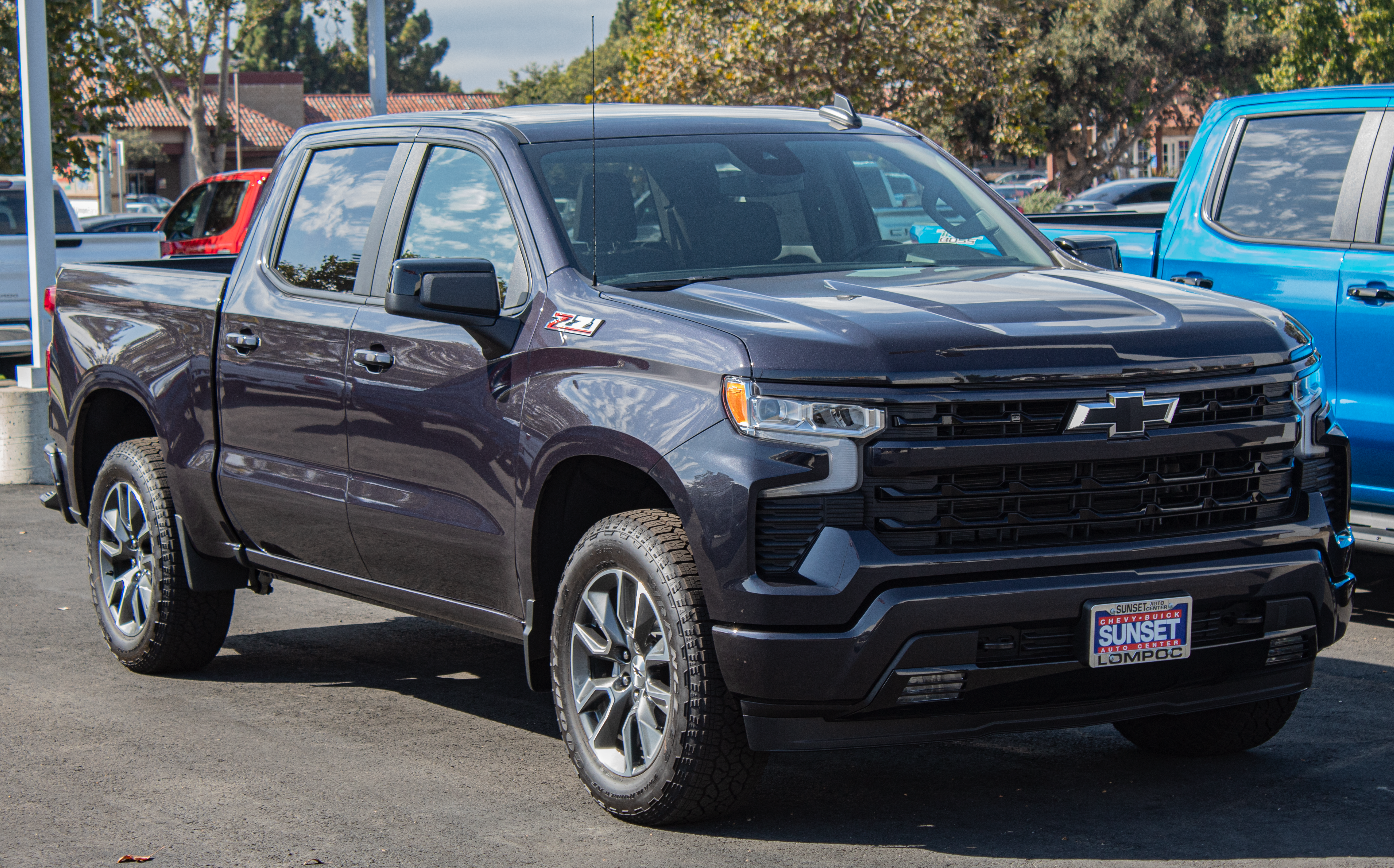
their fast charge on like their Silverado
is somewhere in the 10 to 15 minute range
to get a supercharge on one of those.
That's really comparable to filling gas up
on a gasoline engine car.
The infrastructure for superchargers has gotten really good.
So from a consumer standpoint,
most consumers are gonna buy based on money.
If they can get all the same features,
if the stereo is the same
and the seats are as comfortable and the car rides good,
but your overall costs per year to run the vehicle
are $3,000 less because you're charging it
off the outlet at your house
or through supercharging versus buying gasoline or diesel,
people are gonna choose money,
but they're gonna go with what's cheaper for them.
And I think that electric vehicles do that,
especially when you factor in the expense
of fixed and modern gas engine platform stuff, power trains.
The reason that I wanted to bring this up,
that's only 25 years from now, okay?
If someone was just starting a business,
if they had the goal of retiring like you did
as a young individual 25 years in,
on that journey to that 2050,
they've gotta have the right education
and tooling and people
that will allow them to start working on this mix
of vehicles that are going to be in our car park.
I'm trying to head into my careful what you wish for
as you get into business today, think down the road,
and also the power of continuing education
that we're gonna need.
Is it gonna be as big as it is today for EVs?
I think honestly, we're gonna fix them a little differently.
So by 2050, we're probably gonna have more
of a aircraft repair approach on automobiles,
specifically EVs.
So there's gonna be pre-planned maintenance.
You're gonna replace the brakes
at a certain mileage interval
instead of waiting to check to see what the brakes are doing.
When you have a vehicle problem
where like there's a problem in the drive motor
and EVs are already doing this most of the manufacturers,
they're not having technicians
take them apart in the bays.
So they're replacing entire units,
which means that the technician
that knows how to take apart a drive motor
is probably not gonna be as needed.
They just need to be able to R and R a drive motor.
So I think from that standpoint,
the manufacturers are making the cars simpler to fix.
So the hard part is gonna be understanding
how to do the diagnostics on the electrical systems
and the high voltage and the safety aspects
of that working on high voltage.
So are we gonna be installing R and R
re-manufactured stuff?
They already are.
So Tesla does not take drive motors apart in-house.
None of their technicians do.
So if there's any kind of problem inside
with the inverter, the drive motor, the stator,
anything like that, it's a one-part number solution
and they're really easy to change out.
Right, so we're gonna need mechanical specialists
to work in the back warehouses, if you will,
that all these older units are gonna come in,
they're gonna refurb them,
and then they're gonna go out
through some kind of distribution model
and have available at the street
or what you're saying is beep.
Here comes the screen.
It says it's time we've scheduled you gotta go
and they drop one thing out
and they push another one in.
Yeah, that's for sure the way that I see,
especially Tesla's, how they're built,
they're designed to be modularly repaired over time.
So just drop one component out
and put a new component in and keep going.
Wow, this whole aircraft repair.
It's a great concept to dig into just a little bit.
It reminds me of what a good schedule
preventative maintenance program would be on a vehicle.
It says 100,000 miles, the plug's gotta go.
I don't have the money.
But if it was sold almost a little differently for people,
that vehicle could last 250, 300,000
if they did everything right on the front side of 250, right?
On an electric vehicle for sure.
I don't know if that holds true on a gas engine.
I don't know if that holds true
on most ice engines nowadays.
I think the super thin oils that were run in,
the expensive, you know, catalysts.
I mean, I have a friend that just did cat converters,
a week at converters on a like a 2016 Silverado
with a hundred and some thousand miles on it.
And it was like the T 500 bucks for him
to get the dealer to do them.
Prices like that on ice engines
makes you not really want to have them anymore.
Yeah, I know, I hear you.
Speaking of the oil, someone,
and again, I don't have a newer vehicle,
but I continue to hear 10,000 miles
is what the manufacturer is saying.
But any right minded Pete Rudleff style guy
who's been it says it's got to be five.
So typically I'm going to lean
what the manufacturer thinks on most,
yeah, most oil change intervals.
That being said, I don't know if there's any cars
that I'm super familiar with that are 10,000.
I've heard of some of the BMW and Mercedes
and such like that.
I think where vehicle owners get in trouble
on the long, interval oil changes
is they don't check and adjust the oil level
in between those oil changes.
So from a vehicle owner standpoint, they go,
all right, well, I got 10,000 miles in between my old change.
I never need to pull the dipstick
and check the oil level.
But all combustion engines burn a little bit of oil
and it's completely normal,
especially on modern engines.
And so I think what happens is the engine burns
a little bit of oil.
If you're burning a quarter of a quart of oil per 1,000 miles,
by the time you get 10,000 miles,
that engine's just about out of oil.
So you do that a couple of times
and now you've got an engine that's failed
incredibly premature.
And that's not the oil change interval fault
because the oil as you kept up with it
would have been just fine.
Hey, are you having fun consulting?
I am, yeah.
It's an interesting challenge for me
and it allows me to use a different part of my brain,
which is kind of fun.
Yeah, listen, is it the more creative side?
It's definitely more problem solving.
So more problem solving.
So what I've been doing a lot of
is working with parts manufacturers
and their research teams,
trying to help them with their research vehicles.
These are guys that are engineers.
A lot of them are way smarter than I am
as far as your degrees and stuff like that,
but they don't understand the nuts and bolts aspect of it.
So for me, trying to figure out
how to explain the nuts and bolts aspect to these guys
that don't have the nuts and bolts experience,
it's a fun challenge.
The practicality, Pete practicality.
Yeah.
Yeah, call Pete.
We get this way up here,
but we don't get it way down there.
At least they say that I'm good at helping them understand
and simplifying that in ways that make sense for them.
So they seem pretty happy with what I'm doing for them.
So let me go back to the word continuing education
and what is necessary in today's world?
How many hours a year do you think
our technicians in the Bayes need to invest?
I would say 60 is probably a pretty good number.
So, and that's probably a good number
for the next 10 years.
So if guys are putting in 60 hours a year
and actually going to training classes,
that's probably good.
They should still be reading and getting into forums
and discussions and that sort of thing above and beyond
going to training classes.
And I assume that's what you meant
by continuing education was training classes.
I do, absolutely.
In all kinds, I got a great friend,
shop owner, Bill Hill out in Cleveland
who has the charts on the wall
for the continuing education that all of their people have.
And no matter if it's leader led,
if it's online and any form of education
and he bonuses his people at the end of the year
based on them going over 40.
And they earn a, you know, so much per hour over 40
which is his minimum.
And there's a little bit of a game and ship that happens,
you know, little fun stuff challenges amongst the team.
I was curious about your feeling on that.
And then you basically summed up how they would get it.
You still believe in being out in front,
you know, the sage on the stage, the leader led?
Yeah, absolutely.
I think that's really important.
I think it's harder to find really good
leader led content nowadays
because the market for trainers is really saturated
with a lot of people that say that they are trainers
and not all of them are as good as what we had
15, 20 years ago as the top guys in the trade.
But that's a reflection of society and social media.
There's a lot of people that crow loud
and other people follow them.
Is it because there's so many events
and we're looking to fill larger schedule
with a lot of content?
I've never really thought about that from that perspective.
I think it's that people see that you can make money
on social media stuff and there's a lot of people
trying to add content to get likes and clicks
and not necessarily being cognitive
that their content is valuable and good.
They're just trying to get a lot of content out there.
I get it.
I think you're talking about YouTubers
that may have the greatest latest.
There's big ones on YouTube and ones on Facebook
and all the different social media platforms.
I'm sure Instagram and all those as well.
There's a lot of technicians that 20 or 30 years ago
the trade wouldn't have looked at those guys
and girls as top tier people.
But because they've got a lot of followers
that are considered top tier people in the trade.
So I've got this thing.
I mentioned it to you on our discovery call
when we hooked back up after all these years
that we hadn't spoken and I mentioned boutique training
to you and it was because in my mind
it's Pete travels to Buffalo
and you have an X amount of dollars to be here
for say a day and a half of Friday
and an all day Saturday.
Where there's four or five or six shop owners
that come together and pay whatever fees
there are for their people to have
this quote unquote tight intimate session with you
be it a little classroom be it a lot of hands on.
Is that going to be something that we wanna consider
doing more of?
So in my 30 year history with doing automotive stuff
the best training that I ever got
was the training that was done
through Delaware training group
which was a local group that I organized
and we would do exactly what you're talking about.
We would contact some high level person in the auto trade
and say, hey, what would it cost to have you come here
for a Saturday and give us an eight hour pitch
on something on some aspect of automotive.
Those classes were small.
We would keep them to a maximum of like 28 people
or something of that effect.
It was really good one-on-one interaction
with the trainer.
The trainer was making good money
so they wanted to make sure they delivered
something really good for us
and they didn't have an agenda
because we were just paying them
with a goal that we wanted to get smarter.
So they didn't have to answer to parts house
or a manufacturer or anything like that.
So they were free to teach however they wanted to teach
and it was really, really, really good training for us.
I haven't seen a lot of other people
be able to duplicate what we did with Delaware training group
and when I talked to people
who have attended Delaware training group stuff
back in the day,
they mentioned that nothing seems to be the same with that.
And I think the big aspect of that is
that our trainers were always free
to teach how they wanted to teach.
They didn't have to run an agenda
because they weren't being paid
by or subsidized by a parts manufacturer or something.
You just unpacked an awful lot
and I have a lot to say about it, but I'm not.
Part of my struggle in trying to get this whole concept
and this concept of a trainer going out
and spending time in the field all over the country
with a group of shop owners is not new.
But the reason that I called it boutique is that,
my wife said, I'm going to this shop down the road
and it just specializes in sportswear for women.
And I says, well, what's that?
She goes, it's like a boutique.
It was just specialized, right?
Just specialized.
And I realized that if I'm gonna do anything
in getting this discussion through,
I gotta change the word.
So great to catch up with you.
Your company now is called Rhino Collective, LLC.
Why did you pick that?
Because it's not Pete's garage.
So it doesn't have any hidden meaning
or anything like that.
So I've always thought the Rhino was a cool animal.
So it was just, I needed something
for the new company to be.
And so it was just something
that completely opposite of a Pete's garage.
So.
So what other great advice can you give
to our great listeners?
Anything?
Anybody that's just now getting into shop ownership
should definitely consider looking
into becoming an EV specialist.
Like for sure there's a future there.
Shops that are well established doing gas engine work.
There's gonna be plenty of gas engine
and diesel engine work for the long-term future.
Don't be afraid to charge for what you're doing.
So that was always the big key for me
is I was never embarrassed to set a big ticket
across the counter for a customer
and say, this is what's gonna cost to fix your car.
I was always confident that your car
is gonna be fixed really well if you have us fix it.
And this is what it's gonna cost
in order to have a really well-fixed car.
So I think we should charge for that.
And pay your technicians to go to training.
So I think that's important.
Don't be afraid to invest in tooling.
Ultimately, stay in your lane.
Pick a lane and say, this is what I'm gonna be good at
and this is what I'm gonna do.
If you do that, you're gonna probably be successful
just by default.
So if you don't get out of your lane
and start getting another stuff that's costing you money
and costing you frustration and frustrating your team
and that sort of thing,
you're probably gonna do pretty well just by accident.
It's not hard to make money fixing cars.
It's really not.
That's not the hard part.
The hard part is not wasting that money
on other stuff that you don't need to waste it on.
I love it.
I think the biggest takeaway for me
and maybe for our listener is the
stay in your lane moniker.
And it makes so much sense.
Someone says, listen, I'm gonna all makes all models at shop.
There's nothing we won't touch.
And if I tighten that up to these particulars,
say six or eight different car platforms,
I'm going to take a hit in revenue.
I believe you're gonna do your work so much better, quicker
and you're gonna be more efficient, right?
You're gonna be more efficient,
which is what everyone's looking at.
And there's money to be made at in that realm.
You may not have the car count you want,
but you could have as just as much profit or more.
Many, many years ago, a gentleman named Steve Brotherton,
I would talk to Steve very regularly on IATN
and then we'd have discussions off IATN via email
or phone or stuff like that.
Steve was a European specialist.
So Mercedes, BMW, that sort of thing.
He's probably one of the best in the country at it.
His philosophy was always to work on what you know.
He would not wanna bring a Chrysler into his workshop.
He wouldn't bring a Jeep or a Chevy
or something like that in the workshop to work on.
He would stick with just what he knew.
And he was really, really good at it.
And he built a very successful business doing that,
had an excellent reputation.
And because of that, he could charge whatever he wanted
and he never had to worry about the bays being full.
So that was probably one of the things
I was most proud about with Pete's Garage
was we never had to worry about,
is there more cars coming in?
There is always gonna be more cars coming in
because our reputation was such that it's gonna be fixed.
Whatever we bring in is gonna get fixed.
So, but we only brought in what we're good at.
And listen, the guys that are an all makes model shop,
you can be successful doing that
if you're doing brakes and suspension and alignments
and that sort of thing.
But don't get into advanced diagnostics.
Don't do that as all makes
because you're just gonna frustrate yourself.
Great point.
Beyond wisdom, Pete Rudloff.
Thank you for this catch up.
I appreciate your friendship over all these years
and that you partnered with us in the early days
and some software you were working on.
And this was great.
You got something that's itching.
You wanna say, call me up and say,
Carm, let's do another episode.
I'm ready to do another one with you, Pete.
Thank you so much.
Rhino Collective, formerly Pete's Garage,
retired at 47, the envy of everyone.
Yeah, yeah, yeah, so it worked out.
So I'm very fortunate.
So long-term plan and it worked and things are good.
Thanks, Pete.
All right, Carm, appreciate you man.
Thanks for being on board to listen and learn
from the Premier Automotive Repair Business Podcast,
Remarkable Results Radio.
Get your episodic education on the ARPN listening app
at automotiverepairpodcastnetwork.com.
Also enjoy the podcast
on our Carm Capriato YouTube channel.
Carm is all for advancing
the professional automotive service industry.
Until next time.
About this episode
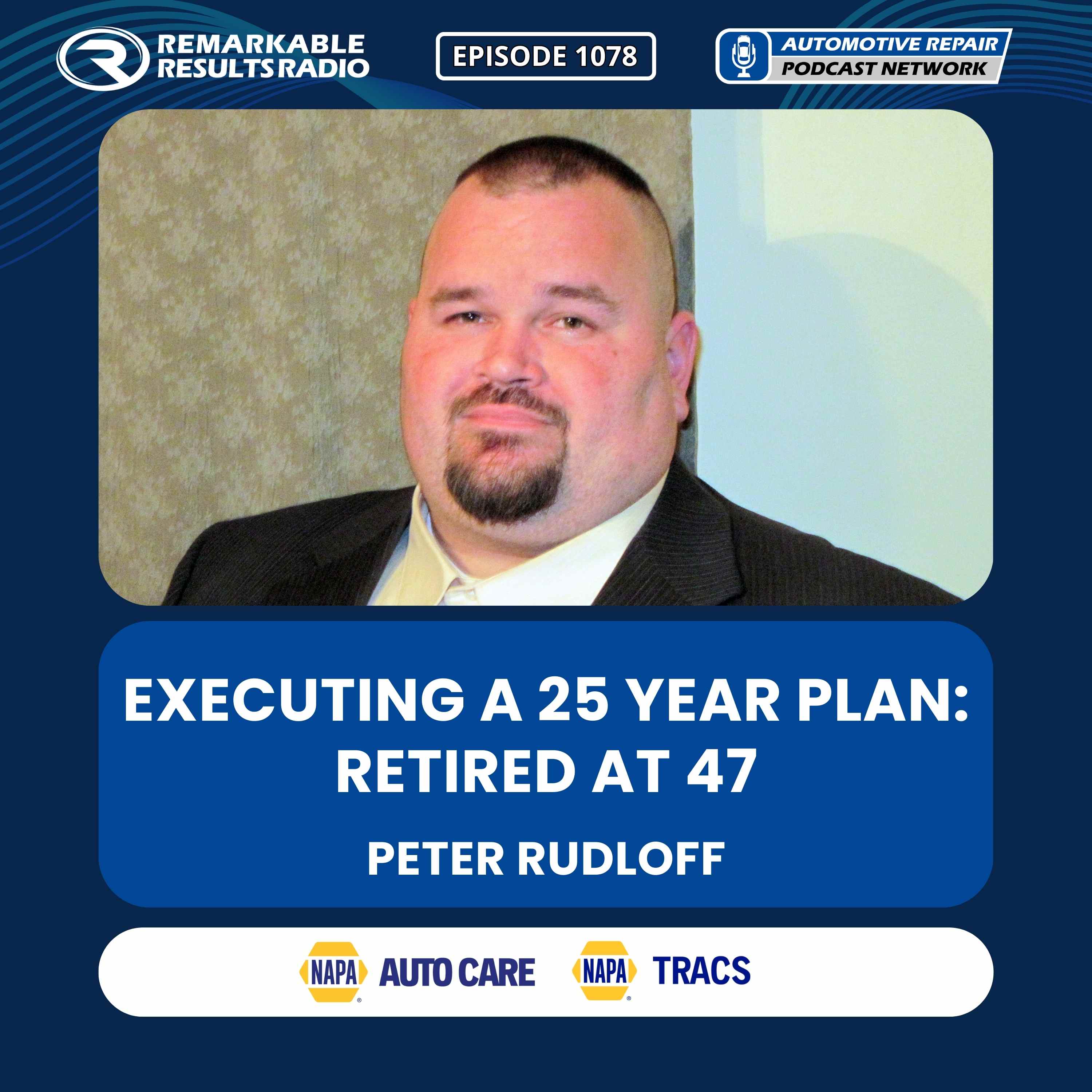
Pete Rudloff shares his journey of retiring at 47 after 25 years in the automotive industry. He discusses his long-term plan to step away from full-time work, the challenges of managing employees, and the importance of staying within one's expertise. Pete reflects on his successful career, focusing on specific vehicle makes, and emphasizes the significance of having a clear plan. The conversation also touches on his transition to working on electric vehicles and the unique challenges they present.
In this episode, Carm Capriotto reconnects with industry veteran Peter Rudloff to explore his transition from shop owner to consultant, his “stay in your lane” philosophy, and the future of EV repair.
Rudloff shares how a 25-year exit plan allowed him to retire from shop ownership at 47 and transition into his home-based “Pete Cave,” where he continues hands-on work without managing employees. He later founded Rhino Collective LLC, helping manufacturers connect engineering with real-world repair.
A central theme is specialization. By focusing on domestic and Asian vehicles and avoiding brands like BMW, Rudloff improved efficiency and profitability. He argues that staying within your strengths leads to “profit by default” and long-term stability.
Looking ahead, he predicts EVs will dominate, and repair will shift toward modular, aircraft-style maintenance. He encourages new shop owners to consider EV specialization as a growth path.
Rudloff also emphasizes ongoing education, recommending 60 hours of training per year and crediting the Delaware Training Group as a major influence on his career.
This episode delivers clear, practical insight on focus, future-proofing, and lifelong learning in today’s repair industry.