LIVE
Fresh air, longer days, a chance to reset.
This season, let therapy be part of your spring cleaning.
Clearing mental clutter, shaking off stuckness, and building something better.
Grow therapy helps you get there.
Whether it's your first time in therapy or your 50th,
Grow makes it easier to find a therapist who fits you, not the other way around.
You can search by what matters, like insurance, specialty, identity, or availability,
and get started in as little as two days.
And if something comes up, you can cancel up to 24 hours in advance at no cost.
Grow helps you find therapy on your time.
Whatever challenges you're facing, Grow therapy is here to help.
Grow accepts over 100 insurance plans.
Sessions average about $21 with insurance, and some pay as little as $0, depending on their plan.
Visit growtherapy.com slash start now today to get started.
That's growtherapy.com slash start now.
Growtherapy.com slash start now.
Availability and coverage vary by state and insurance plan.
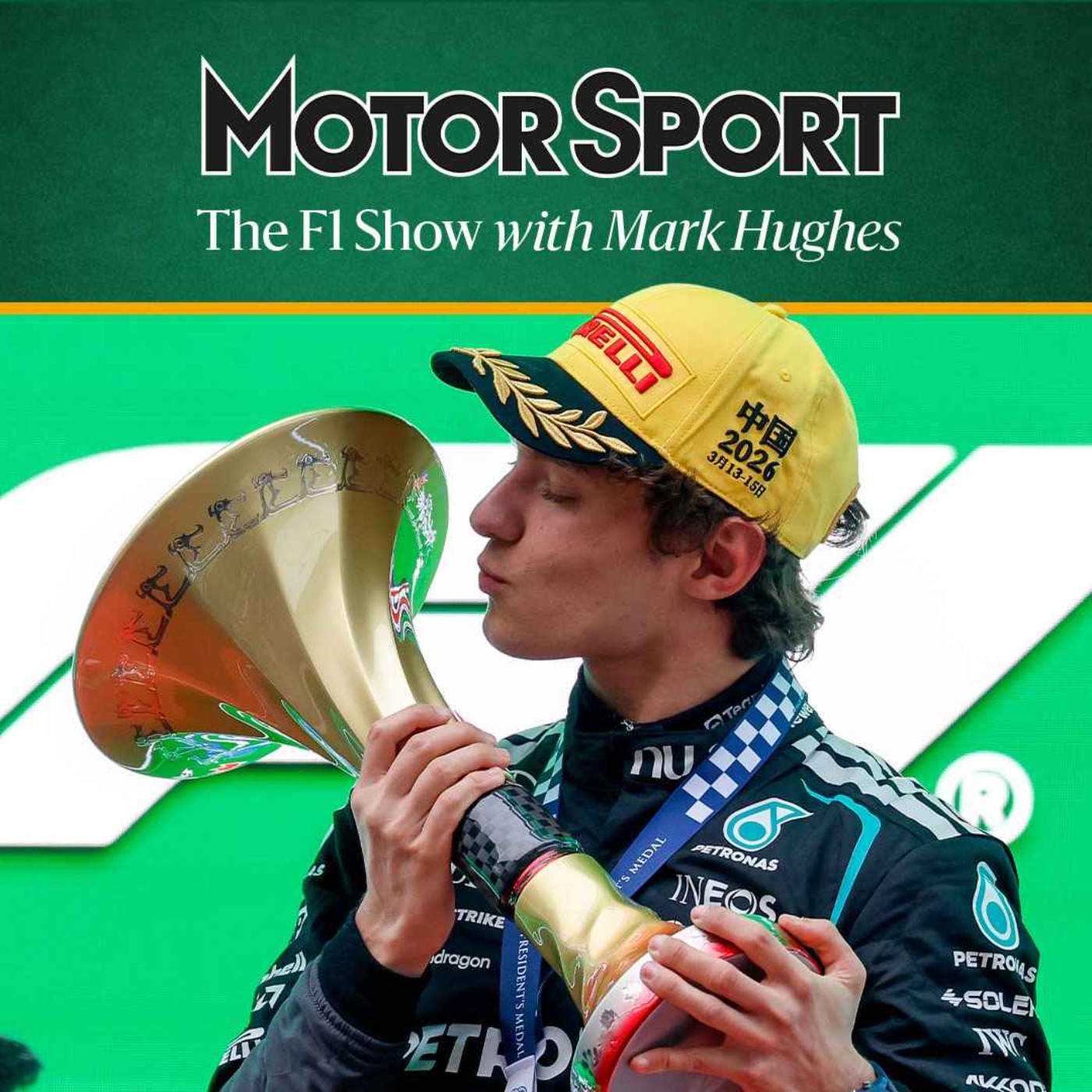
Can Kimi Antonelli become Formula One's youngest world champion?
Why victory in Suzuka proved that he's got the raw speed to take on the favourite and teammate George Russell?
Plus, F1 considers drastic action to ease safety fears while reducing the Grand Prix length be the answer.
And why Max's threats to quit should be taken seriously.
All that plus a little bit more on this episode of the Motorsport F1 show with Mark Hughes.
Well Mark, here we go then.
Three Grand Prix into this season and three very different stories.
Your thoughts on Suzuka really focus mainly on what happened with Kimi Antonelli and his rivalry with George Russell.
That's the topic of your latest column anyway.
Before we dive into that though, what were your thoughts on what you witnessed over in Japan?
It was a flawed race in a slightly different way to what Melbourne had been flawed.
And you'll have heard the drivers complaining about their lack of control over the harvesting, the deployment, etc.
Through the back straight on the 130R and up to the chicane and down a turn one.
That was not a very happy layout for the energy requirements.
And yeah, again, it's to do with energy starvation, which it's a very energy hungry circuit just like Melbourne was.
But it's also to do with the sequencing of those particular corners.
So whereas the middle race in China, we saw a reasonable race.
We still had a very compromised qualifying, but we saw a reasonable race in Suzuka.
It just wasn't a happy combination.
So yeah, a lot of work still to be done and more or less as we're talking, big discussions going on.
To take advantage of this one month break to try and come up with a better solution in terms of energy demands.
That said, there's not really such an energy hungry circuit on the calendar until very late in the season.
So in a way, even if they did nothing, the next few races probably wouldn't be as bad as what we saw there in terms of just how awkward that splitting between the internal combustion engine and the electrical deployment.
And that was very much part of the very alarming incident we saw between Oliver Bearman and Franco Colpinto, which resulted in 50G impact with the barriers for Bearman.
So yeah, safety concerns there as well.
And as soon as he started getting serious safety concerns, it's usually when F1, the FIA jump into action.
Yeah, we'll definitely come to Bearman and what the FIA are going to do.
And it's a frustrating thing, isn't it?
Because this has been a topic for quite some time with teams and drivers and everyone saying, look, something needs to be done.
This won't work. This is going to cause this. It's going to cause that.
And everyone's gone on sort of just carrying on their own route, their own way.
And now having to put out fires all over the place, we will come to the Bearman thing.
We'll come to what the FIA are maybe, maybe not going to do.
But let's focus on Kimi Antonelli and his performance in Seduca, his rivalry with George Russell, which, as I say, is the topic of your latest MPH column.
It's a fascinating piece and it goes into detail about other rivalries as well over the years.
How do you put it into perspective then?
Give us an idea of just how strong Kimi Antonelli is looking and if he really is a genuine title contender or is it too soon for the, I hate saying it, for the young kid?
Yeah, I recall you asking or maybe the reader asked last week or the week before, is he a genuine title contender?
And I said, well, he's not the favorite because George has got more experience, but they have a dominant car.
And so yeah, he is a title contender just by virtue of that.
And that really they might be decided by who gets the clean weekend and who doesn't.
And we've seen the last two races of George not getting a clean weekend.
But I think there's a difference between what happened in China where Antonelli took his first win and what happened in Japan last Sunday.
And that is Antonelli dominated it.
It wasn't, he didn't dominate it as a result of George having a problem in Q3 like he did in China.
Yeah, George had a setup problem, but he made setup changes going into there because he was trailing Kimi before then.
So it was, you know, Kimi had done the job.
He actually did it on raw performance.
And that's the difference that that makes it seem he's now much more serious contender than someone who's just depending on getting through the weekends more cleanly.
He did get through the weekend more cleanly, but he also already demonstrated that he was the man.
He was the man who answers, you know, the two guys in the dominant car.
He was the one that was on top right from the start.
So that puts a very different complexion on things.
If we know that he's capable of doing that, he might not do that every time.
Of course, we know that there's probably still some inexperience and some errors to play out, but he's definitely there.
He's definitely able to take on George Russell and whether he can do it through the season or not.
That's what we're going to find out as these races unfold.
And that's all assuming, of course, that it remains an exclusively Mercedes contest.
It might not do.
We've got the engine equalization thing coming up, which takes effect for Ferrari from Canada, the race after next.
So there's that.
We've got McLaren making progress to where much closer in Suzuka.
So, yeah, there's some assumptions there, but I think, yeah, Antonelli, it's very early to find yourself in a title contending car just your second season.
But if you're good enough, you've got to be ready for that opportunity.
It doesn't always come at the convenient time.
As it has for George, he's absolutely ready.
He's built up all these data banks.
He's super fast.
This is the opportunity, but it's come for Antonelli very soon.
And we've seen this before in the championship's history we saw with Jack Villeneuve in his rookie season in 96.
He makes his debut in a dominant car, but he has an experienced teammate to beat.
We've seen it with, well, going back a little bit further.
The Gilles Villeneuve and Jody Schecter in 79, it was Villeneuve's second full season.
He'd done a few races at the end of the 77, but he was his first full season was 78.
And then he's in a contending on 79 against a top line guy.
And we saw it across with Lewis Hamilton's rookie season in 2007 at McLaren alongside Fernando Alonso.
So there's different outcomes in all those examples in history, but they were young guys, very inexperienced,
probably not quite experienced enough to have all the answers at that moment.
But the opportunity came along and they had to grab it.
And you sort of have to jump up and hang on and, you know, just deliver because you never know if you're going to get that opportunity again.
And that's a situation that Kimmy Namp finds himself in at 19 years old, which would be remarkable just to be in that position at such a young age.
But, you know, if you think about if he did win it this year, it would not only be the youngest ever to win the championship,
but he'd be doing it by three years.
He'd be knocking three whole years off the record of Sebastian Wetter.
Yeah, he was in Groves, was he 23 years and 134 days when he won that title back in 2010.
It is very early to be saying that Amsterdam is a surefire, bona fide title contender,
but leading the championship after three rounds at the 10 range of 19 years old is pretty remarkable.
It doesn't really matter how it goes about happening.
And you're not there to circumstances in Japan that played into his hands somewhat.
Safety car coming at the right time for him and George Russell not having the optimum car.
It's going to come down, do you think, with George Russell to his psychological frame of mind?
Because he's been challenged, but he is in that number one driver position for his second season there.
So with Ansonnelli alongside, how does he work through this?
Does he just carry on regardless and think that I know what happened in Japan was really kind of
maybe extra outside influences coming on in, or does he just have to go and work on himself in a slightly different way?
I think Kimi can take solace from the fact that, yeah, although he was helped by the safety car timing,
which enabled him to sort of put right what had gone wrong with his start, which he's made a bad start from pole.
I think he can take solace from the fact that actually he was the quickest guy anyway.
All that happened was the safety car got him out of the trouble that his poor start put him in.
So even without the safety car, if a suspicion he was going to win it anyway, I think,
he would have just stayed out. It was the overcut that was working rather than the undercut or under pit stops.
And he was so much quicker than Russell at that point just before the safety car came in.
Russell would have had to come in soon to protect from Leclerc.
Kimi would have just kept going and the overcut would have worked because he had so much pace at that moment.
So I think he would have won anyway. So I think he can take solace from that.
He doesn't have to think, well, hopefully I can string together a good weekend and capitalize when George doesn't have a good weekend.
I think he can just park whatever George might be doing and just think, no, I'm just going to focus on myself and get the best out of myself.
Yeah, use your team is a barometer, of course, but I don't think he needs to worry necessarily now.
And in the way that he probably had to, when he was trying to establish himself within the team and within F1 last year,
I think, you know, you always be looking to your more experienced team and saying, how am I comparing? How am I comparing? What's this looking like?
I don't think he needs to, I think he can more or less let that go now and really just relax into his own little world, his own rapport with his engineers and with the team.
His own way of working with the car and, you know, let that just flower as it will and show that he's not always going to be George.
George is far too quick, a world-class driver to think he can do this every weekend.
What he just did to him in Suzuka, you won't be able to do that. You'll be able to do it sometimes, I would think.
But he doesn't need to get his head clouded with whatever George is doing.
Do you know, I mean, temperament-wise, Kimmy Antonelli has only really been on the F1 scene for one full season last year, test driver the year before.
But he climbed the ranks extremely quickly. He even jumped a few hurdles there. He went through frekka, didn't he?
But he also then jumped straight into F2 and had that season before moving very quickly up.
Does that put him a disadvantage, obviously, that he doesn't have the experience?
Or is it the advantage that he is that kind of fearless, I can do it because he has youth in his cyber,
as George might be a little bit more considered than his approach?
I think what that very rushed sort of graduation up the ladder did was it contributed to him not having everything that he needed in his first year,
and his rookie season of F1. There's just too much knowledge missing.
And that knowledge can show in terms of taking a wrong direction with choices with the car,
not understanding how the tyres are working, or it can just be you make errors at the crucial times.
Things that you know after a season, how a weekend progresses and how you work with the team
and who you need to talk to about this and who you need to talk to about that.
All those things, you're just empty. You don't have enough knowledge to be able to consistently do your best stuff all the time.
I think that's all that made Antonelli really not.
I think that quick graduation, that lack of experience, when Hamilton came in and fought for that title in his rookie year,
not only was he 21 years old, significantly older than Kimmy is now, he had five seasons of car racing before then.
This is not quite the same. And if you look at Max Verstappen, who only had one season of car racing when he came in as a rookie,
he was really impressive in that rookie season of some fantastic standout moments in 2015 and that or also.
But there were also some quiet weekends where he didn't do anything remarkable,
and he was no quicker than Karl of Science many much of the time.
Those things are fine as a rookie.
And if you're not in a top team with a spotlight on you, then nobody makes a big thing of it.
Nobody is very critical of it.
But you come in to a top team like that as a rookie and the spotlight straight upon you, you're not going to be equipped.
You're not going to have all the answers.
And the quiet weekends don't get forgotten.
They ram up the pressure and you did see him to come into that pressure sort of part way through last season.
And yeah, he's come out the other side of that.
He knows what that's like.
He probably feels that that was Rob Bottom and he's now on the up.
So I think, yeah, I don't think he needs to.
Everybody finds their own way, you know, the different circumstances and different routes and different backing.
There's no, you know, there's no two drivers or exactly the same in terms of the preparation.
So that's just how he's found his way.
And so you just, you know, you just have to go with that.
George came in in a more structured way and had more experience and had, you know, some three seasons of preparation at Williams,
which he feels was two years to go long.
So yeah, he came straight in and under the spotlight.
But it, yeah, it'll just play out as long as it doesn't destroy the rookie.
And it looks like it hasn't because he's just he's now leading the world championship.
So as long as it doesn't destroy the rookie by putting, you know, to unbearable pressure on them, it's okay.
You get that you get to the same place, I think more or less.
So I'm pretty sure I mentioned Toto Wolf again in a bit, but Toto Wolf, the way he handled Kimi Antonelli last year,
was that part of the process that has enabled Kimi Antonelli to find a confidence that he didn't need to be incredible from day one,
that there were going to be blips, there were going to be moments happen quite quickly.
There were things where his inexperience, should we say, in age and in in racecraft showed.
And Toto Wolf seemed to be kind of cool with that, you know, this is okay.
We haven't got a ready made out of the box driver.
We have to create him a little bit.
Does that helped Kimi a little bit not having a huge amount of pressure put pressure put on his shoulders from race one?
I think so.
But also there was pressure as he was under delivering through that middle part of the season and going off at Zanvoten and going off again at Monza.
It was, you know, even Toto was starting to become a little bit critical and saying, not good enough, you know, this isn't,
he did give him a bit of a kick.
But yeah, the underlying thing is that he's Toto's prodigy.
Toto took him over from 11 years old when he was in in karting.
So he is very much a project of Toto.
So you would have had to have done something pretty disastrous to have been dropped.
But you couldn't have done it.
He couldn't feasibly have done another season like last season.
You know, you would have to show a bit more than that.
So yeah, it was, it wasn't going to get dropped.
But and there's probably an underlying confidence that he, you know, Toto would like to look after him.
But that only goes for so long.
You can't, you can't live on that indefinitely.
Rivalry wise and that's to move also in your column in this talk, really that column, it goes into quite a lot of detail about different rivalries over the years you've mentioned a few already.
But what rivalry, if this turns out to be a championship contender rivalry going on between George Russell and Kimi Antonelli.
And it may change as you've already alluded to Ferrari are going to be able to upgrade their engine with the developing their engine with the way the regulations work.
Come beginning of June, the way they measure the engine and the outputs going to change as well with the FAA.
So there might be limiting factors there.
But if it turns into a two horse race or a three horse race that involves both Mercedes drivers, George Russell and Kimi Antonelli.
What sort of rivalry would you expect it to be a flamboyant, fiery one like Rosberg Hamilton or a more kind of friendly inverted commas one like Piastri and Norris?
I think it'll be respectful.
I don't think it's going to be to have a sort of an edge to it and an unpleasant edge.
But I think it'll be pretty, you know, there's not going to be much quarter given between either of them.
It's the sport's biggest prize that's standing there dandling in front of them.
You know, you're not going to be over polite, but I think it'll be respectful.
They're both respectful characters.
Yeah, I mean, you look at over the years, there's been some absolutely incredible rivalries with Prost Senna being one of the most eye catching.
But even back in the day with Vettel and Weber and Alonso and Hamilton was pretty fiery, wasn't it?
So do you think that kind of respects full one?
What happens as the season progresses, though, and you know, it's very, very tight.
George feels he's the number one driver at Mercedes.
Does he start to get edgy because he demands that number one status?
I think George, if he needs to, if he feels that this is getting away from him, how would he react?
I mean, this is all, you know, an imaginary situation that might or might not happen in the future.
But if he feels it's getting away from him, I don't think George would be shy about trying to use his influence within the team as the experienced guy
and trying to get things coming towards him if it's a setup thing or if it's a development thing.
I don't think he would be shy about using his influence and standing to try and do that.
But at the same time, you know, Kimmy's team around him would have to be protective of that and be aware of that.
I mean, would you say George is a fiery character?
He can be fiery on team radio, he can be fiery on Grand Prix.
Is he fiery when he's not in that extreme situation?
He's very tough competitor.
Fiery, I don't think, is the word you'd use, very focused and extremely competitive.
But I don't know, I wouldn't use the word fiery.
I mean, you can get upset sometimes if he feels he's suffered an injustice.
But I can't ever see that translating in the car on track.
It could happen behind the scenes.
It's that sort of more bats with a dynamic thing in the team.
And then stopping in terms of no try.
I've never seen him lose his crew on the track.
Yeah, that's probably a better way of putting it as focused as opposed to fiery or feisty.
What about Toto Wolf then?
How does he handle the driver rivalry if it goes on to be a solid rival throughout the course of the season?
Does he deal with like you did Hamilton Rosberg or will he have learned a lot of lessons from that?
I don't think it's going to be as quite as tricky as Hamilton Rosberg.
I think just because of the respect of personalities, I think it's going to be a little bit easier than that.
But at the same time, I think George is going to be very demanding and they're going to need to try and equal it as much as possible.
It's going to be a very similar situation to what McLaren were in last year with Norris and Piastry.
And the problem you get then, as McLaren found out, is that if one driver generically just by how they operate
need a little bit more help and a little bit more guidance than the other, i.e. Norris needed more than Piastry,
it can get perceived as the team favouring that driver, which is, you know, that sort of feeds in to the whole, the paranoia,
if you like, of a championship contest.
When that gets fed in, the other drivers think, are they favouring him? Is that right?
And it almost becomes self-fulfilling.
So there's lots of challenges, but which particular challenge it'll end up being depends on the path that the story follows, really.
Say Mercedes look at this season, and I don't want to dwell too much on this Mercedes leading the way, but they are leading the way.
And, you know, McLaren have taken chunks out of that, it seems from the last Grand Prix.
Ferrari, we know they've got that upgrade coming with the additional development time for their engine.
If Mercedes look at their two drivers in a championship battle and they're taking points off of each other,
is that a concern for Mercedes?
I know ultimately Constructors is what the teams really want.
That's the money, isn't it?
But the prestige is the driver's title.
So they don't want to be allowing the drivers to trip over each other too much, or do they?
Do they keep it completely open to a set point in the season and say we get to 16 Grand Prix and whoever's ahead at that point then gets priority?
I think of all those things still to be decided.
I think less of a problem if it remains as dominant a car as it is at the moment.
If it becomes less dominant and McLaren's and Ferrari's are maybe some point down the line,
the Red Bulls are capable of getting in among them, then yes, that becomes a real problem.
Because if you've got one driver scoring all the points for another team and you're splitting between two, then obviously it's a problem.
But I think if it continued as it is at the moment with the Mercedes as the dominant car,
and you're sewing up the front row and you're getting one-two finishes even when you don't get off the line very well,
then you would imagine that by the time you need to start looking at how you have to play it,
you'd be far enough clear that you'd be okay.
You're going to win the constructors anyway and one of your drivers is going to win the title.
So that's the position that every team ideally wants to get to some point late in the season.
They don't know which of the drivers is going to do it, but it's one of them and they're okay with the constructors.
So that's the sort of promised land they would be looking to get to from where they are at the moment,
but whether it plays out that way is who knows.
But yeah, I don't think they need to get concerned about that at this stage.
I think there's many more things to take off before we get down to that.
Yeah, there's a lot of water to flow under that bridge.
Now, a quick reminder, if you want to check out Mark's latest column, the MPH column, go to motorsportmagazine.com.
You can see it all there in all its glory.
You can find out his thoughts on this Antonelli Russell rivalry and other rivalries over the years as well.
It's a great read.
Not the other way around.
You can search by what matters, like insurance, specialty, identity, or availability, and get started in as little as two days.
And if something comes up, you can cancel up to 24 hours in advance at no cost.
Grow helps you find therapy on your time.
Whatever challenges you're facing, grow therapy is here to help.
Grow accepts over 100 insurance plans, sessions average about $21 with insurance,
and some pay as little as $0, depending on their plan.
Visit growtherapy.com slash start now today to get started.
That's growtherapy.com slash start now.
Growtherapy.com slash start now.
Availability and coverage vary by state and insurance plan.
Taking care of your eyes shouldn't be a hassle.
That's why Warby Parker is a one-stop shop for all your vision needs.
Our prescription glasses and sunglasses are expertly crafted and unexpectedly affordable.
Stop by a nearby store or use our app to virtually try on frames and get personalized recommendations.
Did we mention we offer eye exams and take vision insurance too?
For everything you need to see, head to your nearest Warby Parker store or visit warbyparker.com today.
That's warbyparker.com.
Now, Mark, next Grand Prix, it's a way off.
It's Miami, and that's probably a welcome thing for the FAA for Formula One,
because it gives them that time to look at these rules, the regulations,
and make some very much needed changes.
And if we cast light on what happens to ZUKA, and you did speak about it at the very beginning, the bearman crash,
this is something that the drivers have been talking about for some time, that the speed differential is dangerous.
The FAA now have to really look at this, don't they?
And they need to really take it seriously if they haven't taken it seriously from the beginning.
Yeah, they do, and it's just, it's really underlined that and read, hasn't it?
The actual accident, you know, it's one thing talking about a potential accident and this looks dangerous,
but when you see it play out, I think that will have focused everyone's minds.
And yeah, it's one of the two major problems with the regulations as they are at the moment is the speed differential between cars on the track
and the qualifying situation where drivers aren't able to go full attack through certain key corners,
and you have to conserve their energy so that you get a bigger lap time gain on the straight than you're losing in the corners.
So that's fundamentally flawed and as is the speed differential.
So when you address the energy split and how you do it, you go towards solving both of those problems simultaneously.
So that's going to have to be what they're looking at.
Formula One has a duty of care to its drivers, to the people in the crowd watching as well.
It's a very, very important role.
We know that safety has been a focus on Formula One for a long time.
You've mentioned that the crash there, that Berman crash, and when you see it from the outside and there was a shot released on social media
of somebody in the crowd that was directly in line with when he hit that barrier.
Lucky that Oliver Berman could walk away in the way he did, you know, limping, but seems to be okay.
Has this made the FAA look at what the regulation changes need to be and how they make the changes and make them bigger than they were going to?
Is it really, I know you said he's kind of forced their hand a bit, but will they then go harder and further than they were originally going to go, do you think?
I think the team's pushing will probably find the doors not so firmly closed now,
but I think what it's done is inject some urgency into the situation.
And it's sort of come, I mean, first of all, we're lucky that he didn't seriously hurt himself, he just got bruised.
And secondly, we're lucky in that there is a nice four week gap in which to really think through the changes and get something in place
rather than it being, you know, get it fixed by next weekend sort of thing.
So yeah, in a sense, we were quite fortunate really.
What are you expecting the changes to look like? Or maybe maybe not what you're expecting them to look like, but what do you think the changes could look like?
What will they be able to manipulate and change?
The options are you can reduce the total amount of energy allowed to store, which they did going into the Japanese Grand Prix weekend.
So what that does is make it reduces the advantage that there is to be had on the straight if you don't have as much energy to deploy.
So therefore there's not as much incentive to back off through the corners. There's still some.
So that's one thing. The other thing they can look at is increasing the harvest rate during super clipping.
So now you're harvesting fastest. So you've got more chance of having a full battery when you need it.
And the other thing is reducing the rate of deployment. So what charge you do have lasts longer.
So there are all things that can be looked at and they have been modeled to a certain extent.
The early feedback is that it's not going to be enough. It's the basic inherent problems are still going to be there.
You're going to reduce them, but they're still going to be there. You're still going to have the dendrous speed offset just not quite as much.
And you're still going to have the problem of not being flat out and horrifying.
Everything keeps pointing to the fact that you need more power from the internal combustion engine.
And that's just, that's obvious. There are constraints upon that.
The obvious way to increase the power of the internal combustion engine is to increase the fuel flow.
Fuel flow at the moment is very restricted. It was changed last year down to this year to help even up the split between electric and internal combustion.
So if you turn that back up again, you've got the problem in the races of you.
The cars will have been designed with fuel tanks small enough just for this fuel flow, the existing one.
And if you increase fuel flow, increase your consumption and you're going to have a real struggle to be able to last a race.
So maybe as an emergency measure, do you reduce the duration of races?
And it could be as drastic as this. It's such an intractable problem within the time constraints.
You might have to be looking at something as drastic as that.
So increasing the fuel flow of the internal combustion engine, the engine manufacturers are saying that's going to give us terrible reliability problems
because everything has been designed around this fuel flow.
And if we go up the other fuel flow, things aren't optimized, things are going to overheat, we're going to have retirements.
Well, I think if we have a high retirement rate, it's not going to be as farce ago as what we saw worst in Melbourne and Suzuka.
So I think maybe we'll have to look at that.
And I'm sure there'll be great resistance from the engine manufacturers, but there's going to be resistance in whatever you try to do
because none of it's ideal, because of the situation it's from the one it's got itself into.
And we know how it's got itself into and into it.
We've talked about this before.
It's through trying to accommodate the wishes of the automotive manufacturers and just having a bash at getting it done.
But it's hellishly complicated.
And every time you try and solve one problem, there are unintended consequences.
And another possible solution that is being talked about is increasing the straight line running.
So at the moment, it's the straight line mode is within defined areas of track.
So at Suzuka, it was between Spoon and 130R and then again on the pit straight.
So if we said that, well, we'll forget the designated zones, the driver can use it whenever they want.
Or this has been discussed, you can choose between having low downforce and super low downforce.
And then you get your lap time and a similar lap time in a different way.
And you get the teams to choose.
These are all things that would solve a problem, but you would also inevitably be creating new problems,
unthought of new problems.
And so, yeah, I really think there has to be an acceptance that this is a very urgent situation and it's going to require quite a drastic solution.
And I think in the old days, before the Libet era and before the franchise system and when you need teams to be involved in the governance,
and you need super majorities and you can carry things through on agreements between the teams,
but if there's not agreements that don't get carried through.
In the old days, when it was more dictatorial and there were disadvantages about that as well,
but in the Eccleson-Mosley days, this would just be announced.
They would just decide what the solution was and say, you know, turn up the next race with your engines up.
With your batteries turned down, your engines turned up and you're allowed to turn them up this much.
And yeah, if it causes problems, it causes problems, but yeah, that's going to be how it is.
In a situation like this, you almost need that.
You almost need a dictatorial approach to say, right, we've looked at it, we've decided we're doing this, so let's carry on.
But if there isn't a solution, there is a need for an easy solution.
Yeah, trying to please too many people just doesn't work, does it?
Very quickly, what would the timeline be?
We know there's like a month or so between this and the next Grand Prix, but how quickly would these changes be announced?
I don't know how quickly they'll be announced because the meetings, not until the first of several meetings, I think,
the official one has not even happened yet.
But in terms of when they'll be looking to implement them, I think they'll be looking to implement them straight away and for the balance of the season.
And probably with the proviso still that even if we implement them straight away, we might still reserve the right to keep on changing them until we arrive at a better solution.
That said, I go back to the point I made before, there aren't any energy hungry circuits really for quite some time.
So it could sort of scrape by, you know, Miami, Monaco, Montreal.
These aren't circuits that are extreme in the way that Zouper and Melbourne were extreme in the end.
But the underlying problems will be there.
Clearing mental clutter, shaking off stuckness and building something better.
Grow therapy helps you get there.
Whether it's your first time in therapy or your 50th, Grow makes it easier to find a therapist who fits you, not the other way around.
You can search by what matters, like insurance, specialty, identity or availability and get started in as little as two days.
And if something comes up, you can cancel up to 24 hours in advance at no cost.
Grow helps you find therapy on your time.
Whatever challenges you're facing, Grow Therapy is here to help.
Grow accepts over 100 insurance plans.
Sessions average about $21 with insurance and some pay as little as $0 depending on their plan.
Visit growtherapy.com slash start now today to get started.
That's growtherapy.com slash start now.
Growtherapy.com slash start now.
Availability and coverage vary by state and insurance plan.
Every idea starts with a problem.
Warby Parkers was simple.
Glasses are too expensive, so they set out to change that.
By designing glasses in-house and selling directly to customers, they're able to offer prescription eyewear that's expertly crafted and unexpectedly affordable.
Warby Parker glasses are made from premium materials like impact resistant polycarbonate and custom acetate.
And they start at just $95, including prescription lenses.
Get glasses made from the good stuff.
Stop by a Warby Parker store near you.
Yeah, one person who may not be there is Max Verstappen, if you believe the stories that, you know, which stories you read.
Max Verstappen has been consistently very, very unhappy with the regulations, with the way the car's handled and things like that.
And we know that he's always said about Formula One that he will leave it at some point.
And he'll go on to his GT3 team.
He'll go on to WEC something like that.
And in fact, he's going off to the Nürburgring to do the 24 hours, isn't he?
Not in a GT3 because it can't be called GT3, but anyway, he's doing that.
So he's got his eyes elsewhere.
Formula One is a big problem.
If drivers like Max Verstappen turn their back on the sport because of the regulations they've implemented, just how serious is this a problem?
How serious are F1 looking at it?
And how likely is Max to walk away as he says he might?
I think as things stand, I think Max will walk away if it's not going to be changed.
But I think it is going to be changed, whether it'll be changed enough for him to maintain his interest.
Who knows? But I think he's absolutely serious.
I don't doubt him for one moment.
And yeah, it would be a very big public denunciation of this regulation set.
But if he did, I don't think anybody else is seriously thinking I'm going to walk away because I don't like these cars.
But I think it wouldn't need to be more than one if it was him.
Because his stature is such that he's recognized number one.
And if you recognize standard bearers saying I'm not doing it anymore, it does devalue things.
For a while, I mean, new reputation will be built in two or three years and you want to be forgotten about.
But it won't smart so much, let's say, commercially for the owners.
But it'll still be a black mark against the category here.
It's another one of those wait and see moments, isn't it?
And of course, you can keep up to date with everything that's going on in Formula One by going to mokesportmagazine.com.
There you can subscribe to the F1 newsletter.
It'll go into your inbox and you'll be able to see what's going on, keep across Formula One for this season and beyond.
Now, Mark, it's time to move on to the audience questions.
We've had so many questions come in as always.
Thank you very much for getting in touch.
The first question actually was from Russ Taylor.
And that was all about potentially having shorter races.
Russ, Mark has answered that question anyway.
So great thoughts, great minds, think alike.
Your question was selected and Mark, somehow you've answered it in advance.
But thank you very much, Russ, for getting your question.
I selected three questions and there you go.
That's where it works.
The next question then from Adrian John Morrow says,
I didn't understand your Suzuka analysis.
Why would you not want to harvest as much energy as possible?
This is obviously an analysis that was done in written form.
Oh, yeah.
This is referring to the piece of wind up on Monday.
And specifically, I think what he's asking about is why all the bearmen,
as he was chasing, he's in overtake mode, chasing Colopinto.
And so he's absolutely trying to gain as much as he can.
When the car begins to clip and the power unit begins clipping,
i.e. trying to harvest more energy ready for deployment later on,
he cancels it.
And he's asking why would you do that?
It's because in that moment, he will have wanted to be on the tail of Colopinto.
He was trying to get right on the tail of Colopinto and the harvesting slows you down.
It helps you overlap, but it slows you down in that moment.
So it's sometimes, in a recent situation, you want to be prepared
at an earlier part in the track than the algorithm of the car is trying to prepare you for.
The algorithm of the car is trying to prepare you for the ultimate lap.
But sometimes that's irrelevant.
In a racing situation, sometimes you need the power now,
and so you don't want it to start clipping, so you cancel it.
So that's what that was a reference to.
It's so complicated.
Why would you not want as much energy or as much power at your fingertips?
So nuanced.
I mean, the great questions.
Adrian, you're not the only person that has asked that question, by the way.
Many people are like, I don't understand.
Why would you be harvesting when you could be doing this and vice versa?
And they just, we have to say, the F1 teams, I guess, know what they're doing.
And they're just trying to find an optimal way.
The drivers are in the seat, and they've got to decide on what they do at that moment.
Final question then, this is from Patricia Ardo.
I love her name.
That rogue code bug for Russell was just as disconcerting as the bearman crash.
How can a driver lose so much speed without warning and in an unexpected place
when his car isn't breaking down?
Yes.
So this was a reference to when Russell was passed by Leclerc
in that gap between the hairpin and spoon,
sort of looking quite close to where the bearman accident happened.
So George had been told of the radio that what he was doing
in terms of the later super clip, it wasn't working.
So he was trying to do it earlier.
So this was the first time he tried to do it earlier,
but at the same time he changed up.
So he did those two things simultaneously.
And because of the software, there was just a bug in there
that it hadn't thought of that combination before.
It wasn't programmed for that combination.
It briefly went into a sort of safe mode
and reduced the power drastically for a few seconds.
And so he was just literally powerless, just sitting there as the software
sort of going round and round, trying to reset itself
and then bring everything back fully online to full power.
And in that moment, of course, it was many, many horsepower down on Leclerc.
And Leclerc was just, it was a simple driveway.
Yeah, it was an alarming moment, wasn't it?
It did seem like there was a huge problem that just kind of went away into the ether.
Mark, as always, thank you very much indeed.
We've got a while between the next Grand Prix and this,
but we'll be speaking to you again next week
and who knows what the topic will be at that point.
Yeah, there's going to be lots going on, even though there's no racing.
So yeah, I think there's going to be lots to talk about,
certainly in some of those follow weeks.
So yeah, stay tuned.
Thanks again to Mark and thank you as well for tuning in.
Don't forget to like and subscribe.
Tell your friends as well.
Tell them all about this new F1 show.
And if you want to get your questions into Mark,
you can do so by going to motorsportmagazine.com
or by leaving your questions in the comments underneath the YouTube video itself.
There is a brand new issue of the magazine out now in the shops
and the issue covers a whole variety of things,
winding the clock back 59 years to the sizzling summer of 1976,
where there were high jinks, controversies and blistering racing,
hunts and barry sheen race to the F1 and World Motorcycle Championships.
They definitely don't make them like they used to.
Pick up the April issue in the shops
or you can read it online via the website or the app.
As always, thanks so much for your company.
We'll see you next time.
Code Smoothie
0:00
42:55