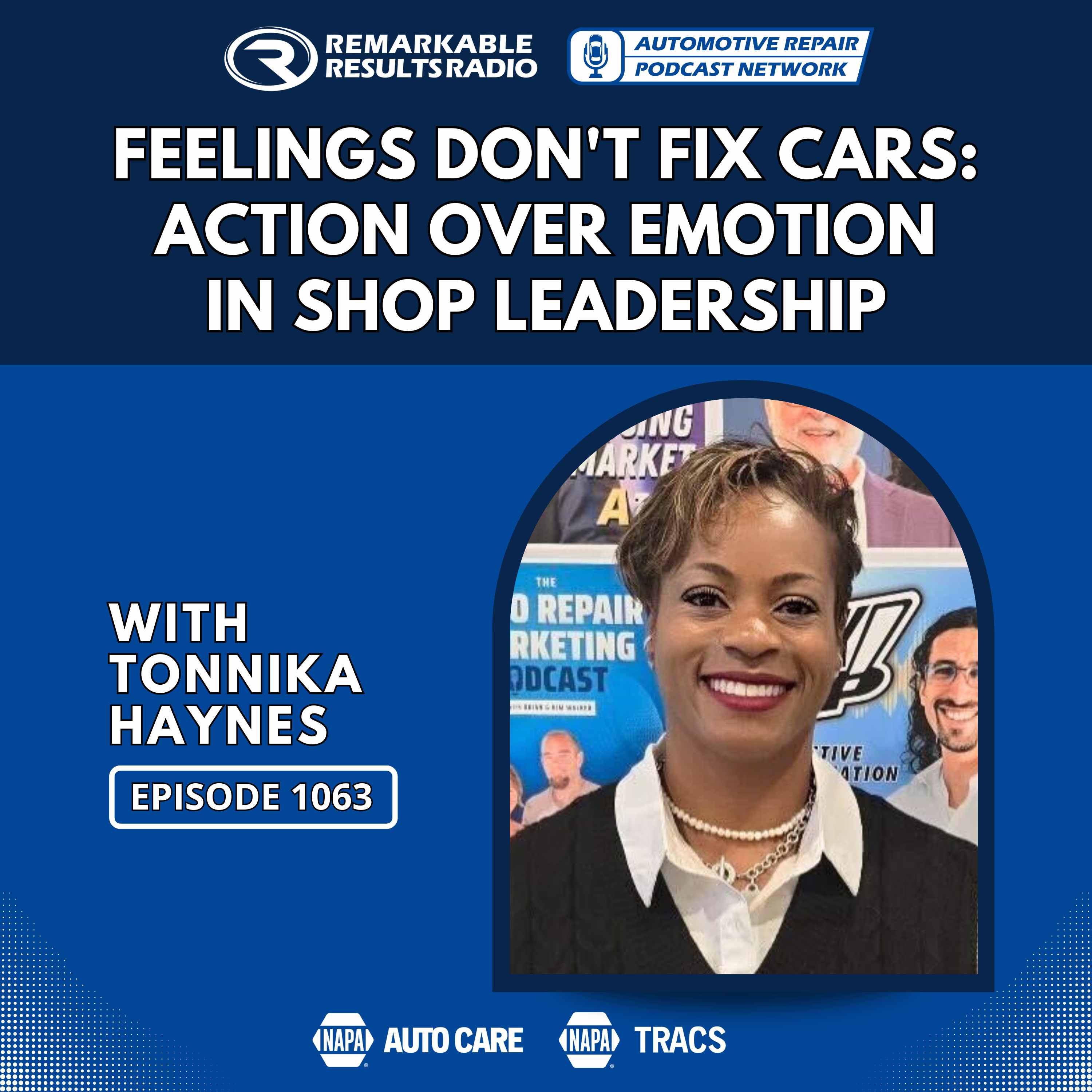
Carm Capriato welcomes Tanika Haynes, owner of Brown's Automotive, to discuss the dynamics of family-run automotive businesses and the importance of mentorship. They explore Tanika's upbringing in the shop, her father's unique teaching methods, and how she balances work and family life. The conversation highlights the need for a supportive work environment, the benefits of a four-day work week, and the challenges of attracting younger talent to the industry. Tanika emphasizes the significance of guiding the next generation while maintaining a healthy work-life balance.
Thanks to our Partners, NAPA Auto Care and NAPA TRACSWatch Full Video Episode
Tonnika Haynes, owner of Brown’s Automotive in Chapel Hill, North Carolina—a family business founded by her father, William Brown, in 1980—joins us for a conversation recorded live at the ASTA Conference in Raleigh, NC. Together, we explore the powerful and defining mentorship that shaped both her leadership and her legacy.
Tonnika shares that she never worked for her “dad,” she worked for William Brown, the business leader. That separation became clear when, early in her ownership, she faced her first major crisis: losing a key employee.
When she called her father for guidance, it wasn’t “Dad” who picked up; it was William Brown. His advice was blunt but transformative. Instead of sympathy, he challenged her: “What would you do if they got hit by a bus? You can’t sit in it, move forward.”
It was a defining moment that taught her the importance of separating emotion from action. As William often reminded her:
“We don’t have time for feelings right now. We have time for fact and action.”
“Feelings don’t fix cars. Facts and movement fix cars.”
This heartfelt episode highlights the power of tough love, mentorship, and maintaining emotional discipline in business. Tonnika's story is a testament to how strong roots and even stronger lessons can prepare the next generation to lead with both heart and backbone.
Tonnika Haynes, Browns Automotive, Chapel Hill, NC
https://astausa.org/pages/asta-expoThanks to our Partners, NAPA Auto Care and NAPA TRACS
Learn more about NAPA Auto Care and the benefits of being part of the NAPA family by visiting https://www.napaonline.com/en/auto-care
NAPA TRACS will move your shop into the SMS fast lane with onsite training and six days a week of support and local representation. Find NAPA TRACS on the Web at http://napatracs.com/Connect with the Podcast:
"I love the smell of that Volvo. Our listeners are listening to this and saying-"
Volvo is a car company from Sweden that makes safe and reliable cars. They are known for their strong focus on safety features.
Volvo is a Swedish automotive brand known for its focus on safety and durability. The brand has a reputation for producing reliable vehicles that often feature innovative safety technologies.
"And the smell of a Volkswagen. That's a good smell. VWs? I never smelled a VW."
Volkswagen is a German car company that makes many popular cars, like the Beetle and Golf. They are known for their unique designs and engineering.
Volkswagen, often abbreviated as VW, is a German automaker known for producing a wide range of vehicles, including the iconic Beetle and the Golf. The brand is recognized for its engineering and design.
"...s. Trainees practice real-world jobs, alignments, breaks, diagnostics in a safe, virtual first environment..."
The Dacia Break is a type of car that looks like a long version of a regular car, designed to carry more stuff or people. It was popular because it was cheap and practical, making it a good choice for families. It's important because it shows how some cars can be both useful and affordable.
The Dacia Break is a station wagon variant of the Dacia 1300, which was based on the Renault 12. It gained popularity for its practicality and affordability, making it a common choice for families and businesses in Europe. Its significance lies in its role as a budget-friendly option in the automotive market during the 1970s and 1980s.
"So let's do it properly. We need to do a pressure test and then we'll find out what's wrong with it."
A pressure test checks for leaks in the car's cooling system by adding pressure to it. This helps find out if there are any problems that need fixing instead of just adding more coolant.
A pressure test is a diagnostic procedure used to identify leaks in a vehicle's cooling system. By pressurizing the system, technicians can detect where coolant may be escaping, helping to pinpoint issues that need repair.
Select text to request an explanation
This is the Automotive Repair Podcast Network.
Everybody, Carm Capriato, Remarkable Results Radio. We are here with the wishes and graceness of
the Aston 2025, and I have a guest who I've actually been longing to have on my show for
maybe a year and a half now, and I'll introduce her in a moment. But first of all, thanks so much
to our sponsors. Hey, stay ahead of the curve with NAPA Auto Care's newest auto tech initiatives,
fast track assessments, accelerator immersive training, and tech assist smart support. The
future of technician training is here. Connect with your local NAPA representative for more
information. Hey, let's face it, your shop management system is the most critical tool
in your shop, and NAPA Tracks will move your shop into the SMS fast lane with on-site training,
six days a week support, and local representation. Find NAPA Tracks on the web at N-A-P-A-T-R-A-C-S dot
com. Hey, welcome back. Tanika Haynes. Hi. Hi. How are you? I'm doing great. Good. We're here at
ASTA, the Automotive Service and Tire Association in Raleigh. We're at the conference, the annual
conference. Last year was a nice conference. This is a big one. This is a big one. Wow. Yeah. How
much did you have to do with this? A little bit. Stop being so humble. Don't be humble. Yeah. I
just say a lot of stuff and I point fingers. I don't do anything. You point fingers and don't
do anything. OK. Do this. Don't do that. Just make suggestions. All right. Tanika owns Brown's
Automotive Chapel Hill, North Carolina. Yeah. Started by your dad. Yeah. Started by my dad in
1980. 1980. Yes. I want to tell everybody what we're here to talk about. It's called Brown's
Automotive. Right. And I had a chance to talk to you and I can't remember where it was.
You started to talk all about your dad, the disciplines and the mentoring and the good
stuff and the bad stuff. And I said, I got to have you on my show. We got to talk about the
brown effect. Please don't call it that. He does not need to brand it the brown effect. That would
be so funny. I'll get him a T-shirt. I would love that. That's right. And here's the reason.
It's a mentoring relationship. It's a guidance relationship. It's a disciplinary father,
daughter thing. And I just thought it was clever to call it the brown effect.
That's what we'll call it. I like it. Very good. The brown effect. And here's why, Tanika. There's
a lot of family businesses in our industry and there's a lot of dads and or moms that want to
succeed the business. Sometimes they have and sometimes they haven't taught, given the
strategies down. They sit in this mode of, I hope they absorbed all the things that were in my brain.
I hope they learned from all the things that I did, even though I didn't explain why I did it.
Osmosis. They want you to learn through osmosis.
Yes. And when dad saw you doing something right, did he ever give you a high five?
No.
Okay. I knew that was going to be your answer. Because my dad.
That's what you're supposed to do.
Yeah, exactly. God almighty. How will I ever find out if you're worthy?
And I'm not going to tell you you did good. My dad did the same thing.
He didn't. I'm not going to say he could have done it more. But I mean, that's the school he was
from. All right. I got it. This is the learning lesson for everyone who's listened, dad or
children and everybody in the industry. My dad told other people.
Yes.
And then they told me. And then I told them, go tell him to tell me.
Yeah. So same, like, even now, I know that my dad's out there just so proud of me, no doubt.
So I don't need to lay on anybody's couch and talk about it. But he'll tell everybody in Chatham
and Orange County about all the things that I'm doing. And then I'll hear it back. Like,
your dad talks about you all the time. I was like, I know. So I'm fine with it now.
But it would have been nice to hear it. Yeah, 16 and 17.
Yeah.
But then if he would have told me that at that age, would have gotten a big head.
I know.
So I would have still been open to more learning. If he gave me too much praise,
then I would become a know-it-all or maybe. So I wonder.
Here's my takeaway from your brilliance. Guidance versus praise.
Right.
It's brilliant.
So, yeah.
Wow. Guide me, dad. Point me. Direct me. A couple of high fives and a sit down that says,
listen, you did a good thing. I would have done it like this.
Right.
Then you take that, you stuff it in your brain and you roll it around and you say,
wow, dad had a great idea, but maybe now there's a hybrid of that that I can do next.
So, yeah, that's what I feel like I do now. I still have everything that he taught me,
but then I try to add a little bit more sugar to it. Not too much.
Wait a minute.
Yeah. Just a little.
You have sugar in your coffee.
I have Splenda.
Okay. All right.
Yeah.
So a little bit.
Throw a little Splenda on it.
A little Splenda on it. You don't want to make it too sweet. I'll be bad for you.
Oh, my God.
But no, like when dad would teach stuff, I was doing talking to Jimmy Lee and he's asking me
about that. Everybody wants to talk about that, which is great because I love talking about my dad
and it hit me that it was like the karate kid when Mr. Miyagi was seemed to be old and cranky
and he was just having him to do random stuff and it wasn't really random.
So when it was time to fight, then, you know, the wax on, wax off, coat on, coat off,
all of that stuff kind of came and it worked out. So he didn't even know the
whole time that he was getting taught a lesson. So all the things that that was doing,
all the things that he would say he was preparing me for actually today.
That's how I see it.
It is amazing about how we value our parent, our mentor as we mature and get older and they slide
back. It was like, what would dad do?
Yeah, I should put that on a bracelet.
Yeah. What's his first name?
William.
So what would William do?
What would William do?
WWWD.
What would William do?
Do you think about that a lot?
I do. I think the first time when he retired, I had a hard situation and I tell people,
Carm, I never worked for my dad. I worked for William Brown. My dad was at home.
That was a different person. So I had a hard situation at work and I lost a key employee
and I felt lost. It was like within the first year of me being on my own.
And I called my father's phone number, but William Brown answered the phone.
And so William Brown gave me the William Brown answer, but then my daddy called after work to
check on me to make sure I was okay. So it's a difference. And so what would William do versus
what would daddy do is two different things, even now.
Boy, is that powerful.
Well, because, I mean, you want your dad to take care of you, you need to cry and whatever,
but there's no time for that in the automotive industry. When I'm dealing with a business,
you cry when you get home. He was pretty much saying, okay, so
an employee quit and he asked me, what would you do if he got hit by a bus? And he literally,
I mean, there were some bad words in it. What would you do if he got hit by a bus?
Well, then I would have to go find another employee. And he said, well, do that.
Like, you want to get in my pocket. You can't sit there and cry about it.
Do it, move forward. You can't sit in that. And so that was the lesson in that. And of course,
it wasn't presented that way, but if he would have said it any nicer, I wouldn't have gotten it.
You know, I call them slap upside the head moments.
Yeah. In fact, frankly, I think that stuff is healthy.
Yeah. We don't have time for feelings right now. We have time for fact and action right now. I can
help you with your feelings and process in that later, but feelings don't fix cars, facts and
movement fix cars. So you're going to have to act and move to the next thing. Don't get stuck.
So think about the DMARC line, business home. You're driving, you know, and again,
I know you're not living with your dad, but to the point where,
you know, that you could steer the car to dad's house and he could be dad for you.
Right. But if you showed up at dad's house,
kind of unannounced, would he be dad or William Brown? Oh, he's dad.
He's dad. He's dad.
But what do you say? All right, I'm done being dead. What do you need now? I'm William Brown.
No, like now at this age, he's daddy. How old is dad now?
I don't know. My dad had me a pretty young age. I think he's 66, 67.
Okay. He's a young man. He's still young.
Very young. Very young. So no, he doesn't show up
for me for work or business. I can talk to him about it, but he's not involved because he's done
all his teaching as far as that, that he could do. So he's just sit back and watching right now.
He's like just in the lawn chair, enjoying what he planted.
Is he just blown away by where this business is right now? Not necessarily your unbelievable
success, but all this things that are happening, all the technologies.
He thinks it's crazy. He'll tell people, he's told me,
and he's like, I started it, but you took it to a whole nother level. So it blows his mind.
Those are proud moments.
Those are proud moments. So I love to hear him say that.
So your son, Jordan.
My Jordan.
Your Jordan. I met Jordan. I met him at the UTI NASCAR school.
Right.
We were all there together. I think it was maybe six, seven months ago.
Was it that long? Yeah, I think so.
We had a great tour. You were so proud he was there. He came over and said hello.
And now he's probably always been in the business,
but he's getting prepared to go to Mercedes school.
Right.
Which is so damn cool.
By the way, he's a young man of all of what, 19, right?
19. Yeah, he's 19 years old. I'm turning 40.
Exactly. He's going on 40. He's got his head so screwed on. How the hell did you do that?
I threatened him a lot. It's a lot of threats,
a lot of pensions. But no, he's just naturally amazing.
Okay.
And his head is not screwed on a hundred percent. It's a little loose. It could be some Loctite.
But for 19, it's got to be loose.
Yeah. I like him to be young. He's been running around the expo like a headless chicken,
enjoying everything. I think maybe he got a tattoo while he was here. I don't know, but.
There's a tattoo convention.
Yeah, there's a tattoo convention.
I think he spent a lot of time over there. We'll find out when we get home, what he's
added to his body.
I bet you it says mom.
I don't have a mom yet, but I tell you what he got for me. My favorite tree is Japanese maple.
So he has that as a tattoo for me. And then my favorite
Bible verse that I used to preach to him a lot. So he's got those two tattoos in my honor.
When we do these shows, I always look for these gems,
gems that come out of the mouths of my guests. And I just wrote down one of your gems,
a Loctite moment.
Yeah. You can use some of that. Well, couldn't we all, right?
Yeah. I mean, I think it's a brand new way. If families can talk to each other,
come here, you need a Loctite moment.
It's just screwed up, right? What is happening?
Your head is spinning and we need to stop.
We need to stop that real quick.
You think Jordan one day will come in and you could be his Haynes moment?
He gets the same thing I got from his grandfather and I do that with a little bit more honey than
dad did. So I just remember when he started working in school, he was like Carlos Perez
and Carlos gave him, he was like, how did you raise this? Cause I don't know Carlos. He's just
great. But then I need you also to uncle him and be a part of the village.
So I think that he's had like a whole village, even like what Benji Burns,
he thinks Benji is the best thing and they've been hanging out this weekend.
So he's got like a whole village of automotive uncles that are looking out for him.
Wow.
It's not just me. It takes everybody.
You couldn't ask for anything more.
No, I'm lucky.
So tell me about your business. You've owned it now. How long?
Nine years.
For nine and dad's been in business. I think you said 80?
1980. So this is our 45th year.
Did you grow up in the business as a kid?
Oh yeah.
Oh.
Every summer flip-flops.
What did you love to do?
So we had dogs. I play with the dogs a lot and we're a body shop. So I like to play in Bondo
and I probably have some mental defects because of the smell of all the chemicals.
Do you bump into walls?
Yes. So there's nothing like a good hardener and some Bondo that smell. So that's probably
what's wrong with me. Right? I like sanding. I would like sanding.
So I had a lot of fun at work.
That is just-
Just walking around to the local parts stores and like I still know people from a kid that
worked in those parts stores. So I am so lucky with my community in the automotive industry.
You probably love to smell cars.
Yes. I love this. My favorite car is like the smell of a Volvo and I can't remember
in a year it was, but my dad had this Volvo and I loved it. Had a little crown on the side.
It was a coupe.
Yeah.
I love the smell of that Volvo.
Our listeners are listening to this and saying-
Damn, me too.
And the smell of a Volkswagen. That's a good smell.
VWs? I never smelled a VW.
Yeah. That's a good smell.
I guess I'm going to go home and go smell a VW.
Just go smell an old VW and a Volvo. Those are my favorite car smells and Bondo, of course.
Oh my God. I had no idea we were going to all these great places.
Great places.
So you went in there and were you wearing your feet?
Flip flops.
Flip flops. But when did you get serious? When did, you know, was it high school?
When did you get serious about-
No, it was middle school that I started to answer the phone. And believe it or not,
and people don't believe me, but I don't like to talk. I don't. I'm not a talker.
I had to learn how to talk because my grandmother forced me to talk. Like what's the cat's got your
tongue. Closed mouths don't get fed. You need to speak up and use your words. So I think I
started answering the phone at maybe 13 or 14. Answering the phones, helping to write estimates
and so on and so forth. But I tell the story that at the age of 16, the summer that I turned 16,
I have a car, my driver's license, and I went to work and my dad went on vacation for the summer
and he left me there.
What?
Yeah, I ran the shop for the summer. Nothing. You were still in business. It worked.
But I tell people that as an adult now, he had to trust me, right? Because there's no way that
I could leave my shop to my six-year-old children. But the Misty Miyagi stuff, I had been learning
the whole time.
See, I use the words deep end of the pool a lot on this show.
When you get so immersed that you have no choice but to try to tread water and get some air.
And that experience says, oh, wait a minute, I can just tread and start walking up to the
shallow end. But wow, what a learning moment that I had.
Yes.
Right?
I think back on it now and nothing caught on fire. I'm pretty sure I made some mistakes,
but nothing that I can remember. And I had to learn to trust myself. My dad already trusted me,
right? I tried to trust myself in doing and the employees had known me forever.
Actually, we still have. He's no longer an employee, but he works next door in the shop
because that's rented out. Eric was there. We've been friends for 32 years now.
Everybody had my back. I had a community like the other vendors around me. They probably knew what
dad was doing. And that's just how you taught stuff. You want to learn how to swim? Let's
go in the middle of Jordan Lake and I will push you off the boat. And did you die? You did.
Yes.
You can do it.
That's the words that I use a lot. I said, did anybody die?
Nobody died.
No. Then we're OK.
We're OK.
Wow. What was the summer of what year? Remember?
So 16 would have been 93, maybe.
Wow.
I think.
That's a long time ago. Is that 32 years?
No, I'm 48. So I was 16, 32 years ago.
Damn, you look good for 48. I would have never done that.
I appreciate that. I can take that.
I would have had you for at least 37.
Yes. Do not cut that out, Tracy. I need a record of that.
Everybody heard it here on the Automotive Repair Podcast Network. I'm 32 years old.
You could start doing our promos, Trace.
I'm 32.
Before she leaves, we're going to have her record some promos.
Exactly. So, yeah, that was a long time ago. I remember it and I think about it now,
like probably during that summer, I thought he was crazy.
And there's a lot of times that I've thought that he was crazy.
The automotive world is changing fast and customers are expecting speed,
accuracy and confidence in every repair.
To keep your shop competitive, your technicians need training that's smarter,
faster and future focused.
That's why NAPA Auto Care is excited to introduce three new auto tech initiatives,
Fast Track Assessments, the Accelerator Training Program and Tech Assist.
It all starts with Fast Track Assessments.
This tool pinpoints a technician's exact skill level, whether they're a student,
job applicant or a new hire, so you know their strengths
and where they need improvement without putting a customer's vehicle at risk.
Then comes Accelerator Training Program. Using immersive technologies like virtual reality,
augmented reality and AI-driven simulations,
it compresses years of technician development into just months.
Trainees practice real-world jobs, alignments, breaks, diagnostics in a safe,
virtual first environment with instant feedback.
Instead of tying up your senior techs, they can focus on customers,
while new hires become billable, competent team members in record time.
And once they're on the job, Tech Assist keeps that support going.
Through AR-capable smart safety glasses, your technicians can instantly pull up torque specs,
wire colors, component locations and even connect with a
live expert who sees exactly what they see, providing guidance step by step.
System integration with information platforms and DVI streamline workflow and boost efficiency.
This assess, accelerate, assist approach helps your shops deliver better quality repairs,
faster training and long-term success.
The full solution launches March 2026, but beta registration is now open.
Want your shop to lead the future of automotive training?
Connect with your local NAPA representative today.
Hey, let's face it.
Your shop management system is the single most important tool in your shop, period.
NAPA Tracks has made selecting the right shop management system
easy by offering the industry's best, most comprehensive SMS.
Now it all starts when a local representative meets with you to learn about your business
and how you need to run it.
After all, it's your shop, so it's your choice.
And having local representation is a huge plus.
Customizing tracks to your business, whether you're a one-person shop
or a large multi-bay or multi-location company,
a representative consults with you to help optimize your shop's workflow,
efficiency and profitability.
Tracks always has the flexibility to do business how you need to do it,
which means it can also grow as your business grows.
And unlike the other guys, we'll be there for you after installation
with the best training and support in the business.
Yes, a learning management system tailored to each role in your company.
Simply put, Tracks was designed and built for shop owners just like you.
Visit us on the web at NAPA Tracks.
That's N-A-P-A-T-R-A-C-S dot com.
Jordan goes to Mercedes school.
He works for them for two years to make the commitment work.
He comes back in the business and you're sitting there saying,
what summer am I going to leave him alone?
I don't know.
See, Jordan likes to be in the back.
I don't know if he's built for the desk,
even though he has the perfect personality.
Everybody gravitates for him, but I don't know.
But ultimately, OK, this is a really cool thing I want to ask you.
Jordan comes in the business and he wants to be in the back
because that's what he loves and he's being trained for.
But mom says at your ripe old age of 37 that you have this timeline in front of you.
And I do want to slow down,
but I've got to get Jordan in the business practicing his craft.
And slowly this goes on in businesses like ours all over America.
I don't want to push him.
Let him be unhappy wanting to leave.
But do you think Jordan needs about a good eight years of gravitating,
maybe a little time on the counter and then slowly?
Because if he could be heir apparent someday,
like you are for William, what do you think you would do?
He does ask me now about numbers.
He'll come in the office and watch what I'm doing.
And I'll give him like this little shower of information,
not too much, not a whole rainstorm, just enough, a little drip every now and again.
So he's interested, but I think maybe it's not really his thing right now.
OK, but I know that the shop's important to him and he'll want to learn.
He's curious.
He's curious.
So now my older son, Santana, is more.
I think he will be in the office more.
OK, he's interested in administration and accounting and marketing.
And what's he doing now?
He's in school for that.
He's in school.
Yeah, he hasn't worked for me yet because I think he wants to find his own way.
But I think maybe two weeks ago he did ask me,
hey, mom, I want to learn more about what you're doing.
Wow.
And I don't know if that was just like I need to make some money real quick
or if he's really interested, but we'll find out.
But he's in school.
Yes.
What's he take?
Business administration right now.
So all those courses.
So think about he's in school, hearing and learning all this stuff.
They're talking business.
Mom's got a business.
So his level of curiosity, I think about it.
Our family was in business.
I'm in school.
I'm going to accounting first one on one.
And I'm trying to think I've never seen our profit and loss statements.
But now I may be able to go and talk intelligently with dad
about what that thing looks like compared to what I'm learning over here.
So maybe he's bridging.
Well, I did that.
I went to UNC Greensboro, which is only 45 minutes.
And I went to school the second year of college.
I started to work and go to school at the same time.
So I only took classes on Tuesday and Thursday.
And I worked at the shop Monday, Wednesday and Friday
because I really like to go.
Well, that happened after my second year
because I like to go in there and implement what I learned.
So I did the same thing.
So it might be time for Santana to start doing that.
I can see it.
Yeah, you as a mom can start in the mom way.
Yeah.
Getting a feel for what he's asking.
And then you can guide him by what information you give him.
And he could bring some stuff to the business.
Oh, I bet you he can.
It's got to be fun being you.
It is fun, but I don't want to force it.
I don't want them to work at the shop and then regret it.
Like I want them to want to be there.
Because my dad used to ask me that a lot in my 20s.
Do you want this job?
Do you want to be here?
Or do you think I want you here?
Are you doing this just to make me happy?
Are you also happy working here?
And so there was never time that I didn't enjoy being at the shop
because I love to be around my father.
Like right now, if my dad was sitting here,
I would just be so giddy because I like to be with my dad.
So I think he worried that I wasn't living my own life,
making my own choices.
And I was just doing what I thought he wanted me to do.
But that was never true.
But I also want to thank that for my voice.
Are you doing this because this is the family business?
You think this is what you're supposed to do?
Or are you doing it because you want to do it?
So I want to make sure that everything that they do
as far as the business is their choice.
A very powerful lesson just spoken there, really.
And I love the idea that he would ask you,
you sure you're okay?
You sure you want to be here?
Because a lot of parents will look at their children and say,
one day all of this is going to be yours.
So tough it up.
I don't want it.
No, I've always wanted it.
But I don't want my kids to say,
I've got to do this because I'm a disappoint mom.
You want it for all the right reasons.
Yeah.
Because you learn to love it.
You're successful at it.
But you've been able to say,
every day I've got a challenge,
but I know how to come up and over it.
Right.
I want to make sure that they are,
have a good work life balance.
Because you know, the shop can be stressful.
I don't want them to do anything just because they think mom wants me to do it.
Like Santana used to play football.
My oldest son, but he decided that I don't want to do this anymore.
And that was a hard thing for him to tell me that.
But what he told me, he said, mom, I'm just doing it for you.
And I said, Oh no, because first of all, you can get hurt.
If your heart's not in it, you can get hurt anyway, but don't do it for me.
I want you to do it for you.
And I think that's an acronym.
Somebody people do it for you.
Yeah.
Yeah.
Work life balance.
You want it for your kids.
How about the people in the shop?
Oh yeah.
So we're a four day work week shop.
No.
Yes.
Good for you.
So we're Monday through Thursday.
They love it.
I mean, I could be open Friday and I can make another, I don't know.
I probably could make another $50,000 a month, but.
Okay.
I had kids growing up.
I was with dad at the shop and I was lucky because I loved it.
But as much as he had to work to build what we have, if I did not enjoy being at the shop
and I was just a really girly girl and I never wanted to be there, I would have missed a lot
with my father because I mean, he, it has to be a hard choice.
Do you work 12, 14 hours a day?
And that's what he used to do.
Or do I go home and be dad?
But to be dad, you have to provide, but you also have to provide emotional stuff.
So with me and my kids and their sports and all the things that they wanted to do, I found
myself when dad retired, being at the shop 10, 12 hours a day, getting home exhausted.
And if I was doing that and I was making a decent salary and my employees were going
through the same thing, what are their kids feeling?
Like, how are they feeling?
Like, if I'm tired, I know you guys are tired.
We shouldn't be this tired.
Life is more than just a paycheck.
When you went to four days, what did dad say?
You can't do that.
You can't do that.
He used to say a lot of, you shouldn't do that.
You're going to lose a customer.
You shouldn't do that.
He said that a lot.
But I think now he's like, I think she knows what she's doing now.
Well, what do you mean you're only open four days a week?
I mean, I am only open four days a week.
So he gets it now.
I still work hard.
I mean, I think he could see everything I'm trying to do, what I am doing.
Do you plan your long weekend every week?
I get dressed on the weekends now.
You do?
It's like, you think about it, you get off of work on Friday.
You put your go to meeting clothes on?
Yes.
I put on makeup and clothes.
I don't wear sweats anymore.
And I take myself to lunch and I do things.
And it's like, okay, so the five day work week, you get off on Friday, you're exhausted.
You get up.
If you have young kids, you got to do the soccer, baseball, all those things.
You go to the Walmart, the Target or whatever you do.
You cut the grass, you clean the house.
Sunday, you go to church.
And then after church, you go to lunch.
And then after that, you're complaining in your mind that you have to go to work the next day.
So when do you really get a break and live and enjoy your mortgage?
When do you get to enjoy your mortgage that you're working so hard for?
Tracy, do you want to go to four days?
We'll never do that, she says.
Yeah.
So, I mean, I just wanted to enjoy my life a little bit more, a lot bit more.
And my kids was important to me.
How long ago did you go four days?
I want to say it's been two years now.
Two years?
Yeah, I had to, because I was doing too much.
Yeah.
I was hospitalized, just walking around with a ruptured appendix, almost died.
Hospitalized, five days is a long time in hospital.
Yeah, my team did the thing.
I mean, they hit all the KPIs.
Everybody worked together.
They didn't miss me.
So apparently I had a good team and they had been listening and I did not have to be there
for everything.
And I get back and they're funny and they looked at me and I was like, hey, we're good
and we want to go fishing.
Hey, let's go do a fishing trip for our reward.
And I'm like, okay.
But I think Cinco de Mayo was on a Friday that year.
And I said, okay, well, let's just go to the beach.
And so the employees and their spouses, I've rented a beach house.
We went to the beach that Friday for the weekend.
And I just left a note on the door.
And I also said for this summer, we're going to try to go to four days only.
Told the customers, email, social media, marketing.
We're doing four days only for the summer to see how that works.
And at the end of the summer, I never wanted to go back.
What did the customers say?
The ones that I wish went away a long time ago were like, well, that's my only day off.
And I'm like, well, that's my only day off too.
So what?
97% praised the idea.
Like even still, that's so cool.
Thank you for taking care of your employees.
So I got praise for it.
But you didn't lose any customers.
I lost the ones that I needed to lose anyway.
All right.
Did you get any new ones?
I did.
Yeah, I did.
Yeah.
What are you doing for marketing?
Marketing.
I use the kids a lot.
I use just a lot of personal stuff.
We don't do a lot of marketing about, hey, this is a radiator.
And this is how this works.
But you're not doing Google ads?
I do Google ads.
So yeah, through our website company.
But we've been there so long and we're right there off the highway.
And I get a lot of great word of mouth advertising.
So I'm lucky in that.
That's the number one avenue for new clients.
My customers are my people.
Wow.
What else is going on at the shop?
Buying any new pieces of equipment?
Oh man, I have to buy two new lifts.
No.
But I mean, it's time.
They're 25 years old.
Okay.
So I got that happening.
I mean, are you here looking for specials?
I think I'm gonna hit up that Carlisle truck just because I want something green.
It's so cool.
Isn't that cool?
It's the coolest truck.
It was in Vegas.
I know it was.
And I was like, whoa.
So I just want green stuff.
You were at Napa now?
That's right.
You were.
That's right.
You were.
Yeah.
Whoa.
That Carlisle display was off the charts.
Yeah.
So when they pulled it in Wednesday afternoon, I was like a two-year-old looking at this big
truck come in.
I was like, it's green.
Do you buy tools for your people?
I got the major tools, but they get their own stuff.
All right.
Yeah.
So you don't buy any tools for them?
If they need something and let me know, like if I go out there to the truck with them,
hey guys, what do we need?
Are they carrying a lot of tool debt?
I've got one kid that I'm worried about.
He just bought a toolbox and AJ knows he's in trouble, but he's been taken care of.
And I'm trying to teach them to make smarter choices with that stuff.
Stop buying.
Come to me first.
Yeah.
Let's talk about beef jerky off the two truck.
Oh my.
Yeah.
Oh, so many people have said that.
It's funny.
It's like we can get a whole box from the Sam's club.
Yeah.
Yeah.
So I think, was it Christmas before last?
I got everyone, one of the Dave Ramsey program about financial freedom.
Perfect.
Hopefully they're using it, but the younger kids, I'm really trying.
I've got one in particular that I'm trying to stay on him about his finances and he's
getting it.
So I love it.
A lot of young people just don't want to listen to the older, wiser parent or shop owner.
A lot of people I talk to do Dave Ramsey for their people and they help them out.
Cause it's important.
Yeah.
They've thrown away money and stuff.
I keep seeing these stats and this morning I read another one that 50% of Americans are
living paycheck to paycheck.
That's a lot.
I'm having a really tough time because when you look around the world that you know, and
I said, I don't believe that person is in that person is, but there's gotta be a whole
bunch of people.
I don't know that are not making it.
They're not making it.
And my shop is in a decent community.
They're like nice.
Average house has probably started 700 K for the size, but I think people buy stuff they
shouldn't have.
I do it too, but they're house poor and car poor and they can't afford the oil change
on the very expensive car.
They just bought their house poor.
They right out of school, college or whatever.
They're just looking on social media and saying, oh, that's how my life's supposed to be.
So instead of getting the starter house, they start out with an extra thousand dollar house.
Like why?
Yeah.
Why?
Yeah.
Why are you so house poor?
So when you see flipping channels and there's this HGTV and they're out house hunting.
Yeah.
And they're like, oh yeah, I did it for a living.
And yes, I paint trees and their budget is 1.2 million.
Right.
Like what?
What I want to have jobs.
They never have a job.
Tanika.
What I want to know is where's this money coming from?
Did they win the lottery?
Are they trust trust fund trust fund, baby?
No, but I want to know the rest of the story.
They get in the house and they cannot furnish it.
They get in the house and they buy stuff like from the yard sale to furnish the house because
their house for they go to Ollie's and get a couch or maybe they just sit on crates.
I don't know.
But they left their friend.
The house is a huge house.
Like, yeah, but you're miserable and there's no love in there because you're unhappy.
There's no love in there because you're not happy.
And things are echoing because you have no paintings on your wall.
You have this brilliant way to say things.
They're house poor and they're just sad.
They're just well, yeah.
Chapel Hill is where the college is.
And of course, that's why the houses are as much as they are.
So the professors have a place to live, right?
It's ridiculous.
The school is run by more than professors and the people actually they have to run the school
and the hospitals that employees can't afford to live where they work.
I think it's incredible.
Oh, boy.
Is the economy and the state of people's attitudes right now affecting your business?
Yeah.
When people complain about prices, I'm like snarky, believe it or not.
Not mean, but people are used to me.
I'll make people think about what they're saying.
Like you get your car fixed every six months.
You get service every six months if you drive home, right?
So you are crying about an oil change, tire rotation, and maybe some filters.
So maybe that's $200.
If your car is in great condition, you don't need anything else.
$225, right?
Do the math.
Six months.
It's not that expensive.
Yet you have absolutely no problem stopping by Starbucks, Chick-fil-A, Jesus is chicken.
What else do we do?
Target for nothing.
You go to Target for soap and you end up spending $100.
They have no problem spending that money, but they have a problem spending the money.
Yeah, you've got a Starbucks coffee cup.
I have a Starbucks coffee cup.
It's up in the camera.
If you're doing audio with us, please switch over to YouTube and watch the video.
Because first of all, Tanika is a beautiful woman.
But if you see the expressions...
I mean, I do it too.
But this is an Americano.
Would I pay $4 for it?
I don't do this stuff at home, but I've kind of no choice when I'm out.
But there are people that do that every day.
But they get...
Like there's 10 words that describe the cup.
It's this big and they're spending $10 on a cup of coffee.
And they do it every day.
And they don't think that you're driving something that could kill you, your children,
the people around you, but you want the cheapest way out.
Help me help you.
Make it make sense.
Yeah.
Give me a deal so I can keep buying expensive coffee.
Exactly.
I'm going to assume there's 18 cents worth of coffee in this thing.
Exactly.
So if people would take the time to think about things like that,
I think they would not say some of the things to say about the automotive industry.
But they don't and they won't.
Because we can't get on board and make a decision on how we're going to present ourselves,
first of all.
I was having a wild discussion this morning.
And this idea hit me a week ago.
My brain, I can't turn it off.
We know.
It's fine.
We love it.
So we were talking about the DIAG process of explaining to a client that you need to do this
testing.
Yes.
And in this particular case, we've got to test for this and get to that.
And how do we explain this to people?
I may not be right.
I may be a little out there.
But I was thinking of the word copay that people understand when they go to the doctor.
Some people have great plans.
They have zero copays.
They don't get this.
But a lot of us, we have a copay.
20, 30, 40, 50 bucks.
And sometimes when you go get a procedure done, you got to pay two or three hundred.
That's the copay.
It depends on your level of insurance.
But yet they have no hesitation to pay the copay because they want to go to a specialist
to get repaired somehow.
They want to get fixed.
I want you to fix my car, but I don't want to pay.
I don't want to pay you.
Well, I think I had a conversation with a customer that did not understand that we need
to charge her for a pressure test.
So my coolant is low.
I keep adding coolant, just add coolant.
No, I'm not doing that because that's like putting a Band-Aid on something that could
need stitches.
So let's do it properly.
We need to do a pressure test and then we'll find out what's wrong with it.
And then we'll let you know what we need to do from there.
She did not understand, but she was a nurse.
And I said, so ma'am, when I come into the doctor's office, I do not want to step on
the scale.
I do not want you to prick my finger or take my blood.
And I definitely don't need you to tell me about blood pressure because I'm already
nervous about being here.
But you have to do it anyway.
I don't get to come to the office and tell you your intake process.
So why do you think you should do that here?
And she got it.
And I said, I mean, I got it so she could understand it.
And she got it.
She said that made so much sense.
The professionalism of our industry needs to be on a higher trajectory than it is.
Right.
Because you're just a mechanic.
You're always trying to upsell me.
That TV show, Tires, that came out on Netflix, really, really good and terrible.
I've said this in a speech funnier than all get out, but it's killing our industry.
And so they just think you're trying to upsell.
But you can't make the proper decision unless you do this proper testing.
Exactly.
And then with the DVIs, because I don't want to know all of that.
Yeah.
So you go to the doctor because it's your annual visit.
And if they don't do those things and they don't test your blood, they don't get to proactively
tell you, hey, your cholesterol level needs to be paid attention to because you can't
feel your cholesterol, but they have to do the testing.
They give you the DVI and say, hey, this is the health of your body.
I need to do the same thing for your car because you get to see the doors and you can see the
headlights and your oil change light comes on your check engine light.
But underneath your car, your axles busted.
You're not going to see that this is happening.
You're not going to see that you've got an old seat that's going to turn into a leak
and you need to plan for that for the next six months.
Let me do my job.
We will let you do your job and we will make a decision together as a customer.
But you can't come in and tell me how to do my job.
Like all you have to do is my favorite thing, people to start off.
Well, all you have to do is.
And if I had a lift, I would do it myself.
But you don't.
So let me do it.
You're amazing with your words.
If you smile and raise your eyebrows when you say it, it doesn't seem like you're attacking
anybody.
Like, yeah, help me help you.
And my specialists are going to be all over.
Let my guys do their thing.
You are amazing.
Wordsmith.
Seep to leak.
Loctite moment.
Uncle him.
Guidance versus praise.
I had so much fun with this.
Tanika Haynes, Brown's Automotive, Chapel Hill.
We started off this thing about her dad.
And I went everywhere with this.
I call it mentoring from the Brown moments.
But final word to shop owners that are listening about where this industry is going, what they
need to do to be at the top of their craft.
My soapbox right now is getting these kids in the door.
We have to get out of our own way of not liking their hair, their tattoos and their music
and mentor these children that want to come in the industry and stop scaring them.
And other industries are not taking them.
We're giving them away.
That's right.
It's looking at the kids walking around here and they look like they're all up to no good.
And as they should be, because they're 19 and 20 years old.
Remember, when you were that age, be the uncle that guides them, teach them what to do and
also take the time to learn from them.
Because if we don't and we keep sending them to the electrical and HVAC, what are we going
to do?
We're a high tech industry.
We're an unbelievable career.
Find the right top shop to be in it.
And we've got to get the message out to the counselors and the parents.
Well, yes.
Thanks for being here.
I'm so happy to be here.
Thanks for having me.
Thanks for being on board to listen and learn from the premiere automotive repair business
podcast.
Remarkable Results Radio.
Get your episodic education on the ARPN listening app at AutomotiveRepairPodcastNetwork.com.
Also enjoy the podcast on our CARM Capriato YouTube channel.
CARM is all for advancing the professional automotive service industry.
Until next time.
Request an explanation for:
1 cars
1 cars featured
Request an Explanation
Heard something you'd like explained? We'll add it to this episode.
Sign in to request explanations for terms you heard.
Want to learn more?
Browse our glossary for plain-English explanations of automotive terms, jargon, and concepts.
See something that's not quite right? Our annotations are AI-generated and can sometimes miss the mark.
Click the flag icon on any annotation to suggest a correction.