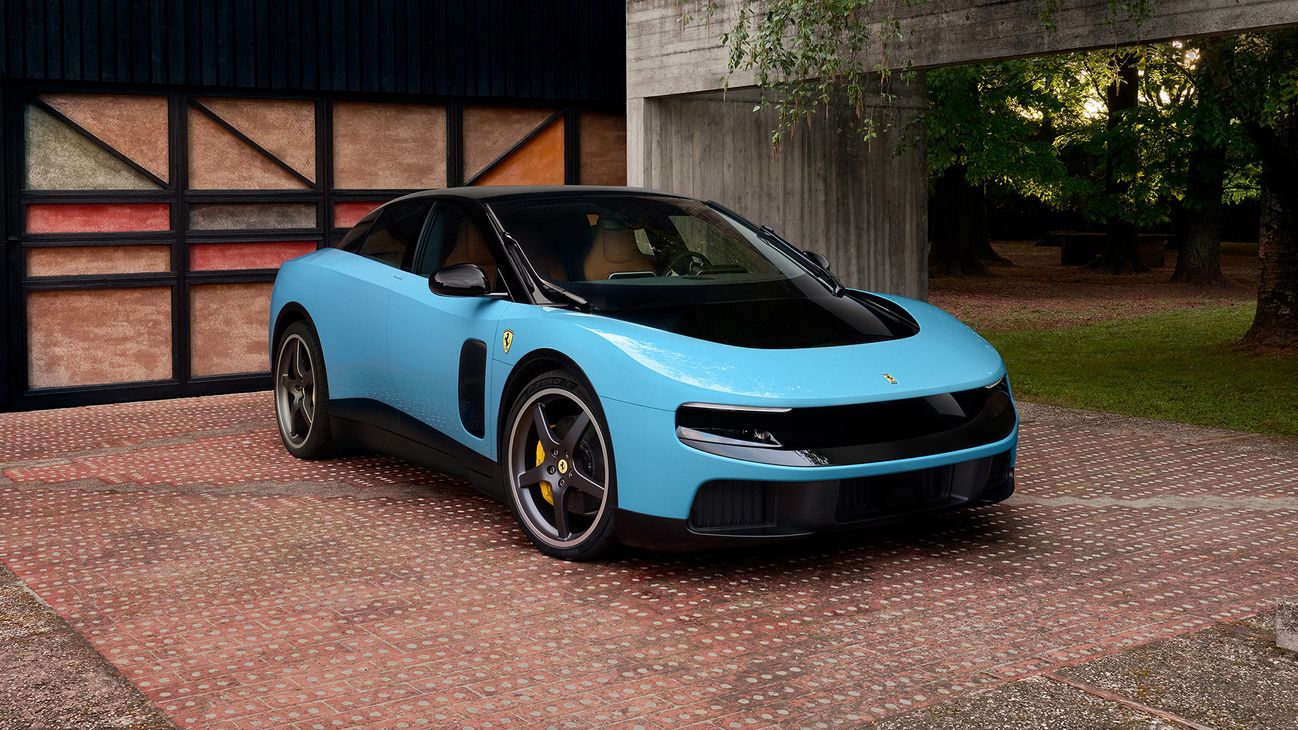
The Ferrari Luce EV is Ferrari’s electric car that recently got announced. The episode uses it as a flashpoint for why some fans feel electric Ferraris don’t match the brand’s old identity.
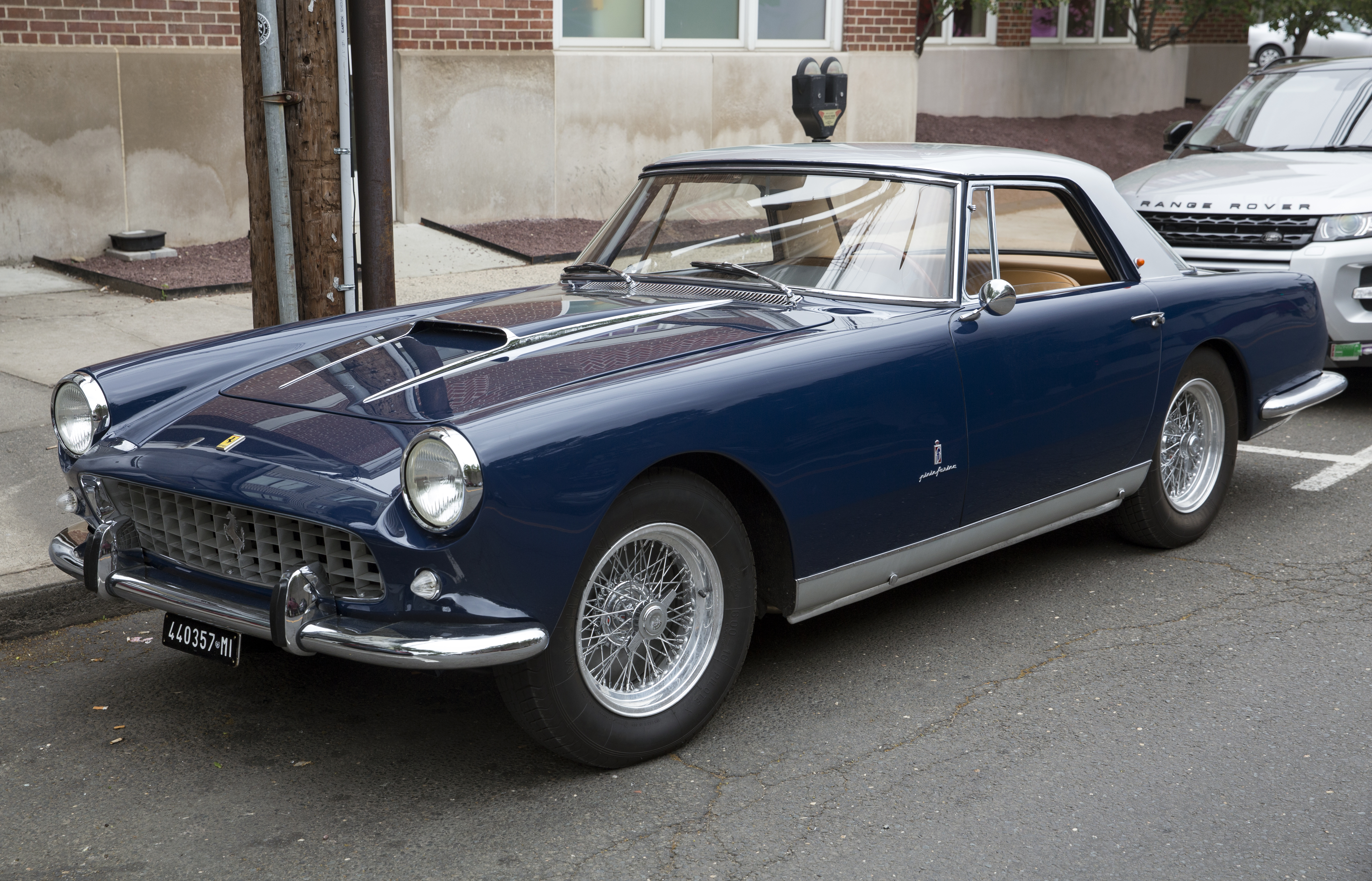
The Ferrari 330 GTC is an older Ferrari meant for long-distance driving. It’s famous for being both fun to drive and comfortable, and the episode focuses on why this specific model matters in Ferrari history.
The Ferrari 250 GTO is a legendary older Ferrari that many enthusiasts consider one of the most important classics. The host brings it up to compare it with the less-discussed 330 GTC.
The Ferrari 512 Berlinetta Boxer is a well-known classic Ferrari from the 1970s. The host mentions it as a more obvious, flashier choice compared with the 330 GTC.
The 24 Hours of Le Mans is a famous race where cars have to keep going for a full day. The host is saying Ferrari’s repeated wins helped pay for the rest of the company’s work, including building cars for customers.
Formula One is the highest level of race car competition with big engineering budgets. The host is saying Ferrari had to manage money and people between endurance racing and F1.
Torque is the engine’s “pulling power,” the force that helps the car get moving. The host is saying the smaller 275 engine didn’t have enough everyday pulling power, so Ferrari chose a bigger 330 engine for the 330 GTC.
A V12 is an engine with 12 cylinders arranged in two groups that form a V shape. The point here is that Ferrari’s V12s were chosen because they sound great and can deliver strong performance.
Concept
product line
Here, “product line” just means the set of different car models a company offers. Ferrari needed a new model because one of the earlier ones stopped being made.
The Ferrari 250 GT Lusso is used in this segment as the prior model that ended production, leaving a gap in Ferrari’s lineup. That “void” is what motivates the development of the Ferrari 330 GTC as a refined, long-distance grand touring car.
The “Geneva show” is a big car event in Geneva where automakers reveal new cars. When a car is unveiled there, it usually means it’s a major new model that the industry wants attention for.
The Lamborghini Miura is one of the most famous supercars from the 1960s. It’s known for having its engine in the middle of the car, which helps it feel very special and agile. The host brings it up because it was unveiled at the same Geneva event.
The Maserati Ghibli is a performance grand tourer from Maserati. In this story, it’s brought up as one of the cars competing for attention against Ferrari.
Car
Maserati Miura
The Maserati Miura is a legendary performance car known for putting the engine in the middle of the car. The host mentions it because it was a big deal at the time and made Ferrari’s job harder.
In enthusiast automotive culture, road tests are detailed evaluations published after driving a car in real-world conditions. They’re often used to judge not just styling, but how the car behaves dynamically—steering feel, ride quality, braking, and overall drivability.
A transaxle is basically the car’s transmission and final drive combined into one unit. Putting it farther back helps the car’s weight balance better, which can improve handling.
50-50 weight distribution means the car has about the same weight on the front and back wheels. That balance often helps the car turn in more evenly and feel less “sketchy” at the limit.
Concept
restores
“Restores” means restoring a classic car—fixing it up and bringing it back to how it should be. The host is saying the book is useful for both restoration projects and judging at car shows.
Concept
concord judging
Concord judging is like a classic-car competition where judges check how correct and original the car is. The host is saying the book helps people prepare for that kind of judging.
The Ferrari 330 GTS is another classic Ferrari from the same 330 family. The host is saying they also worked with/learned from a restoration of one, which helped make the book more detailed.
The chassis is the car’s main structure—the “skeleton” that everything else mounts to. A stronger, stiffer chassis helps the suspension work correctly and can improve handling.
It’s a type of car frame built from metal tubes, with special reinforced sections for attaching parts. The goal is to make the structure strong without adding too much weight.
Soundproofing is what helps keep road and mechanical noise from getting into the cabin. It usually involves extra insulation or damping materials inside the car.
Vakari e Bossi is a company the hosts mention as a supplier. The idea is that Ferrari sometimes bought certain parts from specialized local experts instead of making everything themselves.
Vertical integration means a company tries to do many steps of making a product itself. The episode contrasts that with Ferrari using outside specialists for some parts.
Scalietti is mentioned as a bodywork supplier. The point is that Ferrari could keep quality high without having to build and staff an entire body-making operation itself.
Coach builders are companies that make the car’s body and shape it for a specific model. Back then, manufacturers like Ferrari could work with different coach builders to get different styles.
“Coach work” means the car’s body—its exterior shape and panels. The point in this segment is that Pininfarina handled both the design and the actual bodywork for the Ferrari 330 GTC.
Batista Farina was the leader behind the company that became Pininfarina. The story here is that his nickname “Pinin” became part of the company name as it became famous.
In car design, “timeless” is the idea that proportions and styling cues stay attractive across decades rather than looking tied to a specific era. The segment ties this to the Pininfarina philosophy that when proportions are right, they remain right—so the design doesn’t “date” easily.
Tom Ciarda is a car designer mentioned in the story. The episode explains how he studied architecture, then ended up in Italy to help with car design work.
Pininfarina is an Italian company that designs and builds car bodies. A lot of Ferraris have been styled by them, so it’s a big name in how those cars look.
“Proportions” means how the different parts of the car are sized relative to each other—where the cabin sits, how long the hood looks, and the overall balance. The idea is that if the proportions are right, the design looks great even beyond small details.
The Jaguar XJ6 is a well-known older Jaguar sedan. Here it’s mentioned as an example of how a small design detail on the front can change how the whole car looks.
The Jaguar E-type is a famous British sports car known for its beautiful, timeless shape. The hosts mention it because Enzo Ferrari praised it as the most beautiful car he’d ever seen.
Enzo Ferrari was the founder of Ferrari. In this part of the episode, he’s quoted praising another car’s looks, to show how much he cared about design.
Francesco Salamone is mentioned as a designer involved with Pininfarina’s work. The hosts frame him as part of the creative team behind the design direction that ultimately influenced the Ferrari 330 GTC.
Aldo Brovarone is a designer credited with shaping some major Ferrari models. Here, the hosts say his design choices and methods helped influence the styling of the Ferrari 330 GTC.
Car
Ferrari Superamerica
The Ferrari Superamerica is another classic Ferrari mentioned in the same breath as the Superfast. The episode uses it as an example of design features that later influenced the Ferrari 330 GTC.
Car
Ferrari Superfast
The Ferrari Superfast is another classic Ferrari model mentioned to explain where design ideas came from. The episode says its styling influenced the Ferrari 330 GTC.
The Ferrari 330 GTC speciale is a special version of the 330 GTC. The episode mentions it because it had distinctive styling details and was made for a particular person.
“Flying buttress” refers to a structural/visual element where the support for the roofline appears to “float” away from the body, creating a distinctive silhouette. “C pillars” are the vertical supports at the rear of the cabin (between the rear side windows and the trunk area), and in this context the phrase describes a recognizable rear-quarter design cue.
The Ferrari Dino is another Ferrari model mentioned to show that some of the same styling details appear elsewhere. Here, the hosts point to the curved rear glass as a shared design feature.
Fully independent suspension means each wheel moves on its own. That helps the car stay more stable over bumps and usually makes handling feel more precise.
The Ferrari 275 GTB is referenced here as the donor platform for the 330 GTC’s chassis. The key point is that the 275 GTB introduced Ferrari’s early four-wheel independent suspension approach, which then carried over into the 330 GTC’s more modern road manners.
Leaf springs are an older type of suspension that uses stacked metal strips. They can be less sophisticated than independent suspension because the rear wheels don’t react to bumps as independently.
A GT car is meant for long-distance driving—smooth, capable, and comfortable enough for trips. Here, the speaker is saying the 330 GTC was Ferrari’s first serious effort to make that kind of “top level” touring car.
An A-arm is a suspension link that holds the wheel in the right position while allowing it to move. It helps control how the wheel moves as the car hits bumps.
Term
Coney shock absorbers
Shock absorbers (like Koni) control how quickly the suspension moves after a bump. They help the car settle down instead of bouncing.
Gioachino Colombo was an early Ferrari engineer. In this episode, he’s described as the person behind Ferrari’s first V12 design, which is why you hear “Colombo V12.”
A “Colombo V12” is a specific kind of Ferrari V12 engine design. The host is pointing out that it’s built for smoothness and durability, not just raw racing power.
An undersquare engine means the engine’s stroke is longer than its bore. That usually helps the car pull strongly at low speeds, so you don’t have to rev it hard all the time.
Hemispherical combustion chambers are a specific chamber shape inside the engine where fuel burns. The idea is to help the engine breathe and burn fuel efficiently, which can improve power.
Joe “Kino” Colombo was an engineer tied to Ferrari’s V12s. In this story, he’s credited with recognizing useful engine tech and helping bring it into Ferrari’s design.
Dual overhead cam means there are two camshafts up in the engine head controlling the valves. That can help the engine control valve timing more precisely for better performance.
“Triple Webers” means the engine uses three Weber carburetors to mix fuel and air. Using more than one carb can help the engine respond better and make more power.
“Prova” is an Italian word meaning “test.” The host is saying some Ferraris had plates that signaled they were being tested on the road, so authorities would leave them alone.
Paint correction is polishing the car’s paint to make it look smooth and flawless. They use special lights to spot problems and then fix them before the car is delivered.
Body gaps are the small spaces between car panels. If they’re even and consistent, it usually means the car was assembled carefully and looks properly aligned.
Overheating is when the engine gets too hot. It can happen if the cooling system can’t move enough heat away, and this story says early cars needed fixes to cool better.
This is a more efficient cooling setup that combines oil cooling and radiator cooling in one system. The point is that it improved cooling enough to fix the early overheating issue.
The Ferrari 275 GTS is another vintage Ferrari that the speaker brings up to explain a problem and how it was improved later. They’re saying the 275 GTS had more vibration, and the 330 GTC’s design fixed that.
Shock mount cracks are cracks where the suspension shocks attach to the car. If those mounts crack, the suspension can become less stable or unsafe, so the manufacturer issued instructions to reinforce the area.
A u-joint (universal joint) is a hinge-like coupling that allows a driveshaft to transmit torque even when the angles change. The host says the Ferrari 330 GTC had some u-joint failures, which is a common type of driveline wear/failure point on cars with moving suspension geometry.
Luigi Kinetti was an important Ferrari contact in the United States. He helped Ferrari get established there and was also involved in racing efforts that supported Ferrari in North America.
A technical bulletin is like an official fix guide from the manufacturer. It’s used when they find a problem pattern and want shops to apply the correct repair steps.
NART was a North American racing team connected to Ferrari. The speaker is saying it helped Ferrari race successfully in the US and build its reputation, including big wins at famous events.
A convertible is a car where the roof can be lowered so you can drive with open air. The episode says Ferrari was pushed to make more of these for American customers.
The Ferrari 275 GTB4 is a well-known classic Ferrari from the 1960s. In this story, it’s mentioned because it was used as the basis for a convertible version aimed at American buyers.
The Ferrari 365 GTC is the later model that replaced the earlier GTC. They mention it had a bigger V12 engine (4.4 liters) and that only a small number were built.
Anti-smog equipment is the stuff a car needs to reduce pollution so it can legally be sold in places with strict emissions rules. The point here is that Ferrari didn’t want to redesign the car just to meet U.S. requirements.
“Daytona” is a famous Ferrari model name. The speaker is saying Ferrari expected the Daytona to be the next big thing, so the 330 GTC didn’t get a long production run.
Vintage cars don’t like to sit unused for years. Even if they’re parked safely, things can slowly go bad—like fluids and corrosion—so regular use helps keep them healthy.
A grille is the front opening where air goes in. “Ovoid/elliptical” just means the shape is oval, and the host is pointing out that Ferrari used a very distinctive front design.
This is describing the shape of the front bumper. “Split” means it’s broken into sections, and “stiletto” means the ends look sharp/pointed—basically a very distinctive look.
The Ferrari 330 GT2 Plus 2 is another Ferrari from the same 330 family. The host brings it up just to compare body shape—specifically how the rear/trunk area looks and how it’s shaped.
These are openings in the car’s fenders meant to let hot air out. The host is saying they look good, but they don’t work as well as other vents for cooling the engine area.
Heat extractors are openings that help hot air leave the engine area. The host is saying the engine-lid openings worked better than the side vents for cooling.
Lift is an aerodynamic force that can push the car upward. The host is saying that airflow pressure under the car can make the car feel less planted, and the engine-lid openings help balance that pressure so the tires grip better.
Ground effect is when the shape of the car near the ground helps create stronger tire grip. The host is connecting this to how engineers were learning about downforce and how airflow under the car affects stability.
Downforce is the “squishing” force that presses the car down onto the road. More downforce usually means better grip and more stable handling at speed.
A belt line crease is a shaped line in the side of a car. It helps the body look more interesting and can make the car look lower or more “cut” depending on how light hits it.
The greenhouse is the part of the car that’s basically the windows and the frame around them. If the pillars are thin, the cabin looks more open and “lighter” from the outside.
A-, B-, and C-pillars are the vertical posts that hold up the roof and frame the windows. Thinner pillars can make the car look more open and less “boxed in.”
A cam tail is a rear shape feature that helps the air flow separate less messily behind the car. It’s designed to reduce the “turbulence” that creates drag.
Shed vortices are swirling pockets of air that break away from the car as it moves. If they don’t dissipate well, they can make the car harder to push through the air.
A wind tunnel is a place where they blow air past a car shape to see how it affects airflow. It helps engineers predict drag and other aerodynamic issues before building the full car.
Cotton tufts are little pieces of fabric stuck on the car to show how the air is moving. If they start curling or flapping, it usually means the airflow is no longer smooth.
LIVE
This is Horsepower Heritage, I'm Maurice Merrick, thanks for joining me once again.
You probably noticed that the unveiling of the Ferrari Luce EV a couple of weeks ago
sent Ferrari aficionados into a rage, and the car has been absolutely savaged on social media.
I'm not a fan of it myself, although I know it's a different world these days,
but I can't help but think about all the history behind what made Ferrari the greatest
sports car manufacturer of all time. So this week I've got one from the vault for you,
an interview with Maurice Kwam, who wrote the definitive book on one of Ferrari's most
important road cars ever, the 330 GTC. It was a perfect expression of sporting character, luxury,
and comfort, but it wasn't a compromise, which is what many people think the Luce represents.
Now, if you're not versed in Ferrari, when you're finished with this episode, you will
understand why the backlash against the Luce has been so strong. And if you are a Ferrari fan
already, and you kind of know some of the history, then I think you're probably going to find yourself
nodding in agreement, because Maurice is a terrific interview, he's just such a wealth of knowledge.
So without further ado, here's my conversation with Maurice Kwam, the author of Ferrari 330 GTC
Elegance and Pedigree. Enjoy.
Maurice, thank you for having me into your home today. And you're the first Maurice,
other than me, that's been on the podcast. That's kind of a rarity.
It's a pleasure to have you.
Yes, wonderful. Maurice, this book is absolutely masterful. Congratulations. I was blown away
by the finished product. So it's just wonderful.
Thank you so much.
The 330 GTC is, I would say, kind of an overlooked Ferrari model in many ways.
You could have written a book about the 250 GTO. You could have written a book about the 512
Berlinetta Boxer, some flashier cars, maybe some competition cars. Why the 330 GTC?
That's a very good question. And the answer lies in the fact that Ferrari was a very small
manufacturer of automobiles. If you don't mind, I would like to begin by giving you
a glance at what Ferrari looked like back in 1966.
Please.
So they were established in 1947 in Maranello. And in the 19 years, until the 330 GTC became
available, they had only produced 4,830 cars. So that's roughly about 250 cars per year.
That begs the question is, how could the manufacturer that's producing approximately
250 cars per year survive? And the answer to that lies in racing, believe it or not,
because Ferrari was dependent on the monies that he was winning from races.
In fact, I want to share one statistic with you that I think you'll find very interesting.
And that is from 1960 to 1966, Ferrari won the 24 Hours de Le Mans six years consecutively.
Remarkable.
And that's overall win, not just a class win.
It is an overall win from 1960 to 1965. He won six times in a row. And that's a fantastic
accomplishment. But then he realized that that's not sustainable. So he needed to do something else.
Also, they were divided. In other words, their resources had to go not just to sports car and
endurance racing, but also to Formula One. Yes. He had to share the revenues with the Formula One
team, the engineers, the mechanics. He had a big, big load on his hands.
His customers were telling him, hey, look, we need a car that is not as exuberant as the 275 GT
before and is not as stayed as the 330 GT2 Plus 2. So why don't you come up with something that
has a performance but is civilized that you can live with on a daily basis.
And that's how he crafted the 330 GTC. In fact, the 330 GTC was going to start as the 275 GTC
because he had a 275 GTB in production, a 275 GTS in production. It was logical that the 275 GTC
would fit right in the middle. But then he realized that torque that the engine of the 275 produces
is not adequate enough for a car that was not intended to be a race car, but a car for everyday
use. That's why he made the decision to go to the larger engine from the 330 and he put it in the
275 GTB chassis, effectively, and he came out with the 330 GTC.
We should add a little note here about Ferrari model nomenclature. So the number denotes the
displacement of one cylinder, right? So a 275 would have a 275cc cylinder displacement,
330, 330cc and so on. Yes. And that equates to 330 times 12 is four liters. Right.
And we are talking, of course, about V12 engines. Yes, the Colombo design V12 engines. Right.
And it wasn't the only configuration that Ferrari produced. He played with four cylinders,
six cylinders, eight cylinders. The 12 cylinder was his favorite. He did say that.
that specifically. He said, I tried them all. I tried the V12, V10, V8, V6, the six in line,
the four in line. I always came back to the V12. Do you think it's true that his love for the V12
was based on his witness as a young man to a Packard V12 racing in Europe? It is true.
Yeah. Yeah, very interesting. Because he had never been exposed to any other V12s except for
that Packard engine. Right. And from then on, it just stuck with him. Yes. Yeah. It stuck with him
and then add to that the fact that the engine produces such a beautiful sound and the performance
levels that could be expanded and so on. Excuse me. So I only answered half of your question.
And that is why he chose the 330 GTC to put why I decided to write a book about the 330 GTC.
I gave you the racing argument as to why he did that. But there's also another argument and that is
he needed to expand his product line because this product line had a void in it.
When the 250 GT Lusso went out of production, there was nothing to fill that void. And he quickly
realized that his customers were in fact correct and that they were asking for a civilized car
that they could drive long distances in and not have to resort to sign language to communicate at
over 90 miles per hour. Right. They wanted a refined grand touring car. Yes. So that gave him
the impetus to develop the 330 GTC and lo and behold, found out there is a huge market sector
for that type of a car. And Ferrari's market research was very intimate. It was direct feedback
from his clients. Yes. Yes. His clients knew him on an almost first name basis.
And they shared a lot of concerns with him. And he listened. He listened. And Ferrari did not
advertise. He didn't need to do that. He's a verse to advertising. Right. I think he thought it was
expensive ads in magazines. And that's right that marketing and advertising is very expensive.
Another perhaps apocryphal story, but I think it's true is that when people visited the factory
at Maranello, they were shocked that it was ice cold indoors and it was because they didn't run
the heaters because it cost too much money. Yes. In fact, they were so tight that Laura Ferrari is
first wife would go around, pick these screws and nuts of the floor of the factory and put them
back in the boxes to save some money. And Enzo really didn't care about road cars. He cared
only about racing and the road cars were simply there for another revenue stream. It was a
necessary evil to him. Yes. He in fact, I don't know if you remember reading some of the quotes
in the book, but one of them that really stuck with me is that he said outside of racing cars,
he has no other interests in life. That's right. And that to me is amazing. I mean,
this guy had a singular passion. Nothing else interested him except racing cars.
So he dedicated his entire life to producing the best racing cars he was capable of.
I did make a note of that quotation and another one I wanted to share. You wrote in the book that
Enzo said, I don't know what matters more, success or persistence. I have never been a designer nor
a calculating individual, but an agitator of men. Yes. Sometimes I went too far, but if I hadn't,
Ferrari wouldn't be what it is. Exactly. And if you compare the organizational
ambiance of Ferrari compared to Maserati and Lamborghini, you will find that they are completely,
completely different in the sense that those guys at Ferrari are dedicated to one thing,
and that is to produce the very best car that they can under the budget and the time
constraint that they have to work with. And that's really remarkable because he was able to instill
in them that passion. It was contagious. People that worked at Ferrari, they just wanted to get
to work every morning to be able to get their hands on their cars and build them. He had a loyal
employee base, men that had been with him even since the Alfa Romeo days in the 30s.
But he treated them very, very well. Whenever they needed anything, he was there for them
and he went out of his way to help them out. There are stories about Enzo and his largesse
and he did not advertise that. He kept it on the down low, but he would help his employees when
they were in trouble when they needed something. Yes. We have this image of Enzo as kind of a hard
man. Many of his drivers were put off by him. He set racing drivers sort of against each other.
He created these very competition. Yes, this rivalry within the team
because he wanted the best out of each of them. Yes. Some of them didn't ever get used to that.
Fungio is a good example. Tell us about that. Well, he just didn't care about the politics of
Ferrari and he could see straight through Enzo what he was doing and Fungio was an exceptional
driver and he didn't need to be treated that way. So he just walked. What about Phil Hill?
Well, you know, let me tell you something. Enzo Ferrari in particular
had something against Americans. I don't know exactly what it was, but
he just didn't care too much for them. So when Phil Hill won the championship
and they lost the German count in the accident at Monza, he won trips. Enzo Ferrari was turned off
and he just backed away from Phil Hill. Add to that the team manager at Ferrari didn't care
for Phil Hill neither. So that created a lot of friction and Phil Hill just couldn't put up with
it anymore. He just walked away with Kiti and the third guy and they established the ATS.
Hey guys, I want to take a quick break to say if you enjoy horsepower heritage,
there are a few ways you can support the show. Go to buymeacoffee.com forward slash
hpheritage and become a patron. There's a link in the show notes. You can make a one-time donation
or you can support the show monthly. It's easy and for the price of a latte, you can help me
continue to bring you more of the people and stories behind the machines. You can also leave
five stars and a review on Apple podcasts or Spotify because that helps new listeners discover
the show. Thanks for your support and now back to the show. So the 330 GTC is unveiled in March of
1966 at the Geneva show. How was it received? Well, let me tell you, it was a very, very unusual show
because besides the 330 GTC, Lamborghini unveiled der Miura at the same show. Just a few stands away
and at the same Geneva show, Maserati unveiled their Ghibli a few stands away. So it was an
uphill battle for Ferrari to go against the mid-engine Miura and the sensational Ghibli.
It was a very tough going but then with time, drivers got behind the wheel of the 330 GTC
and they read the road tests like Port Frère wrote the fantastic road tests on the car and
they became convinced that it's not just looks that sell cars, it's the dynamics, but how the car
drives, how the car reacts, responds and slowly, slowly he gained market share and the 330
GTC became a commercial success. And despite it being a front engine car,
this was kind of a genius move. They put a transaxle in it which shifted that weight rear
word resulting in a 50-50 weight distribution of the car. Plus a torque tube. Yes, a torque tube,
right, right. We're going to talk about some of those technical details as we go along because
I've made note of some of the more interesting developmental and I really kind of want to
get into the technicals in this episode because I just think the book is so detailed. First of all,
we should say I'm fully confident in describing this book as a reference for restores as well as
concord judging. Yes. It really is that detailed and you were fortunate to be able to document the
restoration of two 330 GTCs in the course of producing the book. Yes, that was very fortunate.
Tell me about that process in a way that's the backbone of the book. Yes. So a friend of mine
who has a shop for metalwork told me that he's working on 330 GTC for a customer from the east
coast and I asked him, I said, Steve, may I stop by and take a look at the car? He said,
yeah, by all means. So I went over and the car was naked. That means it's completely disassembled,
no fenders, no doors, no trunk lids, no nothing. And everything was exposed, the chassis,
the suspension, everything. So I said, hey, I got to grab this opportunity. So I start snapping
pictures and I learned a lot because when you see it, it's different than when somebody tells
you about it. Sure. And I asked him questions. tons of questions and he was very
kind to respond to me. So I documented that part of the restoration and was very, very happy with
it. Then another friend of mine up in Northern California was restoring a 330 GTS and I said,
hey, do you have any photos that you could share with me? And he sends me the CDs,
chock full with photos, everything. I mean, everything you did to the car, engine,
transaxle, suspension, everything. So I looked at it and I picked up the phone and started asking
him questions too. And before I knew it, I had enough material to cover the restoration from A to Z.
And you mentioned the disassembly of the car, how naked it was. I want to kind of get into some of
the design elements. I think we should begin with the chassis. It's tube and eye beams. There's an
X brace in the center. So it's not unlike a racing chassis in many ways. For the period,
yes. For back then, they essentially used the same layout. Right. The floor sections of the car
were made of fiberglass for lightness. And this gets into the refined character of the car.
Lots of soundproofing and cabin refinements. So it was very quiet compared to other models. You
know, there was a company called Vakari e Bossi. And this is interesting. Why didn't Ferrari build
those in-house? Oh, because it was a redundant work. And if they had a reliable vendor, why not use
them? Right. They're down the street from Maranello. This sets Ferrari apart from, well, of course,
this is an apples and oranges comparison, but I'll do it anyway. So Henry Ford was famous for his
vertical integration. Everything was under his roof or sets of roofs. Early on, decided I don't
want to rely on outside suppliers. Now, of course, again, it's an apples and oranges. Ford production
on one day is greater than Ferrari production in a decade. But my point is that this is two
different approaches. I guess Enzo, it made more sense in a small production environment
to farm it out. Yeah. And he did that with the bodies as well. He used Scalietti, who's also
located in Modena, to do the bodies for him. Right. It was a very shrewd move, in fact,
because he controlled their quality and was not exposed to the financial burdens that
they had to go through. Had he built the chassis in-house like he was doing before,
and the bodies would probably have encompassed him too much because his number of employees would
would need to be tripled to be able to cope with that demand and would have choked him off. So
Vakari and Bossi, they were doing a fantastic job. He was very happy with them. So was Scalietti.
So why not spread out the work? Right. You mentioned Scalietti. Ferrari was famous
since day one for using many different coach builders, Vignale, Scalietti, Touring,
and the most prominent, of course, was Pininfarina. Correct. And so the 330 GTC was a Pininfarina
design, and they also produced the coach work. Yes. Let's talk a little bit about
Batista Farina. So Batista was the boss. His nickname was Pinin. And then later on,
they changed the family name from Farina to Pininfarina because it became so well known.
Yes. Right. But interesting guy, he was not an automotive stylist or designer by training.
In fact, the company was founded essentially as a body shop way back in the, I think,
1910s. Yes. But post-war, they were a premier design house.
Batista Pininfarina and his son Sergio, they had what's called DI. They knew when a design
met the necessary caliber to go into production. They knew when the proportions were right on.
In fact, Sergio Pininfarina in a quote in my book, he says, when the proportions are right,
they are right forever. And that's very true. It is. That's why these designs are considered
timeless. Yes. Because you cannot fault them. They're right on.
Yeah. They don't look dated. Yes. They can still look very fresh 50, 60 years on.
You have a very interesting section in the book with Tom Ciarda. And of course, Tom was
a Dutch American car designer. His father had been a car designer. Fascinating story about how he
came to Italy to design. He graduated from the University of Michigan, got a degree in architecture.
And his professor asked him to, as a project for graduating, asked him to design something
very unusual. So he said, I'd like to design a car. And they went back and forth and they finally
agreed on designing this sports car. Ciarda worked on the car. And finally, when the car was
completed, his professor asked him to bring it over and come over for dinner. It's during that dinner
that he revealed to Ciarda that Gia in Italy had asked him to send over an American student
that could work for, you know, Gia on car projects. And Ciarda couldn't believe it's years.
He said, yeah, yeah, I'll go. So they put him on this ship and he went over to see his relatives
in Holland. As he said, he's a Dutch American. And then after visiting his relatives, he went down
to work for Gia. And he worked for Gia for, you know, quite some time. He actually produced some
very nice cars like the Dito Masso Mangusta is his work. But he, in the back of his mind, always
wanted to work for Pininfarina on Ferraris. And then finally, one day, a friend of his
told him he knew somebody at Pininfarina and they would put the word for him. And sure enough,
Pininfarina asked him to offer them a job. So that's how he, you know, came over to Pininfarina
and started working on the cars there. And he was there for, I think, nine years or something and
got a real insight into what you were talking about in terms of the proportions and how the
Ferrina father and son had the eye. Yeah, they had the eye. But what's interesting that
Tom Tiada shares with us in the book is that the Italians had sort of merged with the Greeks
that came over to Italy. And the Greeks slowly, slowly indoctrinated the Italians
into the design and the proportions. And that's why there's a photo of the Parthenon in the book.
And I found that to be very fascinating. I thought it was all Italian, but in fact,
it is Greek Italian. And he talks in a lot of detail about the importance of proportions
and how he used to bring that up with his professors at universities and try to instill in them
the necessity to share that with their students is that he wanted them to get the students to
start thinking about the proportions early on, because that's what makes a very successful design.
I thought that was a great insight into Italian design, because we think of Italian design as
very seductive. It's very beautiful. And Italian designers, in fact, have been hired worldwide,
whether it's a German car maker or a Japanese appliance maker, they want to beautify their
products and they want that Italian eye. But it all stems from the ancient world. Yes.
Fascinating. Yes. Plus, besides the proportions, the Italians know how to do
the fine touches on a design. And sometimes it's subtle, but it makes a huge difference.
It does. Case in point, and that's not, I don't want to get away from the subject of the book,
but take the Jaguar XJ6, for example. It had a big square calendar in the front,
and the grille was very, very British. So they called Pininfarina and Pininfarina refined
the grille and tweaked the rear taillights. And suddenly the car gained 10 years of life
in terms of looks, and that was a commercial success. No, it's a good point, because a lot of British
cars have rather awkward proportions, let's say. They just didn't quite have, there are some standouts
here and there, of course, but the E-type Jaguar actually Enzo said it was the most beautiful
car he'd ever seen. That's true. Well, he said that also to proud Pininfarina to work hard.
Oh, well, that's very interesting. That's a good, that's an interesting angle on that.
That hadn't occurred to me, but so in the book, we see into Pininfarina through the eyes of Tom
Ciarda. I thought that was a great touch. And he talks about how a gentleman named Francesco
Salamone was designing there. And then a gentleman named Aldo Brovarone. Yes. And Aldo was actually
the guy who was responsible for the Ferrari Superfast and the Ferrari Superamerica. Yes.
And design elements of those cars were highly influential on the 330 GTC.
Right. Right. Right. And it was common practice back then to use elements. Because I asked
Brovarone, you use this nose from this car, the tail end from this car, he said it was
common practice back then to use successful components of a design in a new design.
Nowadays, it's probably will be frowned upon. But back then it was very common practice.
Yeah. And it did establish a design language after all, which we talk about a lot today. Yes.
Another example that comes to my mind is the Ferrari 330 GTC speciale that was produced for
Princess Lillian of Belgium. The rear end on that car is very similar to the Ferrari
Treposti. Yes. You know, the tail lights and the cam tail and the flying buttress C pillars as well.
Right. And the curved rear windshield. The That's right. Again,
you can see that in the Ferrari Dino as well. Absolutely. So yeah, that design language was
very important. So that paints a little bit of a picture of how the coach work was designed and
produced. We've talked about the chassis already. I think we should probably get into some of the
other systems of the car because again, the book is very detailed. The car had excellent
road holding and handling and responsiveness in large part because of its fully independent
suspension. Yes. Which was really a first because the 275 GTB lent its chassis to the 330 GTC.
And the 275 was the very first Ferrari with four wheel independent suspension.
And it was a tremendous movement forward for Ferrari because the cars were transformed
because of the four wheel independent suspension. Yeah. Prior to that, the rear was still on leaf
springs. Yeah. It was very antiquated. Right. And that's why I argue in the book the reason why I
wrote the book about the 330 GTC was because it was the first attempt wholeheartedly by Ferrari to
produce a world class GT car. Unlike the Luso which had a four speed transmission and solid axle
in the back, no AC, no electric windows. The car looked sensational. It was very pretty. It still
is pretty and probably will be pretty for another hundred years. But try to go on a long distance
trip in the Luso. It's unlike the 330 GTC that even today you can get in the car.
It almost feels like a car that was built in the, you know, 2021. Right. It still feels modern.
So that's why I argue that the car deserved to be brought to the fore. And the book is really
a conduit to that because I wanted to make sure that the readers know that the 330 GTC
began a trend at Ferrari to create a bifurcation between road cars and race cars. And he essentially
said, okay, I'm building the 330 GTC and I'm going to continue building a line of cars along the
330 GTC specification that are not dedicated or destined for racing. And that created a huge
market for him. In fact, his production and your production effectively doubled when the 330 GTC
became available. Interesting. So the suspension we said was fully independent. A arms on all four
corners with coils and Coney shock absorbers. Right. And let's talk about the engine.
When you discuss Ferraris, you often hear about the Colombo V12, the Lampretti V12.
Those are the names of the designers. Right. In this case, it was the Colombo.
And Giochino Colombo had been with Ferrari since day one.
Effectively, yes, he designed the very first V12. Right. Which was, I think, 2.5 liters?
Two liters? No, it was less than that. It was like 1.5. 1.5. Right. In this case,
this evolution of the Colombo V12 put it at four liters, 300 horsepower, seven main bearings.
It was a long stroke, but it was an undersquare engine. Yes. That becomes important because it
allows for that low end torque and good drivability at low speed, which you want in a refined road
car. Right. You don't want to have to wring it out every time. Like on the 275. Right. And yet,
it also allows for high speed, long distance touring. Yes. This again goes to purpose of design.
Yes. See, the engine in the 330 GTC was never intended to go racing. It was an engine designed
specifically for the GT application. And they knew they needed torque and they knew they needed to
kind of limit the RPM so that the engine would not be screaming all the time. And
effectively, that engine was never used in a race car, even though there was a Ferrari 330 race car,
but not that particular model, not the 330 GTC. So I think one of Ferrari's forte
is they know how to tailor, make an engine for a specific application. And they are very successful
at that. I mentioned it was an undersquare engine, so 77 millimeter bore, 71 millimeter stroke,
aluminum cylinder heads, two valves per cylinder, 60 degree V, and hemispherical combustion chambers,
which had become popular in the U.S. in the 1950s. And Joe Kino Colombo saw that.
They adopted that technology. Aluminum pistons, dual overhead cam, and triple webers.
Yes. And that did the job. I mean, they were very happy with the output of the engine. The torque
curve was nice, and the engine performed very reliably. They never had a problem. And Enzo
tested that engine in the prototype, and he drove the pistons out of that car
before he released it for production. In fact, Ferrari's test drivers would run the cars in
the hills around Maranello. The Italian road system was their test track, really in many ways.
And if you see a Ferrari with an Italian license plate that says Prova on it, what does that mean?
Prova is a test. The Italian road for tests is like when you go to your tailor who's making your
suit, you go for a Prova. You're proving your car. So they had these license plates that said
Prova. Just to satisfy the carabinieri. The carabinieri won't bother you with those plates.
I mean, they would not bother Ferrari anyway. They just wanted to show that
they abide by the law, and they did the right thing. So the test drivers would take the car up
the hills and come back and say, you need to tweak this and fix that, whatever. And then they did
all this, and then they inspected the car one last time. If they found any flaws in the paint or
road chips, they sent it to a special department at Ferrari. And there's a photo of that in the book
where the guy with his lights would shine on the car and try to fix everything,
do the paint correction, and then they would release the car. One of the things that they did
is they paid very close attention to the finish of the car. And they had these inspectors would
come over and take a look at the finish and body gaps and all the stuff. And if they found
anything, they would squawk it and tell the guys to fix it. And then they would take the car into
a special area in the factory, shine special lights on the car, and do the paint correction,
and then release the car. But they always put a sticker on the back of the rear view mirror
with the chassis number of the car. And that signified that the car is ready to go.
And when the motoring press finally did get a hold of the 330 GTC, it was,
they considered it the best road going Ferrari ever built.
Yes.
And so there's the magic of it that inspired you to write this book.
What about your personal experiences with the 330 GTC? I'm really interested in that.
Yes, very good question. So I had a friend of mine was very close who had the 330 GTC.
And one day he told me, he said, would you like to drive with me up to Monterey for the weekend,
for the car weekend? I said, Chuck, well, of course I would. He said,
yeah, but you have to bring some wine. I said, okay, yeah, I'd bring some wine, no problem.
So I, you know, selected 12 bottles and we got in the car and drove up there. And at Saint Louis
Obispo, he gave me the keys and he said, you drive the rest of the way to Monterey. And that was my
first experience with the 330 GTC. And I had, you know, I had a Dino and I had driven to 50 GTEs
and so on. So I was familiar with the, you know, with the Ferrari, but the 330 GTC was a revelation.
Chuck was a very heavy set guy. He was 250 pounds. And the trunk was chock full with wine and
everything else. And I drove this car and this car is just like, it's like we were on rails.
I couldn't believe it. So we spent the weekend in Monterey. We had lots of fun. And the night before,
I went to bed and I thought Chuck was going to go to bed too. But instead, Chuck went out to the
balcony and finish the rest of the wine. So the following morning, I looked at him,
it's like, Chuck, are you okay? He said, no, I'm not. Not okay. I said, Chuck, but we have to drive
back to LA. He said, no, you're driving back to LA. So that was a blessing in disguise. It was.
So I got him in the right seat, started the car up and drove to LA. I was doing 90 to 100
miles per hour on the 101. In fact, I passed the cup at 90 miles per hour.
Did you really? I mean, he didn't pull me over. He probably appreciated the car.
So I thought it was a good woman. So I couldn't believe what the dynamics of the car were.
This was a fantastic machine. And you had driven. You had a basis for comparison.
So I timed the drive at five hours, including a stop for gas along the way.
And that's Monterey to greater Los Angeles. And I dropped him off, parked the car,
and couldn't get that experience out of my mind. And I started doing research. I'm a very
research oriented guy. So I started looking into the car and it's like, wow, this is a sleeper.
And Chuck had already had paid $85,000 for the car. And now the car is worth $485,000.
Amazing. And it left a lasting impression on me. And when I found out that it shared the chassis
with the 275 GTB and it had the bigger motor and the transaxle and torque tube and all the other
goodies. It was time for me to bring it to the fore and let people know about it.
Right. Now, the car wasn't without its imperfections. There were some early deficiencies like
it was overheating. To correct that, the factory added a pair of oil coolers initially.
Because they had relied on the fins, cooling fins on the sump cover to cool. It just wasn't
adequate. So they added those twin oil coolers. And then they even refined it more with an
integrated oil cooler and radiator, which helped greatly. And then that solved the cooling issues.
There were also some drive shaft vibrations. How did they correct that?
Well, the 330 GTC really did not have the vibrations that, like let's say the 275
GTS had because they knew that the solution of the torque tube was really a final solution.
Because it made it all very rigid. Absolutely. And it eliminated any issues with the transaxle
not being lined up with the engine and so on. So they adopted the torque tube from day one
on the 330 GTC. There were also some u-joint failures and some shock mount cracks in the front
suspension A-arms. Yes. They sent out a recall. It wasn't really called the recall back then.
They sent out a bulletin through their importer, Luigi Kinetti. And Luigi Kinetti came up with
the schematics as to where the welding needs to be added onto the shock tower to eliminate the
cracks. And believe it or not, I still come across 330 GTCs today that haven't had that fixed done.
Yeah, that is an interesting aspect of when you're tearing a car down for restoration. You
witness that, oh, these have these reinforcing plates welded in. You don't see them on some cars.
They never got it. So it wasn't, the cracks didn't appear in all cars necessarily, but it was enough
of a problem where they needed to issue a technical bulletin. You mentioned Luigi Kinetti and I think
we should tell people how significant he was to Ferrari. I mean, he effectively put Ferrari on
the map in the United States because Ferrari didn't speak English. They only had one guy,
a American, I think it was his name, who was their liaison with the US market, but they didn't have
a presence in the States. So he was Luigi Kinetti, who had the presence in the United States. He had
a team of people that spoke English and he of course spoke Italian. So it was natural
for Enzo Ferrari to work with Kinetti, who was a dear friend of his, and Kinetti had won the
Le Mans race for him. So he was quite well established with Enzo, of course on a first name
basis. And that's how it grew. And Kinetti, of course, is famous for the North American racing
team, NART. NART. It's almost like an arm of Scuderia Ferrari. NART winning many Sebring and
Daytona races and racing also in Europe, racing at Le Mans. So yeah, very important guy.
Yeah, he was instrumental and not only spreading the word about Ferrari, but
being there with the product and showing it off to American customers and let them test it,
let them feel it and understand why Ferrari is different than any other car out there.
And Kinetti was also influential in the product line.
Yes, of course. He opened up the eyes of Enzo Ferrari to the US market, especially in California,
and how Enzo Ferrari needs to look into making more convertibles for the US market.
And that's how he talked him into making the 275 GTB4 into a GTS4.
And in fact, there were 330 GTC convertibles.
Yes, they produced 99 of those cars, and two of them were right hand drives. But
the car now is very, very revered and was very well received back then,
still garners a lot of attention wherever it goes.
What was the total production run for the 330 GTC?
Uh, they produced 500, produced and sold 597 cars.
Okay, so that's just a drop in the bucket compared to most manufacturers.
You know, I began by saying the 330 GTC is kind of an overlooked Ferrari.
And in fact, many of them have been scavenged to produce replicas of other, let's say,
more famous Ferraris. And one of the reasons for that is the 330 GTC for a long time was not
worth a great deal of money. That's right. Compared to a 250 Le Mans, a 275 GTB.
But that was the fate of the previous models as well. Yes.
Like the 250 GTs and GTS, a lot of them were sacrificed and turned into a more desirable
looking Ferrari. Right. But not anymore.
No, no, they finally have their day. Now by 1968, they have the successor ready.
It's the 365 GTC, now a larger displacement, 4.4 liter V12.
Correct, correct. And they only built 200 of those.
No, they built less than that.
Less than that.
They built 150.
150. And 20 convertibles. The reason why they produced so few of those was because
Enzo Ferrari did not want to export the car to the US market because it required a lot of
anti-smog equipment to be produced specifically for that car. And he knew that the days of that
model were limited because the Daytona was around the corner. So they only produced 150
of the coupes and 20 of the convertibles.
From a collector's point of view, what is more desirable, a 330 GTC or 365?
You know, I don't think the engine displacement is such a big issue.
I think what's more important is the condition of the car and the history of the car.
Has it been well taken care of, well maintained, driven or is it shoved in a corner in a garage
with a bunch of clothes, basket on top of it and forgotten for years?
Because that makes a big difference in the desirability of the car.
As is true for many classic cars, the worst thing you can do to a vintage Ferrari is let it sit.
Yes. You have to drive them.
Yes. You kill it by letting it sit.
Right.
Slow death.
Maurice, let's backtrack for a moment because I think we blew by some of the styling elements
of the car. I mentioned the Ferrari Superfast in Super America, but they have a very distinctive,
I would call an ovoid grille.
Yeah, elliptical grille.
Elliptical grille and these split stiletto bumpers.
Yes.
And a nice sloping nose, low headlights, very distinctive look.
So those elements came from the Superfast in Super America, but what are some of the
elements of the 330 GTC that were developed to make it, as we say, proportional, that eye?
If you compare, for example, the trunk area of the 330 GTC to that of the 330 GT2 Plus 2,
you will see that on the 330 GTC, it is much more refined, down sloping,
and it seems to occupy less volume.
And that imparts a look of finesse to that particular model.
The other thing is, and a lot of people regret that they didn't transfer that design
element to the 365, are the vents on the fenders.
Those vents, even though, in my opinion, are not very adequate in extracting heat from the
engine compartment, they looked the part, they looked fantastic.
And Pininfarina decided to delete them and replace them with openings on the engine cover,
engine lid.
And effectively, he was right because those extractors were much more efficient in extracting
heat from the engine than the side vents, because heat, as you know, rises.
So when it rises and it finds an opening, it gets out, it escapes, whereas on the side vents,
it has to work its way into the engine compartment to get to those vents and escape.
But there's also another important element of those openings on the engine lid, and very few
people know about this.
And that is, when a car drives on the road, the pressure underneath the car is higher
than the pressure above the car, effectively creating lift, where with those openings on the
engine lid, they equalize the pressure underneath the car and above the car.
So the lift goes away, so the car gets better road holding overall.
Now, that wasn't intentional, it was kind of a happy accident, right?
Well, it was at a time when those things were being discovered.
Right, ground effect and downforce, all of that.
Lift, positive lift, negative lift.
But it worked great.
You talk about the belt line crease of the 330 GTC, and it's more than just a styling cue.
Yes, it effectively breaks the profile of the car into two halves, the upper half and the lower
half, and it takes away from the monotony of just having one single slapsided part of the car.
And because of that crease, it creates different lighting on the body of the car.
So the upper part of the body is lit more than the lower part of the body,
which makes the car appear to sit a little lower.
It seems self-evident that you would want to see a car in the light,
but you talk about in the book how they were very careful to pull the cars out
into the sunlight at Pininfarina and look them over very carefully.
And when they presented a car to Enzo Ferrari, he never approved anything quickly.
He needed to live with it for a while.
Yes, he needed to live with the design, feel it, and go back to Sergio Pininfarina
and discuss some items and go back and forth.
And Sergio Pininfarina caught on about how Enzo Ferrari approached the design critique
of a particular car.
So he developed this extra patience to work with the man.
And he knew that eventually, if his design was right on, that Enzo Ferrari would acquiesce
and approve of the design.
A couple of the other elements of the 330 GTC that are interesting.
First of all, the greenhouse is very light and that is owing to very thin pillars,
yes, A, B, and C. It gives it an airy feel.
It lowers the car in a sense, visually, the perception of the car.
Another element is at the rear of the car, below the level of the trunk lid and tail lamps
it flows back towards the front.
It's a compound curve back towards the front, which, again, finishes it in a refined way.
It's pinched in.
It's tucked in, yes.
Right, yes.
From an aerodynamic point of view, it's really not very effective to have that kind of a compound
curve moving forward towards the nose of the car.
What you want is a vertical surface, also known as a cam tail, that would
help the car and the shed vortices from the car dissipate, so we will not create a lot of drag.
But, you know, I mean, Pininfarina, they did not have their wind tunnel available to them.
They were building it as a 330 GTC went into production.
So, they did things using models, and they tested those models at the wind tunnel at the
University of Turin.
And I have a few photos of the models hanging from the ceiling with wires and how they tested them.
You know, I mean, models are okay to give you a general idea, but they don't point out
specific problems.
A case in point, if you go to the chapter in the book that talks about aerodynamics,
you will see that when we use those cotton tufts on the car, everything looked very, very smooth
from the nose on to the beginning of the rear windshield.
And then, when we hit the rear windshield, all hell broke loose.
And the reason why was because the gasket that they used for the rear windshield protruded into the
airstream about, it was about maybe three quarters of an inch sitting proud of the roofline.
So, when the airstream, which was very weak at that point, because it had traveled from the
nose of the car up the front windshield on to the roof, all the way to the back where it was
very weak, got tripped by that gasket, the airflow separated.
And you could see the tufts curling on the rear windshield.
See, a model would not be able to tell you that because it's way too small.
You have to have the real full-scale body sitting in the wind tunnel to be able to see this.
People will be familiar with what we're talking about.
But just in case, think of little strands of yarn taped on every surface of the car,
every few inches. And that yarn is affected by the airstream and it shows areas of smooth
airflow and areas of turbulent airflow. It's called flow visualization.
Right. And it was illustrated in the film Ford V Ferrari when they were towing with the design
of the GT40 that there was a scene where Ken Miles is driving it and they've got it covered in
strands of yarn to show the airflow. Yes.
So, but in the book, it's illustrated very nicely with a series of photos.
You have the car set up with the tail tails all over and there are separate photographs for
the car driving with the windows up, the windows down, and it shows the flow.
Right. It's a subject that's dear to me.
Right, because you have a background in aerospace.
Yes. And I wanted to illustrate when they say, oh, the body of the car was very refined,
was very aerodynamic, and so on. I wanted to show the reader what is meant by that.
Right. Yeah, it's very interesting. And I would say that the 330 GTC is a very conservative design,
but it's also part of what makes it so fresh even today.
Yes. I think adding to that that the proportions were right on the car from the get go.
Yes, indeed. Yes, indeed. Now, there were also, in addition to the standard production cars,
there were quite a few 330 GT specials that went to prominent clients. For example,
Princess Lillian of Belgium, whom we mentioned earlier.
Yes.
Sergio Pininfarina owned a special.
Yes. It was a car that he bought from Ferrari to test some of his ideas on how to
refine the design. Some of the things that he did were he improved the heating system
inside the cabin to give the passenger his own temperature control while the driver kept his.
Pretty innovative for the day.
Yeah, very innovative. The air outlet on the hood were tested on that car.
They also tested additional lights, pop-up lights. They called them
Supervisors for supervision that they would just turn on when the outside conditions were
necessitated additional lighting.
Yeah, just auxiliary lamps. I love how they're hidden in the front panel of the nose.
You don't even really notice them, but then when they pop up, they're also quite elegant.
They look good up or down is what I'm trying to say.
Yes, and they're very, very complicated. I have a friend of mine who owned that
Pininfarina car that you mentioned and when they first got it, they didn't know that those lights
were on the car. Is that right?
Yeah, because the car had changed color from dark blue to silver and they painted that panel.
By chance, they were tapping in that area or whatever and they realized that something is odd.
So they decided to investigate and they found out that there indeed were lights in that particular
area. So they contacted Pininfarina and I add the letters of correspondence with Pininfarina
on that particular subject and Pininfarina confirmed that yes indeed there were lights
in that area. Now try to replicate those lights when you have no plans, no nothing.
Fortunately, they found a guy who owned Ferrari that had used those exact
light but a different model who was willing to lend the car so that the
fabricator could make those pieces for them.
Very interesting. A couple other prominent owners, Dr. Michael DeBakey, who was a pioneering
heart surgeon, cardiologist in the United States, and Pietro Barilla, the Italian pasta
magnate. And then the fourth guy that very few people know about is Dr. Franco Di Palma,
who was a personal friend of Ferrari. He owned a bunch of pharmacies and that was his domain
of pharmacology. And he advised and helped Enzo Ferrari when Dino was sick trying to procure
some of the medication that Dino needed. Oh, terrible. Muscular dystrophy is what killed
Dino Ferrari. So he asked Enzo if he could have a speciale and Enzo without any hesitation said
yes. Of course, of course. So the production run of the 365 GTC ended in 1969. Yes.
And Ferrari's character and design changed quite a bit from that point forward.
A lot. The design language was taken over by Leonardo Fiolavanti and he
decided to get away from this elliptical inlets and round seven inch headlights and
do something very, very unusual. And he was quite successful. And let me tell you why he was
successful is because he combined two disciplines that are in my view essential for successful
designs. Number one, he was a talented designer. You know, he knew how to draw cars. But the other
thing is that he was a trained aerodynamicist. So he knew what works and what doesn't work.
And sure enough, when he designed the 365 GT before the Daytona, they went out testing it on
Australia and Italy. The car didn't exhibit any of the anomalies. Other cars like the Miura
who had the nose lift at over 150 miles per hour. And the car was very, very stable. And the reason
why it was stable was because the guy who designed it was a trained person in that particular design.
And aerodynamics. And this was the advent of the wedge car era. And not just for Ferrari,
but for other Italian manufacturers, Maserati, Lamborghini, but also worldwide really.
People like Marcello Gandini, Giovanni Michelotti, it was their heavy influence that prompted a
lot of those changes. Yes. Maurice, you also profile many Ferrari 330 GTC owners in the book.
And you gave them an opportunity in their own words to talk about the ownership and driving
experience. Right. And I thought it was essential to have that chapter in the book. And the reason is
I wanted to make the book personal. No, I wanted a lot of people to relate to the cars and the
book. So I figured if I have a lot of people talk about the experiences of ownership of driving the
car and put that in the book, I effectively would have accomplished an objective of making the book
about people and the cars. I think you've done it. Yeah, it's got a nice personal connection
in that section of the book. And of course, in addition to hundreds of period photographs and
new photographs, for example, of the restoration process, and many, many archival documents,
correspondence between Ferrari, Kinetti, Pininfarina and so forth, you also have catalogued
all of the chassis numbers. Yes. Including the production dates, specifications, color combination.
Yeah, right. All of that. And you have a wonderful several pages of all of the standard colors
available as well as all of the optional colors available. Right. That was fantastic. That must
have been a little bit difficult to produce. To produce or to generate. Right. It was very difficult
from a sense of coming up with the right color. For example, I had a very hard time with yellow
because, I mean, have you heard of Yellow Man War? I never have until I saw the book.
I know. But it was one color that was offered and one car was produced in that particular color.
So I tried to find a Yellow Man War. It was like looking for a needle in a haystack.
But I persisted and then finally came across a car with that color.
Maurice, this isn't your first publication. No.
We should mention you are also the publisher. Yes, I am.
Yeah. This is not my full-time job, by the way.
Of course not. Yeah. Certainly, this is a labor of love. You're not getting rich
off these books. However, I will say they are so artfully done. The layout, we should give credit
to the gentleman who laid the book out. Yes. Mr. Lee Lanier, he was very, very patient,
even though it's not in his character to be patient.
Well, Lee, if you're listening, you did a marvelous job.
Yeah. I had interviewed lots of people for this particular task and I'm a very fastidious guy
and I couldn't find anybody who I was comfortable with taking on this monumental task.
And I finally came across Lee and we got on talking and he told me that he got his master's degree
in art design from San Francisco. That was the clincher because I believe in education
and I knew that this guy had the touch, the feel, and the know-how to take on this task.
And he proved it because I made a lot of tweaks as we went along
and he delivered every time. So I was very happy.
I can imagine you're hopeful that everyone who owns a 330 GTC will order a copy of the book.
How many are you going to produce?
Well, we've produced 75 of the anniversary edition. They're almost sold out.
I had Paolo Pininfarina before he passed away write the forward for the book,
which to me was a huge plus because they don't respond. You send them letters.
I mean, even if you knew the Pope, they would not budge.
So I have a friend of mine who worked with them and he was a good client
and I don't want to mention names, but I asked him, I said,
do you think you can ask Paolo to write the forward of the book?
He said, yes, of course. So he picked up the phone and asked him and he said,
yeah, I'll write the forward of the book, just send me a little synopsis of what the book is about.
And I emailed it to him and sure enough, he wrote it.
And I went back and asked him for his photos and his signature to put in the book as well.
Wonderful. Well, it's these little details that really set a book apart.
I should mention it weighs 15 pounds. I know.
It's monumental and more weighs than one, but monumental is a great way of describing it.
Well, thank you. Maurice, thanks for doing this today. It's really been a treat.
It's really a pleasure. Thank you so much for giving a voice to my book.
I really appreciate it and I can tell by the questions that you have,
that you actually went through the book. Oh, every page. Absolutely. I go through.
I'm very happy about that. Cover to cover. The book is called Ferrari 330 GTC,
Elegance and Pedigree by Maurice Kwam. Correct.
Thank you, my friend. And if people want to order, I'm going to put a link in the show notes,
but tell them where to get the book. You can get it on the website, Mac Group Books,
m-a-k group g-r-o-u-p booksplural.com. Very good. Maurice, thank you.
It's a pleasure, Maurice.
That's all for this episode of Horsepower Heritage. Support the podcast at buymeacoffee.com
forward slash HP heritage. Throw a few bucks in the gas tank. You can find more on the YouTube
channel and Instagram. And if you enjoy the show, leave me a five star rating and a review on Apple
Podcasts or Spotify. And until next time, I'm Maurice Mary. Thanks for listening.
About this episode
Ferrari’s 330 GTC gets reframed as a “thoroughbred” classic—especially as modern EV headlines spark backlash. Maurice Kwam, author of a definitive 330 GTC book, traces how Le Mans success funded Ferrari, how customer needs shaped the GT’s torque and everyday usability, and why the car’s transaxle/torque-tube layout delivered balance and reduced vibration. The episode also covers Pininfarina’s timeless design work, wind-tunnel refinements, limited production, and Kwam’s archival approach to restorations.
If the Ferrari Luce isn't your thing, then you'll appreciate the story behind one of Ferrari's greatest creations, the 330GTC.
For many years, Enzo Ferrari's road cars were mostly thinly disguised racing machines. Motor racing, after all, was the company's raison d'être.
But there came a time when its patrons wanted more refinement and sophistication. That car came in 1966 as the Ferrari 330 GTC. Soon it was proclaimed the finest Ferrari road car ever built.
In this encore episode, author Maurice Khawam discusses his book, "Ferrari 330 GTC: Elegance and Pedigree". It's an exhaustive and painstaking work that will long serve as a reference for restorers, collectors and concours judges, as well as those who seek to understand the history of the Ferrari brand and the talented individuals behind it.