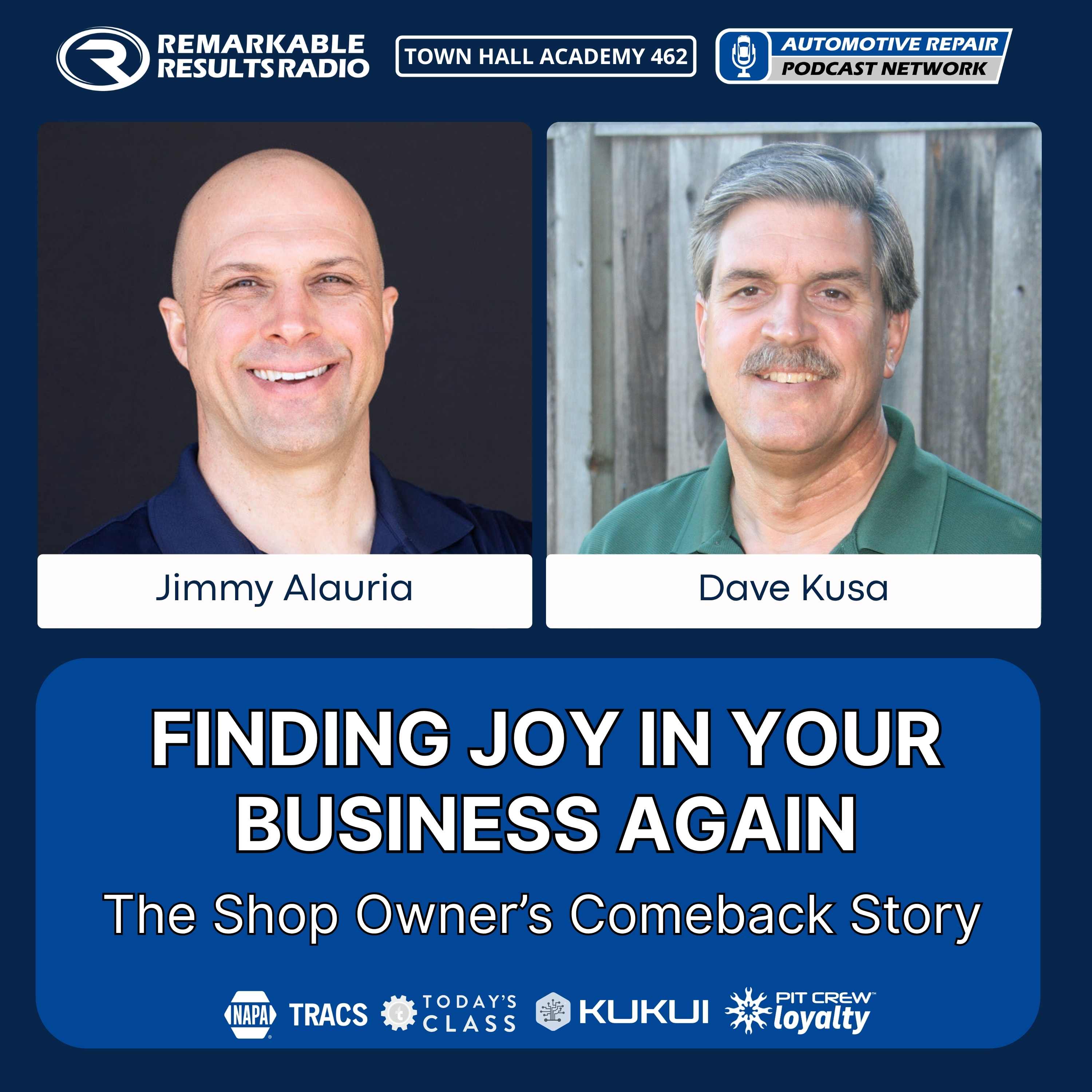
Shop owners Jimmy Alloria and Dave Kusa share their experiences and insights on rekindling passion for their automotive businesses. They discuss the importance of stepping back, redefining goals, and fostering a positive culture within the shop. The conversation emphasizes the need for owners to take time off, delegate responsibilities, and embrace change to evolve their business. They highlight the role of teamwork and communication in creating a thriving work environment, ultimately leading to renewed enthusiasm and success in the automotive repair industry.
Topics:business reinventionteam culturedelegationwork-life balanceclient experiencepersonal growthleadership evolutionemployee engagementcommunity involvementcoaching and training
Thanks to our Partners, NAPA TRACS, Today's Class, KUKUI, and Pit Crew LoyaltyWatch Full Video Episode
Shop owners, are you feeling burned out or stuck in the grind? This episode is for you. Shop owners Jimmy Alauria and Dave Kusa dive into how to pause, reflect, and reignite your passion for the business you built.
Key takeaways:
Think Bigger:Grow your business beyond what you can manage alone—empower your team and expand your vision.
Evolve as a Leader:Stop being just a manager—step into the CEO role and watch your business thrive.
Culture Matters:Set the tone, share your dream, and build a positive environment your team can rally around.
Delegate & Recharge:Offload the hats you wear, hire strategically, and take time off to see the big picture.
Balance Family & Business:Set boundaries to protect both your shop and your relationships.
The truth? Falling in love with your business again starts with falling in love with your ability to lead it.
Thanks to our Partner, NAPA TRACS
NAPA TRACS will move your shop into the SMS fast lane with onsite training and six days a week of support and local representation. Find NAPA TRACS on the Web at http://napatracs.com/Thanks to our Partner, Today's Class
Optimize training with Today's Class: In just 5 minutes daily, boost knowledge retention and improve team performance. Find Today's Class on the web at https://www.todaysclass.com/Thanks to our Partner, KUKUI
Stop juggling multiple marketing tools. KUKUI’s integrated platform delivers 4x better website conversions, automated follow-up, and real-time ROI tracking. Get industry-leading customer support with KUKUI at https://www.kukui.com/Thanks to our Partner, Pit Crew Loyalty
You’re probably tired of chasing new customers who never return. We understand. Pit Crew Loyalty ends the one-and-done cycle, turning first visits into lasting, reliable revenue at https://www.pitcrewloyalty.com/...
"Hey, for over 30 years, NAPATRAX is made selecting the right-shop management syste..."
Select text to request an explanation
This is the Automotive Repair Podcast Network.
Thank you so much to our great sponsors, NAPATRAX, today's class, Kakui, and Pit Crew loyalty.
Hey, for over 30 years, NAPATRAX is made selecting the right-shop management system easy by offering the best, most comprehensive SMS in the industry.
We'll prove to you that TRAX is the single best-shop management system in the business. Find NAPATRAX on the web at NAPATRACS.com.
Hey, how well does your team know their stuff? Test their automotive skills with the today's class of basic, advanced, or service advisor quizzes. It's a quick, effective way to spot gaps and grow stronger teams.
Take the quizzes now at today's class.com forward slash T.C. Quiz.
Shop owners stop juggling multiple marketing tools. Kakui's integrated platform. They deliver four times better website conversions, automated follow-up, and real-time ROI tracking.
Get industry-leading customer support with Kakui. That's K-U-K-U-I.com. You're probably tired of chasing new customers who never return.
We understand. Pit Crew loyalty ends the one-and-done cycle, turning first visits into lasting, reliable revenue on the web at Pit Crew loyalty.com.
Okay, everybody. Here's my panel. Wow.
Jimmy Alloria, 3A Automotive Diesel Repair Phoenix with the weather's always nice.
50 years in business, he was telling me that his dad started the business when he was born.
Cool thing knowing how old you are. The finalist in the Better Business Bureau torched a word for ethics. I have a friend in Buffalo that that happened to.
Yeah, we're hoping to win that next week.
Nice. My friend did win it last year. He did. He win as a finalist and then was nominated the winner. That's a cool thing to have happened.
And also Campbell, California. Is that up in the mountains?
Right next to San Jose.
Got it, Dave. Heart of Silicon Valley.
And so you don't really get snow there, do you?
No.
Never ever.
Well, I mean, once in every 40 years, maybe in the valley, so we get snow around us.
But here in Campbell, or in the valley floor, if it snows, once every 20 or 30 years,
and then it lasts for about 10 minutes, it's very exciting.
Owner of Auto Trend at Diagnostics, Campbell, California.
As I said, very, very active in our association, a SCCA out in California.
And somehow you manage all the laws that they create what?
One new law, a day that affects how you run your business.
Oh, look, that's that many specifically for us.
But yeah, the legislative session will start again in January.
And we figure a good, you know, 1,500 to 2,000 bills would be introduced.
And it runs the gamut for everything.
But, you know, we get down to a dozen or so new bills and regulations.
We have to do with every year.
Because people just love to regulate.
Uh-huh.
That's the regulator's job.
That's what they do.
To me, a favor, don't get me started.
Yeah.
Yeah.
I hear you.
I'm sure both of you, hey, look at so every business really begins with a dream.
Jimmy, I'm sure your dad had one on a vision of what I could build and create.
Being in the auto mode of repair business, a lot of us started in the backyard.
Then we put up a barn and then we worked in there and it got too big.
And we wanted to expand and grow.
And I love the idea of remembering the initial dream that fueled the ambition that we had to run our business.
And I got great talking points from these guys.
This is going to be an episode that I think are going to allow you to even spend some dream time as you listen to what they have to say.
But Jimmy, I want to talk about this one really important.
I love this one.
Make the game of shop much bigger than I can play myself.
So think about that.
Oh my God.
I've created something I've never done before.
This could be fun.
That's really what it took for me to get excited a couple of years ago was my wife and I had bought the business from my family.
We've this year's 50 years in business.
You know, we've been going for 10 years since we bought it.
And it was like, well, what's the next game?
You know, I mean, I've done speaking in the industry.
I've done consulting and stuff.
But that's just like that really warms my heart.
And I helps me.
But I started looking at the shop going, well, we've got to grow.
Because if you're, if you're not growing, then you're shrinking really.
I mean, where's the, where's the business going?
And the only way that I could really get excited about that was saying, OK, well, I don't want to go back in and manage this thing anymore.
I've been there done that.
So I want to bring my key people up with me and go, OK, where's the bigger vision?
You know, where, how many locations are we going to be at?
And then start looking at the lifestyle that the business has afforded me and my family to the staff, the key people that are part of that.
And give them the tools that they need to take us to places we've never even thought were possible.
You know, one of the things that I think about a lot in this whole concept of falling in love with your business again.
Is to get in front of your people and explain to him what your original dreams were.
Because a lot of people who work for us, you've been around forever, Dave.
And, you know, it's your place and I'm coming to work here or I've been here for years.
But we really never knew what was that driving impotence that put you here.
And when I hear about sharing that with people, it almost enlivens the culture because now they have something more to hang themselves onto.
It's your dream and they're part of it.
Yeah, you said culture because that's, I think, you know, a big part of all of our businesses.
And, you know, so much like Jim, you know, in the trainer speaker, you know, do all that stuff and really enjoy doing that.
And we talk about culture.
And finally somebody asked me, it's like, Dave, what does that mean?
What is culture, right?
And it's like, huh, I guess not everybody actually knows what that is.
And it's pretty simple. It's how we do it around here.
Right? It's what we do in our business and our shop.
And, you know, as the owner, we set that, right?
It's up to us to demonstrate it, live it, share it with our team so that and our clients and customers for that matter, right?
So everybody understands, you know, how we do it around here.
And once you get that buy-in and everybody is, you know, pulling that rope in the same direction, it does make things a little easier in your business.
And that falling in love part again, I think what happens is, you know, as time goes by, it just becomes day-to-day, right?
It's like anything else that initial excitement when you first either bought the shop or started the shop, you know, the problem solving, the being there for people, all of a sudden, you look back and you go,
huh, I miss those days. I miss that excitement.
You know, how do I get it back? And, you know, we'll talk about that. I'm sure.
But when you don't have that excitement and drive that you initially had, changes the culture in your shop, you know,
you need to show up every day like rock and roll, baby, here we go. Right? No bad days, right?
You know, service advisor shop owners, no bad days. It bleeds over to everybody else. So in its hard, I get it. It's hard, believe me.
I got to interrupt Dave. And for all of us, when he says no bad days, and I wasn't going to say a thing about culture until you said that Dave,
culture was described to me as the weather in the shop.
Okay, no bad days. What about the thunderstorm going off in Bay three?
It's not because the weather came inside. It's the person that's making the weather that's creating a bad day for the shop.
Although you could have three days with sunny and beautiful weather.
And now you've got one bad one. So it's the behavior of that individual that is driving, if you will, let's call it culture or the behaviors of that operation.
So thanks for bringing that up. I think it's important in a lot of people to your point they can't put a finger on what culture is.
I think you nailed it. And I hear sometimes it's our behaviors. And if we want to behave badly, but we again, it still goes back to the leader and the tone that the leader sets
and the expectations of the leader and the processes that have been, you know, implemented to make sure that the client gets a great experience.
Oh, let's talk about the client experience, posse experience of our people inside of our own business.
One of the things that Dave, I saw you and Jimmy, I'm going to get to you in a minute, but take a break from the shop you told me.
My God, I mean, I think that's brilliant. We're workaholics. This whole industry is like that.
Unfortunately, in many cases, it's true, but generally not speaking or generally not true that if I go away, the shop will die or won't survive or can't live without me.
And if that's true, you know, there's solutions for that. But you know, mostly, no, if you have the good culture, the great culture in the shop and you've, you know, worked with your team and trained your team, you know, and you're like, oh, man, I got to go to work again.
That is going to carry over. So, you know, take a day off, take a week off, right? Whatever you need to kind of reset that perspective.
We let ourselves get beat up by the, you know, like you said, the thunderstorm in bay three, right? And that breaks us down inside and we forget about the great one bay one and two that are doing so well and having a great day.
We have a disgruntled upset customer, a bad review, right? We let that break our hearts and it's like, yeah, it happens. But guess what? 80, 90% of our customers and clients love us.
Concentrate on them. Let that group of people reinvigorate you and bring you up and say, okay, we got a bad review. What happened? Let's fix it. If it's truly our fault, right?
You know, if a customer is upset, how do we fix it? How do we solve it? Let's make somebody happy. And then that, you know, comes back to us and we can feel good about what we did and you enjoy that day rather than being hangdog and then like I said, you know, get out of the shop, take a day off.
You know, go for a bike ride. Go to the gym in the morning, something that clears your mind, clears your soul and you can come back and have that upbeat attitude again and keep everybody happy. Keep everybody moving.
Okay. Jimmy, help me with this. Dave just outlined some incredible stuff. Okay. He just did. And 50% of my audience, I'm going to make an assumption says, great, Dave, good. Thanks for all the junk inside of my head, but I'm never going to be able to do that stuff.
I don't know how. Jimmy, how do you do that? Going back to what he said about culture and what I said before, making the game bigger than what you thought was possible.
You have to step away from the grind to be able to have that view. But how do you get to the gym, Jimmy? How do you make those changes? Dave, I love what you said. And you know, tomorrow, I'm going to go join a gym or tomorrow.
I'm going to go, you know, and walk or run a mile or two. And I have the best intention of the world. And I believe a lot of our listeners do, but they just can't take that first step. And maybe that's part of this whole fall in love with your business again mentality.
I have to change who I am and how I do things.
Well, the thing is, is that research coming out now about how the importance of rest and sleep, you know, it's not a matter of I can't do it.
It's I have to do it. Like you have to get be able to step away. Even if that's shutting down for the weekends and not looking at your phone, not looking at your emails and having that time away and actually not thinking about the shop.
And it's really hard in a family business, especially like with my wife and I, you know, my dad taught me years ago, you leave it at the shop.
You know, and if you try and bring it home, then you're living in that all the time. You don't get any distance to be able to see the forest through the trees, right?
In that time away, even if it's short amounts of time or space away from the shop allows you to take that 20, 30,000 foot view and go, OK, what am I trying to accomplish here?
What am I excited about? You know, you mean, Karin, you are in the Wayne Gretzky keynote at Apex, you know, and one of the things that stuff, you know, you know, I'm a hockey guy, right?
So I Wayne Gretzky, I've been following him since I was a kid. And he said the number one thing that he learned as a leader was that the coaches would come to him and say, I've got to get you and Mario to believe we can win this the Olympics.
And if I have you guys believing that we can do it, then everything will fall into place and everybody will fall in.
Well, who's setting that in your shop of the bigger game and then getting the key people to get excited about what we're doing and getting them to believe.
And then things start falling into place. But if the owner doesn't take time to get away and actually like start thinking bigger than what's going on in the day to day operations, you literally can't.
Jimmy reminded me of something that I learned on one of the podcasts, Karin from you, one of the speakers. So it was a podcast about, you know, husband, wife, shop owners, you know, working together.
You know, those of us that have a spouse, we understand, right? You know, 24 hours a day, you kind of get on each other's nerves, right?
So, you know, when you're working together, too, even worse. So, and if there is friction there, that hurts the culture.
There was one tool that one of the couples that talked about that, you know, when they leave the house in the morning.
They don't talk business. They don't talk about the shop day. They don't talk about what's happening that day until they hit a certain intersection on the way to the shop, right?
Okay. Yeah, right. There you go. Now we're at work, right? And then the opposite on the way home, right? They could talk about the day, talk about what happened, hit that intersection, we're done.
Right. We're talking about what's for dinner. What's going on this weekend? How are the kids doing, right? What typical families do that don't spend 24 hours a day together, right?
So, you know, and it was very successful for them. And, you know, I'm sure we've all seen it.
You know, over the years where, you know, you have a, you know, husband, wife, team, and it's hard for them, right?
So having some tools to reset that distance yourself, clear your mind. And then now you're not bringing that pain and anguish to your shop and bringing down the culture.
Right? And so, you know, you're, you're staying in love with your business rather than having to fall in love with it, right?
Hey, let's face it. Your shop management system is the single most important tool in your shop, period.
Napatrax has made selecting the right shop management system easy by offering the industry's best, most comprehensive SMS.
Now it all starts when a local representative meets with you to learn about your business and how you need to run it.
After all, it's your shop, so it's your choice. And having local representation is a huge plus.
Customizing tracks to your business, whether you're a one person shop or a large multi-bay or multi-location company,
a representative consults with you to help optimize your shop's workflow, efficiency, and profitability.
Tracks always has the flexibility to do business how you need to do it, which means it can also grow as your business grows.
And unlike the other guys, we'll be there for you after installation with the best training and support in the business.
Yes, a learning management system tailored to each role in your company.
Simply put, tracks was designed and built for shop owners just like you.
Visit us on the web at Napatrax. That's N-A-P-A-T-R-A-C-S dot com.
Hey, Carm here suggesting you discover a smarter way to train your entire automotive team.
Experience powerful bite-size training sessions accessible from any device in just five minutes daily.
It's perfect for technicians, advisors, and managers alike.
Today's class prepares your shop for sustained success by reinforcing crucial knowledge.
Plus add a competitive edge with our leader board to make learning fun and rewarding for everyone.
For effective training that delivers, turn to today's class dot com.
Shop owners, we know you are overwhelmed with a flood of missed calls, empty bays, and disconnected marketing tools.
Kakui has spent over a decade building one integrated platform for auto repair shops, one login, one dashboard, and mobile first websites that convert four times industry average.
Smart, innovative CRM with automated follow-up, 24-7 online booking, and real-time ROI tracking.
With 900 plus years of combined team experience, we fuel the growth of 2,200 plus shops and have influenced $3 billion in revenue.
Stop working harder, start working smarter, get industry leading customer support, and book a demo with Kakui, that's K-U-K-U-I dot com.
You know, most shop owners feel trapped spending on ads while half their first-time customers never come back.
It's frustrating. It's exhausting, and it's not your fault. The industry average is 54% one and done.
We understand how discouraging that can be.
Well, pick crew loyalty changes the story. Our clients cut that rate by up to 38% raising lifetime value by more than 50%.
Most of the members visit nearly three times more often, creating predictable revenue without extra ad spend.
Pit crew loyalty, where customers stay, and shops thrive.
On the web at pitcrewloyalty.com, guys, you just gave me a hell of an idea. This whole wife thing.
And I would love to know the stat in our industry is how many wives are involved in the business.
Because more than we really think about, I happen to know Karen Buffalo, a ton of shop owners, and I'm going to guess maybe 40% or 45% the wife's involved.
And the thought that I just had about, how do I get started, Dave?
Let's go to the gym. Let's reinvent ourselves so that we can maybe learn to love our business all over again.
If it's not grinding on us, if we can't make money, is maybe use the wife to help you do that.
Or the spot, significant other, whatever, however it works. And maybe that's part of how it would work.
And then I have a really funny side note. Great friend of mine, a coach, Rick White.
He did a class at Apex. And I said, Rick, what are you teaching here?
And he goes, I think he said he had three. And one of them was, is how to, how to work with your wife.
I think that sort of was how to enjoy working with your wife. And he says, Carm, all I have is one slide.
And I put it up right at the beginning. This is just listen to her.
It's true, though. You know, I mean, like a lot of that started 30 years ago with the coaching companies.
You know, it was like you got to, you get a shop owner back in those days.
They were wrenching. They were selling. They were doing everything work in six, seven days a week.
And one of the solutions was bring somebody in here that will not allow this person to give the shop away.
And that can do some organizing will help with some of the bookkeeping items, things like that.
The typically shop owners aren't great at or don't even want to know how to do.
I mean, at first, when my dad started with a coaching company, my mom had never worked in the business.
And of course, I got involved in the business in about 2000. I was living at home when I first moved home.
And of course, my mom's in the business. I'm in the business, my dad's in the business.
And that's where I learned this lesson was one day, my mom and I were both at him about this and about that.
And he finally just slammed his hand on the table and he said enough.
He goes, for 25 years, I have not brought this work home with me and we are not going to start now.
And that was it. And I tell that story all the time because I love that example of the husband and wife having that policy.
Look, when we get here, we stop talking about this now.
I said, different dynamic of life. We have our business and we have our family and family business.
Unfortunately, it always intermingles, but you got to have strict policy about separating them.
Look, a lot of divorces, a lot of businesses fail because of family business.
Oh, sure, yeah. Marriages and or businesses fail, right? Yeah, both ways. Worse case, both.
And I think about some of the wives that I know that work with their husbands drive separately.
So there is no demarc zone, but I don't believe they bring it home.
Yet a very, very good friend has his office in his basement of his house.
He is trying to take more time off, but he still wants to be engaged and involved and be on the computer systems and stuff.
So he's not there. And again, that whole new came through my head about just getting away and not being there.
At least you could be engaged, but not there. So when you're there, you're sometimes wanting to be a micromanager and into everything.
Anyway, I had this fleeting thought, guys, work with me on this, fall in love with your business all over again.
And if I said, think about falling in love with all the new technology, with all your clients, go upfront, talk to them, find out what's going on in their life.
How about your people's lives? What's going on with them?
I mean, if culture, I love to come to work because they care about who I am, not only in all that I do to make us a great company,
but they care about the fact that I want to buy myself a motorcycle someday and they're helping me try to do that.
And what about falling in love with community, getting involved with community?
So if some of these, and again, there's probably 10 more of these crazy ideas we could throw up.
But if anyone is struggling and they're not happy about the world they've created for themselves,
then to everyone's point here, take a step back and write a new strategic plan for your world and your life and your love to, again, fall in love with your business all over again.
Am I crazy? Am I thinking here?
Nothing you spot on. Yeah, and I do want to be clear. I'm not diminishing the extreme effort it takes to do what we're talking about.
It's a process. It's a road to travel, right?
As a shop owner, when I first bought my shop, right?
You know, I was the service advisor, the lead tech and hang on to business owner and I, you know, the bathroom cleaner and the floor sweeper and so on and so forth, right?
I had one check working for me. There was zero chance I was taking any time off.
The only time off we took a year off we closed the shop because there was nobody to do my job.
And I'm sure that's a very common story across the industry, but I think it's a common story too of, you know,
effort training, you're learning to do better.
And that's where that excitement comes from of that growth of, you know, hey, guess what?
I'm ready to hire another technician to replace myself in the shop.
Guess what? I'm ready to hire a service advisor, replace myself in the shop.
And then I can, you know, do as we talked about, I don't have to deal with customers on a day-to-day basis.
I deal with the ones I choose to. I call it playing with the class customers, right?
It's, you know, he's like, hey, how are you doing? How are the kids, right?
You know, that fun side that we can have and have the people that we've trained and work so well for us,
do the hard stuff, the day-to-day hard stuff.
I guess, you know, as saying that tongue in cheek, but, you know, if there's a customer with an issue,
rarely do I talk to him, right? It's like, it's your job. You talk to him.
And he's happy to do it. He knows it's his job.
So it relieves a lot off of me, which makes me a happier boss.
When I first started taking over this manager of the shop, and I'm going in here, you know, I wanted to build a team culture.
I was a hockey player. I wanted it to be like the locker room feel when you come in in the morning.
And I was getting some resistance from really just one or two guys.
And I was so frustrated. I'm like, I'm leaving. I'm done with this. And my dad's like, why?
And he said, look, Jimmy, he goes, if you don't like something about this shop, it's ours. We create this.
So if you don't like an employee, replace him. If you don't like where your offices at, move it.
You don't like the color of the building, paint it. He's like, we have complete control of our business.
You know, and that was a real eye opening experience for me because it was, it was really just coming from one person.
And when we decided to part ways with that person, things completely changed. And I never forgot about that.
It's like, you know, that saying or somebody said, how you doing? Oh, live in the dream.
And I always say, well, when I say that to myself, I say, I'm living my dream.
And whether that's good or bad, it's mine. You know, I got to take ownership for it.
So as hard as it can be to say, I've got to change what I'm doing.
It's also got to be a responsibility. Like, why are you putting up with it the way that it is?
It is your creation. That's the hard truth of it.
It's your creation. That the conditions that it's in.
And at the same time, you have the power and the ability to make a decision, a change of decision and how that business is going to treat you, treat the employees, treat the customers, and make sure that everybody's winning in that environment.
I got to tell you, I just had this big takeaway from what you just said, Jimmy.
The whole concept of this episode is falling in love with your business again all over again.
Right. And I wrote down reinvention.
And when I heard Jimmy just go through, he reinvented his team by letting someone go, challenging himself to go out and find someone that could come in.
Again, he's going to be so careful on the culture and the fit this next time.
But going back to get involved with technology and clients and community and your people's lives is reinventing who you are.
Everyone around you is going to look and see, whoa, what's going on with Jimmy? What's going on with Dave?
And it's good that the word amongst the team is, hey, wow, what's going on?
That's a positive because you're creating a pulse, if you will, maybe a bigger, stronger pumping heart than you ever had before because you've taken your focus from,
did you get that right? You didn't use that tool. Good. Hey, how come we didn't get that? And here it is. You're the conductor of a, maybe not good orchestra old instruments.
I'm not being negative here. But when I go back to the reinvention, like you said, make the game a much bigger game.
Jimmy, that's kind of almost like reinventing the game board for you.
And the thing that I worry about is, I got so many things on my mind, Dave, you just said, listen, go higher, hire this person, hire that person.
And the best excuse I've ever heard is, can't afford, can't afford, can't afford.
Scariest thing I ever did was hire another technician, right? That was the first scariest thing I ever did because I'm literally doubling my payroll.
And I get that, right? It's super hard, but guess what? It worked, right? And I think, you know, same thing, right?
You know, hiring a, it was worse to hire a service advisor because, you know, I'm the guy, right? You know, people know me, love me.
And I think that, you know, they want to talk to me all the time. And nobody else is going to do it the way I'm going to do it.
And it's like, yeah, you're right. Nobody else is going to do it the way that you're going to do it. They're going to do it their way.
So super scary to do that, but like I said, right? I'm wearing three hats in the shop, right?
Okay, I'm going to take one of those hats off. Well, guess what? Now I can do a much better job at the other two hats, which means that we're going to get more business.
We're going to be better in our pricing. We're going to be better in our sales techniques and our customer service techniques.
And then, you know, take that service advisor hat off and only wearing the business owner hat.
I have eight hours a day to work on the business, as we're always taught and told, rather than in the business, right?
So, you know, again, marketing can be better. You know, I'm keeping track of pricing when, you know, we're not falling behind on what we keep an inventory.
And, you know, that, that oil filter that we stock that we used to pay two dollars for. Now we pay five dollars for, but we're still only charged in $6.99 for it, right?
You know, that kind of thing, right? All of those things that fall through the cracks and guess what?
Now you can afford that person by making the business a better place. You know, that new adventure, that new growth, it just works.
As long as you have the skills and to do it and then that goes back to the training, you know, if as a shop owner, most of us, you know, you came up as technicians, right?
We don't know how to run a business. We, you know, skin and the teeth, but, you know, getting a good training program and a good coach for yourself is paramount.
And again, how do I afford a coach? Well, the first job of a coach is to afford the coach, right? So none of this works just because it takes training time and effort.
It does. I mean, you're talking like what you said their day was so true. Like, you know, it's like, how do I shed some of these hats?
And the thing is, is that a lot of it is it couldn't be a cost issue, but it's also how comfortable the owner is in doing all those things.
So it's just easier to do it myself. And a lot of things that I work on with friends and clients is that, okay, you're the best at that. Have you documented how you want that done?
Exactly. And then turned it over to somebody because it's really easy to just go in there and do it yourself. I mean, I was, was not a technician.
So I didn't go in the back, but there's so many other things that I am really good at. I'm really good at marketing. I'm really good at the financial bookkeeping and things like that.
And I can go in there and speak just time consumed with stuff that isn't going to make us that much more money instead like, you know, instead of like going out into the community where I should be with my wife shaking hands and kissing babies.
And when there's a problem that I've hired somebody to do that that takes a lot of pride in handling that customer to get a better result than I would.
It really isn't it, but it does take some help. Like, why isn't the owner being the owner because the owner doesn't know what his hat is as the owner.
That's a great point. And I got to make a comment on something you said, Dave, you said, I got to hire somebody. It's my way.
And then he comes on board and he'll do it his way. And my initial thought was, no, he'll do it our way.
Think about the power of that. The only way you're going to keep a handle on the structure of the businesses by doing it our way.
And you may have this person could come in with some really nice positive ideas and new processes.
But until he knows your way or our way, can you bring on his, but businesses morph when new talent comes in new ideas come in, they become better as a unit.
And that's the distressingly exciting part of those, you know, those growth leaps of, you know, doubling your payroll, right, of your technician.
So it's going to keep you awake at night, right? But I try and always circle back to those, you know, first few months of owning my business after I bought my business and just that, you know, that energy that drive to succeed, right.
It's scary, super scary, right? Because all of a sudden as a technician, if it's not working out where you are, you just get a job somewhere else.
Last I checked nobody's hiring business owners. So you have to make it work and learn how to make it work and keep it that, you know, exciting, the new technologies you're talking about, Carm, right.
You know, as the owner, I have the time, if I choose to look into those things, learn about those things, I'm necessarily going to be the implementer of the new technologies, but understanding that this is where the world is.
And maybe this affects my marketing of the Bay Area here in San Jose, right. We're hip-deep in EVs, right, more so than anywhere else in the country. And am I afraid of them? No, right.
Because we've worked over the years to keep up on the training, keep up on the knowledge so that when they call, you know, with a niece on leaf or, you know, whatever, right.
You know, the Hyundai, you know, we can fix it. We can say, yes, bring it in, right. We're prepared. We're not afraid, you know, to take that and take on that new adventure.
This is a topic I think we can go on for two hours about how to fall in love with your business all over again.
And if someone doesn't get it, and again, I go over this ad nauseam on a lot of my shows is that you need to hire yourself a coach or an accountability partner or join a networking group and stretch your stealth.
Because if you can reinvent who you are or improve or advance who you are, you're really reinventing your business. You're reinventing yourself. And I think maybe the operative word here is falling in love with your business all over again is falling in love with you and your ability to lead and run and manage a business all over again.
Even though you were excited in early days, and there's a lot you didn't know, as you grew your business, there was an implosion on top of you of things you needed to stay up with and maybe you didn't.
So to all of your points to pull back, may help you reinvent who you are, which ultimately reinvents your business. Am I smoking dope here or what?
You have it right is as the industry we've done a pretty good job of training owners to be managers that next leap of becoming like a CEO is really another level of training because to be a CEO is CEO stands for chief executive officer.
Well, if you're the chief and you're everything else underneath the chief, you're really not the chief, you know, so really and that goes back to my original things like make it big enough to where you need people underneath you that are the managers that are running those areas fully.
Yes, it has to be documented on the way you want it. It's your culture, your policy and things like that and those things are they're going to evolve and you're going to bring people in that they have their way of doing it, but it falls within the policy of the way you want something done.
That's evolution, you know, and we can't be afraid of that. We can't be afraid of having somebody come in and having their way of talking to a customer.
As long as you they get the product of what you want, which is a happy customer that comes back again and again and spends money.
I don't really care as long as they're following, they're saying on the rails of our policy, but it does take that it is another level.
You look at like why don't shops expand out into multiple locations and that's one of the reasons is they're not really looking at from the CEO's perspective and going I've got to have now I've got to have managers.
I got multiple people reporting to me and you know for me that's been a big game changer in the necessity level coming up because you know necessities the mother of invention you talk about like well, how am I going to afford a coach?
Well, you're doing it the way you're doing it now and getting what you've got something's got to change and there's thousands and thousands of shops out there that have paid a lot of money for coaching.
That coach's job like Dave said the first the job of the coach is to be able to afford the coach, but it's also that the mindset in the decision from the owner like I've got to be able to afford this.
I've got to be able to make this work that change of mindset of necessity will change the way that you do things.
I like the word evolution, Jimmy, yeah, that really describes the process that our businesses need to be going through you get what you got any going to keep getting that if you just keep doing it the same way right so you know to evolve to grow.
Again, don't diminish it. It's not easy. It's scary, but that part of being the CEO being the business owner is the hard things right the really hard things of making those big decisions of is this the right person.
In the position right and especially in a management type position right or even a technician right you know if it's not a behavioral or personality issue.
I really want to work with that person get them the training they need. Let's keep them with us right because it's better for everybody in that respect, but at some point you got to make a change and that's hard.
You can't slap off the hard stuff. Otherwise you won't grow you won't evolve.
Dave what you just said about a minute ago was exactly what I wrote down based on what I heard Jimmy saying I think it's a great way to end this episode.
We cannot solve the world's crisis is but hopefully on an individual basis if anyone listens to our podcast and we've been saying this for 10 years listen to learn just one thing.
But the final thought on that is an implement it if you fall in love with something and you learn something please implement it and I think what you said Jimmy was the word evolution and I wrote down.
The evolution of you and I think that's how you have to learn about falling in love with your business again and being a bigger better stronger leader but then finding some other things that would peak your interest.
Just to keep yourself fresh and it's the evolution of you.
Great fitting in to this.
Jimmy a lauria 3a automotive and diesel repair Phoenix Arizona where it's always just beautiful weather.
And David kusa owner of auto to the agnostics Campbell California and little low calm capriato and don't forget to download our app.
Please go to my website remarkable results dot biz forward slash app or the brand new site for the automotive repair podcast network dot com.
You'll see app stuff all over that where you can download it to your smartphone.
Thank you gentlemen for being here.
Appreciate your time and your friendship.
Thank you sir.
Thanks a lot.
Thanks for being on board to listen and learn from the premier automotive repair business podcast remarkable results radio.
Get your episodic education on the ARPN listening app at automotive repair podcast network dot com.
Also enjoy the podcast on our calm capriato YouTube channel.
Carm is all for advancing the professional automotive service industry.
Until next time.
Request an explanation for:
1 cars
1 cars featured
Request an Explanation
Heard something you'd like explained? We'll add it to this episode.
Sign in to request explanations for terms you heard.
Want to learn more?
Browse our glossary for plain-English explanations of automotive terms, jargon, and concepts.
See something that's not quite right? Our annotations are AI-generated and can sometimes miss the mark.
Click the flag icon on any annotation to suggest a correction.