Formula 1 is a famous car racing series where the fastest cars compete on tracks around the world. It's known for using the latest technology and designs, which can influence regular cars.
Ferrari is a well-known Italian car brand that makes very fast and expensive sports cars. They are famous for their success in racing, especially in Formula 1.
Off-road racing is a type of racing where cars drive on rough surfaces instead of regular roads. It tests how well cars can handle tough conditions like dirt and rocks.
Jeep is a popular American car brand that makes vehicles designed for off-road driving. They are known for being tough and able to handle rough terrains.
An engine is the part of a car that makes it go by turning fuel into power. In racing, engines are designed to be very powerful and work well under tough conditions.
Advanced manufacturing capabilities mean using new technology and methods to make parts more efficiently and with better quality. It helps companies produce things faster and more accurately.
The average passenger car price is how much most cars cost when you buy them. This price can change depending on many things, like how many people want to buy cars.
The average truck price is how much most trucks cost when you buy them. This price can go up or down based on what people want and how many trucks are available.
A software-defined vehicle is a car that uses software to control many of its features. This means that instead of needing to change parts to improve the car, updates can be made through software, making it easier to add new features or fix issues.
Predictive failure is a way to figure out when a part of a car might break before it actually does. This helps car owners fix problems before they cause issues, making the car safer and more reliable.
Tariffs are extra costs that countries put on goods coming from other countries. For car manufacturers, this can make it more expensive to sell their cars if they import parts or vehicles.
Variable compression means the engine can change how tightly it compresses the fuel-air mixture. This helps the car run better and save fuel depending on how you're driving.
Endurance racing is a type of car racing that lasts a long time, sometimes for 24 hours straight. Teams race to see who can go the farthest in that time, so they need to balance speed with making sure their cars don't break down.
GT racing is a type of car racing that uses special high-performance cars. These cars are made for both racing and driving on the road, and the races can last a long time.
LIVE
This week, Matt is in Detroit at the Detroit Auto Show where he just sat down with Ford
CEO Jim Farley and the CEO of Oracle Red Bull Racing plus four-time world champion and Red Bull
racing driver Max Verstappen joins us later on. And I'm working on a story about Tesla,
specifically why people are leaving Tesla. And here's the hint. It's not just about Elon.
First, let me tell you about this Tesla story, which came to us really based on the news that
BYD had finally surpassed Tesla as the best selling EV maker in the world, which is a really big
deal. Tesla had such a long head start. Let's not forget, Tesla was making cars, electric cars as
far back as 2012 and even before, but really the Model S came out in 2012. And at that time,
Tesla was really the only player in the game, so to speak, for EVs. Now, of course, there are
basically every automaker has an electric vehicle option. So it's interesting that now the head start
has basically worn off. Obviously, the Chinese automakers have really caught up in terms of
being able to make new cars fast, affordable and very well made. And that has really eaten Tesla's
lunch. But there are some other reasons too, why especially buyers in America are leaving Tesla.
We've known that there have been pools of buyers who have been uncomfortable with Elon Musk and some
of his political posturing, some of his antics, some of his workplace behavior, et cetera, et
cetera. But actually, there's a bigger contingent of folks who were uncomfortable with him, maybe,
but actually kept on to their cars until recently. And now we're seeing sort of a gradual eroding
of some of these buyers who are deciding to go into other things, maybe a Rivian,
maybe an electric car from Porsche, maybe go back to a hybrid or even a nice vehicle. So
we'll have a lot more on that next week. This week, Matt is reporting from the Detroit Auto
Show. He sat down with Ford CEO Jim Farley and Oracle Red Bull Racing CEO Laurent McKase.
It's a pleasure, gentlemen. I'm very excited as a fan of the brand and the league. And
let me start, Laurent, with you because you've said that this is the steepest hill F1 has ever
had to climb. New regulations this year are sweeping. It's not just a tweak here and there.
And you're starting with a brand new partner with Ford who's going to build the engine with
you as a collaboration. Why choose Ford as a partner? At first, you're right. It's the biggest
regulation change probably in the history of Formula One, at least in the modern
history of Formula One. And it's also on that very same year that we chose the, let me say,
crazy challenge to go and build our own power in it. And if you do that, you want a partner with
the best. And we are in a lucky position where we have managed to strike this strategic technical
partnership with Ford in this crazy adventure of building from absolutely zero our own power in
it. And we go together in these new regulations. Jim, for you, this must be exciting because
you've built, honestly, a new legacy for Ford in terms of racing. I mean, on the one hand,
you've got the new industrialized America here. On the other hand, you're going back to Le Mans
with a hypercar in a couple of years. You're essentially doing DFV 2.0, right? This is like
the cause worth of old. When you're talking to Bill Ford, when you're talking to the shareholders,
how do you justify this spend and this drive to go racing? Well, a couple things. First of all,
the tech transfer, this sport that Laurent leads, this team that Laurent leads, you know,
leader in aerodynamics, predictive failure components, and software, software control,
the hybrid system, high discharge batteries. These are all core capabilities that we need
for the next five to 10 years as a company. So the tech transfer is very relevant for us,
like maybe four valves or overhead cams were in the 60s, you know, but the tech transfer is
totally different today. Formula 1 is a complete digital sport. And that's where we're going as
a company. Number one, number two is, you know, racing, especially in the off-road world, gives us
credibility for customers that the product they buy has real capability that's been tested in a way
that a brand who doesn't race can't say. And that's what Porsche and Ferrari knew for a long time,
especially for us in the off-road world. This is really important. Racing is a fundamental
part of our company's business because to beat all the great off-road brands and to establish
ourselves, now we're two X Jeep sales in the US, to keep that going and keep growing the off-road
brand, off-road racing in Dakar, Baja, is where our customers will say, hey, that Ford has the real
deal. It's the real deal. It's not a poser product. So racing is integral into our credibility as a
company. And you've obviously got a deep, rich history there and you're bringing your software
and battery technology, those capabilities to Red Bull Racing. But for you Laurent, this is
a whole new thing, right? Building the engine. I know you're getting a lot of help from Ford.
What are they helping you with on the fuel side?
Lukes have been helping us on many different topics and that list of topics is expanding
every day. But let me give you a couple of practical examples. James team have unique
advanced manufacturing capabilities that we use to produce some of the most critical part of our
engine. And not only are they able to manufacture this path for us, but also they do it in less
time than we would do otherwise. And that gives us a crucial, you know, our business is a time to
market business. We call it a time to raise business. And when we are able to manufacture
complex components in a shorter amount of time at this incredible level of quality
that's what I'm looking for, that's a key competitive advantage.
Especially since I think you've said you gave up some time focused on last year's car.
So you're in a hurry to make sure that this year, this new car, when Max gets in it in Bahrain,
that it's a winner and not a learning moment. How do you make sure that you're winning straight
out of the gate? You know, you will have to bear with us a little bit. The scale of the challenge
is monumental. We are starting to design and build these engines in what was the field, you know.
We've made the factory, we've bought the dyno, we've put together an unbelievable group of people
and group of partners, such as Jim and his team. And it will be foolish and naive to think that
from the first day, you are going to be at the same level than people that have been doing it for
90 years. So bear with us, it will give us a few sleepless nights, it will give us a few headaches.
We feel we have the right people, the right tools, the right spirit across what Red Bull means and
what Ford means. We'll eventually come out of top, but the first few months will certainly be full
Jim, what can you bring back from this, I guess, laboratory, if you will, to the Ford customer
here in America? Because yesterday we saw figures from the Bureau of Labor and Statistics that showed
prices for the average passenger car, not Ford, but across the industry are up more than $500.
Prices for the average truck across the industry are up more than $1,000. What can you bring back
that puts value into those price increases? Matt, I think Laurent said it really well.
If there was an initial premise of what those transfer technologies would be to help the company,
but what we're learning working with him over the last several years is actually that list is
growing and it's more diverse than we thought. Of course we thought it was aero and high discharge
batteries for performance hybrids. Well, now it turns out performance hybrids are really important
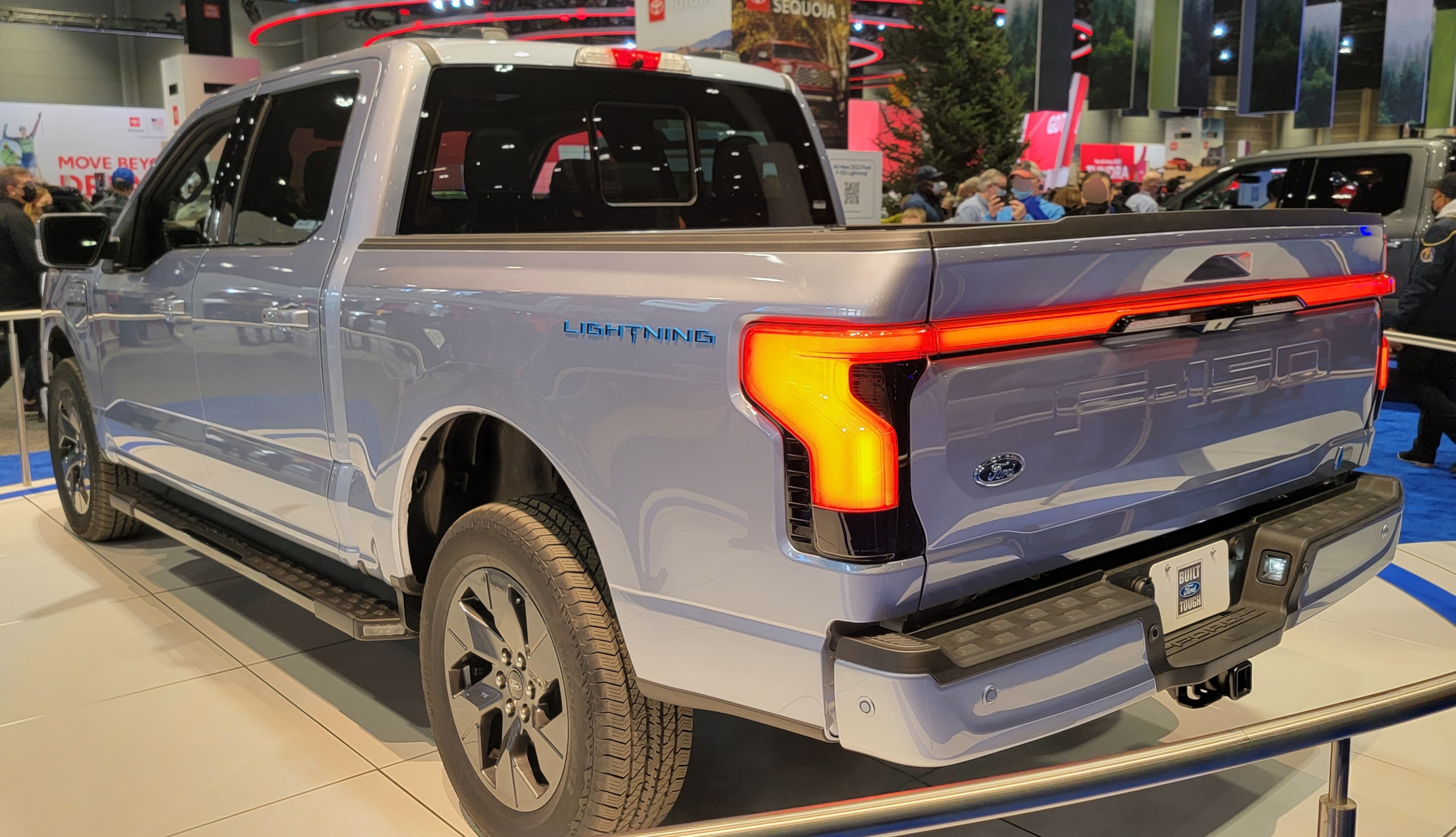
for the company. 25% of F-150 is now hybrid sales. People are buying it because of pro power on board,
not just because of the efficiency. Every day, honestly, the list of things that we can take
from the effort with Laurent and his team, because the sport is so hard and the time pressure is so
high, that list is getting longer every day. I could give you a long list and most of the value
that we're seeing on the tech transfer side are things that we didn't even have on the list when
we started four years ago. It's a long list, but I would say that the real signature is, for me,
is really the software. The control software for the hybrid system, predictive failure components,
these are the essence of the new software-defined vehicle globally. To beat China and they are
really good, we need these capabilities from Formula One and we can put them right in the
transit van. He can help us with the language models and the logic of predictive failure
for a component on a Formula One race. We can use that same know-how, hopefully, to help our
customers in the transit know that something's going to break way before it breaks. That's the
same capability he has to deliver for Max. This is really the cool part of Formula One. It is such a
high-pressure, high-tech sport that actually the list of value, like lubrication, is just going to
keep getting longer. Laurent, the President of the United States was with Jim a couple of days ago
here touring their plants. As the US turns more inward, it's interesting that you're participating
in this global sport. We've just learned of new visa restrictions on people from many nations,
including Brazil. Do you find it harder to get people in to Miami, to Las Vegas, to Austin? I
know there have been problems already holding up gear at the border. Really, it's not an issue
today. We are global sport, as you have said. We are enjoying racing in pretty much every part of
the world, or nearly every part of the world. We have incredible logistic capabilities, which is
also something that we are brainstorming and exchanging with Jim and his team. These teams,
together with the help of Formula One, makes it very, very smooth to go around and we back-to-back
races from the US to the opposite side of the globe without any issues. It's a privilege that
the sport has as a global sport to be able to move around very freely. Jim, how are your discussions
with President Trump? I know that you have pointed out in the past that the tariffs, as they're set
up now, as they're designed, put you at a disadvantage to somebody, even an American auto manufacturer
that produces in South Korea or Japan. Have you had a chance to talk with the President?
Have you made any progress in getting maybe car valves? We're really encouraged. I mean, look,
Ford is the most American car company. We produce the most, most hourly workers. We export the most,
and so the administration has been great to work with. They always answer the phone.
But there is a long list of things we've got to work through. I think we've made progress
on mitigating some of the tariffs, but we have more work to do. For us, we have a high-exposure
aluminum, for example. The EPA changes are really welcome, frankly, and we're seeing that play out
really in our business. Part of the reasons why our valuation is increasing is because
people understand we can build more profitable vehicles now, and that's more employment in the
US. But there's a long list. We've got the USMCA coming up. Very important negotiation for Ford.
We need to change USMCA, but we built our entire vehicle business as an industry between Canada,
Mexico, and the US. We have to get this revised, but it will be very important.
I think continue to work with administration on tariffs. How we handle the China. If you look
at what's happening in Europe right now, in the UK, the Chinese are now quickly almost 10% of the
marketplace in electric cars even higher. They pose a lot of threat to labor locally. They have
huge subsidies from the government that they're exporting. As a country, we need to decide what
is a fair playing field from a cost. How do we handle these vehicles? If we're scared of a balloon,
you could imagine a car with 10 cameras that can drive itself. These are incredibly sophisticated
technologies. When we deploy that in China, it has to be approved by the Defense Department,
because those vehicles can be guided into all sorts of things. We have a good starting point
for that philosophy of the ITC of the vehicle, the digital footprint. Now we have to make sense
of that for the China threat. I know that the President talked about that during his visit
at the economic club. How do we handle Chinese cars? Now his personal opinion was,
we should let them into the US, but maybe. I think we need to work through that as a company and as
a country. I think there's always a lot of big topics for the car industry, because it's so
important for our country. Well, we'll be covering all of those here in Detroit with you, Jim and
you, Laurent. Thank you so much for joining us. And that was Matt Miller coming to you from the
Detroit Auto Show. Coming up, Oracle Red Bull Racing driver Max Verstappen, you might have heard
of him joins us. I'm Hannah Elliott. This is Hot Pursuit. Welcome back to Hot Pursuit. I am
very excited for our next guest. He needs no introduction from Red Bull Racing four-time
F1 world champion Max Verstappen. He spoke with our Matt Miller. Max, the second half of last
season was about as exciting as they get. You were at a 104-point deficit, but ended up only
missing out by two points in the last race. How did it feel to you? Just take it race by race, to be
honest. You know, we had a bit of a tough, yeah, first half, you know, some good moments and some
bad moments and bit of a tough start, but second half was a lot more enjoyable. Yeah, also in the
team side, like, you know, you start to feel more comfortable, confident when things are going well.
Of course, even in the second half, we had a few tough races, but overall way more competitive.
And I think it's always nicer to end the season like that. I mean, it was a great way to end,
even if, you know, you didn't win the ultimate championship, but I can't imagine working that
hard with that set of tools and then having to switch to a completely new set of tools this
year in like this most serious rule change that Formula One has had, at least in my memory.
Yeah, but I mean, you know that even heading into that season, right? So it's not like it comes as a
shock. The team is prepared for that. And it's also a bit of a new challenge. I mean, I enjoyed
the cars the last three years, but at the same time, sometimes, yeah, it doesn't hurt to have a
bit of a change. Yeah, it can also be really upset. Of course, the grid, you don't know. So,
yeah, we'll see how that goes. How do you think the rule changes are going to benefit you as opposed
to the rest of the group? Honestly, I have no idea. I haven't even done that many laps in the
simulator. You know, so for me, I'll just see what happens when I sit in the car. I think what is
always very important as a driver is that you can adapt quickly to the situation that you're in.
If that is on a current car that you've known for a long time or a completely new car,
you just need to be able to adapt quickly, learn quickly as well, because the cars will evolve,
I think, also very quickly. But yeah, I'm not too stressed about that, to be honest. I mean,
Red Bull is seen as the most, at least the most technologically advanced team in the world. And
now you have Ford as a partner. I don't think any CEO, automotive CEO cares about racing more
than Jim Farley. What does it mean to you working with Ford? Yeah, it's great. It's a great opportunity
as well. I'm just excited to get started. There's a massive heritage as well in racing as well.
So, yeah, I think everyone is just now just very keen to get started. Yeah, I think like of the
former winners that have been powered by Ford, Jim Clark, Hill, Fittipaldi, I mean,
Jackie Stewart, like it's such an illustrious list. It's almost like you're going to do
DFV 2.0 with this new team. Let's see. I mean, yeah, we hope, of course, to have a lot of success,
but it's impossible to know. The only thing that I do know is that everyone is giving it everything
they have. What do you think about the development? We've heard that maybe you have
found a bit of an edge with compression, variable compression. I guess there's going
to be a meeting on January 2nd about how this will work for you and Mercedes. Do you feel like
you have an edge? It's impossible to know. I mean, everyone is just trying everything they can and
from our side, and especially from my side. I mean, I have to focus on the driving. I'm not there
to be the engine technician and we'll explain everything in detail to you. At the end of the
day, it's also something between the FIA and the car manufacturers or the engine manufacturers to
sort out. I drive the car and I trust that from our side, we always try to do our very best to
get the most performance out of the engine. Are you excited to have a smaller, more nimble car?
Is that more exciting for you because it'll be easier, I guess, in that instance to pass?
I mean, it's a bit too soon to be able to say that, that it will be easier to pass. I have no idea.
So everything is still unknown. So the cars, I think, look a bit nicer when they're a bit smaller
and not as wide. But once we get on track, then it's a bit easier to get a bit of an understanding
of what is all happening and going on. Let's talk about your career outside of F1. I can hear the
Sims going over there and I know you're deep into that with Redline. So what are you most interested
in outside of racing on the track, which I'm sure is your main focus almost all the time,
but in any spare time that you have? You mean outside of like sim racing and stuff?
No, no, including sims. I mean, is that? It's, of course, we want to win whatever we compete in,
right? I want to try and help young drivers, young people that don't have the opportunities also in
real life, to have an opportunity to actually then become a real racing driver. That all starts,
of course, in the simulator. And yes, it's just very exciting to see these young guys that started
what, 16 maybe in the team and see them grow as well over the years with the potential to maybe
get a real real life drive, which we have done last season with one of the sim drivers. And
you know, he's doing a really good job. And it's just really nice to see how that is all like
progressing. Do you think about that as a progression? I mean, do you have, for example,
a certain number of championships in mind that you want to win before you can walk away? Or
are you still going to be starting races at Alonzo's like 44 years old? Can you see that as a
future for yourself? It's all honestly like it's just I don't really think about it too much. I
think it's more important to just try and enjoy it. You know, it's only enjoyment is there, then
it's also easier to rock up and really demand everything from yourself. And so far, I'm still,
you know, having that feeling. You seem to be enjoying a little bit of GT racing,
maybe ready to do a little bit of endurance racing. I hear you signed up for the 24 hours of
Nuremberg. Well, about that is still nothing confirmed yet. I mean, the plan would be nice.
You know, if that's possible, but it's also very, you know, very hectic for a few months now in
Formula 1. So we have to wait and see. But it's definitely my goal. You know, I want to do 25
races and I want to do endurance. And of course, having started with GT3 racing as well with the
team. Yeah, that's definitely the future plan. Are you just aiming for an outright win at Le Mans?
Or do you think about, for example, the Triple Crown? Is that something that enters the picture?
Triple Crown, not so much for me personally. Yeah, I would love to do Le Mans. And actually,
if you do it, you want, you want to try and win it. Our thanks to four time F1 World Champion.
Have I said it enough? Matt for Stappen and of course our own Matt Miller. That does it for
this week's show. Remember to follow and subscribe to Hot Pursuit on Apple, Spotify, and anywhere
else you listen. You can also send us your comments. We'd love to hear from you. Email us at hot
pursuit at Bloomberg dot net. And you can check out my columns and stories on Bloomberg dot com
and the Bloomberg business app. Go there for car reviews, events, stories, trends, feature pieces
that you won't find anywhere else. We take so much pride in the work we do trying to help you
to know how to spend your time, your energy, your money. Find it all at Bloomberg dot com slash
pursuits slash autos. I'm Hannah Elliott and this is Hot Pursuit.
About this episode
Ford's return to Formula 1 is a hot topic as CEO Jim Farley discusses the strategic partnership with Oracle Red Bull Racing, led by Laurent McKase. They delve into the significant regulatory changes in F1 and how Ford's expertise in technology and racing will enhance their competitive edge. Four-time world champion Max Verstappen shares insights on adapting to new car dynamics and the excitement of the upcoming season. The episode also touches on Tesla's challenges and the evolving EV market, highlighting the shifting landscape of electric vehicles.
This week Matt comes to us from the Detroit Auto Show. He speaks with Ford Motor CEO Jim Farley and Oracle Red Bull Racing Team CEO Laurent Mekies about the latest in carmaker trends, racing and changes across the industry. Plus, Matt goes one-on-one with four-time F1 World Champion Max Verstappen.