The Gilmore Car Museum is a big place where you can see many old and unique cars. It's located in Michigan and is one of the largest car museums in North America.
Brass-era cars are some of the earliest cars made, often featuring shiny brass parts. They represent the beginning of the automotive industry before cars became more modern.
Concept
post-war icons
Post-war icons are cars made after World War II, which became very popular and are now considered classics. They often have unique styles and features that people love.
The Model A Ford is a classic car made by Ford in the late 1920s and early 1930s. It was one of the first cars to be mass-produced and is known for being easy to drive and maintain.
Cadillac is a well-known American car brand that makes luxury vehicles. They are recognized for their stylish designs and advanced features.
Concept
automotive museums
Automotive museums are places where you can see many different cars and learn about their history. They often have old and new cars on display for visitors to enjoy.
The Ford Model T is one of the first cars that many people could actually buy because it was made cheap and simple. It changed how people traveled and is really important in car history.
Concept
historic race cars
Historic race cars are old racing cars that are important because they were part of famous races. They show how car design and technology have improved over time.
Concept
presidential vehicles
Presidential vehicles are cars that are made just for the President. They have special features to keep the President safe and comfortable while traveling.
Concept
Indianapolis Motor Speedway Museum
The Indianapolis Motor Speedway Museum is a place where you can learn about the famous Indy 500 race and see many historic race cars and trophies. It's a must-visit for anyone interested in car racing.
The Indy 500 is a famous car race that takes place every year at the Indianapolis Motor Speedway. It's a very important event in the world of car racing, and many people come to watch it.
Geely Motors is a car company from China that makes various vehicles, including electric ones. They own Polestar, which makes high-performance electric cars.
Dual motors mean the car has two electric motors instead of one. This helps the car drive better and faster, especially in different weather conditions.
Pound-feet of torque tells you how much twisting force an engine can produce. More torque means better acceleration and the ability to carry heavy loads.
A level two charger is a faster way to charge electric cars compared to the regular home chargers. It uses a stronger power source, so it charges the car's battery more quickly.
The Hyundai Ioniq 6 is a car that runs on electricity instead of gas, which is better for the environment. It's designed to be smooth and stylish, making it a good choice for people who want a modern car that helps reduce pollution.
The Toyota Supra is a fast sports car that looks great and drives really well. The newest version has a strong engine that makes it fun to drive.
LIVE
All right, Mr. Marz has our biggest car museums, Mr. Marz.
I guess he does.
I can't hear you, Mike.
No, we can't hear him.
Is he even on with us?
No.
We can't hear you, Mike.
Yeah, okay.
My bad.
I was communicating with David.
Sorry.
So, it's time now for, as I mentioned, your biggest car museums.
Yeah, I just thought that with all this weather impacting the whole country, some people are
here.
Let's go somewhere.
Yeah.
Get out and get about.
So, the Gilmore Car Museum in Hickory Corners, Michigan.
Now, this is one of the largest museums in North America.
It's set on a 90-acre campus.
It's got over 400 vehicles that run from the Brass-era cars up through the classic
American iron and even into post-war icons.
There's a lot of different buildings, and they're all dedicated, got some of them dedicated
to the Cadillacs, Pierce Arrow, the Model A Ford, and even some others that you can
kind of walk around between them and see how the different history blends in.
There's another one up in Tacoma, Washington, and I've actually been to this one.
It's the LeMay America's Car Museum.
It's, again, these are one of the largest automotive museums.
They've got 350 vehicles, and it's really a very modern-looking architecture, and it's
all designed and drawn from the Harold LeMay's collection.
Now, this is his personal collection over the years, and that's how he built this
museum.
They have different displays that rotate in and out, and they do a lot of educational
things for people, including industry and personal freedom that shows how the Americans
have dealt with the automotive through the years.
Then you get into probably the most famous one, the Peterson Automotive Museum in Los
Angeles, California.
Now I went to this one once, and it was under construction, so I got to go into the basement
and I got to see about what's on the screen, and that's about it.
But it's a big place.
They have over 100 vehicles on display all the time.
They look a lot at the automotive design, engineering, and motor sports, so they kind of bring
a lot of stuff in and out.
Hollywood cars are very easy to get to, a lot of concept vehicles here.
It's really one of the more famous museums in the country.
But one of the ones that I'm most impressed with was the Henry Ford Museum of American
Innovation, and it really goes into a lot of things.
It's really America, but the automobile sections of it, it just goes from beginning to end.
It just got everything from the Model T's, historic race cars, presidential
vehicles.
I mean, there is just so much there that you just can't see it all in a day.
I think Don and I were there for less than a day, and it was just amazing, the amount
of stuff that's in there regarding transportation and manufacturing.
Then the Indianapolis Motor Speedway Museum, this is of course in Speedway, Indiana.
It's inside the Indianapolis Motor Speedway, and it's all about motor sports, and
it's got a collection over the Indy 500 winners, got some legendary race cars, some
pace cars, a lot of the trophies, a lot of things about the race itself, but it's
also got more than that as it considers the automotive motor sports across the
country.
So if you're a race car fan, this is the museum that you really want to go see.
So that'd be like five museums across the country that you might be able to get
out to if you get tired of all this rot and weather we're having.
Yep.
Okay, time now for a play.
All right, time now for this hour's car review.
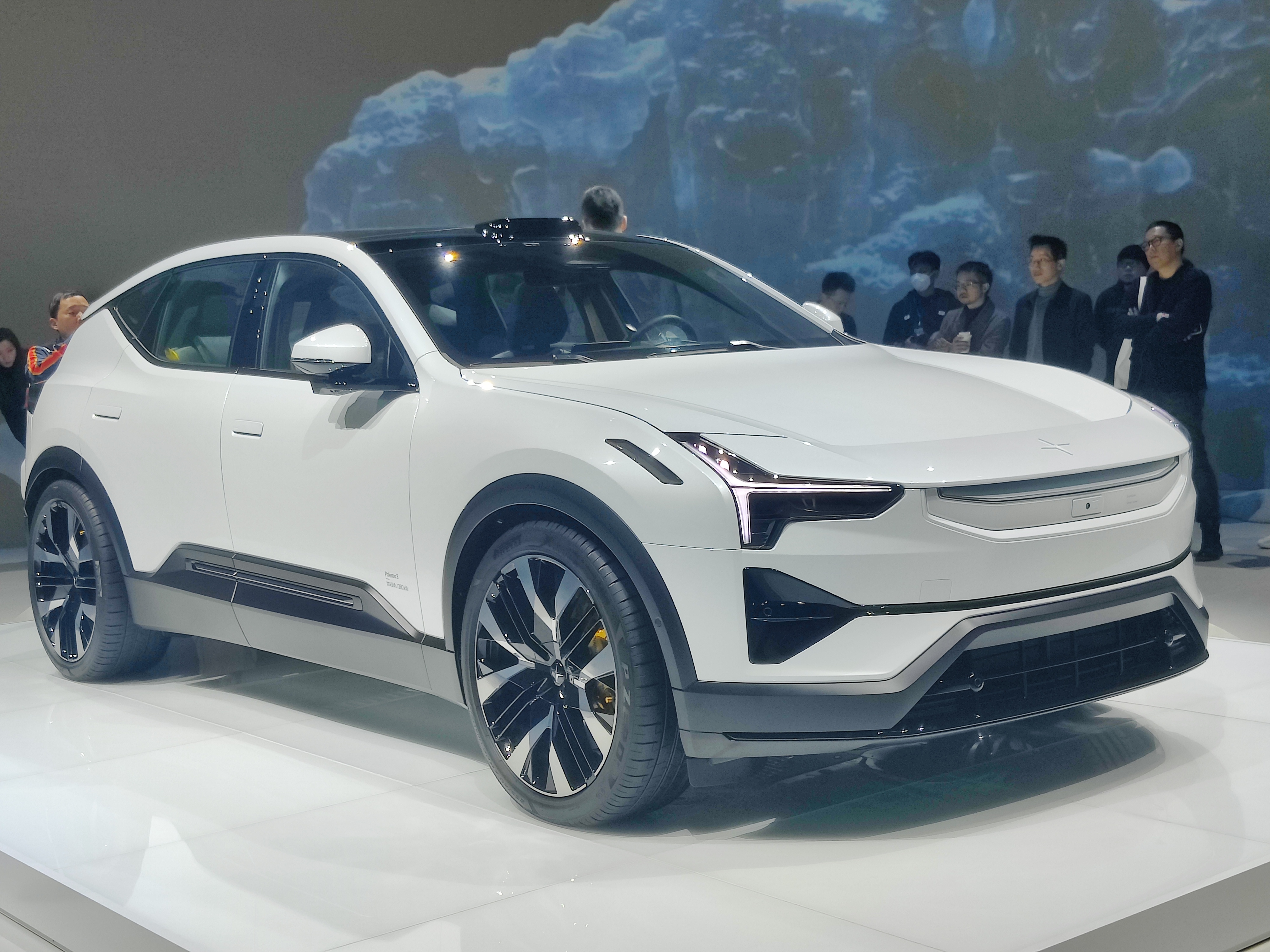
I had a chance to drive the all new 2026 Polestar 4 dual motor.
Now let me go back here just for a moment.
Because when Polestar began a few years ago, it was under the Volvo umbrella.
Well, that ended a long time ago, and I was not aware of that because I had to do
my research.
Who builds the Polestar?
It's a company called Geely Motors, G-E-E-L-Y, Geely Motors, China.
It comes in several versions, the Polestar 2, 3, and 4.
I had the 4 that had dual motors.
You can't get it with the single motor because it's all electric.
Electric SUV is what the government calls it.
Seats including a driver, five built in South Korea with 96% Chinese parts.
I'm not exactly sure what's going on there.
And maybe they just needed another assembly plant.
Hey, we've got one open over here in South Korea.
So we'll build it over here.
But 96% Chinese parts.
Can you tell the difference?
I can't tell the difference.
It's all new.
Exterior features.
There's no rear window.
What?
That's kind of kind of no.
There's no rear window.
If you want to look at the back, you've got a back camera back there.
It sounds like it's weird looking, but on the back, if you're looking at the vehicle
from the back, it doesn't look weird.
How they did that paint and the way that they've got, there is a good picture of it.
It looks like it's got a rear window, doesn't it?
Yeah.
Well, it doesn't.
So forget that.
Split headlights, horizontal split in the headlights, interesting and cool, stylish
horizontal tail lights that kind of go along with the headlights.
It does have a glass roof and there is no shade.
Now, obviously, I drove it a couple of weeks ago and the weather was just fine and I got
a little tip of the fact that I parked it for about an hour, total sunshine, and I got in.
It was a little warm in there, well, because it was turned off.
Okay.
If you turn it on, it's got one of those roofs that dims.
It has.
Yeah.
When it sees the sunlight, when it's running, it dims, it kind of like a tint is on it.
It's really cool.
How it works like that, I don't know, but I drove it basically in the early morning
and after the sun went down.
So that's something that you might want to consider, especially here in Houston, Texas,
where we are.
It could be a problem without a shade up there.
Again, what could use improvement shade for the glass roof?
Interior highlights.
15.4-inch center display.
Oh, wow.
You know how big that is?
That's huge.
15.4 inches.
Yes.
It has a Scandinavian-style minimalist design and you'll have to do the research on it
because where you would normally have knobs and buttons and that sort of stuff, no,
you got to go to the screen.
Canoves?
Canoves.
It could be canoves.
Awesome materials throughout.
It's well laid out.
It's really kind of cool if you get into it.
But you know, I know that I'm an older guy and I kind of like some knobs for certain
things like volume on the radio.
They're coming back.
Yes.
Well, and that's the new thing is they've realized that not everybody's all into that.
Cargo trunk room, small with the rear seats up, as you can imagine.
What I like about it, it's cool environment inside when you get it, but it could use improvement.
Again, some buttons to control often used features.
The problem here lies that eyes have to go off the road to locate the functions via
a screen.
And stop.
Think about that.
I think that you'll agree with me.
For many of the functions, it's really not necessary other than to clean up the dashboard
engine.
Do the electric motors that turn out 544 horsepower and 506 pound feet of torque transmission, none
direct drive range, 310 miles, tell you about more of that in just a second.
Miles per gallon range in the city 90 highway 80 for a combined of 85 miles per gallon.
I got, I don't know how many miles, but I didn't have to stop and put a DC charge
on it.
That cost me $35 and took it almost an hour out of my day.
That's a problem for me personally.
What could use improvement a level two charger in my garage would be nice.
So next time you send me one of those down to drive, please install that charger in
the garage.
We're not cool for me.
Right handling.
Nice ride.
Although like other electrics, it felt heavy.
What could use improvement?
I don't know.
Load pretty good.
Yes.
Overall.
$6229.
Price is tested, 67.4.
You can get in one of these for a base model price of 56.4.
Now, competitors Hyundai Ioniq 9 SUV for 58, 953, Hyundai Ioniq 6 sedan, 37, 850.
And the Tesla Model Y SUV starts at $44.990, so it does have competition.
This week, I'll review the Toyota Supra with 400 horsepower through that BMW straight six
in it.
You like cars, race cars with a license plate on the back of it.
Here is your ticket go card.
Yeah.
Hey, if you like.
Hey, we want to get to Jeff's car culture.
Okay.
We have five longest tunnels in the United States of America.
Yeah.
Do I really want to know this?
Well, when you're outside the longest tunnel in the U.S., you can't help but wonder how
did you build it?
What are the costs?
How many people?
Is it really an engineering marvel?
Well, yes to all of that.
Some of this stuff, you've got to be a real good engineer to figure all that
stuff out.
So here we go, Michael.
The Lincoln Tunnel is another tunnel under the famed Hudson River that connects
New Jersey.
Forget about it.
To New York.
It's a massive 1.5 miles in length.
It's the third largest traffic tunnel in that area.
It's created off of the Route 495.
This is one of New York's most iconic traffic destinations.
So what really makes the Lincoln Tunnel unique is the three separate tunnels that
are involved.
One was built in 1937, one was built in 1945, and the last one was built in 1957.
I didn't know that.
The Lincoln Tunnel averages over 100,000 vehicles daily, and it's one of the
most driven tunnels in the U.S.
So the next one we have is the Ted Williams Tunnel, and it's a renowned tunnel
located in the famed Boston, city of Boston, with a length of 1.6 miles.
It's one of the longest tunnels in the United States, established in 1995.
So when you're there and you're in the car park or, you know, all that stuff,
you got to take the tunnel.
Established in 1995, Ted Williams extension of I-90, which is the longest
interstate highway in the country.
The tunnel is owned by the Commonwealth of Massachusetts and consists of six lanes.
The tunnel has speed limit of 40 miles an hour, and it's a toll tunnel that you
could pay anywhere from 20 cents to $2 depending on where you live.
What?
Yeah, I guess these different accesses to different neighborhoods to have to
pay certain things to get on the road and get in the tunnel.
So that's what they're all about.
The next one, Mike, is situated under the Hudson River and is called the
Holland Tunnel.
This is the second longest tunnel in New York City, and it connects
New York to New Jersey.
Again, if you miss it, forget about it.
The tunnel is a four lane tunnel that carries traffic from both I-78 to I-39.
And it's about 1.62 miles in length.
Clearly, it's the longest tunnel in the U.S.
And the Holland Tunnel was first opened in 1927, making it the oldest
road tunnel in the history of the country.
And this was pretty unique.
Don, you may know this.
One of you probably get on it.
It's in the Colorado Rockies.
It's the Eisenhower Tunnel.
It's 60 miles east of Denver on Interstate 70.
And that's where the tunnel's at.
And the highest tunnel in the world with an average of 11,112 feet.
So it's up there.
It's up high in the mountains.
It runs through terrain, and the average annual snowfall from that
terrain from November to April is 26 feet.
So you've got a lot of snow around a lot of mountains.
Two tunnels measuring just a hair under 10,500 feet each direction.
And it was finished in 1973.
It spans two watersheds and the continental divide.
The federal government purchased it a long time ago, and they paid 90% of the cost.
And the city or the state picked up the 10%.
Average is about 30,000 to 50,000 vehicles.
So it's a lot.
It's pretty high up there.
So if you've got a thing to do with altitude or tunnels, we can do it.
Baltimore Harbor, Michael.
This one is prior to the Baltimore Harbor.
It was being built and placed in a list of the longest tunnels in the US.
Baltimore's narrow streets were the only direct roads between the city,
city of the south side of Baltimore and Philadelphia.
So this was built in 1940.
And it was because of the terrible roads and everything.
That's just pretty crazy right there.
Construction, the tunnel began in 1955.
And by that time, it was pretty well built and over budget.
It has 21 twin tube sections, about as long as a football field.
So if you're into you taking those tunnels, good luck.
That's all I'm going to say.
You don't have to worry about me taking those tunnels.
Now there's a tunnel from Detroit to Windsor,
and that's a little under a mile.
Well, we've got one here called the Washburn Tunnel.
It goes underneath the Houston Ship Shadow.
And I just assumed I'd go on that either.
They look.
Yeah, well, I don't know about that.
But you know, I'm really comfortable with that.
About this episode
Explore five incredible automotive museums across the U.S., from the expansive Gilmore Car Museum in Michigan to the iconic Petersen Automotive Museum in Los Angeles. Each museum showcases unique collections and exhibits, highlighting the evolution of the automobile. The episode also features a detailed review of the 2026 Polestar 4, an all-electric SUV with innovative design elements, including a unique rear camera instead of a window and a large touchscreen interface. Insights into its performance and features make this episode a fascinating listen for car enthusiasts.
Craving a car fix without a road trip? We spin a different kind of tour: five destination-worthy automotive museums that chart the arc from brass era pioneers to Hollywood legends, then we put a cutting-edge EV under the microscope. Our journey starts with the sprawling Gilmore campus and rolls through Tacoma’s LeMay, LA’s Petersen, and the Henry Ford’s sweeping narrative of innovation before landing at the Indianapolis Motor Speedway Museum, where racing history crackles from every display.
With that heritage fresh in mind, we jump into the driver’s seat of the 2026 Polestar 4 dual motor. Think 544 horsepower, a sleek profile, and one audacious choice: no rear window. We talk through the consequences of camera-only rear visibility, a panoramic roof that relies on electrochromic dimming, and a minimalist cabin anchored by a 15.4-inch screen. It’s clean, modern, and quick, but we weigh the trade-offs—less tactile control and more eyes-off-road moments—alongside real-world charging needs, range, and pricing that parks it in Model Y and Ioniq territory.
To round it out, we tip our hats to the unsung infrastructure that makes every drive possible: America’s longest tunnels, from the Hudson crossings to Colorado’s high-altitude Eisenhower bore and Boston’s Ted Williams. It’s a look at how engineering ambition underpins car culture, whether you’re walking museum floors or merging into traffic. If you love the intersection of history, design, and modern EV realities, this one’s for you. Subscribe, share with a fellow car nut, and drop a review to tell us which museum or EV deserves our next deep dive.
Disclaimer: This post contains affiliate links. If you make a purchase, I may receive a commission at no extra cost to you.
---- ----- Want more In Wheel Time car talk any time?
In Wheel Time is now available on Audacy!
Just go to Audacy.com/InWheelTime where ever you are. ----- ----- Be sure to subscribe on your favorite podcast provider for the next episode of In Wheel Time Podcast and check out our live multiplatform broadcast every Saturday, 10a - 12nCT simulcasting on Audacy, YouTube, Facebook, Twitter, Twitch and InWheelTime.com.
In Wheel Time Podcast can be heard on you mobile device from providers such as:
Apple Podcasts, Amazon Music Podcast, Spotify, SiriusXM Podcast, iHeartRadio podcast, TuneIn + Alexa, Podcast Addict, Castro, Castbox, YouTube Podcast and more on your mobile device.
Follow InWheelTime.com for the latest updates!
Twitter: https://twitter.com/InWheelTime
Instagram: https://www.instagram.com/inwheeltime/
https://www.youtube.com/inwheeltime
https://www.Facebook.com/InWheelTime
For more information about In Wheel Time Podcast, email us at