A Land Rover Discovery is a big SUV made by Land Rover. Here, the host is saying Mayo’s dog-friendly rules even apply to the car he drives—so the shop experience fits his life.
“Added value” means you’re not only charging for the work—you’re also offering extra benefits. The host is saying customers should think about the overall experience, not just the cost.
The Volkswagen T1 is a classic VW bus from the early Type 2 era. The host is saying they have one and it’s part of their life with their dog.
LIVE
This is the Automotive Repair podcast network.
Hey, everybody, Karm Capriotto,
Remarkable Results Radio, another town hall academy.
Hey, look, Karm's going to do another episode on marketing and AI.
Oh, we won't hang around.
We won't listen.
Ah, wrong.
That would be a huge mistake because I do episodes,
maybe the same kind of topics, but the themes and the people we have on,
we've got Mike Della Cruz and Michelle Tansy here.
So that's all the more reason to wait around.
Thank you so much to our great partners who've been with us for so long.
How well does your team know their stuff?
Hey, look, I want to tell everybody, please get our listening app.
It is the coolest thing ever for your smartphone.
Yeah, you can listen on Spotify and Apple.
I get that.
But this is a tool for you, for your smartphone,
the ultimate professional automotive repair playlist.
Read the show notes, see links to our sponsors,
and get all the shows in our network on one app,
arpn.app.
Hey, welcome aboard to my friends, Mike Della Cruz and Michelle Tansy.
Mike and Michelle, glad to have you here.
Michelle is co-founder, Euro Clinic in Santa Clara, California.
How are things in the Euro world?
It was a rough start, but I think that, I mean, I love the cars that we work on.
The whole business is based on that luxury Euro kind of world.
And I'm in the center of Silicon Valley, so there is so much potential.
That's pretty much a lot of what we see, especially in my area.
It's a good area to be in the Euro business.
I am curious.
I'm going to ask you a question.
You don't have to answer it.
What's your labor rate?
My base labor rate is 295.
For exotics, it's 395.
I want you to keep in mind, and for all the listeners,
because, you know, when I'm in a room with shop owners and they hear
what the labor rates are, I want you to know.
Like, so my shop is right in the middle of a U,
and I have three major dealership strips,
three miles away from me, Porsche dealers 450 an hour.
Wow.
Mercedes is 400, Audi's 385, and Volkswagen,
and BMW come at about like 350 to 365.
But let me just guess that the average wage in Silicon Valley is 300,000.
I'm just guessing.
Yes.
It's super interesting.
Like when I do all this research on like households,
this is the crazy part, and everybody always thinks it's super crazy.
150K household is considered low income in our area.
Yeah.
Yeah.
That's my point.
Wow.
So like my customer base is a lot of like professional females and a lot of tech.
Like those are our clients.
So when I say it's a good way for me to be a shop owner,
innovation should always be my mindset, right?
How can we innovate to cater to these consumers?
Because those are the drivers that drive the cars where I'm at.
I love what I do.
Like I don't work on cars,
but I love what I do constantly working with like the whole team that we work
with on how can we serve this consumer better due to what they do for a living,
what they drive.
A lot of them, like my client tell in my area is time is money, right?
So taking in your car for service, it costs you more than them being where they need to be.
Well, I think she's pretty much nicely set up, Mike,
all the things that we want to talk about with marketing and AI.
Mike Dela Cruz is your co-founder and CEO of overdrivemarketing.com.
And when you want to type that in, you have to spell O-V-E-R-D-R-Y-V-E overdrive.com.
And Mike, you've been in the industry for years.
You've traveled the country with other companies.
You're embedded and you're there.
And it was a few years ago, you had this off the charts idea.
Yeah, absolutely.
Yeah, I mean, it was January 11, 2023, where I launched overdrive.
And here we are over three years later.
And just a quick plug for Michelle, she's actually my shop.
I bring all my family's cars to her.
She's like less than 10 minutes or so, right, Michelle?
Like eight minutes or something like that from my house.
So I'm in Silicon Valley.
I don't meet those.
I'm in the minimum threshold, but thankfully my wife makes way more money than I do.
So just for context.
But yeah, best shop here in Silicon Valley for sure.
So very grateful to have Michelle, you know, service all my cars.
That's just great, great news.
Now, Michelle, I want to start this entire episode about how AI and marketing, they integrate.
We're hearing so much.
Our shop owners, Michelle, just kidding.
The wrong AI impression right now.
I think so.
And I think it's also like, it depends, right?
Or where demographics has a lot to do with how you embrace technology.
We sit on all these different boards with all these shop owners or different places
in the industry all over the United States.
And I think a lot of them fear it.
Some think it's BS.
In my shop, we're starting to embrace it completely.
Like in everything that we do from we're looking for our vendors to start embracing it as well.
We're looking for the best technology to get information the fastest.
I know Bernard is starting to implement it with the technicians, you know, using chat.
The company has one.
We taught it.
We made it, learned everything that we possibly can.
And a lot of this, people start having negative comments on it.
For me is you have to look how to embrace it and you have to pick technology and then say,
hmm, how can this improve us to be way better?
For example, BS using it with the technicians in a sense where if you tell it,
I already did this, this, this, this.
This is the issue I'm having.
What am I not seeing?
And it's like instant, right?
Instead of calling tech line and waiting and it's how can we get information faster?
And it's utilizing it to the ability to say, hey, how am I having tunnel vision?
What am I not seeing?
But you have to train it.
I always say you have to train this.
This is not replacing humans.
It's helping us think faster.
It's imagine like a machine that's helping you think faster,
narrowing your thoughts, but you still have to tell it.
It's not going to know if I can explain it better.
Mike, I know you want to jump in and you should because you're smarter than I will ever be.
But that whole thing about being able to teach it, Mike,
one of the key pieces that people are forgetting is that you could tell it what you want,
how you want it, what tone you want.
Don't do this.
And it remembers.
Yeah.
Well, think about this shift, right?
If you go back 25 years or so when websites first came out,
we were a little hesitant.
We had to learn this new WWW, right?
Then social media came out.
And I remember 15 years ago teaching classes on social media,
and I used to have to convince shop owners to open up a Facebook page.
It was just, you know, they were reluctant.
Hey, my grandkids are on Facebook.
It's not my thing.
Those same people you talked to today, you can't even pry them off Facebook
because they've embraced it, right?
So as we kind of entered this shift, and what's interesting is,
AI has been around for 50 years, right?
It started with Karthi 50 years ago, but it only became mainstream in November 2022
when Sam Altman, the founder of OpenAI,
when he started to talk about these behavioral things that you could actually,
these learning behaviors that you could actually implement,
as small business owners, we sort of embraced it.
There's still a lot to learn from it because you think it became mainstream
the end of 2022, we've seen some drawbacks, different things like that.
So let me add a little bit more context if it's okay.
So Overdrive offices are Sunnyvale, California,
and our office is kind of the shared space with plug-and-play.
There's over 200 startups within our building.
And every day for the past year, I would see no exaggeration.
Robots delivering food to kiosks.
I would see there's a company called Shield that has literally,
it's a demo in their booth where it's AI detected disease detection
in hospital rooms, right?
So I'm thinking for the past year, I'm like,
and what's cool is recently we've started to kind of embrace this stuff,
but as an industry, we are highly underutilizing it.
A year and a half ago, it was limited to pretty much scoring calls.
They would listen to calls and score calls to figure out missed opportunities,
things like that, and then review responses.
But now I'm starting to see more companies out there starting to add more features,
including Overdrive.
Lastly, Google had a big conference here in Silicon Valley last week.
Masha, I don't know if you heard of it or went to it,
but they talked about token usage.
And the token usage from Q1 2025 to Q1 2026.
So just in a year's timeframe, it shot up to 3.2 quadrillion.
I even know that was a real number, token usage, right?
And then back then, 6% of consumers surveyed said that they utilized
some form of AI, only 6%.
That same period in Q1 of 2026, 46%.
So even though technically, Google still owns the market share and search,
we very, very quickly embrace this stuff.
So I would anticipate a very quick adoption in the next few months.
From a shop owner standpoint, if I can add on to that,
we started hearing a lot when you asked, or the front counter asked,
how did you find us for new clients?
Chat GPT, chat GPT.
Then we said, okay, we got to train our chat GPT.
Those senses where you got to teach it.
And, you know, BE was super reluctant on bringing it into operations.
But a lot of it was, it's the thought that it's replacing humans
or you're hindering the ability for them to learn.
I think my AI has made me smarter, faster than that could ever be.
When I think of AI and I think of us trying to mentally figure it out,
I always go back to an early Star Trek episode.
And I believe the character had this huge brain and didn't speak
and they could telepath their thoughts to the people in the room.
And that's what I think of AI.
It's just big brain stuff.
So, you know, if you've ever wanted a really big brain,
teach AI how to be your big brain.
It's funny you use that analogy.
Like, I look at it almost like you have an assistant, right?
And you're going to spend time training them how to be the best assistant
that you need for your needs as to why you brought them on board.
And that takes time and effort and SOPs and leadership
and all this other stuff.
Imagine having an assistant that you tell,
like when I got onto ChatGPT and we bought it for their company,
I basically told it, this is our company.
This is me.
Learn everything about it.
This is my market.
This is our clientele.
This is what we do so much that I'll tell you something funny.
I was typing an email and I drop it in there for tone
because she already, I called her Pepper.
We're big Ironman fans because we're mechanics and stuff like that.
So my AI, her name is Pepper.
And I tell her Pepper, can you check the tone on my email?
I don't have her type my email form.
And that's the misuse, Reg, with the new generation.
Don't do the email for me.
I type in the email and I say, can you throw it in there for tone?
She told me and checked me and said that I was being aggressive
and that was not my normal tone on how I like to be perceived.
This is how embedded I am with it, right?
That she's telling me, I think you should bring it down a notch
because I know that you don't like to be perceived this way.
I told her everything I like, what I don't dislike, how I carry myself,
everything possible that it's almost like you're assistant, right?
She's checking you like, check your tone.
Okay.
So the softer side of Michelle, I get that.
Okay.
When you heard that back, did you take exception to that?
You know, at first I was like, are you freaking kidding me?
Like what?
But I'm big on curiosity.
Like it's funny.
Like to me, when I get feedback, even if it's from like Google machine
or even like vendors, friends, family, I don't look at it as a,
hey, they're talking down to me.
I get curious.
It's like, I was curious as to, and I reread it, right?
And I reread it and I said, and then you realize, oh crap.
Yeah, this might be perceived as something aggressive.
I will challenge any consumer in any industry that are you in.
It is happening.
It's already happened.
It's been around.
We have to embrace it.
And I feel like as an industry, we're kind of a little bit behind.
Yeah.
Last week I taught a class in Northern Virginia on AI and marketing.
And then two days later, I taught a class in Northern California
in the Santa Rosa area for one of the associations out here.
And I always lead sort of, I want to kind of get a temperature check
of the room, right?
So I ask with, how many people use AI at least five days a week?
Every day, right?
So I kind of have these layered questions.
And then I asked like preferred platform and different things like that.
What's interesting is everybody has different usages, right?
How they use it.
Like Michelle mentioned the tone.
I'm the same way.
I want to check myself.
I want to make sure my email doesn't come across as arrogant.
It's professional, right?
So I don't have AI write emails for me.
I write the email, cut and paste it, and then post it into my preferred platform.
That being said, my biggest takeaway out of both of those classes last week
was that people are still skeptical, very, very skeptical.
There's a lot that you can do with AI.
You can have it write code.
I mean, there's so many different things that you could do with it.
But there's almost this defensive barrier of like, I'm not going to cross this yet.
Let's just kind of wait in the wings, which is highly respectable because again,
it is new.
We're still learning a lot about it.
Whatever we upload, whether it's images, whether it's web hooks,
like whatever we're uploading into Claude or ChatGBT, it goes out there to the ecosystem.
We don't want to share customer information and those types of things.
So I don't do it to that extent.
It's just more kind of self-improvement, self-awareness.
But that was my biggest takeaway, Carm, was that people are still hesitant.
Understandable.
I don't have a problem with being cautious, but I guess the message that the industry needs to hear
and understand is you can't ignore it.
You're going to have to one day embrace it.
Now, it may be in a longer, you know, a longer curve to embrace it,
but you cannot completely ignore it.
And Mike, let's go back to all the, you know, when the SMSes came out and then DVIs
and all this high-tech stuff that started to invade our business.
And some people look the other way.
They're not around here anymore.
And I do believe that we can't look at AI as a toy.
It's a tool.
And like every one of our tools, we have to learn how to use it.
Yeah, is it going to replace humans?
Absolutely not.
Like that is number one, because humans, we have empathy.
We're in rooms.
We're high-fiving, right?
But if you think about, and I'll just use a broader context, any role.
In my world, it's marketing, right?
If I take what a traditional marketing director does as a human, right?
We're capable of a certain amount of performance, right?
Maybe if you're David Goggins, you could extend beyond that.
What does he say?
120% rule or something like that, right?
Possibly.
But if you shifted at least 90 to 95% of what traditional marketing director does
and then made it more predictable, meaning, okay, each individual customer
in our world in auto aftermarket.
Jane customer might have one car come in once a year.
A Joe customer might have three cars and maybe Michelle sees them five times a year, right?
Why should they have the same communication, right?
What triggers Jane customer to respond?
AI, if you embed that, incorporate that in the process, it's able to tell you that.
And the win is, if Michelle sends out a campaign,
what's going to maximize our performance of the campaign, get high open rates
and high conversion rates?
That's the intelligence of AI.
Mike is talking about stop, eliminate the hope that I think I'm doing things right
and get AI, this erector said, if you will, to come in and do some of the lifting.
You know, Mike, I think it's being humble right now.
Like what overdrive is building, I don't know if, can I touch on it?
Sure, yeah.
I mean, as a client, like what they're building is going to be a time saver.
I'm talking to shop owners right now.
If you guys are in here, time saver, shit that we don't like to do.
Sorry, part of my French, but like all the stuff we don't want to do, right?
It's what SEO SEO and margins on this.
Can we track that?
Like it's basically he's building this system where it can anticipate issues.
It can let us know, hey, you're on track.
You're kind of not.
This is what I think that you should do because of these type of clients.
And this is your demographic and this is what you do.
So imagine a software that customizes with data.
It pulls data and it's so smart that it can tell you, like he mentioned, hey, this 20A4
that's coming in with Jane Doe and same car with John Doe, but they have different
lifestyles, different usage for their vehicle.
This is how you should market to them.
Like that's gangster.
I don't want to spend time making more Excel sheets and tracking all those other stuff.
Like it will be in a software to tell you, hey, this is what you're tracking from
margins to KPIs and think about it.
Not just for a shop owner perspective, but for your whole staff.
And you know, shop owners that are scared to share data and reporting with your
staff, this is where you need to evolve.
Our mindset has to shift and we got to think differently.
Let's face it.
Your shop management system is the single most important tool in your shop.
Period.
Napa Tracks was built from the ground up to make your business more profitable and efficient.
We provide an extensive set of tools to increase and track profitability in real time.
Napa Tracks offers the industry's best post sale support.
Hands down and we train your people on site.
Yep.
On site and we offer remote refresher training 10 times a week and customer support is open
6 days a week.
Give us a call, visit the website or join our Facebook community today to learn more.
We'll prove to you that Tracks is the single best shop management system in the business.
Napa Tracks is always customized and tailored for you, whether you're a one man shop or
a large multi bay or multi location company.
After all, it's your shop.
So, it's your choice.
Visit us on the web at Napa Tracks, that's N-A-P-A-T-R-A-C-S dot com.
Transform your team with today's class where automotive training is easy, quick and fun.
Just 5 minutes a day on our app can eliminate hours of looking up forgotten information later.
It's perfect for technicians, advisors and managers alike.
Keep critical knowledge fresh and top of mind ensuring your team operates at peak efficiency.
Today's class is impactful, accessible from anywhere and a bit of fun too.
And we're not talking about after hours pizza either.
For training that gets results, turn to today's class dot com.
Shop owners, we know you are overwhelmed with a flood of missed calls, empty bays and disconnected marketing tools.
Cacui has spent over a decade building one integrated platform for auto repair shops.
One login, one dashboard and mobile first websites that convert four times industry average.
Smart, innovative CRM with automated follow up, 24-7 online booking and real time ROI tracking.
With 900 plus years of combined team experience, we fuel the growth of 2,200 plus shops
and have influenced 3 billion dollars in revenue.
Stop working harder, start working smarter.
Get industry leading customer support and book a demo with Cacui, that's kukui.com.
You know, most shop owners feel trapped spending on ads while half their first time customers never come back.
It's frustrating, it's exhausting and it's not your fault.
The industry average is 54%, one and done.
We understand how discouraging that can be.
Well, pit crew loyalty changes the story.
Our clients cut that rate by up to 38%, raising lifetime value by more than 50%.
Loyalty members visit nearly three times more often, creating predictable revenue without extra ad spend.
Pit crew loyalty, where customers stay and shops thrive.
On the web at pitcrewloyalty.com.
So much marketing, Mike, Michelle, that we've done in the past is what we see, what we hear, what we feel,
what we're paying attention to, it all comes in our gut.
And then we make a decision with our marketing company, should we ying or should we yang?
And I think what I heard from Michelle is that some of that gut, emotion that we bring in
needs to be more analytical and show us what's going on.
And then maybe we apply a little emotion to the decision that we make, which way to go.
But now we're more steeped in logic and objectivity, is that right, Mike?
Yeah, and predictable as well. I think that that's a key thing.
And I'll give you an example.
Let's say folks go to Google to find a repair shop, which is kind of the common thing right now.
I go to Google, I type in Euro repair near me.
Google pulls up obviously the sponsored ads like the LSAs, the MatPak.
And then if a consumer is not satisfied with what they see there, all they have to do is click more options or more businesses
and it's going to collapse a lot of other shops.
Now, there's a journey in that customer cadence, right?
They find you online, they read a review, there's a call to action, they talk to an advisor, they come in.
If you install APIs, for example, into Google Business Profile page, and I won't plug our platform,
but just generally speaking like is able to identify AI, let's say AI is coming in,
able to identify search trends on Google in your market.
And let's say I have a Porsche, but I don't need repair right now.
AI is going to tag that and then be able to predict what you're potentially going to land in terms of,
from a shop perspective, car count, ARO and total sales.
Because everything's dependent on search trends.
If people aren't searching for that type of repair that Michelle's offering, it's redundant.
You could spend a 10000 dollars a month.
If people are not searching for what her specialty is, what she's looking to target,
you're dead in the water, right?
But we want to look at search trends.
So when you combine the Google Business Profile page as just as an example,
and then combine that with what people are searching for,
AI is able to predict, okay, well, based on search trends and all these other parameters,
here's where you're going to end up.
You're going to be 22 leads down on your Google Business Profile page by the end.
I mean, that's how intelligent AI is.
And then who doesn't want to embrace that?
I don't want to switch this discussion down any other highway,
but what just came through my mind and maybe worked with me for a couple of minutes on this
is auto repair shop near me.
Mike, you mentioned that.
The immediate thing that I thought of is why?
Why do I need an auto repair shop near me?
How come we as a professional industry haven't done enough to build the loyalty into people
not having to search?
Am I crazy or not?
Not at all.
I preach this all day long.
Most of what we do happens at the counter.
In marketing, we have a 75-25 ratio.
So for example, if I pulled Michelle's data last month,
and if I saw 75% of total customers had been there at least one time before
and 25% were brand new, I would be happy as a marketer, right?
Would I be over the moon?
Not particularly, but I would be happy.
I'd be content.
Okay, great.
Retention is doing its thing, the people at the counter,
and then internet marketing is doing its thing.
You know I've been to over 2,000 shops around the country and in Canada.
I have personally walked into over 2,000 shops.
I'm an observer.
I ask questions.
I ask open-ended questions.
I want to learn from shop owners, right?
What's interesting, and I gave this analogy to you a couple of years ago
if you recall, the NASA shop.
With NASA, and I know you love this,
with NASA, this is for the audience.
NASA, there's no cutting corners.
We're just seeing people go to the moon, right?
Like a couple months ago.
There is no cutting corners with NASA.
Every step of their process is fluid.
And they're not just checking boxes.
It's really, they've built a process where it's second nature.
There is a handful of NASA shops that I've personally walked into.
And what's interesting at those is, you know, in our industry,
the biggest problem I see, we have a few concerns, right?
But like inconsistency.
One minute our bays are filled.
The next minute they're slow.
And then we do this knee-jerk, sort of this panic marketing.
It's like, okay, now I got to do all this, right?
The NASA shops that I've personally walked into to your point, Karm,
are consistent with their process and their branding.
Year-round, they're a week, say, seven to 10 days out,
booked up with their appointments.
And the vast majority of those customers that they're booked up with
had been in there at least one time before.
So instead of that 75-25 ratio, they're more of a 90-10.
So eventually new customers to them are just icing on the cake.
Ultimately, you need them because people move away, they die, you know,
things happen.
We need to constantly be looking for new.
Mike, this whole build loyalty thing,
I can't help but believe that all the tech that we have, CRMs and AIs
and what you're doing at Overdrive,
has got to help congeal it into a nice glowing ball.
Am I right?
You're right.
And as a marketer, Karm,
our primary responsibility is to drive quality leads to the shop,
which are called MQLs, marketing qualified leads,
that advisors are able to convert into visits, right?
And then secondly behind that is ad appointments, fill their appointments.
So quality leads, fill their calendar up with appointments.
That is primarily what we're doing, but we're not picking up the phone.
So sales and marketing go hand in hand.
Advisors are salespeak professionals, okay?
Their responsibility is to identify a good opportunity,
convert it into the lead, but their work's not done after that
because they have to do everything I call A to Z,
retention marketing A to Z.
They have to do everything to earn that long-term relationship
and we're not going to look at it like $100 oil change.
If you do all of these things right between A to Z
and earned that relationship, there's what's called LTV,
lifetime value.
It's tens of thousands of dollars in added revenue
when you learn your customer.
Lastly, I mean, I could talk about this till midnight,
but I'll spare the audience.
But my Starbucks story that I share in some of my classes,
it's a true story.
2007, I was going to open up a coffee shop.
I was working for Washington Mutual.
We got bought by Chase.
I wasn't happy.
I would sit at Starbucks and I'm like,
man, I'm going to open up a coffee shop.
I would be very particular.
I would count customers.
I would look at average ticket prices.
And during that time, Jim Donald was the CEO of Starbucks.
He was responsible for growing this chain from 5,000 stores
to 30,000 stores worldwide.
And he did it in record time.
And I wanted to know, Carm and Michelle,
why would people wait in these massive lines at Starbucks
to spend $3, $4, $5 or more on a cup of coffee?
And there would be a gourmet coffee cart or a small business
right across the street for 99 cents and nobody's in that line.
There's a lot of things that went into their process.
Like you walk into Starbucks, you know you're in a Starbucks.
There's no sharp edges.
Alanis Morissette in acoustic.
It's very predictable.
Well, one of the things that resonated with me,
and I encourage every shop to think about this,
you were required to address people by first name.
They actually had it in their employee handbook.
It was called forming a complete customer connection.
So you walk into Starbucks, I'm Carm.
I want the triple grande non-fat white mocha.
Nine times out of 10, if you went to that same Starbucks
the next day, they would not only remember your name,
but your drink of choice.
You were not known as, hey, number 27, your order's ready.
You were known as Carm, the guy who drinks the triple grande
non-fat white mocha.
And what happens?
Immediately we're drawn to that.
We're connected because we feel part of something.
All of our customers in the shop feel the same way.
When we learn customers, and sometimes in a very friendly,
polite, delicate way, I'll challenge advisors
because I observe and I see a customer going,
hey, I found you guys on goo is my first time here.
They walk away and I'll ask the advisor,
what were two things that you just learned about
that brand new customer?
And sometimes they'll say, oh, they're from here in Denver
or whatever, right?
But no, I mean, really, what do they do on the weekend?
Do they own a business?
Do they have a family?
Do they go to church?
What are their hobbies?
I want to know outside of the boxings
because I'm trying to create the Starbucks process
of it's predictably okay when people go there.
I'm thinking of Euro Clinic, Michelle,
as he's telling that story.
And Mike, today in our meeting
of 28 independent shop owners here in Buffalo,
somebody walked in with a cup of coffee
with the Starbucks logo on it.
That told me a whole hell of a lot about that person.
Period, right?
That's where the brand is, the image, the logo, the brand.
And I can imagine with Euro coffee cups out there,
even if it was quick to have a cup of coffee
while someone's waiting, but they're out there
and they take it with them and they go to their work.
Oh, you go to Euro Clinic.
Isn't that cool?
Or can you tell me about them?
We have it.
I spent a lot of money on this fancy expressional machine.
And I'll tell you how we utilize it, right?
Going to go get coffee is culture.
Part of society.
Can I show him real quick?
Yeah.
There's for your audience.
There's their latte right there.
Oh, my God.
I love...
Oh, my God.
That is the coolest.
And I have a great marketing team, you know?
And I challenge every single shop owner
to really learn their client base.
If there's something that I am super, super thankful
for over-driving the whole team,
because I've been with you guys almost two years, kind of.
And I did a complete revamp of how we do business,
who is my ideal client,
and what are we really going to offer?
What I offer is I save you time and convenience.
And I looked at my consumer and I looked at my ideal client
and I said, coffee is part of culture.
I had the fancy commercial carry.
That requires them to do something.
That requires for them to walk over after they checked in
if they're in the waiting area
and make themselves a cup of coffee.
I brought in my manager and he's big on hospitality.
And he said, no, our sales team is going to be making
these coffees as we have a conversation, right?
It's so embedded in our day-to-day operations
that when we valet cars, because I offer a valet
and pick up service to the local engineers,
we're embedded with our tech companies around here
to make it easier for them to get service here.
We already know what their favorite drink is.
We serve as a VP of litigation for Google.
She's not too far away.
She drives a Land Rover and she loves cappuccinos.
Double shot cappuccino.
It's in their profile.
Ron already knows and she doesn't even have to ask for it.
If we're delivering her car in the morning,
we're sending her a cappuccino.
So she's getting her car and her cappuccino.
Can I add to that real quick?
So as I mentioned, Karm,
I'm a client of Euro clinics, a proud client.
And NASA shops, they don't cut corners.
Remember I said that?
Ron, who's a general manager, I walk in and I know...
I mean, they've been clients for almost two years, right?
Like, I know them.
For me, I'm super loose.
I'm like, high five, hug, whatever.
Ron treats me the same exact way he would treat a customer.
When I walk in, he'll ask me,
hey, can I make your latte?
Because I have a nonfat latte.
He's like, can I make your nonfat latte?
He knows what I drink.
And he'll offer to make me my latte.
They have this soundproof booth,
which actually, to Michelle's point,
being here in the thick of Silicon Valley,
that is massive for waiters because it's tech.
We're on the go.
And if we need to do a Zoom call,
they could literally do it in Michelle's lobby
in a separate soundproof room.
That's a huge selling point.
So NASA shops, they don't cut corners.
And Michelle and Bea are definitely a NASA shop.
And when you think about it, though,
if your operations are not solid,
no amount of marketing is going to fix that.
And that's conversations that I've had with Mike Delacruz
as the founder of the company that does my marketing,
my marketing director.
We as shop owners have to put our ego aside
and understand that marketing is part of our ecosystem
on what we do to get new clients, retain them.
And we have to listen.
And Mike came to me a couple months ago
because I was like, hey, it's being the proactive stuff.
Why are we being reactionary?
What's happening?
We were running low days here and there.
And as a shop owner, you have to listen
because our marketing team is data-driven.
We're emotionally driven, right?
And we have to kind of train ourselves out of it.
There's always a 50-50% chance
that the marketing company is giving me BS
and stuff is not working,
or my systems are not tight like we think we are.
So it's a constant evolution of you
making sure that the systems are tight, right?
Because I don't care if the phone only rings five times.
That's five opportunities that day versus it ringing 30.
That's still 30 opportunities.
And we have to make sure...
I don't know if you taught this.
Mike came and spoke to my team for kickoff
and it's like you have a certain amount on the phone,
like a certain amount of seconds to make an impression
and basically brand yourselves that way.
So for me, I kind of built the company
after conversations with my marketing company
as I'm the avatar client, right?
What are the things that I like?
Like in my shop, we don't have too many waiters.
A lot of the times when there is waiters,
it's new clients because we want them to spend time.
We bring them out to the shop.
We introduce them.
I want them to know how transparent we are.
My client tells 60% as female.
And a lot of the times,
I don't care what brands you're putting in my car.
That's not how you earn my business.
A lot of my normal actual concerns are,
how long is this going to take
and how much is this going to cost me?
And how is it going to inconvenience my life?
So as a shop owner,
I had to build systems and put people in places
in those systems where we're addressing those concerns.
Whether the client is telling us those are my concerns.
It's like we almost anticipate those needs.
I have a client that comes from me from Woodside.
He passes, I want to say hundreds of shops.
He's about 25 miles away.
The only reason he comes in is because we allow Mayo to come.
And Mayo is this beautiful big old poodle.
And we have treats for their dogs.
We bring out the bull.
We get them an uber pet if the shuttle is not available.
His dog is welcome in our shuttle.
But I want you to listen to it.
In our culture here in Silicon Valley,
Mayo has his own car.
This is the life we're living.
This client has about four euros,
but Mayo's car is a Land Rover Discovery.
It's his car.
So my lounge is super luxury.
Think of Nordstroms.
But the fact that Mayo's allowed in there to him,
it's like he comes to service his car
because we found out that he loves his dog.
And his dog is welcome to come whenever he wants.
When he doesn't come, we ask, how come Mayo didn't come?
And he goes, well, Mayo's not allowed in the GT4 RS.
Mike, I got to tell you,
there's some real powerful lessons in the last five minutes.
I couldn't be happier.
We have done episodes over these last 11 years
where stories just like yours about the love of the relationship
and you probably even have wonderful smells inside
of your weight room, right?
Oh, yeah.
We made our own scent.
I want you to think, okay, you walk into a Ritz Carlton.
They have their specific scent, right?
You walk into Hotel W in New York.
They have their specific scent.
And this is stuff that people can do.
It's like you want to be remembered.
And marketing, it doesn't matter what industry you're in.
You can do whatever you want,
but people respond based on how you made them feel.
How did I feel in that moment when I was in there?
And I'm not saying, Carm, that I am the best shop
for every consumer out there that drives Euro.
It's no.
I am the right consumer for specific drivers
that are looking for this.
Mike's super busy.
He's bringing his car in, I think, today.
And we already offered, like, I know you're busy, bro.
Let us go pick it up.
But sometimes, I mean, I think he wants to come in.
He wants to get his latte.
I was like, we'll bring you the latte.
That's not the problem, right?
It's like...
I'm busy. I can't get there.
I need no work on my car, but I need a latte.
Yeah.
For us, it's like...
I've done that sometimes, Carm, believe it or not.
How can we be of service?
How can we be of service?
All right.
I'm so impressed with where you've taken this.
And I need to ask a really difficult question to the industry.
Michelle's your role.
And that's how your role people are.
And my challenge to that attitude
is I don't care if you're all models.
If you're EV, hybrid, I don't care.
What you've done is taken the client experience.
Basically, you're the CXO, right?
Client Experience Officer.
You're the CXO.
And I don't care what you work on.
It could be at the highest level
because the people that have Cadillacs
and all those other high-end Lincoln navigators and stuff,
they want a high-end place to go
even if you're working on a Chevy in another bay.
So why isn't this professional industry of ours
that's constantly being challenged
by the dealership network?
Why haven't we kicked it up about 42 notches?
In terms of adding additional services?
No, not the services,
but to do the things that, yeah, the experience.
Oh, I see what you mean. Yeah, sorry.
It's this mindset that you can serve everything.
I'm in a metropolitan area.
There's shops all over me.
I get mailers that say, we fix everything.
Do you? Do you fix everything?
Like the way we look at marketing,
conversations I have with my marketing director
is even when we look at competitors around us,
I'm not looking at what they're really good at
because they're really good at that.
That's what they do.
I'm looking at what they're not good at
and how can I be good at that?
Do you know what I mean?
You have to shift your mindset.
It's like Chick-fil-A.
Popeyes has been around longer than Chick-fil-A.
They both have great chicken.
Chick-fil-A built their systems around hospitality.
It is my pleasure to serve you.
You have a blessed day.
It's like I started telling my team a year ago,
we're in the automotive repair industry.
How come we don't tell our clients, please drive safely.
Have a great weekend and drive safely.
Like it's just certain things that you can insert,
but again, I do disagree and I completely agree
and I'm glad that you brought up this topic
and I'm interested to hear what Mike thinks of this
as like a marketing perspective.
But for me, it's like you can't serve as all.
You cannot fix all
because different people are looking for different things.
And I have customers that found me with their Audi
and later on moved on and now have like a Honda
or have a Lexus and they still pay our rates.
But they come because of how we make them feel
and the trust and they know the value they're going to get.
I mean, me servicing a Honda is really expensive.
But then now we're talking, we're getting into value.
Now the conversation is moving into added value.
Like are you a price shop or are you looking for value?
You go to Target, you know what type of experience
you're going to get?
You're probably going to have to bag things yourself.
You go to Nordstroms and they package it up really nice.
They walk over the counter.
They give you a beautiful bag.
You know what to expect when you walk into something
because now we're getting into value.
And they let your dog come in the store.
Well, you look at things that are important, right?
Like Silicon Valley people, kids are expensive.
Kids are really, really expensive.
People sometimes get a dog first, you know,
and it's their whole world.
I'm a huge dog person and Mike knows that.
And I love my dog.
Like we have a Volkswagen T1 and that's for Kobe.
Everybody else, we drive sedans.
But when we got the SUV for the dog
because we wanted to bring him everywhere with us.
Mike, I know you probably agree vehemently with Michelle
and I kind of want to get back to the whole marketing piece here.
But I'm loving this conversation
because I think there's some great wisdom here.
And you brought up the NASA shops.
Actually, Rodaquino gave it in New York maybe a couple of years ago
in trying to motivate people to look at what it took NASA
to get where they are today.
And it was, let's say this, 99.9% of everything done right
and done at the highest possible level.
And then when you mentioned Nordstrom.
So next week to all of our great top shop operators
that are here that are looking for another new advantage.
Sit down with your people and say, you know what?
We're going to become a Nordstrom shop.
What's that, boss?
Maybe there's no Nordstrom in your town.
Explain it.
Yeah, I can't get any better.
You can't have a better experience.
You can't find better quality goods.
You can't walk away and feel happy and proud.
And are we doing enough of that?
And so if we fail in any way,
we could point to the person and say, Nordstrom.
Because we failed to live up to those expectations
by just mentioning the word.
I mean, I know Ron uses the Ritz Colton experience.
That's how he trains our whole stuff, even from technicians.
And again, I want to stress it's a whole ecosystem.
You can't just have a very bad ass like front of the house
and then the back of the house doesn't believe in that.
It's having their buy-in too.
You have to bring out team members that have buy-in.
I'm going to take it a step further
because this is a really important topic to touch on.
And this is mostly for the leadership in shops,
whether you're an owner or general manager.
If you don't have a mission statement created, it starts there.
The reason why it's so important is because as owners
or leadership, we're faced with decisions all day long.
But if your people don't understand your mission,
what you're trying to accomplish,
you're going to get pushed back all day long.
So create a mission, make sure it's well thought out,
and make sure it goes with your fundamental principles internally
and what you're trying to accomplish as a team.
So once you start to implement tech stacks,
once you start to implement the Nordstrom strategy,
if your team is bought into the mission,
you're not going to get pushed back
because they have a common goal, right?
And then lastly to that is success is never going to happen overnight.
You are not going to say, let's change it to this Nordstrom style
as can happen overnight.
We are creatures of habit.
60, 90, 120 days, you have to follow through.
One of those actual foundational intro pieces I do in all my classes
is you're going to get a lot of nuggets out of this class.
But the worst thing that you can do is not execute against it
and not follow through because what happens is it's a Saturday,
I teach a really awesome class, you walk away with nuggets.
What happens Monday? The phone rings.
Somebody calls you and then you're pulled in all these different directions.
Monday turns into Tuesday. Tuesday turns into next week.
Next week turns into Monday and all of a sudden you fall into these old behaviors, right?
Again, we don't want to create a process where we're checking boxes.
Create that mission.
Make sure the team is bought into the mission.
And as you start to implement these new strategies internally,
which are proven successful, right?
I've been over 2,000 shops.
I have seen this firsthand.
You've got to execute and it's got to be a marathon and not a sprint.
Truly, truly, truly.
It's something as simple as how you were picking up the phone.
It'll be awkward at first.
Your advisor is going to be like, well, I don't really want to say that, right?
But think about it like this.
When somebody calls your shop, they're calling because they have a problem.
They don't know how to fix it and they know it's going to be really expensive.
So immediately, once they call your shop, there's already a form of anxiety when they call you.
So a simple greeting, and I've listened to hundreds of phone calls in my life.
A simple greeting of, it's a great day here at Joe's Garage.
My name is Dan.
Who do I have the pleasure of speaking with today?
People on the other end don't expect that.
They expect pushback, these defensive barriers.
They do not expect that in our industry.
But you could almost feel, and I listened so many calls,
you could feel tension being lifted off of their shoulder from that simple greeting.
It's so much more than that.
I could probably talk to my face turns blue, but I'll spare your audience all the time here.
And it's a lot of phone training with war track.
Like there's certain stuff that are not negotiable for us.
We don't use the word no worries.
And even if we're using it because the client is apologizing and we want to say,
hey, no worries, don't apologize.
We don't because there is a freaking worry.
Like there's a reason why they called, you know, they're either worried that time
because it's regular maintenance, check engine lines, the coolant.
So we remove words from our terminology that are going to make them feel more comfort.
Like, hey, regardless, if you pick us, whatever, we're going to do the best that we can to help you.
Like we're here to help.
Like when we text clients, we always put, if you have any questions, we're happy to help.
If there's a client that's asking too many questions and they keep apologizing
because it's human nature, right?
They think they're being annoying because they're asking too many questions.
We're like, we stop and we address that first.
Hey, we're here to help.
There's no amounts of questions that are like, this is our whole being.
We exist because you have a problem.
You know, so we're here to help.
So again, I think it reverts back to the staff.
And if I could just touch on something that Mike said about mission statements and stuff like that,
like I have built all of our systems for every individual to be able to make an executive decision without a person of leadership based on our core values.
Like if they think of all the core values and what the company stands for in our standards,
they should be able to make a decision without me be or their general manager.
Because we have embedded our core values in that for me, core values are not something that we just throw on the wall and in the break room.
And we all kind of just say, this is what we stand for.
Core values is what we live and how we make decisions every day in our daily operations.
And if you're not doing that, first thing I think the shop owners should do if they're listening,
if they can take anything away is do your mission statement, do your core values.
And they have to be embedded in the whole like way that you run from every single SOP.
That's something that I've spent a lot of time and like Mike said, it's not something that just happens overnight.
You also have to find the right people that believe in the same things that you're doing or it doesn't sound genuine.
You got to have that foundation, Michelle, and you're right.
I'm going to make that your summarized discussion point.
We're here to talk about AI and marketing and we went to a million different places.
Mike, help me come back to maybe the center of what we were talking about and that the future of marketing with AI
is probably going to make us more proactive than reactive.
Can you give us a summary comment on all that?
Yeah, we talk heavy about retention, right?
So I kind of touched on it earlier about learning each individual customer's driving habits.
Everybody, their frequency of visits, what triggers certain people to respond.
Maybe I'm somebody who gets my oil change at valvoline, but then for the bigger stuff, I like to use it independent.
Maybe I'm somebody that likes to use my oil change only with you, but the bigger stuff I like to do myself, right?
So every customer has a different pattern and a different footprint.
Utilizing AI and embedding it in your process with that, it's learning each individual customer's behaviors, their frequency of visits,
what triggers them to respond and makes it highly more effective.
In addition to that, from a shop owner's perspective, you could do, and I'll just high level here, you could do things like turn prediction.
So incorporate AI in your process and say, by the end of the year, how many customers am I expected to lose?
We talk about proactive and reactive.
That term has come around a lot and it's going to come around more.
Proactive instead of reactive, right?
That's saying, hey, you're going to lose 3% of your business by the end of the year.
Or based on these goals that you put forth, you're going to be 15 cars shy by the end of the month.
Think about the value in that and not only presenting the problem, but solution-based AI marketing,
meaning you're down 30 cars, here's what you've got to do to bounce back.
And there's so much backend intelligence around it where you're located, seasonality, the type of customer you're looking to attract.
This is how powerful AI is.
And these are things that we need to adopt as an industry.
It is not the future anymore.
This is happening right now.
Scary stuff, Mike.
It really is.
That I think it's scary stuff if you're not paying attention and you're sitting on the outsides,
I don't have the car count or the ARO.
And now you pick up the phone being proactive with your marketing people and says,
we probably have to make a slight adjustment or we need to do some CRM-ing on any decline work.
Again, I think today's successful shop has eight or nine things on the spinning wheel of marketing or opportunity.
And we have to, again, we just can't say, stop it.
Okay, let's do that.
No, because let's do that is coming from, if I'm hearing you right, Mike,
based on the fact that we've done the research and this is the area that we have to concentrate on.
Correct.
And I do want to be clear.
I mean, I mentioned it earlier, right?
There is, you know, we are and we will always be fractional marketing, outsourced marketing,
because there is such a massive need for this because as great as AI is and as predictable as it is,
it's going to certainly help shops.
It's a tool.
Like you're utilizing a tool that's going to help you be more successful.
There's a lot of shops that I talk to that are like great and everything and I understand the value of that.
I just don't want to manage this stuff.
I don't want to have to learn something new.
That's why our kind of traditional foundational piece of that fractional marketing agency and outsourced marketing,
we're still going hot and heavy with that.
But how can we incorporate for shops that maybe, you know, you hire a marketing director internal,
it's like six-figure salary or an agency, right?
You're paying 30, 40, 50K a month or I'm sorry, a year, right?
That's not a drop in the bucket for many shops.
But if you can shift 95% of that and willing to allow AI to walk you through successful campaigns
for 95% less cost for your marketing budget, the total addressable market for independent shops,
it starts to expand because a shop may not have that budget to hire a marketing director.
They may not have the budget to hire that outsourced marketing agency like Overdrive.
But then there's a lot of shops that say, you know what, I can do this.
There's shops that don't.
So we want to be able to create a process where we're creating solutions for all 15 years in this industry.
I owe this industry so much and you know, Carmen, Michelle, I'm on boards, educational foundation,
Yang Mentor.
I do so many things because I feel a responsibility.
I feel that, you know, the up and comers that are wanting to learn about this industry,
I'm not ready to go.
So I'm not passing the baton.
I just want to teach everybody that I've learned over 15 years, the nuggets that I've been able to take away.
That way we could build together.
Competitors doesn't matter.
Look, there's so many people to serve here.
Let's be nice.
Let's play in the sandbox nicely.
Let's help the industry grow.
Not just say we're going to do it.
Let's prove it through action.
So again, I know it's super long-winded, but very, very proud of what we've been able to accomplish.
And the work's not done.
We have a lot more to do.
Good for you, Mike.
A great summary and a very passionate statement.
Thank you so much.
Again, what people hear from me every time I do an episode is I'm so engaged in the dialogue and my mind doesn't stop.
It goes, I'm a 724, okay, on that.
Notepad on the bed stand.
Okay.
It's there.
And what I was inspired by your final comments, Mike, if you're finding out that you're talking to yourself, talk to your AI, buddy.
You're a friend, right, Michelle?
Yes.
It'll keep you in check.
If you're talking to yourself, oh, where am I going?
What am I doing?
There's a tool out there that I think can help maybe ground you.
Yeah.
We got to name the tool, though.
You got to name him.
Yeah, you got to name her or him.
Her or whoever.
Mines are her or bees are he.
My wife has Claudia for Claude and then Charlie for ChatGPT.
Chad, I love it.
Well, Mike Della Cruz, co-founder and CEO of Overdrive, spelled at D-R-Y-V-E, overdrivemarketing.com and Michelle Tansy from Euro Clinic in Santa Clara in Silicon Valley there.
Brilliant, brilliant stuff.
Thank you both so much for coming on.
Thank you, Carm.
Appreciate the opportunity, Carm, and thank you everybody for listening.
Until next time.
About this episode
AI and hospitality-style service get tied directly to shop growth and loyalty. The conversation starts with benchmarking labor rates and then moves into how AI/chat can speed up technician information—without replacing humans. From there, hosts connect AI-driven marketing and data (Google Business Profile search trends, churn prediction, and trained assistants) to better lead quality and retention. Alongside the tech, they emphasize repeatable “Starbucks process” customer experience, strong operations, and hospitality touches like coffee and personalized service.
Thanks to our Partners, NAPA TRACS, Today's Class, KUKUI, and Pit Crew LoyaltyWatch Full Video Episode
What happens when artificial intelligence meets world-class customer hospitality?
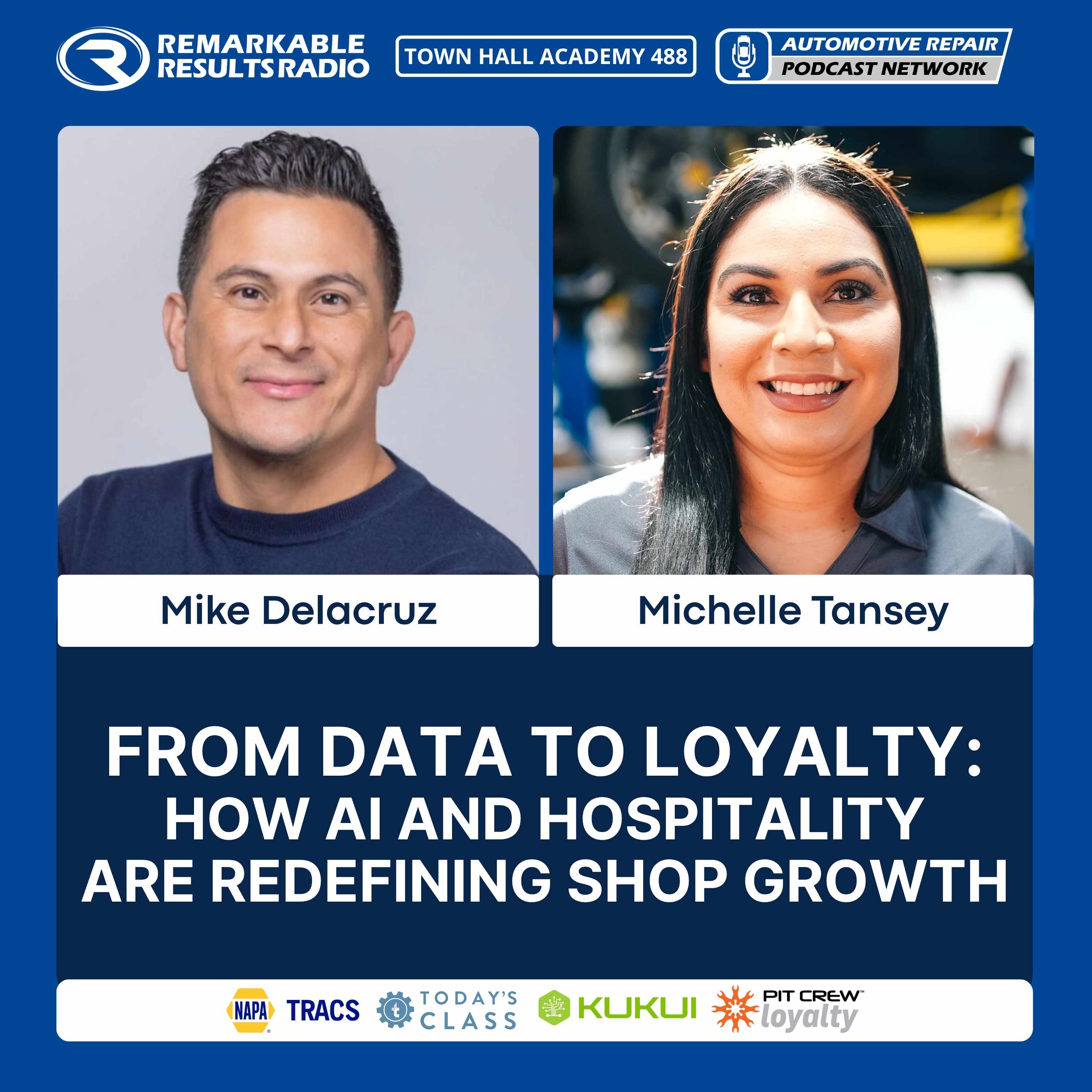
In this episode of Remarkable Results Radio, host Carm Capriotto welcomes Mike DelaCruz, CEO of Overdryve Marketing, and Michelle Tansey, co-founder of Euro Clinic, for a forward-thinking discussion on how auto repair shops can use AI, data, and intentional customer experiences to build stronger businesses.
From using AI as a strategic business assistant to creating a luxury-level customer journey that rivals brands like Ritz-Carlton and Nordstrom, Mike and Michelle share practical insights on what separates average shops from elite operations. They explain how predictive marketing, operational excellence, and deeply embedded core values can transform customer retention and long-term profitability.
What You'll Learn
How AI can serve as your shop's "big brain" to improve decision-making and uncover blind spots.
How predictive marketing can forecast car count, identify customer churn, and improve campaign performance.
The concept of the "NASA Shop" and what elite automotive operations do differently.
How Euro Clinic creates unforgettable customer experiences through personalized hospitality.
The importance of building systems and processes around your shop's core values.
Why strong operations must come before marketing success.
How small communication changes can dramatically improve customer trust and confidence.
The role data plays in making better business decisions and reducing emotional guesswork.
The future belongs to shops that combine technology with humanity. AI can provide unprecedented insight into customer behavior and business performance, but lasting success still comes from exceptional service, consistent operations, and a culture built around caring for people. The shops that embrace both innovation and hospitality will be the ones that stand out, retain customers, and thrive in the years ahead.
Mike DelaCruz, CEO Overdryve Marketing
Michelle Tansey, Euro Clinic, Santa Clara, CA.
Thanks to our Partner, NAPA TRACS
NAPA TRACS will move your shop into the SMS fast lane with onsite training and six days a week of support and local representation. Find NAPA TRACS on the Web at http://napatracs.com/Thanks to our Partner, Today's Class
Optimize training with Today's Class: In just 5 minutes daily, boost knowledge retention and improve team performance. Find Today's Class on the web at https://www.todaysclass.com/Thanks to our Partner, KUKUI
Stop juggling multiple marketing tools. KUKUI’s integrated platform delivers 4x better website conversions, automated follow-up, and real-time ROI tracking. Get industry-leading customer support with KUKUI at https://www.kukui.com/Thanks to our Partner, Pit Crew Loyalty
You’re probably tired of chasing new customers who never return. We understand. Pit Crew Loyalty ends the one-and-done cycle, turning first visits into lasting, reliable revenue at https://www.pitcrewloyalty.com/Connect with the Podcast: