Hey, everyone is Jarrel Martinez. Before we get into this episode,
I wanted to let you know that you can listen to the entire season of Medal of Honor right now ad free with Pushkin Plus. Get all our incredible stories
of courage with a Pushkin Plus subscription. Sign up and
save on the Medal of Honor show page on Apple Podcasts or at pushkin dot fm, Slash Plus. Use the
code twenty five for twenty five percent off an annual subscription. Okay,
Now to the episode.
This July fourth marks the two hundred and fiftieth anniversary of America, two hundred and fifty years of rebellion and innovation, of struggle and survival of liberty and courage and sacrifice.
As many times over the past quarter millennium, our American experiment looked like it could fall apart at the seams when you look closely at those moments, though, it wasn't politicians who held us together. It was ordinary people, people
who spoke up, who protested, who fought. Regular people in
times of great strife, grabbed at the frayed fabric of this country and pulled it together. In this season of
Metal of Honor, as America celebrates its semi quinn centennial.
We're telling the stories of some of those people because bravery is in all of us, and because the same qualities that carried us through the first two hundred and fifty years, courage, honor, and loyalty, will help us endure the next two hundred and fifty. This is season three
of Medal of Honor, Stories of Courage. Thank you for listening.
The helicopter made its way up the river. The rotor
blade was humming against the sky. There was thick jungle
on both sides of the river bank, bright green against the rushing brown water. It was November twenty sixth, nineteen
sixty eight, and that river separated Cambodia from South Vietnam.
The pilot of the chopper followed its path, heading towards the sound of gunfire, towards the battle. The mission had
started with five helicopters, but three of them were already gone.
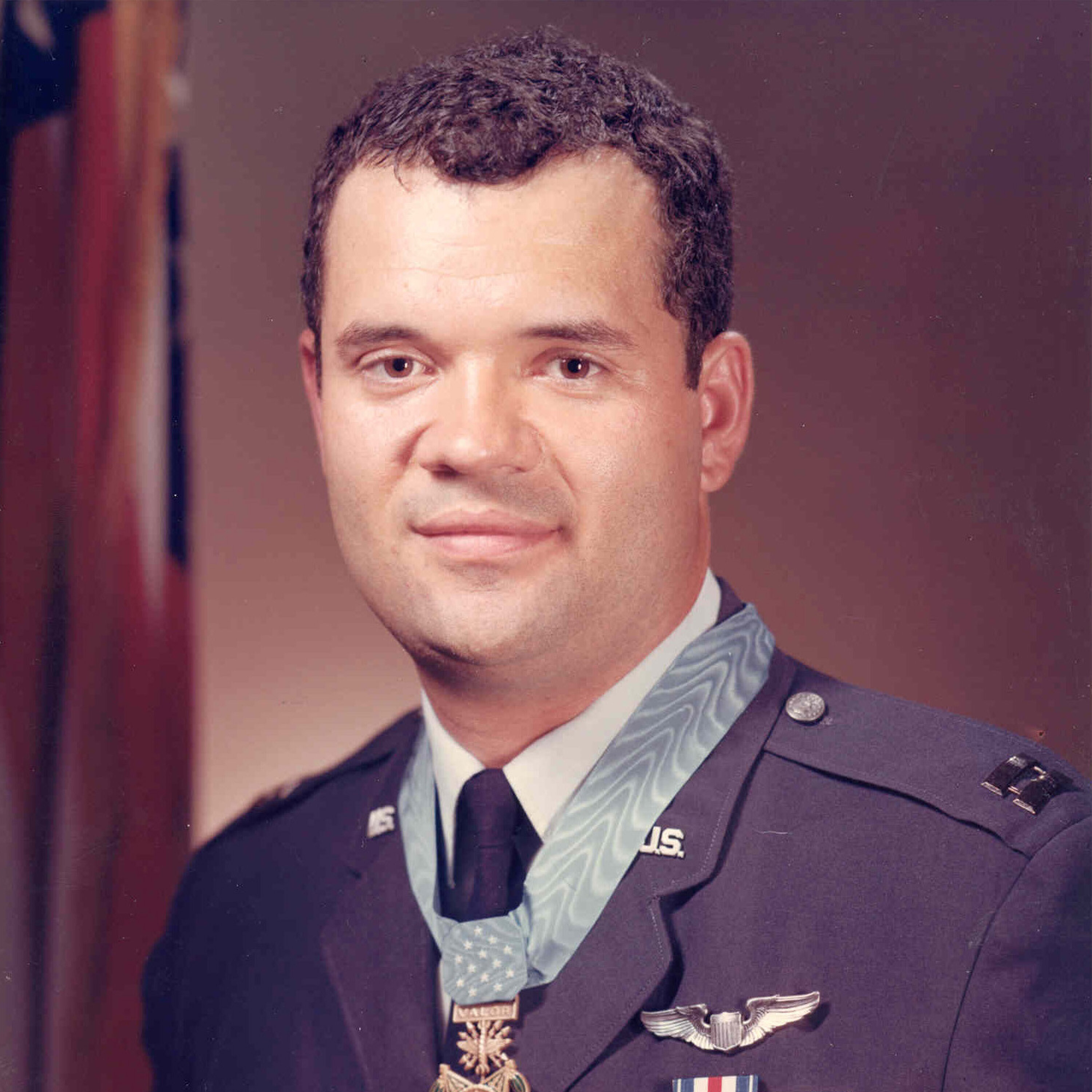
The pilot of this one was twenty five year old James Fleming. He could see a down chopper burning on
the river bank. He knew exactly how dangerous the situation was,
and as he got closer, shots started coming at him from both sides. Of the river. The noise of gunfire
crackled through the jungle. The enemy was everywhere. He was
supposed to touch down in the middle of this mess.
But even if he could get to the riverside without being shot, he knew there wasn't enough space for him to land. But Jim Fleming also knew something else. There
were seven soldiers down in that jungle who were about to be captured or killed by the North Vietnamese Army.
They had fought their way to the river bank, and Jim was their own only chance to get out of their live Jim remember what he told those same guys just a few hours earlier when he dropped them there.
He had told them he would put them in, but he would also get them out. Jim looked at his
fuel gauge and it was almost empty. He looked at
the terrain. Impossible. And then he banked his helicopter and
started in. I'm j R. Martinez and this is Medal
of Honor Stories of Courage. The Medal of Honor is
the highest military decoration in the United States. It's awarded
for gallantry and bravery and combat at the risk of life, above and beyond the call of duty. Each candidate must
be approved all the way up the chain of command, from the supervisory officer in the field to the White House.
This show is about those heroes, what they did, what it meant, and what their stories tell us about the nature of courage and sacrifice. I'm an army veteran, and
in the military we talk a lot about no man left behind, you know, the concept that troops will do anything to protect each other from harm. But the guy
you'll meet in this episode, Jim Fleming, doesn't just see that as a concept. He sees it as a responsibility,
something we owe each other. It's something he feels deep
in his bones, the importance of staying true to your word, being there, showing up. And that's why this story really
stuck with me. It makes me think about the way
we show up in our own lives, because for Jim, that responsibility isn't a burden, it's an honor, the kind of honor that would lead him straight into a death trap.
When Jim Fleming tells the of his life, he begins with the moment he was left behind.
I was born in Saday, in Missouri on the twelfth of March nineteen forty three. We were abandoned by my
father right after my brother was born. He was born
in forty four and she was a single mother working in a town and country combat boot shoe factory in Saday in Missouri.
Jim's mom met John Fleming, an Air Force pilot stationed nearby.
They started dating, and before John left that base for California, he asked her to marry him.
They got married in Las Vegas. He came back and
took my brother and myself and her to California.
John Fleming taught Jim two things. First, what it means
to have a dad, an all in fully committed father. Second,
he taught Jim how to love the Air Force. John
was a career pilot. He served during World War two, Korea,
and even the early years of Vietnam.
My father was the driving force behind everything I did.
He was my hero. I really looked up to him.
I didn't want to work for a living, and I always wanted to be a pilot in the Air Force.
I never wanted to be anything else.
Halfway through his pilot training, Jim volunteered to go to Vietnam.
By that time, the war had been going on for more than a decade. Jim was married. He had two
little girls at home, but he couldn't wait to get into combat and serve his country.
I was terribly excited to go. If you talk to
my wife, she'll probably tell you that I was apprehensive that it would be over by the time.
I got there. I wanted to go and.
Fly in war, but Vietnam wasn't exactly what he'd imagined.
Jim remembers how it felt when he arrived in nineteen sixty eight.
As we get off, the flares are going off around.
You can see artillery going off over here, and it was just no question in your mind.
You're somewhere you've never been before.
We probably got there midnight and got in our barracks probably four in the morning or whatever, to get a couple hours of sleep. And I remember turning over and
a tear comes out of my eye and down my nose, and I said to myself, damn, only three hundred and sixty four more of these.
To go where I got.
You already knew I didn't like it there.
Jim did three days of jungle survival training, you know, just in case the chopper went down. It scared the
hell out of him.
I didn't like that at all.
It taught me I did not want to go down and have to walk home.
But dropping people into the jungle was what Jim was in Vietnam to do. Okay, here's the deal. The North
Vietnamese Army n VA for sure needed to supply their forces fighting in South Vietnam, so they built a supply line through two neutral countries, Laos and Cambodia. The Americans
called it the Hochi Mantrail. The US wanted to stop
that flow as supplies, but they couldn't officially be in either of those countries, so they secretly sent in small teams of Green Berets. They were the Studies and Observations
Group or sg for short. It was totally covert ops.
Those SOG teams were inserted by Air Force pilots from the twentieth Special Operation Squadron, otherwise known as the Green Hornets.
They flew UH one helicopters. In the military, we call
them Huey's. You know this kind of helicopter. You've seen
it in every single movie about Vietnam. Jim was one
of those Green Hornets, and on the morning of November twenty sixth, nineteen sixty eight, he got ready for a drop.
The first mission of the day was to insert a seven man special team, three Americans and four mercenaries.
Those mercenaries were referred to as Montignards. They were members
of a try from the highlands of Vietnam. Montaignards were
a key part of any SAG team because they were not only seasoned soldiers but also expert local guides and translators.
So this SAG team was going to be dropped right at the border of Cambodia and Vietnam. Their target was
the time Laysan River. They suspected it was a route
for the NVA. SAG had already tried to get there
twice before, but each attempt had ended in a scramble to pull the team out under heavy weapons fire from the enemy. But they needed the intel, so back they went.
The team would be taken to their mission by a convoy of five helicopters, two gunships, and three slicks. Jim
flew a slick, which was essentially a bus.
Take the guns out, take the pockets off, open up the cab and it's completely empty.
You carry troops. It was a slick.
A slick's only job was to bring guys in or pick them up. Each slick had a pilot, a co pilot,
and two gunners, one at each door. The convoy always
traveled as a unit. It was safer that way. Plus
there was a Ford Air controller plane, what the guys called a fact. The choppers didn't have much navigation, so
the fact had to lead them in and out. The
saw guys and the green hornets gathered on the runway the way they did before every mission.
Before you took off, you would brief and you would shake hands and hug the team members and the crew members.
Not a lot talking going on. And what's going on
here is what you see in football when men stand around hold hands. These big guys hold hands. There's a
bonding going on there. What you're doing, you're saying, I'm
gonna take you and I'm gonna put you out in the middle of hell. If you have to come home,
I'll bring you home. That's my duty, it's my honor.
I will do that for you. It seems simple enough
to Jim. You make a promise and you keep it.
But this was Jim's second day as an aircraft commander.
He was a lieutenant way younger than the other pilots less season. He didn't know that. It wasn't going to
be so easy.
The fact left first, then the Hueyes, they headed towards the drop location. When they got close, the choppers split up.
To evade detection.
You'd send five helicopters and one of them peels off, and then another one peels off, and if anyone's watching or listening, they don't know who lands.
So we did that and I put the team in.
After the SAW group was on the ground, the Green Hornets met up at a refueling stop. They kicked back
and waited to hear how the mission was going.
We're sitting around listening to rock and roll from Armed Forces radio and eating sea rations and smoking cigars, and you know, sett an alert out in the middle of this miserable little place.
After Jim dropped them, the seven members of the SOG team moved into the jungle. The trees were so tall
and so dense that the canopy totally covered them, and that was dangerous too. Those trees were filled with monkeys
ready to scream and tip off the enemy to their location.
The men would have made their way towards the river, setting up a perimeter of Claymore mines for safety, but then out of nowhere, a huge enemy force was on them.
Suddenly the jungle was blazing with gunfire, monkeys screaming, bullets zipping past the trees. The SOG team knew how outnumbered
they were. They had to get out now.
The radio operator with them keeed the mic and said, tango five one contact, need extraction. As soon as that happens,
we get it. We're on our way.
The pilots scrambled to their choppers and took to the air for the SOG team on the ground of Vietnam.
The situation had gone from bad to really really bad.
Jim Fleming and the rest of the Green Hornets were getting updates from them over the radio. The NVA had
the SOG team on the run.
Now they're after them, and they chased them all the way to a riverbank, this large river which is the border between Cambodia and Vietnam. And they can't get across
the river it's two wide. So there now, with their
backs to the river, set up a defensive position, put Claymore minds out and fighting off these people that are starting to come in on them.
The Ford air controller got to the area first, but he couldn't find the men. The jungle canopy was just
too dense.
The fact has identified where he thinks they are because they're moving. He knows they're on the river, but exactly
where he can't really tell.
Then came to helicopters, two gun ships, and three slicks.
The first guy is to get there are the gunships?
What a gunships like to do more than they like to do anything else, rock and roll.
They were blazing gunfire and rockets towards the enemy, which was both helpful and not because he created a totally new problem. Before the soal team had just been facing
the men in front of them, the ones who had chased them to the river. But after a few gunship
passes and even larger group of enemies knew they were there, they suddenly began taking fire from across the river. It
was coming from six enemy machine guns hidden over there.
They had nowhere to hide. The gunships knocked out two
of the machine gun positions, but then.
They hit the first gunship. He starts trailing blue smoke
and he yells, I'm hit, I'm hit.
I'm going down.
He turns back, goes across the river and crash lands.
One of the slicks spiraled down and landed next to the gunship. Their job was to rescue that crew and
take them to safety immediately.
They go home. They can't help anybody, so they're going home.
Only three of the five helicopters were left. Everyone on
the ground, the enemy and the special forces men had seen the crash, and they watched as yet another Slick flew off engine trouble, low fuel, So now just two helicopters left.
The second gunship, Leonard Gonzalez goes across the team and takes battle damage and starts trailing blue smoke.
So whaile this is going going on?
The Ford air controller is talking to me and he said, damn, what are we going to do? I said, well, I'll
tell you what. This is really a lot of chaos.
I bet you I can get in there and get him.
I'm the only one here. Get me low way out,
throw me in there. I bet you I can sneak
in there and get him.
Jim knew what kind of danger was waiting for him on the ground, but he and his crew of three other guys were in total agreement they had to try, so.
He puts me low way out to go down the river and come back around. So I hit that river
bank and my right door gunner starts shooting. He says,
go right, go right, and I'm starting to go down the river looking for him, and going right, going right, sort of backing up, actually going.
Down the river.
The chopper was skimming over the water, flying through the bullets.
His door gunners and co pilot returned fire and search for the team. The SOG teams saw Jim's chopper come in,
but as they started to move towards it, the woodline in front of them erupted with gunfire. There was no
way for the men to make it to Jim.
The radio operator says, get out, get out. They got us,
get out. Jim got out as fast as he could.
He moved up and away his safety. But here's the thing.
Jim had made the man on the ground a promise, a promise to come back. Remember no man left behind.
And now he and the rest of his crew had to decide if that was a promise they could keep.
Daylight was fading and down on the ground. The gunfire
was so thick you could practically walk on it. Jim
was desperately low on fuel and Ammo. The last remaining
gunship with Gonzalez was still trailing smoke. Jim called out
to him.
He says, we've got some damn. He says, I got
to take this home or we're going to live out here.
We're going to live out here in the jungle. Remember this,
this is Jim's worst nightmare. But his mind flashed back
to the men on the ground. They had to get
them out before dark, if they were going to get them out at all.
I put the nose down, go down the river, and as I come up and I look over, there are people everywhere. The enemy is now focused in where they are.
They found him because they saw me. So the enemy
is starting to go in and I tell the fact, bring me in one more time. I know where they
are now, bring me in one more time. As I
say that, Leonard Gonzalez says, you going back in and said I'm gonna try it one more time. He said,
I'll tell you what he says, follow me. I'll go
over one more time. I'll give him everything I got,
and I gotta go home.
Gonzalez hit the enemy with the final blazing pass.
He goes over him and he rock and rolls, he shoots all his rockets. They give him everything they got
and he says, see at home, Jim, and he takes off.
Jim's chopper was the only one left. He started back
down the river. One of his two gunners, Fred Cook,
was hanging out the door scanning for the team on the ground.
And as we get further down, we're starting to take some pretty good damage and Fred is shooting and yelling and.
Go right, go right, stop stop. I got him.
They had made it down to the river bank and they were half in the water in the reeds, the sort of underbrush and the blades had blown those reeds, and we found them.
Jim knew there was nowhere big enough for him to land, but if he hovered just above the water with his landing skids against the river bank, the team might be able to make it to the chopper. It would be
a balancing act that required some truly insane piloting skills, and it would only work if, by some miracle, his helicopter wasn't hit and disabled altogether. Jim hovered the UH
one against the river bank, his tail boom hanging just above the water, and he waited for the saw team they spotted it and race forward, but as they did, two NVA burst out of the reeds and opened fire.
The men shot back, and they kept on running.
So I'm hovering over the water as close as I can get to the bank and Fred Cook, God bless him.
I hear him go hold your hover, hold your hover.
I got one. And what he's doing is he's leaning
down and grabbing these guys and jerking them, scrambling them in.
The chopper was taking fire from all sides now, but Jim just kept hanging in there as calmly as a mom in the school pickup line. Bullets snapped through the windshield.
They had four men on the chopper, then five, then six.
And I'm looking around and I see people darting up and just sort of jumping up and down, up and down and shooting. And there are seven of them out there.
We only got six. Now I'm thinking, gosh, maybe they
got one of them. I've got enough.
He had enough men, but he didn't have all of them.
And for Jim, was six really enough. The bullets were
getting closer. Now he knew there were seconds, not minutes
away from all of them going up in flames.
We got to get out of here. Sooner or later,
they're gonna get us. Brown's going to hit the me
or is going to hit the engine.
Where was the seventh guy? Jim knew who he was,
Randy Harrison, the commanding officer of this group of Green Berets.
He had volunteered to go on this mission. Jim wanted
to wait for him, but he knew he was pushing his luck too far. He looked over his shoulder one
last time.
And as I look over, Randy Harrison jumps up. He's
a fair haired guy, and he's all painted up, and he's got a bandana on because he wore a bandana over his light hair. I see him jump up, and
he looks at me, and I look at him. He
was the last man, and he waited till everybody was aboard.
He gave him a last burst of his automatic weapon, threw it down, and took off to the helicopter. Randy
took about four steps and jumped in the water, sort of a flying jump in the water, trying to hit the helicopter. Missed and took about one stroke in the
water and got his arm over the skid. And Fred
Cook reaches down and grabs him by the rooksack and yells let's go, and we drug him through the water and off we went.
All of the men were on board, The fuel tanks were pretty much empty. The windshield was shattered. Jim hadn't
even noticed it until he felt the air rushing in as the chopper flew away. Not a single man had
been wounded, and not a single man was left behind.
After Jim Fleming's daring rescue, he stayed on in Vietnam, taking care of his men, bringing them to danger and bringing them home. He was wounded in January of nineteen
sixty nine and spent a few months in the hospital in Japan. Then he got picked up by a helicopter,
of course, to head back to Vietnam. The pilot was
a friend of his.
He said, well, Jim, you're going home. I said, yeah,
I got another three or four months of this left.
He said no, he says you're going home tomorrow. I said,
I'm going home tomorrow.
Why.
He says, the President is nominated here for the Medal of Honor. And I said, yeah, great, because we used
to joke, you know, how can you get.
Out of here? Well, you can be nominated for the
Medal of Honor. You have to go home.
I said, yeah, okay, right, right right. He said no,
I'm not kidding. He says, you're going home. I'm saying, okay.
This is a good one.
It was a good one because it was true. James
Fleming was awarded the Medal of Honor on May fourteenth, nineteen seventy, by President Nixon at the White House.
As we think of the beginning of this country one hundred and ninety years ago, we think of it as the land of the free. We should all be reminded
that it could not be the land of the free if it were not also the home of the brave.
And today we honor the brave men, the men who far beyond the call of duty, serve their country magnificently in a war very far away, in a war which is many times not understood and not supported by some in this country.
The ceremony took place just ten days after the massacre at Kent State University, when members of the Ohio National Guard shot into a crowd of unarmed students. The students
who were protesting the expansion of the war into Cambodia.
Nine students were wounded, four of them were killed, and in response there were angry protests everywhere.
Washington, d c. Is a battleground. We had escorts everywhere
we went.
The tide was really turning against the war in Vietnam, but it would take another five years for it to end.
Jim believes that in all those years, many men did exactly what he had done.
How many helicopter pilots are in Vietnam thousands? How many
helicopter pilots did what I did and got shot down and died no one saw it? Hundreds? I know that.
While Jim did a return to Vietnam, he stayed on in the Air Force. He became a colonel and taught
at the Officer Training School at Lachlan Air Force Base in Texas. He finally retired in nineteen ninety six. By then,
his decorations included the Silver Star, the Distinguished Flying Cross, and eight Air medals. To me, what's cool about Jim's
story isn't just the fireworks, you know, the adrenaline of battle.
After all, he wasn't rocking and rolling in the gunship.
He didn't even shoot a gun. He flew a bus.
But I think that bus was more powerful than any gun.
Could be because it was a symbol of his rock solid reliability. That's what Jim is all about, and he
feels like that devotion to helping one another is deep in our DNA.
I never picked up an American in combat that did not when he got to the helicopter turn around and put his hand out to the next guy. Never they automatically,
no matter how bad things were going. When he hit
that helicopter, that American turned around and looked for the next guy to help him, made sure everybody was there.
That's who we are, That's who we are.
Jim left no man behind.
That was my duty, my honor.
My job was to take these soldiers into enemy territory, to drop them off, to let them do their mission, and go back and bring them home.
All of us understand the importance of showing up, of keeping our word, but I think some people feel that more deeply, like Jim. Maybe it was because his dad,
John Fleming, was there for him, showed him the power of keeping a promise. Jim kept his promise to those
seven men in that jungle, and by doing that, he gave them the chance to show up for the people in their lives, just as Randy Harrison, remember him, the last man on the helicopter, the fair hair guy in the bandana. Here he is speaking at an event at
the Air Force Museum in two thousand six sixteen.
There is an ancient American spiritual, the words to which sorry, all right. I looked over Jordan, and what did I
see coming forward to carrying me home? It was a
band of angels coming after me, coming ford to carry me home. Swing low, sweet chariot, swing low, coming for
to carrying me home. It would be incredibly presumptuous of
me to assume that twice in my life a band of angels and a sweet chariot will swing low to carry me home. But I'll tell you what, if it
happens again, I'm going to know it before I see it, because I've heard the sound of angels wings before. They
sound like a uh one ten feet off the deck, coming in at full speed to carry me home, home to a completed college education, home to great work, home to wonderful friends, home to marriage, and home to children, two sons that I would never have known were it not for the Green Hornets on that day in that terrible,
terrible place.
Medal of Honor Stories of Courage as written by Meredith Rollins and produced by Meredith Rollins and Ryan Swiker. Our
editor is Lydia gan Kott, Sound design by Jake Gorsky, Our executive producer is Gonstanza Gayado. Fact checking by Arthur Gomberts,
and original music by Eric Phillips. Special thanks to the
series creator Dan McGinn, the Congressional Medal of Honor Society, and the National Museum of the Air Force. If you
want to learn more about this story, take a look at our show notes, or we have some of the resources we use to put this episode together. We also
want to hear from you. Send us your personal story
of courage or highlight someone else's bravery. Email us at
Medal of Honor at Pushkin dot fm. You might hear
your stories on future episodes of Metal of Honor, or see them on our social channels at Pushkin Pods. I'm
your host JR. Martinez might have had spen
Original notes
In 1968, in the dense jungles of Vietnam, a team of Green Berets was pinned down by an overwhelming North Vietnamese Army force. Their last hope was a young Air Force pilot named James Fleming. Despite being low on fuel and facing a wall of enemy fire, Fleming refused to turn back. The rescue mission seemed destined to fail, but a split-second decision would earn Fleming the nation’s highest military honor.
Binge the full season of Medal of Honor, ad-free, with a Pushkin+ subscriptions. Sign up on the Medal of Honor show page in Apple or at Pushkin.fm/plus and use the code MOH25 for 25% off an annual subscription.