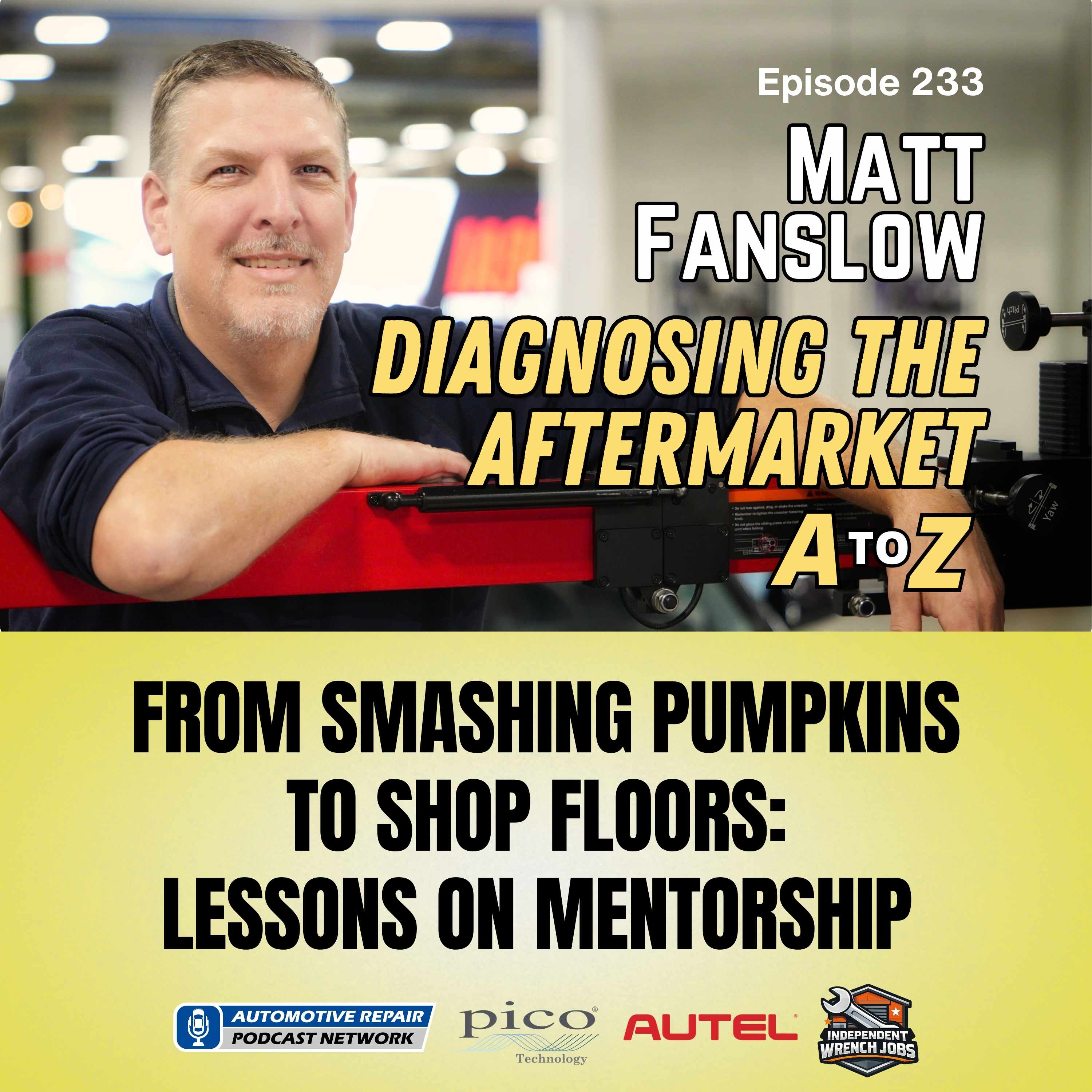
From Smashing Pumpkins to Shop Floors: Lessons on Mentorship [E233]
About this episode
The host connects music stories to real-world mentorship lessons, arguing that guidance must come from both mentor and mentee. He uses Billy Corgan’s Smashing Pumpkins contract situation and Ryan Leaf’s rookie-to-washout path (no one advising him on money and priorities) to show how missing mentorship can create long-term damage. Charles Barkley’s early financial and training talks from Dr. J and Moses Malone illustrate the opposite: timely coaching can protect careers. He then pivots to auto repair, urging shop owners to reduce tool-debt pressure, provide training, and point new techs to free education resources.
Thanks to our Partners, Pico Technology, Autel, and Independent Wrench Jobs
In this episode, Matt Fanslow starts in an unexpected place, music, vocal styles, and Smashing Pumpkins, before using a series of stories from the music and sports worlds to make a bigger point about mentorship. The central idea is simple but important: mentorship has to come from both directions. Experienced people need to step in and offer guidance, and younger people need to be willing to ask questions and listen.
Using examples involving Billy Corgan, Ryan Leaf, and Charles Barkley, Matt explores how young people often make costly decisions not because they are reckless or foolish, but because nobody pulled them aside and explained the long-term consequences. From contracts and money management to discipline and preparation, the lesson is that hindsight may be 20/20, but it is far better to learn from someone else’s mistakes before they become your own.
Matt then brings the conversation back to the automotive repair world, where the same pattern shows up all the time. New people entering the field are often hit with student debt, pressure to buy expensive toolboxes and tools, and unrealistic expectations about how easy the work should feel. Rather than watching them stumble into avoidable financial mistakes, seasoned professionals, shop owners, and managers should step in, offer guidance, and help reduce unnecessary burdens. Whether it is tools, training, or simply helping someone think more clearly about their next step, good mentoring can change the trajectory of a career.
In this episode:
- Why mentorship matters more than most people realize
- The Billy Corgan / Smashing Pumpkins story and the cost of not having guidance
- Ryan Leaf, Peyton Manning, and how early choices can shape an entire career
- Charles Barkley, Dr. J, and Moses Malone as an example of mentorship done right
- The direct parallel between pro sports, music, and the automotive industry
- Why young specialists can get buried in debt before they ever gain traction
- The problem with pushing new people toward expensive tool truck purchases
- How shops can better support newer hires with tools, training, and realistic expectations
- Why learning from someone else’s mistakes is often better than learning from your own
- Valuable training and learning resources for developing specialists
Key Takeaway:
If the industry wants more capable, successful technical and mechanical specialists, it cannot just complain about shortages and washout rates. It has to do a better job of mentoring, advising, and protecting newer people from avoidable mistakes.
Resources Mentioned:
- Scanner Danner Premium
- Autel training videos and user-created content
- Pico Technology training videos and user-created content
- AESwave resources
- Diagnostic Network
- Facebook groups with strong technical communities
Thanks to our Partner, Pico Technology
Are you chasing elusive automotive problems? Pico Technology empowers you to see what's really happening. Their PicoScope oscilloscopes transform your diagnostic capabilities. Visit PicoAuto.com
Thanks to our Partner, Autel
From drivability diagnostics and TPMS service to ADAS and advanced safety systems, Autel helps technicians follow OEM procedures and repair with confidence. Learn more at Autel.com
Thanks to our Partner, Independent Wrench Jobs
Independent Wrench Jobs is a new, tech-only community to help you find better independent shops—fair dispatch, steady work, real leadership. No games.
Built by Technician Find—serving the industry since 2017. Join free at IndependentWrenchJobs.com
Contact Information
The Automotive Repair Podcast Network: https://automotiverepairpodcastnetwork.com/
Remarkable Results Radio Podcast with Carm Capriotto: Advancing the Aftermarket by Facilitating Wisdom Through Story Telling and Open Discussion. https://remarkableresults.biz/
Business by the Numbers with Hunt Demarest: Understand the Numbers of Your Business with CPA Hunt Demarest. https://huntdemarest.captivate.fm/
The Auto Repair Marketing Podcast with Kim and Brian Walker: Marketing Experts Brian & Kim Walker Work with Shop Owners to Take it to the Next Level. https://autorepairmarketing.captivate.fm/
The Weekly Blitz with Chris Cotton: Weekly Inspiration with Business Coach Chris Cotton from AutoFix - Auto Shop Coaching. https://chriscotton.captivate.fm/
Speak Up! Effective Communication with Craig O'Neill: Develop Interpersonal and Professional Communication Skills when Speaking to Audiences of Any Size. https://craigoneill.captivate.fm/
mentorship (both ends)
"We hear a lot about it. I think I'm going to try to bring up an argument that it's got to come from both ends, both sides, both perspectives."
Mentorship isn’t just one person teaching another. Even experienced people should keep learning from others, because there’s always something new to pick up.
The hosts frame mentorship as a two-way relationship: you mentor others while also remaining a mentee. In practice, that means you keep learning from people with different experience and perspectives, not just from formal training.
repercussions of a decision
"no one pulled him aside to explain the repercussions of a decision he was about to make. And as a young, broke person, he was ill equipped to make the quote unquote right decision."
Sometimes a choice you make now can cause problems later. If you don’t get advice or context first, you might not realize how big the impact will be.
This segment uses the idea of “repercussions” to describe how one decision can create long-lasting consequences. The hosts connect it to a lack of guidance—when someone doesn’t get context before acting, the outcome can be harder to manage later.
electric vehicle revolution
"Is your shop ready for the electric vehicle revolution? Don't get left behind. The PicoScope EV kit is your all-in-one solution."
“Electric vehicle revolution” refers to the industry shift toward EVs and the resulting need for new diagnostic skills and equipment. EVs add high-voltage battery systems and different electronic control/communication networks compared with most gasoline cars.
PicoScope EV kit
"Is your shop ready for the electric vehicle revolution? Don't get left behind. The PicoScope EV kit is your all-in-one solution. Diagnose any electric or hybrid vehicle from high voltage batteries to complex communication systems."
A PicoScope EV kit is a set of tools that helps mechanics diagnose electric and hybrid cars. It’s meant to safely and accurately check the car’s high-voltage and electronic systems so you can find problems faster.
The PicoScope EV kit is a specialized diagnostic tool package aimed at electric and hybrid vehicles. It’s designed to help technicians test high-voltage systems and related electronics with guided procedures and accurate measurements.
high voltage batteries
"The PicoScope EV kit is your all-in-one solution. Diagnose any electric or hybrid vehicle from high voltage batteries to complex communication systems."
High-voltage batteries are the big battery packs in EVs that power the car. If something goes wrong, it can cause the car to act up or not charge, so technicians need the right way to test them safely.
High-voltage batteries are the main energy storage for EVs and plug-in hybrids, typically supplying power to the electric drive system. Diagnosing them often involves safety procedures and specialized test methods because faults can affect performance and safety.
hybrid vehicle
"Diagnose any electric or hybrid vehicle from high voltage batteries to complex communication systems."
A hybrid car uses both gas and electricity to move. Because it has two power systems, diagnosing problems can be trickier than on a regular gas-only car.
A hybrid vehicle uses more than one power source—usually a gasoline engine plus an electric motor and battery. Diagnostics can be more complex because faults may involve either the engine side, the electric drive side, or how the systems communicate.
communication systems
"Diagnose any electric or hybrid vehicle from high voltage batteries to complex communication systems. With guided tests and pinpoint accuracy, you'll tackle more jobs and boost your bottom line."
Communication systems are how the car’s computers talk to each other. If that “conversation” is disrupted, the car can show warning lights or behave strangely even if the main components aren’t obviously broken.
In EVs and hybrids, communication systems refer to the networks that let modules (battery management, motor control, sensors, etc.) share data. Many drivability and safety issues come down to network faults, sensor inputs, or control-module logic rather than a single “broken part.”
Autel
"This episode of diagnosing the aftermarket A to Z is brought to you by Autel. Autel is a global developer and manufacturer of award-winning"
Autel is a company that makes diagnostic tools for car repair shops. They sponsor this episode, which is about diagnosing and fixing cars more effectively.
Autel is an automotive diagnostics and tooling company, commonly known for scan tools and diagnostic equipment used by shops and technicians. In this segment, Autel is presented as the episode sponsor tied to the theme of better diagnostics.
diagnostics at their core
"With diagnostics at their core, Autel's real-world solutions support repair workflows ranging from full system vehicle diagnostics to servicing the most advanced automotive technologies."
Instead of guessing what’s wrong, diagnostics means using tools and tests to find the real cause. That helps avoid unnecessary parts and speeds up the repair.
“Diagnostics at their core” describes a repair approach that starts by identifying the fault with scan data and test procedures rather than guessing. This is especially important for modern vehicles with many electronic systems where symptoms can be caused by multiple modules.
TPMS systems
"Whether diagnosing complex drivability concerns, servicing TPMS systems, validating repairs, or working with ADOS and advanced safety technologies, Autel tools are engineered to support accurate, efficient repairs..."
TPMS is the system that watches your tire pressure. When you get new tires or a sensor is replaced, the car may need to be told the new sensor information.
TPMS (Tire Pressure Monitoring System) uses sensors to monitor tire pressure and alerts the driver when pressure is low or a sensor needs attention. Service often involves relearning or programming sensors after tire changes or sensor replacement.
ADOS
"...validating repairs, or working with ADOS and advanced safety technologies, Autel tools are engineered to support accurate, efficient repairs..."
ADOS sounds like a special diagnostic or setup process used for newer safety features. The exact meaning depends on the system being worked on, but it’s typically related to getting safety sensors working correctly after service.
ADOS is referenced as part of “advanced safety technologies,” implying a diagnostic or calibration workflow used for modern driver-assistance systems. Because the acronym isn’t expanded in the excerpt, listeners may benefit from clarifying what ADOS stands for in the context of the specific tool or OEM procedure.
Independent Wrench Shops
"...Ever feel like you've got to play politics just to get fed? One guy gets the gravy, you get the garbage, and then the ad says, great culture. Independent Wrench Shops is a new tech-only community to help you find better independent shops, fair dispatch, steady work, real leadership, no games."
Independent Wrench Shops is presented as a community for independent mechanics. The goal is to help shops get steadier work and better pay without the politics.
Independent Wrench Shops is described as a “tech-only community” meant to help independent repair shops find better work and fairer dispatch. The segment frames it as a solution to industry friction around pay and leadership.
Autotech Resume Pro
"And if you're applying now, use Autotech Resume Pro to generate a resume and shop specific cover letter in about two minutes."
This is a website/app that helps you quickly generate a resume and cover letter. The point they’re making is to use something tailored to shop/technician jobs so you don’t waste time.
Autotech Resume Pro is a resume tool marketed to technicians and shop job seekers. In this segment, it’s used as an example of using a targeted service to improve your chances before wasting time on interviews.
Technician Find
"Built by Technician Find, serving the industry since 2017."
They’re saying the resume tool was made by a company that works with technician job seekers. It’s basically presented as “built by the industry.”
Technician Find is mentioned as the builder of Autotech Resume Pro. The segment frames it as a service created by people in the technician job space.
independentwrenchjobs.com
"Built by Technician Find, serving the industry since 2017. Join free at independentwrenchjobs.com."
That’s the website they point you to if you want to sign up. It’s part of the tool they just recommended for job applications.
independentwrenchjobs.com is provided as the place to join for free. It’s included as part of the call-to-action for the job-search service mentioned earlier.
rookie contract
"He signs the rookie contract, right? It's more money than he's ever dreamt of."
A rookie contract is the first big agreement someone signs when they start their pro career. The point here is that getting paid doesn’t automatically come with the right advice or mentorship.
A rookie contract is the initial professional deal a player signs when they enter the league. In this context, it’s used as an analogy for sudden access to money and resources without guidance.
tool truck
"correlation between those stories I just said, and our world of auto repair, and that's the tool truck. Those new boxes, they get credit."
A “tool truck” is when tool sellers drive around and sell tools directly to mechanics and shops. They may offer payment plans and promises like warranties, even if the tools haven’t been used yet.
A “tool truck” is a mobile sales route where tool brands and dealers bring equipment directly to auto repair shops and technicians. The pitch often emphasizes financing, warranties, and the idea that buying tools is part of becoming employable or productive.
tool financing / lifetime warranty pitch
"Oh, it's only going to be a, you know, this much a week, this much a month, you can have this big beautiful toolbox, all these tools, lifetime warranty, they haven't done anything yet."
They’re describing a sales pitch where you can pay over time for tools and get a warranty. The critique is that people may end up buying expensive tool sets before they’re really established.
The segment critiques the common “buy now” sales pitch from tool dealers: credit terms, weekly/monthly payments, and lifetime warranty claims. The underlying idea is that shops may be pushed to equip workers before they’re ready, increasing financial stress.
student debt
"But the fact that there's a lot of these kids coming out of school, they have their student debt, and then they get into debt with the tool dealers."
They’re saying that when people graduate with student loans, they can be pressured into taking on more debt for tools. That can make it harder to get started in the trade.
The speaker connects student debt to how new technicians get financially pressured into buying tools through dealerships. In practice, this can create a cycle where early-career workers take on additional debt before they’re fully established.
mentoring
"What do you need to do your job? We'll help you out. Because what if they don't make it? Because we're pretty bad at what? Mentoring beyond that and development."
They’re talking about mentoring as more than just giving someone a job. It means helping them learn and grow so they can actually do the work well.
Here, mentoring is framed as the management responsibility to help new technicians succeed beyond just hiring them. The speaker implies that training and ongoing development are often where shops can improve, especially when financial pressure and turnover are issues.
deferred maintenance
"Some of those break jobs, they are gravy. Maintenance jobs, maintenance services, that's gravy. It's easy."
Deferred maintenance means you delay fixing small problems. Over time, those small issues can turn into bigger repairs that cost more and take longer.
“Gravy” maintenance jobs are contrasted with harder diagnostic/repair work, which often happens when problems aren’t addressed early. Deferred maintenance is when small issues get postponed until they become bigger, more expensive problems.
diagnostic time pressure
"But for people coming right out of school with minimal experience... And oh, now there's a time limit, like there's a clock ticking... keeps asking me like how much longer?"
They’re talking about how there’s pressure to finish fast. When you’re rushed, it’s easier to miss something during troubleshooting.
The segment describes a “clock ticking” environment where newer techs feel pressured to finish quickly. In automotive work, time pressure can lead to rushed diagnostics, missed steps, and repeat visits.
direct correlation between income and expenses
"I mean, it's a direct correlation. This money you're getting... has got to pay your bills at home. You don't need to take on more debt."
The hosts connect shop pay to personal financial planning, emphasizing that earnings should cover bills and avoid taking on more debt. While not a car-specific term, it’s a mentorship/business concept relevant to how shops operate and how techs manage their finances.
title insurance
"Maybe you can avoid the title insurance. Save major bucks. Buy"
Title insurance is something you buy when you purchase a property to protect against problems with the legal ownership records. It’s mentioned here as part of saving money for a home purchase.
The speaker mentions “title insurance” in the context of buying a house, not a vehicle. It’s a real-world ownership/closing cost concept that can matter for buyers, but it’s not an automotive repair topic.
toolbox
"If you just absolutely have to go buy a toolbox, go to Harbor Freight. Go to a lumber yard, you know? Go to Home Depot. That's what they'll tell you. If you have to buy a toolbox, that's what you just have to."
A toolbox here means the basic set of tools a mechanic needs to do the work. The point is that you don’t always need to buy everything from expensive tool-truck sales—sometimes you can start with the essentials and build up over time.
In an auto shop context, a “toolbox” isn’t just a place to store tools—it represents the baseline capability of a technician to diagnose, repair, and complete jobs efficiently. The discussion contrasts buying tools from a “tool truck” dealer versus sourcing basic tools from big-box retailers, emphasizing mentorship and practical shop planning.
Harbor Freight
"If you just absolutely have to go buy a toolbox, go to Harbor Freight. Go to a lumber yard, you know? Go to Home Depot."
Harbor Freight is a store that sells tools for lower prices. The hosts are saying it can be a good place to buy basic tools if you’re just starting out.
Harbor Freight is a discount tool retailer that’s often recommended for entry-level mechanics who need basic hand tools without paying premium prices. In the segment, it’s used as an alternative to higher-pressure “tool truck” dealer sales.
Home Depot
"Go to a lumber yard, you know? Go to Home Depot. That's what they'll tell you."
Home Depot is a big home-improvement store. In this context, they’re suggesting it for buying simple tools you need to get started.
Home Depot is a general home-improvement retailer that sells many basic tools and shop supplies. The segment frames it as a practical option for buying essentials rather than getting pulled into expensive tool-truck packages.
shop mentorship and tool planning
"Hey, he doesn't have any tools. He doesn't have any or she doesn't have any tools. They don't have a toolbox... Some basic tools. If you have some time, would you all sit down with me and we'll make a list of what they need? I'll pay you to do it... sitting down and figuring out the numbers."
The idea is to figure out what tools are really needed for the kind of work the shop does, rather than buying a bunch of stuff automatically. It also suggests paying people for helping plan and decide what to buy.
The segment highlights a mentorship approach: instead of assuming technicians need a full toolbox immediately, the shop leader should assess what tools are actually required for the jobs being done. It also emphasizes “figuring out the numbers” and compensating people for planning work, which can improve efficiency and reduce wasteful spending.
scan or Dan
"Why don't you spend your money with, get yourself a subscription to scan or Dan or premium. That would be a good way to spend money."
This sounds like a subscription for car diagnostic tools. The idea is you use it to read what the car is telling you (like error codes) and learn how to fix problems faster.
“Scan or Dan” appears to refer to a diagnostic scanning tool or service subscription used for troubleshooting cars. These platforms typically provide access to scan data, training, and support so you can diagnose issues more effectively.
Pico technology
"Oh, by the way, Pico technology, they do the same thing. They have some channels that they put out the content and users put out content and it isn't always just Pico."
Pico Technology makes diagnostic tools—especially oscilloscopes—that help you “see” electrical signals in a car. That can make it easier to find wiring, sensor, or control-module problems.
Pico Technology is known for automotive-focused oscilloscope hardware and software used in diagnostics and training. Their tools are often used to capture and analyze sensor and electrical waveforms during troubleshooting.
lab scopes
"The stuff applies across the board to other lab scopes. Same with Auto. The stuff applies. It's training. It's education."
A lab scope is a special tool that shows electrical signals as a graph. Mechanics use it to see what’s happening inside the car’s wiring and sensors, especially when normal scan tools don’t tell the whole story.
“Lab scopes” refers to oscilloscope tools used to view electrical waveforms in detail. In automotive diagnostics, they help verify sensor signals, ignition patterns, and communication signals when code-based troubleshooting isn’t enough.
diagnostic network
"They have a Facebook group that has tons of information on it and support stuff like that, you know, a diagnostic network. Great resources and Facebook groups."
A diagnostic network is basically a group of people who help each other troubleshoot car problems. Instead of guessing, you can compare notes and learn from what worked for other techs.
A “diagnostic network” in this context likely means a community or platform where technicians share diagnostic knowledge, scan data, and troubleshooting workflows. These networks can speed up learning and improve diagnosis by pooling real-world experience.
Request an Explanation
Heard something you'd like explained? We'll add it to this episode.
Sign in to request explanations for terms you heard.
Want to learn more?
Browse our glossary for plain-English explanations of automotive terms, jargon, and concepts.
Help improve this episode
See something that's not quite right? Our annotations are AI-generated and can sometimes miss the mark. Click the flag icon on any annotation to suggest a correction.