Paid search ads are ads that show up when you search for something online. Car dealerships pay for these ads to get more customers to see their cars and services.
The Chevrolet Trax is a small SUV that is great for city driving because it's easy to park and has a good amount of space inside for passengers and cargo. It's known for being affordable and fuel-efficient, making it a smart choice for people looking for a reliable vehicle without breaking the bank.
LIVE
This is the Automotive Repair Podcast Network.
Hey, welcome, Carm Capriotto, 10 years in Remarkable Results Radio in the Town Hall Academy
as when we do the Town Hall, it's always with me, plus two or two or three.
Love to have these, if you will, Town Hall style podcasts.
Got a couple of very interesting fellows with me today.
We're going to have one of these.
If you don't listen and you miss it, you're going to be sorry.
That's the kind of episode.
We're going to do kind of a really cool little Town Hall coffee clutch thing.
But before we get started, thank you so much to Napa Tracks,
today's class, Kukui and Pit Crew Loyalty.
Hey, let's face it, your shop management system is the most critical tool in your shop.
And Napa Tracks will move your shop into the SMS Fastlane with on-site training,
six days a week support, and local representation.
Find Napa Tracks on the web at NAPATRACS.com.
Ready to optimize with today's class?
Boy, listen to an episode we did with David Boyz.
Great program, roll out a training plan for your automotive shop.
In just five minutes daily, you boost knowledge, retention, and improved team performance.
They deliver four times better website conversions, automated follow-up,
and real-time ROI tracking.
Get industry-leading customer support with Kukui.
That's KUKUI.com.
You're probably tired of chasing new customers who never return.
We understand.
Pit Crew Loyalty ends the one and done cycle,
turning first visits into lasting reliable revenue.
On the web at pitcrewloyalty.com.
Hey, welcome back.
Here's my panel.
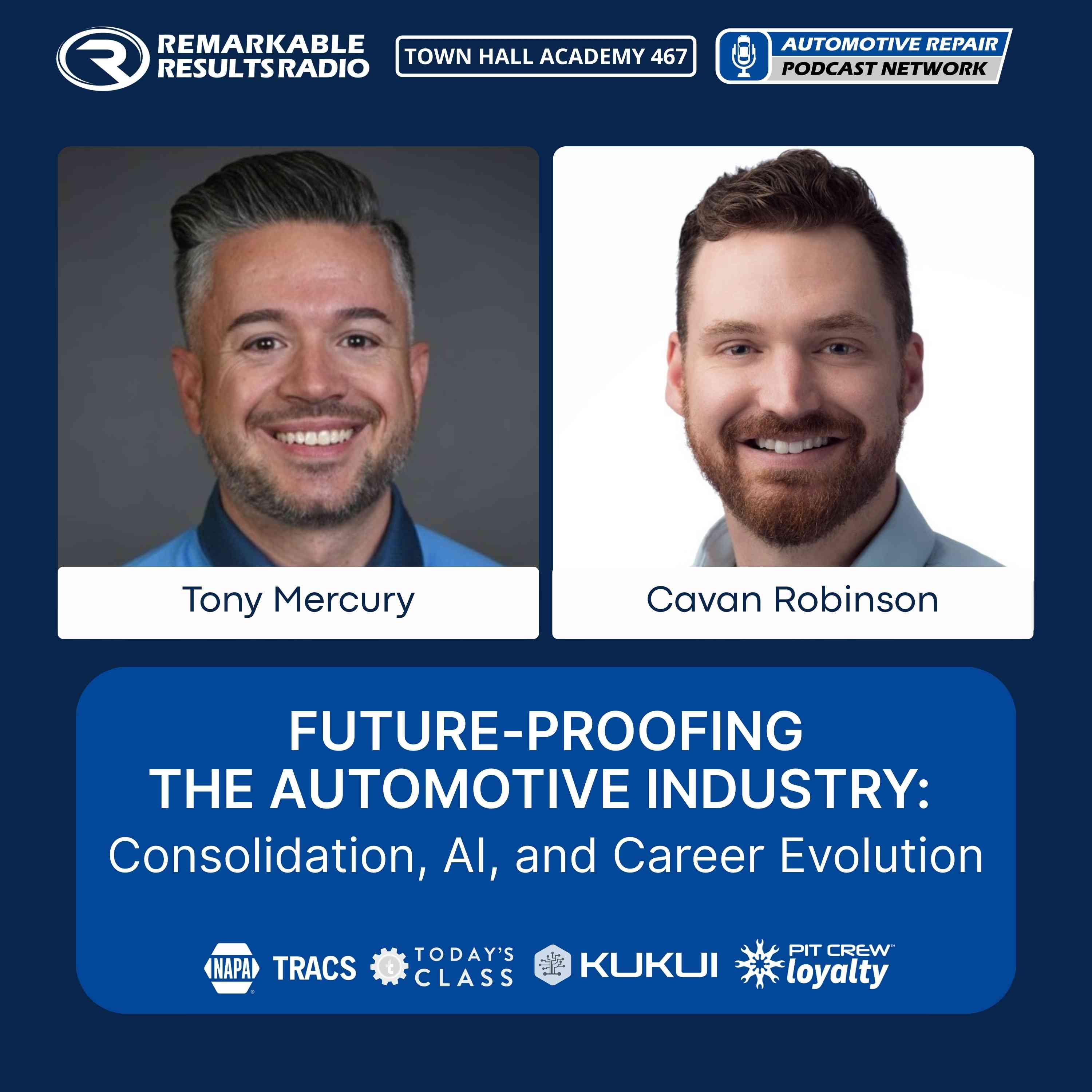
Kevin Robinson, vice president of operations for the aftermarket at Velo.
Hey, Kevin.
Hey, Karm.
Thanks for having us.
This will be a fun little chat that we're going to put together here.
I just can't imagine how big your job is.
Oh, my God, with all those brands and all those products that you have.
Do you sleep?
I get some good sleep.
Tony would relate to this.
I have a seven and four-year-old, so I don't sleep because of them.
I do sleep because of my job because I have a very good supporting cast.
I'll just say that.
Congrats on the kids and I've been there and I've done that.
Right about that same age gap.
Tony Mercury, VP of revenue for AutoShop Solutions.
Hello, Tony.
Hey, Karm.
Good to see you again.
Same here.
Hey, guys.
A lot going on inside of our industry as we near the end of the year,
and I'm not sure when this podcast will release,
if it will release in December or in January,
but however, we got to put our collective brains together as businesses.
I don't enjoy looking in the rearview mirror that much.
I don't.
But what I do love to do is I love to look forward and I love to reinvent,
and which we've done actually of late with the rebranding of the automotive repair podcast
network and the release of our own app, which we're so darn excited about.
And so I wanted Kevin and Tony to come out and just share how they see it.
Remember, Velo is part of the umbrella company.
It's AutoServe One, Protractor, Shop Boss, Tire, Guru Shop,
where 360 payments, AutoShop Solutions.
What a cadre of brands and great products.
So they can actually probably talk to us about anything going on inside the industry.
But the trends that are going on, people want to do MSOs,
they want to scale, they want to get bigger,
and then they want to get bigger so that private equity can come by and
make me an offer.
And I'm hearing that a lot.
I'm talking to so many friends in the industry guys, and I say,
have you gotten a call lately?
And they go, two last month.
It's becoming an interesting side discussion.
And I said, are you ready?
And they say, no, but I was surprised that I got the offer.
What's your take on that, Kevin?
Yeah, it's a consolidation, I would say, is kind of the theme that's taken over,
at least in the last eight months.
And I saw it in two ways.
We're fresh coming off of SEMA and having conversations there.
First is that we had really good booth traffic.
But man, it was all MSOs, enterprises, like, hey, I got five locations,
I'm going to be at 10 by the end of the year, or I have 150 locations,
and I want to be at 300 by the end of next year.
It was a lot less of the single shop owner operator that we typically see.
And that's just representative within kind of our product offerings that we have.
You had mentioned in the Velo portfolio shop boss, right?
That's kind of our single owner operator.
I'm coming off a paper.
We didn't have a lot of those prospects or those types of shops show up at SEMA this year,
like we've seen in the past.
So a lot of that plays directly into the growth and the consolidations of those single shops
getting acquired, going to process some of the smaller satellite shops that are becoming part
of these larger equity plays, essentially.
That's been one of the big ones.
And then I'm sure as you've seen, even on the software side of things,
I mean, we're probably a perfect example is like consolidation of the vendor software,
some of the mergers that have happened recently with,
I'll just throw some of the names out there, whether it's steer auto ops,
tech metrics, shop genie, parts tech, and repair link OEC.
It's happening on both sides of the aisle.
And I think it's really interesting kind of seeing where some of those
efficiencies are being gained, but also where it's pinching parts of the market.
This is such an interesting trend to...
So we'll tell everybody, we're just a week away from Thanksgiving.
And the word that I keep thinking about, Kevin, is gobble up.
It's funny and maybe guffying that maybe it's a reality.
Yeah, we had a partner once.
This is maybe related in terms of like an analogy,
but we had a partner once saying when you're looking for software,
you're essentially sitting at the buffet.
And aftermarket for the growth that it's experienced in the past three or four years,
Tony can attest to this.
We went from having anywhere from 30 to 40 partners integrations to...
I have a pipeline of about 300 right now
that are waiting to work with shop management systems and be AI plugins and do diagnostic work.
The explosion of that software is really great for the customer
and can also be super complex, right?
Like, hey, I'm going to have 10 products now that run my operation
and I have to be kind of a product expert or subject matter expert on every single one of them.
So it's interesting.
I may talk out of school here.
What's going on with the API charges?
Oh, so yeah, on the platform side of things, I'll give you the details,
but basically we have, I think from 20...
Let's call it early 2025.
We've had 175 new vendor requests for API access to all of our systems
that accounts for...
If you want to call it a few million requests per day, essentially of coming in.
Our infrastructure costs have risen.
And I'm sure there's a lot of shop management systems that experience a similar kind of trend,
but our infrastructure costs in terms of housing the data,
distributing the data have gone up by about 80% in two years.
And that's just simply because you have more partners requiring more data at a faster time.
So for us, it's really just a cost sharing and cost recovery program
where we need to build out the infrastructure to support the growth of the market
and it's going to continue to grow as you've seen, like the investment that we have.
So will that end up ultimately being a competitive disadvantage
because I'm going to charge X, someone else is going to charge something else?
Will the industry, do you think standardized, what an API connection would cost?
I think that there's definitely going to be some regulation
who knows what form that'll come in.
I came from the franchise side of things, franchise dealership for about 10 years,
and this was pretty standard practice for most DMS companies of,
hey, if you want to connect into our, I'll just throw some of the names out there
because they're very wide open about this.
But if you want to connect into dealer track, for instance,
now their charges are much higher because there's not only cost recovery,
but also some profitability things there.
We'll just be honest about it.
On our side, it's too prong.
I think the first part is just simply market parity in terms of we've got to get,
we've had an open ecosystem for 15 years.
And if you're talking about protractor 25 years,
that's a lot of vendors and a lot of calls and a lot of API credentials
that have had open access for many, many, many years
and have probably abused the system to some extent.
So the regulation that we're putting into place,
phase one is really just like, how do we recover the cost
to build out the infrastructure and really meet the need of the growing market?
That's one.
Number two is then how do we work with those partners to make sure,
and we'll just talk about the integration partners,
to make sure that we're adding value because obviously if somebody says,
hey, it's going to cost me extra to integrate with a Velo company,
there's got to be extra value there, whether it's a feature in integration,
some sort of reporting or analytics tool, which of course we have in place,
because we have to be able to prove that value simply because of the cost
and we're price sensitive.
So those are the two things that really stick out the most
in terms of how we really go to market with a program like this.
Add a discussion with someone and said, if whiskey goes up,
I pay for it at the bar, me, the customer.
And there's no doubt I ultimately do somewhere along the line
even though the owner of the bar may not be happy about it,
he may have to change the price of his drinks up $0.50 or $1, whatever it is.
And so I think it's something in order to maintain some of the really great
integration platforms that we have out there, we got to just accept it,
move on and somewhere along the line, charge our customer for it.
It's not a good thing to say, but it's been going on forever.
Yeah, it's a maturity aspect of the market.
Like if you look at, I've been at Vila now for five years.
So I've seen the growth of it just from working with our partners internally.
And we have our own complications internally in terms of integrations.
I mean, we have AutoServe One, which is our DVI platform that integrates
into the shop management.
So infrastructure is a very important piece.
And I think what you've seen recently, even from these gigantic providers like AWS,
and I'm sure you just saw a couple of days ago, Cloudflare had a major outage.
A lot of that is driven directly by the amount of traffic that's coming in
what the quality of infrastructure is.
And if these multi, 100 million dollar companies are having issues with it,
certainly it can affect an aftermarket company that's one 25th the size of that.
So the ability for us to do a little bit of resolution,
and it's probably a bit reactive right now just because we need to get into a space
where we're supporting our partners.
And the second piece is we also never charge customer for API access.
So we have hundreds and hundreds of customers that use Power BI tools and analytics tools,
and they have some AI tools that they've built out phone recording tools.
And if they need access to the API, absolutely, like no, there's no cost,
there's no charging there.
It's more the facilitation of, hey, now I have this vendor that needs to send out data to 500
customers becomes a pretty complex web of that.
And we're responsible for it, right?
If the system doesn't exchange the data or if the system goes down,
that's completely on us and we're held liable for it.
So yeah, there's just got to be a bit more regulation in place because we're all friends
and we all want to work together.
And at the same time, we don't want our system to go down.
We don't want our partner systems to go down.
It's not always the easiest thing to be responsible and accountable for
because you have to have conversations like these.
But in the end, it ends up being good for all three phases, the system of record,
the partner integrator, and the customer because they're getting a much more reliable,
efficient, and secure platform to work with them.
Just listening to you, it's just like, do we really realize what's going on under the covers of
all the software that we use or all the example, you know, all to serve one of the DVI and that
connectivity to whatever platform, you know, shop management system?
Wow.
I just think we go turn the on button on and we just make an assumption it's supposed to work.
And then for you to bring up AWS, Amazon's, what would you call it, big data AI Brainiac Center?
Do we realize, Tony, your customers really know where their stuff is sitting?
That's a good question.
So I mean, just like any web base provider, right?
Everything's hosted out on the cloud, either through AWS or Cloudflare.
So, you know, we're using the same tools that shop management systems are using as well.
So what do you see out there, Tony, as far as you guys are the market, a really great
marketing guru, bend to your place, what an incredible operation.
We've interviewed Margaret a bunch of times and boy, what's going on?
Paper click, SEO, social media.
When someone comes to you and says, save me, Tony, what are the top three things you want to help them with?
It's always the foundation is going to be the website, right?
What does your presence look like?
How's your content read?
How is the site coded?
So the basics at the end of the day for that.
Page search has been very interesting the last couple of years, especially really it started
right after COVID.
We saw this huge adoption of page search after COVID.
I feel a lot of it kind of connects with the boom we've seen at just technology adoption
overall, right?
Like so many more people are comfortable using Zoom and video chat and things along those lines.
I did a class last year, two years ago, and I pulled some data points.
Walking into COVID, our average customer was spending about $300 to $500 a month on ads.
The number is like $2,500 to $3,500 a month on ads.
It's gotten way more competitive.
We've seen a lot more dealerships enter page search space because in the dealership world,
car sales overall are down.
New cars are more expensive, right?
So they're trying to facilitate that loss of business with their service centers.
So they're doing more marketing to try to balance their books with fixing more vehicles.
So I'm seeing Facebook ads from dealers.
I'm seeing paid search ads from dealers.
So that's unfortunately, I'm going to say helping drive the cost of average customer click up.
Let's face it, your shop management system is the single most important tool in your shop,
period.
NapaTrax was built from the ground up to make your business more profitable and efficient.
We provide an extensive set of tools to increase and track profitability in real time.
NapaTrax offers the industry's best post sale support hands down and we train your people
on site.
Yep, on site.
And we offer remote refresher training 10 times a week and customer support is open
six days a week.
Give us a call, visit the website or join our Facebook community today to learn more.
We'll prove to you that Trax is the single best shop management system in the business.
NapaTrax is always customized and tailored for you, whether you're a one man shop or a large
multi bay or multi location company.
After all, it's your shop.
So it's your choice.
Visit us on the web at NapaTrax that's N-A-P-A-T-R-A-C-S dot com.
Strengthen your shop's entire team with today's class.
Everyone from technicians to service advisors can access impactful training on their phones
in just five minutes a day.
Opt for solo sessions or ignite friendly competition challenging team members to climb
the leaderboard for the highest score.
Our effective daily training ensures measurable progress helping you develop your team.
Train smarter, not harder with today's class and transform your shop and your people.
Start seeing results today at today'sclass.com.
Shop owners, we know you are overwhelmed with a flood of missed calls, empty bays and
disconnected marketing tools.
Kukui has spent over a decade building one integrated platform for auto repair shops,
one login, one dashboard and mobile first websites that convert four times industry
average.
Smart, innovative CRM with automated follow up, 24 seven online booking and real time
ROI tracking.
With 900 plus years of combined team experience, we feel the growth of 2,200 plus shops and
have influenced $3 billion in revenue.
Stop working harder, start working smarter.
Get industry leading customer support and book a demo with Kukui.
That's kukui.com.
You know, most shop owners feel trapped spending on ads while half their first time
customers never come back.
It's frustrating, it's exhausting and it's not your fault.
The industry average is 54% and one and done.
We understand how discouraging that can be.
Well, pit crew loyalty changes the story.
Our clients cut that rate by up to 38% raising lifetime value by more than 50%.
Loyalty members visit nearly three times more often creating predictable revenue without
extra ad spend.
Pit crew loyalty where customers stay and shops thrive.
On the web at pitcrewloyalty.com.
It's so interesting, I copied this article that I got and dealerships have lost 12% of
service visits to competition since 2018 to study from Cox Automotive.
I mean, they're the big guys.
And so to your point, and I think that's something that we have to pay attention to
going into 2026 is the independent professional side.
They want a piece of that.
They're coming back for it, yeah.
And if they're going to come in with a pay per click,
we just can't sit back and rely on our laurels.
But $2,500, you'll probably do the math for one of your clients and find a decent ROI.
Yeah, your name.
Oh, very positive ROI.
So we've also started rolling out a secondary campaign type called Pmax,
which runs in parallel with the traditional search campaign.
So we've seen better costs for clicks, better conversion actions.
And at the end of the day, what it means to a shop owner is they're getting more phone calls
and better bang for their buck.
And I always like to remind shop owners that we just make the phone ring.
Their big variable is how good is your front counter?
Are they treating every single one of these calls like a brand new phone call,
saying the right things, asking the right questions and booking the appointment?
And that's why we have those incredible pieces of software that listen and analyze
and serve up to you.
What's good?
What's not?
It's amazing where we have come in just a few short years in our industry.
And I love what you said, Tony, about the front counter.
I still believe that's the epicenter, the nerve center,
the thing that makes everything happen.
Because no business gets done unless it goes through our people at our front counter.
Yeah, absolutely.
And honestly, one of the things that's helping accelerate this timeline is AI,
especially marketing huge, huge big buzzword right now.
So the big focus is in what we're looking at and investigating,
running some beta tests right now is looking at.
So GEO was the term that was coined.
So it's generative engine optimization.
So to put it in simple terms, it's people going to Gemini,
and people going to chat GPT and searching for auto repair.
How do you influence the site to show up on those platforms?
The other big one is AEO, so answer engine optimization.
So that's going to be more familiar being seen on Google.
It's answering those questions, that little snippet up at the top.
So we're rolling out some beta programs right now.
We're testing them internally, really to understand of what modifications to files
and code and FAQ sections on the website to really drive those results for shop owners.
Because a year over year adoption rate of AI usage is crazy.
I always use my mom.
This is the litmus test.
And I asked her actually two days ago, what are you using for AI?
And she was like, chat GPT.
And I was like, all right, it's starting.
Okay, you have just blown my mind.
Even though I've heard GEO and AEO, I've heard of it.
But I've not heard it all in kind of one little five minute bundle.
And so here's what my mind blow is.
Wow, I'm a shop owner.
I kind of get what SEO is.
Here's what I'm going to do.
Whoa, here comes GEO and AEO.
Wait a minute, Tony handled this for me.
I got too many other things to do.
And I see the value in a marketing company being able to wrap their arms around
you've got to be their forward sentinel on all of this.
Yeah, the tricky part with AI right now is it feels to some extent like vaporware
or just super trendy, right?
Every week there's five new AI tools that we're getting asked about.
So it's really understanding of we want to make sure at AutoShop Solutions
we're being slow and methodical about our adoption practices for our customers for
AI specifically, because it can change in 60 days, right?
So we got to be very thoughtful of how we're presenting it and how we're testing it
to make sure that these best practices are working.
So I'm free to bit for anyone listening.
The big thing right now is FAQ sections on websites.
So the quick breakdown is we're so well trained how to search on Google
that we're just searching for break repair Buffalo, New York.
When we go to AI, we're searching, hey, I have a 2013 Volkswagen.
My brakes are making weird sounds.
How do I get this fixed?
So we're having a conversation with AI
where we're not having a conversation with Google.
Wait a minute.
You just knocked me off.
I mean, people write blogs all the time.
And no matter where they get their content and they put it up,
they're talking to their client about their vehicle and their upkeep and their maintenance
and a problem that we had and we solved it this way.
Your point is if the FAQ button isn't really big, what's your problem?
What's your issue?
And let that website search its own website for information and bring it back.
Is that what you're saying?
No, no, no.
So the AI tools are using the FAQ sections as a source of truth.
But what about my idea?
That's actually a good idea.
Yeah.
Just have it backfeed into it and cohort all that data.
Why don't we put an FAQ, our AI FAQ.
All right.
Is there a lot of web traffic anymore?
I know people have to have them, but are they going to other places to,
are they doing online bookings and maybe we can do this FAQ AI search,
which forces me as an owner to be incredibly involved with content?
Yeah, it's ever changing, right?
So we're still seeing a ton of traffic coming through Google.
Month over month, we are seeing some of that slice getting shared with AI tools,
but Google's still the champion of source of traffic for us.
Getting me to my website?
So that's the other thing is they're called zero click search results now.
So if I am going back to that example, break, prepare, Buffalo, New York,
I might not be clicking as deep as the website, but the website's getting indexed
and pushing those results to the top.
So we're seeing a lot, especially with schedulers,
that you're getting that index card on the right hand side and we'll say,
Carms auto repair and there's that book now button.
But that's all getting indexed from the website, the content,
just like you're talking about those FAQ sections.
So it's super important to have that on your website,
so it can feed into your Google business profile so you can get that direct booking.
So I need the website for my foundation, but am I getting that many visits of late?
So I would say year over year, we are seeing less visits to websites,
but the conversion actions and the phone calls are up because it's just,
we want to make sure that we're looking at every single path in the customer journey
to make sure that they're still ending up at the shop.
It's the magnet in all of this, the website.
There we go.
Yeah.
All right, I coined that.
You can start using that tomorrow.
I will.
Auto shop solutions is your magnet for everything.
Anyway, love to have some fun here on a, is it a Thursday?
Is it a Wednesday?
I don't even know.
Kevin, what's going on as you see in burnout?
I mean, you're talking to clients and I have to tell you,
I do a mastermind in the industry and I was just at Apex.
I'll be doing my mastermind again at Vision in 2026.
And when I ask the people that have signed up for the class, a very limited class size,
burnout is either one, two or three, that they want to come in and talk about and share some
ideas. What do you see or what do you hear?
Are we talking about burnout in terms of the employees within the shops just grinding it?
Owner burnout, shop owner, yeah, we're just grinding ourselves into fine coffee.
I'd probably say there's two things that kind of thematically fit into that.
The first is, what is your staffing and recruiting?
I think that that's one that's come up a number of times and some people might come into the fray
and basically just say, well, I don't either have time to recruit or the pool is just not
as good as it used to be or I don't have the budget to bring somebody on.
And some of those things are business operations pieces. If you can justify additional work,
I mean, Tony's wheelhouse, you bring in more cars, maybe you have more capacity within the
bay, you can bring in a new technician. So some of those are approved out within whatever your
2026 plan is. So just talking about the recruiting side of things first, I mean, this is exactly why
you see the emergence of companies like, and I'm going to say one of them here, but I know
there's multiple, but Promotive is a great example. One of the reasons I bring that up
is one of our good friends, Lisa Coyle, former founder of 360 payments. We work with them directly
and we actually send them technician data now as well. So they are not only helping with filling
the pipeline for recruiting and getting additional resources into the shop,
but then they're also approving it through technician efficiency reporting, basically
saying, hey, we'll place a technician and it's awesome if that technician can complete specific
jobs for you. But also we need to know based off of what they're making, maybe whatever it's hourly
or flat fee, whatever they end up doing, how much of that is actually contributing to your
business and then how much of that is actually justifiable within that recruiting process.
So I think that that's one of the pieces from a recruiting and just kind of like,
what's out there standpoint, you'd actually be surprised what the pool looks like. And I think
a lot of people just don't necessarily know what that first step is, right? They post on their
Facebook pages or they do staffing and positioning through your online tools and they just are,
it's kind of like us to be quick, but we're hiring CSMs and support people and salespeople
all the time. And you guys probably know as well, it takes a good 100 phone calls to find three
really rock stars that you can then go into the interview process. It's a long tail process. And
if you don't keep the pipeline and the bench fully stocked essentially for when you need that next
up, you're going to run into issues with burnout pretty quickly. So that's just one piece. And
I'll talk about the other which is just operational efficiency within the shop. But I'm curious to
just kind of what you guys have heard from recruiting because I feel like that's one that's
been hitting close to home a lot in the last six to eight months. Great friends with Lisa,
partner with us on Hunt Show. And we've done a bunch of episodes with her just recently.
And I got to tell you that this whole ghosting thing is all part of this burnout thing where
you may have your three finals. One of them may not even respond. You're a final candidate and
you may not even hear from that person, even though you've taken all those steps down the
highway. And I'll tell you, it's not just aftermarket. My wife's a nurse here in Madison,
Wisconsin, and she oversees a department at a clinic and she's responsible for doing all the
RN interviews essentially. And this is a pretty respectable position. Like you got to go through
college, you got to get certification. Like it's a pretty professional. It's not just folks that
are coming straight out of an internship. The amount of times that she has, I got to go into
work this afternoon. I got to do an interview and then she'll call me five minutes later.
The person never showed up. And then the next day I follow up with her, I'm like,
did you ever hear from that person? She's like, no, they never called, they never emailed.
I will never hear from them again after going through this entire process. So yeah,
the ghosting piece is just maybe myself as a bit of a millennial or whatever else.
Like that's kind of crazy to me. Like just send a text message. It goes into some of the economic
pieces too, but just the fact that it happens across the board, every vertical, every industry.
And think about the amount of time that the shop and their resources spend finding those
candidates just to get to the finish line and basically say, I can't cross the line at this
point. Like I have to go right back to scratch. So it can be super frustrating.
Add your time, equate that to money. Add the money you spend on a recruiter and you wonder
that nothing ever happens again. And again, let's go back to why you need that individual and
there's a whole bunch. I mean, we could talk forever on it and I've done tons and tons of
episodes on retention, recruiting and all that great stuff, running a great company.
Tony, I want to ask you, listening to Kevin talk about burnout, and I start to think about
where technology fits in to burnout. And I keep thinking that we use really some really cool
technology tools here as a podcast or we produce seven podcasts a week. We've got our own app now.
Every once in a while, we find this really cool app that makes our life a little easier.
And I'm wondering if technology could help some of our shop owners climb out of chaos,
which is equating to I go home and I'm another great day at the office, dear. Yeah, it was great.
I was talking to a younger technician a couple of years ago. So first point, I was recently
listening to a podcast and they said that the average age of a technician right now is 43 years
old. And you got to think that people in those roles have been doing this job for probably 20
years. Their bodies are beat up. That's not an easy job by any means. So there's essentially a
shelf life of how long somebody's going to be a technician, right? So we really got to start
focusing on this younger generation. And I think systemically, like Kevin and I are of the generation
that it was go to college and get a degree, right? Don't look at blue collar jobs. So it's broken
system. I mean, my boys are 12 and 14. And I hope they go into a blue collar industry because the
amount of money you can make doing that is very real. And I don't think people realize that.
That's a big talking point. Another one is just looking at the hiring process
from the candidate's perspective. So the conversation I had with the younger technician is
he was looking for a new job. He's leaving the dealership. His first step was to actually look
at the shop's websites. He used that as his litmus test because he said he was very specific
on what he wanted, right? He didn't want to go to an older shop that's using pen and paper that
wasn't using technology that wasn't going to these trade shows that wasn't offering training.
And he was solely based on how new and how does this business's website look? Because his thing
was if their website isn't up to date, they don't care about technology. So that like self interview
before they even call or pick up the phone starts by themselves and looking at it. I'm sure they're
looking at Google reviews, right? Because it's do I want to work here? How do they treat their
employees? How do they treat their customers? What does their technology look like?
Are they going to invest in me to be better at my job, right? We all hear the stories of
the new techs. They get paired up with a master tech and they have to do all the crap jobs and
they don't really put the time or effort into them and they make them feel insignificant initially
in the beginning is kind of the gist is what I hear quite a bit. So it's just we need to embrace
this younger crowd of hey, this is a good job. This is a good career path. There's a lot of
opportunity down the road. I mean, how many shop owners were previous technicians?
Yeah, 80% maybe. Yeah, that's what I was thinking too. Or more. Yeah, I know. You're so right. So
43 years old is probably right. A couple of things that you said there. Every time I hear
somebody talk about young people, we got to change the word trade to career. And I think when
parents start hearing the word career, hey, son, there's a lot of great careers in welding and in
electrical and in automotive and in just go down the list. I believe welding is the most important
career in the entire world. Because if you look around yourself, nothing you wouldn't be at your
desk and putting your elbows on your desk if there wasn't a person who knew how to weld.
I just love that. It's got to be a career. I love your point. Three of my best friends from
high school never went to college. I mean, it was kind of to Tony's point on like being a,
you know, in this kind of generation. That was the expectation, right? Like you
graduate high school, that's the minimum that you go to college. They didn't go to college. They
actually started or they actually worked at a farm agriculture, right? I still keep in contact
with them. Some of them are my best friends. And I was just there last summer and, you know,
he walks me around his facility and he was like, so here's our new $10 million John Deere Combine.
And here's our new, you know, blah, blah. And then when he goes to market with his crop,
I'm like, maybe I made the wrong choice out of high school. Like there were probably like my
uncle owns a farm in Plainfield, Wisconsin, middle of nowhere, and has this giant farmhouse mansion.
He's got a lake house. He's got like super, super successful. Never went to college.
I think to your point, Carm, like they are professionals in their career. There's not
the expectation of, hey, you have to have some sort of secondary education to get
to this type of level. Because guess what? I know a lot of people with MBAs that aren't doing so hot.
Like that's just kind of the way the market right now. So totally agree. Like there is absolute
like perception change needed. And I think some of it's starting,
but it's got to be on a bigger scale. And it's not only within
aftermarket, you know, to Tony's point, a few others, like, you know, a lot of these jobs require
a lot of people. And guess what? AI is not going to help me fix a toilet anytime soon.
Like there's a lot of things out there that still require an individual to have expertise in.
You are so right. I saw a post just recently, stop going to get your MBA.
Yeah, it was one person pontificating that I spent all this extra money and I still don't have
anything that's worthwhile. I still believe that the bachelor's degree today that is being
taught in college was the same as I had in high school all those years ago. I'm sorry to say this
that I just think the educational field has kind of dumbed itself down just to make more money and
have more degrees. And so there's so many people out there speaking about trades and I want to
change that word to careers because I think to a young person, they don't think of the word
career. They think of the word trade. I'm going to be a blue collar. I'm going to be wearing jeans
for the rest of my life. And yeah, maybe going to make, you know, $20, $25 an hour wrong.
We're not doing our job as the automotive industry to talk about. Yeah, we say,
you can come out and you can make a hundred grand. It's the wrong thing to say.
You have the potential to make all kinds of six figure money. But when you start, you won't
starve. You'll get yourself an apartment and all that great stuff go out on the weekends.
I think we're setting too high of expectations because of the hobbyist.
Kevin, you basically said it, who's going to Tony? Let's say 80% of our shop owners
came from the world of fixing cars and they decided to run a business. And unfortunately,
I'm going to guess at a number, 45, 50% of them are still hobbyists. They don't know what a profit
and loss statement is. They don't know how to go to the bank. They just don't have the latest
equipment. And it's good to hear that the individuals are looking at websites, which these
people probably don't have to see if they want to come to work for me. And I just believe that
the hobbyists that turned to be professional entrepreneurs went and got educated. And they
didn't go back to school. They went to conferences. They hired a coach. They belonged in a networking
group. They flourished. They had it in them to get out from behind the wrench and get behind the desk.
So there is a whole bunch of ways to get that continuing education. And again, for 10 years,
we've been talking about this. Ever since I started, this was the unbelievable greatest
message in the world. Get yourself in some accountability group or hire a coach. And
every time, no, that's not for me. That's not for me. And they never want to tell you why it's
not for them. But we know we're smart enough to know why. And then sooner or later, one day,
they decide to do it in their pissed that they wasted all those years of not getting educated
and being held to a higher standard. Because today, nobody's going to pay you a million dollars for
a business that doesn't exist. And in fact, you can't even probably live on a million dollars
if you retire. Talking about this reminds me of a great quote. It's success is disguised in
overalls and hard work. Yes, I love that. This was kind of a really neat fireside. We should do
this again. Yeah, absolutely. Anytime. Wow. Kevin Robinson, vice president of operations for the
aftermarket at Velo. Do you have any idea, folks, all the companies that are in the Velo umbrella,
auto serve one protractor, shop boss, tire guru, shop wear, 360 payments and auto shop solutions,
of which Tony is the VP of revenue been inside of his office a couple of years ago when we
Tracy and I stopped by. Hey, thank you for this. A lot of great wisdom tossed around here. It's a
great little salad. I think we just need to get it into a bowl, add some raspberry vinaigrette and
enjoy. Thanks, guys. Thanks, guys. Thanks for being on board to listen and learn from the Premier
Automotive Repair Business podcast, Remarkable Results Radio. Get your episodic education on the
ARPN listening app at automotiverepairpodcastnetwork.com. Also, enjoy the podcast on our Carm Capriato
YouTube channel. Carm is all for advancing the professional automotive service industry.
Until next time.
About this episode
Exploring the future of the automotive industry, this episode features insights from Kevin Robinson of Velo and Tony Mercury of AutoShop Solutions. They discuss the ongoing consolidation trend in the market, driven by private equity interest and the rise of multi-shop operations. The conversation also delves into the impact of AI on marketing and shop management, highlighting the importance of adapting to new technologies. Additionally, they address workforce challenges, including technician burnout and the need for better recruitment strategies, emphasizing the shift in perception needed to attract younger talent into the automotive trades.
Thanks to our Partners, NAPA TRACS, Today's Class, KUKUI, and Pit Crew LoyaltyWatch Full Video Episode
The automotive industry is undergoing one of the most significant transformations in its history. In this episode, Cavan Robinson, VP of Operations for the Aftermarket at Vehlo, and Tony Mercury, VP of Revenue at Auto Shop Solutions, break down what shop owners need to understand—and act on—right now.
The conversation explores the rapid consolidation reshaping the aftermarket, from independent shops being absorbed into MSOs (multi-shop ownership) to major software platforms merging at an unprecedented pace. The discussion then shifts to how marketing is evolving beyond traditional SEO into Generative Engine Optimization (GEO) and Answer Engine Optimization (AEO), where a shop’s website—especially its FAQ content—becomes the trusted source AI tools use to deliver zero-click search results.
On the people side of the business, the episode addresses shop owner burnout, technician ghosting, and a critical reality: younger technicians increasingly view a shop’s technology, systems, and online presence as a measure of professionalism before deciding to apply.
Key takeaway: A successful modern shop is like a smart home—built on strong behind-the-scenes infrastructure, a polished and accessible front end, and leadership that understands the data driving the entire system.
Cavan Robinson, VP of Operations for the Aftermarket at Vehlo
Thanks to our Partner, NAPA TRACS
NAPA TRACS will move your shop into the SMS fast lane with onsite training and six days a week of support and local representation. Find NAPA TRACS on the Web at http://napatracs.com/Thanks to our Partner, Today's Class
Optimize training with Today's Class: In just 5 minutes daily, boost knowledge retention and improve team performance. Find Today's Class on the web at https://www.todaysclass.com/Thanks to our Partner, KUKUI
Stop juggling multiple marketing tools. KUKUI’s integrated platform delivers 4x better website conversions, automated follow-up, and real-time ROI tracking. Get industry-leading customer support with KUKUI at https://www.kukui.com/Thanks to our Partner, Pit Crew Loyalty
You’re probably tired of chasing new customers who never return. We understand. Pit Crew Loyalty ends the one-and-done cycle, turning first visits into lasting, reliable revenue at https://www.pitcrewloyalty.com/Connect with the Podcast:
- Follow on Facebook: https://www.facebook.com/RemarkableResultsRadioPodcast/
- Join Our Virtual Toastmasters Club: