are changing constantly, and earning customer trust
has never mattered more.
Vanta helps companies get compliant fast and stay secure
with the most advanced AI, automation,
and continuous monitoring out there.
So whether you're a startup going for your first SOC2,
or ISO 27001, or a growing enterprise managing vendor
risk, Vanta makes it quick, easy, and scalable.
And I'm not just saying that because I work here.
Get started at Vanta.com.
Captain's Log Supplemental.
Hey, Jeremy, you know those race cars you're busy building?
Yeah, I do.
I got one that I'm looking at every day.
You know what I don't see you working on?
You don't see me working on the amazing Sentinel system
yet.
That's true.
It would take all of 10 minutes for you to have one.
And it's very quick and easy to install.
It is.
It is.
And we could watch you when we are not at the race with you
and see how you're doing.
And then we can call you up when you get out of the car
and tell you everything you did wrong.
And I love that because so many years I've been driving
and not been able to see what I'm doing.
I know.
And now we can.
I know.
You know what I'd like to do with the video?
My most favorite thing is I take the video
and I load it on YouTube.
And then I send it to my coach
and say, look at 26 minutes and 17 seconds.
Look at this one lap and tell me what I can do better.
And every single time, you know what they say?
Everything.
Exactly.
Precisely.
So with the Sentinel system, you get instantaneous feedback
plus useful feedback that, unfortunately,
is accurate for my driving.
I think it's accurate for all of our driving.
Pretty much, yeah.
That's probably true.
Yeah.
But you need to get one in your car, sir.
Yes, I do.
And with the discount code that you're going to tell everybody,
they can save 10% on this awesome system.
Yep.
Trouble-free.
I haven't had an issue getting video every time
we've gone out with the Sentinel.
It's always worked.
Can't say the same for some of the other systems we've tried.
I don't know.
It's on the podcast notes down there.
Don't do it while you're driving, though.
We like to have our listeners live.
It's good.
Who hoped to one day be the world's greatest driving heroes,
created from the cosmic legends of the universe,
comes our team captain, The Vision Bill Fisher.
And their soon-to-be wonder woman, Vicky Fisher.
And our captain marvel and head flight trainee,
Jennifer Scriptjunk.
Their mission to fight injustice,
share what is right and wrong to get you out of your house
and come out racing with them and serve all mankind.
They are the Garage Heroes in training team.
Welcome to the Garage Heroes in training podcast.
I'm going to be the only host for this episode.
I apologize ahead of time to everybody.
We have a guest.
We met him at the recent Ross Bentley event
over in Pine View with Mario and Ian and Sam Smith
and a cast of thousands, it seems.
But he was silly enough to say,
hey, I'll come on the podcast.
And I am always willing to say,
hey, you should come on the podcast.
So welcome to the podcast, Mike Beers.
Thank you very much for having me, Bill.
So we, let's see, how do we go about this?
Vicky was taking the class and I was not,
but I was kind of involved with, you know,
behind the scenes, you know,
whatever it takes to do whatever it needs to be done.
So I got to meet you a bit,
but not as much as I would have or would have liked to.
So could we kind of go over where you're driving
and racing history has come
that brought you to this wonderful event
we all got to attend?
Sure.
So about, I think it was 2016,
I bought a Porsche Cayman
and found out that the Porsche Club
held things called drivers education.
Yep.
And I didn't know that before I bought the car.
And so I went straight to the track as soon as I could
because it sounded like what I'd been wanting to do
since I was in sixth grade, you know, reading motor trend
and road and track and car and driver
at the dentist or the dentist's office.
So I did DE for, I'm still doing it.
So I did it for six years and then,
or seven years and then started doing endurance racing
and the champ car and lemons series.
So this is my fourth season in those series.
Nice.
Yeah, yeah.
So if you did that kind of reading,
there was a little before the time,
but meeting Sam Smith must have been fun at this event.
Absolutely.
Absolutely.
Yeah, he's a great guy.
He is.
Yeah.
Yeah.
The best thing you can do to make him feel uncomfortable
is start asking him to talk about himself
or his driving skills
because he will deny, deny, deny what the man can wheel.
Yeah, yeah.
No, that was a pretty special, you know,
group of instructors that, you know,
it kind of felt like they were just guys standing around
and they're not, you know, they, yeah, pretty big deal.
So it was really, that was a blast.
Yeah, more than one of them were subtly critiquing you
the entire time.
So it was quite fun.
I got to go parade around the course
and take some pictures for everybody.
So they came out horribly, but, you know,
engineer taking pictures, not the way to go.
If we wanted good pictures, Vicki needed to stop driving.
But it was a great event.
So champ car and lemons.
So how's that going for you?
Pretty good.
We just had, I run with the Boston Winers.
So I did a lot of running.
So you know, Adam.
Yep.
Yep, I sure do.
And Vicki told me that you guys are good friends with Adam.
And yeah, he's a great guy.
So in fact, yeah.
So I was in the car that he usually drives,
the 306 Haterade car, this past weekend at Thompson.
Yeah.
Yeah.
And it was great.
You know, I think it was a nice, you know,
one of the things, I don't know if you were in the
classroom session at the time, but, you know,
one of the things that I asked was, you know,
what's the self-talk that you use
when you have lost your mind?
Right?
Yeah.
And you're starting to make poor decisions
and poor judgment enters into your driving.
And, you know, one of the things that was just drive,
just drive, just drive, you know, don't worry about.
And I felt myself, I got into a little bit
of a hairy situation with, you know,
we should have been easily three wide.
And I was, you know, I was in the middle
and I started getting pinched on both sides.
And, you know, I backed out of it and, you know,
I can, I don't have to pass these cars this lap.
Right?
You know, I can pass them next lap or the lap after.
I'm going to be driving for two hours.
Right?
So, you know, I don't have to get it.
It's not a sprint race.
They got time out.
So that was, you know, connecting the Ross event
with racing, you know, that was an important one for me
was being able to dial in that kind of, you know,
how do I turn that negative thinking off?
Yeah.
And it helped.
So, before we get into the depths of the discussion
about the event with Ross and everyone,
did it help you going into Thompson?
Did you see some changes that it brought about you
in Thompson or did you start seeing things
or thinking things or doing things that were different?
I think that I was better at keeping the car at the limit.
You know, that was the one of the,
that was the kind of, if there was a theme of the event,
of the Ross event, it was how to always have the car
at the limit, even if you're on off the racing line
and especially if you're off the racing line
because you have to make up for time, you know?
And so hustling the car wherever you are on the track
and keeping it, you know, just on that, you know,
near the limit, you know, I won't say that I was at it,
but, you know, I didn't spin the car,
but I had the hot lap over two days and six drivers
in the car.
So that felt nice.
Man, that car usually does some serious driving
and all the winers do.
And they're, if you want to really have fun,
go to a wedding with those guys.
Oh, oh my.
I heard it was a good time.
That was, that was, it was a time.
I'm going with that.
And we, we put that on the only fan side of the shop.
So yeah, that would, that would be a several episodes
into itself.
But anyway, okay.
So, so let's, let's start with the facility pine view.
How do you, how do you think when you were coming up there?
Was that the first time you had been there?
What do you think?
Yeah, well, yeah.
What about you?
I was a member there for a couple of years.
So I knew it pretty well.
And Vicki was a member as well.
So not our first rodeo, but did you enjoy the facility?
Is the track layout kind of what you wanted?
Do you think it, any changes you would have made
for the, specifically for this event?
Well, the, you know, the club is the club
and the track is the event, you know,
the club was wonderful, beautiful, you know,
it was a wonderful facility.
That the people were to a person,
they were welcoming and accommodating and friendly.
They made me feel like I was a welcome guest.
That's awesome.
And it really, you know, that never,
what the people in the facilities do
never makes the learning happen,
but they can remove any barriers, right?
They can make it as easy as possible
so that all you have to do is focus on the learning.
And that's what they did.
So I couldn't have been happier
with like the treatment, the reception of facilities.
The track was interesting.
It was almost like kind of an autocross in a way
in terms of-
Big autocross, yeah.
Yeah, yeah.
Big autocross with lots of elevation change,
which, you know, it's so hard and it's so interesting
that things like a roller coaster.
And yet it's so hard to pick that up
on the YouTube videos.
Yeah, listen.
Sorry, the videos, everything wipes out elevation.
Like the first time I knew that it was that way
was when I drove into Rhode Atlanta the first time
and I was just coming through the gate
and the first, do you know Rhode Atlanta at all?
No, I don't.
Okay, so turn 11 into 12 is this,
I think they say it's like nine story downhill drop.
So I'm pulling into the gate and I, you know,
you do your gate stuff.
I've got the trailer behind me is say thank you
and get your wristband, blah, blah, blah.
And then I go to pull out and I look at this hill
and I'm like, oh my God.
And I'm like, I never saw that
when I was watching racing videos.
So yeah, it just wipes out elevation totally
and camber and caster.
And I mean, the whole thing is just, it's-
Yeah, it's interesting.
And that's true in lots of sports.
Like in, you don't get the sense in skiing, I think,
like how steep the slope is.
And you don't get the sense of the greens in golf.
You know, when, you know, it's like a mobile field
when you're out there and you can't really, you know,
it looks like a lot of...
Well, Augusta looks like flat and I've been there.
It's far, far, far, far flat.
Yeah, it's like paint.
It's like trying to put on a piece of glass
that's held at a, you know, 40 degree angle
and it goes into a 20 degree angle the other way.
And you're supposed to stop the ball.
I have no idea how.
No idea how it is.
But this is not the Gracious and Training Golf Edition.
This is-
That's right.
This is a race and so we're going to come back, you know.
Like I said, before we got on, we're going to wander.
And boy-
Right, I already initiated some of that.
Yeah.
Exactly, for sure.
So what do you think about the facility,
mostly the track itself for what you guys were trying to do.
We haven't even gotten into what you were trying to do.
But as far as, you know, it was kind of the tool,
what half of the tool, the car and the track, right?
The tool for what Ross and the team were trying to put forth
as their curriculum and their things to work on
and we'll get into all of that.
But what do you think of that as far as, you know,
is it what they need?
Is there something missing?
Is, you know, who knows?
You know, I liked it.
I thought the way it was set up was great.
And it's not what I would want
for, you know, every track event.
You know, I mean, but I thought it was superb for learning
because it had, it demanded so much of you
in such a short period, you know, a short space,
contained space.
Yeah, anytime.
Yeah, and you could work on a lot of things.
You know, I don't think, you know,
I like walking Glen.
That would not have been a good.
Don't want to push the limits there.
Yeah, yeah.
And, you know, maybe Lime Rock would be, you know,
but I thought Pine View was great for this.
Yeah.
You know, that it really, you did get one long kind of,
you know, where you got the car up over 100 miles an hour
depending on how fast your car was
into a, you know, then had to break hard and execute a turn.
So they had that, you know, it wasn't all autocross.
Yeah, for sure.
But there was enough medium speed and slow speed corners
which is where I struggle, you know, is kind of,
or have is in slow speed corners
because I don't rotate the car consistently, you know.
On purpose, right?
And like the way I, yeah, like on purpose, the way I want.
Right, right.
Yeah, that's a skill unto itself.
Right, right.
And so, you know, I didn't become an expert at it,
but I felt like I learned a bit more about,
you know, getting rotation and feeling it.
And, you know, you can get rotations sometimes,
even though you're not sliding the rear wheels,
you know, you're turning the car's orientation slightly,
right, as you're coming through a corner.
And maybe it's just, you know, how you come off
the accelerator and get the nose tucked down,
but it seems like, you know, it's not just steering it.
That doesn't have to be, right?
Right, right.
We've got more knobs to play with.
That's right.
So anyway, learning that and getting better at that,
that's a long process.
Yeah.
You know, there are lots of people that don't do that,
rotate the car, that's fine.
Yeah, they don't ever do that.
You know, some people, you know, there's people in Lemons
who have yet to rotate a car
and they may have raced for 10 years
and they still don't do it, but, you know.
Right.
Yeah.
So for the home game players, I know the answer.
What was your weapon of choice for this event,
sir, what were you driving?
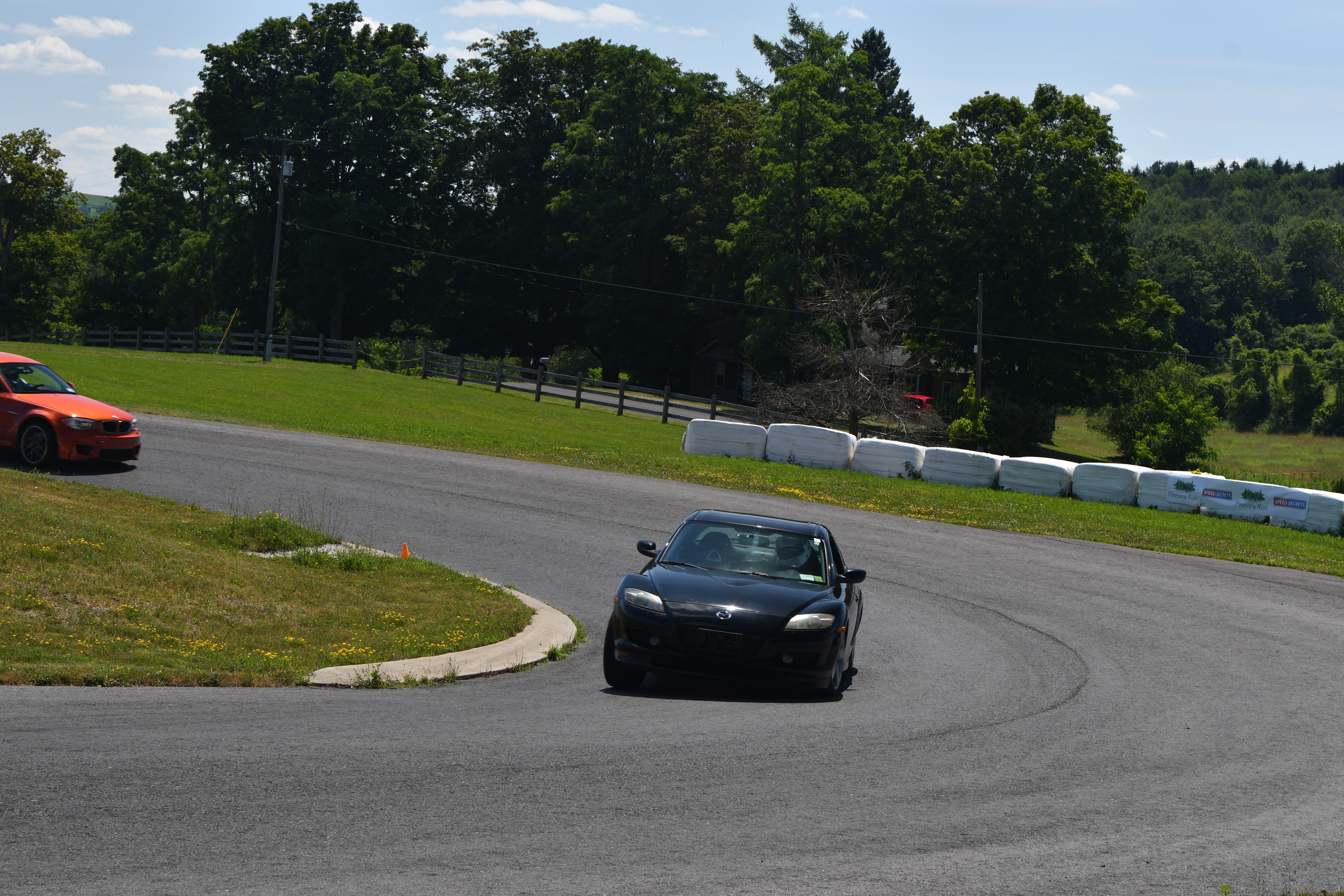
I was driving the Venerable Mazda RX-8.
It was a track rental car that they told me to beat on
and run at 9,000 RPMs and I did and I still overheated it.
I really enjoyed it, you know,
I, it was perfectly balanced.
The tires had predictable grip, you know,
so they weren't the grippiest,
but they weren't, you know, really slippery,
but it was just predictable.
I knew how much grip I had, I could hear it,
I could feel it, and then combined with just
the natural, you know, kind of balance of the car,
it was a lot of fun.
It has no power or torque.
No torque.
Yeah.
It makes up for it in noise though.
Right.
If you floor it, it will get louder.
It gets louder, yeah, and it can get really loud.
Yeah.
At one point, going up one of the hills,
I shifted into fourth and it just started slowing down.
At a floored, but...
It's okay.
Yeah, it tells you when you're doing something wrong
real fast.
That's right.
Yeah, that's right.
So it's a great car though.
I've got a friend, a couple's friends actually,
that race engine swapped versions of those.
So they get all the handling of the RX-8
and all the grunt of, let's just say, LS something.
Oh, wow.
And they're a handful to try and take on
when that car is working.
So it's entertaining though, it's fun.
All right, so if you were sitting at lunch at work
or wherever, and somebody said,
hey, what did you do last weekend?
And your first answer is obviously,
I went to a racing event and they said,
well, what was it like?
What did you do there?
Try to orient somebody.
Honestly, if you're like me,
you're trying to talk me into doing it the next time with you.
But how would you kind of give the five minute elevator speech?
It's what I try to let people know
that it's endurance racing is a team sport
so that there will be four drivers and for one car
for anywhere from seven to 15 hours.
And we take turns and basically at the end of two days
it's whoever has driven the most number of laps
is the winner.
And what we try to do is keep the car on the track,
keep it running and it's a long race.
And I try to ask people because they've likely
have heard of the 24 hours of Le Mans.
Sounds just like it, doesn't it?
Yes, exactly.
So close, so close.
Yes, one important letter.
And so it's grassroots motorsports, right?
This is entry level, but it's just so exhilarating.
It is, for sure.
You know, a friend of mine from the Porsche Club
who's very experienced at eye, he's an instructor.
He's been an instructor for a long time.
It was his first race and he raced with us
this past week at Thompson.
That's why the weather was so nice at Thompson.
You sucked in a newbie with the weather
because Thompson's not like that ever.
Yeah, it was great, it really was.
But he said, you know, he had heard that the Haterade car,
the 306 car was our slowest car
and he made some crack about how he's new
and he's gonna be in the slowest car.
And I said, you're not gonna experience it that way.
You know, you get out there and that thing, I'm sorry.
Yeah, no worries.
Okay.
And you get out there and it's a race car.
Yep.
It's a race car.
And the limit is still the limit
no matter where the limit is.
That's right.
That's right.
And I asked him after his first stint,
now did you experience that?
He said, oh my God, no, it wasn't a slow car.
It was a race car and he had that exact,
you know, once you get going, you're racing.
Yep.
And you gotta race, you race what you got
and what you got is what you got.
And that's, that car is not gonna beat anybody
out of a turn down and blink along straight away.
But it'll kick some butt on the turn.
It will.
And if there are, there are chicanes,
I mean, I, you know, that car at the Glen,
you're flat from the track out of one to the bus stop.
Mm-hmm, which is, which is scary into itself.
But yes, I don't, I don't, I'm not a fan of the Glen.
I know you like it.
It's okay.
Well, not for what we do.
How about that?
So I was gonna go in a different direction,
but you gave such a good description of endurance racing
while you're warm, while you're, while you're loosened up,
you got it, got all the mojo going.
What would you do if somebody said,
hey, what did you do last week
when you were at the Ross Bentley thing?
How would you describe that one?
Because it's not an HPDE.
Yeah, experiential learning.
You know, it was a lot of, there was much more,
let's huddle, let's talk
and then go straight back out.
And, and, and we'll drive for 20 minutes,
come back in, let's talk about it.
Let's debrief.
What did you learn?
What did you feel?
Let's go back out.
Yeah, you know, and so there were more iterations
of that than I had expected.
And one of the things that surprised me, you know,
and you were at exactly right, it's not HPDE.
No one got in my right seat
the whole time I was there.
Nope.
And I didn't feel cheated, you know?
And I've come in my experience with HPDE,
which has been mixed,
is it's hard to learn with someone
in the right seat sometimes.
Sometimes.
It really can be.
It depends on the driver and the right seat
and the environment and, and, and, you know.
Oh yeah.
You're learning styles and, and, you know.
Like I don't risk anything if somebody's in my car.
I will never drive 10 times with somebody in my car ever.
Just one.
So can I really?
Like I'm stuck right now.
Like, you know, let's, let's talk about me.
I'm stuck at a level.
And I know there's more.
I know 100% there's more.
I've had people in my car that do things that I can't do
and they've done things and I don't know the path.
I know there's a gap.
But I can't find that gap with somebody in my right seat
because that gap is where I'm unwilling to do
with somebody in my right seat.
So I have difficulty trying to get from breaking this plateau.
So, so it's, it's one of those, you know,
and I'm not going to say that, you know,
if I can just get this one last thing, F1's calling.
That's not what I'm saying.
But, you know, it's, it's annoying as a, you know,
I'm type of a, I'm one of those lifetime learner dudes.
And if I'm not getting better,
I start to really like go, why am I doing this?
So the right seat's not the answer sometimes.
And, you know, there was a few right seat drives
in the weekend, not many.
And I don't think there was anything negative
about the event because there wasn't.
I actually think they had everything covered.
Yeah, yeah.
I think a few people asked for it.
You know, people were struggling and, you know,
or they just wanted some feedback, you know, on something.
And yeah, I would have been happy with it,
but I didn't feel like I was missing anything
because, you know, that, yeah, I got pretty good feedback.
You know, they were watching us pretty closely.
For sure.
Plus they did data.
Plus they did video.
Yeah, that's right.
And they had people all around that track
so you couldn't hide the thing.
You know, if you did something bad
and turned seven all the way in the back,
they still saw you.
Yeah.
So.
No, it's like, what do you saw that?
No, I'm fine.
Yeah.
Anything go on that?
No.
Oh, excuse me, Mike.
What about you on turn seven?
Oh yeah, that one.
Yeah, but it's fine.
So I think we have our team has its preferences
for where we like our HBDs and where we don't
and we've tried.
I'm not gonna say we tried every HBD organizing event
but we've tried, you know, into the teens.
And one of the ones that we like the best utilizes drills.
And if I were to say one of the cornerstones
for this event was drills,
what did you think about the drills
and even stand out for you any?
Yeah.
The third gear note breaks was a great one.
And I think so much, you know,
and the Porsche Club region that I'm in,
we've tried to do this a couple of times,
but I think that you really have to invest in setup
and like explaining to people what you're trying to do.
And it was also helpful that they put some cones out there
just for reference on, hey, by the way,
if you're gonna be flat, you know,
and you're doing 80, you better lift here.
If you go past here, you're in a problem, sir.
That's right.
Or you're just gonna have to touch the brakes.
Yeah.
Because we don't really have that sense kind of,
you know, we don't have that sense of touch
for just coming off the brakes at a hundred
and knowing when we're gonna be able
at the right turn in speed for a turn.
That's hard to figure out.
So having those was really helpful
and I would, I've always been one like,
drills, you know, you're keeping me
from setting my personal best,
but you know, the drills are good.
They are.
Yeah.
Did you like any of the other ones
besides the no brake drill?
Well, or did you get anything out of a couple of them
that seemed to particularly fill a gap
that you may not have even known that?
Yeah, the braking to the apex was a helpful one.
That helped with car rotation, you know.
And just every corner right to the apex.
Don't worry about your lifetime.
Just see what it feels like
and then you're starting to build up
like that your own sense of,
well, this is the kind of corner
that makes sense to trail right deep into the corner.
I'm gonna lift and I'm just gonna let it,
you know, tuck in and, you know,
but these others, you know,
make sense to pretty aggressively trail brake
and come off closer to the apex
and get a lot of rotation
so you can hammer back onto the throttle.
You know, for me, that's kind of that elusive next step
as I have this, you know,
mind's eye vision of, you know,
coming in fast, you know,
high corner entry speed higher than normal, right?
And then rotating the car
and then hammering the throttle out of it
and it just being, wow, that's not easy to do.
No, and that may not be the fastest way.
It may not be.
No, absolutely, that's right, but sometimes it is.
Oh, no, I can't do it reliable.
Yeah, no, I'm just, it's,
you know, there's, I'm an engineer,
so I get geeky sometimes,
but there's certain things that are path independent,
like if I need to get,
and it doesn't matter what path it is,
I just end up the same.
And then racing is definitely not path independent.
There's braking force, braking depth,
brake start, brake finish.
How hard I hit the brakes?
Am I steering with my steering wheel?
Or am I not?
You know, and then topography turned to geometry.
It's very much path dependent.
There's never one way to drive any turn
and there's definitely not one way to drive every turn.
And then I would even add a la Ross kind of,
you know, and those conditions will change
throughout the day as,
you know, the track gets greasier, it gets cool,
maybe it got cloudy and it cooled off.
And now tracks grippy, you know,
so there are things you can do differently.
Hires go away, you know what I mean?
Hires go away, that's right.
Well, you spot them.
What? That's never, never happened.
The previous driver, man.
Obviously, obviously.
I am my own anti-lock braking system.
It's fine.
So it's interesting, you were not a drill guy going in,
but it sounds like you're kind of open to them now.
I'm big on technique and I'm big on learning
and so, you know, this was well,
that's what I mean for,
that's why I said the difference was in the setup.
You know, they had, that was the fourth time
I've done some version of the no braking
and this was the best one.
And there wasn't like all this mass confusion,
huh, what are we doing?
And it really, I got more out of it.
Now, maybe, you know, the thing is also
is that this is the fourth time I've done it.
And so there's more to be gotten out of it each time.
And so it could be that.
Could be.
Yeah, I would say there was a lot of people in the class
who got a lot out of that drill.
There were some of the people in the class
who got nothing out of the drill on the hairpin.
There's a hairpin there, pretty tough with a no brake drill.
And you know, some people benefited more than others.
So it's a, I find it and this goes for drivers
that I've instructed and organizations
that I've instructed
and organizations that I've tried to talk into it,
there's this thing against drills.
And you know, everybody wants to like set their personal best.
And I'm like, you will just give me
the first two laps of the session, just two laps.
That's all I want.
You can have the rest of the treatment as warm-up laps.
And then, you know, if the thing you came here to do
is get your personal best on, you know,
the particular track we're on today,
A, that's not what an HPD is for
and B, you can't get a personal best
12 laps in a row, guys.
I mean, it's...
Exactly, all four sessions, all three days.
Yeah, every lap.
I'm going... Every lap.
Yeah, okay, good luck.
You're the man or the girl, whichever, it's fine.
Okay, let's see, I'm thinking of things that they did.
Well, why don't you do it?
Cause I've got a list.
What was different?
What were they encouraging?
What were they saying to do?
What did they...
How was it different than an HPDE in your mind?
Cause I've got a few ideas we'll talk about.
One was their comfort level with you sliding the car.
Uh-huh.
You know, and HPDE, it's like, you know, you oversteep.
Your tires made noise, yeah.
Yeah, it's like, hey, what did you do?
What happened?
What happened?
I'm trying to rotate the car, dude.
You know, it's not, you know, reckless driving.
And so their comfort kind of bled into my comfort.
And I think at least some of the students,
like these people are experts,
they're experts not just in driving, but in teaching,
coaching.
And so if they're comfortable with this,
you know, they wouldn't have come out here and just, you know,
yeah, you know, people are going to go flying off the track.
You know, and it's a couple did,
but they didn't, most of them weren't bad.
I just, you know, drove off and that's part of it.
You know, that's one of the good things about pine,
there are lots of runoffs.
Yeah, there's only a couple of spots where you're,
you know, potentially going to have a problem.
And then there's one, two, two, really.
Yeah.
I think, you know, I, being a person,
now we drive mostly low horsepower cars,
like the highest horsepower car we have is an E46 330.
So, you know, 200 and let's say 230 horsepower.
Not a lot.
I've been told more times than I care to,
now it's going to sound like I'm bragging.
I've been told more times than I care to remember
that I'm driving too fast for an HBDE.
And I'm in, I'm not in a car.
I'm in, I got told that I needed to slow down
in my son's stock Toyota 86, the first gen,
because I was pressuring a Porsche 911 GT3.
And I'm like, you've got to be kidding me.
He's in a 911 GT3.
And I'm in an 86 and you're telling me
I've got to back off because I'm pressuring it.
It's like, they need to move.
But it's great.
And that was not the case in this event.
Drive as fast as you could.
Right, right.
And people were good, I think.
People had good track event, track awareness.
They were quick with the point buys.
I had to be, I thought I was going to wear out
my rotator cuff giving out some money in that RX8.
But, you know, that's good too.
I was glad to be,
I was again glad to be in that car.
There was some, to defend you slightly on that,
there was some hardware at this event.
So, you know, you were outgunned a couple,
couple different ways by a couple different people.
Oh yeah.
Yeah, yeah, yeah.
But, you know, that's okay.
I, you know, the car I drive at DE is a 22 Cayman S.
So it has 350 horsepower at stock.
That's a medium horsepower car.
Now, right?
Yeah, now.
When we were growing up, that would have been like,
oh my God.
High horsepower, yeah, yeah, yeah, yeah.
Well, you know, I was, that has a more horsepower,
quicker acceleration, zero to 60 and a quarter mile
and a higher top speed than the original 911 Turbo.
Yep.
Just, and better tires.
And safer.
Yeah.
Much safer.
Tons.
You know, it's heavier, but you know, it's a.
Power to weight though, it's still.
Yeah, yeah, the power to weight is still great.
Mm-hmm, yeah.
Indeed, indeed.
Anything else that you saw that was different
than an HPD that you kind of liked?
Yeah, I was,
lots of encouragement.
Lots of encouragement.
You know, at one point that Ross, I think,
was talking about, you know, how you,
you don't point out what people did wrong
and say, don't do that, right?
Oh, okay.
What you do is identify the things that they did well
and say, do these again.
Mm-hmm.
And there was lots of that.
You know, and so there was lots of positive,
now I assume that if we were gonna be doing something
terribly dangerous that they would tell us not to.
But lots of positive reinforcement
that makes you more confident.
And when you're more confident,
you get less in your way.
You know, less in your own way.
Yep.
I mean, Ross had explained it to us,
he comes on every now and then for us,
actually comes on a lot for us.
He explained it, you know, if you,
if you can fill up your track time
with all the things you're doing good,
eventually you run out of time to do anything bad.
Makes sense.
It does.
It really does.
It pushes out.
Yeah, it pushes out the bad.
Yeah, exactly.
Wish it was the same for golf,
but we're going off again.
Well, no, no, no.
That is not the case for golf.
So one thing that I had written down
that was different, at least in my mind,
I'm giving you some time to think
if you got any more is the event
and the instructors were highly supportive
of experimentation on track.
This wasn't a drive the line, drive the line, drive the line.
Oh, you missed the line by a quarter of an inch.
What are you doing wrong?
Why aren't you on the line?
That had nothing to do with this.
And I found that to be refreshing
and helpful for everybody.
I couldn't agree more.
And that kind of, I would just stack that
right next to that encouragement
to be slightly, let the car move
and be okay with that level of squirminess or twitchiness.
It's a thing that's in motion, not on rails.
It's not a train.
And you feel it, feel it, feel it.
And be in charge of it.
The say, yeah, lots of experimentation.
I love the idea that the mantra sometimes,
hit your apex, hit your apex, hit your apex.
Well, sometimes you don't hit your apex
because you came cooking out of the previous turn.
And you couldn't make the apex
because you're doing three miles an hour faster
and you've never done that.
Well, that's not bad.
You know, I mean, you're gonna have to learn
if you can hit that corner exit like that every time,
you're gonna change something.
But you know, that's, yeah.
And if you look at the data,
you're probably faster on that lab,
even though you didn't hit the apex.
Right.
You know?
Now, and maybe I could get faster still,
but it's a process.
Yeah, I mean, when the prior turn changes
and you come out three miles an hour faster,
the next turn is something you've never seen before.
That's right.
You know, it's a whole different turn.
Yeah.
It's like, oh, I didn't expect to be here so fast.
Yes.
So they had a two-day event and they had a three-day event.
And we talked a little bit with Mario and Ian
about the differences between the two.
First off, how much track time did you get?
Did you get enough?
Did you need more?
And do you think that third day
was gonna get you appreciably more
or you think you were kind of mentally full
and challenged after two days?
Yeah, I think that I could have gone another day.
Okay.
I would have had to see the curriculum, you know,
and sort of, you know, how they laid it out.
I felt that, you know, we kind of rushed
through some things and there were some times
where, you know, we had to bring a session to the end
so we had to get out on track
to make sure that we did all our drills.
So maybe over three days, that would have been easier.
But it was a long, I was tired.
Yeah, I was gonna say, Vicki was kind of wiped.
Yeah, I was really tired.
After both days.
Yep.
And that was a long ride home, you know, from there.
So, yeah. Vicki stayed and did it the next morning.
Yeah, yeah.
You know, I wouldn't, if they had offered me my choice,
you know, I was offered a slot in the two-day.
I was not offered the choice.
Okay.
So you said yes.
I said, I asked them exactly.
Just what I wanted.
I thought, I couldn't ask for more.
That's right.
Another day.
Yeah, except for another day.
But I probably would have picked, you know,
because, you know, I always think more is better.
And, you know, especially with learning, you know,
I mean, because the games that you get
are tentative, you know.
And the insights are right there on the track,
in the car with, you know, and they decay over time.
And so, you know, getting more of that in the moment,
I think is always better.
But I was thrilled with it.
What was Vicki's?
I think she was done.
I think she was full and she was tired.
She stayed late both days and played on the sim.
And, you know, the dinners were wonderful
and everybody was there.
And, you know, Vicki being Vicki,
she had conversations with like everybody,
the frog, the toad, the rabbit, all the students,
perhaps a pencil, you know, the girl can talk to anything.
And, you know, makes that for me at a party.
But she was kind of cool with it.
And I think, you know, the benefit of a third day,
because you get a second night of sleeping on it
and thinking about it is appreciable for sure.
But it's not like she left there saying,
oh man, one more day and I think I would have got it.
I mean, she got a lot for the two days.
So she was pretty good.
Yeah, that's how I felt.
That's how I felt.
It was, it's hard.
I didn't come away thinking, yeah, God,
I don't know if any of that's gonna stick, you know.
And then it was nice having the Thompson event
so shortly after that.
Yeah, I can imagine that would be helpful.
Yeah, yeah.
And that gave me a lot of confidence having, you know,
because I had had, the previous two races,
I had some mishaps.
I had a couple of moments.
And so I was trying to redeem myself
both in the eyes of, well, myself,
but also the person who was in the car.
So that's why Thompson this time was so great.
Yeah, and you set the benchmark for the weekend.
So nicely done, sir.
Oh, you know, don't do it every time,
but sweet when you get it.
Yeah.
So, how did you use the data?
Did you use any of the Sims that were there as well?
I tried the Sim, do you use Sim?
Yeah, yeah.
Okay.
Okay, I couldn't get into it.
I'll have to try it again.
Okay, yeah, it's tough.
You have a lot of other stuff to do.
And, you know, honestly, I was looking at it going,
should you stay in Sim or should you go home and sleep?
I don't know.
And I was so tired that first night.
Yeah, first night was excitement.
I was pretty B.
And, you know, yeah, I have,
it came across to me as kind of a clumsy video game interface.
And so I think that was me.
I need to give it more time
and, you know, have some instruction with it
because it didn't feel like anything.
You know what I mean?
I do.
It's got its own learning curve.
It's not, oh, I know how to race a car.
Oh, I can Sim now.
No, it's different.
Okay, that's what I got.
Yeah, it didn't seem like driving.
It didn't seem like racing.
A little bit like driving.
Yeah.
But I needed more time to get used to it.
And at that point, I had, you know,
lost all patience for that kind of fine tune learning.
Indeed.
So if you, sorry, I haven't been talking all day.
If you look back on the weekend,
do you have a highlight for the weekend?
You know, I think getting the car to rotate
in a couple of those turns, you know,
I mean, it wasn't, you know,
I was hoping to be, you know, Mr. Rotation
coming out of the two days.
But not too much.
No, that's right, that's right.
Just enough.
And so, yeah, when I got those, ah-ha, you know,
this is how I can do it, you know,
like by breaking a little later,
coming off the brakes a little quicker, just here,
you know, in this one, you know, I can rotate it.
And that felt great.
You know, that really, those little breakthroughs
can be a real highlight.
So if I can add my instructor cap for you
for your next HPD event, here's a little drill.
I'd like you to do one session.
Yes.
Don't care when.
I want you to try and get the car to rotate,
but on corner entry, pre-APEX.
I want you to see if you can get it to rotate
almost too early, almost too early,
but nothing after the APEX before.
And this, see.
Okay.
And what's the purpose of that?
Just so you get a feel for what it takes
to get it to rotate, and you're doing it in an awkward place,
and you're also doing it in a safe place,
because if it over rotates, you're fine.
And if it under rotates, you're still fine.
You may butcher the corner, but you're still fine.
And it'll give you the ability
to determine not only if, but when
you can rotate the car, because sometimes
you want to rotate the car really early
and just get on with the next straightaway,
because I've just eliminated this turn,
and sometimes you want to do it a little later,
but you never want to do it too much, right?
And this'll, you'll fall into two categories.
You'll either have trouble getting it to rotate at all,
or you'll have trouble getting it to stop rotating,
and those are two different problems,
and we can talk about that separately, so.
Yes, yes.
So just try it one session, see what you think.
Okay, yeah, no, I will.
That's great, I appreciate it.
I've had some luck with that one.
Well, for some of my more advanced students,
some of my early students, it's like,
look, gray stuff good, green stuff bad.
Let's just start with that, so.
So going back to the event,
is there anything that you would have changed
or anything that you would have liked to have seen added,
or maybe stressed more, or, I don't know.
I don't know the best way to put it,
but is there anything that you said there,
saying, you know, that was good?
Yeah, you know, I came away overall,
they asked for feedback, and you know, I felt,
it's difficult for me to, I'm not gonna say it's perfect,
it was great, and I thought that it was a good value.
It was not cheap.
It was not an HPDE cheap, that is for sure.
Right, but it wasn't exorbitant,
it wasn't an exotic kind of thing, you know, where, you know.
But you got what you paid for,
and I think you got more than what you paid for.
I think so too, I thought it was really high value.
Yeah.
And I came out of it with my head in a better spot,
which a lot of this is, you know,
it has to do with your head.
So, yeah, I can't think of anything
that I would ask them to change.
I was really happy with it.
Cool, cool.
So did you have any goals going in?
If you listen to the podcast,
you know, I'm a pain in the butt about goals.
Did you have any goals going in?
My goal was carb rotation.
My goal, yeah, number one goal,
and I felt like I got closer to an understanding
of not just, you know, what it takes,
but, you know, like here are the levers that I can pull, right?
I can break later and come off the brakes sooner or later.
I can break earlier and come off them softer or harder,
you know, or right?
So you can vary these things systematically.
Or break harder, break harder, break softer,
you know, you got all these notes.
Harder or softer,
and then earlier or later.
Yep, on and off.
Yeah, yeah.
And so, along with my new drill of getting to rotate 148 facts,
that helped.
I mean, it really did, yeah.
That drill didn't help you yet.
It'll help you next time.
No, it will, it will.
So, yeah, yeah, it's fun.
So, your goal was to get carb rotation
and get an understanding for it.
I think we've talked enough about it
that I guess your goal was met.
So, did you look at any data during the weekend
or did you not have a chance to?
I'm not sure.
A little bit.
No, because I broke my garment,
but I didn't bring the,
I forgot to bring the camera.
I had two of them there.
You just need to tell me.
Oh, no kidding.
That's too bad.
Well.
I actually had two of them there and a spare camera
so we could.
Oh, jeez.
So, I, but I did come up with some good plans
for using the garment differently
based on what everyone was going on.
Talking about, yeah.
What were they?
Well, one is, you know, when I try,
when I'm trying different lines, for example, right?
You know, run three laps,
one conspicuously different line
and then run another three laps on the test line
or whether that's the baseline.
You know, so you have a clear, clear, you know,
here's this and here's this.
If all you try to do is your fastest lap
every single time,
the differences aren't going to be that great.
You're not experimenting.
You're not getting a sense of, you know,
that wider has more grip or, you know, anything like that.
You're just, the differences aren't there.
So I think that, you know, that is like my main takeaway
is to be more disciplined in my experimentation
so that I can look at the data afterwards
and have it be more clear.
Does that make sense?
Absolutely.
I mean, if you're not,
if you do three laps identical,
one of our friends, Khan has this problem.
He will drive the same lap every time
and the Garmin doesn't know what to do with that.
Right.
You know, as long as it sees,
if you drive the identical lap
and it sees you're hitting entry apex, corner apex
and exit apex and you're using the entire track,
if you do it exactly the same every single time
the Garmin will sit there and say, yay.
It doesn't have anything to work with.
So it deals with the Delta's really
is the way I think it is.
So last thing that I can think of unless I miss something,
the event, one of the things that I did not get to attend
and I'm kind of bummed about it was
you guys did a track walk, but not a track walk
to walk the track, but a track walk
to learn how to do a track walk.
How did you think of that aspect of the weekend?
One quick insight that stands out
was Peter Kraus saying, look backwards,
look backwards, because you never see the straight away
except from the direction that you're coming, right?
And so if you look backwards from turn one,
you're going to see whether
and how does the track start to dive?
Does it go uphill?
Does it start to go off?
Okay, you see that behind you in a way
that you don't see when it's in front of you.
Yeah, for sure.
Peter's made that observation with us a couple of times
and it's true, looking at something as you're doing it
is different than looking at something after you've done it.
And you'd be amazed like you'll drive,
even if you're walking, if you walk the track
and you get to the turn and you turn around,
and you'll be like, oh, I just went downhill.
I had no idea, like you just don't see it.
Because again, and looking at video, you'll never see it.
Right, right.
And there are some like, you know,
turn one at Thompson is uphill at the end.
Absolutely.
And it's hard to imagine it.
Yeah, yeah, but it's hard to imagine it that way.
It just, I think of it in my mind's eye.
I try to override that, you know,
that it rises, you know, near the end.
It's got a big exit.
I mean, you can go through that turn much faster
than you think you can if you just think about it.
And then if you look at the geometry in the topography,
you're like, oh, I left so much on the table.
You can break deeper into the braking zone, you know.
Carry a ton of speed.
Yeah.
Yeah, rotate the car.
Well, you can now, sir.
Yeah.
So.
Right.
I missed that.
I was kind of bummed.
I got a duty that I needed to take care of.
And I did, but I'm sniffling about it still.
It's okay.
So Thompson was your next event.
You got to use a little bit of your newly earned skills.
You dominated Boston winers and like to hear that.
Anything I can do to poke them a little bit
because those guys just have way too much fun.
What's your next event coming up?
I'm doing a DE event at the Glen.
The end of the month and then a,
I'm doing the Hooptie Fest, Halloween Hooptie Fest.
New Hampshire?
New Hampshire.
Yeah, with Lennox.
Excellent.
That's fun.
Yeah, we're doing summit point the weekend after, so.
Oh, great.
Where is summit point?
Down in West Virginia.
Okay.
It sounds further than it is.
Yeah, it's actually.
No, because I know a lot of people in Maryland will say,
oh yeah, summit point right there.
You know, yeah.
Yeah, it's not the middle of West Virginia.
Right, or Western West Virginia.
Yeah, it's kind of, I mean, because West Virginia is,
you know, I mean, we're not talking, it's Alaska Lake,
but you know, the West Virginia from one side to the other
is a little bit of a trip.
So, but it'll be kind of fun.
Hopefully that'll be our next race.
We only did two so far this year.
So it'll be fun.
Hopefully we got to still get some car repair to do,
but we'll get there.
Are you in the Gatorade?
Haterade?
No clues.
They make those assignments, you know, at the last second.
So often I don't know what I'm driving
until I show up at the track.
And this is what you're driving.
That's fine.
Hopefully Adam will be able to make it this year.
We'll see.
Yeah, I hope so.
Don't know what his schedule is like.
He's a busy boy.
Did I miss anything for the weekend?
No, it wasn't a weekend, it was a Wednesday, Thursday.
Did I miss anything from the event
that we should make sure our audience knows it?
I don't think so.
I think you gave a pretty good summary of it.
You know, it was a great event.
And, you know, they forced you to learn.
You know, that was the thing.
They didn't just tell you stuff.
They forced you to learn and experience it.
You know, and if you didn't,
they made sure you did the next time you went out.
Yeah, yeah, it wasn't like with a stick.
It was, you know, making sure you didn't miss anything.
So rumor has it.
I'm breaking news, breaking news.
Rumor has it that there may be a part two
at another venue.
I'd go.
It's kind of what I was thinking.
Yeah.
I think we may go.
I may instruct or I may student.
I haven't decided.
They're both very appealing to me.
So it'll be fun.
I can't wait.
I can't tell you where.
Okay.
We'll leave that for the OnlyFans podcast.
This side of the country.
I cannot say, sir, but if you hang on just a little bit
after we're done, there may be an OnlyFans episode
where we covered it.
So it was great to see you at the event.
I hope you had as much fun as Vicki did and I did.
Thank you for coming on the podcast, sir.
Well, thank you very much for having me
and say hi to Vicki.
It was nice meeting you both.
Thanks for having me.
Yes, awesome.
Thank you, sir.
And I'll see you in the next episode.
during and after your stay.
We've planned for the plot twists,
so support is always available
because a great trip starts with peace of mind.
About this episode
Mike Beers shares his journey from Porsche Club driver education to endurance racing and reflects on a recent Ross Bentley event at Pine View. The discussion covers the unique learning style of the event, emphasizing drills, experimentation, and positive reinforcement over traditional HPDE methods. Mike highlights how the event improved his car rotation skills and mental approach to racing. He also talks about the supportive atmosphere, track characteristics, and the value of continuous learning through data and feedback. Upcoming races and the possibility of a follow-up event add to the excitement.
GHiT 0722: Mike Beers Racing and a Ross Bentley Event Review
We caught up with Mike Beers a few weeks after the Ross Bentley instructional event at Pineview Run. What did Mike think? Did it help him in his next race? That and much, much more.
A link to the episode is: https://tinyurl.com/GHiT722
We hope you enjoy this episode!
If you would like to help grow our podcast and high-performance driving and racing:
You can subscribe to our podcast on the podcast provider of your choice, including the Apple podcast app, Google music, Amazon, YouTube, etc.
Also, if you could give our podcast a (5-star?) rating, that we would appreciate very much. Even better, a podcast review would help us to grow the passion and sport of high performance driving and we would appreciate it.
Best regards,
Vicki, Jennifer, Ben, Alan, Jeremy, and Bill
Hosts of the Garage Heroes in Training Podcast and Garage Heroes in Training racing team drivers
We hope you enjoy this episode!
If you would like to help grow our podcast and high-performance driving and racing:
You can subscribe to our podcast on the podcast provider of your choice, including the Apple podcast app, Google music, Amazon, YouTube, etc.
Also, if you could give our podcast a (5-star?) rating, that we would appreciate very much. Even better, a podcast review would help us to grow the passion and sport of high performance driving and we would appreciate it.
Best regards,
Vicki, Jennifer, Ben, Alan, Jeremy, and Bill
Hosts of the Garage Heroes in Training Podcast and Garage Heroes in Training racing team drivers
Money saving tips:
1) Enter code "GHIT" for a 10% discount code to all our listeners during the checkout process at https://candelaria-racing.com/ for a Sentinel system to capture and broadcast live video and telemetry.
2) Enter the code "ghitlikesapex!" when you order and Apex Pro system from https://apextrackcoach.com/ and you will receive a free Windshield Suction Cup Mount for the system, a savings of $40.