Want to help the young people in your life use their creativity to make a difference?
Students Rebuild is a free program for youth ages 5 to 25 to share their creative work and
spark a $5 donation to non-profit organizations.
This year's project, Unique and United, invites them to explore their identities, celebrate
their differences, and use creativity to build a more united world.
Sign up at StudentsRebuild.org
Captain's Log Supplemental
Hey, Jeremy, you know those race cars you're busy building?
Yeah, I do. I got one that I'm looking at every day.
You know what I don't see you working on?
You don't see me working on the amazing Sentinel System yet.
That's true. It would take all of 10 minutes for you to have one.
And it's very quick and easy to install.
It is. It is. And we could watch you when we are not at the race with you and see how you're doing.
And then we can call you up when you get out of the car and tell you everything you did wrong.
And I love that because so many years I've been driving and not been able to see what I'm doing.
I know.
And now we can.
I know. You know what I'd like to do with the video?
My most favorite thing is I take the video and I load it on YouTube.
And then I send it to my coach and say, look at 26 minutes and 17 seconds.
Look at this one lap and tell me what I can do better.
And every single time, you know what they say?
Everything.
Exactly. Precisely.
So with the Sentinel System, you get instantaneous feedback plus useful feedback that unfortunately is accurate for my driving.
I think it's accurate for all of our driving.
Pretty much. Yeah, that's probably true.
Yeah, but you need to get one in your car, sir.
Yes, I do.
And with the discount code that you're going to tell everybody, they can save 10% on this awesome system.
Trouble free.
I haven't had an issue getting video every time we've gone out with the Sentinel.
It's always worked.
Can't say the same for some of the other systems we've tried.
So I don't know.
It's on the podcast notes down there.
Don't do it while you're driving though.
We like to have our listeners live. It's good.
Share what is right and wrong to get you out of your house and come out racing with them and serve all mankind.
They are the garage heroes in training team.
Welcome to the podcast.
Vicki's going to jump in anytime now.
She's not waiting for anything.
I'm one of the hosts, Bill.
Vicki's here too.
We have Peter.
Peter Kraus.
Peter Kraus, welcome back.
Well, thank you, Bill.
Thank you, Vicki.
It's always a pleasure to be here.
I have to truncate the normal podcast intro because Vicki cannot control herself.
I know.
I love Peter.
I do.
Why?
Why?
Why?
Because you're awesome.
I don't know if Peter knows Vicki's earned nickname.
Peter, do you know what Vicki's nickname is on the podcast?
No.
Her nickname is a bulldozer.
You know why?
I have.
There it is.
That's why.
Just a little bit.
I get excited.
I have to write things down so I don't interrupt.
It doesn't work.
But that's okay.
So, Peter, we've had you on the podcast a couple of times before.
We just went to an event that we're going to talk about.
You are a silly man and have agreed to come on every 50 episodes so that at least
now between the every 50 that Ross comes on and the staggered every 50 that you come on,
we'll have two good episodes every 50.
Well, Bill, I tell you, I love being on the podcast because you guys have a great and
unique take on everything that we talk about.
And we're not talking about simple things.
We're talking about hard things.
And that makes what we're talking about and what we're doing so much more important.
I mean, it's really fun.
Well, it was way too kind.
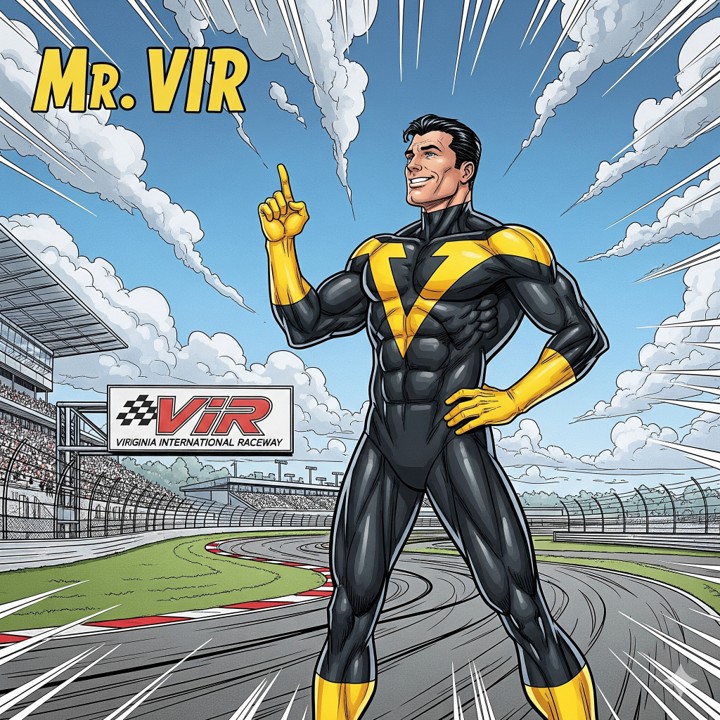
But we want to remind you that your official title on the podcast is Our Mr.
VIR.
Well, you know, I never get tired of that place.
I never do.
We don't either because we can't ever get there.
We keep trying to get there.
I know this year we tried to get to VIR this year this year and come to find out that our
co-driver that was going had to have surgery had to have eye surgery.
So he goes, I can't even drive.
So we sent him out a shirt and a bunch of googly eyes.
But yeah, so like we can't even make it because we just came back for a vacation
and immediately people get surgery.
So we can't go and he's like, I can't go.
I can't make it this year either.
So bulldozer and Peter.
Yep.
You two did a thing a couple of weeks back and it's been a little bit of time.
But I thought we might start off with the Ross Bentley.
I don't even know the official name.
Ross and Peter and Ian and Mario at Pine View Run set up what's not an
HPDE but if it was, if we're going to call it an HPD, I would pick HPDE
exclamation point.
I don't know.
It was much better, I think.
And I just wanted to get your feedback, Peter.
You were one of the instructors there.
And you personally had the highlight of my, I'll call it a weekend
even though it was during the week, was when you got so excited
when you heard a certain Orange Miata going around the track.
And I believe you screamed out in the middle of someone else's sentence.
And my favorite part of the weekend.
That was so much fun.
That was really, really good.
It was, it was so much fun.
And, you know, it's interesting because you don't get a chance.
A lot of times to work with people who are really, really tuned in.
And I think Ross put together a group of people that I think they put
together a program called SSA, Speed Secrets Academy.
So this was under the secrets banner.
And Speed Secrets Academy was an idea to talk about more than just
HPDE stuff, but how to teach yourself how to move in a particular
direction, how to get the most out of what you were doing.
And it really wasn't even dependent on the circuit.
That's what was really, really fun about it.
I think everybody has a sense of familiarity that they really don't
want to transcend because they're anxious about it.
And I think that's fair and that's reasonable to say,
well, you know, I don't think I can learn unless I'm on a track
that I really know well.
And in this particular case, this was very different from
everything that had ever happened before with Ross in the fact
that we went to a circuit to work with 40 people over the course
of five days on a track that none of us had ever been on before
with the exception of Ian and Mario Korff.
And it was really fun.
I just can't tell you how much fun it was.
And we had such a good group too.
We were in the first group and we had such a good group.
They were just funny.
They were a funny group.
They were.
They were great sense of humor.
They had a sense of humor.
People had the right perspective about the whole thing.
That was what I thought was neat.
They had an attitude.
Nobody had a chip on their shoulder.
Nobody was nervously laughing.
They were laughing genuinely and humanly and fully and openly.
And that's a big deal.
That's hard to do.
Right.
I would have to agree.
I think what made at least in that particular group,
because I can only speak for that group,
was just the receptiveness of everybody and the openness.
And they were just drinking in the knowledge that was coming,
which is what I really enjoyed about it.
It wasn't knowledge all the time.
I'm just going to say that.
It was pretty, yeah, it was pretty great.
That's true.
Well, I don't know why it was great.
I mean, I think we need to look at a little bit of that.
And from your guy's perspective,
because I think both of you are both incredibly experienced
listeners, which is a hard thing to do.
What did you say?
What did you say, Pierre?
I don't know what he's talking about.
I just think that it's unusual for people that are really good
at listening to latch on to this and say, hey, this is true wisdom.
And I don't know.
It just seemed like it worked out very, very well.
I think the hardest part we have is sometimes we're aiming
to help people either get better or get started.
And sometimes when we're doing the get started ones,
we have to ask questions as if we don't know the answer,
which I guess is part of coaching.
So it's always interesting.
Because some people are, you know, I've met a few people on the track
and they're like, you don't suck.
You're not slow.
And I'm like, no, I'm not.
I'm not fast, but I'm not slow.
So everybody's a spectrum.
That's a win.
That's a trade.
I mean, I think, you know, I get mad because there's a current.
I'm not going to say I get mad.
I get frustrated.
One of the biggest online forums that I spent a lot of time
with is Wren List.
And it's just Porsche-centric.
Because a large number of Porsche owners are very, you know,
really religious followers of driving on a circuit
and doing all kinds of things with their cars.
But the thing that was remarkable to me was that the
you could always learn more.
Everybody seemed to be able to be open to learning more.
And that is, that was one of the things that was really special about
what we're doing over the course of the, I'm getting a little lost here
because there were so many cool things I wanted to talk about.
We got plenty of tape in the podcast.
So we're good to go.
Well, we can start off, Miss Vicki.
Do you remember what your biggest learning points were
and what you were going to try to work on after?
Maybe you can entertain Peter.
Yeah, there was, there was something that I had a really
massive takeaway from.
And it wasn't until I was talking with Mario and Ian,
Dr. Ian, sorry, that early on, part of the reason in why I do
what I do on the track, okay, was, was that I have always been
working on waiting for the car to settle, which is why I do
and perform the way I do after looking at what the car can do
with the reference lab that she put down.
And some, and they just said, why do you do that?
Why do you wait for the car to settle?
And I said, well, that's how I was taught.
That's how I was taught because I remember going to NJMP
and NJMP has this off camber turn that when you go around it,
I had not waited for, I had gone off because I felt the car float
and then it would have to settle.
And then you could take off when you need to feel all the grip.
This is turn five at lightning.
Turn five at lightning, okay.
And they're like, well, why do you do that?
And I'm like, because I had gone off and that's what they
had told me and that's what I had learned.
They said, make it settle.
Make the car do it.
Instead of waiting for the car to do it, make the car do it.
And I'm like, oh, I can do that.
So now that's what I'm working on is now is to really work
on throwing that car around instead of waiting.
Because all of a sudden you're ahead of the game.
You're ahead of the horse.
That's been five years of a bad, of a bad, not bad.
It is what was done through HPDEs and training
and coaching, you know?
But that stuck.
So I'm like, what else stuck that I'm doing?
So, well, yeah, I got Bill.
I can answer.
I can answer.
Yeah, what's that?
The saddest question you asked during the entire weekend
was what does full throttle mean?
Because nobody.
You're into me.
It's so elementary.
It's an elementary question.
But what does that mean?
Seems like it's an elementary question,
but it's an elementary question
only because people haven't thought about it more.
And I think it was very interesting
because we talked about that.
We talked about the number one difference
between what you were doing
and what Alyssa was doing.
And you went up later further down the road
doing substantially more full throttle.
I was throwing myself into that thing
that they referred to as the catcher's mitt.
You guys said this is like a cat.
By the end of that weekend,
which I did not want to take that last run
because, well, I did, but I was really cautious.
I'm always cautious on the last run of the day.
I think that's why.
That's just wise.
Right.
But I think towards the end of our weekend
or days that we were doing that,
I was really trying to throw myself into that.
I was like, let's see how hard
I can slam into that before I go up the hill.
But yeah, so there was some...
I would like to do it again.
I would like to do the Academy again
because it's like, what else am I doing?
Because I'm not saying that what I learned was wrong,
but I think that I've outgrown it.
So now...
I agree.
Now it's time to like the data.
We had that conversation about the data
that I had to go into, which is like,
I think that there's a certain time
in your learning for that.
It's not something that you just say,
oh, we're going to do data.
So I'm going to teach you now.
You have to be receptive for it.
You have to get to that point.
Now I can do that.
Now I got all this other stuff.
Now I can focus on it.
But yeah, so that was massive.
That was the biggest takeaway that I got from that.
And then especially I was looking at a thing
that popped up on my feed.
And it was just, it was for high planes.
And there was like, this Corvette goes around
and he's going around the corner.
And then another car goes around the corner.
And then there's this frickin' Miata that comes around
and he is drifting into the corner, grabs it
and then goes, I'm like, that's what I need to be doing.
Like you said, and that was drilled in my head,
full commitment.
Right.
Because you yelled at that in the class
when you heard...
I love that, you know what I mean?
But you're just like, full commitment.
I'm like, ah!
And he came and said, my car doesn't sound like that
because it was in your car.
It's fun when you pull it off.
It's really fun.
But it's hard to do.
You can't just turn a switch on and have that happen.
No.
I mean, you had a journey.
You had a journey.
And then the light bulb came on.
And that I think is what is so much fun about this sport
is we really get multiple opportunities to get better
and to recognize what it takes to get better.
Right.
For sure.
But the thing is, is that elementary question
that we had, full throttle, what does that mean?
What does that translate out to?
Because to me, it's just punching it.
But then you can't really punch it
unless you're in the proper gear
and then what does that look like?
It's such an elementary question, but you're right.
It's something that you didn't really think about.
And all of a sudden, like a bunch of other people are like,
yeah, what does that mean?
What does that mean?
It's not that people are afraid to ask the question.
That was one of the things that I thought was really,
really cool about Speed Secrets Academy
is everybody was there
and nobody was worried about the judgment
of anyone else there.
It freed everybody from
afraid of sounding not up to speed
or asking silly questions or anything like that.
And obviously, Ross is the best about it.
He's like a kid.
He's like a baby.
He is.
He disarms people's anxiety
about asking these questions so easily
and so with such wonderful slate of hand
that people want to ask questions
for the sake of asking questions.
And that's what he got.
And my problem is I'm a kid too
because I started bouncing off the wall going,
be me, me, me, me.
And he's nice enough to throw me a bone every now and then
and say, okay, talk it, talk it through.
And we, you know, Ross and I have so much fun
because we do believe in the same thing.
We almost can finish each other's sentences,
but we don't necessarily agree with each other
as to the priority of things.
And that to me is helpful
because it gives people an additional perspective
like you saying, man, I was,
it was pounded into my head to do this, this way,
this way, this way.
And now you people are telling me this is all wrong.
Or at least they didn't give me enough detail
to get, help me get to where I want to be.
And that was really cool about showroom,
about Speed Secrets Academy.
I keep thinking showroom stock A.
Yeah.
Not obsessed at all.
Our main classroom from SCCA racing years and years ago,
I raced a Z28 Camaro about 30 years ago
in showroom stock A.
It was really fun.
79, 79?
Yeah.
Yeah, but one LE it was all.
Oh, look at you.
It was a, that was 179.
I think it was a little later than that, 82, 83.
Well, it still had the plastic bumper, so that's good.
Really, yeah.
Those things were really fun.
Anyway, I think it is your revelation, Vicki,
is the reason why I did this,
is the reason why Ross,
after five years of pestering by Ian and Mario,
got, said, okay, if we're going to do this, let's do it.
But we're going to do it this way.
And Ross is really, really good because he knows a structure
that works because he's done it a thousand times.
I also thought that the group that he put together,
particularly Ian and Mario,
but also Sam, who has the most wonderful way with words
and, I mean, talk about a guy who can think on his feet.
Right?
Sam, he really is.
And I've discovered since then that he's actually a very gifted racer.
He won't, he will deny, deny, deny.
If you want to see him get uncomfortable,
the only time he will be uncomfortable speaking is if you ask him,
it's like, alright, how good a racer are you?
Or, alright, here you're a really good racer.
Then he's like, blah, blah, blah, blah, blah.
Well, it's so funny because he got a deal to drive
the McLaren F1 car that Montoya,
or no, it wasn't Montoya.
It was, I think, Lewis.
Well, no, it was Alonzo's, McLaren F1.
So this would have been 2008, 2009.
And he drove it for a magazine article at Indianapolis.
And I can count on two hands how many people I know
who have driven in anger a modern F1 car.
And by modern, I mean something younger
than the last F1 car I drove,
which was about 40 years old, which was an Alfa Romeo B12.
And this car had modern electronics
and really cool stuff.
And I mean, it was a spaceship.
And it required the ministrations of two dozen people
just to start the car.
And Sam wrote a wonderful article about it.
And if you do a little bit of a search
on some work that he's done for Road and Track Magazine,
I think it's Road and Track.
It's got a wonderful article of him driving this MP4-12,
I think it was, at Indianapolis.
And it was just remarkable.
But he would never come out and say that stuff.
And we would leave the Speed Secrets Academy
daily activities and then we would go back to the farmhouse.
And Ross and I and Sam beat to death
would just sit around talking about racing in cars
and vehicle dynamics for the next three hours.
It was crazy.
It was nuts.
And about wonderful cars that we have known and loved
and traded the fact that all three of us
have been with the same partner or ladies
for three decades more, more decades.
And so that's always a good thing.
But anyway, that's a little far afield.
But I just thought the chemistry between everybody
at that event was really, really good.
And everyone who came in, the first group and the second group,
and it was a very different group, I think, Bill.
Maybe you had a better insight.
But it worked out great.
It was very fluid, I'd have to say,
the way everything was set up.
It just, it went seamless.
Like, if there was hiccups, which I knew there were hiccups,
we didn't know about them.
Well, that's a successful program.
It really is.
I mean, we were sweating bullets, actually, all of us.
But once everybody gets into it
and the questions start rolling and people get into it
and we know we have the room,
and all of a sudden I was looking at my watch going,
holy Moses, we're two thirds of the way through
or we're three quarters of the way through.
And it felt like it took 15 minutes.
And it had been four hours.
I was just shocked.
And that's how you know it's really, really good
because we covered so many different things.
And Ross is a master at rejiggering the program
to address a particular group or an audience
that is hungry for a segment or sector
or piece of the pie of information.
And that was another part of the magic,
was the program was defined by the people that went to it.
And that's another reason why the feedback was phenomenal.
I'm always worried because I think Ross is his own worst critic.
I think Sam is his own worst critic.
I tend to blow it off now.
I'm my worst critic.
I mean, I always think I've hit the wall
and people sit there and say,
man, that's something I've never heard before
or that really made a difference
or people come up 10 years later and say,
what, when you gave that discussion about end of breaking,
which has been a thing for as long as all of us have been studying.
Self-preservation kicks in.
So it's tough to get over it.
Self-preservation kicks in.
It is really hard.
And the problem is self-preservation is such a limiter.
You know, we sit there and we say,
I'm trying harder.
I'm doing something different.
And then they look at the stopwatch and it's the same time.
Or slower.
Or slower.
My God.
I mean, that can be the most,
that can suck all the oxygen out of the room
for the people that I work with at the track.
Is they're sitting there saying, but I tried this and I did that.
And I said, okay, we have to break it into smaller bits.
We have to make, we have to focus on a smaller,
best execution of fundamental skills.
And then you need to do more of that.
And then it will get better.
And sometimes it doesn't get better that day
that we work together.
Sometimes it takes a little bit of time,
but almost always the light bulb comes on
definitely like it did for Vicki.
And bang, people are up to speak.
So it works okay.
You can become comfortable being slightly uncomfortable.
It's a great program to figure out what,
like you've doing it, like you said, like if you're stuck
or if you're feel like the HPD ease
or wherever you're at is just not enough.
And in your racing and you're doing, like you said,
you're doing things, but you just can't seem to improve.
This is what your program is really great for.
You know, I'm not saying that's the only thing is great for,
but it does help you sort things out.
It helps you think differently.
And I think that's what I really appreciated
when I talked to Ross about it.
And just the way you guys discuss things,
it was like, it just made me think
about a lot of things differently.
Not, and it was like a takeaway of like, oh,
and he spent, first of all, first of all,
the walk around on the track.
Now I've walked tracks before and I'm like, yeah, this,
yeah, that, yeah, this, yeah, that.
And they kind of point out the basics,
but yours was more in depth when you guys did it.
It was, it was more of, yes, we look at, you know,
pitches and yes, we looked at edges and yes,
we look at transitions and, you know, the apex,
but you guys had us really looking at the track
and skids and where the traction is
and where the where marks are.
And it was more of an in-depth thing
that I had this massive takeaway,
like I'm going to walk every track now
because now I know what I'm looking for.
And the second thing was, was that he thought,
part of it was, is that you are what you tell yourself.
And that was my biggest takeaway
and it wasn't just about racing.
So now I walk around and I'm like,
that's not a great thought
or if I'm having a really bad day
or if I'm really, things aren't really going to go,
like going well, like we keep hitting walls or whatever.
But if you keep focusing on those things,
you're going to hit all those things.
So now it's just like, I'm even looking at other people
in my life and what they're telling themselves.
I'm like, you're giving yourself a self-fulfilling prophecy.
You are what you tell yourself.
Absolutely.
So, I mean, it just blew my mind
some of the stuff that I walked away with.
And I'm like, this is, it was incredible
just changing the thought process
of even being behind the wheel
and getting behind the wheel again.
That was crazy fun.
So that was, that was the cool thing was
we could talk about it all we wanted in class,
but then everybody got in their cars.
Right.
And that cycle allowed people,
much quicker uptake
of everything we talked about in the class.
And I mean, I still,
I love the track walks because
everything that we talked about in class
and on the track walk is universal.
It doesn't matter what car it is.
It doesn't matter what track it is.
It doesn't matter what tire you're on.
I mean, I love Ian and Mario and those guys
and they have spent a lifetime, it seems,
charting the characteristics of a 200 treadwear tire.
But the laws of physics don't know the difference
between a 200 treadwear tire
and a 40 treadwear Hoosier.
It's just that the limits are higher.
That's it, you know.
And so, so the thing about it was,
was how can we talk and speak
and address universal truths
rather than this specific stuff
everybody seems to get involved in?
You talk about HPDE,
and I'm not going to get off on this
because I get off a cliff if I do.
Oh, yes, you are.
My next question is getting there.
So don't you worry.
You know, you talk about HPDE
and HPDE, I think, is a wonderful introduction.
I think it serves a very useful purpose
and I think the right seat instructor
serves as a tremendous resource.
But I also think that a lot of HPDE programs
are stultifyingly stuck in the mud.
I mean, they really are.
This is the way we've always done it.
This is the secret sauce line.
This is the school line.
It's never any discussion about driving the car
to its limit to the point where it pushes back.
Never any discussion about that.
And they can't and they don't
to keep everybody safe.
I understand that.
And that, like I get that.
There are ways that people can probe the limit
with such fine increments
that they don't endanger themselves or others.
But it's like a nanny holding
and toddler and saying,
don't step off the sidewalk.
When just putting one foot off to see
what the grass feels like is a good idea sometimes.
Yeah.
And I just, you know, I feel like, you know,
HPDE has gotten into a little bit of a rut.
Sure, there are some programs
that are better than others.
But unfortunately, or fortunately,
that's a lot of the reason why people go racing
is because they experiment
without the sort of Damocles over their head.
HPD is very widely, I think,
is the easiest way to put it.
We've been to some very good ones
and we haven't.
Right.
There's some that we just use as a track day.
We don't really even pay attention
because there's no coaching available.
It's just go in.
It's just a point buys.
You know, I'm out there, you know, raising my hand
saying, listen, if you're in three or four
and you're still talking about point buys,
you shouldn't be in three and four.
And I love the fact that you're raising that
because that's important.
The organizers hear that.
The people that are running a meeting to hear that.
Right.
If this is what your major concern is
and all your people, and that's all you're talking about,
you shouldn't be here.
You need to be, you know, I'm just saying.
But then there's other ones who are really great,
you know, and they really focus on drills
and things like that.
But I think that some of them work
on such a volume
of people
that it's now, now it's,
it's like you got what you can out of that
and now it's like you got to focus on nuances
and then you got to break old habits.
You got to break bad habits you picked up
because you don't have that side-by-side seat
and you don't
have some of the
personal coaching.
And I think that the nice thing about the program
is that they didn't
discuss,
they didn't really
focus so much on
how the car
drives.
You know, because we're all expected
to know that.
We're all expected to know how to handle a car,
how to recover a car,
how to, you know,
these things we
already should be there.
Now let's
tweak things.
We're tweaking things. We're solving problems
that we've picked up along the way,
which is what I really
appreciated about that so much.
So much.
You walk away thinking.
You walk away thinking
and not just saying, oh, that was a great day.
Now,
like,
the whole thing,
the whole thing especially,
over the course of those five days is
how many tools can we give these people
to help themselves?
How many tools can we
help them?
Can we give them to allow them
to know how much is too much
and how much is not enough?
Because
when the questionnaire went out
to all of the attendees,
the number one
answer that came back out of the question,
what do you most
hope to achieve by attending this program
was
I would like to know how to approach
the limits
of driving my car.
That was the one answer.
And we were saying, oh my God,
they don't talk much about that
in DE.
They don't want to talk about that in DE.
But there are ways
to do it in such a way through
calibrated exercises,
through highly targeted drills
to do it without
adding undue risk.
That's the key.
That was the thing that I really liked.
Yeah, I just
it took me back to this one drill.
This one drill.
Oh my gosh, it was the no brakes
drill.
I have
I woke up a lot of people.
Oh my gosh.
And you know, Ian,
it was Mario saying, that's been
around for decades, that drill.
I've never had it.
But when I pulled in
with Ross
and he goes, how was it?
And I'm like, it was great.
It was scary, but it was great.
He goes, okay, great. Now do it one gear higher.
And I'm like, oh jeez.
And I took off.
He can't let you
let you lie. He has to push.
And I'm like, that was hard, but oh jeez.
Okay.
And you did.
And I did.
You know, that was another thing like, oh, I don't
really need brakes
in certain spots. Like, what am I
doing?
Yeah, so anyway.
That was what I remember the most.
You know, the beauty
of that whole thing was that it showed everybody
how much the car slowed just by turning the
steering wheel.
That you could actually overcook it
a little bit going in
and still rely on the
scrub to slow
the car down to the point where by
the apex or shortly after
the nose was
tightening up and the car would stay on track
leaving.
And that was the first exercise
Ross and I did Tuesday
afternoon when he brought me back from the
airport arriving.
We go out in that
Corvette
in that C7 Corvette
and Ross says, oh, let's do a no brakes
drill.
And I got to say, that's a lot of car for
that track too.
Because they're arriving at a relatively
high rate of speed and
all credit to him, he did not
touch the brake pedal one time.
I've never done that before.
That was crazy.
That's the one of all the drills.
That's the one drill I remember the most
and I'm like, oh my God.
That was something.
We looked at some of the data
from some of the people who had been
running conventionally
before the no brakes drill
and then
their data from the no brakes drill
and a lot of the slowest
v-mins
higher
in the no brakes drill.
Well, I'm not
a full blown advocate
of Mario's idea
that a no brakes drill
is always
yields a faster lap
than a conventional lap.
I think that
there's no question that it helps people understand
they can roll
a lot more speed in and through the
corner.
That
I learned
from other people who are a lot smarter
than me, a lot older
than I am, 20 years ago
was
the concept of rolling speed
into the corner.
Everybody
tends to stop short.
It's the self preservation.
So they over break, they over slow
which means they come
they break down to
speed that is slower than they
need to negotiate the entry
of the corner.
And then they sort of trundle around
to the apex and then they go,
ah, now I'm pointed in the right direction
I can accelerate.
And where the
if you look at any of
good professional drivers
you hear the engine
note continue to
drop
not steady, not
but it continues to drop
past turn in
to the apex and then it rises again.
So they're either slowing
down and speeding up
or they're rolling
speed into the corner and using that
steering scrub to get rid of the rest
of the speed to get the car as the car
slows down it can tighten the
radius
and we are always taught to be smooth
this fast, right?
A lot of people are taught that
it's one arc of the wheel.
You turn one arc of the wheel when you turn
in and you hold it all the way through.
Well, what people
don't realize is
the radius that the car
will accept changes
according to the speed that you're
going.
If you are going faster you can't turn
the wheel as much. If you're going slower
you can turn the wheel more.
So if
correctly choreographed
past the end of braking
to the apex
you could conceivably
add a little bit more steering
swoop
into the apex
and roll on out.
This was
something that was really important for all of us
to cover and
something that the no brakes
drill pounded
home for a lot of people.
Wow, this thing
sticks a lot better than I thought. It rolls
a little more speed than I thought.
Crazy.
You wouldn't have known that
if you hadn't done the exercise. No.
That's what was really fun about it.
It was incredible.
I recommended
a friend of mine for the second
three day program
who is racing a Formula 1 car
1989
Formula 1 car with a
Ford DFR V8
truck
in a week
and
he told me about
I don't know, the morning of the second day
he said
is this course really going to
give me a lot to work on
and I said yeah, it will.
And
morning of the second day he's like
I haven't heard the epiphany yet
and then he did
the one gear up
exercise
and he had been used to screaming
around at high revs
and get the acceleration out of the corner
and
and he ended up
going around the track in one
maybe two gears higher in his
purpose built race car
and he went quicker and he was like
mind blown.
I would not have tried that
on my own but you guys
asked me to ask the question
so I did
and I
learned something and I'm like
yes
this is what we want
I mean
so
so
I have to defend my beautiful bride just a moment
and she won't listen because it's a compliment
so she never hears that
the one thing she'll do
is she will do the same thing
over and over and over again
until she's told not to do it
like Ross said hey why don't you go try driving
one gear higher
so my beautiful bride
goes to the next HPD and she drives one gear higher
then she goes to the next race and she does
one gear higher
and she goes to the next race and she goes one gear higher
and she's at the next race and she goes one gear higher
and she's like I won't get into fifth gear
I'm like why are you in fifth gear
you don't need to be this is Thompson
you don't need fifth gear what are you doing
I'm drinking it up
I'm drinking it up I'm drinking up the knowledge
so
HPD providers please
please realize
that when you say
breaking a straight line
and then turn in my beautiful bride
is going to break in a straight line
and then turn in
for the rest of her life until you give her the
get out of jail free card this is hey trail breaking is okay
that was a big epiphany
you know what you learn
she does what they say
she just doesn't stop
but
so Peter I think the
one of the things I wanted to get from you
was
I'm always interested in what
the instructors and the coaches
learn so what did you learn
from the event at Pineview
oh goodness
I mean where do I start
I mean the best part about it is
I think that the best coaches and the best
instructors learn from every student
that they work with
and every client they work with
and every car they work with
and every group of instructors
and coaches that they are in contact with
because there's always a better way
to communicate something
there's always another complex
concept that can
return rewards
if the time
to learn it is invested
what I
learn more out of Pineview
is
that
people are open people are more open
than we think
they're more malleable than we think
their minds are more
flexible than we think
we need to give I mean I didn't
learn this from this program per se
but it reinforced it
is that people who are open
to learning can make great strides
and
and you know Vicki you
hit the nail on the head and Bill you just
reinforced this
I believe that people look to
instructors and coaches as authority
figures and I am one of those
people who doesn't believe
in that culture
I do not put pro drivers on a
pedestal I think some of the worst drivers
I've ever worked with
are quote unquote professional drivers
to me
a professional driver is a driver who makes
a majority of the share of
his living racing
cars and that's a very
small number of people in North
America and only
slightly bigger worldwide
right
mostly pro drivers are people who
have perfected
a sponsorship proposal
which provides them with the money that
allows them to retain a professional
team to prepare
a car enter the car
campaign the car and win
some poultry winnings
unless it's the Indianapolis
500 or NASCAR
because it certainly ain't
IMSA
and the point is you can't live
on those winnings
but what I'm trying to say
is I don't believe in hero worship
I believe in
proven
tested results
and I think that
pro drivers and very
very well practiced AMS
AM drivers
put their pants on the same way every morning
bleed red when they get cut
on a jagged edge of the car
the same way
there's really no
yes
Tommy Milner is an exceptional
Corvette driver probably one of the
finest there's ever been
but the point is he's a man
and he has been
in a racing family since he was born
his father started
the BMW factory racing program
in this country in 1995
with the M3
and worked before that with
SuperV and Porsche
and a whole bunch of other organizations
and now his kid
is a factory driver and has kids himself
and all
I'm saying is
these people dedicated
the time and effort to learn
and they are learning every day
I am learning every day
Ross is learning every day
Sam is learning every day
everybody in that room was learning every day
and you were like
man, my friend
Ben, mind blown, you
I walked away with all this cool stuff
and I'm sitting there saying
yes, yes, that's what I learned
is that there's so much more
out there
and there's always gonna be
more out there
and we can afford to learn
as long as we keep our minds open
that's what I came away with
it's so great
so I'm gonna give you two things
Peter
for coming on the podcast
one, see this
this is your own personal soapbox
alright
so I'm giving you the power
you have the power
five things
maybe six, maybe 20
maybe three
what are the five pet peeves you have
with the current HPDE
haha
so
I don't know if I can stop at five
but I have always
said
that I am a distiller
I'm not really a coach
I'm a driver performance analyst
Ross is a coach
he works on the head
he works on the heart
he works on the physiological response
I don't really give a damn about that
what I care about is
are you doing what you think you're doing
that's why I love data
data is not a tabletail
it's just a tool
and we remember things the way we wish they were
not as they were
and that's okay
that's the way the human mind works
it's a very powerful thing
about DE
about the conventional DE program
and I agree with you 100%
there are
there are
mark club
drivers education
events
chapters of the PCA
and BMW CCA in particular
as well as the Audi Club
Potomac
region
in my mind
I'm talking primarily east coast
you know I could talk about
across country but
I'm talking about mostly mid-Atlantic
northeast east coast
there are some
really really good programs
I wish every DE program could look
at the instructor training
program that
BMW CCA runs
because I think that is
something that has begun
was begun a long time ago
was begun
through under the auspices
of a number of really really good people
including Scott Hughes
and Dan Unkefer who is a guy that I
taught classroom with for
20 times a year for 8 years
very dear friend of mine
he has passed
since but
has touched so many lives
that it made a big difference
but the instructor training
seminar program that
BMW CCA runs
people should go look at that
they should look at that
training their instructors
the second thing is that
I think
the secret
sauce
the way that
drivers education programs seek to
differentiate their own program
from other programs
should not be
thought of in a punitive way
as a mind expanding way
by that I mean
instead of
vesting people with the power to
come down on other people
or
decide other people's fates
people ought to be able
to demonstrate competence
and move through the system that way
and when I look
at PCA
like Niagara region
in upstate New York
or
Potomac region in Maryland
I think
that
or Suncoast
does a great job in Florida
New England region
Northern New England region
and NJR
Northern New Jersey region
PCA does a very good job
New England region PCA
does a really good job
if
people could look
and open their mind
to visit other programs
people who operate the DE programs
I tend to feel like
my second thing about
the thing that I would like to change
is I would like to see more
cross-pollination between programs
I'd like people to be able to say
maybe we don't know all the answers
we should go
and audit
another region's
premier DE
date
and then have
some of these regions
that are doing a pretty good job
make a space
or leave a space or two
for visiting region
officials and volunteers
to come in and see
how they do it
and the problem is
you know as well as I do
racing is extremely
stratified
secularized
NASA people race with NASA people
champ car people race with
champ car people
Porsche Club America club racing
thinks they run the most safest
club racing program in the country
and I can tell you that's just not
true with the number of incidents
involved
there are
three dozen
significant historic racing
organizations in North America
and everybody
only knows
or most of the people only know what
they do
they don't know what other people do so
again the distillation
might come down
to one thing on the soapbox and that is
I wish there was more cross-pollination
I wish people would go out and visit
other people to see how it's done
now
to back that up we've been to a couple
of D.E.s that were regionals
different regions
and we addressed
that same question like why is
one region is all
based on learning and drills and you go
to another one and they do none
and
I think what the gentleman had said
was that we tried that
and our
people here
don't want that they want track time
but I don't think you should
do that
I think that if you're there you want to
make sure of safety you want to make sure
that people are learning and how to
properly handle their cars now
when those two regions get on track
it's usually the one that doesn't have all
the strict learning is the one that ends up
in the most accidents
absolutely
and that's how we've divided up our time
we would go one to get all the education
and we'd go for the one not even paying
attention to them just do the track time
because you didn't have anything to pay
attention to really right there really
wasn't any learning involved I mean it was
just some grievances that people
have when they come in off the track
and you know how to do things maybe
a little bit better but there was zero education
in it and it was just you know
which I think is highly dangerous
I really do and that's why
my soapbox position will always be
pie in the sky
always be pie in the sky it's not possible
to do it
we were lucky enough to stumble
upon that as
we went to a few HPD
once we knew what an HPD stood for
our second year
of racing and I saw
that there was a very big difference so we spent that year
in the following year going to I think
we did 13
we traveled 10
hours to get to an HPD
which is kind of silly but we did
but you guys now know more than
anybody else
runs those HPDs
you know who cares zero for that
Ross I have tried to get somebody
closer to me to listen and say
listen I've tried them all I know
I'm actually a teacher
at college level
but they don't care
at least I haven't told anybody who cares
but that's okay someday
I mean you just have to accept that
and that's part of the deal
nice to see but
you know that and what
snow, snow cones and icicles
and July would be nice
snow cones
you got me off track now you're thinking snow cones
I'm thinking shave ice okay
sorry
you know you're one of the few
guests that we have on Peter
you're one of the few guests where I
come in with like 15 questions
and I leave
with 13 of them I never asked
and 20 more so
you're stuck with us buddy we know your number now
you're toast
I just thought you know you'd like to know
but that's okay
I think that's a compliment
it is for sure
and one of the things that I did was
I went back and I listened to
I think I went to
four different podcasts that you'd been on
and I pretended to be
a somewhat educated listener
and I pretended to be not that the
podcast host wasn't doing their guest it's very difficult
to host and talk and think
and listen at the same time
sometimes there were some follow
up questions where I was like
but but but because
you kind of talked around it but you didn't really
give me you didn't really give me something
to get into so
there's this guy
there's always
this guy
there's this guy and you're right
has a cheeseburger in his hand
there's this guy there's this guy
cheeseburger so it's not me
he
he does this speed secrets
thing you know and he
he used to he used to podcast with it but now
he has all kinds of fun with
with Sam and
I just blanked on him
Jeff oh Jeff Jeff
yeah but but way back
way back
in the old speed secrets podcast
you and Ross got into a discussion
about how there is no magic bullet
there's no magic you know
the fast guys know this or the fast
girls know this and then none of you
people are allowed into the club because you don't know
the secret handshake
and he said that the thing was
they were just better at the
basics they had they had been
proficient they they knew what the basics
were and how to get better out and how
to use them to
manufacture the best
lap very quickly very safely
so
backseat quarterback bill wants to say
what would
those key basic
pillars be
that the the
part time
amateur grassroots
people who race
that they should be focused on
oh my god where do I
start okay that's why
I only get through three questions Peter
get that so we're gonna say
three things whatever you want
as many as you want
so this is
a fantastic question Bill and I thank you
for asking it because honestly
this defines my whole
professional occupational
existence is
I have compiled
somewhere between
18 and 20 terabytes
of video and data of some of the finest drivers
in the world
including a world driving champion
and
you know
class winners at Le Mans
outright winners at Daytona
and Sebring
and
this is
this compilation
of information that I have
there is not a needle
in a haystack there is not
the silver bullet
in that 20 terabytes of data that
if I gave it to you
you could just do it
that's all I need Peter just give me that one bullet
that's all I need
but I will tell you that the three things
that the best drivers
do more than any other single thing
is
they have
absolute and stunning
commitment
to throttle and brakes
and steering
they have no doubt
no pause
no
that doesn't mean that they're
either on the gas or on the brake
the cars
sliding around at the limits of adhesion
sometimes and if you gave it a tiny bit
a break or a tiny bit of throttle
it would go off into the next county
but the point is
that they are totally committed
to
excising
to pulling from the car
and the tire grip contact patch
the maximum that can be pulled
from that over the largest percentage
of the lap
and they can do that
over and over
and over again
the second thing they do and the reason why they can do this
over and over and over again
is because they place
the car
as best they can
on a trajectory
that will allow them
to stay
relatively on the pavement
they are not
totally and completely
in control of the trajectory
of the car once it is set
entering the corner
they are actually
slightly over driving
the car
from the beginning
of braking all the way through
wide open throttle
and track out
so they are not
following cones
that are placed besides the track
that is a
foreign entity to them
that is superfluous to them
it has no bearing
on their selection
of the beginning of the radius
where the meat of the tightest radius
is
where the area of the apex is
and where the car is carried
to
upon track out
so the first thing is commitment
they are in a conversation with the car
and they set the car
sail
to sail through the corner
the third thing
they are really really really good at
and this is something that
I was really happy to hear
Ross pound on everybody
so much in this speed secrets academy
is they are really good at end of braking
they are so
freaking good at end of braking
they are so good at blending
the end of the braking
into maximum cornering
that there is no
lost opportunity
to use all the grip
that is in the tire
and in the car at that point
so those are the three big things
and what is remarkable to me
is when I look
at and I have done this
if I look at six
of the leading
GTD pro drivers
in IMSA from a couple of years ago
and I overlay
their
throttle and brake
and their speeds
in particular closely
matched cars
due to BOP and other
performance adjustments made to the cars
to equalize their performance as much as they can
it is almost indistinguishable
there is really not as much
of a difference between some of these
drivers as you might think
but they are maximizing
everything they got
all the time
and that is magic
to watch and it is something that we can
always drive for
first in little tiny pieces
in slower areas
of the track with less
risk and then as we
get more comfortable and we get to the
point where we know what is going to happen
before it happens
then we can start
scratching
on the
edge of what
a lot of these top level drivers are doing
and I must say
I have worked with amateur drivers
drivers in no recognized
series who are
exhibiting some of the best
execution of
fundamental skills
that I would put them
against
the top level pros
I mean you know it is not magic
that is the issue and that is where that
comes from
is the fact that Ross and I have looked at so much
information from so many
high level drivers
that we realize it is all about
hard work and it is all about seat time
but not just
pounding around
doing the same old thing
that is the key
we have to
do something different nothing ventured
nothing gained
these people have gotten to the point where
they are consciously
slightly over driving the car
even though
you could sit right next to them and not
even know it
wow
so I've got two follow up questions before Vicki
explodes on me and we have the
she will not let this podcast go
and I don't want to respect your time
so
an example of that
would be
I believe when you look at the data for
Miss Vicki versus Alyssa
their min speeds were
the same or very close
yet
Alyssa was quite a bit faster
so what Alyssa did
and this is funny Vicki
that you open this podcast
with me jumping up
and down next to that window
when I heard your car going
around the track and you were sitting at the desk
and I didn't know this was going down
was cracking up
I didn't know
I didn't know it was going down until it was
happening
and I was
I mean all I had to do
and this
this comes from a lot of things
but it comes from the fact that my
office at VIR
is up on a hill
about
half a mile from the racetrack
I can't see the racetrack
but I can hear everything on it
and when somebody leaves the pit lane
in a particular way
I know that that person knows
what the hell they're doing
yep you can tell
I can tell right away
I can hear the first three gear shifts and I go
I think I'm going to stop what I'm doing
for a second
because I can tell exactly where they are on the track
I can tell exactly what they're doing on the track
I can tell exactly what's next on the track
and if they do it right
I know exactly what it's supposed to
sound like
so I was sitting next to that
window we had the window open because it was
hot in the classroom
your car
leaves the pit lane
and I'm like hmm okay
and just for reference it's a 99
Miata
expect Miata
expect Miata
and what was remarkable about it
was I could hear the driver
building
so I could hear a recce lap
which was an out lap
that was not at
6 tenths or 7 tenths
but more like 8 tenths or 8 and a half tenths
right off the bat
meaning that the driver had some
level of confidence in their own
capabilities
if the car decided it didn't want to do what
they were asking it to do
then about the fourth lap
in well third lap in
it was up to speed
and I heard
such crisp transitions
between wide open throttle and braking
between the end of braking and throttle pickup
between the throttle pickup
and wide open throttle
and just sustain periods
of just
all out
and I was like okay
first off this person knows this track
second off this person
doesn't just know this car
they know the physics and dynamics
that are going to affect this car
before they get to where they're going
to next
and so
that was really really fun
that you picked on that
opening podcast and said you
jumped up and down you yelled commitment
commitment that's what it was
it's just like right in the middle of this
seminar that we were
happening he goes no that's commitment
yeah I mean
lost a sitting there talking about
mental imagery and I'm like no this is
commitment
commitment I was
dying it was so freaking funny
and I was jumping up and down and I was like you know
there is something so satisfying as a
professional as a person that
makes their living
24-7 365 about how to
help people go quicker and help them
help them help themselves
go quicker that what
happens when you hear
that dynamic
reinforcement of the
best execution of fundamental skills
to me that
that is a really important thing and that's
why that was so much fun Bill
it was
100% it was
so
it was part of the follow-up of the prior question
because I have to do it so
would you say
that the
concept of a driver
style is overstated
then
you know that's a
that's one of the best questions I've ever been asked on any podcast
that's how we roll Peter you know we always ask the best
stuff you know I gotta tell you Bill that
that is awesome you know
I used to think
more than I do now that
style was a thing
style is like
English hitting a tennis ball
you know trying to figure out how to make it arc
in a different trajectory than just
a straight on trajectory
I have
had an opportunity to look at
some
Michelin pilot
drivers driving GT4
factory built race cars
last couple of years
and you this is a
because it's a two hour and 45 minute
race you always have
a co-driver so I've done
a lot more comparisons between
two drivers in the same car
on the same track in the same day which is awesome
yeah for sure
and
based on that
and based on the fact that
a lot of the best driver pairings
are within
tents and hundreds of a second
for hours
of the stretch
I would have to say that style
is overblown
now when you get to something
like formula one
where
you have quote unquote the smooth
style of Jensen button
versus
Max Verstappen who is
organized chaos
but you never see it
because he's already
ahead of the car
I think that
that there is style is
more of a thing
at that ultimate level
but in terms of production
based cars
I think style is overblown I think that
a smooth driver
is often
a slow driver
and
a driver that is
bent on slightly over driving
the car
whether it be with
steering frequency
which is how often
they move the wheel
or steering amplitude
which is how much they move the wheel
those differences
when you look at the output
at what their speeds are
at any given point on the circuit
and what their time is
over the lap and the cumulative
amount of wide open throttle time
over the lap and percentage
and all of these real
numbers we can put to what we thought
were subjective measures
no I don't think that style
I don't think one person's
style is automatically better
than another person's style I do not
I think that people do
what they're comfortable with
and
when people say I have a particular style
where I need a particular setup
it's because
they are most comfortable with
what the car is going to do
when they give it their
perception
of what the car needs
whereas
I have plenty of drivers
who drive at a very high level who get in a car
that is not set up at all
and they're right on pace
right
and then they come back in
and the crew chief says okay what do we need to do
and the crew chief says
or the driver says
it's fine I'll drive around it
now
as you get
higher and higher in the food chain
in the pyramid it does
those changes make more of a difference
and the
operating margins between the competitors
are much finer
so yes
then it becomes more of a collaborative
experience but I think in terms of
driver's style
I think it's still the best execution of
fundamental skills rules
take that
anyway
so Vicki will not leave
I have been I want to tell you
the success that you've had so we've been
racing for you know this is our 8th season
this year
I have been an engineer
longer than that
and I have tried to get Miss Vicki to be
entertained with either
a graph
or squiggly line or a chart
or anything and I am
over about 050,000
now she goes to one event
with you and now she says
we cannot get off of this podcast
without talking about
a data 101
for someone just starting out in data
what should somebody
let's go with code name Vicki
or someone similar
what should they
look to and
try to pay attention to because I have tried the whole
V
path and U path and I have tried the
I have tried the ball Peter
she doesn't like it
so with your
eloquence and your tone
perhaps she will
finally become at one
with the data because she actually wants
to
she is taking notes
she may become as one with the
data and we may actually use
any of the systems we have
just tell her which one or what
data point she should look at her
data 101
101 maybe even 100
you know pre calc instead of calc
whatever
well I think you know
I you guys both know
that I have
hung my hat
on the objective
evaluation of driver
performance
since I started
one-on-one professional coaching full-time
18 years ago
and
I didn't want it to be my
opinion I wanted
to look at the accumulated
information
and in consultation with the driver
together look at it
as two people trying to
solve a common problem which is how do you go faster
based on what you're doing
now
and so I
think that there are
two levels of data
one level is
just
simple speed and track
position and segment
timing information
we know
devices like
some phone apps
which I don't particularly care for because
they're not updated quickly
enough or accurate enough for
good
reliable consistent information
then there are
devices like the AIMSOLO
or the AIMSOLO 2
which does not
have any connection physically to the car
so there's no
driver input information there's just
speed, lap time
segment time
lap time we decided a long time ago
lap time is too big a
measure
to figure out whether or not
people are doing
the best thing
lap time is the combination
of dozens of
decisions and skill executions
made every lap now if we
make every
skill execution
the best it can be
and you do that a dozen times
or dozens of times a lap
you will go quicker
so chasing a lap time
is chasing your tail
whereas working on the best execution
of fundamental skills
that is a building block
and a foundation for further
improvement
so if you have a device
that is like a Garmin Catalyst
or an Apex Pro
or a
SOLO 2
or a Garmin
I probably already said
Garmin Catalyst
which I think is a wonderful tool
no driver
does
their best individual corners
all in one lap
I wish I could sir
I try
I think everybody does
but I think that
if you were able to
find and focus
using
segment time analysis or split
time analysis
or opportunities in the Garmin
or the theoretical best lap
in Trackmate
or a theoretical best lap
in Apex Pro
or the ideal lap
in Vbox
or the eclectic lap
in Motec
a collection of your best
individual corners
drawn together
in one
ideal lap
that is a very powerful tool
because that is a set of goal posts
and that is
a set of goal posts
that always moves forward
so if you are doing 127.5
and your theoretical best is a 126.8
if you
get closer to a 126.8
that theoretical best is going to go to
a 126.2
then if you get to a 126.4
your best
theoretical might get to a 125.9
and so all of a sudden
you have
a goal
I want to get to
my theoretical best
I had
I have a lot of drivers who tell me
I really want to break
210 at the IR
Vbox stock Cayman
and I say
what are you doing now
and they say well I have done a 210
and they send me the data file
and I look at the data file
and there is a couple of 212
and 213, 214, 215
oh by the way there is a 210.8
and I say well the first thing you
got to do is you got to do
210s every time out
to call yourself a 210 driver
and to do a 209
you need to be able to do
more than one 210
so don't think you are going to
sit there and go from 212
which is your average lap
which is what the Garmin
actually calculates
a fast average
which I think is actually
more representative of a driver's
performance then people always
look at their best lap and they go
that's my performance, no it's not
it's an outlier
don't kid yourself
quit kidding yourself
so let's get to the point
where we are able to do
quick laps consistently first
you don't need throttle position
or brake pressure or engine revs
or gear or anything
to get to the point where you can drive
consistent quick laps
you need to shoot tight groups
that is the number one
thing I ask people to do first
because if they aren't running
if they aren't shooting tight groups
if they cannot do 3 or 4
laps in a row
on a clear
track within a couple of
tenths I'm talking 2 tenths
3 tenths 4 tenths max
then that means that
they are doing different things
at the same spot on the track
each lap they are not doing
the same things at the same
point on the
circuit lap after lap
and that is the other difference
about professional
drivers and top level drivers over
the rest of us
is they are like metronomes
so the first order
business and whether
you do it squiggly lines
or whether you do it a split time analysis
or whether you look
at
the optimal lap in a
Garmin, ideal lap in
V-Box, a split
time report in AIM
if you look at that
and there is too much of a
split
between the eclectic lap
you know what your best corners
strung together are
and your fast lap
or your fast average lap is not
as quick as
the outlier
the fast lap
then that is where you work on first
you know you got to be able to do that
over and over and over again
the second thing
is video
I mean I have had a discussion
you know
it is funny
I have a colleague
who is
a really good educator
on data
but he is married to one particular brand
and for years and years
this brand
they were the last to the table
offering squiggly lines with
the video
in the same window
and I got to tell you
the power of video is
extraordinary
and the point is that
most people
can assimilate more information
visually quicker
than they can trying to
parse through
squiggly lines
rows and rows of an excel spreadsheet
in
channels reports
or vmin charts
or whatever
if you look at the video
and especially intelligent video
intelligent video being the video
with throttle and brake
and gear and other stuff
that the driver is doing
rendered
on the background of the video in real time
so you are looking
at everything that is going on
so you will watch
that video
every driver can watch their own video
of their quick lap
and they can say
85-90% of that lap
is exactly as I remember it
but 10-15%
of that lap
that is not how I remember it
I don't remember blowing that apex
I don't remember missing that gear
I don't remember being offline
right there
I don't remember
crabbing in
at that point on the circuit
I need to fix that
so what happens is
a simple review of
video especially video with
throttle on the back of it
throttle is
the watch word, the throttle is the daddy
throttle is the commitment
throttle is the window into the mind
of confidence
and comfort
surety
if you watch that video
and you
identify the 10-15%
of the lap
that isn't as you
remember it
that's where you should work on next
because that
you jettison
all the stuff you are doing reasonably
well
and you find and you focus
on the area that
can really make a difference
and that is
so many people go out
we've discussed this
on this podcast multiple times tonight
about how people do the same
thing over and over again and expect
a different result and we know all know
what that is
what the definition of that is
and
what we really need to do
is we need to find and focus
on the 10-15% that will make a difference
and
stand pat
on the 85% or 90%
that we are already doing that well
drive as well as you can
that section
but find and focus on the areas that are not
as you remember it
because that means that there are gaps in your knowledge
gaps in your confidence
gaps in your precision
gaps in your commitment
gaps in your commitment
and all of these things
can inspire
to rob you of the lap time
you justifiably deserve
he loves what he does
you can so tell
it's so much fun
it's you know I thought I would get
tired of it but I
and I do get tired of it sometimes
I mean people come up to me all the time
Ross will call me up and he say
so how many
different ways can you say more gas less break
but
or the
there's always the bar
there's the harbor
hotel bar at Watkins Glen
where all the pro coaches
gather after the first day
of a club race
and sit around and say
so
how's your day going
and the other person will say
you know how it goes
sell your company buy a cup car
or something like that
but
occasionally
when the light bulb comes
on and when Vicki says
man I walked away from this thing
with so much more to think about
but with some really bright
light bulbs going off flash bulbs
going off they're really going to
affect me going forward and you guys
have already both said that
it just makes me want
to do it more you know
hang out with other people that do it more
you know I that's what
was so fun about I mean I haven't been
with Ross for
I guess two or three years last time
we were together was at Thunderbolt
when we were working with grid life
and we were
sort of the coaches for that and I love
grid life I think that is
a fantastic culture
and a really welcoming
warm environment and
some amazing driving going on
some really killer cars
but it had been a couple years since
I'd been in the same room with Ross
addressing a group
and so it was always fun to do
that and then with the addition of Sam
and Mario
and Ian
and Josh
I mean you know
and all the people that were there
I mean everybody cared everybody gave
a damn it's just like you said you know
he loves what he does well
I mean
anytime you can turn your passion into
your living that is a total
win
so Peter I have to keep my marriage
nice and solid so Miss Vicki
Miss Vicki Peter don't listen
Miss Vicki do you now know what to do
for data 101 part 1
I do
I do and
I'm excited to start
that journey because you're right
it is a journey
the whole thing has been a journey
since Bill's like
hey you know there's a car for $500
that we can race
and now look at
you know
I'm ready to start hopping into lots
of other things and other trainings but
I have one more question for you though Vicki
mm-hmm
what captured
your fancy
the most about data
at Pine View Run
Alyssa
she sat down
with you
no no
the reference lap
and then comparing
my lap to the reference lap
but it was also it wasn't
just that it was the fact that
the particular data unit that I had
which linked everything together
it wasn't just lines
it was video that was in there and then
there was speed that was going at the same
time and of course my
the way that my like I am very
in tune with the way my brain is structured
to receive information
I'm not by the way
yeah but
that kind of knitted everything
together
for me the way that was
because you're right it wasn't just squiggly lines
when I'm looking at squiggly lines
and I'm coming out of a race car
my brain's already popping
and I can't focus
on just the lines because
the lines aren't resonating with me
but when it got linked with the data
and then the speed
and I'm like oh
and then of course with the reference lap
so now
now it kind of
gave me something
to focus on
and for the other fact too was that
I've gotten into
a point of my learning
where I'm ready to
receive that information
where
now I'm not just
HPDE-ing or I'm just kind of slapping
a car around with reference laps
or you know
endurance racing
most of my endurance racing
in the particular sometimes the circuit
that I'm in is a lot of traffic management
until like you're on the second day
so it's really hard
to get
data to do that
but I haven't been in that particular
kind of racing but now
I'm at that point when I'm ready to receive that information
and do something with it
so I'm excited
because this whole
thing has been a journey
everything's been a journey
and you know
after I just left
that particular
academy which is a great word for it
it did feel like an academy
um
that
it just
it elevated
what I was already doing
I didn't feel like I was slamming laps
I didn't feel like I've heard all of this before
and I'm just kind of
it was different
well it's fun because as Bill pointed out
you were fully as quick
as the reference lap
in several points
on the circuit
the V-man's in the slower corners
but the reason why
you were slower is because you were slowing
sooner
you were slowing
to a low speed
sooner than you needed to
and that you were waiting until it was fully safe
and until you could see
the way out
to accelerate out
so what happened was
more area
under the curve for you
and there was
and so to me
that
throttle trace and that speed trace
together with the video side by side
was
amazing because we looked at the video
and we said there's nothing wrong with
your line
it's now working on
for aft it's now working on
that commitment
and
now you are
absolutely primed to receive that
because
understand
the difference that it can make
and I thought that was good
so
if only there was a trick to getting the
aim smarty cam
pointed in the right direction
because there's no
screen to say
there's no
oh I'm looking directly where I need to be
oh I'm looking at the back of her head
especially when you're trying to peek into a race car
so
that would be lovely the only thing I like better
about a GoPro is they have a little screen and I'm like
oh I'm looking at what I want to look at and the smarty cam just says
screw you
we're just going to have to do a test lap bring it in take a look at it
and then say okay that's good
well the best part
about those cameras is
that you can actually press one of the buttons on the face
of the camera and it will record manually
for a short
moment and you can push the button again
to turn it off and pull the card and take a look at
I knew there was a guy
who knew something about these things
I should talk to that guy
some more I think I will
the best part about it was
your car
you know I mean we talked about
data 101 100
about
the basics speed sector
times
lap timing
but what you've done is you've gone to the next step
you now have
data 201 because now you
have all your inputs
what are you actually doing with that brake
pedal what are you doing
oh
how fast are you applying
the brakes are you breaking
harder earlier
and releasing
but in fact sometimes we find
the opposite which is not as good
you know and then
the throttle which is
your big breakthrough
when I look at it
I'm looking at you going
I think yeah I like that sort of
yeah well no it's about time to slow down
see Alyssa go
time to go
stop
got places to be
that's right I gotta get air
right now
but anyway
you have everything you need
to
really supercharge your effort
yeah
spend the time to do that
we took
this
year up to this point off
and
we had a lot of stuff that were going on
and
getting in the car for me
was after
what about it was like seven months
or almost a year
of not even driving
we were
we were in two races
but because of everything we were dealing with
I think we were all just kind of going through the motions
you know they were fun
but when I went to the clinic
or the academy that you guys were doing it was like
this is like I missed this
I missed the adrenaline part of it
my body has felt
so lazy
and trying to find like these things
and everything is calm
but that's what we needed at the time
but then I got back in the car
and I'm just like I missed this
I missed this a lot
and I got real excited so when I got back
I got back in the garage to start putting
all of our stuff back together and getting ready for
autumn racing now
so we have a couple races that are coming up
and I'm just so excited to get behind the wheel again
and now we're already
discussed you know
going out and officially getting my comp
license and then officially going to get my
instructor license and
you know of the likes
but you know just kind of getting
back involved
with it all and
having fun so it was a lot
it was pretty great
that's great
that's really good to hear
Peter thank you for coming back on
thank you for putting up with us again
thank you for not putting us on the auto
junk filter that's greatly appreciated
we will bother you again don't worry
well I appreciate it Bill I really do
and I always enjoy talking to you and Vicky
it's a lot of fun
there's a reason why you'll be coming
on a lot
we love talking to you too sir
that sounds great thank you
alright podcast over
Miss Vicky you got a finger
I do I have a finger
I was just waiting so we just didn't you know
float off
so thank you so much
for coming on I just like
Bill when I had saw him I was like
I remembered
Peter Krause's name
and then when I saw him and I heard his
freaking voice I was like
I know him he was the first
he was the first guy
that registered in my brain because he taught
me the line when I first got behind the wheel
you don't remember that
I don't know I don't think
you know because I think it was a video
or something that okay
did we have a discussion with him
it was no it was
the
Road Atlanta
it was our fourth race ever
and we were going to Road Atlanta
and I bought yours and Ross's
Track Walk
and
Vicky can't stand to listen to me for a few minutes
but two and a half hours later
she's still listening to you guys talking
about turn 12
we haven't quite finished it
everybody else is tagged out
and Miss Vicky's just sitting there enthralled
like gotta do this and then we get there
I'm like oh there's a line he taught me the
line he taught me offline and a rain line
he taught me all this and then when I heard
your voice I'm like I know
and I was so excited when I heard his voice
and I told him I'm like you taught me
the line
and the best
joke I had
Ross and I have so much fun
doing those things
there's a few tracks I can make requests for
you know
there's a couple more tracks out there sir
there's a lot more tracks out there
I appreciate all you do
Peter I really do
and this idea
that you guys have all come up with
I really think
I really think it has something
unless work precludes
we will both be at the next one
whether I'm instructing or
studenting
we're empty nesters now
my daughter
just went off to college
congratulations were she gone
University of Vermont
oh terrific
that's a wonderful school
it is a great school she's
she went up there she's like this place feels like home
so she's
she's having the time of her life
we just moved her in just a couple days ago
yesterday that's great
congratulations good deal
alright sir well thank you
and we'll talk
go hopefully again soon
it doesn't take long we'll get you
it's great to hear from you Peter
thank you
good luck on your race good night
good luck
this podcast is supported by
midi health
are you in midlife
feeling dismissed
unheard or just plain
tired of the old health care system
you're not alone
for too long women's
serious midlife health issues
have been trivialized
ignored
you're not alone
for too long women's
serious midlife health issues
have been trivialized
ignored and met with a
just deal with it attitude
many of us have been made to feel ashamed
or forgotten in fact
even today 75%
of women seeking care for menopause
and perimenopause issues
are left entirely untreated
but here's the powerful truth
it's time for a change
it's time for midi
midi is not just a health care provider
it's a woman's telehealth clinic
founded and supported by
world-class leaders in women's health
what sets midi apart
we are the only women's telehealth brand
covered by major insurance companies
making high quality
expert care accessible and affordable
our clinicians provide
one-on-one face-to-face consultations
where they truly listen to your
unique needs
we offer a full range of holistic
data-driven solutions
from hormonal therapies and weight loss protocols
to lifestyle coaching
and preventative health guidance
this isn't one size fits all care
this is care uniquely tailored
for you
at midi you will join our patients
who feel seen heard and prioritized
you will find that our mission
is clear to help all women
thrive in midlife
giving them access to the health care
they deserve because we believe
midlife isn't the middle at all
it is the beginning of your second act
ready to feel your best
and write your second act script
visit join midi.com today
to book your personalized
insurance covered virtual visit
that's join midi.com
midi
the care women deserve
About this episode
Peter Krause returns to discuss the innovative Speed Secrets Academy, a unique driver training program focused on pushing limits safely and improving fundamental driving skills. The conversation covers the value of data analysis, mental approach, and breaking old habits in HPDEs. Vicki shares her personal breakthroughs, including learning to commit fully and rethink braking techniques. Peter emphasizes the importance of openness to learning, cross-pollination between driving programs, and the myth of driver style. The episode offers deep insights into coaching, driver development, and how to use data effectively to improve lap times.
GHiT 0725 : Peter Krause Returns and We Start a New Tradition for the GHiT Podcast with Him
Peter Krause is back and in a moment of weakness, he has agreed to help us celebrate with him every 50 episodes!!! We could not be any happier. Welcome to our third podcast lap with Peter. In this episode, we talk about the recent driving event we all attended and several aspects of driving and racing that we haven't ever delved into deeply, until now. Please welcome our Mr. VIR - Peter Krause back to the pod.
A link to the episode is: https://tinyurl.com/PK725
We hope you enjoy this episode!
If you would like to help grow our podcast and high-performance driving and racing:
You can subscribe to our podcast on the podcast provider of your choice, including the Apple podcast app, Google music, Amazon, YouTube, etc.
Also, if you could give our podcast a (5-star?) rating, that we would appreciate very much. Even better, a podcast review would help us to grow the passion and sport of high performance driving and we would appreciate it.
If you would like to help grow our podcast and high-performance driving and racing:
You can subscribe to our podcast on the podcast provider of your choice, including the Apple podcast app, Google music, Amazon, YouTube, etc.
Also, if you could give our podcast a (5-star?) rating, that we would appreciate very much. Even better, a podcast review would help us to grow the passion and sport of high performance driving and we would appreciate it.
Best regards,
Vicki, Jennifer, Ben, Alan, Jeremy, and Bill
Hosts of the Garage Heroes in Training Podcast and Garage Heroes in Training racing team drivers
Money saving tips:
1) Enter code "GHIT" for a 10% discount code to all our listeners during the checkout process at https://candelaria-racing.com/ for a Sentinel system to capture and broadcast live video and telemetry.
2) Enter the code "ghitlikesapex!" when you order and Apex Pro system from https://apextrackcoach.com/ and you will receive a free Windshield Suction Cup Mount for the system, a savings of $40.