Kara here from the Kara Golden Show. If you're not using Ironclad for contracts, you could be
leaving millions on the table. Ironclad's AI instantly surfaces what matters. Renewal dates,
pricing terms, and obligations. So you can act quickly before opportunities slip away.
That's why they're trusted by great brands like OpenAI, L'Oreal, Salesforce, and so many others.
Find the savings hiding in your contracts at ironcladapp.com slash podcast. That's
ironcladapp.com slash podcast. Who hope to one day be the world's greatest driving heroes.
Created from the cosmic legends of the universe comes our team captain, the vision, Bill Fisher.
And there's soon to be Wonder Woman, Vicky Fisher, and our captain marvel and head flight
trainee, Jennifer Scriptjunk. Their mission to fight injustice, share what is right and wrong
to get you out of your house and come out racing with them and serve all mankind. They are
the Garage Heroes in training team. Welcome to the Garage Heroes in training podcast. I'm going
to be the host for the episode by the name is Bill. Anybody else hosting? I'm Vicky.
She's trying. She's nursing a cold. I am. Post-race hangover turned into a cold.
She was due, but she's a trooper. She's going to put it in. Ms. Vicky, we have a guest.
I am. I'm here. Yep. Ms. Vicky, our guest. Mary O'Corf is back. We're going to talk to
you. I know one of my favorite people. Thanks. Yeah, I'm really excited to talk to you guys
about aerodynamics for endurance racing. Yes. And I thought about this because when I went down to
your garage recently and I saw your race car before your race, I was like, Oh, they could
do the following things. And then I went to pit race and did a race there. And I saw lots and
lots of cars that looked a lot like your car. And I was like, Oh, they could be doing a lot
of these things. And I thought there's a lot of low hanging fruit in endurance racing
for aerodynamics. And, um, you know, there's very lax rules for most of it.
And there's really not a lot of reason not to, but I thought, well, let's find out
what would be the best arrow for Bill and Vicky. And let's find out. I think they're being nice
when you say that the rules are lax because most of the arrow rules for most of the endurance
racing series, at least at the grass, whose level are near zero, you can basically,
you could put a yacht on top of your car and they won't care.
Yeah, that's true. You've done that with your cookie. And with the cookie is not the
arrow solution that we're looking for. We've, we've built a boat around our MR2,
which was also not the right solution. Not the solution. It was a solution to a different
problem. Yeah. But it was fun. So I wanted to do something I've never done. So this
is sort of done in Kruger. I'm on the slope and I'm thinking, Oh, let's try and do this
thing. I wanted to try and coach you into some arrow. Because what's the difference between
coaching and instructing, Bill? It's a two direction communication. Yeah. Yeah. So coaching
is maybe asking a lot of questions. It could be almost like a Socratic method or Socratic
dialogue, where I might ask you questions and illicit things from you. And in doing
so, you would learn about them because you'll be teaching yourself without me instead of me sort of
like, you should do this. It has the following coefficient of drag and coefficient of lift
and you blah, blah, blah. It won't stick. It won't stick. But if you come to those conclusions
yourself, maybe it would. So for the home game players, if they're not familiar with
Socrates, he was the gentleman on Bill and Ted's Excellent Adventure. If you need to know
any more, that that'll cover it. Yes. There might be other references to him in history,
but you know, that's the one that comes to mind. Exactly. Exactly. So I just want to start open
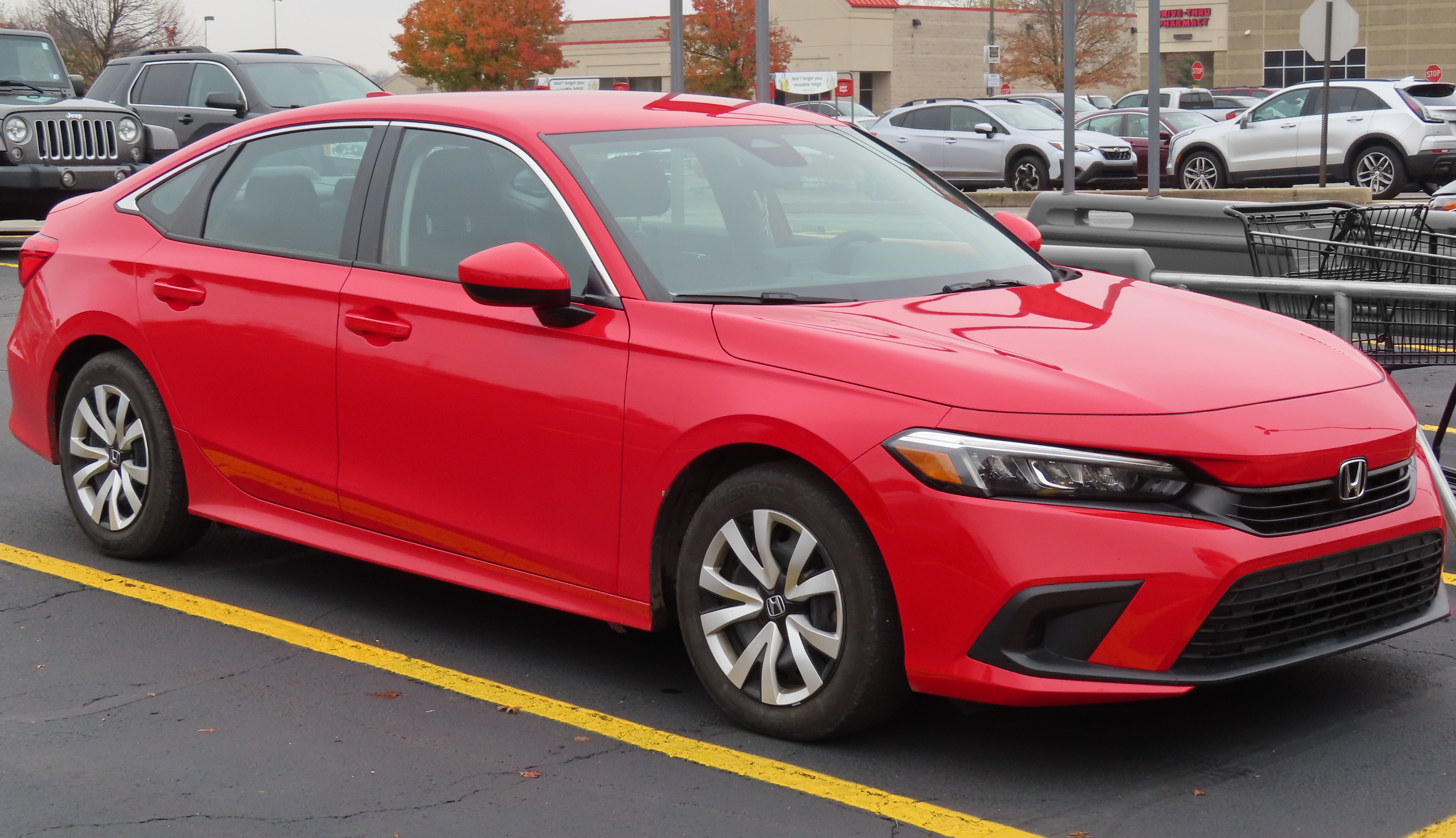
the floor and by saying, you know, looking at your Civic hatch, but I also want to look at
two cars. Your Civic, because I have some experience with Civics. And I want to talk
about your Miata. Okay. Even though Vicky, you're not, it's a spec Miata and you're
not endurance racing it. Like, if you were going to endurance race your car, what would
we do to that? Because there's a lot of Miata's that look a lot like yours.
This is true. Well, actually, if you, if we could expand it to our third car, that would hit
even more people. The E46. I think that's another great one. Like, because it's generic platforms.
Yeah. I mean, if you're going to stay to the spec class, of course, you can't
modify it, but if you're going to go endurance racing, why not try to spoil the run or whatever.
Okay. So there's, there's this guy crawling around inside my head, Mario.
That I'm, I, I always try to put myself in the shoes of our listeners and some of them
wear very small shoes, which doesn't work very well for me, but that, that's beside the point.
I could see a listener saying, but Mario, it's just going to slow me down because
it's going to be all drag and I don't go that fast. So why bother?
See, that's a great question. So that is a statement, but I was going to try and
ask a question. Why, why wouldn't you do arrow on your car? And there's your first answer
would be something like, well, you don't want to slow your car down.
Yeah. It's slow enough with us driving. We don't need to go any slower.
So I think that brings up one of the fundamental misunderstandings of aerodynamics,
which is that it causes drag. There are lots and lots of things that reduce the drag on your
car and would make your car go faster and use less fuel and use less tire and use less brake.
Well, that was the second one I was going to get to is, you know, if all this down force is just
going to push my tire into the ground, I'm going to wear my tires out.
Right. So that's a good, I guess we're not going to do this graphic method.
I'm just going to have to play myth buster. So, well, I'm trying to give you questions that
I've, yeah, well, no, that's a great one because down force makes your tires last longer.
This is not like a mysterious thing. This has been, this is known through time.
Tires wear through abrasion by sliding mostly. And when you slide through a corner,
it braids more than when you stick through a corner.
So just because it's a heavier, effective car, it's not pushing more and wearing out.
It's it's the slipperiness. Yeah, let's just take a, for instance, of like a track
like Watkins Glen where maybe turn 10 in a lot of cars, you're kind of flat out.
And some cars, you kind of roll off and some cars are flat out.
But if you were sliding through that corner, you're going to be wearing your car tires,
whereas if you were stuck down your note, right? And so maybe there's only one turn
on your entire race track where you can go through with aerodynamics
down force and stick instead of slide. Well, that's just one corner and doesn't
matter. Well, over the course of an endurance race, hitting that corner many, many times,
you will use less tire. There was a great, you know, you guys know I love the wind tunnel stuff.
There was a in the 2000s, early 2000s, there was a SCCA group that was racing C5 Corvettes
and they took a C5 up to the wind tunnel in Canada. And you can, you can purchase
this wind tunnel report from them. I think it's 35 bucks. Anyway, it goes through the
what they were trying to do, which is they were struggling with some tire wear issues and
a sort of grip issues and changing. Anyway, the long and sort of it is, when they increase
the down force, they absolutely increased the tire, the tire endurance less degradation
and it lasted longer. So first of all, does down force increase tire wear? No.
Okay. Let's get off of that one. Yes. Does it slow my car down, Mario?
Does down force slow your car down? Of course not. No, it does not. It makes your car go faster.
So there are, I think what you're asking me though is about drag, that down force. Yes.
Yeah. So this is definitely not the Socratic method. Okay, let me instruct.
Usually there's a relationship between down force and drag such that if I down add down
force, I also increase drag. Yes. Okay. But that's not always true. Some things
increase down force and also reduce drag. And some things of course, just reduce drag and
they don't change the car any other way, but they reduce drag and we would want to do probably
all of those endurance racing, right? Right. If you could get, if you could reduce the
your drag by 10% and then it made no other changes on your car, you would do it.
Yes. Yes. So when I looked over your car and your Civic, which I love,
I had a EF hatch and your EG is just strikes all right numbers.
I'm just like, well, there's a lot of low hanging fruit just when I looked at the
front of the car, for example, and also when I went to pit race. So let me ask you guys about
hood vents and fender vents. I didn't see any hood vents on your car.
Well, we had just replaced our hood from when we put holes in it by hitting a bridge.
So we have, we have, we had thought about it. We had thought about it, talked about it,
but we ran out of time. What do you suppose happens?
Let's just follow the path of air for a moment as it hits the front of your car,
goes over your car, under your car and through your car.
Mm hmm. I want to ask each of you a question about that. So let's start with
Bill. Oh, Vicki, you're going on and on and off for some reason, your camera, but it's okay.
So, Bill, let's talk about the air that goes over the top of your car. What do you suppose
what do you suppose is happening dynamically to your car as the air travels from to back over your car?
Uh, I guess my thought would be I'm getting, well, the air that goes over my car, I think,
would push the car down and backwards.
Sure. That's a good, that's a good one. What about, so that is true of things like
the windshield, right? And probably the more vertical the windshield, the more it would push
it, right? Yeah, like by many it would be just, you know, basically a brick going through the air.
Yes. But generally this, the rear of a sedan or even a hatchback sort of slopes downward and
what do you suppose that does? So there's, I would think there's going to be a little
turbulence off the transition and then perhaps some suction down, perhaps.
So, well, yes, to the turbulence, but if you follow the sort of the path of air as it goes in
any direction, there's sort of a force in the opposite direction. Okay. So if air is shooting
downward off the back of the slope of the car, it's lifting the back of the car upwards.
And what do you suppose happens when your car, the back of your car lifts upwards?
Well, with our drivers, Mario, we are going to spin.
Vicki, let me ask you about that then because I know that I think you're spun your car.
So aerodynamic lift is what we're talking about and all cars, street cars have a certain
amount of aerodynamic lift. Okay. It's almost impossible to avoid. Yes, some air hits the
front of your grille and your windshield and pushes the car into the road,
but the rest of your car is sort of teardrop shaped and lifts upwards.
And if you can think about tire grip as being the weight, as based mostly on the weight of the car,
if you decrease the weight of the car by 10%, you have lost 10% grip.
Does that make sense? Yes. Okay. So we talked about the air hitting the front with the windshield
and then sloping up and sort of lifting the back. So what is happening at speed,
the faster you go to your front and rear tires relative to the grip? What's happening?
Well, I mean, just by nature, the whole back end is light. The whole back end is light.
So I have to be extra careful when I'm actually driving the front wheel drive
because it is easy for the back end to come around if I don't do something properly.
So I'm wondering, is that what it is when the air is going over and it's lifting and is kind of
maybe making the back end lighter? Yeah. So let me give you some numbers.
To put this into context, I measured a few cars in the wind tunnel and I have some data from some
other cars. And generally at about 100 miles an hour, you're seeing around 130 pounds of lift
over the rear axle. Now, what does that mean? It means not just for me, but for everybody else.
Yeah. It means that the rear of the car is lifting upwards with the force of 130 pounds.
Okay. It's just like an airplane wing creates lift largely because it's sort of shooting
air downward at an angle downward. And the car is too. As the car goes through the air,
air goes over the roof and kind of shoots downward at the back and it lifts the back
of the car up. And so you've lost 130 pounds of rear weight. So I just want to think about
like on a Miata, which let's say is 2,400 pounds, okay? 1,200 pounds over each axle.
If you were to lose 130 pounds over the rear axle, you've lost the rear. The rear of the car now
weighs 1,070 pounds and the front of the car is 1,200 pounds. Okay. Yeah. Essentially though,
you've lost 11% grip on the rear tires alone. Okay. At 100 miles an hour.
You know, that's probably straight line speed and more realistic, let's say 71 miles an hour.
You've lost 5.5% grip on the rear tires as you're going around a corner. We've all gone
around corners at 70 miles an hour. And now you've lost 5.5% grip. That's a lot of grip.
Yes. What happens on a front wheel drive car?
That is, I'm attributing that to the front wheel drive car.
Okay. We were talking about a Miata. I'm sorry. I was saying. No, no, no. Because the front,
because it's the Honda, I'm sorry, it is the Honda itself that is super light.
Okay. So because also it's light, I don't have a differential back there.
In the same sense where it's like a rear wheel drive where there might be more components back
there to make it heavier. I'm not exactly sure. I just know that with the front wheel drive and
the engine up front the way it is, and there's nothing back there, then the balance is highly
off. Yes. Let me give you some numbers. Okay. So I wanted to start with a Miata that was
I'm sorry. I'm sorry. No, no, it's fine. We're talking about a Miata that's 2,400 pounds,
and it's got 1,200 pounds on each axle. And it lost 11% grip at 100 miles an hour.
You're civic with just 2,400 pounds. Let's just say it's the same weight.
Okay. Yeah. It's going to have 1,600 pounds on the front and 800 pounds on the rear.
Oh, wow. Yeah. It's roughly 6,535 or something like that. Split. So what happens is when you lose
130 pounds of rear downforce, you've lost, I mean, 130 pounds of lift on the rear,
you've lost 16% grip on your civic, not 11%. Oh, wow. Yes. So this is why aerodynamic
downforce over the rear is so necessary and also actually quite necessary for a front wheel drive
car. Front wheel drive cars have most of their weight in the nose less on the rear.
And so when they lose grip on the rear from aerodynamic lift, they lose a lot of grip.
Because they don't have that much to start with. They didn't. They only had 800 pounds on the rear.
And when you take 130 pounds off on the rear, now you're left with 670 pounds, whereas the Miata
at the same point had 1,070 pounds, 300 pounds more grip. Thank you for that. I think you
guys understand that rear lift is treacherous. Yes. So when people make fun of front wheel drive
cars with wings on the back, because the engine's not back there and the wheels aren't doing anything,
you know, why are you doing that? There's a fault in their logical assumption.
Well, yeah. I mean, it's the same people to say, oh, it's stupid if you have a wing on a car
that doesn't have 200 horsepower. Those people are great because you can go around them.
You can be everywhere. I want to tell you a quick short story about my Veloster N.
It's a front wheel drive hatchback. It's roughly the same weight balance as your Civic.
And I did a bunch of aerodynamic tests, which was just adding rear arrow. I didn't add anything on
the front. Left at stock. And I just added progressively more arrow. I started with the stock
kind of no spoiler situation. I mean, just a stock hatchback. I added a spoiler,
then I added a wing and then I added a dual wing. Okay. Each time I added more rear arrow,
the car went faster. So at Pine View Run, which is where I do some of these tests,
the wing and the spoiler were actually the same speed and the car went 0.7 seconds faster.
And you're like, making a 0.7 seconds faster. That's a short track, though.
Yeah. So and then at, and there's only honestly three corners where
arrow matters on that track. And then when I put the dual wing on, it was 1.3 seconds faster per
lap. You know, this is a minute and 26 seconds, right? So then I said, okay, let's take this
same situation to a New York safety track where the lap times are around 100 seconds,
okay? A minute and 40. But your speeds are higher there.
Yes. The speeds are higher. There's a long straight. There's time for things to happen.
Right. So I went to New York safety track
and it was about double. The wing and the spoiler were about 1.5 seconds faster
than no wing. And the double wing was 2.5 seconds faster. So the people who say that you
shouldn't put a wing on a front-wheel drive car, let me just say I'll go 2.5 seconds faster
with no front arrow, 2.5 seconds faster per lap. That's all day long.
Hmm. Right? So, yes. I mean, no doubt that's a big deal. A lot of times you'll see
front-wheel drive cars with a diffuser but no wing.
Would that be complementary, supplementary, or opposing what we're saying now?
I want to talk about underbody in a bit. Okay.
And we're going to table that because we were just talking about only about the car,
the air that goes over the top of the car. Right. For starters.
Let's just do the underbody right now. Okay. So, Vicki, what happens to the air as it goes
under the car? Follow the path, follow the path of air. It lifts.
Probably, yes. Yes. It probably does lift a little bit. What else is underneath the car?
Just a lot of components. I mean, it's not smooth.
You have a lot of rigidness from the engine and components that are up underneath there.
Yeah. There's all sorts of junk. There's pipes. There's suspension arms.
There's a big old exhaust can. And as the air hits those things, it does so in a sort of
disorganized manner, right? Just sort of creates what we call local flow separations around every
single object. So the more air that goes underneath the car, the worse your situation is.
Okay. Yeah. And then we have to also think about tires. And Bill, what happens when air hits
the front of a tire? I mean, from an aerodynamic standpoint, I think the air is
very turbulent. Like I'm thinking really high Reynolds numbers and non-laminar in almost any
aspect. From what I understand, it's like the worst surface on a sports car for aerodynamic impact.
Good summary. Good summary. It's the worst. For the reasons that you mentioned, there's a lot
of turbulence around it. And also as the tire rolls forward on the ground and it
air is hitting it at 70 miles an hour, it's squishing that air, like kind of compressing it.
And it shoots out either side of the tire. There's a compressed jet of air that shoots out
either side of the tire. Some of it, half of it goes to the outboard side and it's not a
problem. Half of it shoots across the inside of the car. And it goes all the way down the
car, hitting exhaust pipes and suspension components and all the other things underneath the car.
Right. So we really want to organize the air underneath the car, get as less air as possible
underneath the car and keep it away from the tires. Right? Good. All right. Final thing.
How does the air move through the car? And this is a two-parter. I'm going to ask Vicki
about engine and I'm going to ask Bill about cabin. So Vicki, how do you suppose the air
moves through the front of the car to the rear of the car as it enters the radiator, brake ducts,
or anything else that's in the front of your car? Well, I'm thinking that if it's entering
in through my radiator, it needs some place to go and work its way out and it really doesn't
right now. So it just kind of goes into those components over the engine through the
radiator. Well, through the radiator, probably if you don't have anything smooth in the radiator
between the radiator and the engine, it just kind of blows up and kind of
creates a mess up underneath there, I would say air-wise. Yeah. I would agree with that. And where
does it end up? I don't know. I don't really know because I know that there's some kind of venting
up near like the windshield. Actually, that is a high pressure zone. So actually,
the air at the windshield goes into the engine compartment. Yeah. So it probably doesn't really
go anywhere. It just kind of hovers in there unless you have vents at speed. Well, it has to go somewhere,
otherwise the air... Or it goes back underneath the car. Yes, it does. Because if it didn't go
anywhere, the radiator would stagnate and it would move further. So instead of pushing,
go underneath the car. Right. So just like we said, it's terrible for air to go under
the car. And now we've put more air under the car. Right. More air, more worse. Yes. So Bill,
what do you suppose happens to the air that goes in the cabin?
Well, in trying to think if there's any... In all of our cars, they're kind of enclosed
towards the rear. Like there's basically the side window for egress. So I think it kind of
goes in or gets turbulent or gets buffeted around and eventually it just...
I mean, it's got to leave for more air to come in, but it's got to leave the same way it came
out. So it's... I can't imagine that being anything good from an aerodynamic perspective.
No, it kind of sounds parachuted. Yeah. It's got to go in, but it's got to come back out. And like
you said, buffeting and other things that you can feel that sometimes, right? Your windows
are open because we have to race that way. Or hear it, but worse is worse.
And let's say you're going around a right-hand turn. I mean, the air is coming in that left
window like crazy. So anyway, yeah. So we've understood though that the air going under
the car is terrible. Air going over the car lifts it up and air going through the cabin
sort of pressurizes and creates a parachute. So wouldn't it be great if we could like mitigate
those things and make our cars not do those things? We need a track that's in a vacuum.
That would be so easy. That's such a good answer. Actually, that would solve all those problems
except that you couldn't really create downforce. And now downforce is grip.
It would be tough to do an endurance race with no air either. So...
Well, just so as we said that lift was bad because it creates less traction,
downforce is good. It creates more traction. Yes. So there are some things that we can do to our
cars that benefit drag reduction and don't otherwise greatly harm the car. Now, given
some of the things that we talked about, Bill, let's just go backwards in time and say what
kind of things do you suppose we might try to do to make the cabin less of a parachute?
I think we could use window nets perhaps and maybe the more tightly woven mesh type would be
better than the widely spaced NASCAR grid net looking things.
So what you're saying is keeping air from going in the windows?
Yeah. Or maybe a deflector on the A-pillar might give us a little bit of love.
Not sure it'd be good or bad, but it might help.
Those are things that we tested in the wind tunnel that are in my second wind tunnel report.
We tried deflectors on the A-pillar. We tried a little rail on the roof edge,
the top of the roof edge, to keep air from curling into the top of the window.
So we did have one car that we've had in our history that had, it was a Foxbody Mustang.
And it had no rear window, so it was just open. And I wasn't sure if that was helping us or
hurting us because I could logically make several assumptions and I never figured out
what the answer would be. Or is there a general tendency or is it case specific?
Well, I did test something like that on a racetrack with strain gauges, not in a wind tunnel,
but I want to tell you something else we did in the wind tunnel with the Miata we took there.
So oftentimes you'll see somebody with a Lexan rear window and they've vented it.
They'll put some circular holes in the window.
And they do that on bumpers too.
Yeah, they do. So what happens if you put, let's say,
a few holes at the base of the windshield. What do you think happens to the car in terms of drag
and downforce or lift?
The rear at the base, so towards the back.
That's where you often see people have like little pop holes or other stuff.
I think it's probably better than if it was at the top or the roof line.
But I'm not sure it's doing anything for you.
Well, that's why people put them there. They think that it's going to vent the cabin
and it'd be nice to get that pressure less of a parachute, right?
Let's put a hole in the top of the parachute and let some air out.
But you've got a Bernoulli effect going, so I'm not sure it's working for you.
Well, the problem is, is because the air that goes over the top of the car
hits the trunk and becomes a high pressure zone. The air actually goes in the car
if you put the holes at the base of the windshield.
So if you read my wind tunnel report, not a hard sell. I'll give you the data.
It increased drag and reduced the rear downforce. So you get less grip and more drag
if you put the holes at the base of the window.
That sounds like racing. You do all that work and you get worse.
And of course, you have exhaust coming back into the car,
which was an issue that we had at one point with one of the cars.
Yeah. So if you put those holes at the top of the windshield,
the opposite, you actually reduce drag and you gain grip.
Yeah, but it's not just you that's wrong. It's just about 90% of the cars that I see
that vent their rear window do it incorrectly. So to answer your question,
should your Fox body Mustang have the whole rear window gone? No.
You should probably just leave a small gap at the top of the window,
but the window intact. But if you leave, let's say a two inch gap at the top of the window,
it would extract the air from the cabin and sort of almost sort of like lengthens
and reduces the backlight angle of the rear canopy. I'm not going to explain exactly why,
but that is like a useful thing to do. Sure. Don't drill holes in your glass window, people.
Yeah, not at the base. Or the top or the bottom or the middle. I know how to do it.
It's not fun. So that we were talking about the cabin, but I also want to talk about the underbody.
So what are some other things that we might do to reduce the drag on the underbody?
You often hear people talking about flat floors or
I just blanked on the word. The piece of wood that we cut, Mario, that we put on the front,
splitter splitter. Yeah, let's come back to the splitter in a minute. But yeah, flat floors.
There's obviously some problems with your diff and your exhaust getting really hot.
So you need to either put NACA ducts or other things. But for endurance racing, absolutely.
There's a ton to be gained by reducing drag on things underneath the car. Like why wouldn't you?
And also oftentimes you'll get some downforce of that if there's some suction there.
I do want to talk about the splitter because in the world of aerodynamics, there are things that
can reduce drag like we just talked about, right? Maybe some vent holes. And then there are things
that both reduce drag and give you downforce. These are sort of the magical things, right?
I get downforce and drag reduction at the same time. I know one. Tell me.
Big desserts because I get rounder way more. So I have more downforce and more aerodynamic efficiency.
Yes, but only on the left side. Whatever. Just give me more dessert.
Don't get in the way of my dream here. I wonder if there is anything like a dessert. Yeah,
you know, so the desserts, Vicki, what about you? Do you have any ideas about what might
give you downforce and reduce drag?
Well, definitely we would have to vent the hood. Yes. Excellent.
So venting the hood is a triple win. So A, you reduce the drag. And sometimes, I mean,
it's not always hugely significant, but it's a small amount. Okay. What's happening is
all the air that was going into your engine compartment and hitting all those things underneath
the car and in the engine compartment, all that air now goes out the roof in a much more direct
fashion, right? Out the top. And because it's going out the top and not creating lift,
it actually pushes the car down, right? The air is exiting upwards. It pushes the car
downwards. You get a small amount of downforce. Like, you know, if you really vented the
shit out of your hood on your E46, you might get in the neighborhood of 40 pounds
of downforce at 100 miles an hour. But you'll be cooler too. So that'll help you as well.
That was the triple win, but you're jumping ahead. Sorry. I saw the test. I stole it from
your office. Awesome. Well, even if you could get, let's say, 25 pounds of downforce,
which is a reasonable size hood that, you know, let's say 200 square inches or something like
that, you could get around that. And it's free. Like, it doesn't create drag.
The hood vents on my car made my car run about 10 miles, 10 degrees cooler.
You'll see the temperature fluctuate around the track and at there's, you know,
between six and 10 degrees cooler, which I think is pretty significant.
Especially in endurance racing. Yeah. And you got that with drag reduction and
re-grip. You're like hallelujah. Fender vents are similar in a way. You don't get the cooling
effect, but they do almost nothing as far as drag. And you might get like 14 pounds of downforce.
This is around your wheel wells. Yeah. On top of the fenders, basically. The arch of the fender there.
That reduces the pressure in the wheel wells because air is getting pushed into there from
your splitter and other things and it just lets the air out. Sort of a parachute effect to there.
What about when you see like the some people or some cars will have a flare towards the back of
their quarter panel and the back will be open? Yeah. Like if you were to really direct
the air there in a smart fashion and it can be useful. On the Miata that we tested, it was zero.
We cut across, we cut that whole fender out to see what would happen.
Yeah. And it's because there's basically a 90 degree angle that the air would have to come out
and a forward facing lip, like a small gurney flap. That's basically where the
frame is pressed together by the unibody there. And so it can't really go around that.
So fender cut on the back of the wheel looks cool, does jack shit. Fender vents on the top,
they work. Okay. So hood vents, fender vents, something for free. Let's do another one.
Splitters. Splitters reduce drag. Oh, so many people think, oh, I don't want to put a splitter.
I don't want to put downforce on my car because it's going to make my car slower.
Well, what if I told you that my best splitter reduced drag by three horsepower at 100 miles an
hour? So this is, I got three horsepower for free with a splitter. So just to be clear for everybody
listening, you're talking about just the planar horizontal piece, not the front air dammer,
anything like that. Or are they together? No, no. The air dam is just,
yeah, we'll talk about air dam in a second. On most cars, let's just say you just put a flat
piece of wood underneath your car. Okay. Like it sticks out three inches and it's, let's say,
four and a half inch ground clearance because that's what I tested. These are pretty mild numbers.
A three inch splitter is short. That's grid life touring cop size and it's very short.
And four and a half inches is really high. It's like you would really typically run
your splitter at three inches, three and a half inches. But I wanted to test it at this
absurdly high number because I was doing other tricks. Anyway, so the standard splitter,
which I was just called basic bitch splitter was a flat piece of wood plywood with a sharp lip.
Like I didn't bother rounding it over or doing anything to optimize this splitter.
I just stuck it on the bottom of the, on the front of the car and it reduced drag slightly
like on the order of like, you know, 0.5 horsepower or something like that. Not
much, but it did reduce drag, but it gave 130 pounds of front grip, front downforce.
Is that by just making the air underneath a little more, a little less turbulent or is that?
No. So yeah, it's, it's a good question. It's, there's pressure, high pressure on the top of the
splitter blade and there's low pressure underneath the splitter blade. There's suction underneath
it and there's pressure on top and the difference between the two is where you get the downforce.
So even if it's flat horizontal, I know it's flat and horizontal, but it still creates suction
underneath the car because there's more air going over the top and it's there's friction
going coming down. Yeah. So that is the basic, basic splitter. Like I didn't try it all to
make that thing any good. Then I did the same kind of splitter, the same exact shape, the
same everything. I rounded the lip a little bit better. I tapered the trailing edge and I curved
the entire thing five degrees and it made 195 pounds of downforce, not 135 or 130, 190. So 150
percent more downforce by sort of curving that splitter, which means that the trailing edge
kind of kicks up a little bit. Okay. So all it does is let the air expand behind the splitter
a little bit more. And then I did another fancy splitter that was sort of in between.
It actually had more curvature and it had some streaks on it and other stuff.
And that one's the one that made 175 pounds of downforce and reduced drag significantly
to the effect of gaining three horsepower. So if anybody wants to see that, they have to go
see Khan's race car because I'm sure he didn't let you leave with that. Oh, no, that's not legal.
It's not legal for his class. I would have done it in a heartbeat, but they have the
dumbest splitter rules. So what I want to say about splitters is every car should have hood vents
and most cars should have splitters. But I do understand that like endurance racers
rip their splitters off all the time. They go off track, which I don't understand.
It's not a sprint race. Stop going off track. That's not where you want to make time up. Anyway.
But that tenth of a second, Mario, that could be the difference over 15 hours.
Yeah. No, it's not. It's not where you make up time. You know it. So for the endurance racers who
like to go off-roading, I would say, don't make a splitter. I would say make an air dam. Just like
you said, this is just a flat front section that builds up a little bit of pressure, but the underside
is still kind of like a splitter. It comes back. It has a flat surface. It has some diffusion
to it and it creates downforce, but it doesn't have that lip that sticks out and gets stuck
in the mud. But it still can create a significant amount of downforce and it just doesn't get in the way.
So in looking at your car, Vicky, when I came into your shop, I said,
oh, you don't have any hood vents. You don't have an under tray.
You said a lot of things. I did. I was unkind. You were horrified in an aerodynamic way.
I was. But then I went to pit race and looked at those cars.
Let me count the ways. No, I looked at the pit race and all the cars I saw there were the same.
I mean, most people are doing a terrible job with endurance racing aerodynamics
and they are losing out on free drag reduction and free grip. So do the venting, right? Like we
said, do the fender venting, do the hood venting, do a splitter or an air dam and an under tray.
The under tray is the secret. It's not the splitter lip that's super important. That
is, of course, important, but doing a proper under tray and your car didn't have an under tray at all.
Nope. Yeah, which means that there's a you're not building any suction or any additional front grip,
which in your case might be good because you have nothing on the rear of the car to counteract
the downforce. We have the beginnings of an under tray. You know, I've got it. I've got a
terrible, great idea. Yeah. It's brewing in my head. We have this thing we call friends
giving weekend where we have people come over and we do car projects in the hangar and I bribe with
large, huge pieces of cow and other assorted animals and sidelines that Vicky makes because I
make things that move. So I'm just saying, if your schedule allows the friends giving weekend,
we have it's difficult. We have plywood. We have everything. I would love to do it,
except that my son is coming to town and I haven't seen him in a bit and we will bribe you another
weekend. Don't worry. I have cow in the freezer. I need three days to get it thawed and prepared
and we can have it covered. Outstanding. I'll be there. So I wanted to move to the back of
the car because we were really just talking about some of the things on the front of the car
that get you get something for free. So one thing before we go there, do we want to
vent the wheels in the back as well? The rear wheels are behind the wheels. There's
less to be gained there. By that time, I think the air is maybe a little dirtier and I think the
front air is a little easier to work with. I know that some people have done some interesting
thing with the rear, but I haven't. Part of the reason for that is that the wind tunnel I use,
this A2 wind tunnel, it doesn't have a rolling floor. It doesn't have a suction for the boundary layer.
It's kind of a smaller wind tunnel. It's basically what can people like me afford.
Accuracy decreases the further you get downstream. Because of all the interactions.
Yeah. You were asking me about a diffuser and I did test a diffuser in the wind tunnel
and I got really miserable results, but it might be because of the wind tunnel and not
because of the diffuser. So it's a really hard question for me to say. I'd love to say diffusers
suck, don't use them, but all I can say is my diffuser sucked in that wind tunnel.
So let's talk about the rear of the car and there are some things that you can do for free.
I saw a lot of Miata's as usual and some of the Miata's were just basic like spec Miata's,
right? Yep. With nothing on the end. So let's talk about spoilers for a second.
You guys know what a spoiler is? Yes, sir. It's the swoosh in the back. Oh, no, no, it's when
you give away the ending of a movie. That's a different that's a different spoiler. Oh, sorry,
wrong spoiler. Wrong. This isn't a wood episode. This is a. Oh, dang. Go ahead, Mario. Yeah.
Well, here's the spoiler. Spoilers can reduce drag and give you downforce. So on a Miata, for example,
like we tested spoilers at five and seven and 10 inches tall. But mathematically, you can kind of
create you can kind of interpolate that data and see what would happen at different heights.
And probably somewhere around two and a half inches or three inches, a spoiler is reducing
the drag of the vehicle and also creating downforce. Is that because it's affecting the
turbulent flow behind the trunk area? It has to do with some of that. It has to do with a cleaner break
at the at the at the aft end of the trailing edge of the car, a cleaner break, but it's
I won't even I can't even say 100% that I understand the mechanism behind that.
I know it kind of lengthens the roofline in a way because it sort of creates this high pressure
bubble over the trunk, but I do know that it reduces drag. Anyway, the five inch tall spoiler,
which is kind of decent sized, right? If you think about a five inch spoiler,
like that's pretty chunky spoiler in the wind tunnel that made just over 100 pounds of downforce
rear downforce. And like everybody said that the Miata made like 130 pounds of rear lift,
right? Right. So you're almost back to neutral. Yeah, you've counteracted almost all of that lift,
right? And it actually makes a little bit of front downforce to the spoiler does.
Okay. Why do you suppose
and that's not the question I want to ask, how much horsepower do you think it costs
to make that 100 pounds of downforce?
It's guesstiming time. Vicki, how much horsepower do you think it costs at 100 miles an hour? How
much horsepower are you burning to put a big five inch big blocky thing on the back of your car?
I couldn't even tell you. Well, just throw out a guess.
How much, how much force, how much weight? No, how much horsepower, like let's say
your car has 120 horsepower. Let's say 80 pounds due to drag. How much is it losing just from the
spoiler? 20%, 10%. Wow. That's a good guess. Bill, what do you think? I was thinking it was like five.
Two, maybe. Two? Well, that's my guess just upside down. Yeah. It was kind of surprising
that this five inch tall spoiler only used 2.3 horsepower. Wow. Okay. That's almost nothing. So
when people say, oh, I don't want to air on my car for endurance racing, and we've already gone over
the things that they can do for free. And here's the spoiler that is 2.3 horsepower loss, which is
nothing. And they gain over 100 pounds of downforce, which means they lost that rear
less rear grip, which means the car is going faster. And on average, like on a decent track
like pit race, a spoiler would probably be, you know, two to two and a half seconds faster for a lot.
I'm sorry. I have to correct you. Pit race is more than a decent track, by the way.
Everybody, let's just have a moment of silence. Yeah, really?
Okay. I'm so sad. Yeah, I'll be there in a couple of weeks, by the way, for the last
time. Again? Got me jelly. Yeah. I'm coaching that last event with hooked on driving. Super stoked.
Anyway, yeah, so the spoiler was really not draggy at a height of five inches. Well,
when we cranked it up to eight inches, it was dragger and at 10 inches, it was really draggy,
but of course, you know, those are huge. Yeah, the downforce just keeps going up. This was
one of those Blackbird Fabwork spoilers that you can change the angle, basically. So we could
five inches as low as we could put it and 10 inches as high as we could put it. So we just
tried through things. The wing, we tried the nine lives racing wing was actually more drag than
the spoiler than a five inch spoiler, which kind of surprised me. It's still a very low drag wing.
I think it was only like on the nature of 2.8 horsepower burned through using a wing.
And it made a lot more downforce than the spoiler. But on an endurance racing car where
you're like, okay, maybe I don't want to run a splitter. I think I'll just use the spoiler and an
air dam. That is a fantastic package, right? That like has very little drag, has a lot of grip,
and a good decent air balance. Before I get any further, I want to do talk about air balance.
So we talked about the splitter, maybe it makes 130 pounds of downforce or whatever, right? 180
whatever you want. It actually loses a little bit of rear downforce because the whole car
sort of tilts forward, you know, it has and it loses the rear. It's like a seesaw. Anytime you
put a whole bunch of weight on the front, you lose some on the rear and vice versa. Right? So
if I put 200 pounds of downforce on the back of a car with a rear wing, I'm going to lose 40 to 45
pounds of downforce on the front of the car. That's just that's normal. And the splitters
were kind of similar into the wings in that respect. But spoilers don't do that. A spoiler,
if you put 100 pounds of downforce on the rear, you don't lose anything on the front.
It doesn't lever the car up in the same way. I'm not exactly sure why I think some of that
high pressure area extends further forward. And also it's just, it's not as high or as far
rearward. But I was just flatly amazed by how well spoilers worked in the wind tunnel.
So digesting everything that we've gone through so far to this point, which we're not done,
a question came to my mind, which is probably Bill overthinking. I know it, I know it's hard to
imagine, but you guys are both sitting down. So I figured I could do it. Would I want to
account for the weight distribution due to aerodynamics at some nominal speed when I
start corner balancing and adjusting the weights of my car either front to back,
probably front to back and mostly. You know, I think a person who's smarter than me would
probably do that, but I don't, I wouldn't do that. Juice not worse to squeeze, maybe.
I just think it's so easy to adjust rear arrow.
Then I would just do that. Like, I think like one of the benefits that I don't,
people don't talk about much is that rear arrow is the most easy to adjust thing on the entire
car and it has the greatest effect on high speed stability. So if you think about like
your suspension, you've got camber, you've got toe in, toe out, you've got caster, you've got
your alignment specs, your corner weighting, your sway bars, your shock stiffness, your
damming ratios, all of those things. All that stuff. Yeah, that shit's confusing, dude.
And what do I need to make my car handle better? Well, the rear wing is such an easy adjustable
thing. Like you could be like, okay, the car feels, you know, really loose and high speed
corners, add wing angle. Oh, the car is pushing a little bit too much in, you know, high speed
corners. Take a little wing out. Like it's one of the easiest things to adjust. Right. And I
think that that, so I wouldn't also look, I wouldn't be able to calculate, oh, this is
going to add so much, so much downforce and we're going to want to do this to the corner
weights. I just, I don't have that kind of knowledge. Sure. Okay. Overthinking done.
Yeah. Like also, like, like we started with eons ago, tire wear
increase is reduced with aero and adjustment of the car is easier with aero. I love those
two things about aerodynamics and endurance racing. Like you could even be like,
you know, why one driver likes the car loose and my one driver likes the car
tight. And you could change that in a driver's swap. Like try doing anything. What are you
going to change rear rake? Like, you know, like, what other things let me adjust that sway bar
while we're in 30 seconds. That's like one of those things that I love about aerodynamics.
We need a spring change. And I just think that also just being at an endurance race
and seeing your car off, both of those things maybe say, ah, I want to get on Bill and
Vicki's podcast and talk about this really low hanging fruit, because there's so many ways to
go faster in endurance racing. And none of these things are to make the car super draggy.
We're not talking about a dual wing and canards and this and that. We're talking about things that
benefit both drag and downforce. Very simply. You forgot the most important thing though,
Mary, all this tech, all this science, the car looks cooler.
That does look cooler. I love spoilers. I think that I got a street car spoiler looks cool and
a wing is a little gaudy. But on a racetrack, they both look super cool. Yeah.
So can you use a spoiler on like a hatchback or is that?
Yes. So hey, I'm so glad you asked. So on my Veloster N, I've tried, I think at this
point, eight different wings and a couple of different spoilers. And I will tell you,
yes, the spoilers work really well on hatchbacks also. Yeah.
And here's the way when I would use one or the other. If you're using a splitter, I would use
a wing. If you're not using a splitter, I would use a spoiler. I would say the same
thing on a sedan too. Because of that seesaw effect, when you have a splitter,
you lose some rear downforce. And when you have a wing, you lose some front downforce.
So you kind of do them both, splitter and wing. But if you're going to just run an air dam with an
under tray and some hood vents, throw a spoiler on there and either make it adjustable for height
or just make a base spoiler that you can add different heights to. If you made a three-inch
spoiler and you could make it four inches or five inches just by changing a metal plate
or something. So when you say height, I'm just trying to get the picture for the people because
they can't see our hands when we're doing our podcast. When you say height, are you talking
angle or length? That is such a good question. All that really matters in a spoiler is the
total height above the deck. Okay. You would think that the angle would matter a lot,
but it doesn't really. And the shape doesn't matter. There's a lot of factors that are
very, very small players in this thing. I think vertical spoilers look dorky. So I wouldn't do a
vertical one, but I would do 75 degrees, for example. I think that has sort of a duck deli wedge look
that looks fun. So a nice black diamond slope for the skiers of home. Okay. 45 degrees, I think
is laid back a little too much. Too much. Okay. So somewhere in between. Yeah. I mean,
I think NASCAR was using 70 degrees for a while and it does look fantastic.
So the grid life stalker in me makes me think to James Houghton's spoiler
that he had a square surface area limitation. So what he did was he drilled holes
to reduce the surface area. So they still had the right surface area,
but he had a bigger, effective spoiler. Would that be beneficial or hard to say?
It's hard to say. Like you'd have to think that there's some air resistance going through
those holes and so that it probably did was beneficial. But I mean, there's just a certain
height at which the spoiler is going to work. And if that got him into that height
better, probably work higher. Yeah. But I think it's also a really good way for him to,
for people to look at, not look at other parts of the car. If you, if the left hand
is doing this, you don't see what the right hand is doing. And so I've heard so many people talk
about his spoiler and the holes he put in it. And the real magic is that they haven't talked
about the other shit. Plus he's a phenomenal driver and all the other stuff that he's done
to his car, right? I'm sure. I'm sure that. Yeah. So I would do something flashy. I think that like
end plates, you know, like wings that have fancy end plates are great. It's a great distraction.
None of them do eject shit more than a rectangular piece. But they look cool.
But they look cool. And they distract people from all the other cool stuff that you've done
in your car that perhaps they don't see. Yeah. I saw the end plates this weekend that were,
I believe they were Coolio in Coolio's head shape. It was kind of funny.
So awesome. I was saying that now you guys have an understanding of how you thought about
how the air moves over the top of the car and underneath the car and through the car.
And you can think about ways to reduce the drag and increase the downforce or reduce the lift,
which is the same thing on those things. Right. I would love to see what you guys
would do with the blanks plate E46 that you wanted to take into interesting.
Okay. So I'll tell you what stopped us a little bit. And we've talked about this when you came
down a couple of times. The hood vents. I've got no problem doing it. Ms. Vicki does a
wonderful job. Ms. Vicki is very concerned about doing it wrong. So but she's artistic.
We're good. We can do hood vents. We've never done fender vents to this point,
largely because we just, we kept breaking other stuff and never had time.
The one that concerned me from the beginning is the splitter, not from a functional standpoint,
but from a dysfunctional standpoint in that I don't want the splitter to come off
and hurt us, the car or our friends. So until I can bribe you with cow and other forms of me,
I am not going to put a splitter on my car until I see what to do and how to do it properly,
because I am so fearful. I'm going to have this 100 mile an hour, four foot wide frisbee go flinging
off into the sunset and go through somebody's windshield. So I'm not going to do it because
I'm ridiculous. Like I said, I don't think that it needs to stick out. It's really
just an under tray that I'm talking about. Right. But that can come off or fall off or
I mean, you know, talking a wheel, but I mean, you can mount it solidly, Bill. I will come down
and hold your hand. That's what I need. I need the comfort of Dr. Arrow. And also BMWs especially
have very short overhangs like a E36, E46 splitters are really quite short compared to even Miata's.
So there is a, it's a less of a less of a projectile you're worried about.
Yeah. It's just, you know, I've always, that was my one concern with the cookie and I never even
thought about the performance impact of having a 50 pound cookie on top of a 2000 mile car. But,
you know, whoops, I was, I was like, make it stiffer, make it stronger. And everything was
just getting heavier and heavier. And he's like, okay, I got this, I'm going to fiberglass now.
And after around my, my steel frame, we're going to fiberglass this thing. And then
we're going to, this thing just got to be like so heavy. Well, I will say this also about splitters,
like I talked about sort of basic bit splitter, which is just a flat piece of wood. That's not
very perfor, I mean, when you think about, oh, I got 130 pounds of downforce and I reduced the
drag, that's phenomenal. Right. For a jigsaw, right? Yeah. It's also easy to get 150%
more than that with curvature. And then it's even possible to get better drag reduction
using vortex strings. So that was just the very basic. And I would say take that whole thing
and mount it higher than you think. Yes, of course, splitters are ground effects devices and they
work better closer to the ground. But like you said, let's not make a death frisbee out of it.
Get it up nice and high and make it perform really well and then stick it up in the
air. So it's just basically the same thing at that basic splitter. Just okay. Yeah,
I'll help you with this. Yep. And I'll help you with either a spoiler or a wing mount,
depending on how much front area you have. Just to tell you, this plan has been in
effect for quite a while. I have purchased a spare trunk lid for the BMW,
so I can do spec E46 or I can do Mario E46. I'm ready for it. Yes. We just four bolts and
boom, done. Yeah, that story should be done. Oh, and I didn't mention this, but spoilers
and wings together, of course, can be used together. You could have both if you really
wanted to. It does work better. So yeah, you could have the spoiler one and then you could be like,
okay, now we're going all for this downforce. We're going to put our wing on our splitter on,
but we'll have that another day. Cool. Yeah. All right. Well, it sounds like
I've got some bribe in the do after we complete. Did we miss anything for you, Ms. Vicki?
No. I know that I have a partially built spoiler and I think that we have components for a wing or
on the civic for the civic. So I think it's just a matter of maybe the Honda itself needs minimal
things post whatever you want. It might be a good winner project. Yeah. Yeah. So oh,
go to raceleavers.com. Okay. Browse what they have. Talk to Al Watson about which ones would be
appropriate on your car. There's actually quite a lot of sort of science, that sort of science,
actual science that goes into the proper size of your hood vent and he will talk you through
that on the phone. He's also brilliant and super kind and we'll just hook you up and
every single race car should have hood vents unless it's just not legal in the class.
I mean, it's free downforce, free engine cooling, free and drag reduction. Do it.
Well, the good news is we purchased our hood louvers from him for the BMW.
The bad news is I'm not sure what's right ones, but that's okay. We've cut more holes. We can
do more holes. Yeah. Put them on something. Put them on defend events. Yeah, exactly.
There was a team there at the race this weekend at Summit Point where they were running
HVAC vents as their hood vents. HVAC vents? Yeah. Yeah. You know, if you go to Al's site and you
look at all his PDFs, he's got, I don't know, 20 PDFs where he tests different things. He tests
those sort of air conditioning vents versus commercial vents versus that and you can see that
proper hood vents have such much more benefit to drag reduction, downforce and cooling
that you just, that's why I said buy the race louvers. I'm a DIY guy, but I'm not going to reinvent
that science just by the race louvers. Yeah. I mean, the worst, most expensive
being worst is $600. The cheapest one's like $200. Yeah. That's like one tire.
Yeah. And it lasts forever. Yeah. And it makes your cargo run cooler.
Yeah. All those good things. Well, cool. Good seeing you guys. Vicki, thank you for staying on,
even though you're sick. I'm sorry. No problem. I learned a lot. I'm actually excited to start
playing around with that. Cool. Okay. I'll see you soon. Yeah, I'll be fine. Thank you,
Mario. If people want to get in contact with you, check in with you about all things
Arrow and keep up to date with what you're doing. Yeah. Best way for them outcomes racers.com
OCC AMS racers.com. Yeah, I don't have Instagram or Facebook or any social media at all. So you
just have to go through my website and email me or call me. Yep. Or so you meant to track
or have them as your instructor at pit race for the last event ever. Yay. Yay.
Thank you, Mario. Glad we got this one in. This is a good one. Me too. Thanks. Thanks. Bye.
Thanks. Bye.
Honestly, I put off building a website way longer than I should have. Then I tried Wix Harmony and
it was way easier than I expected. I just described what I wanted and I had an incredible
looking website. The best part? I could change anything myself or ask my AI agent for help.
I had everything my business needed right there. So if you've been procrastinating,
this is your sign. Start building a website for free at wix.com slash harmony.
About this episode
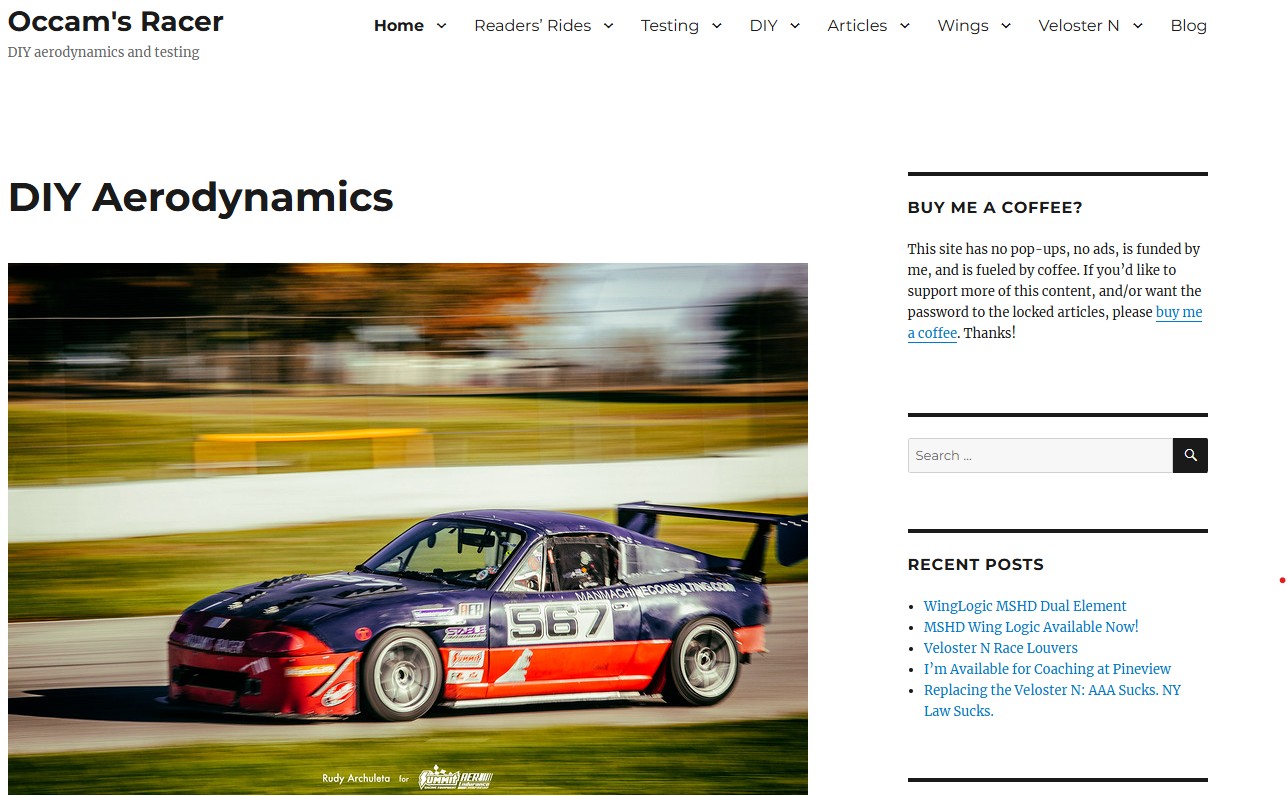
Mario Korf dives deep into the overlooked world of aerodynamics in endurance racing, focusing on practical, low-cost modifications like hood vents, fender vents, splitters, and spoilers. He busts myths about downforce causing tire wear and slowing cars, explaining how proper aero actually improves grip, reduces drag, and extends tire life. The discussion covers front and rear aero balance, underbody airflow, and how even front-wheel-drive cars benefit from rear downforce. Mario shares real wind tunnel data and personal testing experiences, encouraging racers to embrace aero upgrades for better performance and cooler engines without sacrificing reliability.
GHiT 0741: Aero for Endurance Racing with Mario Korf
We are joined by Mario Korf to talk all things aero, but especially with a focus on the use during endurance races. We address many of the typical concerns, misunderstandings, and lore in the area of using aero in endurance racing and even using aero with a front wheel drive car.
A link to the episode is: https://tinyurl.com/AeroEndurance
We hope you enjoy this episode!
If you would like to help grow our podcast and high-performance driving and racing:
You can subscribe to our podcast on the podcast provider of your choice, including the Apple podcast app, Google music, Amazon, YouTube, etc.
Also, if you could give our podcast a (5-star?) rating, that we would appreciate very much. Even better, a podcast review would help us to grow the passion and sport of high performance driving and we would appreciate it.
Best regards,
Vicki, Jennifer, Ben, Alan, Jeremy, and Bill
Hosts of the Garage Heroes in Training Podcast and Garage Heroes in Training racing team drivers
We hope you enjoy this episode!
If you would like to help grow our podcast and high-performance driving and racing:
You can subscribe to our podcast on the podcast provider of your choice, including the Apple podcast app, Google music, Amazon, YouTube, etc.
Also, if you could give our podcast a (5-star?) rating, that we would appreciate very much. Even better, a podcast review would help us to grow the passion and sport of high performance driving and we would appreciate it.
Best regards,
Vicki, Jennifer, Ben, Alan, Jeremy, and Bill
Hosts of the Garage Heroes in Training Podcast and Garage Heroes in Training racing team drivers
We hope you enjoy this episode!
If you would like to help grow our podcast and high-performance driving and racing:
You can subscribe to our podcast on the podcast provider of your choice, including the Apple podcast app, Google music, Amazon, YouTube, etc.
Also, if you could give our podcast a (5-star?) rating, that we would appreciate very much. Even better, a podcast review would help us to grow the passion and sport of high performance driving and we would appreciate it.
Money saving tips:
1) Enter the code GHiT 25 for $50 off the Fire Links hardware system with a 1 year membership included and/or a an extra three months if you subscribe now at https://firelaps.com/
2) Enter code "GHIT" for a 10% discount code to all our listeners during the checkout process at https://candelaria-racing.com/ for a Sentinel system to capture and broadcast live video and telemetry.
3) Enter the code "ghitlikesapex!" when you order and Apex Pro system from https://apextrackcoach.com/ and you will receive a free Windshield Suction Cup Mount for the system, a savings of $40.