00:00
This is the Automotive Repair Podcast Network.
00:30
You can see us at the Automotive Repair Podcast Network.com, go there, all kinds of stuff pointing
00:35
you in the direction in order for you to get this app and download it.
00:39
I've got a great topic today, tactics to stay out of debt, got a great panel before we
00:45
Thanks so much to NEPATRAX, you know, local reps are there to optimize your SMS and you
00:50
get daily training for your entire team.
00:52
Today's class is also a great sponsor, a quick way to spot knowledge gaps and grow stronger
00:59
Kakuwi, thanks to Kakuwi, get industry leading customer support with Kakuwi and Pit Crew
01:05
Turn visits into lasting vehicle revenue.
01:08
Hey, did you know that NEPATRAX has on-site training plus six days a week support?
01:13
It all starts when a local representative meets with you to learn about your business and
01:19
After all, it's your shop, so it's your choice.
01:22
Let us prove to you that tracks is the single best shop management system in the business.
01:27
NEPATRAX on the web at NAPATRACES.com
01:33
Hey, how well does your team know their stuff?
01:36
Test their automotive skills with the today's class of basic, advanced or service advisor
01:41
It's a quick, effective way to spot gaps and grow stronger teams.
01:45
Take the quizzes now at todaysclass.com forward slash TC quiz.
01:51
Shop owner stop juggling multiple marketing tools.
01:54
Kakuwi's integrated platform.
01:55
They deliver four times better website conversions, automated follow-up and real-time ROI tracking.
02:02
Get industry leading customer support with Kakuwi.
02:05
That's K-U-K-U-I.com.
02:08
You're probably tired of chasing new customers who never return.
02:12
We understand Pit Crew loyalty ends the one and done cycle turning first visits into lasting
02:19
reliable revenue on the web at Pit Crew loyalty.com.
02:24
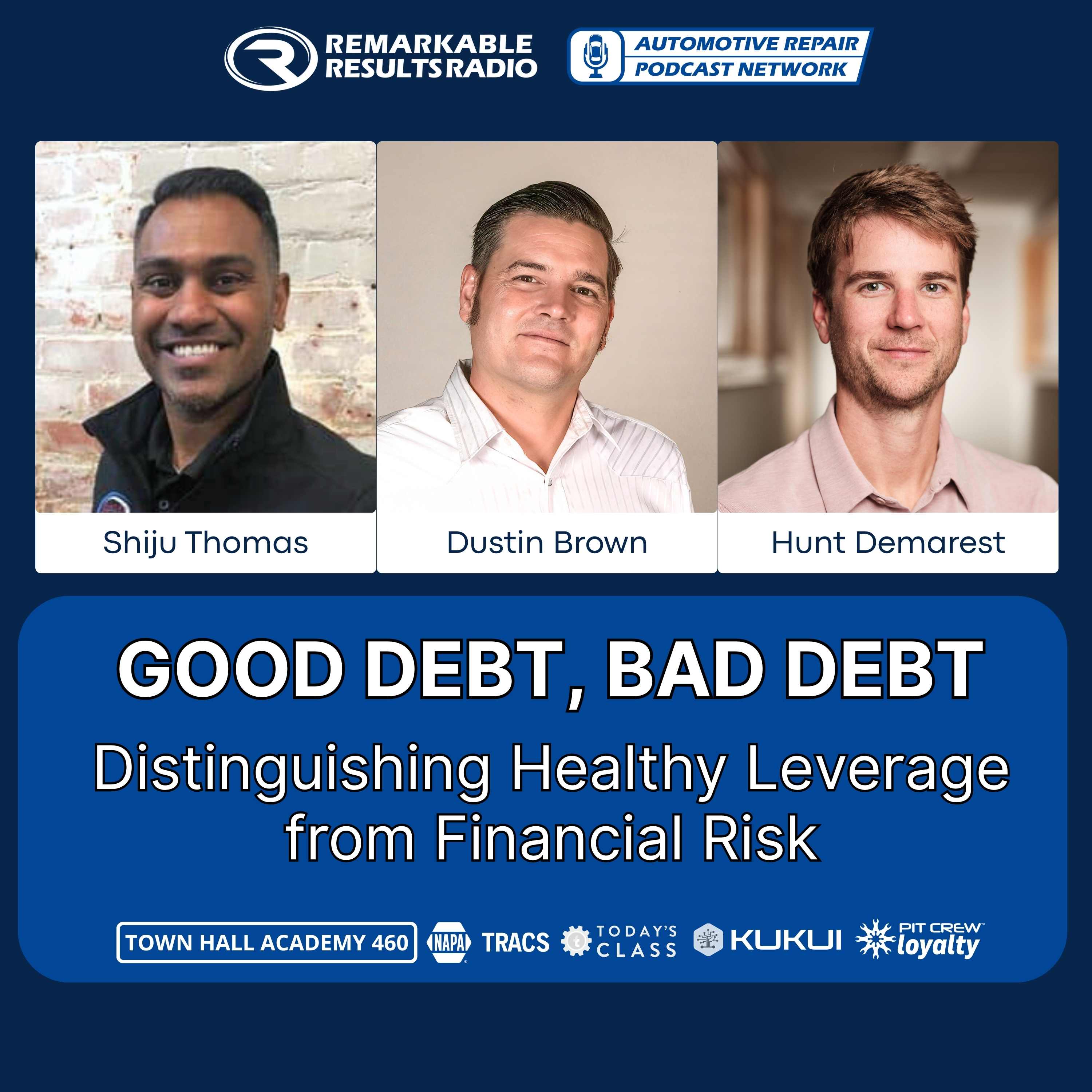
Let me introduce my great panel to talk about tactics to stay out of debt.
02:29
Siju Thomas, five shops, Denver, Colorado.
02:35
Now we're actually at six.
02:38
I knew that and I was at his place.
02:47
It gave my rise of the specialist speech to the Denver Napa BDG.
02:52
And on the way there, Dustin Older just said, listen, we're going to go to this place.
02:58
This is one of his oldest buildings.
03:01
You got to go in there and see it.
03:05
And so we met for the first time.
03:07
But of course, we knew that a week later, he's going to be on this podcast.
03:13
I met a lot of his leadership team.
03:15
Good to meet you, man.
03:17
Hunt Demarest is here.
03:18
C-P-A-PAR, Melis and Associates.
03:21
And business by the numbers podcast on the Automotive Repair Podcast Network.
03:26
When I listen to your stuff, I always hear the rings of debt.
03:31
You always say, pay attention to your debt.
03:33
I thought you were going to say you hear hums and a lot of pauses and stuff like that.
03:36
So I'll appreciate that.
03:38
We do, but our job is to get rid of them so that the listener has a really quality
03:44
Justin Brown is here.
03:45
I'm probably going to say the number of locations wrong.
03:49
How many are you up to now?
03:53
So a couple of years ago, I think there were three.
03:55
Now there's five in New Mexico.
03:59
Mexico's trying to cool off a little bit.
04:01
But it's all right.
04:02
We're enjoying the weather.
04:05
So we've got the specialist in Automotive Shop, C-P-A, Finance, Smart Guy and two multi-shop
04:13
operators that have probably dabbled in debt in their lifetime.
04:19
And so we want to talk about maybe scaling trends and what to do about money, maybe cash
04:23
reserves, budgeting, good debt versus dumb debt.
04:27
I think Hunt wants to talk about that and investment and equipment.
04:31
But first of all, I want to talk about one thing, Dustin, and you, this is a talking point
04:36
And I have to tell you, I've always believed in this cash is king.
04:39
Cash is always king.
04:41
You can't make anything happen.
04:42
Hold on to that cash.
04:44
You can even move it.
04:45
You don't have to necessarily keep it in the company, I think.
04:48
I love some things to say about the risk associated with stashing a whole lot of cash
04:54
within your entity itself.
04:57
But yeah, cash is king.
04:58
If you can utilize cash to expand and grow, use it as a tool that's going to be much
05:05
more beneficial on the long run.
05:07
And you know, it's going to give you better terms as well when it comes to any debt that
05:10
you're going to want to acquire.
05:12
You know, when we're talking about cash gentlemen, do we need to have, or maybe Hunt, you
05:17
can, how many months of expenses, I mean, let's go back to COVID and just think about
05:22
boom, that happened to us.
05:24
How many months of cash reserves do you need just to sustain the business if something
05:29
So general rule of thumb is three to six months of operating expenses.
05:32
Really, I will tell people of, hey, if you want a rule of thumb, then fine, but it's
05:37
In actuality, it's a lot more complicated because it depends on your specific business.
05:42
If you have a high volume shop with lower air row, don't have a whole lot of carryover
05:47
from month to month and are extremely consistent on your sales, you can probably operate with
05:51
much lower reserves because you don't really have a whole lot of cash flow crunches.
05:55
And compare that to some of my fleet guys or maybe your restoration shop, you're going
05:59
to have to have much larger reserves because of some of those inflows and outflows can swing
06:03
massively from week to week.
06:05
Any thoughts on that, did you?
06:07
Yeah, I think that's exactly right.
06:09
Hunt brings up that point of every shop is going to be quite different in my organization.
06:14
We have those high value volume shops that have tremendous car count, strong ARO, strong
06:21
customer demand, and for shops like that, you can be a little more, I'd say, liberal
06:28
or have less cash stashed because there's a strength and foundation to that business.
06:33
At the same time in our organization, we have a few shops that are a little bit newer.
06:38
There's more marketing spend as a percentage of total revenue.
06:41
It has a higher growth trajectory.
06:43
And if something were to go sideways, whether it be COVID, whether it be something geopolitical,
06:50
those are the stores that I feel are going to be less resilient.
06:54
And like when COVID happened, I took a lot of pride in not laying off employees, making
07:00
sure our team was taken care of.
07:03
And I think that's part of the ownership responsibility to have financial discipline
07:07
for the sake of all stakeholders, employees, vendors, customers, et cetera.
07:12
Hunt, is there any kind of magical formula you take on a new client and you look at their
07:17
Do you look at one of these teeter-taller things by saying, one of the things that we have
07:21
to work on is getting you a semi out of debt?
07:24
Yeah, I mean, I think that you could argue two different aspects of this, right?
07:28
Just like what does she do about saying, if cash is king here?
07:32
So the businesses that did well during COVID and were able to keep their customers sleep
07:37
at night, not make impulse decisions based on cash flow, or not my most profitable businesses,
07:43
it's the ones that had the most cash.
07:45
Because some of these extreme events that happen, profit and cash flow can stop instantly.
07:50
But if you have the proper reserves, you can still stay the course and make the right
07:53
long-term decisions.
07:55
Whereas if you don't have the cash and you don't have access to any cash on it,
07:59
you're making decisions specifically based on cash flow.
08:03
And so, yeah, we got some clients where we come on board and they say, hey, your business
08:07
The actual business itself is making money and we got to get a plan to tackle this debt
08:11
and get out of debt.
08:13
But there's also some businesses that are also stifled by their lack of cash.
08:17
And there's ways to bootstrap it.
08:18
You could say, hey, you know, well, we don't want to get into debt.
08:21
We're going to bootstrap this and we're going to try to get out of this on our own, but
08:24
there's also some people where it's like, maybe we need to get some smart debt to
08:27
be able to invest in ourselves and actually dig ourselves out of a hole even faster than
08:33
I would suggest that you would know better than me.
08:36
The majority of debt held by auto shop owners in this country, I bet, is related to real
08:44
estate, which is probably a very different type of debt than when we think about the business
08:49
And it has a different risk profile, particularly because most of that real estate debt
08:54
is really getting paid by the businesses that need to pay a normal market rent for that space.
09:01
And therefore, your real estate debt is actually far more healthy and less risky than, say,
09:09
the business debt that some people might acquire, whether that be for equipment or potentially
09:18
Yeah, if you want to use two examples of the most common things that I see, and we want
09:21
to talk about good debt for one and bad debt on the other, if you have real estate, that
09:26
is good debt, right?
09:27
It's collateralized.
09:28
There's an underlying asset behind it.
09:30
We have a liability, but the asset should be worth significantly more than it'll continue
09:34
But if you look at good debt and you're saying, you're going to have to be in a piece of real
09:38
estate or a location no matter what, your rent is $6,500.
09:42
If you buy that, it's going to be a monthly mortgage payment or $4,500.
09:45
I mean, that makes sense from cash flow, investing, future, everything on this.
09:50
If you want to look at what the worst that is on the average shop's books, it's a high
09:54
interest credit card advance.
09:56
There's your collateral on it.
09:58
There is no underlying asset.
09:59
It is strictly a liability and even worse on that compared to maybe a 25-year amortization
10:05
or 30-year amortization on real estate.
10:07
Some of these high interest aggressive credit card advances are three-month, three-payment
10:11
or six-month, three-payment, which is really what's killing shops.
10:15
We could probably go on and do a whole entire show on that, honey.
10:17
I think you may have been the past on your show.
10:22
I hear the word cash flow, and I'm going to add a third word to that cash flow statement.
10:27
Do all of your clients get a cash flow statement every month?
10:31
The way that we issue all of our balance sheets is in comparative format.
10:36
What we're looking at is we're looking at current year numbers and we're relating it
10:39
to the end of the previous year, previous fiscal year, and then the third column is going
10:45
If we give out the cash flow statement out of QuickBooks, QuickBooks actually does a really
10:49
bad cash flow statement.
10:50
They give people way too much information.
10:53
One of the primary objectives when I've talked to my clients is we're going to say your
10:58
profit and loss made $150,000.
11:02
My clients look at their bank account and they say my bank account is no different.
11:05
That comparative balance sheet allows us to show the cash flow.
11:08
There's the change in inventory.
11:10
There's your change in accounts receivable.
11:11
Here is you paying down debt because you're absolutely right, Carm.
11:15
Everyone wants to know what their profit is but what people are really feeling and really
11:19
care about is their cash flow.
11:21
You said I made all that money.
11:23
Where is the money?
11:24
If you had a legit cash flow statement, but I love your idea why get another statement
11:30
Just look at the, you want to know where your cash is?
11:33
Well, it's over here in this debt category and that's why there's none compared to what
11:38
you had at the end of the last year, even though you made a lot of money.
11:41
You spat money or you moved it around in different places instead of the bank.
11:45
You didn't go in there in the safe deposit box and count the hundreds.
11:49
I think a lot of shop owners, you know, they're not accounted, so some of them I don't think
11:53
are even looking at PNLs as regularly as they really need to be and they look at PNL
11:57
and they say, for example, I even made 150 grand.
12:00
Just to comment, you know, not everybody realizes that if you're paying off a note, only
12:06
the interest is going to be on the PNL.
12:08
The principal comes off afterwards.
12:13
So you make a hundred grand.
12:14
You have to pay taxes, then you have to pay your inch, your principal and all your loans.
12:18
So and then whatever's left after that is money you could put in your pocket.
12:23
I'm going to be missing one, but those are the two big ones that are always on.
12:25
You've got to pay the tax and you've got to pay the principal really be mindful of what
12:30
that looks like to manage your PNL and to know, okay, I need to net profit X amount of dollars
12:37
just to cover the cash needed to pay these loans is important to know what that number
12:43
is and that helps you take a decision on if you're going to take on more debt or not.
12:48
Do I take out a loan to replace that alignment rack at $30,000 or do I hold it off because
12:54
I don't have the cash flow after the net profit to pay that note on top of whatever responsibilities
13:01
I might already have.
13:03
Some people just don't really put those two together.
13:06
You make a really good point too, does it here because one of the things that we notice
13:09
a lot is people think that they're healthier when we think they're unhealthy and vice versa.
13:15
So a great example of this is, if you have someone that goes out and gets a high interest
13:19
loan deposit into a bank account, they're going to think that they're doing pretty well
13:22
because they look at that operating account and they say, man, I got $100,000 in here.
13:27
And then we look at this six months later on it and they're almost out of money and
13:30
they say, man, what the heck is going on with the business?
13:33
And we look at the underlying profitability and we say, actually Dustin, you've never been
13:38
Your business has turned around and we are actually making profit.
13:42
But since that loan that you got was a six-month repayment, you're not seeing any of that.
13:46
You're making profit and all that profit is going back to a principal off.
13:49
I mean, at the smallest baseline, what a bank is looking for is 1.25 coverage.
13:55
So if you make $125,000, $25,000 of that's going to go to taxes, leaves you with $100,000
14:02
to pay your mortgage payment.
14:03
So if you have $100,000 of debt service and you make $125,000 on your PNL, you should
14:09
not expect to have any more money personally, any more money in the business.
14:13
And that, like Dustin says, is a surprise to a lot of people.
14:16
That's a great comment, hunting really from a finance perspective.
14:20
It's a question of cost of capital.
14:23
At the end of the day, the business generates some level of cash flow.
14:28
From that cash flow, there should be investments in capital expenditures and it might be that
14:33
lift that's $30,000 or $40,000.
14:35
Now in five different situations, hunt might be advising as clients very different things
14:42
On one hand, you could have a different interest rate environment.
14:45
If you can go buy that alignment rack and get it financed at two or three percent over
14:50
the next few years, then that's a great way to utilize leverage.
14:55
That's healthy debt at a low interest rate.
14:59
In another environment over the last couple of years, it's very high interest.
15:03
So if you have a seven, eight, nine percent interest rate on that loan and you don't have
15:09
great debt service coverage, you're putting your shop at risk when you think you're investing
15:15
and improving your business with that alignment rack.
15:18
Let's face it, your shop management system is the single most important tool in your shop
15:24
Appetrax was built from the ground up to make your business more profitable and efficient.
15:29
We provide an extensive set of tools to increase and track profitability in real time.
15:35
Appetrax offers the industry's best post sale support, hands down, and we train your people
15:41
Yep, on site, and we offer remote refresher training 10 times a week and customer support
15:46
is open six days a week.
15:49
Give us a call, visit the website, or join our Facebook community today to learn more.
15:53
You'll prove to you that tracks is the single best shop management system in the business.
15:59
Appetrax is always customized and tailored for you, whether you're a one-man shop or
16:04
a large multi-bay or multi-location company, after all, it's your shop.
16:09
So it's your choice.
16:11
Visit us on the web at napetrax.com that's n-a-p-a-t-r-a-c-s.com.
16:20
Form your team with today's class where automotive training is easy, quick, and fun.
16:25
Just five minutes a day on our app can eliminate hours of looking up for gotten information
16:30
It's perfect for technicians, advisors, and managers alike.
16:34
Keep critical knowledge fresh and top of mind ensuring your team operates at peak efficiency.
16:40
Today's class is impactful, accessible for anywhere, and a bit of fun, too, and we're not
16:44
talking about after hours, pizza, either.
16:47
For training that gets results, turn to today's class.com.
16:54
Shop owners, we know you are overwhelmed with a flood of missed calls, empty bays, and
16:58
disconnected marketing tools.
17:00
Kakui has spent over a decade building one integrated platform for auto repair shops,
17:06
one login, one dashboard, and mobile first websites that convert four times industry average.
17:12
Smart, innovative CRM with automated follow-up, 24-7 online booking, and real-time ROI tracking.
17:19
With 900-plus years of combined team experience, we fuel the growth of 2,200-plus shops and
17:25
have influenced $3 billion in revenue.
17:28
Stop working harder, start working smarter, get industry leading customer support, and
17:33
book a demo with Kakui that's k-u-k-u-i.com.
17:37
You know, most shop owners feel trapped, spending on ads while half their first-time customers
17:44
It's exhausting, and it's not your fault.
17:47
The industry average is 54 percent, one and done.
17:50
We understand how discouraging that can be.
17:53
Well pick crew loyalty changes the story.
17:56
Our clients cut that rate by up to 38 percent, raising lifetime value by more than 50 percent.
18:02
Loyalty members visit nearly three times more often, creating predictable revenue without
18:09
Pit crew loyalty, where customers stay, and shops thrive.
18:13
On the web at pitcrewloyalty.com, here's with burning in my mind, and I need to ask
18:18
to you and Dustin, would you pick up the phone, your successful, your smart, you've been
18:23
around a while, you get this thing, but for the hell of it, would you pick up your phone
18:28
and call your accountant and say, I think I want to do something like this, I want to
18:32
maybe it's a capital improvement, or maybe it's an eight-ass piece of equipment, and you're
18:35
going to spend 50 or 60 grand, so you or Dustin, would you pick up the phone and call
18:39
the accountant, or you've gotten this yourself?
18:41
I don't, you know, I actually use to use a hunts group over there, and there are cases
18:45
that I call Billy, but for the most part, you know, I like to keep a really good thumb
18:51
on my pulse when it comes to the financials.
18:54
We mentioned Dave Ramsey a little bit, but I'm going to be looking at my cash to pay for
19:00
If I don't have anything down the line such as another acquisition, right, because
19:05
we are constantly kind of stacking some cash, because we are lining ourselves up for the
19:11
next acquisition, for the next investment opportunities to be ready for that, potentially.
19:17
So if I'm in the market for an expensive piece of equipment, we're weighing that against
19:21
timeliness of acquisitions and growth, and so I always, you need a lot more cash to
19:28
acquire than you need to buy equipment.
19:30
So mostly equipment is generated on like a cash purchase for our company, and unless
19:36
there's something more strategic on, you know, ADAS would be a more strategic play, like
19:41
how are we going to enter the ADAS environment?
19:44
How are we going to enter the ADAS competition level?
19:47
How much ADAS work are we going to be doing in-house and how are we going to go out and
19:51
That's a whole different markup.
19:53
So I kind of strategy there on how do you, getting into ADAS repairs.
19:58
But yeah, we're going to utilize cash at all possible if we can, if not, we're also
20:04
going to utilize our vendors.
20:06
So vendor utilization is going to be like, I don't know, buy a lift from an all-by-piece
20:13
they see coming from NAPA, and NAPA says, okay, increase your revenue by X amount of
20:18
dollars each month, and we'll pay that note off for you.
20:21
So there's utilization for vendors to help avoid any debt, but even in that case, I want
20:27
to buy the equipment cash out front and look for the rebate on the statement, and not
20:32
depend on the rebate to pay that payment, because I don't want to be continuing to add
20:38
more payments to the balance sheet.
20:41
I want to always have a very healthy looking balance sheet, very healthy looking P&L, especially
20:49
when we're looking in acquisitions and growth.
20:51
Lastly, they'll stop you riding your tracks, can't buy this building because you're
20:56
Now, your goals of acquisition and growth, you're going to be halted, yeah.
21:01
Seems like Dustin and I have near identical playbooks, I need to drive down to Alper Curkey
21:06
so we can get a pair of notes.
21:08
So I have a very similar mentality.
21:10
When I think about the debt that I would bring into my organization, that the healthy debt
21:15
as we mentioned before is going to be real estate, as it relates to acquisitions and growth,
21:20
the second would be some of the business acquisition debt, particularly the best version
21:26
is a promissory note from a seller, and then the third, which I would consider, is equipment,
21:32
but in reality, you really shouldn't be making huge equipment purchases.
21:37
If your cash flow can't cover those purchases, and I think Dustin hit it nail on the head,
21:42
we have amazing vendors in the automotive industry that will partner with you for earnbacks
21:49
and credits, and we've used WorldPac, NAPA, factory motor parts, and it has been a great
21:57
asset to use Tridentrude vendors because they'll help you on the financing side if needed.
22:03
And at the same time, you're getting a lot of earn back on spend you would already do with
22:08
best in class vendors.
22:10
So again, I think equipment financing, there's a place for it, especially in a lot of industries,
22:15
we're in an industry where healthy shops should generate a solid amount of cash flow and
22:20
really equipment financing should be, I think, within that cash flow that the shop generates.
22:25
And obviously, that's different for brand new shops, where you know there's X, Y investment
22:32
because you're trying to get it off the ground, but certainly not a mature shop.
22:36
Yeah, it could probably be different for like a green field or brown field build-up, right?
22:40
If you get to buy six lifts and everything new, but I agree, 100%, I wish it should
22:47
Well, if you look at the cost of capital and just like the cost of equipment in general
22:52
for an auto repair shop, it should really pair in comparison to what the revenue is, right?
22:56
You go out and you buy a fairly expensive rack for $10,000.
23:00
It's there for 10 years.
23:02
How many gross profit dollars did that lift create for you?
23:05
Like Siju said, and Dustin was agreeing to, if your business has run correctly, you should
23:09
have plenty of cash to replace that a decade later.
23:12
If a decade later, your business doesn't have enough cash to replace that lift, then I'd
23:17
really be looking back at the underlying profitability or cash flow decisions that led
23:21
You know, when I sit and I listen to some of the incredible panels we have here, and to
23:26
think if the semi-marginal shop was listening to this, and they became not overwhelmed, but
23:34
in, enveloped in this discussion of how this really intelligent discussion can help
23:42
them move forward and make a lot of right moves.
23:45
You had told me, paying down debt too quickly may not be the right thing to do.
23:50
Yeah, I think what I see the most common issue is like debt is like a mountain or valley
23:57
Either things are all good or all bad.
23:59
And so like the most common example that I see of someone coming out of a rough year,
24:03
like credit cards kind of going up, line of credit kind of got maxed out on it.
24:08
This is generally in smaller shops that have some volatility, right?
24:10
Maybe you lost a key player, key production member in the shop.
24:14
So over the course of 12 months, they've built up $60,000, $80,000 in debt, but then they've
24:19
kind of righted the ship profitability looks good and they're training in the right direction.
24:23
So they try to undo all of their past sins as quickly as they can.
24:27
I don't want to be in debt.
24:28
I know I want to retire at some point.
24:29
I'm going to pay down debt, pay down debt.
24:31
And now where we are is we're sitting here in August, September, October and they're
24:35
like, great, I am debt free, but I'm now also cash free.
24:39
The way that you stay out of debt is by having cash in a way that you continue that is keeping
24:44
So if you pay down all your debt and you have zero reserves left, it only takes one bad week
24:48
or one bad month to be right back where you started.
24:53
And I'll add, when I bought my first shop, didn't have a lot of credibility as an auto shop
24:59
The interest rate was relatively high on an SBA 7a loan.
25:04
And it was a 10 year maturity that I paid back in two to three years.
25:10
And I did that because it was expensive debt.
25:13
Fast forward a few years, I was able to get much lower rates when I was doing other 7a
25:20
acquisitions loans.
25:21
I was able to get low rates when I did 504 SBA deals.
25:25
And those interest rates were anywhere from the high twos to the low force.
25:30
So I tell you what, I didn't prepay any of those because those are really cheap long-term
25:35
fixed rate loans that meant I could use my cash for other investments, whether that be
25:43
equipment financing, whether it be additional business acquisitions, and especially real estate
25:50
opportunities that come with those businesses that tend to be quite expensive, but great
25:54
wealth building strategies.
25:56
So again, I think there's nothing wrong with managing your leverage and making sure you're
26:02
paying down expensive debt.
26:04
Good example would be things like promissory notes that might come in those acquisitions
26:08
that sometimes not always might demand a higher interest rate.
26:12
Well pay those down and then work from your highest interest loans to your lowest interest
26:18
loans if you're really trying to be cash rich.
26:22
Something that we haven't mentioned is keep in mind, that interest is tax deductible
26:29
So in the long run, it's actually a way to create more cash flow in your pocket and decrease
26:37
your taxable income.
26:39
The cash flow's key again for a batch of, like with both you said, let's say you pay off
26:44
a debt accelerated, you pay off a debt quickly.
26:47
In that example, you gave Hunt, at the end of the year, he still has taxes on that money
26:53
that he doesn't have, right?
26:54
Because all that money he put into paying off the debt was all taxable income.
26:59
So then the tax bill comes and he goes, oh my God, how am I going to pay this tax?
27:02
Well, I don't have any money.
27:03
I use it all to pay off his debt.
27:05
I think you've been listening to my phone calls.
27:11
You need to hold on to it.
27:13
As you're aptly right, we've got some loans that are low interest rates and we've got
27:18
some that are now in the six and a half, like the last one I got was like 6.5 or something
27:22
that we just bought our last building, last April.
27:25
So if I'm looking at getting rid of cash and putting it towards principal, that's going
27:33
Am I going to put it, I'm definitely going to put it towards the highest interest loan?
27:38
And I'm going to be looking at, okay, I have a hundred K, I can put a hundred thousand
27:42
dollars towards this principal on this loan, never get it back.
27:47
Once it's gone, it's gone, right?
27:48
On that situation, or I can put a hundred K down on this other property or on the
27:56
other acquisition and start generating a much quicker ROI on not a hundred K, because
28:03
real estate generates an ROI of course and builds wealth.
28:06
Just kind of slow and take some time.
28:08
You've got to live there, you don't, you don't just, I fast as ROI is going to be putting
28:13
that a hundred K towards another building, another store, right?
28:17
Or if you're a single store operator would be injecting it into some marketing to increase
28:22
a car count, increase revenue, increase sales, so you inject that money into building and
28:27
growing the value of the company, growing the revenue will give you a much higher ROI, much
28:35
faster than dumping the cash into the principal of a loan specifically if it loans low rate.
28:43
Now, if you're on a high interest credit card, you got to pay that thing off right away,
28:48
You need anything of that.
28:49
Line of credits, keep those things low.
28:50
Any of those high-rate stuff like, yeah, don't mess around with that.
28:52
But if you got some 2015, 20, 30 year fix, some of these SBAs are 30 year fix, or do you
28:58
just cash as a tool that you use?
29:02
One of the things, too, that exactly what you're talking about, how do we attack debt?
29:06
Which one are we going for?
29:07
It's fairly simple.
29:08
Get your motions out of it.
29:09
It's going to be the highest interest rate.
29:11
What's the most expensive?
29:12
But then going back to what I said before and what you just said now, Dustin, if I have
29:17
a hundred grand of bank count and I have a hundred grand on a credit line, I'm paying
29:20
off the credit line immediately, as long as I have assurances that I can get money back
29:24
If I ever need this, I can always get this back, but why am I sitting here paying 12% interest
29:29
when this is getting me 0% in my checking account?
29:32
Same thing with high interest credit cards.
29:33
Yeah, I can pay off that $30,000 balance.
29:36
If things get tight, then I'm just going to run up that card and swipe it everywhere
29:39
the following month.
29:41
Stuff like paying down true debt, where it's either equipment debt or real estate, it's
29:48
Yeah, in real estate, in a larger sense, if you aggressively pay that down, you can get
29:52
the money back out.
29:53
But what if you can't qualify for refinance?
29:56
What if interest rates go up?
29:57
Stuff that I can always draw back on, revolving credit lines, I'm always going to be much
30:01
more aggressive on.
30:03
And then the last one on here is I think that probably the most common question I got
30:07
during COVID, a lot of people got a lot of government money, what do they want to do?
30:11
It's what everyone is shooting for as soon as they buy a house is, you want to own that
30:16
You don't want to bank to own it.
30:17
So I had a lot of shops that were like, huh, I got 300 grand in my bank account.
30:20
I'm going to go on, I'm going to pay off my mortgage.
30:24
And I say, I wouldn't do it if it was me.
30:26
If you need to do this fine, but it's probably one of your dumbest financial moves because
30:31
right now you could put that 300 grand into a money market account and get 4% like clockwork.
30:37
Why am I going to spend 4% to save 3.2%?
30:40
It just doesn't make any sense.
30:42
But again, if you have the same perspective on it and your mortgage is 6%, then yeah, it makes
30:47
no sense to squirrel all my money away at 4% when I'm paying 6%.
30:52
But a lot of people look at this and say, well, hey, what is your opinion?
30:55
Going back to what Dustin was saying, if I can't make that decision for my client, I can
30:59
give them the education, I can give them the tools to understand the stuff themselves,
31:03
but they're the ones that ultimately need to make the right decision for their shop,
31:06
their overall perspective.
31:08
One thing I'll jump in, great conversation Dustin and Hunt on the point of revolving
31:13
credit lines, normally most shop owners I've talked to are leveraging a credit card for
31:23
However, if you have a reasonable banking relationship, oftentimes you can get a line of credit.
31:31
And for that line of credit, it's not going to be your 3% and 4% type of interest rate,
31:37
but it's also not going to be the 20% interest rate that you have on a credit card.
31:41
So you open this line of credit and I've had one for years in which I've used it a total
31:46
of zero times and I pay a small fee each year to have it.
31:51
But if something happens and somehow we are in a cash crunch, I could use that line of
31:58
credit, access cash at a 8, 9% interest rate, not great, but it's far better than rolling
32:07
the dice on a credit card.
32:08
But those are usually prime plus or minus, aren't they?
32:12
And depending on your credit and your banking relationship, that's where it's going to
32:15
be better than a credit card, but certainly not better than a standard conventional bank
32:21
So banking relationships, did you are like King?
32:24
You know, you bring up a good point, Garm, that I think traditionally banking relationships
32:29
have held tremendous value in business growth.
32:34
I venture to say today, they're still important.
32:37
It is really important to know your bankers, but increasingly the power at the bank is in
32:45
the credit department.
32:46
It's the underwriters and the credit officers.
32:49
So one needs to be extraordinarily wary of bankers with great intention to promise you
32:58
And then all of a sudden, the credit department and the underwriting department don't like
33:03
what deal you're looking at, what expansion strategy you're trying to pursue.
33:08
And I've had some challenging situations where the bankers told me X and on the backside
33:15
the credit department couldn't back up what the bankers said.
33:18
So yes, banking relationships are important, but this is where getting to know other people
33:23
at the bank is extraordinarily important and understanding what kind of influence that
33:28
banker has on the credit department.
33:32
I would add to that, great point is quality banking relationships I have found to be more
33:41
The reason is there's just been so much M&A activity when it comes to banking in general.
33:49
So I had banks with a good relationship with a banker here in town.
33:54
They got bought out and I don't know who's in charge and this guy's no longer there.
33:59
And then I find my new banker and then he's there for six months and then he goes somewhere
34:04
It's made it a lot more difficult in this day and age to really kind of create those
34:09
relationships with bankers.
34:11
I located a local bank.
34:14
There's a last locally owned bank in town, you know, and the CEO is my banker now, right?
34:22
I got a cell phone number.
34:23
We go have lunch together lunch couple weeks ago and regarding acquisitions and growth.
34:28
He's like, let's turn key this.
34:29
Let's put together a package when you make a deal.
34:31
We got to move fast.
34:32
I can move fast with you.
34:34
It's more difficult now.
34:36
I think than ever to establish those relationships with these bankers because he wants to do business
34:43
I have a bunch of cash in his bank, you know, and this is different worlds.
34:47
It's a little more challenging to find these guys.
34:49
Dustin's point was great in order for him to get deals done now.
34:52
He needs to be friends with the CEO of a bank that sells you something.
34:56
Hey, it's like known who the head chef at the local pizzeria is, right?
35:02
He's going to make it extra special for you.
35:04
Or it's like, hey, you were working with the vice president of Wells Fargo.
35:09
Unfortunately, there's 50,000 vice presidents at Wells Fargo, right?
35:12
I love the point about being local.
35:15
Do you feel that you're paying slightly, you know, half a quarter point more on money?
35:20
I think it's about the same.
35:22
He's just what it is, what it is.
35:24
I would say that it wouldn't even be a quarter point and there was a local bank I was using
35:29
for multiple years and I knew their pricing was probably 100 to 150 basis points higher.
35:38
But it was significantly easier to work with them and there was greater transparency.
35:45
Their deal execution was flawless and at some point, always looking for pricing, i.e.
35:52
the cheapest product or the cheapest debt is no different than, you know, auto shops.
35:57
Customers out there that just want the cheap service and the cheap oil change and the cheap
36:02
repairs with the terrible parts.
36:04
Well, that's not necessarily my target, customer and I think there's banks out there that
36:09
invest in high levels of service, extraordinary execution and really take care of their clients.
36:17
But there's a price to pay for that.
36:18
So I don't mind paying a little bit more in my debt to know it's in good hands.
36:24
Just like our customers, our key droppers, right?
36:26
Just get a fix, call me when it's done, right?
36:27
If you get these relationships and you trust them and they're going to make it happen and you
36:31
might look back, it's like, yeah, I paid a little more, but it was seamless, it was easy, worth
36:36
Yeah, and like you said of like sometimes having that banker that actually is willing to fight
36:41
for you at loan committee is the difference between you actually getting opportunity and you
36:45
not getting the opportunity.
36:47
So if you're looking at something being like, hey, this bank's going to be at 6%, this one's
36:51
going to be at 7%, what you actually might find out is the bank that's cheaper takes
36:55
nine months to actually go to closing on this and I'm missing every single opportunity.
37:00
What I would say in 2025, you can kind of tell by all of our tone here, Carm, it's never been
37:06
harder to get a lasting relationship with a banker.
37:10
It's easy to get a relationship for one year, but whatever one's looking is a banker to grow
37:14
They understand what we're doing, they understand where we come from.
37:17
When I call them up and I get these opportunities, I don't have to sell it to them because he knows
37:20
what we're doing here.
37:21
Realistically, I have always preached, you should probably have a big bank and probably
37:27
The sad reality is for probably 60% of my clients, they have one option or two options and
37:34
it's all the big banks.
37:35
The consolidators, the local regional credit unions are just kind of being gobbled up, which
37:40
I think it is even more important to understand this stuff and let your financial speak for
37:45
yourselves because for most shops listening to this, you're not going to be able to find
37:49
a CEO to fight for you.
37:50
There's just not an option or maybe you're not large enough for them to really care and
37:54
so you're going to have to have the strong numbers so that they speak for themselves and
37:58
any banks going to want to do this deal.
38:00
Hunts exactly right.
38:01
I hate to say this and I'm almost embarrassed to say it, but across my various properties
38:07
and businesses in the organization, I probably bank with six to seven different institutions.
38:14
I'm not proud of that and I've always tried to be loyal to one or two, but it tends to
38:20
be that every time there's another acquisition opportunity, growth opportunity, I go to the
38:25
banks that I'm banking with and something might be odd or it's not the perfect fit.
38:31
Then I'm moving on to the next one and over time it means that you're in bed with a lot
38:35
of different banks and I think one of the other issues that I'll bring up that is problematic
38:41
for a group like Dustin's or myself is that at some point, a lot of MSOs transitioned
38:48
beyond that traditional small business banker.
38:53
There's not a lot of bankers that service groups in the middle because there's the commercial
39:00
lending groups, but they're looking for organizations and businesses that are doing $25, $50 million
39:09
and a lot of the small business banking groups are looking at businesses and organizations
39:13
that might do $1, $2, $3 million.
39:17
Well, who's servicing the businesses and organizations that are making between say $5 and $25 million?
39:25
That's a really challenging place to be and particularly when we look at the products
39:30
by the US SBA, the small business administration, those really tailored for small businesses,
39:37
Now, I'm not sure if you guys have come here and you probably won't want to publicly share
39:40
this on here either, but what a lot of people don't realize is there's limits to SBA.
39:44
I think right now the SBA 7A limit is $5 million, so you're going to get to a certain point
39:49
if you're trying to scale this that the SBA is not going to give you any more money.
39:53
We've given you all the money that we're going to give you and you have to prove yourself
39:56
where when I see a lot of people scaling, they have to either find that bank that's willing to
40:01
do this conventionally or willing to go along with them on the ride, but realistically for most
40:06
multi-shop operators that I see, they originally start the SBA route. They try to go commercial,
40:11
but most of these guys are doing owner financing or some sort of alternative method
40:16
because you're pushed to the secondary or tertiary markets and you're right,
40:20
she do. In one aspect, you're too big for the classic banker that's used to one location,
40:26
but then when you go to the next level, you're way too small to even get a meeting with some
40:30
of these guys. So getting that creative financing to handle these deals is what a lot
40:36
of people are trying to do and all the time struggling. This banking discussion was very interesting
40:42
and I think extremely critical in trying to learn to scale, but also in the struggles that many
40:48
shop owners have and not being able to manage a cash to consolidate, to pay off debt because
40:56
they don't know how to talk to a banker. They only know how to talk to a car and the cars don't
41:00
talk back and that's why they do this. Right and this is where I think the platforms like yours,
41:05
Carm, just does a really extraordinary job of allowing a lot of operators that just know that
41:11
car extraordinarily well, but need to understand how do we look at a P&L? How do we educate ourselves
41:17
beyond fixing a car? How do we think about ourselves as a hospitality industry rather than just a
41:23
you know fixing car industry? And I think there's a sophistication that you've been talking about
41:29
for years that is so critical to us elevating this industry to one where, you know,
41:37
we're more highly respected, we're a trade that people know require engineering sophistication
41:43
and everyone within our trade, whether it be the technicians, the front-offer staff,
41:47
the owners, everyone needs to step up their game. I so appreciate this.
41:51
Seju Thomas, Hunt Demarest, Dustin Brown and in lightning discussion, Hunt will make you the
41:57
rap guy will do Dustin first, Seju and then Hunt. Dustin, final words or three. Final words will be
42:03
just be smart with your money, cash is king. That was a great final. Be smart with your money,
42:10
cash is king. I love it. Seju Thomas, talk to me, man. Well, I'll keep it simple.
42:16
Leverages a tool. If you overuse it, you're going to be in dangerous waters, but if you use it smart,
42:22
it's great for growth. It's great for scaling. It's great for risk management.
42:26
In so many of the marginal or struggling shops, it says, now I'm going to learn something new,
42:31
hot leverage. Wow. But you know what? It's critical. And again, this is where I would pick up the
42:37
phone and say, huh? Teach me how to leverage. Hurt your final words. Final words, I mean, I guess,
42:42
you know, kind of coupling on what these guys have said on this is be smart. Know your own finances,
42:46
know your own direction, know what you're trying to do here and keep in mind. You might have got to
42:51
this point and it might have taken you four or five years and maybe misdecision misopportunity
42:56
to build up this debt. Don't try to get out of it in the next five months because it's a recipe
43:01
for disaster. Well, thank you all so much. Tactics to stay out of debt. I learned a lot. Very
43:06
enlightening. Thanks, guys. Appreciate it, Carm. Thanks, Carm.
43:10
Thanks for being on board to listen and learn from the premier automotive repair business podcast,
43:15
Remarkable Results Radio. Get your episodic education on the ARPN listing app at automotive
43:21
repairpodcastnetwork.com. Also, enjoy the podcast on our Carm Capriato YouTube channel.
43:27
Carm is all for advancing the professional automotive service industry. Until next time.