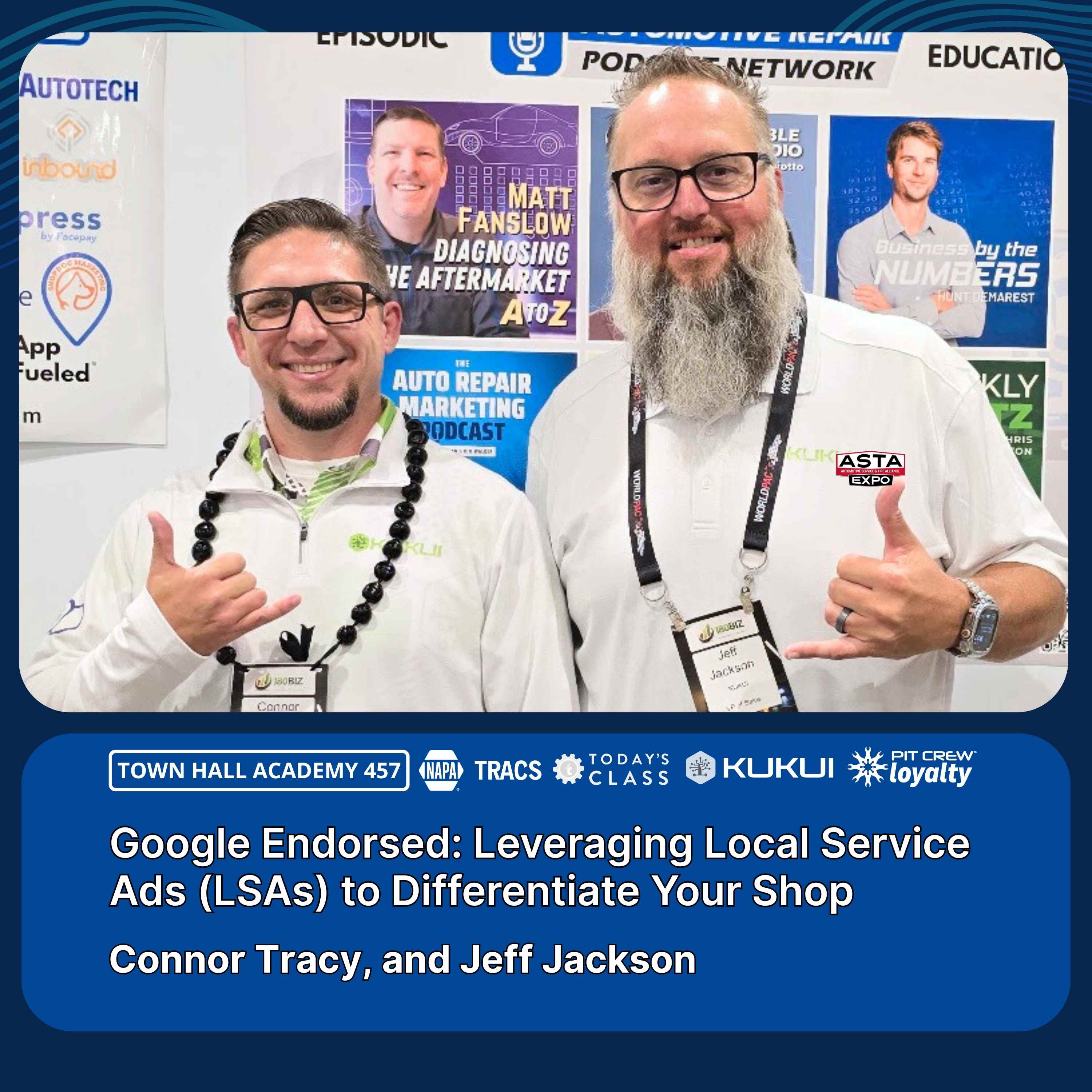
Exploring the world of Local Service Ads (LSAs), this episode features insights from Jeff Jackson and Conor Tracy of Kukui. They discuss how LSAs differ from traditional Google Ads, emphasizing the verification process that enhances consumer trust. The conversation dives into the importance of effective website design, customer retention strategies, and the psychology behind consumer behavior in automotive repair. Listeners will gain valuable knowledge on optimizing marketing efforts and the role of technology in improving shop efficiency and customer experience.
Thanks to our Partners, NAPA TRACS, Today's Class, KUKUI, and Pit Crew LoyaltyWatch Full Video Episode
This episode takes a deep dive into the evolution of digital marketing in the automotive repair industry, with a strong focus on Google’s Local Service Ads (LSAs), website performance, and empathetic customer engagement.
Connor Tracy and Jeff Jackson unpack how LSAs are transforming how shops attract and convert customers. They explain Google’s rigorous verification process and how LSAs differ from traditional pay-per-click models by emphasizing verified leads, call monitoring, and actual revenue generation over vanity metrics like clicks.
Beyond advertising, the discussion touches on ways to stand out, like adding live scheduling, using empathetic CRM communication instead of constant sales pitches, and avoiding wasted ad spend that doesn’t deliver results..
"Hey, did you know that NAPA Tracks has on-site training plus six days a week support? It all starts when a local representative meets with you to learn"
NAPA Tracks is a program that helps car repair people learn new skills right at their workplace and get help every week.
NAPA Tracks is a training and support program offered by NAPA Auto Parts, providing on-site automotive repair education and weekly assistance to technicians.
"I'm sorry we jumped on a curve left here, but back to LSA. The biggest thing about LSA is setting yourself as a market differentiator."
LSA is a safety feature that helps the car stay stable when driving very slowly, like in traffic or while parking. It turns on extra help from the car’s computer to keep you safe.
LSA stands for Low-Speed Activation, a feature in some vehicles that automatically engages certain systems—like traction control or stability management—when the car is moving slowly, such as during parking or low-speed maneuvers.
"I got to go smell tranny fluid. I did it last week."
Transmission fluid is the oil that keeps a car’s gearbox working. It needs to be checked and changed regularly so the gears stay smooth.
‘Tranny fluid’ is a colloquial way of referring to transmission fluid, the lubricant that keeps a vehicle’s gearbox operating smoothly and protects its moving parts from wear.
Rust is when metal turns reddish and weakens because it reacts with water and air. It can make parts break if not fixed.
Rust is the oxidation of metal, typically caused by exposure to moisture and oxygen. In automotive contexts it can weaken structural components like wheels or chassis.
Wheel corrosion is when the metal of a car's wheel gets damaged by salt, rain, or dirt, making it weaker.
Wheel corrosion refers to the degradation of wheel rims due to chemical reactions with road salts, moisture, and pollutants. It can compromise wheel strength and safety.
"[2641.8s] we're just checking in on the 2009 Hyundai.
[2643.8s] I want to make sure everything's good."
They are talking about a car made by Hyundai in the year 2009. It’s a specific model that people might own or be interested in.
The speaker is referring to a 2009 model of a Hyundai vehicle, indicating they are checking on its condition. This specifies the make (Hyundai) and year (2009), which helps listeners understand the context of the conversation.
"By the way, my Alpina B7 needs a repair. So for those who don't know, an Alpina B7 is a completely coach built BMW 7 series."
It’s a special, upgraded version of the BMW 7 Series that has more power and better features. Think of it as a super‑deluxe, custom version made by the company Alpina.
The Alpina B7 is a high‑performance, coach‑built version of the BMW 7 Series, featuring upgraded engine tuning, suspension, and interior refinements for a more luxurious driving experience.
"I just paid for an ADAS thing. I have no idea what the hell that is, but I trust these people."
ADAS is a set of computer systems in cars that help you drive safer by warning you about hazards or even steering the car a little bit. Think of it as a smart assistant that watches out for you on the road.
ADAS stands for Advanced Driver Assistance Systems, a suite of electronic technologies that help drivers with driving tasks such as lane keeping, collision avoidance, and adaptive cruise control.
"[2805.4s] and the team's like, [2805.9s] well, it's live scheduling. [2807.5s] And I had to bring it back to the team and said, [2809.3s] hey guys, we know that live scheduling is a term we've adopted in the industry,"
Live scheduling means you can book or change appointments right away, usually through an online system that updates instantly. It’s like calling a friend to set up a meeting on the spot instead of planning days ahead.
Live scheduling refers to the practice of setting up appointments or events in real time, often using digital tools that allow immediate confirmation and adjustments. It contrasts with pre‑scheduled or batch scheduling, enabling more flexibility for both service providers and customers.
Select text to request an explanation
This is the Automotive Repair Podcast Network.
Hey everybody, Carm Capriato, Remarkable Results Radio, another Town Hall Academy here
at the ASTA 2025 conference. We're having a good time, we're doing a ton of great
interviews, and the training here is just like off the charts, a lot of good things happening.
Thank you for being here. We can't do it without you as our listener. We hope and try so hard to
give you very powerful episodic education to lift you no matter what job it is that you have in
this wonderful automotive repair industry, and keep your ear to the ground because we're getting
ready to announce our listening app exclusively for the Network Podcasts and exclusively for you.
Here's a great word from our sponsors. Hey, did you know that NAPA Tracks has on-site training
plus six days a week support? It all starts when a local representative meets with you to learn
about your business and how you run it. After all, it's your shop, so it's your choice. Let
us prove to you that Tracks is the single best shop management system in the business.
Find NAPA Tracks on the web at n-a-p-a-t-r-a-c-s dot com. Ready to optimize with today's class?
Boy, listen to an episode we did with David Boyes. Great program. Roll out a training plan for your
automotive shop. In just five minutes daily, you boost knowledge, retention, and improve team
performance. Start seeing results today. Join your peers at todaysclass.com. Shop owners stop
juggling multiple marketing tools. Kukui's integrated platform, they deliver four times
better website conversions, automated follow-up, and real-time ROI tracking. Get industry-leading
customer support with Kukui. That's k-u-k-u-i dot com. You're probably tired of chasing new
customers who never return. We understand. Pit Crew Loyalty ends the one-and-done cycle,
turning first visits into lasting, reliable revenue. On the web at pitcrewloyalty.com.
Hey, welcome back. In the studio is two geeks, okay?
Fair. That's fair.
Can I call you two geeks?
Take it.
It's Jeff Jackson, the Vice President of Sales, and Conor Tracy, Kukui's Director of Partner
Development and Product Evangelist. And before we turn down the mics, they're geeking to me.
I can see the temperature in the house. I'm getting ready to play a song for my daughter,
I think, the device in that room.
The Waker Up with the Barbara Ann by the Beach Boys.
Barbara Ann. So do you guys stay up at night trying to figure out how you can automate
everything in your life?
Conor does, I know for a fact.
Yeah, the YouTube stream for automation videos and yeah.
You geek on that.
We'll put it this way. When I get a quarter mile from the house on my CarPlay screen,
my garage door pops up so that it can be opened. It also is automated so that when I reach that
quarter of a mile, it just opens anyway.
Keep in mind, this whole conversation started because
Conor was excited that his lights in the studio had a remote.
Right.
So that's where that began.
Come on, don't call me out on that.
You were genuinely excited about that.
Yeah, and I wanted to get the remote back from Tracy so that I could show you all the
different color changes and the brilliance and the bright. And it's the first time we're
using key lights in our studio as we travel. It only took a few years to figure this thing out
because wherever we would go and broadcast from, sometimes we'd get a room that was dark
in the back of a hotel and it was very difficult to light. We had small lights, we never had big
ones. So yeah, my lights have a remote.
It's exciting. It's an exciting day.
And so does your garage door. Does your stove have a remote too?
It's coming, I'm sure.
It is. Yes, I can actually access my stove by my phone.
I don't want to know.
Hey, hon, what's for dinner? I'm sorry, let me find out.
Yeah, no, you can literally preset the oven and yeah.
Oh my God. I have a Keurig coffee pot that has a Wi-Fi connection. I've never used it.
Look at you.
See?
And it's the one when you put the pot in and you close it, it reads the QR code and it tells you
what brand it is and it says we'll brew it based on manufacturer's brewing specs.
Wow. It says that we not only don't have you grind or put water in this anymore,
we now no longer trust you to just push start. We're just going to go ahead and handle this
from here.
Oh my God, I know. Well, okay.
We're here to talk about websites. We're here to talk about SEO maybe, and GEO maybe,
and all of these really cool acronyms that we have as business people not only have to know,
but we're being bombarded by a lot of new stuff. And when Connor and I were chatting,
because I wanted to have him in the studio and Jeff, what are we going to talk about?
And I believe we're spending a ton of money on marketing on our websites.
Is there anything when you work with your clients to say,
we can see all this inbound stuff, we know what you need to have on our website,
and we can also tell you if you're getting your money's worth?
That's been really critical to Kukui all along is the integrations that we have with shop
management. At this point, we have almost 65 different shop management system integrations.
And that's how we truly measure the success or ineffectiveness of marketing.
We don't live in a world of sunshine and rainbows because
nothing is rubber stamped, paint by numbers. Every shop is different,
their needs are different, and none of those are finite throughout time either.
So for us, that North Star metric that we use to measure the success of any of our marketing
efforts, whether it's website, Google Ads, we'll talk a little bit about local service ads through
Google in a little bit. CRM, live scheduling, any of that is revenue. And there's a lot of ways to
report revenue. We've seen a lot of different methodology. We feel like we have a way that
is just kind of goes a little bit more in depth. We use four steps before we
kind of contribute any of those efforts towards that lead source.
So we look at, of course, a found lead source. Do they visit the website, open an email,
whatever that would be through our channels? Then we look to see, okay, did they actually
reach out to the shop? Did they click to the appointment scheduling or did they call the shop?
Did they actually make outreach? Next, we look at, was an appointment logged?
And then we match a repair order to that. So we're actually looking at that entire process
from found marketing source to revenue. And unless we see all of those, we don't share
that revenue as contributed because we feel we can't confidently say that delivered that.
Now, the brilliance of that is if something isn't working as intended, for instance,
we roll out an email campaign and we aren't converting at the rate we want, where is the
breakdown? Or if Google ads are delivering 200 leads in four convert, is it a question of lead
quality? It could be. We don't know. It could be a question of call handling. It could be anything
in between that pit stop on the information superhighway and a car in a bay, but we can
evaluate each step because we're measuring. Tell me about surfers. We all surf and we're
curious about stuff. So I end up becoming a lead source, but I wasn't ready. So I'd skip.
Under lead source, reach out, appointment logging and matching the repair order,
are each of those like 25%, 25%? I mean, how do you-
It's variable between every shop. The first thing is our industry. People are just searching
automotive repair, whether we want to believe it or not. People don't want to think about us
until they have to think about us. Automotive repair is uncomfortable.
So no one surfs for the hell of it. I got to get my oil changed in a couple of weeks. Let
me look around. It's like, oh, I got to get my oil changed. I need it now.
Right. Got it. The modern day website, in the past, that was the case. That was the
information source. That's really been replaced by social media now. That's where we go and we
have things like ChatGPT and other resources like Wikipedia as those resources, where it used to be
in past times, that website would be that resource, right? You would do that Google search,
that Yahoo search, and you would find that. What really the evolution of a website has grown to be
is one, just that kind of window. Interesting is about 65% of people that we've measured that go
to websites don't even scroll anywhere on the site. They get that snapshot of information when
they land on that landing page, and overwhelmingly, that's on a smartphone, right? So it's pretty-
It's tight.
Pared down information, and they're going to decide to reach out to the shop or not.
The remaining balance of the website, really, it's a library for Google to find.
Google's crawling software, it's software, so it can only recognize letters and numbers.
Can you design a site where people want to scroll up?
You can, and that's some of the brilliance of what we've done is we have not just been
looking at clicks and impressions for our 15 years almost that we've been doing this in automotive,
and we have built out kind of a framework how we lay out sites because we've seen what gets them,
not just getting that click for appointment, but what's actually landed a car in a bay.
So there's a lot of psychology behind that between how we read, how we feel comfortable
digesting information, making sure that appointment scheduling addresses, reviews,
making sure that the review rating and the ease to see reviews and the dates on those reviews,
that they look current and present, all contribute to that, to removing the necessity to scroll.
Because again, people are, when they're engaging with our websites, they're already
in an anxious state, right? My car's broken, I'm elevated. So anything that we can do to
ease the steps between broken car and the shop delivering that estimate to them
is going to increase their ability to create better client success, to create better retention,
and it's going to increase their ability to sell because we've created, for the shop,
a more comfortable solution. It provides that kind of calm, soothing, it lowers the temperature of
what is generally an anxious situation, which is somebody's transportation.
Yeah, who wants this? I heard years ago, the term above the fold and normal Windows desktop,
there is such a thing, I think, as a fold, but maybe not necessarily on a mobile device. And
that would be what you see on the first screen, tiny. Is there value in putting a five-star rating
way at the top?
Massive. It's critical, especially now in a world where ratings are placed on everything. When you
do a Google search, you see those reviews right there, right? Or if you search on your iPhone
through Safari, those review ratings are there. That is the modern-day word of mouth is peer
review, right? So that review rating is how people are instantly judging everything we do as a
review. You go on Amazon, this product is reviewed in five stars. Everything is five-star rated.
Pretty soon, I think we're all going to walk around with stars on our forehead for how we act,
right? That would be nice because-
Oh my God, wouldn't that be something? You were really a jerk to your wife.
That's a star rating.
And all of a sudden, she presses a button and she gives you a one-er right here, right?
And you're going out, you're doing things, and all of a sudden, now you're working your ass off to
get back up to at least a four, maybe, God help it, a five. So you go out and you start doing all
these chores, and all of a sudden-
You get daily review rating to help-
Yes, you get daily review ratings.
To help lower that bad review, right?
Oh God, help it if you were single and you were at a bar and there was just one star up there.
Look, there is an episode on Netflix of Black Mirror that is about exactly this.
It is literally this.
Stop it.
And it depends on what kind of car you rent. It depends on what kind of house you can buy.
It depends on what seats you get on an airline,
who your Uber is, all that is dependent upon an instant review of your person.
So you need to be a saint.
Yeah, all the time.
I mean, it's happening. I read an article last week that the police departments are using AI,
they're using city cameras, they're using driving telematics to actually look at driving habits,
and they're using it to help.
They pull behind a car and it's got some way that it factors all these factors in,
and, hey, do we need to take a look at this person?
OMG, thank you for all this great information.
Let's go to, before we get too deep into the episode, LSAs, local service ads.
They are.
And is it specifically for automotive or is it for any company?
They just have become available to automotive.
Google's releasing these, they're kind of slow rolling it.
So they're releasing it to certain industries as well as certain search terms.
Like right now it's automotive, but certain things in automotive,
like detailing and other items are not available and they're not available in all markets.
So it's kind of slow rolling.
We're really proud of the fact here at Kukui that we feel that we're leading the industry.
We now offer and can manage and even help establish a local service ads for shops that we work with.
How hard is that?
It's a really different process.
So for local service ads, and I guess let's back up,
let's kind of talk about what the heck a local service ad even is.
It functions very differently from a traditional Google ad,
which is a pay-by-click based on keywords that you tell Google
that you want to present search results for.
With local service ads, what they do is that Google goes through a verification process
and it endorses your business.
So when you find somebody that's using a LSA, a local service ad,
you'll see a green check and it'll say Google endorsed or Google verified.
And the psychology behind that is Google is now kind of vouching for you
and the consumer now has an additional level of comfortability.
And in theory, that is going to provide you a warmer lead.
What's Google looking for?
So they do a full background check.
I mean, they really actually, they do.
I mean, are they going to the IRS or anything?
They do a complete background check, just like you'd be vetting an employee.
Wow.
So we actually embark on that whole process for the shop.
And then once they are approved by Google,
and the reason why is, of course, if Google is endorsing a business,
there's risk for Google to endorse the wrong business and it's the wrong person.
So yeah, there's a whole background check process and it functions very differently.
So rather than charging you by click, Google uses its AI.
It'll listen in on the inbound call because it's call based
and it will verify if it's a viable lead or not.
And you get charged by lead rather than by click.
Yeah.
Google's listening to your call.
So you have to have a Google number on that.
Google assigns a number to that.
Through our process, we work with Google and then that number will pull into our software.
And then we have that same conversion metric I talked about earlier.
It pulls into, but it goes to the shop.
But Google, mother Google, father Google, God, Google is listening.
I mean, they're listening one way or another.
But yes, this channel's right through the AI tool.
Oh, it's scary.
It's scary to see what happens on my phone when I even had a thought.
We were talking about something yesterday when I pulled up Facebook this morning.
And it was something we mentioned just kind of in passing.
And then it pulled up and I was like, okay.
Yeah.
Really?
Yeah, I know.
Yeah.
It's scary.
Don't talk about your gutters at home.
Honey, you got to go clean the gutters.
All of a sudden.
Yeah, the gutter feed.
Leaf filter, Ed.
And it's just not one in any stream.
It just keeps coming at you.
I would love to know the algorithm of, listen, we can't crash through this person.
They haven't clicked on it ever.
Right.
When do we stop?
Because we're listening for something new to put up there.
It's the leaf filters, as an example, who are paying for that position.
Yeah.
Based on what they know is kind of an invasion of privacy.
Wouldn't you think?
Well, Rick White and I were talking about it yesterday.
We were talking about when you decide you want to take a break from social media.
And if anybody's ever done that, what you'll find is those apps start to become the paranoid
ex-girlfriend.
So, oh, I hadn't logged into my LinkedIn for, I don't know, a month, six weeks.
I've just been busy.
And all of a sudden, my email feed was like, this person mentioned this.
And I'm getting four and five emails a day from LinkedIn.
I'm getting LinkedIn notifications with posts and feeds where I normally...
It's like, hey, we're here.
Plug in.
I'm here.
I'm here.
I'm here.
I'm like, whoa.
And I didn't even think about it until Rick pointed it out because we were talking about
taking breaks from social media.
Of course, in our roles with our companies, we have to engage on social and personal stuff.
And those apps have been built that way too.
They act like that girl that you ghosted.
I love that part.
It's scary.
I'm sorry, Jeff.
I think if the common man knew what was being programmed in those deep 10 levels below the
earth, in those brainiac rooms where no radar penetrates, and they're building all this
crazy stuff, and they're in their think tanks, how do we get Connor back on LinkedIn?
And what are we going to do?
We're going to drag that puppy back in if he likes it or not.
Let's write the code.
And so there was a documentary on it a few years back.
I made my girls watch it.
The whole Cambridge Analytica thing.
Yeah.
It was crazy.
We know somebody I won't mention by name who got off Facebook, am I right?
And I'd love...
In fact, he's here.
We need to ask him if he's been tortured at all by any emails.
I can imagine.
Wow.
Okay.
What didn't we finish about...
I'm sorry we jumped on a curve left here, but back to LSA.
The biggest thing about LSA is setting yourself as a market differentiator.
That's one thing that we really pride ourselves on, Kukui, is how can we help you stand out
in your marketplace?
More and more in a world where you can get auto parts on Amazon, and you can do a chat GPT search
and find out what shops in your area are charging.
There's an attempt to commodify what we do.
How do we stand out?
Things like having a Google integrated live scheduling tool.
So if there's four search results presented in the Google map, I'm the only one that I
can just easily click that button and book an appointment through Google.
Now I'm the easiest shop to do business.
Let's face it.
Your shop management system is the single most important tool in your shop, period.
Napatracks was built from the ground up to make your business more profitable and efficient.
We provide an extensive set of tools to increase and track profitability in real time.
Napatracks offers the industry's best post-sale support, hands down.
And we train your people on site.
Yep, on site.
And we offer remote refresher training 10 times a week.
And customer support is open six days a week.
Give us a call, visit the website, or join our Facebook community today to learn more.
We'll prove to you that Trax is the single best shop management system in the business.
Napatracks is always customized and tailored for you, whether you're a one-man shop or
a large multi-bay or multi-location company.
After all, it's your shop.
So it's your choice.
Visit us on the web at napatracks, that's N-A-P-A-T-R-A-C-S dot com.
Hey, Karm here, suggesting you discover a smarter way to train your entire automotive team.
Experience powerful bite-sized training sessions accessible from any device
in just five minutes daily.
It's perfect for technicians, advisors, and managers alike.
Today's class prepares your shop for sustained success by reinforcing crucial knowledge.
Plus, add a competitive edge with our leaderboard to make learning fun and rewarding for everyone.
For effective training that delivers, turn to todaysclass.com.
Shop owners, we know you are overwhelmed with a flood of missed calls,
empty bays, and disconnected marketing tools.
Kukui has spent over a decade building one integrated platform for auto repair shops,
one login, one dashboard, and mobile-first websites that convert four times industry average.
Smart, innovative CRM with automated follow-up, 24-7 online booking, and real-time ROI tracking.
With 900-plus years of combined team experience,
we fuel the growth of 2,200-plus shops and have influenced $3 billion in revenue.
Stop working harder, start working smarter.
Get industry-leading customer support and book a demo with Kukui.
That's K-U-K-U-I dot com.
You know, most shop owners feel trapped,
spending on ads while half their first-time customers never come back.
It's frustrating.
It's exhausting.
And it's not your fault.
The industry average is 54%, one and done.
We understand how discouraging that can be.
Well, Pit Crew Loyalty changes the story.
Our clients cut that rate by up to 38%, raising lifetime value by more than 50%.
Loyalty members visit nearly three times more often,
creating predictable revenue without extra ad spend.
Pit Crew Loyalty, where customers stay and shops thrive.
On the web at pitcrewloyalty.com.
Are you integrating through an API to someone's calendar?
Yeah.
So we have a fully integrated live scheduling tool.
It connects into their calendar and
shops have different levels of comfortability with that.
So we can throttle that on or off.
You can set parameters.
Yeah.
So really, the goal with live scheduling is creating bay flow 1.0.
That should be configured how you flow your bays.
So you, in theory, should not have to reschedule that.
Well, with everyone wanting to say yes to a client and make sure that they can
figure out how to satisfy that client's needs, take the appointment.
Well, so some interesting facts as we were building out our live scheduling tool.
And I was blessed to be involved with our product development team
in that process as we looked at it.
And we first looked at the data about, okay,
Kukui has been scheduling appointments for 15 years.
And it was the old school appointment way where customers would go to our website and
they would click and they would select two times and ask for permission to come into our shop.
And then we would get that appointment and, oh,
we will bless you with the permission to come into our shop.
We will approve your appointment.
When I say it's okay to bring the car in, we'll let you come in.
Well, when we looked at that data, what we found is well over 10% of the appointments
that were coming into Kukui didn't get touched by the shop for one reason or another.
Okay, that was an interesting fact.
Now, when I talk about numbers, last year in 2024,
Kukui delivered $3 billion in revenue for shops.
We contributed almost 5% of the entire revenue reported by the ACA and the industry.
So 10% of appointments not getting approved or touched by the shop,
I kind of had a bit of a Code Brown moment.
But why is that?
And is the shop getting that data from you saying,
nasty boy, are you looking for me to confirm, send a text?
Is that...
Exactly.
So my fear was in the going psychology of how we had done appointments really
till about two years ago when the whole live scheduling thing came into our industry was,
I will let you know when you can come into the shop,
hold tight until we get back to you, right?
So the thought process is, okay, we've got this
huge bank of appointments that weren't getting approved.
And I'm putting my mind to the revenue that was associated.
Now, the interesting part is then we went to that, we looked at that data and said,
okay, out of this block, how many of those customers actually still showed up?
Because you would think I didn't approve your appointment.
I didn't tell you, yes, it's okay to show up.
Hold tight.
About 80% of them still showed up.
So the reality is, is not that they're waiting for us to say, it's okay to bring the car.
And they hit send, they're making ride arrangements.
They are already coming, whether we like it or not.
So what we need to do is we need to make sure that we have all of the foundation in place
that when we can be most convenient for them, when they have said,
I can bring my vehicle in, we're ready to take it on.
And it's so that having those, each job configured, each timeframe configured,
whether it's waiting, drop off, how much time we need to do that.
And having that integration should make that so we can eliminate rescheduling.
That also helps with micro inefficiencies too.
When I thought about it, like back in my shops, back in the day, a conversation to
reschedule somebody to come into the shop was maybe a three-minute conversation.
Okay.
But then I go into shop math, right?
It's all these extrapolations.
One of those calls a day multiplied by 20 days in a month, I've now lost an hour of productivity.
How much more could we be making by selling ROs during that hour?
So it's these efficiencies that we're striving to help create,
but also set us apart in the marketplace, right?
If I'm the shop that's easiest to do business with,
and then I do great service at the end of the day, there's no way I'm not going to retain my customer.
I call that an opportunity zone.
Yeah.
In my mind, I'm thinking about it.
Why would you say no to any opportunity?
Right.
Especially if it's digital, like a website, like a great marketing team company,
that's a partner of yours to drive revenue.
And you've got then to be sure that your service advisor has been trained
and is of the right everything to be able to take that opportunity.
Even if the customer never calls, sets the appointment, comes in, heard about your place,
the old word of mouth.
I never told the guy, but I've told him enough times,
I've got a great experience down at Connor's place.
And now he's searching and there it came up.
And I remember Karm saying this, blah, blah, blah.
And so they book it.
Now they come in, you still have to have a great service advisor
to be able to handle the inspection report and the timeline.
And if it's a courtesy car, whatever it is, that experience,
maybe it was a great experience on the web, but now you've got to finish it.
But then we've got to give that service advisor the opportunity to be great, right?
So if they're spending their day monitoring a calendar,
if they're spending their day, even worse than that,
we want to accommodate the customer.
So then we're shuffling bays.
We're not efficient through our service delivery.
So now we're giving that person an hour back.
That's more opportunity for that service writer to be awesome.
And then LSAs do the same thing.
So to go back to the prior question,
the LSAs are that now another market differentiator, right?
So when they search and in my marketplace,
if I'm the shop that says Google says that they verify me,
hey, I'm trusting Google because I'm doing a Google search, right?
So Google is some sort of voice of authority.
I've got these Google reviews, which is peers talking,
telling Google that we do well.
And now Google says that this is the shop for me.
Okay.
Because I don't know who the shop for me is.
I'm John Q. Public.
I don't know anything about my car.
All I know is that it's angry right now and I need it to not be angry
because my kids need to get to where they need to get
or whatever that equation is, right?
Did you hear Connor just say some kind of authority in describing Google?
It is.
Jeff, years back, we would use Google
and we would almost trust it to the letter.
And now today with AI and their quick interpretation
of your concern, question, thought, idea that you're looking for,
who knows?
I'm not 100% sure that some of the information that comes up
is accurate.
It's right because there's so many content creators out there
that can come up in a Google search, but some kind of authority.
And that just rocked me there for a moment.
Jeff, as I was saying years ago, I think we trusted.
Is Google still that trusted source?
I think it is.
I think it's only growing.
I don't think that there's anything to dispel that or to make it think that.
I mean, I think people know when you Google it,
depending on who's Googling it and where you're Googling it,
different information can populate.
But I think for the most part, people trust it.
So if I do an LSA, I got a green check.
You're almost trusting Google to almost a higher degree.
Well, because that data set is larger.
Now with the advent of AI, there's more data being compiled in different ways.
Not only that, you can ask ChatGPT,
hey, where should I take my shop in the area?
Who's the best rated?
You can ask ChatGPT and it gives you...
It's not an opinion.
It's postulated as an opinion, but it's using data, right?
It's looking at consumer ratings.
It's looking at overall satisfaction across different platforms.
I mean, so...
In seconds.
In seconds.
I'm sorry.
I am just blown away by that.
Yeah.
Just blown away how fast...
Are they using quantum computers or what?
Any idea?
They're using massive amounts of GPUs.
That's why if you have kids that are gamers or anybody that's into gaming,
that's why a graphical processing unit used to be a couple hundred dollars
and now are thousands of dollars
because the compute power that's been required is massive.
I mean, that's why the world has an overall...
The power demands are what they are.
Part of the reason why during COVID,
why there were chip shortages for automotive vehicles
is what the automotive companies bid to build the silicone for those chips
was a lot less than what NVIDIA was bidding to build these GPUs.
It's amazing to hear all of that.
But let's stop and think for a moment.
If we're doing LSA,
if Google certifies us,
God blesses us to the world,
why do I need a website?
Because the website is your library of information
for Google to understand who you are,
where you are,
and what you do.
Google can't just understand that.
It'll get little snippets and reviews,
but your website has two functions.
That main page where they land,
that's for the consumer.
The rest of the website,
which is pages and pages of content,
that's a library as Google software crawls to understand who you are.
And those pages need to be formatted in certain ways
so that Google can very quickly and easily understand who you are,
what you are,
and it needs to be unique information.
If your website is made up of pages of information
that are on hundreds of other websites
that are not unique to you,
Google's going to keep it moving
because now it hasn't found anything else new about you.
It's seen that on 13 other websites.
Okay, fine.
I'm moving on.
Really, it's a twofold thing.
All of those back pages that make up a website,
our Kukui websites now as we build them,
they have somewhere between 100 to 150 back pages
that are indexed and logged with Google
so they can be seen for whatever services
and vehicle types that shop wants to be viewed for.
That's what those are there for.
It's that library of information,
and Google's not just using that.
Also, things like app consistency,
name, address, and phone number consistency,
really important information on your website to do that.
A lot of shops don't know that,
but there's also hundreds of rating agencies
throughout MapQuest.
It still exists.
How it exists is that it reports name, address,
and phone number information to Google.
Yellow pages.
There's hundreds of those agencies
that also report name, address, and phone number.
Those really assist in map visibility,
but your website also is partially a hub for that.
So if I walked up to the Kukui booth here
and I said,
Connor, Jeff,
name one thing that my website has to have
that I need to go back and look at.
You don't even look at their website.
What would you tell them has to be on page one?
Home page.
It needs to show who they are.
It needs to...
How about a picture of the team and the owner?
It needs to be familiar.
I look for about stuff.
That makes me curious.
What's the team like?
Who's the owner?
Is there a team picture?
Do they look semi-happy?
Do they look professional?
And I see some of that migrating to the home page.
So that above the fold,
the kind of critical information that we say
that absolutely is have to have,
you need to have a logo.
Typically placed top left.
We read top to bottom, left to right.
So from a psychology standpoint,
from a comfortability standpoint,
have that present there.
Recognizable logo.
Okay.
You know, branding is really important,
especially from a retention standpoint.
Again, a familiar picture,
picture of the shop,
picture of the crew,
all that kind of stuff.
Phone number, clickable.
Address, clickable.
Appointment button, clickable.
All right there.
Have your review rating.
Have the ability to click on that review rating
and read reviews.
So if that's the critical information I need,
where you are,
how do I get ahold of you?
And can I trust you?
If I can answer those three questions,
chances are I'm going to bring my car in.
Because those are the only things I need
to feel okay with bringing you
and having my service done.
So I meet shop owners all over the country.
I just maybe,
I want to have them on my show.
I had a brilliant discussion with them.
They're on fire doing things.
I can't find their website.
And I say,
are you serious?
And then one of them,
Google search, business side,
click on the website.
It goes to Facebook.
And I wonder why.
Because we don't want to invest in a website.
We're too lazy to invest in a website.
We think Facebook is it.
What should I be as an outsider,
as a consultant,
as an observer of the industry?
Why is that happening?
The excuse generally is that I'm busy.
I don't need it.
I see.
Okay.
All right.
What if you weren't?
Okay.
So what if we have,
I think we've discovered in the last five years
that outside market forces can have massive shifts
in how busy or not busy we are.
You would almost think
the way the industry is being enveloped,
consolidated.
I mean,
there's some bigger players out there
and there's some really successful top shops
that are now on their second,
third,
fourth,
fifth shop.
And they're spending.
I remember I did an episode with Chris Cotton
and he bought a shop in Durango,
Colorado.
Yeah.
He mentions the fact
that he spent marketing money
as a percent of sales
as if he was a $200,000 a month shop.
And he went from 125,
that spend 250.
And when I did this episode with him,
he was like,
he says,
well, this month we're going to hit 180
because I've been spending like I was 200.
What a powerful.
It is.
But we have a problem in this industry,
especially when it comes to Google ad spend.
There's been a lot of providers
that have created this belief
that you need to spend
massive amounts of money
every month on Google ads
to get a level of conversion
that generally is not necessary.
The reason why is that
all of those providers
have never been able to look at the revenue
that they're generating for shops.
The only thing that they can report
to that shop owner
is clicks,
impressions,
and maybe phone calls.
That's only half the battle.
So they're asking shops
to have 2,000, 3,000.
I've literally talked to a shop
that's in the Midwest,
the mid market.
They're spending $4,000 a month on Google ads.
And I asked him,
I said,
is every month,
are they using that entire budget?
They said, yeah.
How is that possible?
How does your market have
that consistent click through rate
for your Google ads?
It's not possible.
What they're doing
is they're bloating those ads
because the only thing they can report
is clicks and impressions.
That's the only value proposition they have.
Well, here at Kikui,
we report revenue.
We don't just look at that click and impression.
Okay, we've had this lead.
Here's how much we've generated.
Our average shop
is getting well over 600% return
on their Google ads spent.
Many shops get well over 1,200%.
More so than that,
we actually look at retainability.
We look at if those customers
are willing to return
from a lead quality standpoint.
Generally, what we have found is
the other problem is those companies,
because the only value they have
is saying,
hey, we made your phone ring this many times,
or we got you this many clicks.
Then it's incumbent upon them
to get those clicks.
So what we're finding as we analyze
when those customers come over to us
and we're able to look at
some of those historical data
is they're being lead stuffed.
So at week three,
if only half of their budget's being used,
that provider is then
rebidding their ads for 10 times
what it should be.
Or they're reaching outside of their market
where they shouldn't be.
So yes, did I get clicks and impressions?
I was talking to a shop in Cincinnati
and I did a search in their area
and I can spoof Chrome to look like
I'm in a different geographical area.
I had a Google ad for a shop
in Cleveland come up.
That's three and a half,
almost four hours away.
So I called that shop
after I got off of that meeting
with that shop and I said,
hey, I know you don't know me.
I'm Connor with Kukui.
I got a question for you.
I stumbled across one of your Google ads.
Can I guess how much
you're spending a month?
And the guy, sure, I guess.
I said, you're spending probably
$1,500, $2,500 a month on Google ads.
He goes, how the hell did you know that?
I said, well, I can tell you how.
I said, because they put your target map,
not five miles, not 10 miles,
which are your normal areas
that you should be delivering
the leads for your shop from.
If I had clicked on that ad
when I was in that meeting
with that shop in Cincinnati,
I would have cost that shop
about $5 for that Google click, right?
Nobody's driving three and a half hours
to have breaks done
because that was my search term.
What was it on?
500 miles or something?
Yeah.
I mean, they're completely one.
But isn't it the fault of the owner
when he decides to set his parameters?
But they're not setting the parameters.
The company that's running
their Google ads,
they're basically telling them,
hey, this is what I want to run.
They basically made a mistake, though.
And they're trusting that that's happening.
I would love to think that it's a mistake,
but this isn't the only time I've seen it.
Because those companies that don't
have that conversion metric,
what keeps us honest here at Kukui
is there's the revenue.
If we spent $2,000 a month
and I delivered five leads
and it only brought them $1,500 in revenue,
I've become an expense.
Okay.
So help me understand the depth
of a marketing company doing Google ads.
Are they earning a percentage of that?
Or it's just a flat fee they're paying?
It's billed in different ways.
So we, for instance, we bill 20%
on top of whatever Google bills.
And that's...
So some do it differently,
some will do it a flat fee per month
and some do it...
So here's the story.
You have to pay attention in a very big way
how large a geographic area
that your Google ads is supposed to cover.
And if it wasn't for you,
three and a half hours away,
see that and then pick up the phone.
And if the only data that you're getting
is Google's AI-generated reporting
from that provider,
why aren't you...
I guess you're happy you're getting all these clicks,
but you're wasting your money.
That's so interesting.
Yeah.
So recruitment is...
A lot that we've been talking about is gaining.
What should or could we do,
websites, CRM, et cetera, for retention?
Massive amounts.
So one, I joke with shop owners,
and I talk to shop owners every day,
and my experience is,
I spent 20 years in shops.
First and foremost is with CRM.
I use this analogy,
but even to this day,
and I haven't been working in a shop
for about six years,
but when it snows...
Do you miss it?
There's days when I'm on my third meeting
about having a meeting,
I'm like, man, I would really love...
Listen, Jeff, go easy on him.
Jeff, go easy on him.
They're not all my meetings.
But yeah, there's days
where I absolutely miss it.
I've done it my whole life.
I mean, I started working on cars
in a shop at 12 years old.
So that's the core of who I am.
So yeah.
But I'm blessed.
Like if I want to go visit a shop
any day of the week,
I can go hop in the car
and go visit a shop.
So if I need to be in the environment
with my people,
singing the song of my people,
which is the Air Hammer,
I can do it.
So I'm very blessed.
Honey, I need a fix.
Yeah.
I got to go smell tranny fluid.
I did it last week.
So last Friday,
we live in a town
that's got a very successful
high school football team.
My daughter's a varsity cheerleader.
We don't do bi-weeks at our high school.
So we didn't have a scheduled bi-week.
So we put it out to everyone
in the Midwest.
Hey, who wants to play
one of the best teams in Michigan?
Great.
A team in Ohio decided
to raise their hand and take that on.
So they're in the Columbus area.
It's almost five hours away from us.
And I'm talking to Jeff.
Yeah, he took the off
going to football game.
I said, yeah,
I'm going to stop over and date.
And he's like,
you know, that's not anywhere near there.
I said, yeah, that's OK.
So I, you know,
I've got the kids in the car.
They're like, Dad,
we're going to a shop.
I'm like, yep,
we're going to go visit a shop
on the way.
Yeah, I knew it.
You had to get your fix.
I did.
I did.
I'm a fiend.
That's my whole life.
And it was a friend of yours.
It's a shop that's working with us.
Yeah, we wanted to stop in and say hi.
And you needed to go breathe
some brake dust or something.
I did.
You know, if I don't have
enough asbestos in these lungs, man,
like they start tickling.
You have to go settle it.
Right.
I used to have a saying
that a clean fingernail
is a useless fingernail.
And now I have really clean fingers.
So like, you know,
I got to tell you,
part of my history
is having been in the aftermarket
and the distribution side.
And, you know,
I visited shops every day,
you know, 40, 50, 60 a week.
And that's back in the day
when the air hose came out,
the drum came off.
And you know what?
On a cold winter day,
all the doors were closed.
And I just said to myself,
I don't think this is good for me.
And so I'd walk outside,
breathe some air
until I saw the level of dust
in the doors of the garage go down.
And then I went back in.
I was so smart to feel
that would be wrong.
But boy,
I've got some of that in my lungs.
I actually rigged, you know,
so in Michigan,
you get a lot of rust.
So wheel corrosion is big.
So we were a big tire shop.
So, you know,
we would grind every bead,
get all the corrosion off
so that the tire would seat.
Yeah.
And what we figured out
is we were generating
a lot of aluminum dust.
And I don't know
if you do a quick Google search,
as to what aluminum does to your lungs.
It's not stellar.
And again,
closed doors through the winter.
So I actually went out
and I purchased an industrial,
it's built for like countertop shops,
a dust collection system.
I ran ducting and built it
into our tire machines
to help remove some of that dust
because we would come home
with what we would call moon rocks.
And that was the black boogers
that you would have
when you would get home.
So did you have a bag?
You put them in?
No, we wouldn't keep those.
I bet you they'd be great
for compost in the garden.
More than likely, you know,
they've got a lot of minerals
in those things.
You can pull them
and snap them in the garden.
Yeah.
Sorry to make this so gross, my listener.
That happens.
Oh my God.
I'm with Connor Tracy Kukui,
Director of Partner Development
and Product Evangelist.
We can hear that.
So to go back to that,
the conversation about CRM.
Yeah.
The analogy I use for shop owners is,
you know,
do you ever have those people
that whenever their car is broken,
they're your best friend,
but you don't hear from them in between?
It happens to all of us.
Yeah.
Yeah.
Hey, buddy, my car is broken.
I had the guy that met
that they met at the bar
that figured out that, you know,
the sad part is,
is most CRM platforms
treat the customer the same way.
They're solicitation platforms,
so they'll happily reach out to a customer
and ask them to come in for declined work
or they'll let them know
that they have an oil change that's due.
They're asking for money every time.
What do you think that does
to that trust bond, right?
The overwhelming anxiety
people have about automotive repairs,
they're just going to try to,
quote unquote, sell me something.
Well, if the only outreach
we have post visit
is they're trying to sell me something,
we're validating that thought.
So we've really tried to flip the script
with our CRM and how it functions.
So much of what we do
is really empathetic,
personal care and messaging.
Most of the messaging that we send
are things like,
hey, this is, you know, XYZ Automotive.
We just want our job.
Check out and see how you're doing.
It's been a couple of months.
There's anything let us.
They're not asking for anything.
Hey, it's been a little while
since we've seen the 2011 Dodge.
Just checking in on.
Hear any noise.
Car still driving straight.
TPMS light ever come on.
I mean, these are things that go on
every day in our world
as we're sitting in that seat.
And if we're aware of the world around us,
the vehicle is around us.
The whole goal for us,
then, is to mine that investment
that shop owners have made.
So when I talk to shops,
I say, you know,
I want you to think about,
you know, give me a percentage
of the time, energy,
effort and investment you've made
in providing the best possible
customer experience that you have.
Generally, it's 99%.
You know, it's the building
that they have.
It's the parts that they buy.
It's the employees that they have.
It's the software.
It's everything.
It's millions of dollars
in every single shop.
And it's hundreds of thousands
of hours.
That cost is immense.
So my question for them is,
what are you doing to reap
that investment that you've made?
We just sprinkling be back dust
on them when they leave the shop.
Yes, they feel great.
We provided great customer service.
99% of the service that people get
in automotive repair shops is positive.
But what are we doing
to reap that return?
So the goal for us is to create
these periodic touches of just
really nothing conversation.
Hey, we're just checking in
and you see how things are going.
What that does is that extends
that goodwill that we built.
And what we found is organically,
it opens up a lot of opportunities.
Tammy Shoemaker, who I know
that you guys know,
I was looking at some of her messages
and this was from about a month ago.
And they were like, hey,
we're just checking in on the 2009 Hyundai.
I want to make sure everything's good.
Customer goes, yeah, everything's great.
By the way, my Alpina B7 needs a repair.
So for those who don't know,
an Alpina B7 is a completely coach
built BMW 7 series.
So you want to talk about
completely opposite types of vehicles.
But they took just a,
hey, we really care about you.
And I ended up looking at the RO.
It was a $400 oil change for that vehicle.
And we didn't ask for anything,
but just showing them we care.
The brilliance then is as we then
need to layer in our typical
retention marketing,
reminding people of the client work
or sending that promotion for AC.
The rate that it converts
jumps up well over 10%
because the customers don't feel
like they're just being sold.
We've shown them that we do care
because we do.
Shop owners,
they really do care about their customers.
And the ones that don't,
they don't stay around long.
But the ones that do well,
they really do care.
Well, this has been so interesting.
I learned three new words
in a level of succession,
be back dust.
I'm sorry.
I've been around for a long, long time.
That's the first time.
And in my mind,
it's just like, hey, thanks.
It's been great.
They're walking out the door
and you throw some be back dust at them
in hopes that they be back
in hopes that we did everything right.
But you don't necessarily own,
even though it was the best
and stellar best experience of ever.
You have a chance to lose it
from someone's else efforts of marketing
because they're just going to pull this out
when they have next.
So even there,
even if they search for your shop,
we have a lot of shops come to us.
They're like,
why are you running Google ads
for my shop's name?
Okay.
Do you want,
oh my God,
your competitor shop to pop up
if they're searching for you?
I just got a wild thought.
Well, be back dust.
Okay.
Yeah, thanks.
You know,
I just paid for an ADAS thing.
I have no idea what the hell that is,
but I trust these people.
They've been good to me
and they don't know what the hell it means.
We're living in a world of acronyms
and we share those acronyms to our clients
and they walk out
and no amount of be back dust will work.
If you don't take the time
and bring the level of professionalism
in what we say to our clients,
we calibrated your vehicle back to OE specs.
So it drives straight and it works
and all those computers that help you
stay on the road,
stay away from people,
know that there's people on the side
or the left or behind you.
It all works.
And that's part of be back dust.
We actually just had a conversation
about that yesterday
when we were talking,
we were looking at our listing for SEMA
and it said online appointments
on our scheduling
and the team's like,
well, it's live scheduling.
And I had to bring it back to the team
and said,
hey guys, we know that live scheduling
is a term we've adopted in the industry,
but our consumers are looking
at online appointments.
Yeah.
Hey guys,
I think we can go on for a couple of hours.
It's been a very interesting talk.
Jeff,
I see why he's doing what he's doing.
Does a great job.
You got any final words to someone?
Just that we appreciate being here.
We appreciate your time.
We appreciate being a part of the podcast.
Yeah, thank you.
Your continued support as well.
We appreciate your support.
You guys have done a great job.
Ever since I got in the industry,
seeing everybody with the kukui beads forever.
And I'm so glad you became a partner on the show.
And wow, I have more questions than ever.
So we've got to come back and do this
because it was very, very educational.
Very educational.
I learned a lot.
Connor Tracy,
Jeff Jackson,
VP of sales kukui.
Thanks.
Thank you.
Thank you.
Thanks for being on board to listen and learn
from the premier automotive repair business podcast,
Remarkable Results Radio.
Get your episodic education on the ARPN listening app
at automotiverepairpodcastnetwork.com.
Also enjoy the podcast on our
Karm Capriato YouTube channel.
Karm is all for advancing the professional
automotive service industry.
Until next time.
Request an explanation for:
1 cars
1 cars featured
Request an Explanation
Heard something you'd like explained? We'll add it to this episode.
Sign in to request explanations for terms you heard.
Want to learn more?
Browse our glossary for plain-English explanations of automotive terms, jargon, and concepts.
See something that's not quite right? Our annotations are AI-generated and can sometimes miss the mark.
Click the flag icon on any annotation to suggest a correction.