I'm begging our advertising guy to get some hygiene products or something like that.
So just to hear him read the text for it.
All right, with that same enthusiasm.
Hey, that's why he gave me the big bucks.
And the thing is his wish will probably come true and I'm going to have to make it happen.
Yeah, like a Ricky Bobby.
Yeah, exactly what he says all the time.
And for the listeners, we are literally in the flight path of the Monterey Airport,
which is probably going to show you never pay attention.
But on set up day, all these people that are bidding millions of dollars
on these cars this week, they're the ones you see coming and going.
Yes, exactly.
And speaking of coming and going, while you guys were talking,
a CGT just came by, the one that's going to be next to the stage tomorrow.
So all sorts of stuff coming through for Works Reunion tomorrow.
But back to Le Mans, like how did that happen?
When that happened?
And what was it like once again?
Your age, your age, yeah.
Yeah, so that that year, yeah, first time I did it was 2000.
So I had just barely turned 18.
And and, yeah, the guy that we had done Daytona with and,
and, you know, similar sort of thing, like customer, my dad's running historic cars.
And I just was lucky enough to sort of ride on the coattails and be able to do that.
But what car was it?
Also a GT3R.
OK, GT3R.
And and, yeah, so I was the quickest guy in the car.
And and so I did the qualifying and then I started the race.
Did they expect that or a surprise?
No, I don't know.
I didn't really ask, nor did I really care.
We were the home of the every team.
Firstly, when you had the drivers, they're paying their way.
Right. They had the pro, if you will.
And I'm like, well, this guy's going to get us qualified and then we'll drive.
So, yeah, I'm sure they were probably expecting that you'd be the one to.
Yeah, I mean, so.
Just to really let everybody know how much experience I had at that point.
I think I worked it out.
Le Mans was my eighth ever car race.
What? God.
So I did that.
I did the I did the nerves of steel.
I did the Atlanta Historic.
I did Daytona Historic.
I did a Grand Am Cup race, which I had to do in order to get my FIA license.
Then Daytona, 24 hours.
They driven in night at least.
Yes, like the race at night.
Yeah. Yeah. Daytona, 24 hours.
Sebring, 12 hours.
A Charlotte, Alamass race.
And then Le Mans.
And at that time, there was no sim for you to like.
Oh, no, no, no.
You used to where to turn right, where to turn left.
No, no, that was very, very much pre iracing or anything like that.
There was a Le Mans video game, and I did that some and watched the Duke videos
that had like a little clip of an onboard on it.
And that's how I prepared.
Yeah, absolutely.
You know, one of the coolest moments of my life being on the grid as
we're about to start, I'm strapped in the car and like fully having
the heartbeat Steve McQueen, you know, movie moment.
And and so we started the race in about
four laps in or something.
One of the Cadillac LMP cars caught on fire.
And so they go safety car and only under safety car.
Now, when you're going slowly, can you like look and take in the fact
that there's 300,000 people around this track and like just trying
to then process all of that was, yeah, it was with something.
And so as your first lap, second lap, third lap, when do you feel like
at ease, like, OK, I can do this?
Yeah, I mean, it once the race actually started.
I mean, you just you just click into race mode.
Yeah, you're just thinking about racing at that point.
That's incredible.
And and yeah, I mean, since I was the youngest and the fastest,
like I want to say I probably did about 11 hours of that race. Wow.
And yeah, and it's just, you know, it's little memories now of,
like, you know, my I did a double stint and at that point,
a double stint in those cars, like those cars could go for about an hour
and a half on a tank of gas and the sun's coming up.
And this was before they changed the the the Dunlop section.
So it was still you'd go underneath the Dunlop bridge and go
straight down before the S's and that Rouge and the the carnival
and fair used to be on the left hand side.
And as it's getting into morning, I've been in the car almost three hours
and I'm smelling all of the breakfast that's being cooked there.
The bacon and pancakes and sorry, French toast.
Just toast there, sir.
Just toast. Yeah.
And and just every time going through that section,
I'm just frickin starving.
And so it's just, you know, little things like that.
So what if you think back, what was the most challenging part of driving all that?
Besides the hunger? Yeah.
Yeah. No, I mean, I wouldn't pick out any
single challenge from that year.
The following year, we finished second in class
and and I actually crashed the car in practice and almost tub the thing.
And it was a it was a German team and
overcoming that to then be able to perform in the race.
Like that was a big challenge.
Like I would imagine a lot of that's mental.
Oh, yeah. Everything's mental. Yeah. Yeah.
Like, yeah, we're lucky to be in a day and age
where you can have some pretty big crashes.
And the likelihood is you're not going to break something or kill yourself.
But, yeah, there's definitely some scarring
and PTSD that comes with any time you have a big mistake.
Good taste of that with that Michael Fassbender series.
Oh, gosh, that Porsche did.
Because same thing happened to him and all the drivers,
the factory drivers trying to console him, right?
But nothing. He's almost a controllable because he knows it was his fault.
Right. And how do you get back out there?
And they're trying to tell him, no, just you got to get back there.
Yeah. And people don't realize how hard it is to drive like an RSR on Michelin,
particularly the Michelin confidential tires at that time in a car with no ABS.
Or like some of his shunts were in mixed conditions.
Like any armchair quarterback out there.
Sure. Go hop in a race car with no driver aids or ESC or nannies.
Try to just keep the damn thing on the road, let alone go race with some.
Right. For hours on end.
In one of the lower classes.
Yeah. You're not the prototype where you're passing everyone.
Yeah. And then you have traffic and LMP1 cars that are going 50 miles an hour faster around you.
Who expect you to probably move out of the way, right?
Yeah, not move out of the way. They expect it to just be aware.
Yeah, be aware.
But yeah, that series and anybody that hasn't seen it, I encourage you to watch it.
I mean, there's there's some painful things to watch,
but they do a great job of showing what endurance racing is like.
Yeah, they add to the fact they had a camera right there documenting his breakdown.
You know, I felt bad for the guy.
It was like, I can't imagine the pressure.
And while it's not his his livelihood, it's still something he wants to excel at.
Yeah, exactly. Yeah, you're committed a lot of time.
Yeah, you're putting a lot of effort into it.
Yeah. And at this point, I'm not even sure you're legally allowed
to have a beer yet. In France, I was. You were.
Not in the state.
But you're you're you're you're running at Le Mans, you're 20, 21 years old.
But it was 17 when you were the youngest driver to finish Le Mans.
Yeah. Yeah.
So yeah, just 18.
So in in that race, we actually we had a.
We had a cylinder go down.
I forget what the issue was.
We actually went in the garage for about an hour and a half,
maybe two hours and there like you have to to complete a certain percentage
of the race to actually be classified as a finisher.
So like we worked out, OK, how long can we sit in here?
We actually took the spark plug out of the bad engine or sorry, out of the bad cylinder.
That's only and then finished on five cylinders.
Really? Yeah.
And so, yeah, it was it was a lot of effort just to finish.
And I mean, unfortunately, you know, we didn't finish as well as we could have,
not having the issue, but it was still, yeah, pretty awesome to become
the youngest finisher, which has since been beaten,
but records are meant to be beaten or whatever.
So you said you are you're quite mature for your age and you're doing all this
before you're 20. What's at that time?
What was the long term goal?
Yeah. What's next? Yeah.
How do you drive Le Mans?
I'm going to do something else afterwards.
Yeah. So yeah, at that point,
the rest of that first year was just kind of hopping in rides here and there
that kind of came up at that time.
There was both Grand Am and the American Le Mans series.
They hadn't merged together yet.
So it was kind of just doing a hodgepodge of.
And still the family business is still going during all this, right?
So, yeah.
And and then, yeah, for the next year, we were able to put
that deal together to run the GT1 at Daytona,
which didn't end so well.
We got an oil leak very early on in the race and had to retire
because we couldn't fix it.
So that was unfortunate.
But then like there was rumblings of this, you know, Porsche,
wanting an American junior driver.
And so through our family friend, Alwyn Springer.
Yes, Alwyn was still very much Porsche Motorsport North America at that point.
And and so Alwyn is kind of helping pull some strings to,
oh, you should go do this.
Oh, you should go do that.
Like you should hop in a cup car.
Like we'll arrange a test for you at BISOC to then do Super Cup Race at Indianapolis.
And so, OK, well, now I'm 19 and I get to go to BISOC and test.
And and then sort of at the end of that year, sort of doing, you know,
a mix of other things.
And I was still doing a lot of historic driving.
And at that point, I had linked up with somebody that had some real big
GTP cars, so like the Intrepid GTP car of Lola Judd,
like all sorts of like really, really fast stuff.
And and so I ultimately was going where I got an invite to go
to the Porsche Junior training camp that they were having.
And and at the same time, Paul Newman had been working on talking to Don Panos
because he had a relationship with Panos, who, you know, if you're not familiar,
like was a race team, had his own car, but also own the American Le Mans series.
And and yeah, a number of things.
But but so Paul had driven for him also.
And Panos was saying they wanted an American driver.
And wouldn't you know the test for both of those things?
We're on the same day, the same damn day.
The Porsche thing was an extended, you know, it was a junior training camp.
So you would go over and do like physical fitness stuff, which then would be
four or five days and would culminate in a two day Carrera Cup test
around Misano and, yeah, two day test at Rhode Atlanta
in the Panos LMP one car on the same day.
So like first existential crisis of my entire life, I'm 19 and I'm going.
Well, like I've always been a Porsche guy. Yeah.
And there's going to be a lot of juniors there
that have been doing lots of Carrera Cup and other stuff.
Right. Like I'm not a Carrera Cup guy.
Like I've been driving GT3Rs and stuff in endurance racing.
But like I haven't been doing single make
sprint race kind of stuff.
And I didn't think that I had as good of a chance
to be successful in that, you know, sort of environment there.
Whereas the Panos thing, like we know they wanted an American
and we had a pretty good in and the pool was quite small.
Yeah. Now I say this, like I'm 19.
I've been racing for two years and like going up to LMP one is, you know,
this this massive thing. Right.
And but yeah, ultimately, like decided to go do the Panos thing
and went and tested had an awesome two days there.
And I got a contract to be a Panos factory driver. Wow.
And so that that first year with Panos was as sort of the endurance
and and reserve driver.
But I got to drive at all of the tests and, you know,
pal around with Jan Magnuson and David Brabham,
who are two of the coolest human beings that I've ever met
and got to call sort of mentors.
And then I drove with with David Donahue
and and Bill Oberlin and Brian Hertha
kind of across the board and yeah.
And and then sort of through that, then, you know,
it was just kind of bad timing because Audi had come out with this
R8 LMP one car that sort of, you know, destroyed everybody.
Yeah. Yeah.
So most of the time we had no chance.
But but yeah.
So then, you know, two years at Le Mans in a Porsche GT three
are and the next year is as a factory
driver in a Panos LMP one. Yeah.
And and in 2002, that first year, we had mechanical issues.
And then in 2003, in the next year, I finished fifth overall
first non Audi or Bentley.
Yeah. And and that was Panos's highest finished at Le Mans.
And how different is the driving experience in an LMP one car?
Yeah. I mean, it's amazing.
The Panos especially is different because it was a front engine car.
So like the driver is sitting just in front of the rear axle, the rear tire.
And so it feels very, very different.
And in terms of visibility, you know, you're sat low.
You've got this long hood.
Different. Yeah. Yeah.
Hood and and, you know, engine and and forward chassis
and all of that stuff.
But but yeah, it was it was super cool times.
And then when Panos got out of the the P one car
and went into the GT car stuff, then I continued on with that program
for, you know, a number of other years
then before transitioning into doing stuff with Multimatic.
So Multimatic, which makes the Penske 963.
Yes. Among other things.
Yeah, lots of other things.
But yeah, through through the Panos stuff, I met Larry Holt of Multimatic
and he really became almost like a second father to me.
And I ended up spending, yeah, lots of time with Larry and his family.
And then, yeah, I got to be involved in lots of cool projects with Multimatic.
It's really cool. Yeah.
So yeah, as a driver, like at that sort of singular moment,
took me away from Porsche and and competing directly against Porsche
then in the GT class and which happened to a lot of drivers.
Yeah. And that's just what I was going to say is that, you know,
I think in your career, you have to just understand that
it's very rare that you're going to have a affiliation
with a single manufacturer through that whole whole career.
Yeah, that whole career. Yeah.
And so, you know, I've driven plenty of other manufacturers' cars,
but it's it's really cool to be in the place that I am now
that with our entity AO, with what we're creating,
we're creating that with Porsche that then brings me full circle
and to even make it more full circle.
Like when we decided that we were going to to do AO
and we wanted it to be a Porsche, they had just announced the the 992 GT3R.
And like just getting an allocation for this was going to be difficult,
especially for a team that really didn't exist.
Like it was just like, yep, we got three guys.
We're making a racing team.
And did you get the allocation from the Porsche Motorsports North America?
Take that or that in Germany?
No, that was a North America thing.
And I, you know, knew Volcker a little bit,
but it was Alwin Springer.
I was going to say, yes.
It was Alwin.
It was Alwin. Here's what we're doing.
Alwin knew PJ. PJ had had he got the 935.
PJ had had just got the the Andyle 935,
the swap shop car that that one day tona.
And and Alwin went to bat for us to to Alwin's everywhere.
In fact, he'll be here tomorrow.
And and that was really the start of of AO.
But but yeah, to to then have that relationship with with Porsche,
with all the success that we've had in our short amount of time
is really, really cool for our listeners to understand.
You run that in GTT Pro.
Yeah. So it is two car.
But they run two class of the same car.
It's really the drivers.
But with being the, I think,
and I'm sure you're the only Porsche right in GTT Pro.
Yeah, at the moment.
The WC, I know the iron dames on.
Yeah. In the WC,
Mantae runs both cars here.
How how much influence does Porsche have
on the team versus the GTT car,
like right motor sports and the other ones that are just running GTT,
not pro. Yeah.
So with with us, we I mean, it's all still customer racing.
So anybody that can get a car
allocation can enter and go race in GTT Pro or GTV
as long as they get an actual entry from IMSA.
We are we get a certain level of support in terms of,
you know, parts, packages and that kind of stuff.
And we can get drivers.
So, yeah, our drivers are our Porsche selected drivers.
I think only the guys that officially race for Penske
are factory drivers.
But for all essential purposes, they're Porsche factory drivers.
Because I would imagine motor sports comes over during the race
to check when you guys are to see how things are going.
They're watching all the time.
Yeah. I mean, in modern racing,
with the telemetry and and all that stuff,
like they're they're getting our telemetry live on what's happening on the car.
They have our radio stuff.
We have a live chat thing.
So they're always in communication.
And and, yeah, we have a great relationship with the people from PM&A.
And it's it's pretty neat because there there's some other people involved
in the project over at PAG, like Andy Singer,
who is the son of Norbert Singer.
Well, and so so that that's just it's just back to the the cool sort of family
thing, like growing up. Sure.
Not knowing Norbert personally, but very much knowing who he was.
And now it's like I get to work for the son, Andy.
It's just sure. Yeah.
So for our listeners, we always love to give them the inside track or the inside story.
Can you share with us how AO, what is AO, how did it come about?
And of course, maybe talk a little bit about Rexie.
Yeah. So my partner and co-founder of AO is PJ Hyatt.
PJ has always been a car guy,
went out to Silicon Valley, formed a very successful
tech business, was able to sell it at an early age
and be able to sort of do whatever he wants for the rest of his life.
Nice.
Which is exactly what I would do if I had that money.
Yeah, exactly.
So he first started doing a car collection
and mostly street car stuff, then started sort of expanding into some race
car stuff and started driving them naturally as you're going to.
But the car collection is called Autumn Oaks.
So that that's the name.
And originally, we were going to be Autumn Oaks racing, but Autumn Oaks racing
just an awful. Yeah.
So in the end, we just shortened it to AO and kind of came up with a cool logo.
And I would never guess everybody.
So that's why you listen to the inside or you get the inside stories.
OK. Yeah.
So that that was sort of how AO came about.
Rexie is definitely that's family and kids.
Well, yes.
So so PJ being, you know, relatively new, sort of much like me, Daytona,
24 hours was his first professional race and and sort of an all of the lead up.
And actually, sorry, no, it wasn't his first professional race.
We had done the Bahrain WEC race actually in an RSR before that
and finished on the podium, but PJ still had a carbon helmet.
He didn't have a helmet with like paint on it with the design.
And so in the lead up, it looked like a driver's
that PJ man, he got to do something here.
And so we found a really, really good
and creative helmet painter, Mike Savage,
who does a lot for the professional paddock.
And and him and PJ came up with this cool theme
to do for his kids where, well, to reverse even more,
he couldn't really figure out what he wanted.
So one night, he just asked his kids, what should I have on my helmet?
And his son said a T-Rex and his daughter said a unicorn.
So perfect.
His first helmet and most helmets after have a T-Rex on one side
and a unicorn on the other.
And they look really, really cool.
And especially in the P2 car, because where your helmet is,
he's got a T-Rex right there.
And so our first race in in 2023 is AO
with the Swap Shop 935.
It was the 40 year anniversary of the Swap Shop 935's win.
And we thought what a cooler thing to do
to do a tribute throwback livery and have both cars be there.
So Daytona 23.
We did the Swap Shop GT3R and the T-Bird livery
with the Andiol on it and all that.
And we getting back to BOP, we didn't have the best BOP.
In fact, it was so bad.
All of the portions were basically in a Carrera cup class.
And but we finished the race
and we're sitting in the RV a little bit delirious
and maybe having had a couple of whiskeys.
And I said, well, we can't run this livery more
like it was a one off thing.
So what the heck are we going to do with the car?
We kind of went back and forth about a couple of things
and PJ's helmet is sitting right there.
And he looked at it and jokingly said,
oh, we can make the car a T-Rex.
I was like, we can.
Some of the best decisions with a whiskey.
Yeah. It's like, we can make the car a T-Rex.
And and, you know, that was sort of it.
And then we leave and I'm going, OK, well, yeah,
I think we can really do this.
And I reached out to a friend of mine
whose father was the BF Goodrich tire rep
when my dad was racing nine sixty twos.
Oh, the iconic red and blue and white.
Yeah, yeah, exactly.
And and he was a graphic designer
and he had just sort of stayed in touch and said,
hey, if there's any livery stuff that I can ever do for you guys,
like I would love to be involved in, like, creating a race car.
And he told you that, but he was not expecting you to call.
No, no, exactly. How about with the T-Rex?
And that was the thing, man.
I was like, I called him and I said, T.J.,
I know you've been saying this
and this is going to be one of, like,
the most difficult things to bring to life.
And he was like, all right, let's let's see if I can do it.
And so he and another guy, you know, worked on it for a couple of weeks.
And I remember being at our pre-sebring test in February
and I got the first rendering of the car.
And I mean, it wasn't completed yet.
But I was just like, oh, my God, this is going to be so good.
And I got so excited about it and I left and I went home
and I showed it to my wife and she was like, oh, my God, really?
Like that. I don't think that looks good at all.
I was like, I was just so shattered.
I was like, no, no, no, no, no, this is this is going to be it.
It's going to be amazing.
You just show it to a kid.
Well, yeah.
And and so we kept working on it.
And then to see the car actually come to life
when it got wrapped and photographed.
And you're always nervous that people aren't going to
to respond as well to it as, you know, we are.
Yeah. But I mean, what a more perfect place
to launch something like that than Seabream.
I mean, Seabream has, you know, some of the craziest, most
enthusiastic fans and the people just went nuts for it.
And how sort of I, but my family and my dad operates is
you always need to sort of
take it to another level or or get people to engage with it.
And so, you know, showing up with a car that looks like a T-rex
like that's not enough.
Right. You need you need to get people involved and enthused.
So at Seabream, then we had, like, you know, the Jurassic Park
palm trees and we had other inflatable dinosaurs like hanging
from the thing and then the actual people in the in, you know,
the rexie suits, then around during the autograph session.
And that kind of is that like crew members or is that the fans?
No, no, that that was crew members.
Yeah. And you find out what somebody's really like real
quick. If you say, hey, you got to hop in a rexie, you know, inflatable
T-rex suit and go interact with the fans.
But but yeah, and the weekend was just a hit and and then,
you know, sort of continue to grow from there.
And then we were running the WEC at that time in the RSR.
And and so then it was like, OK, well, we can take rexie
to Le Mans. And so then we made the RSR into rexie for the
23 Le Mans, 24 hours.
And it went crazy over there as well.
And I remember during the parade, I think, or something.
Yeah, yeah, yeah, yeah.
The crew members dressed as the rexies.
Yeah, I was wondering if the French had ever seen that.
Could we see that here in the U.S.? Right.
But I thought that must have been pretty wild.
Yeah. Yeah. And and so it, yeah, it really exploded.
And then to create the other characters,
Roxy, the pink dinosaur, which was pretty easy to do.
But then when we expanded into the LMP2 program, man,
I don't know how much time you guys have looked at an LMP2 car,
but trying to take that body shape and and well, they're all the same car.
Right. Well, the LMP2 right right now.
Yeah, everybody's running an orica because that was the best manufacturer.
But but yeah, creating Spike was was way more difficult.
But what a way to differentiate yourself from cars that all look the same.
Right. You have one that stands out.
Yeah, yeah. And you know, sports car racing is
it's a great place to get feedback from fans
because we have autograph sessions every race weekend.
And so the amount of people that come up and give you direct feedback of,
oh, you know, thank you so much because now my kids actually want to come to a race
or my wife and and I can bond with my kids or even the parents that say,
you know, I wasn't really planning on coming here,
but my kids knew that Roxy or Roxy was going to be here and we're here
because of that and and that's really, really been been fun to see.
And and and then, you know, we keep sort of
evolving our presence and show
and and yeah, doing things non-traditional
are our autograph sessions, not all of them because of how involved it is.
But we do these autograph extravaganza's now,
which are actually sort of parties and we have sort of smoke machines
and some pyrotechnics and bubble guns and like all sorts of stuff.
Because we've we've created such a phenomenon
that people line up and we'll wait like for an hour
before the autograph session even starts. Absolutely.
So I'm going, OK, well, you know,
I want to to give everybody that is so enthusiastic
something to do while they're in this line for an hour, right?
So like, let's let's do something and put on a show to
you know, make people want to be here and be involved and engaged.
And and pressure on the other teams up their game, you know,
PJ and I sort of talk about it pretty often that like
we figured other people would have kind of jumped on the bandwagon
at this point and seen what we do.
But I just I don't think people are interested.
You know, most of the race teams, they have,
you know, either a gentleman driver or a manufacturer or something
that is ultimately paying and allowing and funding the program to happen.
And they have to want to do that to give back to the fans and the people.
And I think everybody is just focused on themselves.
Well, and also it's it's not easy to do.
I mean, it's it's easy for us to watch from this side
and look at all the fun and look at all the entertainment.
But now as a team principal and you're managing these expectations,
looking at those lines and how can you make that experience better?
Like that takes effort.
And some people might say, well, that's taking away effort
that I might be using into something else.
So it has to have you have to have that dedication that you want to do this.
Yeah. And and that, you know, I think
when people first saw the T-Rex thing, it was the, well, you know,
that team's not serious because we've got a T-Rex livery.
But you know what?
You can be serious about racing and be serious about, you know,
having fun and giving back and making memories at the same time.
And that's, you know, ultimately what we as a team are about is first and foremost,
like is always performance.
We're not going to be out there if we can't do well and have a chance to win.
But yeah, to your point, there is a lot of other effort that goes into
into our listeners know that we always give a race report
like every other podcast of how M-SENWC is doing.
And I mentioned Rexty quite a bit as podium.
So it's not just the looks.
It's actually your drivers are phenomenal.
Yeah. In fact, for the L and P2, we talked about switching drivers,
drivers switching teams and whatnot.
You actually got Dane Cameron, who was the American 9-6-3 driver.
Right. And he was very successful and won the championship.
Yeah, won the championship.
And then, yeah, I'm not going to say what went on in the background,
but was essentially asked not to continue with the program.
So we're very happy to have Dane and Dane is helping us to lead the points
in both the IMSA L and P2 championship at the moment
and also the European championship.
So Dane has been a very, very good addition to our program.
That's great. Yeah.
Well, time is certainly fine,
but we do want to try to get in one more topic and go ahead.
Yeah, I'm happy to continue for as long as you guys want to.
Yeah, so this will be an article that's going to come out in panorama.
We always hear Sunder once and we know all the all the guys
over at Sunder watching the stuff they do.
So it's always interesting to hear they always say,
you dream it, we'll make it happen. Right.
And so and I thought to myself,
this guy is so busy running this team and whatnot.
How did the whole making a Sunder once,
if you will, version of Rexie come into being?
Yeah, so we're
on the racing side, we are able to get
allocations through Porsche Motorsports North America.
And so I was able to get one of our teams allocation from 2024.
And and through dealership partner
and a good friend of mine, Rodrigo Salas,
sort of put me in touch with the right people to talk to,
which ended up being Mason Doren at the Atlanta office.
And I told him what I wanted to do.
And at that point, like it was still early in Rexie being a GTD pro car
and sort of through the timing of things like
the dates just kept getting pushed back further and further and further.
I said, you know, I wanted to do a tribute,
like here are all of the items that I would like to do.
And then as the date sort of kept getting pushed
and then we were sort of evolving through the race season,
like the final build date was then the day after Petit Le Mans.
And now we're leading the championship.
And so I'm thinking, OK, well, if we win the championship,
like I want to get GTD pro champion and we're going to have all of the
the race tracks that the car won at sort of on the dashboard.
And and I really, really wanted the Rexie character that we have
embossed in the headrest.
And and all of these things, you know,
the door sill stuff was pretty easy,
although we do multiple colors in that.
So that was a little bit of a challenge.
The dashboard stuff was not too big of an ask,
but the embossing a T Rex character on the headrest and coming up
with the die for that was definitely push their team.
And and we went back and forth on it a good bit.
And then they finally said, OK, like we understand.
And it was also interesting because again, at the beginning,
you could tell, you know, priority level wasn't super high for him.
But then they started to to see and understand like, oh, well,
yeah, it's it's Rexie.
Like we get it now and the cars leading the championship.
And we've won three races.
Would you call the guys at MotorSport?
Yeah. And so then like everybody over there in Germany
got more invested in the program.
They're like, oh, yeah, we're pretty sure we can make it happen.
And I remember seeing the photo of the embossed Rexie sort of
after they did the first test piece and was just like, oh, my gosh,
this is so awesome. So cool.
And and so explain to our members.
So I know you watch on reality TV, these bill shows,
and they do all this custom stuff and you're probably thinking yourself
of why does Porsche do something like that? Right.
But for them, they have to make the stuff last.
They have to do all these testing before they put their blessing on it.
So something that's seemingly as easy as maybe putting a logo
because they think if you can put it on the head,
why can't you put it on the head rest? Right.
It's not that easy.
Yeah, everything's got to work with the the material and whatnot.
So, yeah, it's a big ask.
Yeah, it is a big ask.
And and, yeah, the I actually just received the car
right before our Road America race.
So from, you know, getting the allocation in late 2023
to delivery, I mean, was a better part of a year and a half.
And and, yeah, to to see what they were able to create
with it was just absolutely amazing.
Is the color, Rexie's color a Porsche color?
Is it a car color? No, so that that's actually a funny story.
So that was probably the hardest thing was figuring out which green to use.
And it was only once I got the car allocation and I started doing this.
I was like, man, what an idiot.
Like, I had the opportunity to create
Rexie with a Porsche color and we didn't.
We just used the final color that looks good because so we
we based ourselves at Porsche Motorsport, North America,
which is in in the PEC in LA, sort of for the West Coast
when we do Long Beach and Laguna and that.
So our teams, their racing and the cars there.
So when I was there, then I went over on into the the paint to sample.
Grabbed all the frogs off the road.
I grabbed all the greens and put them on the car.
And I was like, oh, man, which one am I going to choose here?
Ultimately, I went with Viper Green because that's
sort of it goes back to the original
seventy three RS with the green and that kind of stuff.
So it's not identical, but we just did.
We did an on track photo shoot with the two cars together.
And and yeah, I mean, it it still looks great.
So you go all the way out and he's any Rexie fans
and pay tribute to Viper Green.
Yeah, but I will say, please do not put a T.
Rex, Rexie, livery knockoff on your Porsche.
We have many people that do those.
Really? Our livery is copyrighted and trademarked
because we don't want people to have a knockoff livery
and leave a cars and coffee, crash into a bus or, you know,
all of that stuff.
So yeah, one of one of the the difficult things with having
cars and characters that people are so into
are then the knockoff products that come with that.
But we're very fortunate to have created something
that so many people want to be a part of.
Is there an official one 18 scale?
Oh, yes. Yeah, yeah.
Yeah, we have put that on exactly models.
Yeah. Yeah.
One eighteenth, you can get the RSRs from Spark
and the any of the the GT three R's are TSM.
Which is the official IMSA partner.
Very cool. All right.
Well, let me just remind folks that the PCA Open House
is September 13th.
We're sold out.
So if you didn't sign up, we'll catch you next year.
Treffen at C 2025, our 70th anniversary cruise,
Saturday, August 30th to September 6th.
Also sold out.
We'll see you on the next treffen at C.
Treffen at C sold out.
It's sold out. Yeah.
I was coming to it.
I was coming to that as well.
The high seas.
We talked about some racing earlier.
So if you want to check out PCA's version of some racing,
PCA SimRacing.com looking for PCA Insider swag.
You can go to our PCA Web Store.
Check out the merchandise we have there from bottles, mugs,
shirts and such.
You can send your address to podcast at PCA.org.
And we'll send you some PCA Insider decals as well.
And, man, I know we could go for at least another several hours.
We're going to have to have you come back.
You're going to have to give us an update.
Well, we'll remind listeners.
And I'm sure the first video will be out by the time you listen to this.
Damon's. He worked his butt off yesterday.
Yes, he did.
We went to three auctions and we just have to look pretty on camera.
But he does all the behind the scenes and all the hard work.
And we'll have several films or videos, I think,
from from the lots of lots of content.
We gathered just from the few hours that we were here yesterday.
And I hope you enjoy them.
And I want to thank everyone.
Thank you for joining us.
I know this was somewhat last minute because we didn't know
what your schedule was going to be like.
But you came over here and we had such a great time.
We got to do this again.
So everyone, I hope you enjoyed it.
Thank you for listening.
Be sure to like, comment and subscribe.
Consider sharing our show with fellow Porsche enthusiasts.
Until next time, stay safe.
And we'll catch you down the road.
Can I say one last thing?
Absolutely. Sure.
When do we think this is going to air?
This one is going to air.
He has a date for it.
It's two weeks from now.
Two weeks from now.
OK, so we'll drop something to any PCA members
that are in Chicago regions.
We are going to be doing an AO Block Party
open house event at our shop in early September.
September 1st it drops.
Oh, OK.
So it's going to be pretty close
because the event's going to be September 6th.
So this is for hardcore Chicago PCA people
that watch this religiously.
We are at our shop going to be having multiple cars out.
We're going to actually have a stage
where I'm going to talk about cars history.
We're going to have maybe an RSR that will fire up
and make some great noises.
So if you're in the Chicago area,
you're welcome to come by.
Man, we're going to make sure when this goes out,
we have to say, listen to the end.
You don't want to miss that out in the end.
This isn't your second notice because we'll
make sure next week's podcast we put in a bit about it.
This is like the Marvel Easter egg, right?
You got to stay for the end.
Exactly, you did it very, very good.
Thank you so much.
And have a great rest of the weekend.
Great.
Thanks, guys.
Thanks, Damon.
About this episode
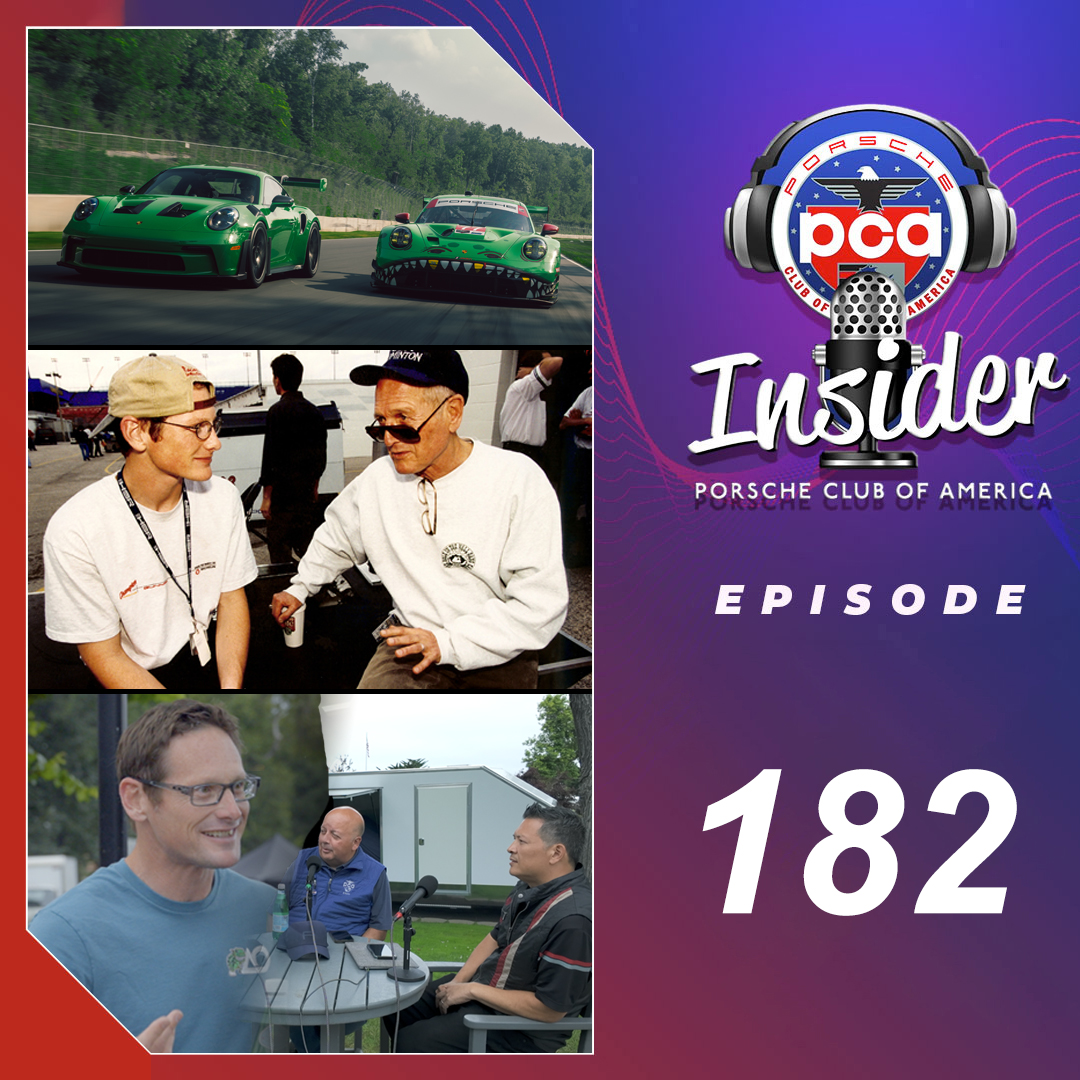
Gunnar Jeannette shares his journey from a childhood immersed in Porsche racing to becoming the team principal of AO Racing. He discusses his early experiences at the racetrack, the challenges of transitioning from vintage to professional racing, and his memorable participation in prestigious events like Le Mans. The conversation also highlights his innovative approach to team branding with the Rexie character, engaging fans, and the importance of balancing fun with serious racing. Gunnar's insights into the evolution of motorsport and his current endeavors with Porsche make for an engaging listen.
We got to spend an hour, talking racing and history, with Gunnar Jeanette from AO Racing during Monterey Car Week. Gunnar was one of the youngest drivers to finish the 24 Hours of Le Mans. He was born into a Porsche family since his dad was a mechanic and crew chief for many Porsche teams during the 935 and 962 glory years. After racing, he partnered with a friend to start AO Racing which is more famously known for the team cars, Rexy, Roxy and Spike. Gunnar’s story telling is on point and he’ll keep you glued to hear the end of each one.