Oil return tubes are pipes that carry oil back to the engine after it has been used. If they leak, it can cause a lot of oil to spill out, which is not good for the car.
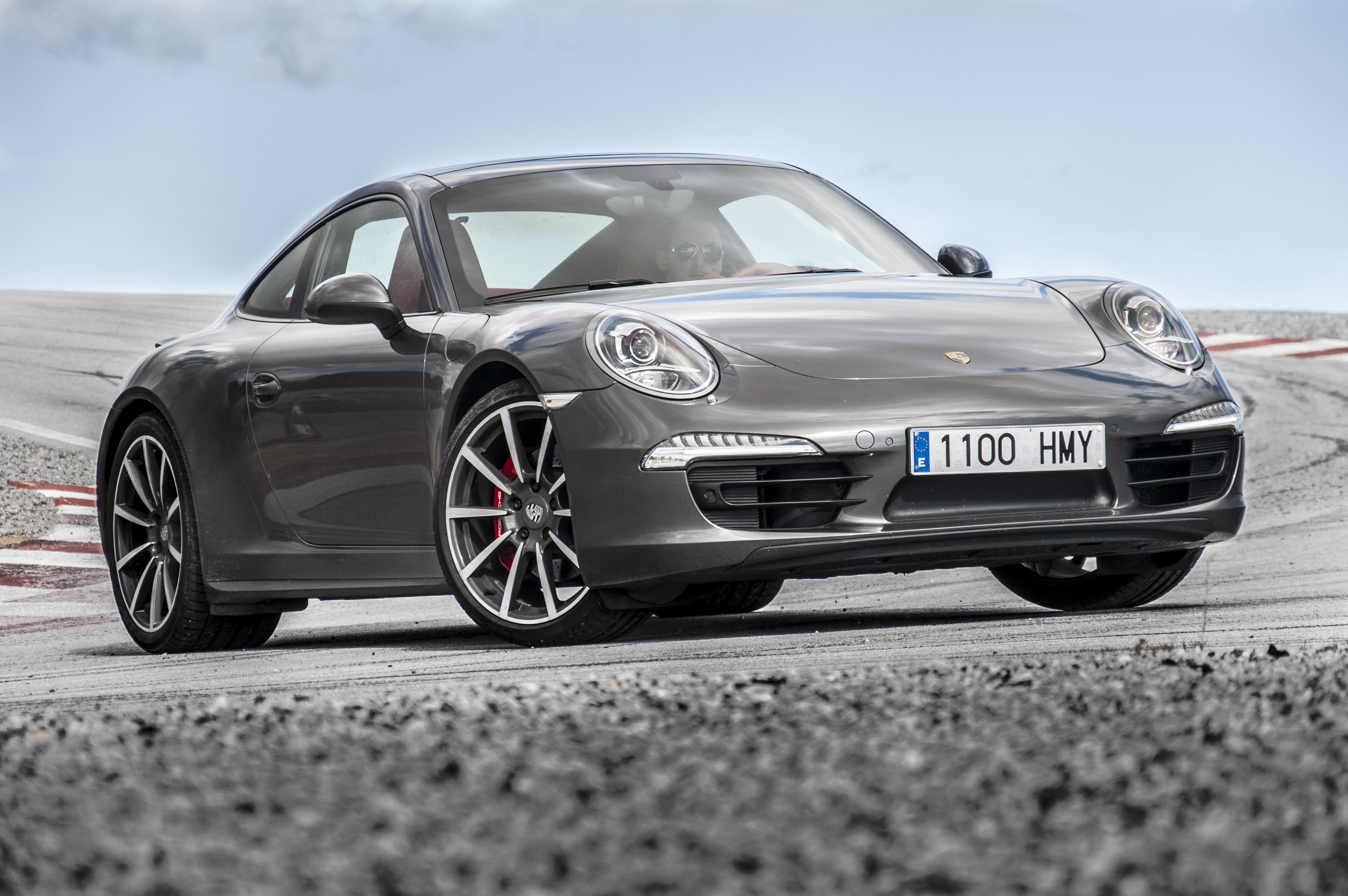
The Porsche 911 is a famous sports car that has been around since the 1960s. It's known for being fast and stylish, and many people admire it for its performance and history.
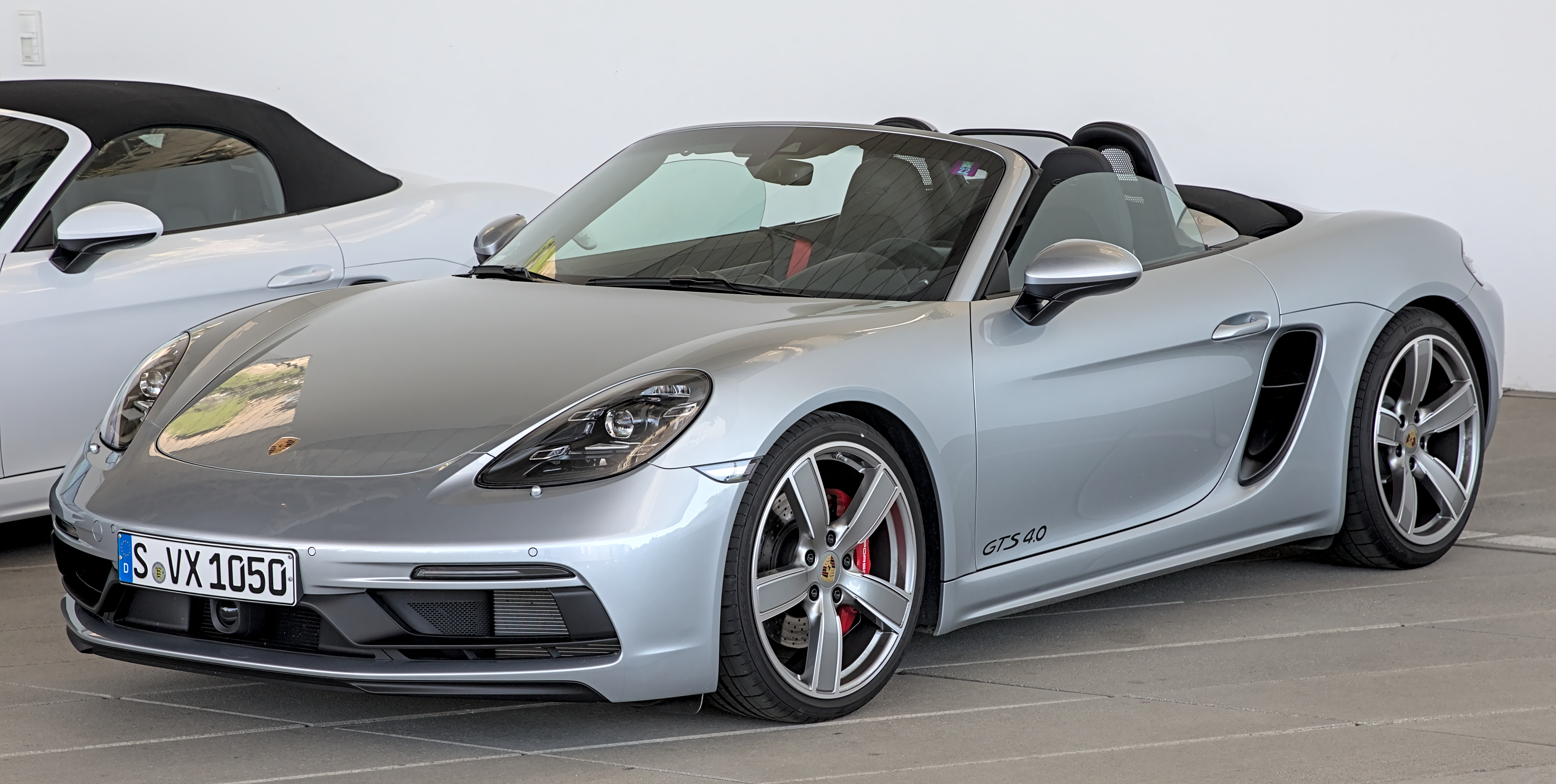
The Porsche Boxster is a small sports car that has a convertible roof, meaning you can drive it with the top down. It's designed to be very fun to drive.
The Nürburgring is a well-known race track in Germany where many car manufacturers test their vehicles. It's famous for being very difficult and is often used to see how fast cars can go.
The Porsche 356 is a classic car made by the German company Porsche. It was popular in the 1950s and is known for being lightweight and good for racing.
Car
Porsche Speedster
The Porsche Speedster is a lightweight version of the Porsche 356, known for its sporty look and feel. It's a favorite among collectors and enthusiasts.
'Numbers matching' means the car's engine and parts are the same ones that originally came with it. This is important for collectors because it can make the car worth more money.
'Headrests' are the parts of the car seats that support your head. They help keep you safe in case of an accident by preventing your head from moving too far back.
Car
Porsche 912
The Porsche 912 is a less powerful version of the 911, made by Porsche. It has a four-cylinder engine, which makes it cheaper and more accessible for buyers.
Term
901
The 901 was the original name for what we now call the Porsche 911. Porsche had to change the name because another car company already owned the rights to names that had a '0' in the middle.
A detuned engine is an engine that has been changed to make it less powerful than it could be. This is sometimes done to save fuel or to make the car easier for more people to drive.
The affordability issue is about how much a car costs and whether people can afford to buy it. The Porsche 912 was made to be cheaper than the 911 so more people could buy it.
The 356 engines are the engines that were used in an older Porsche model called the 356. They were reliable and helped keep costs lower when making the 912.
A flat-six engine is a type of engine that has six cylinders laid out flat instead of standing up. This helps the car handle better because it keeps the weight lower.
The Toyota MR2 is a small sports car that has its engine in the middle, which makes it handle really well. It's known for being fun to drive and is often cheaper than other sports cars.
The Porsche 917 is a famous race car from the 1970s that is known for being very fast and winning many races. It's considered one of the best race cars ever made.
The Volkswagen Bus is a classic van that many people love because of its unique shape and roomy interior. It's often associated with road trips and fun adventures.
The Datsun 240Z is a classic sports car that was made by Datsun. It's known for being fast and stylish, and it was cheaper than many European sports cars.
The Porsche 914 is a two-seater sports car made in the 1970s that has a unique look and is fun to drive. It's considered a more affordable option for those wanting a Porsche experience.
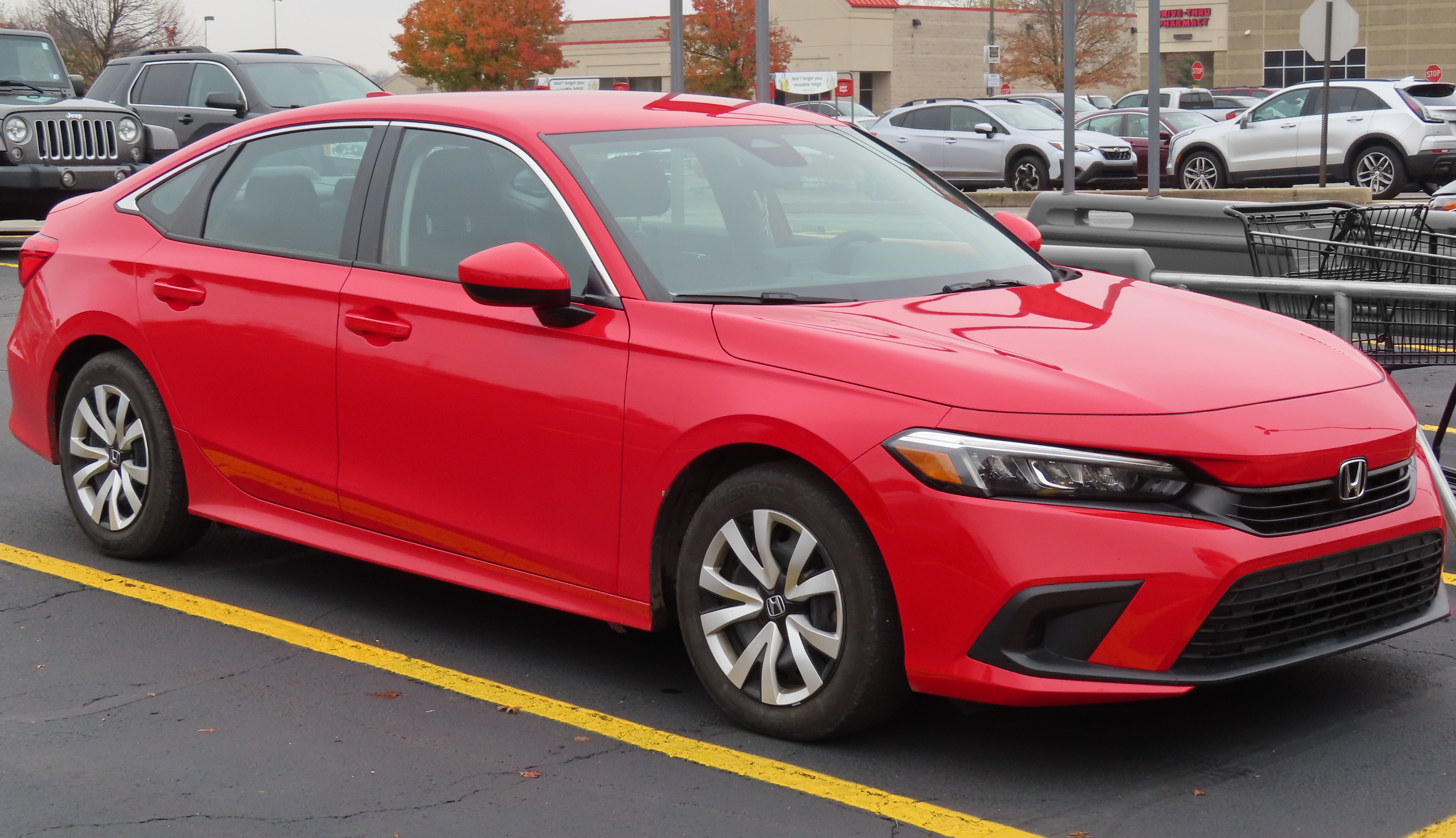
The Honda Civic is a small car that many people trust because it's reliable and gets good gas mileage. It's a popular choice for those looking for a practical vehicle.
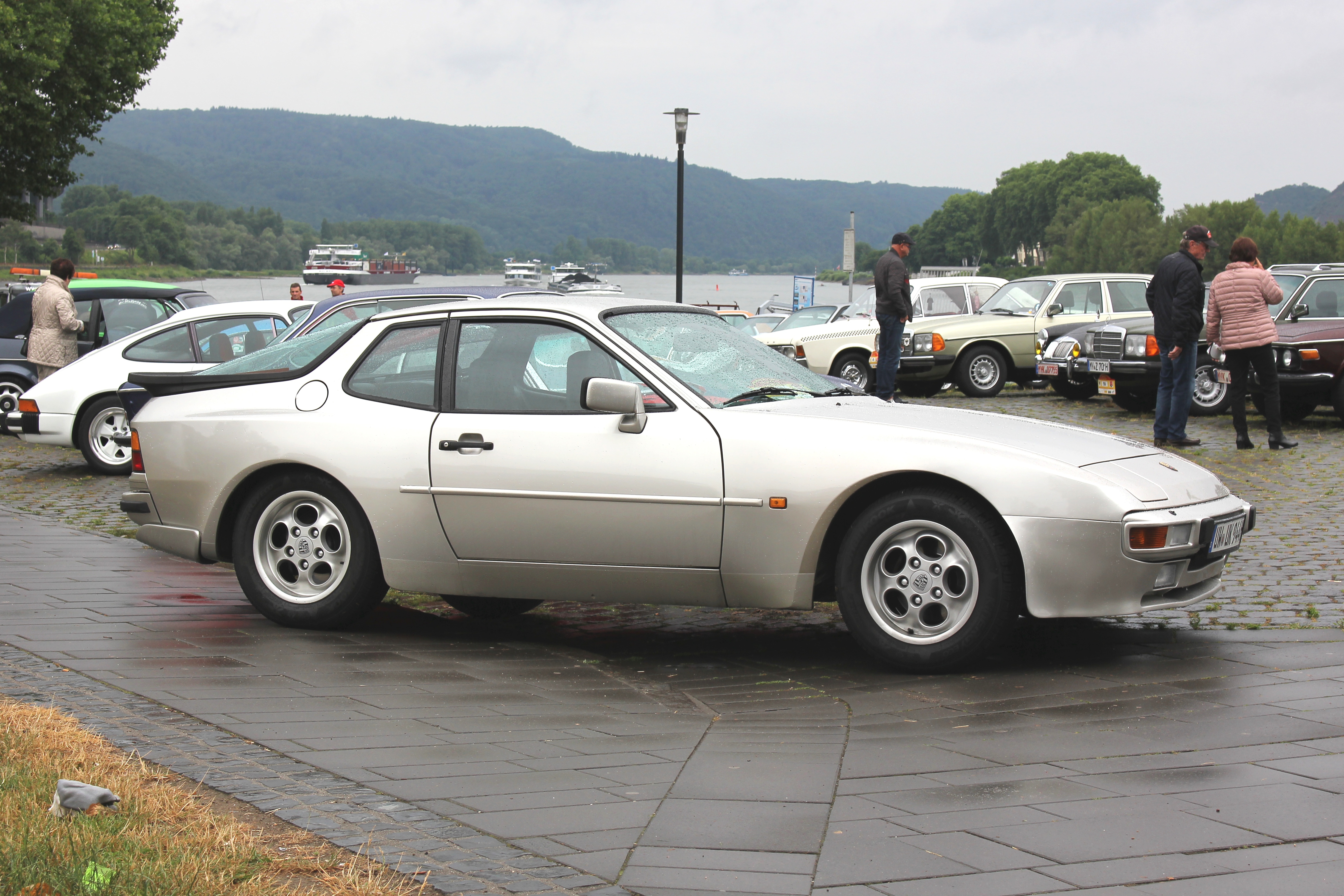
The Porsche 944 is a sporty car made in the 1980s and early 1990s that is known for being fun to drive. It's often seen as a more affordable way to enjoy the Porsche brand.
The Porsche 928 is a fancy sports car made from the late 1970s to the mid-1990s. It has a different engine layout than most Porsches, making it comfortable for longer drives.
The Porsche 924 is a sports car made from the late 1970s to the late 1980s that is easier to buy than many other Porsches. It's known for being fun to drive and not too expensive.
The Toyota Corolla is a small car that is very popular because it's cheap to buy and run. Many people like it because it lasts a long time without many problems.
The Porsche Carrera GT is a very fast and expensive sports car made in the early 2000s. It's known for its amazing looks and powerful engine, making it a dream car for many.
The Porsche 550 Spyder is a small, lightweight sports car from the 1950s that is known for being very fast and stylish. It's famous partly because a movie star owned one.
The Ford Excursion is a really big SUV made in the early 2000s that can carry a lot of people and tow heavy things. It's great for those who need a tough vehicle for big jobs.
LIVE
Welcome to the Porsche Club Insider, your one stop for all things Porsche and PCA.
Here's your host, Vu Gwin, and the Insider crew.
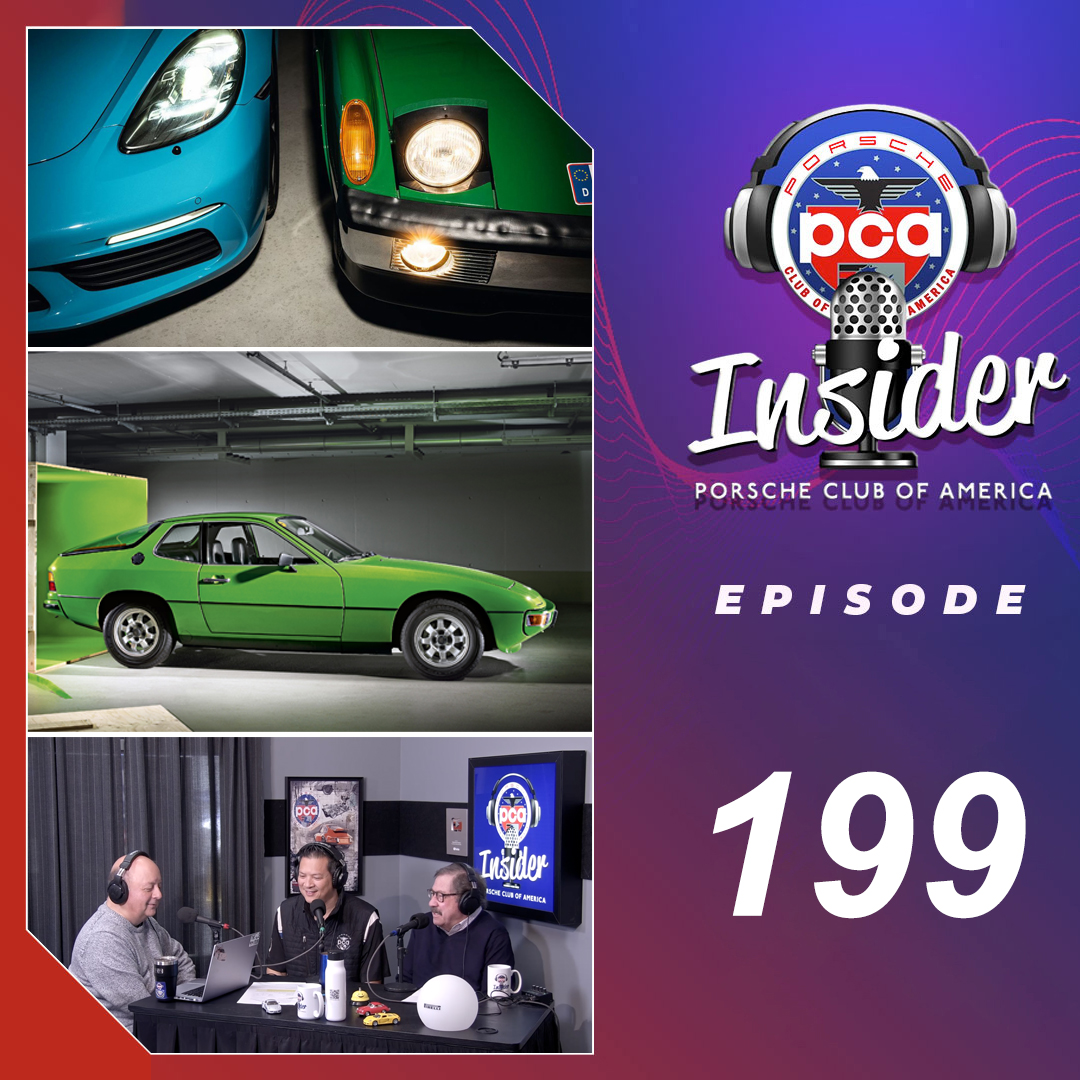
Welcome everyone to episode 199.
I think for our listeners, this will be the last podcast that they'll hear for 2025.
Correct. Wow. And then one away from the big 200. Well, everyone here probably admits all the
holiday celebrations. So from all of us, we wish you the very best and we're looking forward to
2026 with you. Want to thank, of course, our presenting sponsor who's been with us
from the beginning, Pirelli. Pirelli tires have to achieve the highest levels of performance,
safety, noiselessness, and grip on the road surface. Innovative tires that can satisfy even the most
specific mobility needs of the end consumer. And thank you all for listening. If you aren't
currently a PCA member and own a Porsche, what are you waiting for? Grab that VIN,
head over to PCA.org and make yourself a member. If you don't currently own a Porsche,
check out our test drive program where we unlock resources to help you find that special Porsche
for your garage or driveway. Again, just head over to PCA.org. At the table, of course, I have
Manny to my right, Damon's at the controls. And back to the show is Michael Maurer, a longtime PCA
member who has sold Porsches for over 30 years. Wow. Wow. That sounds so cool. Doing anything for
30 years is an accomplishment, let alone selling Porsches. But when you're having fun, remember
time flies. Exactly. Speaking of having fun, how was everyone's past week since our last get
together? So I'm waiting. I bought the set of wheels for the Macan. They're on the car.
But the center cap said again, we didn't have the crest in the middle.
Not colored crest? Nothing at all. Where the crest would go is empty. So you don't
have the plastic tabs on the inside? Yeah. They're not like the ones that fit on my 964.
So I look online and I find some as cheap as $40. Oh, Chinese specials. For all four?
For all four. Oh, gosh. Deliberate. So I'm waiting to see what these look like. It's colored crests
and the pictures look great. They're coming across the globe. Will they be hit? They're coming from
California. Oh, California. Oh, so you've got a U.S. Okay. Well, speaking of tariffs, also,
well, I'll report on those how they look like. I got no one to blame about myself
for $40 expecting anything other than, we'll see. If they fit, you'll be happy.
I will be, because it's just winter tires. So the book that I got, the Motorsports book from
Type 7, at least from my social media feed, they're advertising like crazy for this book.
I thought I wasn't going to have to pay tariffs because I got it delivered.
But yesterday I got an email from FedEx. You did? $44. Oh, wow. Okay, so just make sure you
plan on. Around 11% of the, so normally the book would be $400. Wow. So you got that like a week
after you got the book? Interesting. So I said, well, you got the book, you don't have to pay it.
I'm like, this is FedEx. Yeah. I'll be like the credit reporting, get a FICO score of $500
because I don't want to pay $44. Your student loan is in default. Exactly. So do you want to
give a shout out to the tire supplier for your winter tires? Didn't you have an ordeal with the
sizing? Yeah, I have not talked to the seller yet. Oh, you haven't? No, I haven't. Not the seller,
but the you bought tires from? No, because they haven't finished the transaction. Oh, they haven't.
Right now. They picked up the tires to take back. Yeah. And they said, no problem. My mechanics,
though, I haven't had a chance to put the labels on. Let me put the labels on. And the driver said,
hey, no problem. I'll put them on myself. Yeah. Never put them on. Two days later,
the tires get delivered back to the shop. Oh, no. Oh, no. And then like, what an idiot. So
the more I got to go pick, I'm going to pick them up and drop them off directly myself at FedEx.
Well, I had my little FedEx episode. We ordered for the office here some air tags,
and they got shipped to my house. But for some reason, air tags have to be signed for.
And so you go home and you see these white tags on your door. And of course, I signed it,
just leave it here. And the next day I come home, a second white tag. Like they wouldn't leave it.
For air tags? Well, I didn't know what it was initially. But after the third time they delivered
Saturday night, we were home. And I'm like, really? Signatures for Amazon? Or where did you order
from? From, I forget where it was. Yeah, I don't know the staff order. I don't have an Amazon
account, but my kids do. Yeah. So they've been shipping all the Christmas gifts. But they don't
ring the doorbell or anything when they drop stuff off. They don't? They just leave it on the porch.
Interesting. So, I mean, one time, it was the next morning, I went to work and there was
two Amazon packages sitting on the, and I looked at my phone, they delivered like 11 o'clock at
night. Oh, yeah. Well, they didn't want to wake you up. Well, in the cold weather, too, I had
something delivered two days ago. I didn't know it was there. Yeah. Opened the garage door this
morning. Whoa, look at that. Oh, they're nice and frozen and preserved shelves. Yeah. Speaking of
cold, speaking of tires, you really admit that winter is here when you mount your winter tires.
And so, I mounted the winter tires on the Cayenne. And I will say, have you ever
experienced where the, I guess, the pin inside one of your valve stems? Because once I put my
tires on, I went around and checked the tire pressure on them to make sure that they were
correct. And the next morning, my front left tire was probably down to like 10 pounds. I'm like,
oh man, did I run over a hole? But as soon as I took my cap off, I noticed that the pin was like
kind of pushed in a little bit. So I kind of wiggled it a little bit and just moved it around
and aired it up and all is good. So thankfully it wasn't a puncture, but I didn't know that, I guess,
the cores of valve stems might get. Well, that's the way you used to bleed it off, bleed the air
down, but yeah, but it was just out of whack. I'm just going loose though. Yeah. So it wasn't that
it was loose. It was just that it was like stuck in like not fully off or whatever you want to call
it. Do you keep a cap on it? I do keep a cap on it. Yeah. But they are old wheels. So maybe
that's something where people, you know, I know like when we get tires mounted, I always ask for
new valve stems, which has a new core and stuff like that. So anyways, I also, I also, I didn't
get to go to the new member party, which I heard was extremely well attended. I was at home trying
to stay warm and turn my oil return tubes around. And I'm happy to report that after one week,
and they are not leaking and all went well. This is good. It's good. But that leak that I had,
because I left it on the rack for about two weeks, I leaked about a quart, a quart of
oil, which is a lot, which is a lot. And the sad part is there was a BMW underneath the 911
that collected some of that oil on the rear trunk lid. Yeah, that, you know, I had, I had a drip
tray, but drip trays only work if you place it exactly where the drip is. Ah, yes. I missed it.
Details, details. Anyways, today we're going to be talking about remembering Porsche's entry-level
sports cars from the past. We'll discuss why these cars were built and how, and the reason why you're
here is how well they were received and if they are collectible today. So, and the reason I came
up with this is because all over the news now, and this drives me nutty, is that one news agent,
one website will come out with an article, and then everybody in his brother rewrites the article
that comes out the same thing, but you read it, nothing's new. Yeah. And the news was that Porsche
is going to be building Cayman and Boxster ICE engines. Right. And so Porsche has announced
that officially they will bring back the GT4 RS and the RS Spyder. What kind of form we don't know
yet, the rumor is, and I think Damon had a good observation that will probably be a hybrid system,
like they use in the GTS. And that, to me, would make perfect sense. But as far as making, coming
back with the old Boxster, old Cayman, there's no proof of that or anything, but you read these
headlines and it's a done deal. But you really get the bottom, it's like reportedly at the end.
Yeah. Porsche has not confirmed any of this. All those little words that mean a lot. Details,
details. So you got to, so if you're listening to this, just remember they're working off
rumors. Yeah. It's nothing that Porsche has officially, I think, I don't know if they even
officially acknowledge that they're making a Cayman, they were making a Cayman electric car.
I remember every time we would talk to them about, ask them a question about it, they're like,
we know nothing about that car. Yeah. That blank stare. I'm like the one that everyone is
broader, including you guys are testing at the Nuber ring, you know, nothing about that.
We have no idea. No idea. So just keep us. Anyways, I do believe because of the financial
stresses that Porsche is experiencing right now, that made me think in past history,
when Porsche has run into where, hey, we better tighten our belts, which, of course, we would
last podcast, we talked about a Porsche is going to be doing some
alignment, realignment of positions and people are going to be let go and blah, blah, blah.
Usually this means that we're going to get some kind of entry level car, because that's the quickest
way to get revenue into the company is to bring a car that more people can afford to buy. And so that,
I look back at Porsche history and there's like five big models, if you want to say,
that were Porsche entry level cars. So that gave me an idea. And then we were talking
Mike Price experienced quite a few of these either on the sales floor, just remembers
when they came out and how they were initially viewed. And we can talk about how to view today
and whatnot. All right. Well, let's go deep, deep, deep into our past back to 1956 and talk about
the 356. But even in 1954, actually. 54. 54 is the first one. Oh, 58 was the last year,
actually 59. They were still building some Porsche built some, 58 technically was, but
Porsche built some in 59 that were precursors that wanted to still race them. So a lot of them were
GTs. And I always, when I write this stuff, I got to make sure I'd get the outliers because otherwise
the comments will come alive. The historians in our club will correct me very quickly.
So 1954. 54 is the first one. Wow. Yeah. Wow.
Max Hoffman saying, please send us an affordable car. But price wise, the price point of the
early Speedster was in the 2995. I remember that poster. But my dad bought a 57, 356A and it was
$3,000. So there was only about a 10% price differential, base price, between the Speedster
and a 356A coupe, I think 1,300, the base model. Yeah. So, but it was 10% for Porsche at the time.
That was a, that was pretty hard for them to meet that $3,000 price point. They had to, and I think
someone pointed this out to us. If you look, if you look at their original advertising poster,
there's no side mirrors. Because that was optional. Every early car's attack was optional.
Heating was optional. Yes. A lot of things were optional in the car that they call them most
called them, they, I think they called them mandatory options, meaning that the dealers
automatically ordered them with either side mirrors, heat, attack. So I'm thinking, I would
love to see a Speedster with no tech on it. I was about to say, I don't think I've ever seen,
you know, with that whole field and odds are 36 guys who can chime in here, I would love to know,
but I would imagine odds are prior none that they were all ordered with a attack. But that's one
of the things that did my research. It said that the attack was an option initially. I think later
on in the Speedsters, it became a standard. So how do you think they, I mean, at the time, the 356A,
you know, was the predominant car. But when they clamored for an affordable car, that the body of
the Speedster was much different from an A. Like, how did, how did they kind of, how did they
cover that cost for, for the Speedster? I think they knew they were going to make a lot of them.
Oh, okay. Yeah. It was, it was enough for them to invest in a new body.
They wanted to capture the people that were buying the British sports cars.
Max Hoffman wanted to, he knew that they were losing business to,
which you look at those cars and it's almost laughable that you would compare an MG,
but TD maybe? That was a TC, TD was contemporary car to the 256. The 256 looks so much more modern
than those cars. But if you look at the period photographs, those cars were on the racetrack.
And how did they compare price wise to the, to the Speedster? Like those British cars back then?
Significantly less. They were like 2600. 16 to 1800. Okay. So it was, so even though this was a
base car, this was still a premium sports car price. Yeah. It was, Porsche was never affordable.
It was always something that was just a little beyond the reach of many people or way out of
reach. That's funny that you said that because you always, or at least some of your friends,
always talk about how Porsche, you know, doesn't make an affordable. I remember reading was,
Porsche needs to go back to making cars that the working man can have. That's what it was.
When did the working man have a Porsche? Yeah. So what you just said is true. It's like it's
always been a premium. Yeah. And they may know, know, they ever hit the fact that they were
essentially a luxury car maker. And if you wanted the working man's car, you bought a VW. Well,
in 57, the Volkswagen Beetle was $1400. And that $2800. That's double the price. I mean,
that's a big jump. Now, admittedly, a Volkswagen Beetle is not a Speedster or a 356,
but that shows you the price differential. That's huge. Double the price. Oh, gee. Well,
even with that big price tag, I think they sort of hit the mark for enthusiasts because if I look
back at the print that we have on the wall right outside of accounting from the very first Porsche
parade here in Gaithersburg, that parking lot photo has at least 11 maybe maybe 10 or 11
Speedsters there. So like the enthusiasts got it right away. And it's really impressive when you
think about the fact that that was pictures in Virginia, not Southern California, right? So these
are people that were especially I'm sure they didn't come from California for the first parade. So
let's say they came from Ohio or something. Yeah. With the point being, these are not the
best cars in bad weather, which we have. We have rain. We have snow. You know, they had a plastic
side curtains, the windows in roll up or down. They didn't have any rear defrosters or front
defoggers. And also, my dad, we were living in Europe and I was a little, little boy,
but dad wanted a Speedster and you couldn't get them in Europe. They were designated to the U.S.
market. U.S. only. Yeah. Yeah. That was, let's send the cheap ones to the Americans so that they
can get by Porsches and have them seen because they were so exclusive except in Southern California.
So compared to Cabriolet, the Cabriolet had the pad at top, much more luxurious where the Speedster
was just a very thin top. You could see all the bows and everything. What's the earliest Cabriolet?
At least 50, right? 51? Yeah. My 356 knowledge is skinny. Someone will tell us online. Yeah.
But I mean, the Cabriolet was out. So there was the drop top 356 available, but this was
more sporting, different windshield, lower priced, lighter weight. Side curtains. I've had the
opportunity to drive a Speedster and I got to tell you, even today's speeds and traffic,
a Speedster, no problem hanging in with modern traffic. That's pretty cool. They feel so light
and so nimble and just, it's a real experience. Everybody should. But not so light where it's
scary that you're going to feel like you're going to get blown off the roof. Nimble and maneuverable.
If you fast forward to today, because you talk about collectability, I think we all know it's
incredibly collectible, but a Speedster now runs in what price territory? I bet you, for one, that
Damon's got one up here. 1956 356a Speedster that was sold September 16th, $250,000. That sounds
like a pretty good deal too. That's a non numbers matching probably for $250,000. That's a good driver.
Especially in that color too. Repaint from something else. But when you compare a
Speedster to it, once again, a cabriolet at the time, it was a pretty significant drop,
which made people who wanted to get into convertibles a much easier decision if they were
to live with some of the luxury items gone. I think the, I thought was funny, was the
driver, no passenger side, sun visor was optional. Every little piece. Driver had that.
Well, Mr. Bill has a luxury touring seats, but the car came with standard bucket seats,
which some people didn't find comfortable, like the regular sedan seats. But back then,
the headrests were optional for the passenger or the driver. Sometimes the driver just gets
a headrest. Mr. Bill's car also has the optional armrests on the doors. Luxurious Speedster.
Exactly. All right. Well, let's fast forward to the next one. This is sort of when the 356 era
was moving into the 911, but then there was sort of an in between and affordable vehicle that I
have to be honest with you. The first time I was in California where one of Lowance's best friend,
her then boyfriend drove a Porsche and of course they knew that I always wanted a Porsche and they
said, oh, you know, they're going to pick us up in his Porsche. I was like, all excited, right?
And then I hear it. Like there's like bug sounding. Four bangers. Again, not to be disrespectful,
but like I didn't know any better. I didn't know any better in a silver,
what looked to be a 911, but it sounded like a bug. And I'm like, what is this? He's like, oh,
it's a 912. I'm like, oh, okay. And like I really like did not appreciate it like I do today because
I was just like, well, how come you didn't get the 911? But it was a cool ride. We went all around
Hollywood in it. But there was a time when you could pick up 912s just just 15, maybe 20 years
ago for cheap, cheap money. But now I think they've seen their day where it's kind of come into their
own. So tell me a little bit about how the 912 came to be. Well, they were developing with the
901 actually was called the 902. Because they knew that the pricing of the 911 was going to alienate
a lot of the 256 customers. It was a big jump to the 911. So they needed something to buffer
until people got used to the pricing of the 911 and made sense that, hey, it's not that hard to put
it in a 256 engine in here and set it up for 256 engine and like the body and everything the same.
Initially, they only had three gauges instead of five. They still had the dash set up the
four to five, but they only had the three in the middle, which also made 256 owners kind of comfortable
because they were used to a three gauge layout. From the outside, it looked like a 911 until you
turned it on or you tried to race one at a stop sign and then you realized that you didn't have much
power. So they took the 256 SC. I think they detuned it by five horsepower. They detuned it.
So it was at 95 or 90 horsepower, I think they got it down to.
Yes, it was only about 10 horsepower, I think, man. If five or even 10 horsepower from the 356,
yes, C. So it was a little bit of a drop, but it was an engine that 256 owners who
were very familiar with the car so that they wanted to do the work themselves. This wasn't
a big jump to the flat six, which was a whole different design of an engine.
I understand the reasoning and why they would be familiar with it, but do you think 356
individuals embraced the 912 over the 911? I feel like the 912 from the very beginning,
unlike the Speedster, the Speedster was less amenities, but it was lighter. It was kind of
looking more performance oriented. So I don't think its birth kind of started with a lot of
excuses. I'm trying not to get myself into this corner, but I think the 912, you come out with
a car that's heavier and it has a detuned engine. It's slower than a 911 and the 356 people probably,
I don't know, I didn't know. How was it received? Well, the affordability issue is a big part of
that. Take a 912, 45, $4,600, same 911 was $5,700. A big jump. A sizeable. Let's say
$4,700 to $5,700. That's a jump. Also from a business perspective production, you got these
356 engines still. They didn't know when they were going to cease production of the 356, the SC.
So we've got, hmm, we can use these four bangers and we can put them into a car,
put it at an affordable price, kind of like the Speedster. Let's get rid of the top,
let's get rid of the roll up windows. So the 912 made perfect sense from many perspectives
and at one point the 912 was outselling the 911. Really? Yes. Oh, I didn't know that. Little known
fact. Yeah. I mean, that's a lot of base models outsell the GTS or S models because people can
get into the car at a much cheaper entry price. So the 912 was actually fairly well received by
the media when it came out too. What people now know is that the car was lighter and the engine
was pushed closer to the middle of the car than it was far hanging out rear. So it actually was
better handling car than the 911, although it didn't have that extra power that the flat six had.
But I think as the car got older, when I joined in the 80s, and I was doing all my research to see
what Porsche I wanted to buy, that they would tell you in the 912, just save your money and get a
911 because you're never going to be happy with the horsepower or you're going to want to put a
six-cylinder engine in it. And they basically told you to shy away from the 912 and just go for
911 because you'll be happier, which is kind of funny nowadays, right? And I'm sure a lot of people
put six cylinders in them because it wasn't that far of a stretch to put a six in it.
Yeah, it's just how it was received. I still think they are, I would say,
I don't know, would you say that 912's have its full sort of respect in its
mainstream? Because I feel like I don't see that many of them and I don't know that I hear
much about them. I've seen growing respect. Growing respect, for sure. But not like a
speedster. Or not like a 911S. Yeah, exactly. Yeah, I would agree with you there. But I think
for the money right now, I think they're still like a great buy. Yeah, I mean, here's one.
Damon just threw up August 10th auction on Bring Your Trailer, $65,925 speed,
$75,000, which looks to be like a nicely restored vehicle. To me, a lot of car,
a lot of classic car for the money. Air-cooled 911? I mean, air-cooled portion. Yeah, cool vintage
looks. Because now that we, now 60 years later, the 911 isn't that fast compared to in modern times.
If people get into a 911 with that vintage, they're going to say, oh, this is as fast as I
thought it'd be. Right. Oh, yeah. Damon, can you hold that picture? See the rear end of the 912?
The bar is going horizontally across, yes. Across the bumperettes, yep. That was a very,
very popular AMCO, AMCO made those because the license plate and the rear valence was so subject
to being bumped into. So everybody had to have that. But that was not a factory operation?
Oh, no, that was aftermarket. That's a great way to hide your license plate. Oh, yeah.
At least that's chasing you. Not that anyone would do that. Yeah, that was a very popular 912.
They're going to catch you. You're just kidding. Oh, guys. See, I was very respectful, man. He
not so much. He teed up for me. He couldn't help himself. But what a beautiful combination
that we're looking at a black 912 with red interior, chrome wheels. That's a cool looking car for
$75,000. And you couldn't touch an early 911 for that price, right? No. I mean, that's very tempting,
like you said. It looks like it's all set up, great interior. And it's a classic. I mean,
I can't think of anyone that looks down at a 912 now. It's always, cars and coffees are always
topical conversation, you know. And are 912s, do they have the difference in wheelbases?
Same thing. Same body? Same wheelbases. Same body. In fact, one of the guys that come to cars and
coffee, he has a Sunroof 912, which was, I think, really rare because, you know,
that's a luxury option. Yeah, sure. As you added more options, you got closer and closer to the
base price of the 911. So at some point, you're like, wait a minute, maybe let's just get a 911.
So you didn't see a whole lot with Sunroof. And that's why a lot of them didn't have
Fuchs wheels. They had this one they called steel wheels. And afterwards, people started
putting Fuchs wheels. But originally, they were, even like 911Ts had steel wheels. It wasn't like
every single 911 came with Fuchs wheels. You know what I find funny? I find funny that early cars,
people that have Sunroof and early cars, you go, ooh, ah. But then later cars, everyone's like,
Sunroof delete or slick top is the one to have. So true. I think also the way, and 912s
are always coupes. No, no, no cabriolet. Well, there wasn't any cabriolets back then.
Donna Brandt has the Targa version. Oh, that's a window off window. Yeah. Yeah.
To give you another differentiation in pricing. Let's 912, approximately 4,700. 911, 5,700.
Volkswagen Beetle, 1,700. So you're seeing a huge, you're starting to see a gap, a bigger gap.
Did the 912 come soft window Targa availability or not? Oh, yeah. I did. Okay. So is that a
premium? Yes, it was a premium and it's also very rare. There wasn't too many. Because you're
adding price to the base car. And he sold a lot of 912s. The Targas were much, much less. So
you can find a 912 Targa. That's a rare car. That's a rare car. Yeah. I'll tell you why
back to the sunroof. Yeah. But what I always wanted a sunroof 911 was the scene with Steve McQueen
and Lamar driving through the town of Lamar. Remember, he had a sunroof 911 and that's stuck
in my head between that and when the big chill when William Hurt drove the Targa in the early 911.
I used to watch that. That was kids that was before the internet. So we didn't have pictures we could
go and Google and find. So I used to watch those two movies and those lean calls when they would
have the Porsche shots. The big chill. There's so many great movies from the 80s that just planted
the seed for so many current Porsche owners. I would agree to come out. I wish I could find,
we'll have to do a podcast about Porsches and movies, but I did back in the early 90s when
we had VHS players. I edited like a one minute cassette about the tribute contest with Porsche
movies for the region. We need to go back to something like that. But I played it and then
everyone would write down what movie they thought it was. And at the end, we saw who had the most.
And I had some obscure stuff in there. I think I spent like $120 at the video rental place
getting movies and bringing them home and editing the... That's funny. That's funny. That would be
cool if you could find that VHS and we could digitize it. That'd be pretty cool. Yeah. That's
the ultimate trivia movie. I remember a Lee Raskin, you know, who was head of the on the podcast
that James Dean expert. There was a movie with Holly Hunter and I think James Spader called
Crash. And these people who enjoy watching crashes. And so there's like underground club. Anyways,
they go to a underground meeting where they recreate the James Dean crash. Oh, really?
So in the movie, I mean, in the tribute contest, I spliced where they do the scene where they
recreate the crash. And there's grandstands and they have a replica 550 and then the four tutor
and everyone's dressed up in period. And so Lee was like afterwards, you're like,
what is that movie? Where did you get it from? I said, I looked down on my list. I said, oh,
it's Crash. I think it's called Crash. I think it's from the 80s. And he went out right away.
And he was like, I got to see this. I've never seen this before. I haven't seen it.
Nor have I. I've never even heard of it. I'm sure you YouTube, but you can find it.
Now we know the answer to that trivia question. Definitely not a movie for the kids.
I've seen Crash. I've seen both crashes. Oh, there's two of them?
There was a later one that's nothing like the one that you're talking about.
Are you saying that because it's like gruesome? No, it's a fetish.
Every, everything about it. Yeah. Everything. It's crash fetish.
Oh, interesting. So in everything that goes with...
I was trying to keep a peach or G-rated before you start sweating and everything.
I didn't mean to go there. I didn't mean to go there.
So let's talk about the next affordable vehicle.
A car that many loves and I also have, or most people don't realize that I have,
and we're talking about the 914.
Yeah. So that comes out, I said a 912 finishes in 69.
And Porsche obviously still needs an entry-level car.
They're liking having these younger folks coming into the dealership and
they were working on a project with Volkswagen. Was it Heinz Nordhoff, I think?
It was Nordhoff. Nordhoff, yeah, was the CEO of Volkswagen Ferry Porsche.
And they essentially had a handshake agreement of how much Volkswagen was going to charge them
to build the bodies and assemble. And then Porsche would do a six-cylinder,
and they would do that in-house, in Zufenhausen. And it would be sold as the Volkswagen Porsche
in Germany and Europe. And then the United States would be sold as a Porsche.
But Heinz dies. 69, I think, or 68. And the new guy comes in and he's like,
yeah, there's nothing written. It's... Oh, no. We're selling this way too cheap.
Here's a new price. And suddenly all the money that Porsche thought they were going to make on
these cars dwindled, because now they had to absorb the cost of what it was really going to
cost to produce this. Was Porsche at this time in distress, or were they just doing this to grow
a market share? I have a feeling. You read history, they're always in distress.
Other than the Vedicang days, when they were joined.
They seemed like they were like one bad model away from going just belly up and belly up,
exactly. Because you think of, see, of all these cars that say Porsche, I'm thinking,
one more date. They're always being saved. Well, it was always a design project for
other manufacturers or a Vedicang with his hedging and currency hedging. But yeah, that's...
Yeah, so in 1914, it was a departure, styling wise, from what they had been doing. Although,
if you look at it, you can see that they use a lot of family highlights, if you will. When you get
in the car, you have the race fenders, like a 911. The signature, yeah. But it was very boxy-ish,
and so it almost became a love of our hated type thing. But it was very sporty, and for what it
was compared to the British cars and the Italian cars, it was miles ahead. It was mid-engine,
which back then was not as common as it is... Actually, nowadays is not that common when
you think about it. But for a while there, we had like MR2s that were mid-engine, FIATs and what
on. But back then, it was a little like the Mura you had to get, or 917, or the 914. So for the 914
to be a mid-engine as a entry-level car was pretty high-end. Plus, it had fuel injection,
had four-wheel disc brakes, which you figure the 924 that replaces the 914 had drum brakes in
over here. It had the front end from a 911, transmission from a 911, and the engine was
Type 4, which at the time was state of the art for Volkswagen. They were getting ready to put it
in their buses. So you can imagine, you think of it now, you're like, it has a bus engine. Yeah,
exactly. It has an engine that was going in a bus in a little tiny car. That's pretty impressive.
It removable hardtop, two trunks. It packed a lot of convenience and practicality. So it actually
sold very well. I'll bring up my article that I wrote because I actually put the production
numbers for all these cars. It was over 100,000 cars they sell. So
so what cars would have been sort of its competition when it came out? A TR6? TR6, yeah.
A front-engine car, a rear-wheel drive. Yeah, the Fiat X19. X14, was it? X19.
X19, with the mid-engine. The 124, I think. 124 Spyder. Yeah, a Spyder.
When every road test that I saw, including the Datsun 240Z, Porsche would come on top. Once in a
while, a couple of them sometimes, the Datsun would come on top a little bit, but yeah, because
it was such a neutral handling. It was very wide, right? The steering was so light because it had
nylon steering with nothing in the front. It was very desirable. They would end up making 119,000
914s. Across all of its years? From 70 to 76. The 912 was 32,000.
So a lot more 914s. Yeah, so you figure this was a good moneymaker for Porsche.
I don't know if it was a car to save Porsche, but it was certainly a car to help Porsche.
I wonder how the club reacted in those years. So I did research on this because that also is my pet peeve
when people say, and I'm sure the comments are going to say, well, I went to a meeting and somebody
said 914s aren't real Porsches and I can't control what your region said or what's happened
locally, but I can tell you from a national standpoint, I could not find one single negative
comment about the 914. In fact, the club was very excited about the 914 coming out because they were
calling it the next Speedster because much like a Speedster, right? It was aimed at young people.
It was a convertible. It was bare bones, very light, four cylinder. A lot of people are super
excited. This is going to be the next coming of a Speedster. And I think in the 1970 Panorama
year, there's a quote from Chuck Stoddard who was at a tech presentation and someone asked him,
you considered a 914 a real Porsche because it uses Volkswagen parts.
And Chuck paused and he said, by you asking me that, you might as well ask me, is Porsche number
one really a Porsche? The Porsche number one used majority of Volkswagen parts. Of course,
we call it a Porsche because it was designed by Porsche. Porsche is the one who made it and it's
Porsche. So I look at the 914, he said as a Porsche because it was made for Porsche,
it's Porsche designed, so it is a Porsche. So later on, it was very well received by the press.
Styling was questionable, but the car's handling and whatnot was very well received.
Later on, the car would suffer because like all entry level cars, they would call it the
poor man's Porsche. And you had a lot of neglect because they were prone to rust. They became
known as rust buckets and with the 119,000 built, I think a fraction of those survived today.
Now, I think whenever you take it to a car and coffee, people always gravitate towards 914.
They're so unique. Yeah, a lot of people don't say them and it's funny with the younger people,
when I show them that the top goes in the trunk, they're like blown away.
Well, not only that, but you also have pop-up headlights, which is cool. It's a Targa and the
first thing that I think I was sitting, I sat in your car. So I grew up with my dad and this photo
of him standing next to a random 914 at like a rest stop. It's like an iconic photo that I have
amongst the family albums. But that's all I really like. My dad has always loved the 914. He
always gravitated to them at shows. But the first 914 I actually like really saw was his 914.
And I remember sitting in it for the first time and going, I can't believe how much like room
is in this little car. Like if you were 6'2", you could fit in it. It was a guy that got in that
was 6'5". And I told him, I said, that's as far as the seat goes back. And he's like, no, it's fine.
This is pretty comfortable. He goes, I didn't think I'd fit in this.
And how low you said you, when you talk about go-kart handling, like I think that came about
through the 914 because you're, it feels like your butt toxin is like two inches from the ground.
And when you drive that low to the ground, I don't care what kind of power you have,
like it just feels like fun because you look to your left in the 18-wheelers lug nuts is like
eye level. So as Mani said, not a lot of them didn't survive because they suffered rust or
ill repair and just got crushed. What had done to the engineering faux pas on this car was they
put the battery inside the engine compartment in the middle, which is great. But they put it
right on top of it was the engine grill. So it would rain and water would rush over top the
terminals and wash all the acid and everything straight down into the longitude. And it would
start creating what people call the hellhole, which is kind of funny because Charlotte
member services manager emailed me. She goes, I'm afraid to ask this, but is there really
a thing called a hellhole? And what is it? And I say, yes, I said explain to her an opportunity,
though. I thought it was something else. And when a member asked me about it,
I didn't know what he was talking about. But yeah, so you always hear people say,
check the hellhole because that's where, now, of course, you would make an easy
fix to that. I think in 72 maybe, which was a plastic cover that kind of like a recall that
sits on top of the battery. Now when it rains, the water splashes off the plastic cover
and doesn't carry all that acid down. But yeah, that was because the cars literally
break in half when that longitude had rusted through. They were unibody. So that was the
key part. And it was just you would see sagging cars and a lot of them when they started putting
one left, it would start breaking. Oh, I have a close friend who was stationed in Germany
back in that day, bought a 914 and the door started rusting. He said six months after he bought it.
And he said there was this little ESO gas station near where he worked. And he said there were a
couple of porches parked outside and he thought maybe they can help me with this rusted door.
So he pulled in, met a young guy who has become a lifelong friend 40-50 years later.
That was a Lois Roof who was at the gas station. Oh, really? Just starting. Yes. Oh, wow.
That's cool. So his rusty door led to a lifelong friendship. So Damon, we know these are rare now.
I still think these are, again, if you're looking for an air-cooled classic car that's extremely
unique when you go to a car show, you want go-kart handling, I still think it's a phenomenal buy.
There's one on the mart right now that's a 72. I think there is in 19,000.
If it's not the original owner, the owner's had it for like decades. California car 1.7.
Not a show car. Are you rubbing this in? Are you looking at me rubbing this in that?
It's very original. No, because my friend Chuck, everyone in my cars and coffee group,
keep on looking for a car for Chuck. And it's yellow and he was like, I want green.
He also wants like five minutes from his house. But anyways, I thought that would be for 18,000.
That's a lot. That's cool. I daily drove a 72914 when I was 20 for like two or three years.
And when I mean daily drove, it's through winter through snow.
And they were pretty good in the snow because they had narrow tires.
Are you thinking of reliving your youth? No.
But I thought every fun car they have for less than $20,000.
So, Damon, the one you had up there from Bringer Trailer, a 7914 sold May of this year,
$35,000 for a yellow 914 that looks immaculate with black interior. Yeah,
you can still get into these cars for that. That's less than a Honda Civic.
Obviously, you know, not necessarily the best daily driver, but you know,
I get work thumbs up in my 914 than any other car. Oh, yeah.
When I go fill up the gas and like new friends, because you have to lift up the front hood
to be able to get to the gas and people, you'll see them like peer around the corner
and try to look inside and see what I'm doing. And I remember a guy came up and he said,
I don't know what kind of car this is, but it must be really cool if you got to fill up
your guess and take that away. As a trunk. Very cool.
All right. Well, the next car entry level, in fact, not only will
PAG be celebrating, but PCA will be celebrating starting at work's reunion, Amelia Island.
And that is the transactional cars, the 924 and the 944.
Will we celebrate 928? And 928. 928 is not an entry level car, but 924 was.
And Mike, when did you start selling car Porsches? 82.
Okay. So that's near the end of the 924. Well, the 924 was a replacement for the 914.
And it was also a joint joint project that most people weren't aware of.
I have to say this, but once again, before historians started roasting me,
we had a one year car in 76 called a 912V. Yes.
Which was a 911. We put a U.S. market or North America market. I think it was just U.S.
That was a 76, 911 with a 914 engine, a 914 2 liter engine.
Oh, that's what the E was?
The E was injection. Injection.
Injection. I was in sprinter.
It was a four cylinder. Yeah. And it wasn't available in Europe.
So had the same five speed, basically the same idea as the 912, the original 912.
That was also filled in just for one year until the 924 came.
And that was available worldwide or no?
Nope. Just U.S.
Just U.S.
When we were in Germany one time, we went to one of the car shows and there was a guy with a 912
and I walked up to him and he bought it from the U.S. and had it imported.
But you must be like super rare when you show up and no one knows what it is and they see it.
So the collaboration for the 924 was not VW but Audi, right?
Well, I think we think VW, too.
Well, the engine was an Audi engine. It was built in Nekalzone, the Audi factory initially.
Is that a good thing? I don't know much about that era Audi.
To me, it's all in that family, the Porsche PX family.
This is what they're going to do for the next century level car, too.
They're not going to partner with Toyota or GM or Ford.
They're going to go to their own backyard and get something from the partspan or make something
just like the Macan. The Macan, they went Audi, Volkswagen to build that.
So with the 924, the big deal about that was the engine was in the front and they used antifreeze.
Watercooled.
First water. First watercooled? Yes. First watercooled.
This proceeded to the 928 by year. It was a big change for Porsche.
Kind of like when Volkswagen went to the Gulf or the Rabbit here in the U.S. and from the Beetle.
That was a big change. They did the same thing, essentially, right?
They even went so much further. They made a front-wheel drive.
The 924 was rear-wheel drive but it was also a more modern car.
It had a hatchback with plenty of space. It was, I think, a step up as far as technology and
starting to show that Porsche was moving with the times. Air conditioning was, I think,
dealer-optional. It was dealer-optional.
But back then, it wasn't uncommon for cars not to have air conditioning.
It wasn't like today. A lot of people are like,
my air conditioning is to roll down the windows. I like nature.
255. Two windows at 55 miles an hour.
Exactly. I think my father bought an 82 Nissan. The first year Nissan,
the brand came and it went from Datsun to Nissan. Had Nissan on the back tailgate and
then real little letters that said Datsun. I guess not as they were transitioning but
that had no air conditioning.
And a lot of people back in the day really considered air conditioning as something that
takes away performance because the compressor really dragged down the engine. In fact, my 83
320 IS was special ordered without air conditioning. And I have a different center console because
the guy ordered it without air conditioning. Yeah, the 924 and Bob Goodyear wrote this
in the panel years ago. Some of them were really botched up jobs that dealer did
were once again, because they didn't come to the factory. Just like the 914 air conditioning was
all dealer installed. So there were separate different companies that offered air conditioning for
924. And some of them looked, I mean, they did not look what I would call factory at all.
But a 924 was still very much premium because it was much more expensive than say like a GTI.
Yeah. Oh, yeah, right. It's almost $10,000.
Whoa. Yeah, a lot of money. Yeah. But they the fate that a lot of 924s and 944s ended up
and that's so good. Like they fell into disrepair and then
to maintain them a lot of the labor cost is still kind of Porsche labor cost.
Big cost from that was a clutch. Really? Because you had to,
I forgot how many hours was it like 12 or 15 hours? Huge. Yeah. Just the labor. Yeah. Yeah.
It was I know a little bit about this. I think it was, at least with 944s, it was closer to eight
or so and the turbos 944 turbos was more like 1516. 16 what hours to do a clutch later.
So not quite 15 hours, I don't think for the 924s probably. Because you had to lift the engine up
a little bit and then move the transaxle back. Yeah. And it was not like a 911 or 914.
It was much more involved. But they built a lot of them. So you have the 924 that comes out and
as a 77 model in the US, it receives praise for its styling and handling.
A lot of people said it was underpowered because the first ones were a 95 horsepower.
Yeah. They later jumped up to 110 but the first wave was 95 and used a four speed,
not a five speed. Like I said, drum brakes in the rear. They didn't put disc brakes until almost
82. I think you had to get the option or I think maybe the 79 became available but they weren't
too popular. 81, 82 that time frame. I forgot which M option you had to get.
And a lot of cars in that era were around that 100 horsepower mark because for those of you that
didn't live it, I mean at the time there was sort of this thing called a gas crisis, right?
There was. And so it wasn't like you were looking for a 300 horsepower or something that gobbles
10 miles per gallon. Exactly. So they had to have a performance car but also be somewhat efficient.
So yeah, there were some things you had to give up, so to speak.
But the funny thing was that the 924, as opposed to the 944, 924 you saw that adjusted valves.
Really? They didn't have hydraulic valves like the 944. But a 944 times 944 comes out.
It's what's a Porsche designed engine and you don't have to adjust the valves.
So 924s these days are probably still at the very bottom of the pricing?
I would say the issue is the ones that are like featured in this Damon showing,
they get top dollar. That's the Martini edition. But that's almost no money.
So we're looking at 1977 Porsche 924 championship edition four speed sold just a month ago
out the door. $7,100. Are you kidding me? Like you can't buy a used clapped out Corolla for $7,100.
You can't afford not to buy that. I just got like a look at the interior. Where are you looking for
used clapped out Corollas? $7,100 is like no money. Like it is. That's truly that's incredible.
My Cayenne was $3,500. Yeah, but look how nice that this one is. Oh my god, David. I think he just
assaulted you. That looks like it's ready for a car show. It does. Look at that. Wow.
Yeah, so a little disclosure here. Okay, now you show me the pictures where? Okay, now underneath
there's, I mean, that doesn't look bad. It doesn't look bad. Rust wise. That's just service stuff.
But to me, I'm still of that mindset where how did any 924 ever sell for more than $7,100
on the used market at least. That's where I'm coming from. But that's my personal opinion about it.
Like when do you mean when you say when I could sell for that much? Well,
I guess $7,100 for any 924 to me seems like I'm I probably wouldn't be willing to go
more than that, like maybe more for a turbo. But but in my mind, you've got all these options.
Like in today's money? Yeah, if you're going to spend, let's say $10,000 on a 924,
why not go for 914 that's in maybe slightly rougher condition? Let's see. That's the
difference though, because when you say slightly rougher condition, it's like your Cayenne,
you can say, well, I paid $3,000 for it. But you do a lot of work yourself. And the car had a lot
of miles on it. This car here isn't going to be a daily driver. It's going to be a, like you said,
a show car weekend car. I guess that comparing like a 914, I would think to get a decent one,
minimum $20,000 minimum minimum. And that's like a I don't have to work on it or do media work to
it. It's it's ready to go 924s suffered the same fate as 914s, people didn't take care of them.
So it's hard to find a good 924s because of that, because now not, you know, that
Porsche pricing on vintage cars have gone up. I see more and more 924s showing up on Facebook
marketplace that are just complete pigs. Well, they were the orphan top dollar. Yeah, the 924
became the orphan child when the 944 came out. So 924s, who cares about those 944 was a huge
and you that's when you started. So you started prime time when so much fun comes out of the 944.
That's a wide body. Yeah. And this is what Porsche should have built from the beginning,
people are saying. It was a Porsche design engine, 2.5 liter. But it had the Porsche had already
raised the 924 Carrera GTR. So that had the wide wings, the wide flares, and they made the car
look phenomenal, just like the 914 GT, this is the 914. So when people saw the 944, they were
like, this is the way it should have been. So that was an instant success. So considered an
entry level for Porsche. But if there was a long waiting list when I was first selling them. But
I do, I do look at the 924 and I like the purity of its design. Yeah. Like I like how it's like
that's the initial way they inked. The 944 had the 924 interior. Oh, yes. They kept it until
85 and a half. Yeah. That was the big year 85 and a half. What the heck? Finally updated the
interior. Got rid of the VW interior. So we're still looking at cars that to me seem like a
cool buy for a fun weekend cars and coffee kind of car. Now 944s also suffered the fate of 924s
and that the 944 would go on to make 944 turbos, a cabriolet, and go to the 968 and so forth.
But the basic eight valve 944 fell into disrepair and it almost has the same fate as the 924 where
when you see when a car's in coffee that's all original maintained, it stands out. Right.
There's a lot of, you know, people buy cheap. I came very close to buying a guards red 944
and it was so clapped out like it barely like it leaked oil on my parents driveway as I was test
driving it. And my dad's like, what in the world are you thinking about? Like, no, we are not going
to restore this car. And it was only like three grand. I was like, Oh my gosh, Dad, I can get a
Porsche for $3,000. My dad said, take it back. Well, take it back to the owner. One of the issues
of the 944 was ownership turnover. Yeah, somebody would buy one. Oh, they're cheap. And then they'd
find out it's a little fragile and sell it quickly. Yeah. And to find a 944 with only a handful of
owners is extremely rare. Most of them have 1520 different owners. And it's very short time frame.
Because the oil leak in the driveway, I got to sell this. Well, they were not. They're really
expensive thing for a long, long time was a water pump. Oh, yes. Yes. Because you also need a special
tool to replace a tensioner tool that measured the tension. I forgot. And I remember reading
and panorama and even our local newsletter of them talk people talking about making group
buys or that the club should buy these tools and lend them out. It was I think a couple thousand
dollars to have this tool that would measure the tension. I'm not sure if anyone uses that
to anymore. They replaced the belts. But back then that was the key thing. And the water pump was
fairly expensive. They really have dropped in price from what they used to be. So clutch and water
pump were two things that they were. What about was it the 944 that there was the number two rod
bearing issue? Yes. And that I think became more prevalent in the track. Okay. In fact,
when I started doing Driver's Ed, they would tell 944 owners to add an extra court. I refilled the
engine by court to help combat that oil starvation and number two, I think. Yeah. Yeah. But so to
Porsche and PCA. Oh, yeah. PCA's membership really skyrocketed in the 80s because of the 944.
Brought a much younger audience to the club, much younger audiences to Porsche showrooms.
And like for Mike, he couldn't have timed it any more perfect than to get in there with the 944
coming out. At Brumos, we gave complimentary PCA membership for one year if you bought a 944
in addition to a day at the track. So it was. So when you came,
so you saw the end of the SC and then the Carrera, which was a pretty big deal when that came out
too. Yes. Yes. Then we had the Motronic. And so you were like, you nailed it perfectly. He wrote
the way perfectly. Exactly. Time was everything. That was the beginning of their little glory days.
Oh, and you never discounted anything that we sold. I mean, it was sticker price. We didn't gouge,
but discount? No. And there was a 20% profit margin, which is very hefty in the industry.
Did everyone want red? Because it seemed like I remember my when I first joined PCA 89. It seemed
like everyone had a guard's red 944. I have numbers at home, 87, 88, 89, Porsche,
60 plus percent of the cars were guards red. 60 plus percent. Wow. I love the car when I wasn't
selling and owning them. And then after you started saying one after the other after the other,
guards red. No, no, please. No more. Black and silver. How long was the waiting list?
Oh, for 944s? A couple of years long. We had and we had more allocation than any of the other
dealers. We always had a couple in stock that you could actually drive. No one else had that.
Since they were built in, I can't pronounce the neck. Neckarzone. Neckarzone. The Audi plant.
Was that something that they did European delivery for? A couple of people did,
but it wasn't popular at all. And Porsche almost to this day really doesn't like to do the European
delivery. They do it and it's improved. And I've done many, many of them, but no, not just wasn't,
wasn't a big thing. Some of the military people, yes, army officers, army people would bring them
back because of the shortage here in the US. All right, we've got one more. I know we're at the
top of the hour here and we still have the one car that a lot of people say saved Porsche.
And before we get into that, I want to make sure we recognize Auto Atlanta, our corporate sponsor.
If you're chasing down Porsche parts that are impossible to find, maybe you're looking for a
part for one of these cars that we were just talking about. Either way, Auto Atlanta has you
covered. They've been taking care of Porsches and only Porsche since 1978. Not only do they have
parts, but they also ship internationally and they offer tech advice if you need it. So no matter
where you are in the world, if you need to find it, find it online at autoatlanta.com. They also
buy and sell pre-owned vehicles. So if you have a car in the garage that needs a new home or if
you're looking for one, give them a call. Whether you're rebuilding a classic or just need a single
clip to finish a project, Auto Atlanta has you covered. Head to autoatlanta.com. Be sure to use
the PCA discount code. It's P-C-A, the number five, O-F-F, for a 5% off your first order. Again,
that's Auto Atlanta, Porsche parts, Porsche people, Porsche passion since 1978. And the car that's
saved, many people say saved Porsche, the Boxster. Yep, debuted at the Detroit Auto Show in 93,
was an instant hit. People were handing over money, they said, to be the first to get this car.
It was a car that they, surprisingly when they came with the production version,
looked very similar to the show car version. Yeah, slight differences, but overall was super
close. They nailed it. Just the air intake. Yeah, just a few things, but they kept that
same 550 Spyder type inspiration. It was Grant Larson, I think one of the best designs ever.
Two trunks, power retractable top that actually went down, once again, looked like a 550. Didn't
have that Beetle look that the 911 Cavaliers would have on it. It was... So well balanced.
Yeah, mid-engine too. It was... I guess they had a waiting list for that one too when it came out.
About five to six years. Wow. Five to six years waiting list. Wow. So those of you that are
waiting to get on the list, man, it's not as bad as it was back then. Well, we would take $100
deposits to put you on the waiting list. And then when a car became available, we'd call and
two people would say, no, no, no, no. And then the third guy, oh yeah, oh yeah. But at least five
years. Wow. Never did we charge over sticker price. It was sticker. And unlike the other cars that
we've talked about today, the Boxster was never... I never heard anything like it's a poor man's
Porsche. I never heard negative comments. When it first came out? Yeah. It was pretty much
universally accepted as this is a real Porsche, mid-engine, all the attributes we've just talked
about. It was pretty... But then it fell into the hairdresser's car. Oh yes. Because when it came
out of the S, of course, everyone said this is the proper Porsche. This is what it should have been
from the beginning and whatnot. But 201 horsepower in that car was a lot. I mean, what a drive.
I'd be the first one to say it wasn't a snap your back. You're heading to your headrest type thing,
but it was definitely a fun car. Absolutely. Well, it was $39,990. And that was really entry-level
Porsche back then. Because you were looking at... Oh, 911 was 70. Oh, wow. I mean, it's a big,
price break. And that was also during the dot-com era. And I had a flat panel monitor
at my desk at the dealership. Everyone else had big CRT monitors. Yeah. And all the AOL people and
all the dot-com kids who were making lots of money would walk into the showroom and immediately see
this flat panel monitor. Gravitated. It was like bees to honey. Hey, man, where'd you get that flat
panel? I said, oh, yeah. And that was an opener to... Let me take a deposit for you on a brand new
Boxster. It's nice to see. I know just like all the other cars now, for a while there, these
affordable Boxsters kind of were neglected. Lots of owners. Some ended up crushed or whatever,
or modified to some crazy whatever. But now, if you see a clean 98, 97, 98, 99 Boxster,
like that, it's a cool sight to see. They're size. My wife, Loanne, has a Zenith blue one.
And it's so compact. And it's so fun to drive. And it revs to the moon and handles very well.
And it's very simple, not a whole lot of options in the car. And as the years progressed, we have that
Porsche Evolutionary as opposed to Revolutionary. The Boxster really did have some nice improvements,
not huge, but over the years, they just improved the car so much. But it was easy to sell
two-year-old car, a new car to a guy who had a two-year-old, three-year-old car. Say, look at the
change. Drive the car. See how much they've improved it. And for those of you that are considering
a Boxster, I will say also, they're quite fun to work on. They're fairly easy to work on. There's
not a whole lot of electronics in it. True. Yeah. And there's tons of resources out there for
those of you that are looking to DIY stuff. And of course, a lot of these cars end up in
club racing and the Spec Boxster program. So there's people doing things to these cars so that you
can make them durable and easily as a daily driver. Even if you want, like the air conditioning
systems in these cars are very modern. Oh, yeah. And you can sit in traffic.
As another anecdote, so the first Boxsters come into the showroom and everybody's there to come
and see it. The question that was asked nine out of 10 times is, where's the engine? No.
Because you couldn't see the engine. Right. And the next question was, where do I put my golf
clubs? So we would keep a set of golf clubs in the trunk of a Boxster and say, you don't need to
see the engine because you never have to work on it. Oh, nice. Nice. Yeah, that's what I remember
with when they first came out, people would complain that they're like, I work on my own
cars and you can't there's not even an engine that I can get to my engine. And I always say,
what are you going to do to the car? No, there's no what spark plug changes were 30 or 40,000
miles. I said, there's no valve adjustments anymore. And you can get to the engine. But
it's not anything like the 914 was as far as maintenance goes. Yeah. So it's
and to this day, it's something that people can work on themselves. Oil changes. I mean,
oil changes. Have an access panel to get to the water pump and belts and everything. It's
still quite the bargain. Damon, you had a car up there. Let's get an example here.
Car that was sold just last month, a 43,000 mile 97 with the hard top with a hard top.
15.5 15.5. Whoa. You know, for all your friends and family members that said, oh,
I want to get into the Porsche game, you can for 15.5. You know, if you don't want to pick up
that maybe the 924 is too old school for you. But if you want a modern driving car with basic
amenities that you need in a modern car, to Damon's point, I would look at that car and say,
unless you're in love with 944s for 15,000, I would get a boxer, get a boxer. Yeah.
And that's the thing too, because, you know, you'll see people spending, you know, I've seen
people spend 10,000 bucks on a 924. You could also spend 10,000 bucks on a nice boxer. Yeah.
So I don't mean to be like poo pooing on the 924. I owned a 944 and loved it. But man, when I...
Well, if you compare apples to apples, like two beautiful, ready to go cars, that's closer.
Not ones that need work. And I think... It's a personal preference. Sure. Yeah.
Some people love 924s or 914s. Some people had that 944 as a poster car, and it's not really
about pure performance. It's about this. If I see a beautiful early 944, I'm like,
by the space I would park what it is and get one just to have before someone buys it and doesn't
take care of it. Well, so much of it is perception and it's generational. I mean, it's pretty obvious.
Someone in their 20s or 30s, they'd look at a boxer and go, no, I'd like one of those cool 914s.
That's my son. That's my son. He's 21 and he loves 944. I mean, he likes, you know, all cars,
but he really gravitates around, especially with the whole Radwood thing in the past couple years.
It's a cool ride. But for the Boxster, it's a heck of a buy. Oh, yeah.
It's a common car. They made 357 Boxers, and by 2021, they built 357, sold 357,000 Boxers and Caimans.
357,000. Yeah. But the important thing is, when we say this all the time, especially when we
highlight them in Martfresh, is buy them right. Buy them, get a PPI. We have at least half a dozen
videos how to make sure you stay away from cars that are going to cost you money. And even if
that nice car that was for $15,500, I would still set aside about $5,000 to take that car to your
favorite mechanic and go front to back and just kind of reset everything. And then from there,
you just kind of enjoy it. And you can't say that loudly enough. Really. It's critical that you do
that. Exactly. Before we get into the question of what do we think next of the
what might be the next entry level Porsche? I want to remind you to head over to PCA.org
and sign up for PCA's newsletters, performance news, e-brake news, and Martfresh all free.
You know, what do we think? Will there be, there has to be, but what will it be, the next entry
level Porsche? I don't think it's going to be a sports car. I agree with you. I think it's going
to be a compact SUV. More than likely. Yeah. So that's what sells. I think their plans of sticking
with the top line Cayman Boxster will be what they do because I agree with Gabe Dayman. I think
it's going to be a hybrid system and that's not cheap. Yeah. So before you like poo poo the idea
of them going coming out with a reasonably priced entry level four door SUV, let's make, let's hope
that they do well with that because if they do well with that, then they can continue the two door
cars that, you know, us enthusiasts want. As an interesting question, all the development costs
research on electric vehicles, that's, that's sitting there at Porsche. They develop, they've
got Cayman, they've got the 718, all that EV technology, it's sitting on the shelf. So
they never said they're stopping any of the EVs. If you read into it, the headlines make you think
that they're shifting, but the Porsche never said we're not coming out with this. They're just trying
to fill in the gap until the EVs become more popular and, you know, they just want to stay
above water by making something that can hold them through this. Well, just food for thought,
though, all of that technology, EV technology, could be the very next introductory level new
Porsche sports car as well. Down the road, down the road. I would love a rear wheel drive,
single motor, Boxster Cayman, that would be electric, that would be instantaneous torque.
It's time will come. It's time will come. Speaking of all this tech, I'm just going to hop into
Porsche News. We have this tech award for wireless charging. Yeah, so we talked about this
a few months ago. This is where you, basically, you drive your car over top this pad. Obviously,
you put it in your garage and you don't have to plug anything in. It's just like if you ever
charge your phone wirelessly, you lie down and you see your phone light up with a little
plug-in symbol and it's charging. And then you can just walk away from it. You don't need any
wires. You don't need fumbling for your USB-C cable. It's all wireless. So this is the same thing
with this wireless charging pad. You'll pull up and it'll say you want to start charging or what
not and automatically start charging. You don't have to plug anything in. And this is for your
home, but I think down the road, there's probably going to be a commercial application and all cars
will have some sort of standard that instead of you rolling up to put fuel in your car or plugging
the thing in, you just park in the parking lot of your grocery store and while it's parked there,
you get universal charging. So again, it's coming. It's just that the transition time
might be a little bit longer than they originally anticipated. This is something that's not very
common here. This next article here that Manny pointed out and it talks about
incentives ahead of January's price increases.
Yeah. So Dave, let me see if I can pull this up here. Actually, Damon has a little screen.
It actually listed the incentives and they were pretty cool. I think you scrolled. Is that
scrolled on a little bit more, Damon, maybe? Here we go. Return less Cs up to $2,500 cash back.
5.9% financing conquest credits. That means you're coming from another brand.
$4,500 off.
$4,500 off. That's pretty good.
Yeah. So it's unusual, I think for, you don't see Porsche doing too many, at least advertising
a whole lot of incentives. They may do so for the dealer, but it's never something I see them
advertising. Yeah. And what I found interesting was the McCons and the McCon Electrics,
they're within $50 of each other, $9.99 a month.
Yeah. So very, very interesting.
So it's the polarization of that market currently.
If you're thinking about buying one, it might be time to stop by the dealer to see how real the
deals are. And before you pass judgment, test drive them, test drive them, test drive them.
It might just change your mind.
I actually saw a McCon Electric in Hartford County.
Oh, I've seen the best in the world. I was like, wow.
All right. Upcoming events, Tech Tactics, East February 21st and 22nd, and it's East in Pennsylvania.
Registration opens January 7th. Hope to see you there. Usually we have a great time.
It's cold outside, so come hang out with us at the Porsche facility there. Works reunion, Amelia
Island on March 6th. Believe it or not, the judge area is sold out. We still have Corral
areas still open. So looking forward to seeing there. We'll be back at the Amelia River golf
course and we'll look forward to some warm weather. March 6th works for you.
And I'm calling out Rich for not registering for Amelia Island. And he cannot complain that we
don't have cars that he has. Low hanging fruit cars. We told him it's perfect timing for his
924 turbo is 944 turbo. He's not coming? It's more than five minutes from the south.
Also want to remind you that Treffenet C 2026 registration is open there. We sail September
19th. Registration is open. We've got Alwyn Springer, we've got Bruce Meyer, we've got Nathan Mers,
and probably best of all is this is a wine cruise that's going to go out of Vancouver,
stop in San Francisco, stop in Santa Barbara, and we will end up in LA. And each time we come to
port, we've got some special excursions awaiting you. So we have more days to see with this cruise,
which means you got to come with more entertainment, right? Absolutely. Absolutely. And we'll have a
good time. If you're looking to race other PCA members online, check out PCASimracing.com. We'll
get you set up and how to race. We also have been streaming a lot of these races. So if you want to
check it out, just head over to our YouTube channel and check out the live area PCA insider swag.
You can get bottles, mugs, t-shirts at the PCA Web Store, PCA Web Store.org. And if you're looking
for decals, just send us your address information to podcast at PCA.org. Well, gentlemen, and all
you listeners, I hope you had a wonderful holiday. Looking forward to seeing many of you in 2026.
Looking forward to our 200th episode. Manny and I tried to put something together,
something fun there. And until then, thank you for listening. Be sure to like, comment,
subscribe, consider sharing our show with fellow portion enthusiasts. Michael, thank you for joining
us again. Thanks for... Damon and Manny, thank you for a great year. Until next time, stay safe
and we'll catch you down the road.
About this episode
Exploring the world of entry-level Porsches, this episode dives into the history and significance of models like the 356, 912, 914, 924, 944, and the Boxster. The hosts, including veteran Porsche salesman Michael Maurer, discuss how these models were received, their collectability, and how they shaped the brand's legacy. With anecdotes about personal experiences and insights into market trends, the conversation highlights the evolution of Porsche's entry-level offerings and their impact on enthusiasts today.
Join us for Episode 199 where we welcome Mike Maurer who sold new Porsches for over 30 years. We are chatting about Porsche’s past entry level cars. How they came to be, did Porsche enthusiasts accept them, what did the media think and how are they regarded now. It’s an informative episode that will have you thinking back to a car or two you may have owned.