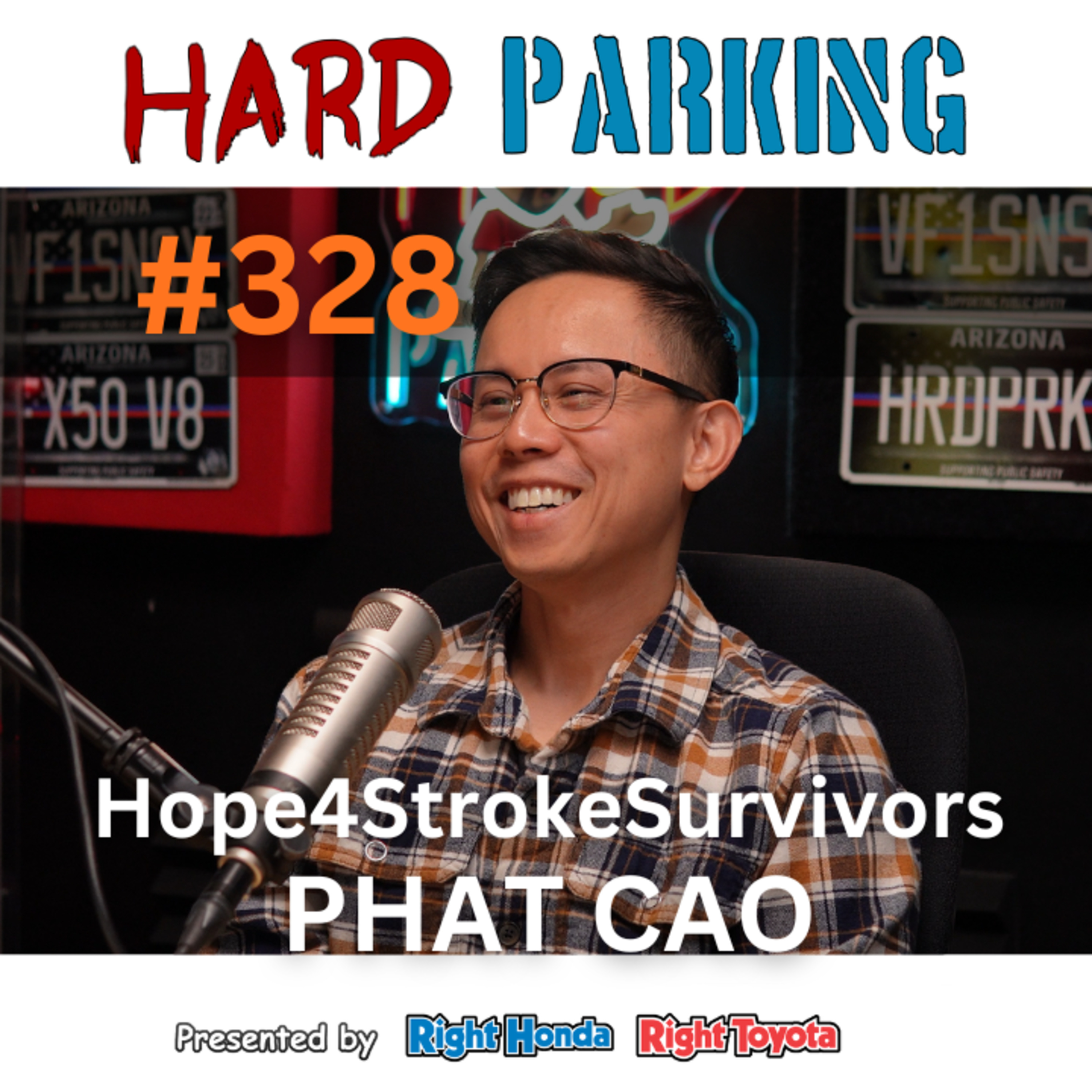
Phil Cao’s stroke story anchors the conversation, from early assumptions like “food poisoning” to the reality of recovery, uncertainty, and learning new therapies. The guest explains how symptoms built over days, why causes can remain unclear, and how coming home can be “one of the hardest things.” Alongside hope and persistence, they share how “May is stroke awareness month” and point listeners to their online hub for resources. The hosts also weave in quick car news and a CT calcium score screening discussion.
In EP328 of Hard Parking, Jhae Pfenning starts with his signature Car News segment on recent Dodge SRT and Dodge Hellcat stories, then welcomes Phat “Phil” Cao — stroke survivor, podcaster, and founder of Hope4StrokeSurvivors. Phat opens up about his hemorrhagic cerebellar stroke experience, the road to recovery, mindset shifts, and building new habits while helping others through advocacy and community.
This candid conversation offers hope, practical insights, and resources for stroke survivors, caregivers, and anyone facing life-altering challenges. A must-listen for inspiration and real talk on resilience.
"... has confirmed they do have a 700 plus horsepower challenger coming out. I know that a lot of the Dodge people..."
The Dodge Challenger is a sporty car built for strong acceleration and high power. People talk about it a lot because Dodge has offered very fast versions over the years. Here, it’s being mentioned because there’s talk of a new Challenger with over 700 horsepower.
The Dodge Challenger is a performance muscle car known for powerful V8 engines and a long-running lineup of high-horsepower trims. It often comes up in discussions because new variants and power upgrades are a big deal to fans, especially when rumors or confirmations point to very high output. In this podcast context, it’s mentioned in relation to a coming “700 plus horsepower” Challenger, which highlights the car’s ongoing role as a top-end performance option.
"...re probably a little upset when they canceled the Hellcat and canceled doing all that kind of stuff. But yo..."
In this context, “Challenger” means the Dodge Challenger. The podcast is saying some fans were disappointed because certain very high-performance versions (like the Hellcat) were canceled. That’s important to fans because those versions are part of what made the car famous for big power.
“Challenger” here refers to the Dodge Challenger model, and the podcast is discussing how some fans reacted to changes in the lineup. Specifically, it mentions the cancellation of the Hellcat and other related plans, which matters because the Hellcat name is strongly associated with the car’s most extreme performance. That kind of lineup shift is often a major talking point for enthusiasts who follow how the car evolves.
"Not even the Viper was this low, but according to them, it's going to be a."
The Dodge Viper is a very aggressive American sports car. Here, it’s mentioned as a comparison point for how extreme the rumored Copperhead might be.
The Dodge Viper is a hardcore American sports car known for its big V10 engine and raw, analog driving feel. In this segment, the host uses it as a benchmark for how “low” a car is compared to the rumored Dodge Copperhead.
"The Copperhead will be a hyper muscle car, not a sports car.
Some of the key points about the Copperhead is it won't compete
with the C8 Corvette or mimic the Viper."
The Copperhead is a rumored Dodge performance car the host is excited about. They’re saying it could be a big, V8-powered muscle car that’s meant to stand out instead of just copying other famous cars.
The Dodge Copperhead is being discussed as a rumored “hyper muscle car” from Dodge. The host says it’s expected to have a V8, won’t directly compete with the Chevrolet Corvette C8, and won’t be a copy of the Dodge Viper—positioning it as a distinct flagship-style performance car.
"Some of the key points about the Copperhead is it won't compete
with the C8 Corvette or mimic the Viper."
The Chevrolet Corvette C8 is the eighth-generation Corvette, notable for moving the engine behind the driver (mid-engine layout). The host mentions it as a competitor the rumored Copperhead is not expected to directly challenge.
"They got their head out of their ass and decided that EV is not now.
It might be for the future, but it's time to get back to internal combustion
and really well improved hybrids."
Internal combustion is the traditional way cars make power by burning fuel in the engine. The host is saying EVs might be later, but for now they want better gas engines and hybrids.
Internal combustion refers to engines that burn fuel inside the engine to create power, typically using gasoline or diesel. The host contrasts it with EVs, arguing that it’s time to focus on combustion again while also improving hybrids.
"and really well improved hybrids.
And so whether it's this the new Hellcat,"
A hybrid uses two kinds of power, usually a gas engine and an electric motor. The idea is to get better efficiency than a normal gas car while not being fully electric.
Hybrids are vehicles that use more than one power source—most commonly a gasoline engine plus an electric motor/battery. The host frames hybrids as an “improved” middle ground between EVs and traditional internal combustion.
"And so whether it's this the new Hellcat,
which I don't say I don't really care about, or this Copperhead SRT,"
Hellcat is Dodge’s name for its very high-performance cars, usually with a supercharged V8. In this segment it’s brought up as another big performance model in the lineup.
Hellcat is Dodge’s performance branding for supercharged engines, most famously paired with high-output V8s. Here, the host mentions the “new Hellcat” as part of Stellantis/Dodge’s comeback lineup alongside the rumored Copperhead.
"[1769.1s] It doesn't have to make sense.
[1770.7s] Oh, it doesn't.
[1771.8s] I like the McLaren.
[1774.6s] One of the McLaren's?"
McLaren is a car brand that makes high-performance sports cars. People who like McLarens usually like them because they’re built to drive fast and handle well.
McLaren is a British supercar and race-car brand known for mid-engine cars and strong track heritage. When someone says they like “the McLaren,” they’re usually pointing to that performance-focused design and motorsport DNA.
- Car News: Dodge SRT & Dodge Hellcat Stories
- Phat's Stroke Story: "Heard a Pop in My Head"
- Introducing Phat “Phil” Cao & Hope4StrokeSurvivors
- Immediate Aftermath & Recovery Challenges
- Mindset, Habits, and Long-Term Healing
- Supporting Survivors & Caregivers
- Resources, Advocacy, and Community
- Final Thoughts & Messages of Hope
- Wrap Up & How to Connect
Select text to request an explanation
God, as great as Adobe products are, their transcription sucks.
This is our parking brought to you by right,
Honda and right Toyota out of Scottsdale, Arizona.
I'm your host Jay Finning recording from my home studio in Gilbert, Arizona.
I try to be loud with that.
I try to say it clearly and concisely.
I guess it's not concise because it is kind of long-winded.
For some reason, Adobe transcription continues to screw up the
transcript of these episodes.
And I have to go in and correct not only my name, but right Honda,
right Toyota, and it gets a little annoying.
Coming up on today's show, my friend Phil Cowell in 2021,
Phil suffered a stroke and he's only in his 30s.
And that was a very scary time.
And it took him a long time to, you know, go through speech therapy.
I think he lost some of his memory, but he's been working on that.
And when the time was right, I said, you know what?
One day you should come over to hard parking and we should talk about it
because I care about him, you know?
And for anybody who's seen somebody go through a stroke, you know,
you kind of think about the old people or somebody who might be physically
out of shape, but it's going to surprise you, Phil's stroke story.
He also goes by the name of fat, which is actual name, ph-a-t, fat.
So I'll refer to him as Phil.
I might refer to him as fat, but that's coming up.
And this is going to be one of those types of episodes where
you're going to love this podcast.
And hopefully it's your first time listening or watching because
you're going to be hooked on it.
And if you're a return listener or viewer, then you already know.
Sometimes we can go to these sweet places and get you right in the feels.
Little bit of car news before we get to that part.
Dodge has confirmed they do have a 700 plus horsepower challenger coming out.
I know that a lot of the Dodge people were probably a little upset
when they canceled the Hellcat and canceled doing all that kind of stuff.
But you knew it would be back.
That train is never late.
Those cars, they sold so many of them.
They are incredibly badass.
I've never driven one.
I've seen a lot because everyone seems to have one.
So much power, but that has been confirmed.
Dodge is also working on a vehicle called the Copperhead.
The Copperhead SRT.
I don't know if you've seen that.
I'll talk about it a little bit here.
That is a badass looking car.
I don't know if whatever is online is the real car.
If it's just an AI render of the car, but it looks pretty cool.
If it does come out, it's not going to be slam like that.
That'd be really weird for Dodge to slam a car like that.
Not even the Viper was this low, but according to them, it's going to be a.
So this article is from AutoBlog.com by Sebastian C-E-N-I-Z-O.
I'm not even going to try to pronounce this person's name.
The Copperhead will be a hyper muscle car, not a sports car.
Some of the key points about the Copperhead is it won't compete
with the C8 Corvette or mimic the Viper.
The Copperhead may have a V8, but more clues will come ahead
of roadkill nights in August.
So it sounds like there's still a lot to be discovered with this vehicle.
But you know, Stellantis lost like shit ton of money.
And so did every other manufacturer.
We all know Honda ate the big one, the biggest one, I think, in their history.
And Stellantis, for all intents and purposes, felt like they were kind of left for dead.
But no, no, they're coming back and strong.
They've announced a bunch of new models.
And I, and I hope that this is the bounce back like every other manufacturer.
They got their head out of their ass and decided that EV is not now.
It might be for the future, but it's time to get back to internal combustion
and really well improved hybrids.
And so whether it's this the new Hellcat,
which I don't say I don't really care about, or this Copperhead SRT,
this thing looks sick and hopefully it's it's the one.
It's going to be their flagship, obviously.
And it may not be designed to mimic the Viper,
but for all intents and purposes, that's exactly what it is.
It's their badass car.
I'll allow the Viper, the hypercar.
And so can't wait to see what happens with that.
Coming up after this word from Arcus Foundry, Sparkforge, Fat Phil Cow.
If you're in a business and you're tired of juggling tools, chasing logins
and constantly feeling like the tech side of things is heavier than it should be,
this might hit close to home.
That tech fatigue usually shows up as an outdated website,
reviews slipping through the cracks, missed calls when you're busy,
or social media that's always on the back burner.
Most business owners know something's off,
but fixing it feels like a bigger project than they have time for.
Sparkforge is just to take that weight off.
It handles the tech behind the scenes, helps clean up how your business shows up online,
makes sure calls and messages don't get mixed,
keeps reviews from slipping through the cracks and wrangles social marketing
so you don't disappear for weeks.
If you're curious, there's a short discovery session
and it comes with 90 days free to actually see if it makes things easier.
No pitch, no pressure, just a real conversation about what's working,
what's broken and what you can simplify.
So head over to getsparkforge.ai forward slash hard parking to get started.
Fat, Phil.
Yeah, Fat, Phil, yeah.
Fat, Cal, I mean, you know, people know you as Fat,
I know you as Phil in pre-recording discussion that just kind of helps date.
But welcome to hard parking.
All right, thanks, Jay.
Yeah, somewhere around 20, 21, maybe a little, you know, before that, you had a stroke.
Yeah, 20, 21, I had a stroke.
20, 21, OK, and you're doing a lot of stuff now for, you know,
I watched you do an interview with a guy named Ali,
Hope for Stroke Survivors.
Yeah, and I wanted you to come on and kind of talk about everything you've kind of
gone through, you know, and then some of the things that people like me who,
you know, when I when I think of somebody who had a stroke,
it seems like it's it's something immediate, right?
I mean, it's immediate, but it's like, OK, well, that person's having a stroke
and, you know, either they're going to make their way back or they're not.
But there's a lot of little things, I think that I wouldn't say
ignorant to, but just not being educated on,
you know, some of the the things that happen to people.
And then some of the positive outcomes, right?
Because it's yeah, it's it's hope because, you know, Ali said, you know,
he was told that he would never talk again.
And I just watched a 30 minute interview with you guys having a conversation.
Yeah, and I threw a lot at you.
It's all right. Yeah.
But just just start from wherever you'd like to start.
Yeah, as far as what you said, I relate to it 100 percent.
And I think we all have our assumptions about stroke,
you know, some misconceptions, you know, maybe it just happens to other people.
You know, for me, I thought it was your life is over.
Now, no one in my family actually had a stroke before.
And, you know, it was new to me.
Well, yeah, I've learned a lot.
You know, since 2021, it's been actually next month is five years.
And, you know, I've learned a lot through this time.
But, yeah, I think having just the misconceptions, I'm learning that there is life after stroke.
You know, I am still working on things.
And I feel like in a way in life, you're always working on things.
And, you know, I don't know when I'll stop.
You know, I don't know if you can't really stop.
You know, but I've learned a lot.
And, you know, I think it's made me better.
Do you remember what led up to it?
Like for you, you're young.
Yeah.
But how old are you now?
I'm 42 now.
Yeah.
But you look like you're like 20.
But even 42 that put you in your mid-30s.
Yeah.
You know, when I was, I was 36 at the time when I had it and I didn't have any preexisting
conditions or family history, which those tend to, you know, get people to have strokes.
In my situation, I didn't.
And they couldn't actually figure out how I had the stroke either.
Wow.
Yeah.
So, so it's, in a way, it's scary, right?
Because it's kind of better to know how exactly you had it so you can avoid it or, you know,
just knowing the cause.
You know how to see and build up nothing?
Yeah.
Nothing.
That's crazy.
Yeah.
So I found it's still a mystery or no, it's still a mystery.
And in ways, we did put some energy towards that.
And I gave up on that because you can run a bunch of tests.
You can do different things to find a cause.
You know, in, in my situation, it wasn't apparent.
And also I found out about 40% of people, they don't know how they had a stroke.
Yeah.
So I'm one of those.
Yeah.
Do you remember anything?
I do.
Is that, is that, is that unusual?
To remember?
Is it like a certain percentage of people just don't remember that either?
Yeah, that I'm not clear.
I know I remember everything leading up until the point where I had the stroke and I got
taken into the ambulance.
And there were things that happened and I was kind of in denial.
I do remember at the peak, I had vision problems and I was throwing up and the last thing was
my balance issues.
It was kind of leading up like days.
And, um, oh, there were signs that you didn't know what the signs were.
Yeah.
There were little signs and I was like, oh, maybe it's food poisoning.
Right.
Cause the big one was my balance.
I had a hard time walking.
I felt dizzy.
You didn't go to the doctor or anything?
Or you did and they were like, yeah, I didn't even go to the doctor.
Actually, I was with my girlfriend and she's like, let's go to the doctor.
And I was like, it's okay.
It's just food poisoning.
I'll probably sleep it off.
Yeah.
So I tried to sleep it off.
Okay.
What restaurant did you blame it on?
I blamed it on this Vietnamese restaurant.
Yeah.
I don't want to put names out there yet, but yeah, I thought it was food poisoning.
And I'm like, let me sleep it off.
And, and I'm glad that, you know, she called when she did cause I was telling her, I was
kind of being like, Hey, you better not call.
And she listened for a day or so and she noticed I was kind of out of it.
You know, as the days went on.
So then good thing she called cause I wasn't at that point.
I didn't remember anything after that.
Yeah.
So it's, it's, I think about it as you talk and what you just said a couple of minutes
ago, like even as you had gone in when you first started having issues, like
what, what would they have found?
Yeah.
I hear a lot of times which happens cause at the time I was 36 and sometimes you
go in and people, they don't take it that seriously cause one, they might look
at you and just like you, you're younger.
They're like, Oh, you know, you didn't have a, you're not having a stroke.
Sure.
And that does happen a lot.
They turned down people and in my situation that could have been the case and at
the same time, I'm not sure.
Yeah.
Cause none of the science.
Unless, unless your body's going through something as you're doing that and not
just, you know, something you can't see, like, you know, this would get you down
for an echocardiogram or, you know, or something like that.
But I don't think they would, you know, I'm not a medical professional or
anything, but I do work in, in radiology it since 2008, you know, and so we do a
lot of stuff by proxy with cardiology and it just goes, I always kind of listen
to that stuff.
I'm like, even if they would have taken you in, I mean, who knows, right?
Yeah.
You're right.
Who knows?
I mean, I would have thought that.
I remember when that happened because we, so you went to California with us at
least once and I'll never forget cause that was when I first was experimenting
with the one auto movement brand.
And so everybody had a sample shirts on and there's a famous, famous between our
group clip of Yoshi, you know, having someone park.
And so even to this day, Eric and, and Mike, we all say, and even Yoshi more
angle, there's like this video where he's like more angle, more angle, you know,
and then what I remember most about you is, is you were so outgoing, outgoing
and accommodating because you're, you're just as accommodating now as you've
ever been and that's awesome, you know, but you're the guy who would, we'd walk
in there and you'd go up to people and be like, Hey, let's take a picture.
Let's take a picture.
You know, it's like, oh, that's, so then when this happened, we're like, fill,
fill.
And so, you know, we reached out, um, but I at that day changed Eric forever
as well, you know, and, and I noticed that he stopped being as, as public
with social media and he just, he did what people should do.
Everything turned inward to the family structure.
Yeah.
You know, um, and so that changed him and everybody, you know, involved with
that and we just, we were kind of helpless cause we could just kind of root
from the sideline, you know, and, um,
I think it makes sense.
Yeah.
And then I think you like, what did you go through some memory, like recovery
and stuff like that?
I kind of talk about your road back to kind of being out in the social circles
cause it was a while.
Yeah.
Definitely going through something like that is very traumatic, right?
And it affects you not just physically, but mentally and different things.
You know, thanks for saying that I do feel like, I mean, my memory is not the
best in the past, but I'm glad that I do remember things.
And that was fun.
Yeah.
That was fun.
When we went to California together, you know, always remember that.
Yeah.
When that happened, I think with stroke sometimes or something that happens
that is traumatic is it not only affects the person, but also the people around
them and Eric, he did step up in a lot of ways.
And you know, I do appreciate everyone just stepping up and even people
from the sidelines, you know, just like you do what you can, right?
Uh, but yeah, it did teach us all a lot.
I think, um, you know, I think people's true selves come out and you see
how different people respond.
You know, we all take it differently.
And for me, I think having a stroke at first, yeah, we were all in shock, right?
I mean, for myself, I woke up, it was like, it's pretty crazy because you wake
up and all of a sudden you're like, what the hell happened?
You know, for me, I couldn't walk.
I couldn't talk.
You know, there was a lot of different disabilities I was going through and
definitely I couldn't go to work.
You know, so then all of a sudden you just learned because I never really had
any health issues and you just start learning about a different side, you
get exposed to like therapies.
I didn't know all these therapies existed.
And you know, for you to be in like kind of like the medical or, you know,
whatever feel you start having a lot of respect for people who do what they do.
And so I just started learning about different types of therapies, how to
recover, and it was all new to me.
And I was like, Oh, okay.
So I started realizing that, Hey, you can start recovering.
And I'll always remember this, but there was a lady that was right next to me in
the hospital and she had a stroke, but I guess she had been there for like so
long and she didn't, she stopped recovering.
And so I remember that because I was like in my head.
I, I wasn't fully there because so much had gone on.
So you're like, yeah, it's like overwhelming.
And a part of you can't comprehend everything, but I remember thinking,
okay, maybe I can't recover.
You know, I didn't hear it from anybody really, but I knew I could just tell
what they were thinking, right?
Cause at that time I had so many issues going on.
And so, yeah, it just gets you by surprising.
I just, you know, went with what the therapist told me to do and I would do it
and I would see improvements.
So yeah, I just kept on doing it and it kind of went from there until the
first thing was I just focused on getting out of the hospital.
I want to get out of there.
Took me about, I think a couple months.
But yeah.
And it's, it's scary for everybody else to your point.
It's not just you as everyone around you because nobody knows, right?
No one knows really what to expect.
And then all we know is the doom of, you know, stroke and stroke survivors.
Um, and you said the woman next to you stopped recovering.
Did she get to a point and just not progress?
Or did she start to get to a point and start going the opposite direction?
Do you remember that as far as what I know, I think she just stopped recovering,
but she had been there for years.
And I think people kind of gave up hope for her and she just lived there.
And so in my situation, I remember I was working hard to improve until I got to
a certain point where I can leave, but she was still there.
And I didn't like go visit her or anything.
I could just tell she was like next door to me.
And so I just knew that not everyone is able to recover.
Wow.
Yeah.
So that's, that's all I could comprehend.
I think at that time, but I was so focused on myself that I was
just trying to get out of there and you know, work in a way.
And when I graduated, it was cool cause I could go home and I did know that not
everyone graduated.
I could tell that some people kind of felt, I guess, maybe resentment that like,
okay, I'm getting out of there and there's some people that are stuck there.
So there's, it sounds like there's a step program in order to be able to get out
and what do you have to show that you can be not dependent?
You can function like, what is that?
Cause that's just, you just opened up a whole new thing for me.
Oh yeah.
Yeah.
You know, they do track your progress and you're making the gains and depending
on what type of program it is, they have different therapies like speech therapy
is one cause I couldn't talk at that time.
And so they help you kind of learn how to talk and different things.
And then there's the physical.
So they'll like monitor like how many steps you can take, how far you can go.
They'll do different exercises for you to build up to till they feel like you're
safe enough, you know, to go home.
And I think at the time I had graduated to like a walker from a wheelchair.
And so, you know, they felt like I was good enough to go home.
How long was that?
Do you remember approximately?
It was about two months.
Months.
Yeah.
I think it was about two months, but I think, you know, going.
Actually, I forgot.
What's the most frustrated you think you were during that time?
Oh, you had to have been frustrated.
Yeah, I was especially having to learn with the speech therapy.
Yeah, you know, in a way, I was frustrated, but I think going through
the brain surgery, I couldn't fully comprehend it.
It's really hard to explain.
I just knew I was frustrated.
I remember taking things out on my nurse, even just showing like emotions and
stuff.
And actually we got in an argument.
Yeah, that's the first thing I remember because I was just annoyed.
So there were things that I could fully, I couldn't fully comprehend.
And that was one of them, I think.
What did the surgery do?
The surgery, what they did was, oh, cause I had, there's two types of stroke.
It's ischemic and hemorrhagic.
Ischemic is when like one of your arteries is clogged and the hemorrhagic is
when something bursts, right?
And I had a hemorrhage.
And so with the surgery, what happened was I had complications and what
that's what made it worse is that after the hemorrhage, they repaired it.
They were able to repair it.
And then I had internal bleeding and swelling.
And so they had to do a second surgery.
And so that's what they did with the surgeries.
Scary, dude.
Yeah.
They actually had to remove part of my brain.
So that's why a lot of people didn't think I would recover.
The worst part.
Yeah.
Yeah.
Yeah.
If I would survive.
Yeah.
That's wild.
What about getting back out on the scene?
Oh, yeah, that definitely took time.
Were you worried about it or you just wanted or you were just kind of excited
to kind of get out and do things?
Yeah, I was at that time, I felt like I was just focused on the next step,
which in a way worked to my advantage.
And I think that's kind of a practice that I've been working on is kind of
focusing on the path ahead in a way.
And there's a lot of qualities and stuff out there, you know,
just focus on the path ahead, you know, or the journey begins with the
first step or something like that.
And I kind of practice that a lot.
What about people who came up to you where you're like, oh, cool.
Good to see you, but I don't know who you are or because I remember
the first time I saw you.
It's like, Phil, what's up, Phil?
And you're kind of like, Hey, I'm thinking, God, I know he's been through a lot.
I wonder if he just doesn't really remember me.
Like some of those relationships, you know, were they easier to put back
together than others?
Yeah, I think sense.
Yeah, no, that makes sense.
What you're saying.
I think depending on the phase I was at, right?
It was different.
It was a while ago to be fair.
Yeah, yeah, I was.
But each stage was different.
I think coming home was like one of the hardest things because you come home
and that's when it really hits.
You can't do the same things.
You know, I couldn't drive, couldn't work.
And so being at the hospital is actually easier because you have somebody
there and then now it's kind of like you're on your own.
You got to figure it out.
But definitely I think when I saw you, I was at a better point.
Sure.
So it's like, Hey, what's up, Jay?
It's nice to see you, right?
I feel like it gives you a different lens on things.
You know, just being able to get to that point.
I can kind of get into the community again.
So yeah, I think it takes time though.
You've got to grow it up.
Did you, I'll say this for me.
When I, when I see you, it's like a treat every time.
Like I feel really good that you're there, you know, and at any time that I see friends
of mine that have gone through anything, you know, it's, I'm grateful for that
opportunity to still be a part of their life, you know, because there's so much
going on, you know, and there's, I mean, there's so few people that make it back.
I mean, you talked about maybe the, the sense of possibly a little resentment
from, from making it out of the program.
That means a lot of people just don't make it out of the program or like,
I wish that maybe no matter how hard you want to do it, maybe your body
and your mind just doesn't let you do it.
But for you, you did it, you know, and then now you're doing the hope for
stroke survivors and you know, what, what have you been doing to kind of help
those that were in the position of the lady next door, you know, and, or
yourself, you know, and then when it comes to the two different types of stroke,
you know, what are the, what does that look like for people?
Yeah, you know, I feel the same way about you too.
You know, if I want to see you, it's like, Hey, what's up, Jay?
You know, yeah, it feels, it feels nice to see you.
But I think it depends on everybody too.
You know, you connect with different people more than others.
And I think we all have different relationships, right?
But for me, that's why I'm so passionate about it because in the beginning,
after having a stroke, I remember I wasn't sure the possibilities.
If you could recover and to me, the traditional system out there is
kind of limited and especially back then.
And so that's why for me, I figured things out on my own.
And in ways, you know, of course, I got help from professionals, but then
after that, I had to figure things out on my own because if I would have
fully listened to them, you know, I wouldn't be where I'm at.
And now that's why I'm passionate about it.
And I do want to share it with people to let them know that, Hey,
you might reach a stopping point, but there's still room for improvement
because, you know, I had to do that on my own.
Well, similar to Ali, were you told anything different than what you've become?
You know, I don't remember if anyone ever said, Hey, he's not going to recover.
Like no one said that to my face.
And so that's the benefit.
But, but I felt like it was kind of not clear.
That's what I felt like people were like, Oh, he's, he's pretty much messed up.
Yeah.
Yeah.
And I mean, we, we believe in the medical professionals, you know,
they're still people with opinions based on hopefully data, you know,
so maybe, you know, maybe they're looking like, well, based on statistics,
you know, this, this, this, but, you know, I think if we were to do everything
exactly the way they said all the time, like who knows, right?
So like people like him pushed through and again, we just watched a 30 minute
interview of you guys having a conversation and then even with you,
like no one really knew, right?
But I mean, you're, you're here, you know, you're not supposed to drive
or you can drive now, or at least Tesla can bring you over here.
You know what I mean?
Yeah.
You know, it's the powers of technology.
Yeah, technology is killer.
What do you think's been your biggest, your biggest help to get to where
you are now, just with anything out there other than your belief in yourself?
Yeah.
Definitely learning from the professionals.
And I think the biggest thing is pairing it with advocating for yourself too.
I think those two together, you know, as big, the internet is powerful
nowadays too.
We have different technologies.
You say, you know, and it can really, you can leverage that, you know,
it just depends.
There's so much information out there and you know, it's like, okay,
how do you want to use it?
Right.
And I was starting to use that information out there from the internet to find
like different therapists and people that were sharing groundbreaking
things.
So that way it helped me to elevate my recovery.
And it's even better now.
I mean, even now in 2026 and it was in 543 especially,
you know, in 2022 and 21, you know, there's just so many tools.
So what would you tell people to do?
Like let's say that someone watching or viewing either has a stroke or
has someone in their family with a stroke.
And of course, we know you don't have to be able to have one, you know.
Yeah.
I mean, it does happen more to old people, which, you know, makes sense.
Right.
What I would say is, yeah, just a lot of it does come down to how you think
and what you believe to, because I think, you know, it's whether if you
think you can or think you can't and you are right, you know.
So yeah.
You still like cars, man?
Yeah, I like you're at the last air events, but you know, you're there for
the cars or just to support family or a little bit of both?
I think it's a little bit of both.
Yeah, it's definitely to support Eric, my brother and family.
And also a part of it, I think of things, a lot of things as therapy.
That is what helps me a lot too, because there's a lot of details
that I do want to go to those events.
And just like talking to people, I think, you know, it's different
when you're talking to different people that helps me to improve.
And yeah, there's different things.
I think also to spread awareness when I can, you know, there's a lot
of different reasons, but I, but I like cars still, you know, I love cars.
I don't get down to the details, but I love cars, you know, they're beautiful.
Yeah.
I respect also the invention of cars and how they're built and things
like that.
What do you like?
I like, you know what?
I like everything, man.
Such an easy answer, right?
If I were to hand you the keys to something right now, what would it be?
It doesn't have to be practical.
It doesn't have to make sense.
Oh, it doesn't.
I like the McLaren.
One of the McLaren's?
Yeah, one of them.
I don't even know what it's called.
Yeah.
Yeah.
There's a couple of them that are really nice, but I don't even think
I can answer that question if someone would ask that.
Oh, okay.
It's just so hard on the spot, right?
But that just means you really like everything.
Yeah, I do.
I mean, so many cars.
I'm just like, wow, I'm just like drooling over them.
Yeah.
Strange question for you.
Strange question for you because, you know, did, did going through
that experience change any of your core likes and dislikes?
For example, you used to love foe.
You know, now you can't stand the smell of foe.
Like, does it do any of that?
Yeah.
If not to you, but yeah, okay.
Well, like what were some things that are different from today's fat to
yesterday's fill?
If we're talking about food, I used to like fish sauce.
Now I don't like fish sauce anymore.
And you know, like in Vietnamese culture, this sauce is everything.
But I think it changes your taste, you know, your body to adjust things
differently.
And also, I think a lot of things have changed what I prioritize.
Sure.
Yeah.
I think health is a big one for sure, right?
Because, you know, you can be worried about so many things, but I remember
when I had a stroke, I was only worried about one thing just to get healthier.
And yeah, it does change a lot of things.
I think it really impacts you and especially coming back, you know, now
that I've tried to transition myself into society again, then I've learned
to appreciate that more too.
So yeah, sure.
Yeah.
That's those things that just kind of changes your perspective on all sorts
of stuff.
Do you ever just kind of sit back and say those, those people have no idea.
Yeah, whether they're fries or crunchy or soggy, that doesn't even matter.
You know?
Yeah.
Yeah.
Sometimes I hear, especially nowadays, just coming back, a lot has
changed and I think things are a lot faster now.
So in my situation, I remember starting to drive again and I get people
who are driving by, flipping me off like, get the fuck out of the way, you know?
Yeah.
But yeah, sometimes.
It's a slow Asian driver, man.
Just another one, right?
Yeah.
Another bad Asian driver.
Oh yeah, I hear that all the time and sometimes people complain and yeah,
definitely, yeah.
It's just their perspective.
They only knew, yeah.
Right, you know, everything can be taken away or the threat of it can be
taken away, you know, we have to decide what's really important, what really
matters, right?
Yeah.
Everything matters as much as you think it does, you know, and then I think
you look up and maybe you've wasted too much time having an opinion on this or
having an opinion on that and not focusing on what's in front of you.
I would imagine.
Yeah, that's a good one.
Sometimes you don't know until you actually go through it.
Right.
In a way, we all know, right?
I shouldn't complain too much.
I should be grateful and it just does something to you when something happens
to.
So his hope for stroke survivors is that like a charity that you've put together
or you're just a part of and what else is out there for people to get more
education and get more hope on the recovery that you know of?
In my experience, especially in the beginning, I didn't know where to find
the resources and I'll elaborate on the story is I created this page.
You do.
Yeah, a separate page.
Yeah, I created it and it was called hope for stroke survivor without an S and
I just started collecting data.
A part of me, I just wanted to consume stroke related content and also things
that were fun and so I built it for myself and also I like recovery
comeback stories because that motivated me and so I actually at that time,
I wasn't sure if I could work again and so I hired this coach and she said,
why don't you make that public?
So I made a public and all sudden people started gravitating towards it and
then I just started doing it and sharing like recovery tips because at that
time I couldn't find a lot of information out there and so then as it started
growing, I changed it to hope for stroke survivors with an S and then my
girlfriend just made me some random logo and then it just started growing
after that and I just continued with it and now it's at this point.
Good for you.
Good for everybody, right?
Because if you do, if you can't find much information on it, that means other
people can't either and so you become kind of that hub and that uniting
point for other people out there looking for hope, trying to get through just
having a stroke or a family member or a good friend of theirs.
So yeah, good for your coach, lady, good for you to teamwork,
right?
Yeah, right.
You can't do it by yourself or it's harder.
Yeah, so it's grown to this point.
I think when I'm looking back, it's pretty crazy because I've done a lot in
the past with like nonprofits and so in a way it prepared me for this and now
I want to take what I went through like the bad stuff and put it into this and
turn it into a nonprofit.
Yeah, because I think we can alleviate a lot of the problems, you know, or give
information.
There's a lot of things we can do with this platform.
So for now, people could just go to the YouTube and go to the Instagram.
Yeah, yeah, they got it's on YouTube, Instagram and TikTok.
And is it the same on all three platforms?
You know, it's yeah, it is the same hopeful stroke survivors.
I think each platform we kind of do different things on it and now I'm
starting to get more survivors to be a part of it because I think it can help
them in my situation.
It did help me to recover because also when you're posting and I'm sure, you
know, it's different platforms.
They teach you to do a lot of different tasks and I didn't know what I was
doing at that time, but I had to figure it out.
And so I think just that platform alone, you know, if you check it out, you
can find information on a stroke and right now, you know, we're just sharing
different things.
I'm getting other survivors to help on it.
I think, uh, yeah, we're just trying to share as much as we can.
And actually right now, May is stroke awareness month.
So we're kind of stepping it up a little bit.
Yeah, recording this in May.
I was just going to ask you about that.
So how can people get just more educated to it?
Just use the tools that are out there now because there's so many.
Yeah.
For sure.
The tools out there, you know, using Google, you can search different things.
I think there's so much information that even I don't know how to access
it all because a lot of times I get overwhelmed.
Right.
But yeah, search it online.
I think that's a good one.
It definitely hopeful strokes survivors.
I'm trying to share more information, especially for this month.
So I want to kind of tackle like myths and different statistics.
I want to share it out there because there's so many different ways
to find it.
So I want to kind of put it all in one.
What's the one thing you would tell a stroke, someone going through stroke
surviving right now and recovery?
What's one message you would have for them?
That's a good one.
Yeah, I think.
Yeah, as far as a stroke is easy to focus on all the bad things that are
happening and in a way for everyone, you know, there's going to be good
and bad in your life.
You know, but definitely you got to make sure it doesn't.
You don't overlook the positive and you just focus on the negative
because there's a lot of blessings out there also.
Well done, man.
Yeah.
Can you get any other words?
No, that's actually, I guess it.
Well, thank you for coming through hard parking.
It's great to see you as always and we'll try to get the message out there
so that other people can see this and take some motivation and inspiration
and hope from this.
So I want to thank you.
Oh, thank you, Jay.
Yeah, it's an honor to be on here and this is a sick as studio.
That was an incredible episode with Phil or fat being who you are and how
long you've known him.
Obviously, he did say his coworkers know him as fat.
I've known him as Phil.
It's interesting for that to be kind of a timestamp.
That's what he said.
And I don't think we talked about that the episode, but in the opening
when we were kind of talking amongst ourselves, he said that when people
referred him to Phil, he remembers there was a relationship before the stroke.
It's kind of scary that he had no signs or symptoms and even they even
though they did the exams, they found nothing.
It had to have been something.
So, you know, that in itself is a little wicked.
But, you know, what I did is I a few years ago, I went in for an exam.
I heard about it on the all in podcast and it's a CT calcium score and
usually they give it to people that are a little older than I am.
I think you're the age that they kind of talk about is like 55 or 60.
When I went in and got it, I was probably 45 or 46.
And it's kind of a, it's a low cost outpatient exam.
And so some insurances don't know how to deal with it, but for, it was
like a $250 copay and I think I even had to pay less.
I don't know if they're running a special, but it's a great exam to
get because if you have any calcium and this isn't, didn't happen with Phil,
but for men, women going and get this exam and it's cheap and they check
your, your walls for calcium buildup.
If you've got any calcium, whether it's 1% or whatever, and they prescribe
your medicine and it actually eats away at it and it could save your life.
And you know, if that goes unchecked, it could be a stroke.
Could be something even worse.
And so your, your health is obviously the most important thing.
And I think, you know, like, like I said, many times in the conversation
with Phil, you know, you never know, right?
And when, when it happens to somebody that that I wouldn't say you're close
with, but you consider in your friend group and you see what it does to them
and to hear that story about the woman in the recovery house that just
stopped improving and that could have been him.
It could be anybody, you know, it's just, it's just one of those things
that kind of it frees you up.
It's like Bryce that was on a couple of weeks ago or a few episodes ago
that had the crash on his Ducati.
You know, he shouldn't have made it and like a week after I aired that
episode, another local writer here, same thing happened to her and she
didn't make it.
And I even, I elected not to post a specific clip of him talking
about how lucky he was because it was just the wrong time.
And you know, we're going to have Charles Warden back on the show pretty
soon who's going to be in studio.
We're going to drink some tequila and he's doing a lot of
bikes now, you know, cleaning up Charles.
And I think he said they've lost something crazy, like eight people
in the last month or something crazy like that.
And so long story short, you just, you just never know what, what the next
day holds.
And so, you know, for the prices of the world and for the fills of the world,
you know, they got to count their blessings and we have to count our
blessings that we're friends with them.
So with that being said, I want to thank Wright Haun and Wright Toyota,
Marcus Foundry, Sparkforge, same company, AutoCannon officially licensed
Honda and Acura Gear.
Got to think my Patreon business supporters, Kuyo Automotive out of
Niagara, Florida, Automotive specialty tool out of Owings Mills, Maryland,
Beakhouse, small home design out of Ashburg, Virginia and Traverse
City, Michigan.
The Lucky Break Sportsbreakers out of, uh, they're also out of
Caledonia, Michigan.
I'm going off of memory on this one and I think that's everybody.
I apologize if I missed someone.
Shaping success, Treasure Valley.
I lost my script.
I'm just going to have to pull it up.
Thank my Patreon business.
Also want to thank my Patreon supporters, Mark Stolman, Catherine
Cox, Eddie Ramos, Richard Graves, Bob and Jones, Bo Jung, Al Scamina,
Drew Bunkley and Andre Mullins.
You want to support the show?
You can at Patreon, Heart Parking Podcast.
If you're watching this on YouTube, become a member.
You can join the page, get early access, which is rare, but it
still helps me out.
It's like three bucks a month.
I mean, come on, whatever.
If there's something you want to contribute to this episode, you want
to leave a comment, you know, make sure you leave a review, but info
at HeartParking.com, you can leave a comment or review on most
podcast platforms.
If you're watching this on YouTube, give it a thumbs up, leave a comment.
Otherwise, I'll talk to you all next week.
Request an explanation for:
3 cars
3 cars featured
Request an Explanation
Heard something you'd like explained? We'll add it to this episode.
Sign in to request explanations for terms you heard.
Want to learn more?
Browse our glossary for plain-English explanations of automotive terms, jargon, and concepts.
See something that's not quite right? Our annotations are AI-generated and can sometimes miss the mark.
Click the flag icon on any annotation to suggest a correction.