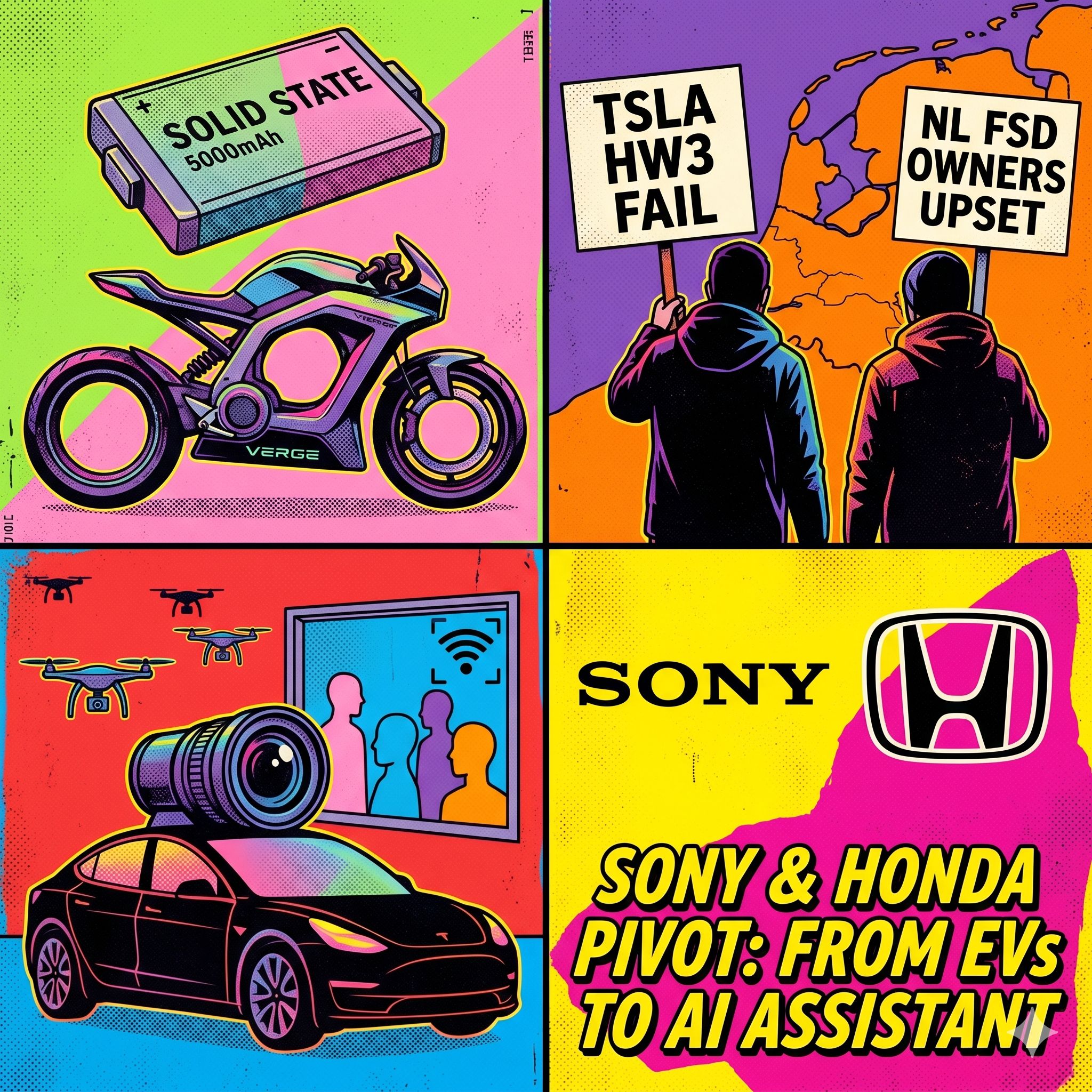
Sony and Honda are teaming up to work on an electric vehicle idea. The episode is pointing out that their partnership is changing, which can affect whether and how the car ever reaches production.
CES is a big tech event where companies show off new gadgets and prototypes. The hosts mention CES 2023 to remind listeners when this EV idea was first revealed.
EVs are cars that run on electricity from a battery. If a company says they’re not making EVs right now, it usually means they’re stopping that plan for now, not necessarily forever.
A joint venture is a partnership where two companies work together on one project. They split the work and the risk, but if the partnership stops making sense, they can walk away and redeploy people elsewhere.
An AI assistant is like an in-car voice helper. You talk to it to control things like music, calls, or navigation, and it can learn what you want over time.
The audio system is the car’s sound setup—speakers and the electronics that control them. In newer cars, it’s often connected to the same tech that runs voice commands and apps.
Company
Sound Hound
SoundHound is a voice-recognition/AI company. The host is saying it might have been easier and cheaper to work with a company like this rather than trying to develop the tech internally.
They’re saying the comparison isn’t perfectly fair. Even though the averages are close, the kinds of cars included in each group might not be the same.
Penalties are money automakers have to pay if they don’t hit emissions goals. The idea is that discounts can be a cheaper way to comply than paying fines.
To get the discount, the electric car has to be priced below a certain limit—37,000 pounds here. That rule means only some EVs qualify, which can lower the typical prices people end up paying.
That “£37,000 threshold” is a policy line in the sand. If a car costs less than that, it may qualify for better pricing or incentives, so both buyers and car makers pay attention to it.
If the penalties for not following the rules are small, companies may not feel much urgency to comply. That can affect how aggressively they push EVs and how low prices go.
EV incentives are money the government gives (or tax breaks it offers) to help people buy electric cars. When more people can afford EVs, it can push automakers to adjust pricing.
Ford is a major U.S. automaker whose CEO, Jim Farley, is cited here warning about competitive pressure from Chinese EV brands. The discussion frames Ford’s stance as part of a broader industry debate over market access and national security concerns.
The phrase means the worry that EVs could collect information using cameras and other sensors. If that data can be accessed or shared, it could potentially reveal sensitive locations or people.
Electric and connected cars can send information back to companies. The worry is that your data might be collected, shared, or protected poorly, so your privacy (and sometimes your money) could be affected.
Telematics is basically “vehicle data” collected by the car and sent out. If that data goes to insurance companies, it can affect how much you pay, so it matters whether you’re told and can control it.
The hosts mention GM because they say GM sent driving data to insurance companies. If you didn’t clearly agree or understand it, that can make insurance more expensive and raise privacy concerns.
This refers to using production techniques and supply-chain efficiencies that Chinese automakers have developed to reduce cost. In EVs especially, manufacturing scale, battery supply, and simplified architectures can strongly influence whether a vehicle can be priced aggressively.
Concept
fear mongering / disingenuous argument about low-price competition
The hosts are critiquing an argument that Chinese automakers are uniquely harmful or unfair, while pointing out that U.S. brands don’t currently offer cars at comparable low prices. This is essentially a discussion about competitive positioning and market coverage—how pricing gaps can be framed as “threats” rather than as a product strategy issue.
The Toyota Camry is a very common, everyday car. People like it because it’s practical and usually dependable, so it’s a good example of an affordable gas car.
The Toyota Celica is an older Toyota model that was more sporty than a typical commuter car. In this discussion, it’s being used as an example of a cheaper gas Toyota rather than an EV.
“Peace of mind” here means you’re less worried about unexpected repair costs because the car is covered by a warranty. They’re saying it’s better to buy something you can afford with coverage than to stretch your budget.
The Kia K4 is an affordable Kia model. The hosts are using it to show that there are plenty of cheap gas cars, but EVs are still harder to find at those prices.
The Nissan Sentra is a budget-friendly sedan. It’s being mentioned as one of the cheaper cars you can buy for around the low-$20k range, which is still mostly gas-powered.
Connected cars can communicate over the internet, which means they can be targeted by hackers. If that happens, personal data could be stolen or misused.
Privacy issues mean your car may collect information about you and where you go. The concern is that this data could be exposed or used in ways you didn’t expect.
Data misuse means someone uses your personal information in the wrong way. That could happen after a hack, a breach, or even through poor handling of data.
Slate Auto is making an affordable electric truck and the big selling point is that it’s meant to be easy to change and customize. They’re building parts that are simpler to swap, and even offer things like wraps so owners can personalize it.
They’re describing a design where the truck is built from parts you can swap out more easily. That can make repairs and upgrades simpler and cheaper, and it can also make customizing the truck easier.
A wrap is like a big vinyl skin you put on the outside of the truck. It can change the look without repainting, and they’re saying Slate makes it easier to do yourself.
They say Slate got $650 million in funding. That kind of money can help a new company build more trucks and support the parts/accessories they’re promising.
“Reservations” are customer deposits or sign-ups that indicate demand before a vehicle is fully produced. For EV startups, reservation counts are often used to gauge market interest, forecast production volume, and attract investors.
They mention Amazon’s Marketplace as a place where people could buy truck accessories and parts. The point is whether Amazon’s online selling platform could help Slate sell add-ons for its pickup.
They’re using the “razor-and-blades” idea: sell the main item for less money, then make money later by selling the things people need repeatedly. For a truck, that could mean accessories or replacement parts that customers buy over and over.
A warranty is like a guarantee from the maker. If something covered breaks while the warranty is still active, the repair cost is reduced or paid for—usually through the dealer.
A dealership is the official store for the brand, and it’s often where you go for repairs and warranty work. The speaker is saying most service happens through that network.
The idea is you start with a basic version of the vehicle, then add what you need later. Instead of buying a whole new car, you upgrade or change it as your life changes.
Concept
make it an SUV instead of a two-seater truck
They’re describing a vehicle that can be changed after you buy it. For example, you could add parts so it works more like an SUV instead of staying a two-seat truck.
Concept
relationship between the consumer and the auto manufacturer
They’re saying the car company shouldn’t just sell you the car and disappear. The idea is that support and upgrades should keep going after you buy it.
The aftermarket is the market for car parts and upgrades you buy after you’ve already purchased the vehicle. The hosts are talking about automakers potentially finding new ways to sell extra parts later on.
A solid-state battery is an EV battery that uses a solid material inside instead of a liquid. The goal is usually better safety and more energy in the same space, but it’s hard to make it work consistently.
Donut Labs is a company working on a new type of EV battery. They’ve been promising big improvements, but the hosts say there’s still doubt about whether it really delivers yet.
Nordic Nano is the company they say helps actually make the battery. In EV projects, that usually means they’re involved in building the battery at scale, not just designing it.
Helsingin Sanomat is the Finnish newspaper that reported on this. They claim there’s documentation showing the battery being shown is older than the newest version.
The segment contrasts an “older generation battery” with a “newest generation battery,” implying that the public demo may not reflect the latest chemistry or design. In EVs, battery generations can differ in cell chemistry, pack architecture, manufacturing process, and performance/validation results.
They say the project is moving away from the older battery and toward a newer version. That typically means the company is trying to improve the battery—like making it better or cheaper to build.
“New generation batteries” is shorthand for next-gen battery chemistries and/or pack designs that aim to improve range, charging speed, cost, or safety. In EV discussions, it often becomes a credibility issue when marketing claims don’t match what’s actually delivered in production vehicles.
Term
newer generation battery
A “newer generation battery” means a battery design that’s supposed to be better than the previous one. It could charge faster, last longer, or store more energy, and EV companies use these upgrades to promise better real-world driving.
“Battery technology” here refers to the underlying design and manufacturing approach for batteries, including what materials and processes are used. The hosts discuss claims about battery properties and production, implying performance and safety characteristics are part of the debate.
“Battery properties” are the battery’s measurable traits—how much energy it holds and how it behaves over time. The segment says they’re running tests to confirm those traits with outside help.
Third-party testing means someone outside the company runs the battery tests. It’s often used to make the results more trustworthy, and the speaker is wondering who did the testing and what stage it’s in.
It means someone else should run the tests to confirm the results. If the same company controls everything, the numbers might be biased, so independent testing helps you trust the claims.
A third-party test is done by an independent group. It’s supposed to make the results more trustworthy, but people may still wonder if the test setup is fair and whether the results are being timed strategically.
“Independent tests” are checks done by someone not trying to sell you the product. For EV batteries, that matters because it helps confirm whether the battery really performs as promised.
A “gigawatt” measures how much power something can produce or use at a time. For batteries, companies sometimes talk about the wrong unit, so you want to know whether they mean power or how much energy the batteries store.
A “gigawatt-hour” measures energy—how much “stuff” the batteries can store or how much battery energy capacity gets produced. It’s different from “gigawatts,” which measure power at a moment in time.
“Battery rollout” is how a company brings a new battery to market. It’s not only building the batteries—it’s also sharing the test results and updates so people know what to expect.
Concept
tests will stand on their own
They’re saying the test results should be convincing by themselves. But in EVs, the way you test—like temperature and how full the battery is—can change the results a lot. Knowing that helps you judge the data fairly.
Verbal Network is one of the companies mentioned in a list. The hosts are saying multiple businesses were put at risk together, but they don’t explain details here.
Verge Motorcycles is an electric motorcycle company. The hosts are talking about how its business decisions and connections to other companies could have affected outcomes.
“Fraud” is a serious allegation in the transcript, tied to how information was managed during a rollout. In the EV world, this kind of discussion often centers on whether claims to customers, investors, or regulators were misleading or not supported by reality.
“Hubris” means arrogance or overconfidence. The hosts are saying the people involved may have acted like things would go well without properly planning for problems.
Progressive is an insurance company. They’re talking about a way to get insurance quotes that fit your situation instead of using one generic price for everyone.
Tesla is letting some drivers try its advanced driving software for free. Whether you can try it depends on local rules and which Tesla version you have.
“Hardware 3” is the version of the computer inside the Tesla that runs the driving software. Some features only work (or are offered) if your car has the right computer.
FSD is Tesla’s software that tries to help the car drive more on its own. It’s not the same as “fully autonomous,” and who gets it can vary by country.
The hosts note that Tesla’s FSD offering has shifted from a one-time purchase price to subscription-based access. This matters for budgeting because the cost becomes recurring and can change over time.
This is about a Tesla Model 3 owner. They paid for FSD, but after years they still didn’t get the full self-driving features because of Tesla’s rollout and computer/hardware limits.
Hardware 3 is the computer in the car that runs the self-driving features. If Tesla later requires a newer computer, cars with Hardware 3 may not get the newest FSD functions.
This segment describes “feature gating,” where access to advanced software (like FSD) depends on the car’s onboard hardware generation. Even if a customer pays for a package, the newest capabilities may require newer compute and may not be delivered to older hardware.
AI four is Tesla’s newer computer in the car. The episode is saying that FSD features may only work with (or be released to) cars that have this newer computer.
Term
$6,800
$6,800 is the money number being discussed in the context of what owners paid for FSD. The speaker uses it to show how long people waited and how frustrated they became.
HW3 refers to Tesla’s “Hardware 3” compute platform used to run advanced driver-assistance and autonomy features. The segment contrasts HW3 owners’ expectations versus reality, implying that Tesla’s software rollout and/or regulatory approvals lagged behind what HW3 owners were told.
Instead of one person suing alone, the idea is to group many owners together into one shared legal case. That can make it cheaper and more effective when lots of people have the same complaint.
Instead of paying once, you pay every month (or every year) to keep the feature. That can be convenient, but it also means you might lose access if you stop paying.
Instead of paying monthly, you pay once to unlock the feature. The hosts point out that some countries still offer this option, while others push subscriptions.
Requiring tutorials and a quiz before enabling advanced driver-assistance features is a form of user onboarding and safety gating. The hosts argue it should be available broadly and be short enough to be practical while still teaching drivers how to use the system correctly.
They’re suggesting drivers should get occasional refresher training, not just a one-time lesson. The goal is to help people use the self-driving features correctly over time.
New EV features often arrive by updating the car’s software, not by changing hardware. Sometimes the car may ask you to go through a short tutorial so you understand what the new features do.
An interactive map is a navigation screen you can tap and use, not just a static display. In this case, it’s shown on a screen for the backseat so passengers can follow along.
RoboTaxi is an autonomous ride service—think of it like a self-driving taxi. The host is saying it’s starting in some cities now, so people can actually request rides.
The Tesla Model Y is an electric SUV. The host is talking about a Model Y that had “RoboTaxi” written on it, which suggests it was connected to the autonomy/ride-hailing idea—even if it might not have been an official RoboTaxi vehicle.
“AI4” sounds like a particular level of Tesla’s self-driving/AI features. In this segment, the host says it affects what self-driving app features you get and what kind of usage information you can see.
Term
Hey Grock
“Hey Grock” is presented as an always-available assistant feature (accessed by voice/interaction) that comes with the car. The host discusses privacy concerns—specifically whether the company keeps user data—even if it claims not to, which is a key consideration for connected-vehicle assistants.
Some cars have lights inside the cabin that can change color. Here, the lights are used to warn you when there’s a car in your blind spot so you don’t accidentally change lanes into it.
A blind spot warning system helps you notice cars you can’t see in your mirrors. It alerts you—often with lights or beeps—so you’re safer when changing lanes.
Century Mode is a built-in dash-cam recording feature. It keeps a rolling record of what’s happening, so if something happens you can review saved footage.
Some cars show weather on the navigation screen, like where it’s raining or snowing. That can help you plan your route and be ready for slippery roads.
LIVE
Save big money on everything you need at Menards.
Your roof is the first line of defense against the elements
and it enhances the appearance of your home's exterior.
Owens Corning shingles offer ultimate protection
and impressive curb appeal.
Choose from 26 colors of Owens Corning duration shingles
and transform your home today.
Shop our selection of roofing products on menards.com.
Plus check out our weekly flyer
and find plenty of great deals happening now.
Save big money at Menards.
Hello everyone and welcome to Kailawana podcast
about electric vehicles, renewable energy,
autonomous driving and much, much more.
My name is Bodhi and I am your host
and on today's episode we've got a lot of news.
So let's go ahead and dive right in.
Sony and Honda are no longer using their joint venture
to build the Affila One EV.
If you remember back in 2023 CES, so January of 2023,
Sony and Honda announced the Affila
and I was there and I wasn't at the announcement
but I was there and I looked at the car
and it looks really cool, you know,
giant PlayStation and whatever.
But you know, it'd been cool if it went somewhere
but didn't really think it was gonna go anywhere
over the years, they've had several updates to it
and back in January of 2026,
they decided that they were going to show off
their SUV version and then recently just decided
they're not gonna make any EVs.
It doesn't sound like they've closed that door completely,
it's just in the immediate future,
we're not gonna see any EVs from this joint venture.
So that leaves around 400 employees
that are gonna be reassigned back
into their respective companies,
either Sony or Honda, depending on where they came from.
The thing is though, the joint venture
is gonna work on other projects
and Nikkei is reporting that they're gonna work
on an AI assistant and an audio system.
So there you go.
They went from probably spending billions of dollars
on production or on R&D for an EV
only to turn that into an AI assistant and a audio system.
I feel like they could have gone to Hound or Sound Hound,
whatever they're being called today
and save themselves a lot of trouble and money.
Moving on to the UK, autotrader.com says
that the average petrol car or ICE car right now
is 43,405 British pounds
and the average EV is 42,620 British pounds.
That means that the average EV in the UK
cost 785 pounds less than the average gas car in the UK.
Now, this is not an apples to apples comparison to everything.
This is just average, but it's notable
because for such a long time,
the average EV used to cost so much more
than the average gas car.
So we're getting close to parity
or I would not call this a success yet,
but I would call it a move in the right direction.
So there's a couple of things that are helping out
with the average EV price being lower
than the average ICE car price.
First, automakers are selling the EVs at a discount
and this is so that they can meet
government decarbonization targets
that are set by the government for the auto industry in the UK.
So in some cases, it's cheaper to sell the EV for less
than it is to pay the penalties.
Even if they're taking a slight loss on that
and I don't know if they are or they aren't,
the penalties from what I understand are quite high.
So that's one thing.
They're trying to hit decarbonization targets
to avoid fines.
The other thing is the UK is providing a grant
that will cover anywhere between 1500 British pounds
to 3,750 British pounds of the price of the EV.
Now that will certainly bring the cost
of the average EV price down
because you're knocking at most almost 4,000 pounds
off the price, right?
But there's another factor to this
is in order to get that grant, the electric vehicle,
the car needs to be under 37,000 pounds,
British pounds to be eligible for that grant.
So that's also bringing the average price down.
If you look at automakers are selling these EVs
at a discount and then you have this grant
that is helping owners buy these cars
at a more affordable price.
And then on top of that, in order to be eligible
for the grant, you have to be under 37,000 pounds.
This is all driving that average cost down.
Now, not that long ago, it would have been kind of difficult
to find a car under 37,000 British pounds.
But now the Chinese automakers have arrived in the UK
and the UK at the moment has zero tariffs on Chinese EVs
which is yet another reason why it's easier
to stay underneath that 37,000 pound threshold.
So I thought this was interesting.
While I think it's great that we have an average price
of an EV under the average price of an ICE car.
So I do think that's great,
but there are certain governmental and,
well, it's really governmental pressures
that are pushing that price down.
Again, I wanna be clear, I think this is a good thing,
but it is, would this be the case?
Would the average selling EV be,
or the average price for an EV be less than the average price
for an ICE car if there wasn't these decarbonization targets
or maybe the fines were minimal
so that automakers could bend the rules a little bit
and not worry about hitting these targets.
And there was no government grant
for helping people buy an EV.
So I guess my point is if all of these things
weren't in place to drive down the cost of the average EV,
would we be talking about this today?
I don't think we would.
I think that the pressure that the government
is putting on automakers and the incentives
that they're giving owners who wanna buy an EV,
I think that is what's driving that average price down.
But I mean, I'm glad that it's happening,
don't get me wrong.
But it's not organic, I guess.
And maybe organic isn't even the right word.
But let's move on.
Speaking of Chinese EVs, Jim Farley, who's the CEO of Ford,
has been sounding the alarm about Chinese EV brands,
specifically if they were to come to America.
He called them an existential threat to US automakers,
that might be a little bit of hyperbole,
but he also pointed out that the Chinese cars
could be used as spy machines on wheels,
I'm paraphrasing there.
But basically, they have cameras
and they're collecting a lot of data.
So could be used to spy on certain people
or specific locations like military bases for a while.
And I don't know if this is still the case or not,
but Teslas were not allowed on Chinese military bases.
Just they just were not.
So I don't know if that's still the case, like I said,
but that's not unprecedented in terms of a fear.
There's also concern about cyber or privacy risks.
I don't know, I do think this is more fear mongering than it,
I mean, I think it's a concern.
I definitely think it's something
that people should think of
when purchasing these kind of cars,
but I don't think that's just limited to Chinese automakers.
I think that's all automakers.
GM not that long ago got in trouble
because they were sending driving statistics
to insurance companies
and that was making people's cost of insurance go up.
From what I understand,
there's something you can turn off in the Ford settings,
but Ford does something similar,
but you have to agree to it
whereas GM was maybe doing it
surreptitiously, it sounds like they didn't notify anybody
that they were selling this data.
So anyway, the point of this is all of these automakers
are spying on you in one way or another.
And Ford, just because he's calling out Chinese automakers
for these risks, they are certainly not,
they're doing it too, is how I should say it.
Maybe they're not selling back military secrets
to the US government,
but they're definitely using the data
that you have in your car to their advantage
and mostly financial advantage, if I had to guess.
So all of this comes at a time
when Ford is currently working on a pickup truck
that will start at around $30,000.
And one of the reasons that this pickup truck
will be able to start so affordably,
the starting price will be so affordable,
is that they are using manufacturing processes,
they borrowed from Chinese automakers.
So yeah, I mean, he doesn't have,
like I'm not saying that he's out there
bashing Chinese automakers because he's not,
but he's also not necessarily,
he's not necessarily,
I think there's a little bit of fear mongering
and I think there's maybe a little bit of disingenuous
that when it comes to this,
if Chinese automaker came into the US
and sold the car for $18,000,
Ford has no cars at that price range.
As far as I know, GM has no cars at that price range.
I can't think of one automaker that could maybe Honda,
Ford or maybe like a Toyota Camry or something like that
or a Celica, whatever the more affordable Toyota is.
Maybe you can get something like that at that price,
certainly not an EV, it would be a gas powered car.
So there's not a lot of automakers competing
at that super low end.
And I would rather somebody be able to get a car
that they can afford that would be new
with warranty and all this good stuff.
And they have some peace of mind,
then maybe go into debt to buy a new car,
more debt to buy a new car,
maybe stretch what they could afford at $30,000
or $28,000, which is,
where a lot of cars are starting right now,
we call this affordable cars.
And you know what, I actually stopped the recording
to do a little bit of research here.
I'll just give you the top five cheapest cars in the US.
And I'm just gonna give you the price range
and then I'll tell you what cars are in that price range
just to kind of make this go faster.
So in the $23,000 price range,
you have the Kia K4, the Nissan Sentra,
the Hyundai Elantra, and then at $24,000,
you have the Toyota Corolla, $25,000,
you have the Volkswagen Jetta,
and then it just kind of goes up from there.
So those are the cheapest cars in the US,
nothing in the teens.
And to be honest, if Chinese automakers came here
with tariffs and the way the market is here in the US,
I'm sure that they would be in the low 20s as well.
But anyway, I just find his argument,
Jim Farley's argument about the Chinese EVs
to fall a little flat with me.
And I wanna be clear here,
I'm not saying that cybersecurity risks
or privacy issues aren't a concern,
it's just that Ford is doing some of these things as well.
So anytime you have something connected to the internet,
you have an opportunity to be hacked
and you have an opportunity for that data to be misused.
And that misuse can come from an auto manufacturer,
it could come from a bad actor,
or it could come from some sort of cyber attack,
some sort of breach.
And now we're back into having
all of our personal information leaked.
Oh, and you know what?
One other thing on Ford is they dissolve their EV unit.
So that doesn't mean they're no longer going to build EVs,
it's just they don't have an entire unit committed to EVs.
So do with that data as you will.
Let's move on to another affordable EV brand Slate Auto.
If you don't know, I mean, I don't know how you wouldn't know
if you've been listening to this podcast
for any length of time, but if you don't know,
Slate Auto is building this really affordable truck
and it's super easy to mod.
Like the company is building out different pieces
that you can easily replace on your car.
Think of like a Saturn,
but it's actually easy for you to replace parts.
And then you can also do things like it comes
as a pickup truck, but then you can do the modification
and make it into a SUV, for instance.
It's very easy, if you wanna wrap the truck,
they sell wraps so that you can easily do it yourself.
It can be done, they were doing it
in like 15 minutes in the demo.
So this is a neat idea for a truck.
Well, Slate recently raised $650 million.
Most, if not all of this money,
is gonna go to manufacturing the Slate pickup truck.
Right now, Slate has 160,000 reservations and a new CEO.
So Peter Faracy, who was formerly the vice president
of Amazon Marketplace, he is now the new CEO.
And if you were like, well, that's an interesting pick.
This guy doesn't have anything to do with auto manufacturing.
Well, Jeff Bezos is a huge investor in Slate.
And because this truck is so easy to mod
and there's gonna be all sorts of different accessories
and mod pieces for the truck,
don't you think that Amazon Marketplace
would be a great place to sell these accessories
and parts for their truck?
I do, and it really does sound like
that's what they're planning on doing.
So yeah, I mean, does it make sense
to make this guy the CEO?
I don't know, but maybe not from a purely automotive
perspective.
If you think of it less as an automotive company
and more of like a razor company,
like the razors to like shave your face.
So they sell the razor is sold at a low cost,
but the blades, the replacement blades
or the consumable part of the product
is sold at a much higher cost.
You know, most automaker, your relationship
with most automakers ends after you buy the car
and maybe you'll spend a little bit of time
with the, maybe you'll have some warranty service here
or maybe some repairs,
but that's really usually done with the dealership.
In this instance, if you are tight on cash,
you can buy the truck,
which is expected to start around $25,000.
You can buy the truck and then you can add
and modify it over time to meet your needs
without having to buy a new car.
So if you're like, well, this is a two-seater truck,
now I need, you know, something in the backseat,
you can actually order those parts
and then make it an SUV instead of a two-seater truck.
Is it perfect?
No, but it's an interesting idea.
So anyway, it would make sense
whether they would make Pharisee the CEO
just for this reason,
because that relationship between the consumer
and the auto manufacturer is not going to immediately end
after someone buys the truck.
There's an opportunity for the auto manufacturer
to sell you more components at a later time.
And by the way, Slate isn't like hogging this market.
They're letting, they're opening it up
and letting anybody operate in this market.
So it's not, Slate, I guess what I'm trying to say here,
Slate isn't hogging the aftermarket for themselves.
They're making this available.
I think they're even planning on selling
some of these things on Etsy,
like for people who just make their own parts,
sell them on Etsy.
And I don't know, it's gonna be interesting.
We'll keep an eye on it for sure.
Okay, our final EV story for today.
As we know, Donut Labs has their Technicolor Solid State
battery, it's not really called that.
They're their magic solid state battery
that's supposed to do so many cool things,
but they have yet to fully prove
that it can do all of those things.
There's been a criminal complaint filed
against Donut in Finland.
The complaint claims that Donut's battery
doesn't live up to the lofty promises.
And in return, and I'm gonna read Donut's official reply
in just a moment, but in return,
Donut said that the person who made this complaint
did not work on the battery project, so they don't know.
But the person who made the complaint
was the chief commercial officer for Nordic Nano.
Nordic Nano is the manufacturing partner for the battery.
So it's not as if this person was,
yeah, maybe they weren't directly involved in the project,
but they're not working in the cafeteria
and they heard some people talking.
This is a person that's in the C-suite
and is privileged to a lot of different meetings
and a lot of different information.
The Finnish newspaper that broke this story,
and I'm gonna do my best to pronounce that newspaper name,
Helsingin Sanomat, I'm 100% sure I'm saying that wrong.
Anyway, this Finnish newspaper saw documentation,
according to them, that the battery
that Donut is showing off in its I do not believe videos,
all the testing, that's an older generation battery.
That's not the newest generation battery.
And that Donut has given up on developing
that old generation battery
and instead is putting focus into the new generation battery,
but the new generation batteries in its early phase.
I don't know, it's hard for,
like if it is the older generation battery
and those batteries can do much,
if not all of what Donut says,
I don't know that that's a big deal.
Like if they're putting something else entirely
into the Verge motorcycles that are supposed to be,
that are supposed to be manufactured
with this new battery and they haven't been yet,
as far as I know,
nobody's seen a delivery of these vehicles.
I don't know if that's a bad thing.
If that old generation battery meets the claims
or comes close to it
and is actually put in these motorcycles, who cares?
If they try to do something shady
and put some other type of battery in there
that's not a solid state and doesn't meet the,
doesn't meet what they said the battery would be able to do,
then that's a bigger deal to me.
But if it's just an older battery,
an older generation battery that they're putting in there,
I don't think that that's newsworthy to speak of,
as long as it meets all the things that I said.
Donut and Nordic Nano have both responded
in a public statement, one in Finnish and one in English.
I do not speak Finnish,
so I will read to you obviously
with my pronunciation of the newspaper,
I will read to you from the statement in English.
Are we ready?
Here we go, let me blow this up a little bit.
Make it bigger.
Okay.
Donut Lab and Nordic Nano Group have today been informed
that an employee of Nordic Nano
has filed a criminal complaint against Donut Lab.
The companies do not know the exact nature of the complaint.
In addition to the complaint,
the individual has contacted media representatives
and provided confidential company information
to the press.
Okay, I'm gonna stop reading right here
so we can kind of discuss this.
So what that Finnish newspaper is reporting?
I tend to believe that they are giving accurate reporting.
Whether all the context is there, I don't know.
But when they say that there's a newer generation battery
that's being developed and they've given up developing
on the older generation battery, that's probably true
because this person probably gave them or did give them
the documents.
They're admitting that some documents were handed over
from Nordic Nano and Donut Lab that were not supposed
to be out there and they didn't say that the information
that the newspaper got was incorrect.
So they don't know Nordic Nano and Donut Labs does not know
what the complaint is about specifically,
although I'm sure they have a really good idea.
And then on top of that, they're not refuting anything
that this newspaper is saying in terms of the information
the newspaper is putting out there.
All right, continuing on with the statement.
Furthermore, the individual has made claims
concerning Donut Lab despite not having the necessary
knowledge of the battery technology or the overall picture
of the development work.
The individual is not a shareholder of Nordic Nano Group
nor are they involved in the working group developing
Donut Labs batteries.
Nordic Nano Group does not share these views
of a single individual.
Okay, breaking back in here.
I'm sure that there is a reason why they expressly pointed
out that this person is not a shareholder of Nordic Nano Group
although I'm not familiar with all of the business customs
in Finland, but it does seem weird
that somebody who is the chief, what was the title here?
Chief commercial officer of a company would not have shares
in that company.
It seems weird to me, but I don't know.
Maybe that's a normal thing in Finland, let me know.
So that's weird.
Also, again, as I pointed out, this person is in the C-suite.
They are chief commercial officer.
So they're gonna, again, they're gonna be privileged
to conversations that folks who work in the cafeteria
or who are working on the production line may not have.
So is it to say that this person is credible
and knows everything that they're talking about?
They're probably credible.
They probably don't understand everything
that they're talking about.
You know, I spend a lot of time talking
about different battery chemistries and technologies
and I understand less than 1% of that world.
So this person doesn't need to be a battery expert
to be good at being a chief commercial officer,
but on the other side, they probably have enough battery
knowledge and information to put two and two together
and say, this doesn't sound right.
This doesn't seem like, this doesn't seem right to me,
so I'm gonna make a complaint.
Doesn't mean he's right.
It just means it doesn't seem right to him.
Moving on with their statement.
Donut Labs takes the allegation seriously.
Denies having committed any crime
or any or misleading investors.
Donut Lab and Nordic Nano Group are working closely together
on the development of the battery technology
and both companies strongly stand behind previous
announced information regarding the battery properties
and production.
Donut Lab is currently conducting tests
measuring the battery properties with a third party
and more research results will be published
during the spring.
Breaking back in, I find this weird
because they handed the batteries over to a third party,
which was that finished testing place
that I can't remember off the top of my head.
I would assume that those battery tests were done,
so I don't know who the third party is.
Are they giving it back to that same testing organization
or are they giving it to some other testing company?
I don't know.
I would like this to be independently verified.
I'd like them to ship it off to somebody
and let that testing place do run all the tests
that they want to run and see if it's valid
in the ways that they want to run it.
You have to be careful though,
because as much as Donut is being blamed
or accused, I should say,
of dictating tests to that finished lab,
in a way, tell them to test it in such a way
that would maybe be more favorable to their claims,
as much as they're being accused of that,
other companies can take this same battery,
test it independently of what Donut has,
and they could probably test it in a way
that makes it fail at every single benchmark
that Donut said that it could hit.
So we gotta be careful here is what I'm saying,
but I do think it's weird that they have another
third party test with results coming out in the spring.
Does anybody else think that's weird?
Like they just made a big deal
about how their independent tests were going currently,
and it just, I don't know, seems weird.
Anyway, continuing on, regarding the increase
in production capacity, the company has publicly stated
that the goal is to reach one gigawatt this year.
Should be one gigawatt hour in production this year,
but that's neither here nor there.
Donut and Donut Lab and Nordic Nano
are currently investigating the matter together
with the legal advisors of both companies.
The companies naturally view such matters
with extreme seriousness.
Any unsubstantiated reports that aim to negatively influence
the company's businesses and brands
are handled with the same rigor.
And then it's signed by the CEO of Donut, Marco Ledemacchi,
and then Issa Parjanen, the CEO of Nordic Nano.
Yeah, yeah.
This does not mean that Donut is taking anything.
Doesn't mean they're a fraud.
I just wanna be very clear about this,
but I do think that they have very much mishandled
how they're rolling out this battery and the information.
Initially, they were just throwing the tests
and one could argue that they were showing these just to be,
so it's as transparent as possible.
They're going to pull back from giving too much information
or steering the narrative one way or the other.
And so we're just gonna show the tests
and that will be, the tests will stand on their own.
Unfortunately, that doesn't make for a very compelling story.
And also a lot of people such as myself
and even people who claim to be experts in battery,
who are not necessarily experts in battery.
Maybe they know more than me.
That leads to other people telling your story.
So you could easily give the same information
that you give with the battery with context.
You don't have to say, you don't have to tell people
what to believe, but you can provide context.
You can show what they're looking for.
And I'm sure there's gonna be a little bit of bias
in everything, but there was a better way to do it.
And I will say that Donut recently
has had a more storytelling type of videos
that they're sharing and I think that's better.
I think they have a little bit more to work on
in terms of their storytelling capabilities, but yeah.
So all that to say, do I think that Donut is a fraud?
No, I don't know, no, kind of, I don't know.
So I think that for somebody to put their business,
there's three businesses involved in this.
There's Nordic Nano, there is Donut Lab
and there is Verbal Network.
There's Verge Motorcycles.
To put all three of those businesses at risk
seems like a very, on something that's fraudulent,
seems like a very, very, there's a lot of downside
and very little upside in this.
So I don't know why they would do that.
Do I think that maybe they came out of the gate
with a little too much hubris?
Yes, I 100% do because they maybe could have done a,
they maybe could have done a little better job
in how they manage the information when they rolled this out.
So yes, I do, I think they're guilty of fraud.
Not really, but do I think they're guilty
of a tremendous amount of hubris?
Yes, 100%.
Oh, and I should say that while Verge Motorcycles
and Donut Lab, while they are connected
in so much as Donut used to be inside a Verge Motorcycle
and then they were spun out,
Nordic Nano, as far as I know,
is a privately held Finnish startup that was founded in 2024,
but Donut Lab did make a,
from what I understand, a significant investment
in the company into Nordic Lab or Nordic Nano.
So they're still their own company,
but Donut has a decent stake.
I don't know how much that stake is,
but it's a piece to the puzzle, the overall puzzle,
and we'll leave it at that.
But man, all of these folks, if you go
and you looked at the people running these companies
and then you look at their LinkedIn profiles,
I just find it really hard to believe
that any of these people would wanna be associated
with out and out fraud.
And I'm talking about folks at a high level.
I'm not talking about an engineer that has no idea that
or very little idea that any fraud's being committed
in different parts of the company.
I mean, these are people that are involved
in high level meetings.
And I just find it really hard to believe
that they would want to risk all
of their hard-earned reputation on something like this.
All right, that's our EV news.
Now that would have been a show in itself,
but speaking of being guilty of hubris, me, hello, me.
On Friday, I had a little show to give on Saturday.
I was like, I'm gonna put a little bit more in.
And then I ended up, the show really grew on Saturday.
And by the time I got done writing all the notes for it,
it was late, so I'm recording this on Sunday morning.
But yeah, that's just, we are 34-ish minutes in,
and that's only the EV news.
We still have some Tesla news to cover.
Fortunately, I don't think the Tesla news
is gonna take so long.
So I just wanna say, if you wanna support me
on Patreon or Supercast, you can go to supportkilowatt.com
and you can choose one of those two services
to support the show on.
All of the money goes back into the show
that you give on these.
I don't use any of that money
for my own personal expenses.
All of that goes to business expenses.
So when you donate to the show, you are supporting the show.
Insurance isn't one size fits all.
That's why drivers have enjoyed Progressive's
name your price tool for years now.
With the name your price tool,
you tell them what you wanna pay,
and they'll show you options that fit your budget.
So whether you're picking out your first policy
or just looking for something
that works better for you and your family,
they make it easy to see your options.
Visit Progressive.com.
Find a rate that works for you
with the name your price tool.
Progressive Casualty Insurance Company and Affiliates
price and coverage match limited by state law.
All right, moving on to Tesla news.
Tesla is offering free full self-driving trials
in the Netherlands.
Now, if you own an AI3 or hardware 3 vehicle
in the Netherlands, you will not get to participate
in this free trial, but if you have AI4, you're good to go.
So I have to go back a little bit.
The last time I talked about FSD
being approved in the Netherlands,
I mentioned that the $8,000 purchase price.
So one, as I forgot to clarify,
that that's no longer a thing, right?
There's only subscriptions now, kinda.
We'll get to that in a second.
But two, I didn't do a very good job of clarifying
that when I was talking about people
who purchased FSD outright,
I was talking about Europeans who bought FSD
before FSD was approved in Europe.
And I think that's really important to point out,
and I didn't do a very good job
on the last show of pointing this out,
but I think it's really important to point out
because Electric has an article right now that is,
there was a Dutch Model 3 owner paid 6,400 euros for FSD
back in 2019, which was right around the equivalent
of $7,500, right?
And they don't have, after seven years, seven years,
they don't have access to full self-driving.
And by the way, because they have a hardware three vehicle,
they don't, they're not getting access anytime soon,
which is a problem.
So that Model 3 owner is named,
and I am so gonna butcher this,
Miske Siktersman.
I'm just gonna call him the Dutch owner for now on.
He took to X with a post about his dissatisfaction
with the current scenario of FSD only being available
for AI four vehicles and not hardware three vehicles.
So here's what he had to say on Twitter.
Tesla owes me 6,800 euros.
And if you're a hardware three plus FSD owner, they owe you two.
In 2019, one of the first Model 3 owners
in the Netherlands paid for full self-driving.
So this is him in 2019.
They promised same hardware, same software updates
with full autonomy, just wait.
And then he says, I waited seven years.
Last week, the RDW, which stands for Royal Dutch,
something or another, I can't remember,
but they're the ones that approved the FSD.
Last week, the RDW finally approved FSD here.
And for hardware three owners, question mark,
nothing, radio silence, four million cars worldwide.
So I stopped waiting and built HW3 claim.n,
like Nancy L, like Larry Netherlands,
to bundle Dutch hardware three owners
for a collective claim.
36 signups and 24 hours, no ads.
Sign up if you are a Dutch hardware three plus FSD owner,
two, $6,800 buys a lot of patience, but mine ran out.
Now, I will say for this particular owner
that's setting this up, one is I commend you
because you're doing something about it, not just complaining.
But two, I would be angry too.
But as far as I can tell, he's not a lawyer
in this site that he built where people can sign up
if they're interested on more information
about like a class action style lawsuit.
That is not an actual class action suit.
It's just if you want to keep abreast
of this kind of information and be a part of it
if it does turn into a class action style suit, you can.
Again, it's hw3claim.nl,
if you're interested in seeing what they have there.
He put together a pretty nice site.
It's got lots of information.
He has a lot of what Tesla promised
and what is actually true type situation,
which I found actually be very helpful reading through it.
But I completely understand if you go there
and you sign up, which actually I'll probably sign up,
if you go there and sign up, you're not signing up again
that you're going to be in a class action suit.
You're just, if legal proceedings, you'll be notified.
If they move forward, you'll be notified.
If not, then if we don't want to be a part of it,
you don't have to be is basically what I'm trying to say here.
Now that took a pretty long side-jag from the initial story,
which is that if you have an AI-4 vehicle in the Netherlands,
you can get free full self-driving.
The other thing is, as I mentioned,
that full self-driving is now a subscription-based service,
but in the Netherlands, they still have
the one-time purchase available.
So if you want to do that kind of thing,
and again, you have an AI-4 vehicle,
you can purchase it for whatever the one-time purchase price is.
If you do get the trial or you have full self-driving already
that you've paid for, before you can use
the full self-driving feature,
you have to watch some video tutorials
and then take a quiz before you're able to activate it.
And I think this should be available everywhere.
And it shouldn't be like,
I mean, it shouldn't be like three hours of class,
but it shouldn't also be like,
click here and start your self-driving.
There should be some education as a part of this.
And I think that is fantastic.
As a matter of fact, I think every now and again,
there should be some continuing education.
Maybe every three months,
you gotta watch a two-minute video and answer question
or something like that to keep people engaged
and reminded of what it is that this software is capable of.
And maybe we do this again at updates and a periodic time,
or maybe if somebody is maybe not abusing the system,
but not using it as intended,
maybe before they can reactivate it,
they have to go through one of these tutorials
so that they can be reeducated,
which sounds orwelling,
but maybe be reeducated on the different features
and what they're capable of and not capable of.
I'm a whole, I think they should be everywhere.
All right, happier news.
Tesla Spring Update is here,
and we have a few of the features that they are offering.
Now, not a Tesla app, which is notatteselapp.com,
has a really good video that you can go through
and they walk you through all of the features.
And if this is something you're interested in,
I would highly encourage you to go do that.
In the meantime, we can just kind of go over
some features real quick.
If you have a car that has a screen in the rear
for the backseat folks, there's a fully interactive map.
So that no more of the are we there yet,
they can look at the map and interact with it in the back.
Something that's brought over from RoboTaxi,
which I think is neat.
By the way, RoboTaxi is rolling out in Dallas and Houston.
So I think people can get rides now.
If you can't, there's probably an early waiting list,
but they're rolling out now.
And it sounds like Phoenix is coming soon after that.
I actually saw at a restaurant a Model Y
with RoboTaxi written on it,
but it didn't look like it was one of the RoboTaxis.
It looked like it was somebody put it on their car, basically.
So I don't think it was an official RoboTaxi.
Anyway, back to the features.
Some additional newer updated features for the car.
If you have AI4 in your car, there's a self-driving app
where you can see usage stats.
For everybody, you get access to Hey Grock, which, yeah,
I mean, I think Grock is fine and I do use it sometimes,
but I am not signed into it.
I'm sure they still keep all of my data,
even though they say they don't keep information on you.
I'm sure it's still there.
But if I use it, it's just to see if it can do something
or not do something.
On the newer cars that have ambient light,
if there's somebody in your blind spot,
the ambient light will change to warn you
that there's somebody in your blind spot
when you're trying to make a lane change,
which I think is great.
That's cool.
That's a really cool feature.
You can now record up to 24 hours of footage on Century Mode.
There are better weather maps that show rain and snow.
Media controls now have a swipe gesture
that you can cue tracks for, I guess.
Seems like you shouldn't be doing that when you're driving.
Dog Mode is now called Pet Mode,
and you can change your avatar.
One of the avatars that I saw was like a hedgehog,
so that's neat.
Better in-car graphics for the Model Y and Model 3.
Cars equipped with premium audio.
We'll get tweaks for better sound.
Model S and Model X owners
will get some custom in-car vehicle avatars.
Honestly, I don't know that this is all that important
or interesting.
One of the things that I think is,
because the Model S and X,
they're not producing those anymore,
but they are saving the last 250 Model Ss
and the last 100 Model Xs,
and they are calling those the Signature Edition.
So they're charging more money.
I think the Model S starts at $159,000
for the Signature Edition,
or the Special Edition is what it's called,
not Signature, sorry, Special Edition.
But these last few cars come with some cool upgrades,
like lifetime full self-driving, free supercharging,
four years of premium service,
which I think is the windshield
and the tire service that they have.
Premium connectivity is free
for the lifetime of the vehicle.
The thing is though, is if you sell this car,
you don't get any of these features, right?
These are not features that are directly related to the car.
These are features that are related to you
and when you own the car.
So the lifetime full self-driving,
I assume that that follows you to your next car for life
because it says lifetime full self-driving.
But these other things, like the free supercharging,
the four years of premium service,
the premium connectivity,
those perks don't transfer to the next owner.
So if you buy this and then you sell it,
the buyer is not getting those perks.
And as far as I can tell,
the Special Edition is just these perks.
You're not getting anything really
out of the ordinary Special
that's about that particular Model S or Model X.
You're just getting the perks.
So anyway, if you buy this version of the car,
you have to agree that you will not sell or transfer the car
from you to someone else for an entire year
or Tesla will find you $50,000,
which is insane.
Tesla also reserves the right to refuse to sell
a future car to anybody who tries to sell
this vehicle within a year.
And in the cases where you have a legitimate reason
to sell your car within that first year,
you have to contact Tesla
and they have the right of first refusal to buy the car back.
So the right of first refusal,
this makes me uncomfortable.
I do like that they offer an out that says,
hey, if you want to sell this car,
then you got to let us know and, you know,
will be cool if you come up with some sort of financial issue.
But I don't like that they have the right of first refusal.
I don't like that they can say,
all right, we'll buy the car back for X amount
and you have to take it.
Otherwise you're still on the hook
for either paying for the car or paying the $50,000.
Like what if Tesla offers you an amount
that is lower than what you owe on the car?
So let's say Tesla says, okay, we'll buy this car from you,
but it's $6,000 less than what you owe on the car.
So you got to come up with $6,000 to make the bank hole
or whoever's holding the note for the car loan.
You got to come up with that $6,000.
But if you went to the private market,
you could sell it for let's say $3,000 more than what you owe.
So you'd actually get to pocket $3,000
instead of take a $6,000 hit.
I don't like that.
I don't love it when companies do this kind of stuff.
I do think it's important to make it fair.
Like I don't like people who scalp things either
like buy up a bunch of playstations
and then charge three times the price.
I don't like that either.
I don't think that's okay either.
So I get why companies kind of do this kind of thing,
but these cars cost $160,000.
If you want to, if somebody sells it
and you want to strip away the perks, great.
If you want to ban somebody
from ever buying a Tesla again for doing this, great.
Or you can ban them for a specific period of time.
They can't buy a new Tesla, fine.
I don't like the $50,000 thing.
I don't like the ride a first refusal thing.
In the ride a first refusal,
Tesla will take off 25 cents per mile driven.
So if you've driven 10,000 miles,
that's $2,500 off the price of the car.
And then they're also going to take off money
for wear and tear and what they consider to be damage,
which honestly seems subjective.
Now what Tesla's doing here might be completely fair.
I just don't like that they're doing it.
So yeah, not a fan.
I don't think this is fair.
Again, if they want to ban or bar somebody
from buying a new Tesla, fine.
I think that's fine.
And if you want to go so far as to,
like if your cousin bought you the car
and then you bought the car from your cousin,
you want to ban the cousin too, fine.
Like it's easy to figure out who's doing this
based on who's transferring the car to whose name.
Like eventually you're going to run out of people
and I don't disagree that this is a problem.
I don't think this is the way to handle this problem.
All right, that is enough for me.
So I hope everybody enjoyed this episode.
It's a long one.
If you want to email me, it's bodi.
B-O-D-I-E at 918digital.com.
You can find me on X at 918digital,
although I don't post there.
I am on LinkedIn quite a bit.
So you can go to search into LinkedIn, Bode Grimm.
And you will find me there.
That's B-O-D-I-E-G-R-I-M-M.
What out?
Hmm, I think that's it.
I hope, oh, you can email me bodi at 918digital.com.
All right, everybody, thank you so much for listening
and I will talk to you soon.
This episode is brought to you by Progressive Insurance.
Do you ever think about switching insurance companies
to see if you could save some cash?
Progressive makes it easy to see if you could save
when you bundle your home and autopilot.
Try it at Progressive.com.
Progressive Casualty Insurance Company and Affiliates.
Potential savings will vary, not available in all states.
About this episode
Sony and Honda shut down their Afeela One EV plans, pivoting the joint venture toward an AI assistant and audio system—leaving hundreds of employees reassigned. UK pricing trends show EVs nearly matching ICE averages, driven by discounts, decarbonization penalties, and grants (plus Chinese EVs under tariff-free thresholds). Ford CEO Jim Farley warns Chinese EVs are an existential threat and data-spying risk, but the host argues privacy concerns apply broadly. Slate Auto raises $650M for a modular, easy-to-modify EV truck. Donut Labs faces a Finland criminal complaint over its solid-state battery claims. Tesla news covers Netherlands FSD trials (AI4 only), spring software updates, and controversy around “Special Edition” Model S/X resale restrictions.
In this episode of Kilowatt, Bodie dives into a whirlwind of EV news, starting with the surprising pivot of the Sony-Honda joint venture away from EV production and toward AI assistants. We explore the shifting market dynamics in the UK, where EV prices have officially dipped below those of gas cars, and examine Ford CEO Jim Farley’s warnings about the "existential threat" of Chinese automakers. The episode also covers Slate Auto’s massive funding round for its modular electric pickup and the growing controversy surrounding Donut Lab’s solid-state battery claims. Finally, we look at Tesla’s latest Spring Update and the legal stir caused by FSD trials in the Netherlands for Hardware 3 owners. It’s an action-packed look at the friction between legacy auto and the next generation of tech.