Progressive is an insurance company that sells auto insurance. They’re saying that if you switch to them (or shop around), you may be able to lower your insurance bill with discounts.
They’re saying most people who buy auto insurance with Progressive get some kind of discount. That discount could be based on things like how you drive or what other insurance you have.
This is the idea that prices go up when lots of people want something and down when fewer people want it. For cars, it depends on how many are available and how many buyers are looking.
“Going up market” means trying to sell more expensive, more premium cars. If customers don’t like the change, the brand may have to lower prices or rethink its approach.
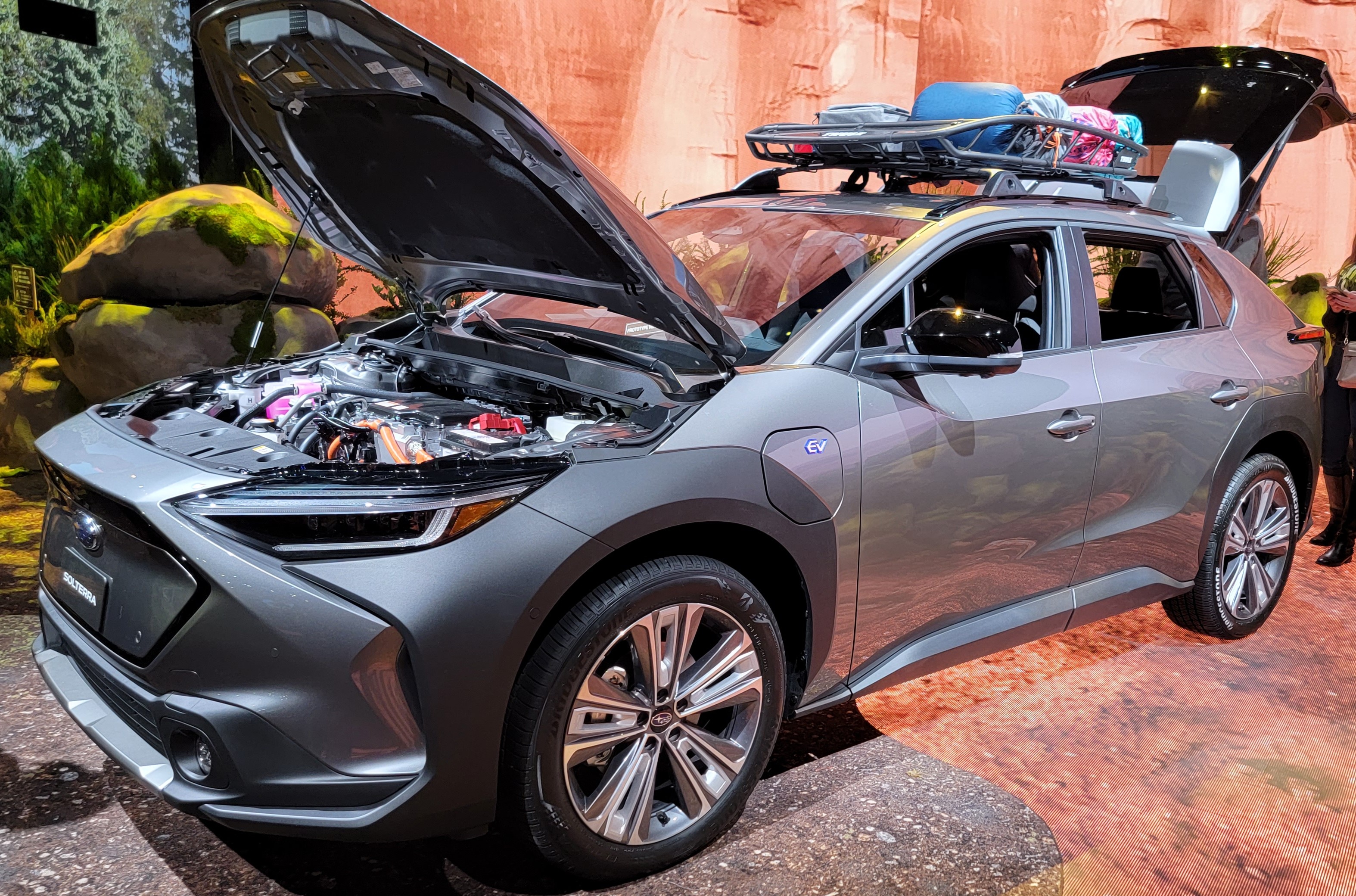
The Subaru Solterra is Subaru’s battery-electric crossover. The host calls it a “bright spot” because its sales were increasing while other Subaru vehicles were down, suggesting EV demand (or incentives) may be helping that model.
Market share is a brand’s percentage of total sales in a given market. If a manufacturer loses market share, it often signals weaker demand versus competitors, which can lead to discounting or other incentives to regain sales.
The Subaru Impreza is a smaller everyday car made by Subaru. The podcast brings it up because the speaker says its sales dropped a lot. That’s why it’s part of the conversation about how Subaru’s lineup is doing.
The Subaru Forester is a popular Subaru SUV. The hosts are talking about how many people are buying it and how the prices have changed, which can make sales go up or down.
“Day supply” is basically how long the cars on dealer lots would last if sales stayed the same. If it’s low, dealers are selling through cars faster; if it’s high, cars are sitting longer.
Car
Peugeot E208
The Peugeot E-208 is an electric small car from Peugeot. They’re using it as an example of how companies are trying to get people to lease EVs with lower monthly payments.
They’re saying car sales are dropping a lot. When that happens, dealers and brands usually have to change prices or how many cars they’re making to get vehicles sold.
Cross shopping means a buyer is looking at more than one brand before choosing. If people are comparing options, dealers and brands have to be more competitive on price.
If cars aren’t selling, the company and the dealer may offer deals to get people to buy. That can mean lower prices, rebates, or special financing that reduces what you actually pay.
Affordability refers to whether typical buyers can realistically pay the total cost of ownership and purchase price. The hosts argue that even with price cuts, many cars remain out of reach for most people.
Dealer discounts are extra savings a dealership can offer to get you to buy. The point is that the final price can be significantly lower once those discounts are added.
CPI is a government-style measure of how prices are changing over time. The speaker is using it to show that car prices rose a lot and then settled into a higher level.
Volatility means prices are jumping around instead of staying steady.
LIVE
You're listening to this podcast, so I know you've got a curious mind.
Here's a helpful fact you might not know yet.
Drivers who switch and save with Progressive save over $900 on average.
Pop over to Progressive.com, answer some questions,
and you'll get a quick quote with discounts that are easy to come by.
In fact, 99% of their auto customers earn at least one discount.
Visit Progressive.com and see if you can enjoy a little cash back.
Progressive Casualty Insurance Company and Affiliates,
national average 12-month savings of $946 by new customers surveyed,
who saved with Progressive between June 2024 and May 2025.
Potential savings will vary.
It's noon here in Vetner City, New Jersey,
and I was going to say, and our nation's capital, and it is.
But Zach's not there.
This is Courage Live for Wednesday, April 15th Tax Day
for all of us that had the right to check.
And your hosts are me, Ray, with my son, Zach,
hanging out in my condo in Vetner, New Jersey.
How are you today, Hampton?
I'm doing well.
I hope you're feeling okay, Pups.
I know you get the cough drops in the mouth,
so hopefully we don't hear too many coughs out of you today.
I think you've been feeling better though, which makes me happy.
Today's show is brought to you by CarEdge.com.
The team is doing a big migration.
We're out of beta today, Dad.
Tax day is also out of beta day,
so folks, check out CarEdge.com.
There are some bugs as we're doing the migration today,
but really exciting stuff.
Everything's all in one new place, back at CarEdge.com.
So take a peek, have some fun,
and spend some time with us, back at CarEdge.com.
Now, the big story we're going to talk about this morning, Dad.
Yeah.
Huge price cuts are coming to the car market.
I am going to build an argument here,
and we are going to see if you agree or disagree.
You ready for this?
I'm not quite sure, but yeah, sure.
Why not?
Stalantis shipments jumped 12% in Q1
as North America leads recovery debt.
Yeah, yes.
We've talked about it ad nauseam for years on this channel.
Car prices are a reflection of supply and demand.
What do we see here, Dad, with Stalantis?
Well, they're finally selling more cars,
because they've ultimately decided to lower
the prices of those vehicles.
North American shipments, the dealers increased 17%
in the most recent quarter,
and it's because of that right there.
Price cuts and fleet sales boosting deliveries.
No.
Yes.
Not my word.
It's automotive news, this word.
Price cuts leading to increased sales for Stalantis.
At the same exact time, Dad, another friend.
Wait, wait, wait.
Before you jump to the other brand,
so we're talking price cuts at Stalantis.
Have led to increased sales.
Price cuts on some of the most overpriced vehicles
that were offered in the United States.
Price cuts on vehicles that rose in price
more than their competitors did.
Price cuts for a brand that decided to go up market
and then abandon its customers.
And so now, in an attempt to recoup some of those customers,
they're lowering their prices?
They are, and they're selling more cars.
Or in this case, yeah, shipments versus sales
to consumers, big difference.
But Stalantis did actually have an increase in sales
to consumers as well.
Price cuts leading to more deliveries, more vehicles sold.
I see what you're trying to do here,
but that doesn't really matter.
Price cuts lead to more volume.
So that's over in Stalantis land.
Now Subaru, Dad, Subaru sales for the month of March
were down 40% for some of their vehicles.
It's 25% for the entire brand.
The bright spot was the Solterra actually increasing sales.
50%.
Yeah, yeah, so 50%.
So what, it went from two to four?
It went from two to three?
I mean, come on, you know.
Subaru is another brand, Dad, that is looking in the mirror
and saying, holy cow, our vehicles are not selling.
Yet another brand, Dad, that is struggling significantly
right now would be the Volkswagen Group,
which would be Audi as well.
Let me pull up right here.
Audi is struggling significantly.
Sales were off 30% for Audi.
Some of the only vehicles over there, the A3, A5, and A6,
are the only ones that have increased in sales.
So here's a whole laundry list.
So there's an SUV segment, which seems to be
the most popular segment of vehicles in the United States.
The best selling group of vehicles in the United States
are SUVs, and their SUV sales have declined.
And the only thing that has increased
are their A3, A5, and A6 sedans.
So think about that for a second.
And sedans don't really sell.
Why would the Q5 not be selling well right now?
Saw a huge, huge price increase as a result of the tariffs.
And ultimately, year over year, they increased the price,
suppose it up to almost like $10,000?
It was, I think, like $75,000.
So think about that for a second.
Why are Subaru sales down so bad right now?
Many Subaru vehicles saw their prices go up significantly.
Yes.
And then obviously, Stellantis here, it's kind of the opposite.
They've actually done, over there, they've done price cuts.
They have done price cuts.
Jeep and many of the models have actually seen their MSRP decrease
year over year.
And obviously, fleet sales means they're selling cheaper vehicles
at lower profit margins.
That's got to become the playbook that these other automakers
are going to look at.
So that was my hypothesis to propose to you today.
Huge price cuts are coming to the car market
for some of these new car brands that are not
able to sell their vehicles.
OK.
So that stands to reason.
For vehicles that, for any commodity that doesn't sell.
OK.
How do you get it to sell?
You lower the price.
I don't care if it's potatoes or pork bellies or cars.
OK.
So you agree with me?
So are there brands out there that miscalculated dramatically?
OK.
And now have to cut their pricing in order to recoup some of the losses
that they're seeing in the market share.
Yeah.
But for manufacturers who didn't, I'll name a couple.
Toyota, Lexus, Honda.
You're not seeing price cuts.
Let's look at Subaru in-depth care, Dad.
Let's look at their sales numbers for a second.
So this is year-over-year sales for their models.
And I really want to hone in on this because if you look here, Dad,
the Impreza saw sales fall off by 51 percent.
The outback, the staple of Subaru's lineup for a long time
saw sales decline 42.9 percent.
Well, that's because you've got ugly.
Take a look at it recently.
My God.
They decided that the outback, which always looked like a station wagon
that a lift kit had been put into some degree,
they decided to make it look more like an SUV.
And apparently somebody at Subaru had this brilliant idea and they said,
let's uglyfy it.
Let's get it as ugly as we possibly can.
You need to pull up a picture of the new 2026 outback
because it is truly one of the ugliest vehicles that are available out there.
And so why would you wonder that their sales have gone down?
I mean, take a look at that.
That's a Forester.
That's an outback right there.
Yeah.
Yeah.
You know, before it looked, you know, it had like nice lines to it.
This is like nobody knows what the hell it's supposed to be.
All right.
So part of it could be styling, but also dad.
Part.
It is styling with Moose vehicles.
What about Forester?
Forester sales are even down 10 percent.
That's their biggest seller over at Subaru.
What do we know about Foresters?
Prices of Foresters went up significantly.
So you can't just say it's all styling.
Maybe styling accounts for why it was down 43 percent instead of 10 percent.
But this lineup entirely from Subaru has been strong selling.
Subaru used to be one of the brands when you and I would look at market day supply.
They always had the lowest day supply.
They were growing for what was it?
Many years every single month.
Yes.
They grew.
Yes.
And now we're in a moment where their sales declined 24 percent year over year.
Think about that for a second.
That is crazy.
And so in the same breath as we review these Subaru sales numbers, we can come over here.
Stalantis for the first moment in a long time has momentum.
This whole article about Stalantis talks about how they've built back some momentum.
Yes.
Why?
Because of price cuts.
For example, this is an international story.
This is not just a domestic story.
Stalantis in where is this?
France is offering the Peugeot E208.
150 euros a month for a lease with no down payment.
So Stalantis globally, I was going to say nationwide, but globally is turning to lower
margin fleet sales and cheapening the prices of their vehicles that they're selling.
To be clear here, it's yielded a 17 percent increase in sales in the United States of America
and North America.
Shipments.
Shipments.
But again, we actually have seen Stalantis sales up.
So if I'm Subaru and my sales are off 23.5 percent and some of it is styling,
and the other part of it is the prices of my cars are too high, what do I do?
And we're going to look at Audi next, but what do I do?
You lower the prices.
Huge price cuts are coming to the corn market.
I don't see how they can't be.
To some brands.
Yeah.
But Subaru is a good brand.
People love Subaru.
Mazda is on the come to have big price cuts sometime soon.
They want too far up market.
Nissan price cuts coming soon.
Like a lot of brands have an oversupply of inventory right now.
Somebody, from all the comments I read, somebody needs to explain to Nissan dealers
that they need to cut their prices because they don't seem to be.
Nissan dealers do need to watch our videos and realize that they need to sell cars.
Either that or if they watch our videos and continue to lower the price, they could all
go out of business.
If they watch our videos and continue, why would they go out of business?
Because they wouldn't be making any money on the cars they're selling.
That's true.
So I get where you're coming from, but I think overall, this impacts some brands.
It's not going to impact all brands.
It's not like we're going to see, I guess we need a definition of the word huge.
Okay, huge to me is like, oh my God, we're going to see price cuts of 10, 15, 20 percent,
where the price cuts might be two or three percent.
I think there'll be a little bit more than two or three percent.
Let's look at Audi next at Audi sales.
We were just looking at Subaru sales.
Let's spend a moment on Audi.
Q5 sales were down 26 percent year over year.
Q3 sales down 20 percent year over year.
And Q7 sales off 30 percent, Q8 sales off 25 percent.
So let's sit with this for a second.
Yeah.
What's going to happen here?
What's going to happen in a world where sales are off 25, 26, 30 percent,
they're going to have to lower prices significantly.
Or they're going to restrict production.
They could do that as well.
It could go either way.
If the dealers are overloaded with inventory and we know they are,
some of the dealers, those dealers that are sitting on inventory
are going to be forced to be more aggressive in their pricing
to try and move that inventory when they have a live body threatening to take one off their lot.
But the whole way that Audi has been set up for years,
at least when I was still running the Audi dealership,
it was set up that the gross profit was not going to come from the customer.
Whatever profits you made as a dealer were because you hit the sales objectives that they gave you.
And if you hit them on a monthly basis, you got a nice check.
And if you hit them on a quarterly basis, you got an additional check.
And so their theory was, we don't want you to make the money off of your customer,
just sell the vehicles at whatever price it takes to sell the vehicles.
And we will reward you with enough factory cash that you will be profitable.
That's their theory, or at least it was.
Yeah, but their theory is not working out in practice because sales are down 30%
year over year. And Audi and Subaru are great examples because they're very different.
No one's, I mean maybe someone's cross shopping and Audi and a Subaru,
but very infrequently, they're very different brands and both are in the same reality,
which is they have too many cars and they're not selling.
And so I do think what happens when cars don't sell,
they end up with big incentives and big price discounts from the manufacturers and from the
dealers. And so I'm banking on it, dad. The Salantis news was kind of like a big moment
for their company because they've been doing really bad for many years.
And that whole article is about how they're getting momentum back.
Their sales are still down from 2023, but they're coming back up.
In the same breath, you can look at the numbers for Subaru.
You can look at the numbers we didn't pull it up, but for Mazda, you can look at the numbers,
even for Honda, Honda sales were off.
You can look at the numbers for Nissan. Their sales were up in the first quarter of the year.
And why would that be?
They're still struggling.
But why would Nissan sales be up? Because they've lowered prices,
they've offered good incentives. I think so.
You know, you read the comments and it's like the Nissan dealers think they're selling the
premium products. You know, it's like, oh my god, you realize this is a Nissan, don't you?
You got to pay for one of those. I just,
I don't want to give people the false hope that you're going to get 30% off.
But there's going to be these huge discounts that are available.
The other side of the coin is that new car MSRPs have continued to increase
this year, year over year. And that is contributing to why as the new car prices
increase, perhaps the incentives increase to help offset those. But you're still paying,
in most cases, way too much for the cars.
It's the new normal. It's the new normal.
But the new normal is out of range for most people.
Totally. But I hear you don't want to set bad expectations for people to get discounts.
But I think it is really fair to say that there is a ton of negotiability. And it's April 15th,
the end of this month. If you go to a Subaru dealership and you threaten to buy a Subaru
Outback, they're going to be very aggressive on pricing. Or maybe they won't be, but if you are
aggressive on pricing, they will meet you. Or you'll find the dealer that will,
similarly for an Audi dealership. End of the month for any of the brands we mentioned earlier in
the show today. I think, okay, huge figure out, quantify that for yourself. But we're talking
about significant discounts off of MSRP because their sales are down a lot. And I have an oversupply
of inventory or a building supply of inventory. If, for instance, you take Audi,
what do you think if you looked at all their vehicles? What the average
price is for new Audi's? It's got to be in the 60s. So even if it dropped into the low 50s,
it's still not affordable.
99% of their auto customers earn at least one discount. Visit Progressive.com and see if you
can enjoy a little cash back. Progressive Casualty Insurance Company and Affiliates,
national average 12 month savings of $946 by new customers surveyed who saved with Progressive
between June 2024 and May 2025. Potential savings will vary.
Why? Because they're selling more cars to fleet. Okay, that doesn't really help any of us in the
car. Yeah, it should be. The other line was price cuts. These other brands. For instance,
like the Grand Wagoneer, they reduced the base price of the Grand Wagoneer from like 100,000 to
80,000. And even at 80,000, it's not going to sell. For sure. And then the dealers have to give
you a discount. The point is today's show is not about affordability. Cars are not affordable
for many of us. I've got a chart here that starts to quantify this as well. This is your chart that
shows you new vehicle price levels since 2017. It's insane what's happened. It looks like a roller
coaster. It's crazy what's happened. And on the other side of that, many brands now are experiencing
what Stalantis experienced about two years ago. Yes. Subaru sales. We had gone on here every
month for years. And what would it always be? Subaru sales increased again year after year?
Yes. Yeah. Like literally for multiple years in a row. If this was two years ago and we came on
here and Subaru sales were down 24%, we would have had in the thumbnail of today's show,
your hair on fire, your body on fire. What little bit of hair I had last month for it.
What would have been the craziest show we've ever done? Like, is Subaru going to go under,
is what we would have been talking about? Because 24% drop in sales would have been so out of nowhere.
But now look where we are. Like, they've been struggling for a little while now.
Yes. And Audi VW shirt had some challenges, but 3% sales drop. So I'm just trying to call out here,
like, why are we in this position? Yeah, affordability is crazy. But negotiability on the
other side of that becomes huge. Negotiability for some of these brands. Better today than it's
been in a long time. Should be. Should be. And for other brands like Toyota and Lexus, Godspeed.
Yeah, Honda. Yeah, Honda sales are off, but they're not off enough on many of the models.
Honda for, like, a prelude. Yes. Oh, my God, a prelude. They should be. If you come in and you,
as much as a look at it, they should offer you $30,000 off. I mean, nobody wants them.
All right, now let's come here to the chat. We've had a couple kind contributions come in.
First here from Lego Joe. We appreciate it, Lego. Joe, another reason. Thank you, very generous.
Yes. Another reason the outback sales have crashed, in my opinion, is because the 2025
base MRSRP was $29,995 and now they don't have a base. The premium, now the base,
has the lowest starting price of $36,000. So this further solidifies our argument,
which is that, yeah, they've jacked the prices up and what do you have to do when they don't sell?
Cut the prices back down. Or perhaps bring back a base model at a lower price point.
This was trimflation. We talked about this years ago, where the manufacturers just
dropped the base models and moved up at least one notch and that's expensive for customers.
It's more expensive than what many customers can get.
There was a whole proliferation of removing the base trim and then removing previously
standard equipment in the next higher trim. Yes. I remember my friend Logan. You know,
Logan? Yes. Logan, unfortunately, his Honda Accord was total. Yes, I remember.
And they ended up getting a new Honda Accord. He could no longer get the same trim level. He
had to get the next highest trim level and it was missing features that he became accustomed
to in his prior one. Yes. And it was more expensive. Welcome to America. Welcome to Subaru,
sales being down 24%. Yeah, so no, that's part of it. I mean,
you, somebody that can only afford a $30,000 outback might not necessarily be able to afford
a $36,000 outback. Pricing some folks out of the market, which again, the reason this is
prescient today, SAT word right there. The reason this is prescient today is because
Stalantis is coming out with all this positivity. And what did they do two years ago?
Price everyone out of the market. We were talking about Stalantis' sales charts being down into
the right for many years. Well, now we have Subaru, for example, getting rid of base options,
increasing prices. What's happening? Sales are down. What's going to happen on the other side?
Eventually, price cuts are coming. Yeah. I mean, if you think about it, a $6,000 increase for a vehicle.
And if you figure it's about $20 for every $1,000 finance, that adds $120 or more a month to the
payment. So that could take somebody's payment on a $30,000 vehicle from affordable to a $36,000
vehicle that is terribly unaffordable. Now, let's come here from Scott. Thank you for this, Scott.
Really appreciate it. I'm not a fan of Stalantis styling. However, it's a new brain, a RAM 10-year
100,000 mile warranty on a new 2026 and Jeep wagon. Your higher terms are down almost $20,000
before incentives and dealer discounts. Scott, you want to have a field day? Go look at some
Maserati deals out there right now. I mean, there's some Maserati's. They're 40% off of MSRP.
Alfred Romeo's too, if I'm not mistaken. Godspeed, if you go to a fiat dealer,
some of the discounts you can get on their products are insane.
Yes. No. I mean, you have to bring back your pricing to the point that you can attract your
customers that you basically thumbed your nose at for a number of years as you continued to go
more and more upmarket. Stalantis, in many cases, just reached the point where their customers
could no longer look at them as a viable... They reached the point they had to fire their CEO.
They needed a whole new person to come in to say, oh, yeah, cars are too expensive.
Yeah. Let's get back to what we did well that attracted customers as opposed to
hoping we can steal upmarket customers from upmarket brands.
Again, early indications are it's working. We get slack on here because we don't talk
about positivity. That's positivity. Sales at Stalantis up. Delivery is at Stalantis up.
Why? Price cuts, please. There you go. Price cuts help. Absolutely.
All right, Ted. The other story I wanted to talk about today, car and truck inflation in America
cost of vehicle ownership has soared by 36% since 2020. There's a series of charts in this
article from Wolf Street that break down how expensive things have gotten. Different components
aspects of car ownership. Here's the CPI motor vehicle maintenance and repair price level from
2017 to 2026. Just since 2020 death, we've seen a 50% increase in the cost to maintain and repair
vehicles. Let me run through a few more of these. That's not even car prices.
No, that's maintenance and repairs. Then you keep going here. Insurance prices, Ted,
for vehicle insurance up 56% since January 2020. Motor vehicle parts and equipment,
so now parts and equipment up 27% since January 2020. Then vehicle fees. This is what's interesting.
Vehicles actually are not that bad relative to the other areas where we've seen such tremendous
increases in cost of ownership. Think about that for a second. Insurance costs up 56% since 2020.
Maintenance and repairs up 50% since 2020. What was it? Parts and equipment up 26%, 28%.
Which is why so many vehicles are unaffordable for people today. New war youth.
Or if you could convince yourself to buy it, but then realize, oh, how much the insurance
is going to cost. Or I have to take it for its first maintenance appointment or repair.
If it's a new car, you have a warranty. If it's a pre-owned car, you might have some warranty
or you might not. But the reality is that the cost of everything has dramatically increased
when it comes to cars. We know the pricing of cars dramatically increased from 2021 and 2022,
and then they've come back a little bit, but they're still so elevated above where they had been
prior to COVID. I sold cars for 43 years. One of the biggest mistakes people made
was they would buy a car, take delivery of the car, then call their insurance agent
to let them know that they bought a new car and they need to get it insured
and find out how much their insurance went up. These are things you need to know before you go
into a dealership and start looking at vehicles because vehicle cost is not just your monthly car
payment. Okay, that's either 60 months or 72 months or 84 months or 96. It's not just that
payment you have to make every month. It's the insurance that you have to pay for to cover that
vehicle that's financed and the finance company insists that it has to have insurance covered.
By the way, if you let your insurance lapse, your finance company will go out and buy insurance
for that vehicle, and they're not shopping right for you when they do it. Okay, they're not,
and they're charging you. They're adding that back to your loan, so you're going to have to pay for
it. So, owning a car is way more than a monthly car payment. It's your insurance payment.
It's your fuel costs. It's your maintenance and repairs. And they have all skyrocketed.
Fuel is recent as the increase in the fuel prices. But the increase in repairs and stuff,
that and the increase in insurance, the increases we've seen are staggeringly high.
This is fuel debt. So, yeah, what you're seeing here with fuel costs is they were
significantly higher in 2022. They have obviously spiked back up here in 2026,
but they're still not down below. Yeah, they're below where they had been in 2022.
Look at this for a second. So, we looked at the chart. This is new vehicle price levels.
This is from the CPI data. So, they were kind of doing their normal thing,
and then they skyrocketed, and now they're doing their new normal thing all the way up here.
Look at used car prices. So much more volatility in the used car market.
But look at where they are today compared to where they were in 2020, in early 2020.
It is. So, even though they've given back some of that...
Price appreciation.
Yes. It is still...
It is crazy.
30% above where it had been.
It is crazy, though, because this chart of used car prices shows a lot of the
appreciation being given back.
Yes.
The new car chart looks totally different. The automakers have decided we're not going
to get rid of any of our pricing power. But then again, where we started today's show
was this chart. Subaru sales off 23.5%. Audi sales off 30% for their entire lineup.
Who's now selling more cars in America? Stalantis, the company who really led the
league in terms of increasing the prices of their vehicles, and why are they now selling
more cars? Because they're lowering the prices. So, it is all very circular, but then you have
to look at insurance costs of 56%, maintenance and repair costs of 50%. Those are huge, huge
detriments to would-be buyers.
And it's those costs that are going to keep people out of the market.
It's one thing to say, gee, I don't know. I don't know how I'll do it, but I can stretch
and I can make that $775 a month new car payment. I'm not quite sure how, but I'll figure out a
way. Maybe I'll give up Starbucks and I'll give up Netflix and Apple TV, whatever it is.
But you can't give up fuel and you can't give up insurance and you can't give up maintenance
and repairs. You can give up the maintenance and repairs. I'm just going to play you in the
phone. Don't give up maintenance and repairs. So, when you look at all those costs,
even though somebody might say, yeah, I can stretch and make that $775 a month car payment,
but boy, once I start adding in the insurance and everything, that's way above what I can do
comfortably. And I think, at least in my opinion, that it's even though prices might come down to
some degree, it's still because of the overall costs. It's still going to be too much for many,
many people and I don't think we'll see. I'm certain we're not going to see incremental huge
increases in new cars. Yeah, that's out the window. Yeah. And then there's a limited supply of used
cars. So, those people fight over because there is such a limited supply. I don't really see
that pricing coming down to any great degree. And so, it's still going to be a struggle
for the vast majority of Americans to afford some form of transportation in my opinion.
I think you're right, Dad. I think you're right. All right. First thing I want to do here,
at the end of today's show is remind y'all, caredge.com. It's updated. Yeah. Play around.
Thank you to everyone who supported us through the beta experience. We still seek out your
feedback and input as always, but check it out, caredge.com. And Dad, just to jump into it for
a second here, back in my area of DC, I saw space in the chat saying the BRZs have gotten pretty
expensive and I'd say they have. Yeah. $40,000 seems to be the entry point to get $37,794.
The issue is this is that an F-rated dealer. Let's see. A moment of truth here. Drum roll, please.
Yeah, this dealer adds $1,000 in add-ons and charges $1,000. So,
but other than that. But other than that, expect an additional $2,000 in fees and add-ons.
Well, then I guess you're at $40,000. You're at $40,000. But yeah, I mean, these have gotten
pretty expensive, man. So anyway, just another example of how Subaru has kind of priced themselves
out of the market. We'll be back tomorrow with more caredge live. We appreciate everyone tuning
in. Thanks everyone for subscribing to the channel as well. Put a smile on our face. And yeah,
I'll be back in DC tomorrow. No, you'll be back in DC tonight.
I'll be back in DC tonight, but for the show tomorrow. Yes. So, tomorrow I'll be able to say
it's noon here in Richardson, New Jersey and our nation's capital, Washington DC. But until then,
everybody have a great day and we look forward to seeing you back here tomorrow.
Thanks, Bob. See you guys tomorrow. Thank you.
If you liked the show, please take a moment to rate, review and subscribe. It really does help
the show to grow. Thank you for listening.
About this episode
Ray and Zach argue that “huge” price cuts are coming as automakers struggle with slowing sales and excess inventory. They point to Stellantis momentum driven by lower MSRPs and more fleet sales, while Subaru and Audi are cited for steep declines tied to higher prices and weak demand (plus styling changes for Subaru). The hosts also discuss how negotiability is rising at month-end, but affordability remains constrained by soaring ownership costs—insurance, maintenance/repairs, and parts—up sharply since 2020. They wrap with practical buying reminders and CarEdge.com updates.
Today on CarEdge Live, Ray and Zach discuss the latest news on automaker sales. Tune in to learn more! Hosted by Simplecast, an AdsWizz company. See https://pcm.adswizz.com
for information about our collection and use of personal data for
advertising.